Chapter-2
Pharmacokinetics
BY
Khadga Raj Aran (Bishal)
ISF College of Pharmacy
Moga, Punjab
Contents
Definition
introduction to pharmacokinetics
mathematical model
drug levels in blood
pharmacokinetics model
compartment models
pharmacokinetic study
Definition and Introduction of pharmacokinetics
 Pharmacokinetics:- explains the rates
of movement of drugs in the body with
the help of a suitable mathematical
model.
 Clinical pharmacokinetics:- application of
these pharmacokinetic principles in the
safe and effective management of
individual patient.
 Applications:- support drug discovery, to
interpret the results and extrapolate
human data from the animal data, fix a
dosage regimen to the drug in clinical
 MATHEMATICAL MODEL:-
 Drugs are in a dynamic state within the body. The
biological system is very complex and the kinetics of the
drug is very complicated. We can describe the drug
kinetic processes or interpret the data using simple
mathematical models (mathematical representation of
the data). It is just a hypothesis.
 Why model the data? Three main reasons due to
which the data is subjected to modeling.
 1. Descriptive :– to describe the drug kinetics in a
simple way.
 2. Predictive:– To predict– the time course of the drug
after multiple dosing base on single dose data, the
absorption profile of the drug from the IV data.
 3. Explanatory: – To explain unclear observations.
 Advantages PK models:-
 1. prediction of drug concentration in
plasma/tissue/ urine at any point of time.
 2. Determination of optimum dosage
regimen for each patient.
 3. Estimation of the possible accumulation of
drugs/ metabolites.
 4. Quantitative assessment of the effect of
disease on drug’s ADME.
 5. Correlation of drug concentration with
pharmacologic activity.
 6. Evaluation of bioequivalence.
 7. Understanding of drug interactions
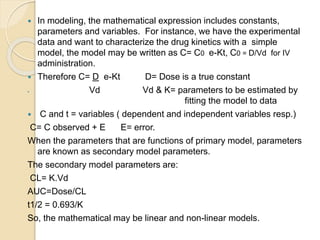
 In modeling, the mathematical expression includes constants,
parameters and variables. For instance, we have the experimental
data and want to characterize the drug kinetics with a simple
model, the model may be written as C= C0 e-Kt, C0 = D/Vd for IV
administration.
 Therefore C= D e-Kt D= Dose is a true constant
 Vd Vd & K= parameters to be estimated by
fitting the model to data
 C and t = variables ( dependent and independent variables resp.)
C= C observed + E E= error.
When the parameters that are functions of primary model, parameters
are known as secondary model parameters.
The secondary model parameters are:
CL= K.Vd
AUC=Dose/CL
t1/2 = 0.693/K
So, the mathematical may be linear and non-linear models.
Qualities of a mathematical model are:
1 Validity: it should have practical applicability and should be valuable in
describing the events chosen accurately with high precision.
2. Generality: once developed, a mathematical model should have a
general application to all the drugs that behave similarly under a given
set of conditions or assumptions. This is one of the best qualities of a
mathematical model.
3. Prediction ability: it should allow the calculation of new parameters
which are not in actual data and should predict the qualitative and
quantitative changes in these parameters under a given condition. The
parameters like the rate constants, half-lives of drug, etc.., can be
calculated.
4. Computability: the application of a model to biological science in
general and pharmacokinetics in particular is dependent on the degree
of computability. The assessment of the data should be easy and must
not involve lengthy mathematical equations and quantities, making
calculation of parameters with a simple calculator practically
impossible.
5. Consistency of Results; Reproducibility certainly is an important
quality of a mathematical model. Unless the results are reproducible.
The model is of little use.
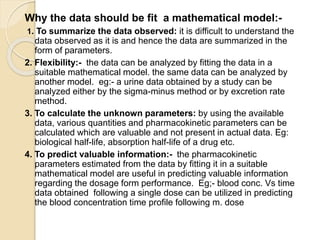
Why the data should be fit a mathematical model:-
1. To summarize the data observed: it is difficult to understand the
data observed as it is and hence the data are summarized in the
form of parameters.
2. Flexibility:- the data can be analyzed by fitting the data in a
suitable mathematical model. the same data can be analyzed by
another model. eg:- a urine data obtained by a study can be
analyzed either by the sigma-minus method or by excretion rate
method.
3. To calculate the unknown parameters: by using the available
data, various quantities and pharmacokinetic parameters can be
calculated which are valuable and not present in actual data. Eg:
biological half-life, absorption half-life of a drug etc.
4. To predict valuable information:- the pharmacokinetic
parameters estimated from the data by fitting it in a suitable
mathematical model are useful in predicting valuable information
regarding the dosage form performance. Eg;- blood conc. Vs time
data obtained following a single dose can be utilized in predicting
the blood concentration time profile following m. dose
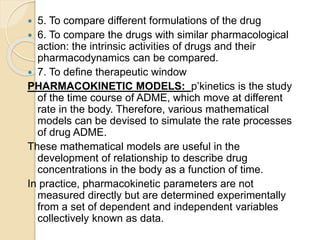
 5. To compare different formulations of the drug
 6. To compare the drugs with similar pharmacological
action: the intrinsic activities of drugs and their
pharmacodynamics can be compared.
 7. To define therapeutic window
PHARMACOKINETIC MODELS: p’kinetics is the study
of the time course of ADME, which move at different
rate in the body. Therefore, various mathematical
models can be devised to simulate the rate processes
of drug ADME.
These mathematical models are useful in the
development of relationship to describe drug
concentrations in the body as a function of time.
In practice, pharmacokinetic parameters are not
measured directly but are determined experimentally
from a set of dependent and independent variables
collectively known as data.
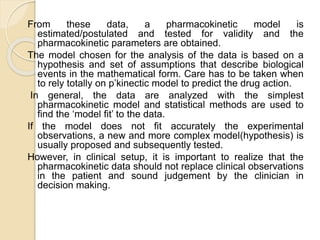
From these data, a pharmacokinetic model is
estimated/postulated and tested for validity and the
pharmacokinetic parameters are obtained.
The model chosen for the analysis of the data is based on a
hypothesis and set of assumptions that describe biological
events in the mathematical form. Care has to be taken when
to rely totally on p’kinectic model to predict the drug action.
In general, the data are analyzed with the simplest
pharmacokinetic model and statistical methods are used to
find the ‘model fit’ to the data.
If the model does not fit accurately the experimental
observations, a new and more complex model(hypothesis) is
usually proposed and subsequently tested.
However, in clinical setup, it is important to realize that the
pharmacokinetic data should not replace clinical observations
in the patient and sound judgement by the clinician in
decision making.
P’kinetics classified in to following approaches:-
Compartmental models:- statistical analysis, interpolation
Non compartmental models:- Data summarization
Physiologic pharmacokinetic model (flow model):- Integration of
diverse data, extrapolation
Non- linear pharmacokinetics
COMPARTMENTAL MODEL
in a pharmacokinetic analysis of the data, the living system (human body)
is assumed to consist of a no. of interconnected compartments (is
defined as a group of tissues which behaves uniformly with respect to
the drug movement).
Each tissue may have a different concentration of drug but they all are in
an equilibrium in such a way that a change in drug concentration in
these tissue is linear or similar.
These compartments are virtual and not a real physiologic one, which only
provide reflection of the biosystem.
The human body is divided into kinetically homogeneous hypothetical
compartments based on the vasuclarity and the distribution pattern of
the drug. Each compartment behaves differently regarding the drug
concentration and time course data.
1. Highly perfused (central compartment): highly perfused lean tissue group
consisting of blood cells, heart, lungs, hepatoportal system, kidneys, glands and also
certain tissues protected by specialized lipid membranes such as the brain and the
spinal cord. Drug elimination is assumed to take place from this compartment.
2. Moderately/poorly perfused (peripheral compartment): muscle and skin fat group,
consisting of adipose tissue including bone marrow.
3. A negligible perfuse tissue group, consisting of bones, teeth, ligaments, tendons,
cartilages and hair.
4. Methods:-
5. A graphical analysis of the plasma concentration Vs time data following an I.V.
injection can be used to estimate the no. of compartments.
6. A statistical analysis of the plasma concentration Vs time data is another method use
to find out the no. of compartments. Computer programmes are available for this
purpose.
7. In general the kinetics of most drugs can be described by a hypothetical model
consisting of one, two or at the most three functional compartments. It is usually
assumed that the rate of drug movement between compartments follow first-order
kinetics.
8. One compartmental model: drug is both added and eliminated form a central
compartment. When an intravenous dose do drug is given, the drug enters directly
into the central compartment.
Two compartment model: drug can move between the central or plasma
compartment to and from the tissue compartments. In these models, the total
amount of drug in the body is simply the sum of the drug present in the central
compartment plus the drug present in the tissue compartment(s).
Knowing the paramaters of either the one or two compartment model one can estimate
the amount of drug left in the body and the amount of drug eliminated from the body
at any time.
Properties/characteristics of a compartment:-
A compartment contains tissues and organs that are kinetically homogeneous
Within each compartment, distribution to tissues is immediate and rapidly reversible.
Although kinetically homogenous, tissues within a compartment have different drug
concentration.
Between compartments, barriers are considered diffusion rate limiting.
Compartments are connected through first order rate processes.
Distribution to any tissue in any compartment depends upon blood flow, blood volume,
partitioning, tissue binding, and plasma protein binding.
So the compartments can be arranged either parallel to each other( mamillary model)
or in series to each other (caternary model).
Mamillary model:- in the mamillary model, all tissue compartments ( the peripheral,
shallow tissue and deep tissue compartment and any other compartment with which
the drug undergoes distribution) are connected directly to the central compartment
like satellite.
Advantages:-
To estimate the amount of drug in any compartment after the drug is introduced in to a
given compartment. This is because the mamillary model may be considered as a
strongly connected system.
As in other models, in this model also, elimination of drug occurs from the central
compartment since organs predominantly involved in elimination are well perfused
tissues.
The mamillary model is most preferred in pharmocokinetics studies, cos it seems to
follow the pattern of drug distribution in the body.
Shallow
tissue
compartment
Central
Compartme
nt
Deep
Tissue
compartme
nt
K1
2
K2
1
K1
3
K3
1
Drug input
Drug
output
K1
0
Catenary model:- the catenary model consists of a series of compartments joined to
one another like the compartments of a train.
In this model the drug transfers from central compartment into the shallow tissue
compartment first and from this compartment it then transfers into the deep tissue
compartment ( second tissue compartment).
The drug cannot transfer from central compartment into the deep tissue compartment
without first going through shallow tissue compartment, because shallow tissue
compartment is sandwiched between the central and deep tissue compartments.
This model has not found universal acceptance due to several reasons. The most
important objection to this model is that while most functional organs in the body are
directly connected to plasma, the catenary model depicts the connections otherwise.
Classification of compartment models:-
One compartment open model
Two compartment open model
Three compartment open model
The term open indicates that drug can be eliminated from the system and absorption
and elimination are unidirectional. Means that the system has lost the dose initially
introduced.
Advantages:- it gives a visual representation of various rate processes involved in drug
dispostion
It is possible to derive equations describing drug concentration changes in each
compartment.
It is an easy means of assesing qualitative conjectures and of narrowing the range of
decisions for which experiment may be necessary.
One can estimate the amount of drug in any compartment of the system after the drug is
introduced into given compartment.
Disadvantges:-
Tissue levels of some of the drugs such as digoxin, and thiopental cannot be predicted very
well although blood levels can be predicted very well.
A drug given by IV route may behave according to single compartment model but the same
drug given by oral route may show two compartment behaviour. The type of compartment
behaviour, i.e. the type of compartment model may change with the route of
administration.
Salient features of compartmental modeling:-
1. To predict the drug concentration-time profile in both normal and diseased state.
2. helps in ascertaining a good dosage regimen.
3. Meaningful interpretation of a biological response to a dose.
4. provides visual interpretation of various rate processes involved in drug ADME
5. Provides information about how about many pharmacokinetic parameters are required to
describe the process adequately.
6. Delineates the entire ADME preocess into quantiitaive relationships.
7. Determination drug connentrations especially when little is known about individual tissues.
Pitfalls:-
1. The compartments are only hypothetical and do not bear any relationship between physiologic
function or anatomic structure.
2. Involves lot of mathematical computations
3. Prediction accuracy primarily depends upon the correctness of the curve fitting.
4. Compartmemt models for one drug differ with route of administration
5. Results from animal species cannot be extrapolated to human.
NON COMPARTMENTAL MODELS
This describes the pharmacokinetics of drug disposition using concentration and time parameters.
Here there is no concept of “compartmentalization” and it is based on statistical moments theory.
Also called as model independent method. Cos predict the ADME of a drug in the compartment
is a difficult task. Errors can arise from the specific experimental design utilized in the study, as
well as the intra and inter-subject variability, route of admn. the drug behaviour in the body may
fit different compartment models.
This method is new and provide a simpler and a general approach for pharmacokinetic analysis. It is
generally based on the theory of statistical moments.
Statistical moment theory:-
Which provides a unique way to study time-related changes in drug concentration in plasma can
usually be regarded as a statistical distribution curve. With in this, zero moment of a drug
concentration in the plasma versus time curve is the total area under the curve from time zero to
infinity (AUCα-0).
In calculating various pharmacokinetic parameters, the plasma concentration versus time
data is plotted and the AUC from t=0 to the last sampling time, t*, is calculated by means
of the trapezoidal rule.
Trapezoidal rule:-
in trapezoidal method, plasma concentration Vs time is plotted on a rectilinear graph paper.
The plot is divided in to geometric figures whose area can be determined individually using
an appropriate geometric formula for each figure. Therefore the conc. Vs time plot is not
drawn as a smooth curve, but adjaent conc. Points are joined with straight lines. A
perpendicular on x-axis is drawn from each conc. Point to obtain a geometric figure.
Area of trapezoid = Area of trigangle + area of rectangle.
Area of triangle = (0.5) (height) (Base)
Area of rectangle = (0.5) (Base0 (Sum of the two parallel sides)
Table and figure shows concentration data obtained during and after 1 hr constant rate of IV
infusion. Also listed are the values of (c) X (t) i,.e concentration multiplied by time. These
values are plotted against time in figure. The area under the ( C) X (t) Vs t plot from t=0 to
the last sampling time t*, is called the first moment of drug concentration with respect too
time (AUMC). The area under the curve from t* to α for both the curves may be estimated
using appropriate equations to obtain AUC t- α ; AUMC t- α. Addition of these areas to AUC 0-
α and AUMC 0- α respectively.
Various pharmacokinetic parameters are calculated using the above values.
Non-linear Pharmacokinetics
the biological processes(ADME) are assumed to first order process . The course of drug
action described by the linear pharmacokinetic models are based on the assumption that
the pharmacokinetic parameters for a drug would not change when different doses or
multiple doses of a drug are given.
However, for few drugs, ‘concentration’ or ‘dose’ dependent kinetics and in some time-
dependent pharmacokinetics are observed. That is, at high doses, zero order kinetics is
observed, whereas at lower doses first order kinetics is seen.
This ‘dose dependent’ kinetics is referred to as non-linear pharmacokinetics .
Unlike linear pharmacokinetics which is described by first order kinetics, Non-linear
pharmacokinetics follow Michealis-Menten (Saturation) kinetics.
Reasons for non linearity:- May be at different levels of ADME due to pathological alteration.
Physiologic pharmacokinetic Model ( Flow Model)
Also called as blood flow or perfusion models, are pharmacokinetic models based on known
anatomic and physiologic data. The models kinetically describe the data with the
consideration that the drug is carried from the site of administration by blood flow to
various body organs, where the drug rapidly equilibrates with the IF in the organ.
Drugs are carried to organs by arterial blood and leave organs by venous blood.
Therefore, these models have been used in p’cokinetic studies to describe distribution of
drugs in blood and into various other organs.
In these models, the concentration of drug in various tissues is predicted by the following 3
factors.
a. the size of the organ tissue b) blood flow the organ tissue
C) The experimentally determined ratios of drug concentration between the tissue and
the blood.
The no. of compartments in the perfusion model varies with the drug because only
those tissues are included in the model, which exhibits presence or penetration of
drug in to the tissue.
Uptake of a drug into organs is determined by binding of the drug in these tissues.
In contrast to the tissue volume of distribution the actual tissue volume is used. Cos
most drugs have little penetration into the brain, into the bones and into other parts
of CNS. These organs are therefore generally not included in a perfusion model,
It is for this reason that the no of pharmacokinetic compartments in a perfusion model is
determined by the no of organ tissues into which the drug penetrates.
Fig shows a schematic example of perfusion model
Advantages:
The derived information from the models can be applied to several species e.g.,
humans and experimental animals.
Pharmacokinetic study
At a fundamental level, p’cokinetics is a tool to optimize the design of biological
experiments with drugs and chemicals. Bio p’ceutics and p’cokinetic studies of drugs
and drug products are useful in understanding the relationship between the
physicochemical properties of a drug product and the p’cologic or clinical effect.
in order to estimate p’cokinetics of a drug or drug product, drug concentration in a
biological sample Vs time data are required. Actually the conc. of the drug at the
receptor site Vs time data are required to make meaningful interpretation of a
biological response to a dose.
Practically it is not possible to obtain the biological sample from a human at which
drug acts and hence few biological fluids, such as blood/plasma/serum, urine, milk,
saliva etc., are utilized in any pharmacokinetic study.
In most of the p’cokinetic studies plasma concentration of drug-time data are used to
estimate various p’cokinetic parameters and to assess the biological effects.
The assumption in using the plasma drug concentration-time data to assess biological
response is that there exists a dynamic equilibrium between the plasma and tissue(
receptor site) drug levels, and a change in drug levels in the plasma quantitatively
reflects a change in the tissue drug levels.
A drug/drug pdt is administered to human volunteers by a selected route of
administration. The no.of subjects, period of study, biological sample, no. of samples
to be collected, time intervals at which samples have to collected should be decided
to prior to study.
Sampling of Biological specimens:
Invasive methods:- sampling blood, spinal fluid, synovial fluids, tissue biopsy,
or any biologic material that requires parenteral or surgical intervention in
the patient.
Non-invasive methods:- sampling of urine, saliva, feces, expired air, or any
biological material that can be obtained without parenteral or surgical
intervention.
The measurement of drug concentration in each of these biologic materials
yields different information.
Spinal fluid, synovial and tissue biopsies- diagnostic purpose, also
ascertain the presence of a drug in sufficient concentration in the biological
specimen.
Urine:- is an indirect method to ascertain its bioavailability
Feces:- may reflect the drug that has not been absorbed after an oral dose or
may reflect that has been biliary secreted after systemic absorption. In
mass balance studies estimation of a drug content in feces is carried to
account for the entire dose given to the patient.
Saliva:- carried out for several drugs for TDM. This concept is based on the
fact that the drug in saliva is in equilibrium with the drug in plasma so that a
change in drug concentration in saliva reflects a change in plasma drug
concentration.
Significance of measuring plasma drug levels:-
1) Monitoring the concentration of drugs in blood or plasma ascertains that
the calculated dose actually delivers the plasma level required for the
therapeutic effect.
2) Monitoring of drug plasma concentrations allows for the adjustment of the
drug dosage in order to individualize and optimize therapeutic drug
regimens.
3) Pharmacodynamic response to the drug may be more important to
measure than just plasma drug concentration. Eg. ECG – cardiotonic
drugs, Diabetes- taking insulin will monitor their blood or urine glucose
levels.
4) For drugs that act irreversibly @the receptor site, PDC do not accurately
predict pharmacodynamic response. eg:- cancer chemotherapy often
interface with N.A or protein biosynthesis to destroy tumor cells.
5) For those drugs the PDC does not relate directly to PD response. In this
case, other pathophysiologic parameters are monitored in the patients to
prevent adverse toxicity.
Data required for p’cokinetic analysis and interpretation:- drug/Drug Pdt,
sensitive analytical method for measurement of the drug in the biological
specimen, route of administration, dose admin., sampling interval,
Biological specimen( plasm/Urine).
Likely questions:
1.What are the qualities of a mathematical model.
2. Why the plasma drug concentration-time data should be fit in a
mathematical model
3. Define therapeutic window, duration of action, Cmax, tmax,
following an oral administration.
4. What are the desired characters of an ideal drug for the best
therapeutic effect?
5. How the human body is divided into compartments? What are
they?
6. Why a mammilary model is generally used rather than caternary
model n compartmental pharmacokinetics
7. What are the advantages of a physiological pharmacokinetic model
over other models
8. Write about sampling of biological speciments
9. write a note on statistical moment theory
10. What is the significance of measuring the plasma drug level
References
 1. Jamhekar, S.S, Breen P.J. Basic
pharmacokinetcs. Pharmaceutical pressInc.,
UK
 2. Schoewald, RD Pharmacokinetic principle
of dosing adjustments. Understanding the
basics. CRC press 2001. USA
 3. Shargel L Wu-pong S, Yu, Applied
biopharmaceutics and pharmacokinetics
 4. Bio pharmaceutics and pharmacokinetics
second edition by PL Madan
 5. Bio.Ph & P’cokinetics byShoba rani
Hiremath
 6. Bio.Ph & P’co kinetics by Brahmankar.

pharmacokinetics

  • 1.
    Chapter-2 Pharmacokinetics BY Khadga Raj Aran(Bishal) ISF College of Pharmacy Moga, Punjab
  • 2.
    Contents Definition introduction to pharmacokinetics mathematicalmodel drug levels in blood pharmacokinetics model compartment models pharmacokinetic study
  • 3.
    Definition and Introductionof pharmacokinetics  Pharmacokinetics:- explains the rates of movement of drugs in the body with the help of a suitable mathematical model.  Clinical pharmacokinetics:- application of these pharmacokinetic principles in the safe and effective management of individual patient.  Applications:- support drug discovery, to interpret the results and extrapolate human data from the animal data, fix a dosage regimen to the drug in clinical
  • 4.
     MATHEMATICAL MODEL:- Drugs are in a dynamic state within the body. The biological system is very complex and the kinetics of the drug is very complicated. We can describe the drug kinetic processes or interpret the data using simple mathematical models (mathematical representation of the data). It is just a hypothesis.  Why model the data? Three main reasons due to which the data is subjected to modeling.  1. Descriptive :– to describe the drug kinetics in a simple way.  2. Predictive:– To predict– the time course of the drug after multiple dosing base on single dose data, the absorption profile of the drug from the IV data.  3. Explanatory: – To explain unclear observations.
  • 5.
     Advantages PKmodels:-  1. prediction of drug concentration in plasma/tissue/ urine at any point of time.  2. Determination of optimum dosage regimen for each patient.  3. Estimation of the possible accumulation of drugs/ metabolites.  4. Quantitative assessment of the effect of disease on drug’s ADME.  5. Correlation of drug concentration with pharmacologic activity.  6. Evaluation of bioequivalence.  7. Understanding of drug interactions
  • 6.
     In modeling,the mathematical expression includes constants, parameters and variables. For instance, we have the experimental data and want to characterize the drug kinetics with a simple model, the model may be written as C= C0 e-Kt, C0 = D/Vd for IV administration.  Therefore C= D e-Kt D= Dose is a true constant  Vd Vd & K= parameters to be estimated by fitting the model to data  C and t = variables ( dependent and independent variables resp.) C= C observed + E E= error. When the parameters that are functions of primary model, parameters are known as secondary model parameters. The secondary model parameters are: CL= K.Vd AUC=Dose/CL t1/2 = 0.693/K So, the mathematical may be linear and non-linear models.
  • 7.
    Qualities of amathematical model are: 1 Validity: it should have practical applicability and should be valuable in describing the events chosen accurately with high precision. 2. Generality: once developed, a mathematical model should have a general application to all the drugs that behave similarly under a given set of conditions or assumptions. This is one of the best qualities of a mathematical model. 3. Prediction ability: it should allow the calculation of new parameters which are not in actual data and should predict the qualitative and quantitative changes in these parameters under a given condition. The parameters like the rate constants, half-lives of drug, etc.., can be calculated. 4. Computability: the application of a model to biological science in general and pharmacokinetics in particular is dependent on the degree of computability. The assessment of the data should be easy and must not involve lengthy mathematical equations and quantities, making calculation of parameters with a simple calculator practically impossible. 5. Consistency of Results; Reproducibility certainly is an important quality of a mathematical model. Unless the results are reproducible. The model is of little use.
  • 8.
    Why the datashould be fit a mathematical model:- 1. To summarize the data observed: it is difficult to understand the data observed as it is and hence the data are summarized in the form of parameters. 2. Flexibility:- the data can be analyzed by fitting the data in a suitable mathematical model. the same data can be analyzed by another model. eg:- a urine data obtained by a study can be analyzed either by the sigma-minus method or by excretion rate method. 3. To calculate the unknown parameters: by using the available data, various quantities and pharmacokinetic parameters can be calculated which are valuable and not present in actual data. Eg: biological half-life, absorption half-life of a drug etc. 4. To predict valuable information:- the pharmacokinetic parameters estimated from the data by fitting it in a suitable mathematical model are useful in predicting valuable information regarding the dosage form performance. Eg;- blood conc. Vs time data obtained following a single dose can be utilized in predicting the blood concentration time profile following m. dose
  • 9.
     5. Tocompare different formulations of the drug  6. To compare the drugs with similar pharmacological action: the intrinsic activities of drugs and their pharmacodynamics can be compared.  7. To define therapeutic window PHARMACOKINETIC MODELS: p’kinetics is the study of the time course of ADME, which move at different rate in the body. Therefore, various mathematical models can be devised to simulate the rate processes of drug ADME. These mathematical models are useful in the development of relationship to describe drug concentrations in the body as a function of time. In practice, pharmacokinetic parameters are not measured directly but are determined experimentally from a set of dependent and independent variables collectively known as data.
  • 10.
    From these data,a pharmacokinetic model is estimated/postulated and tested for validity and the pharmacokinetic parameters are obtained. The model chosen for the analysis of the data is based on a hypothesis and set of assumptions that describe biological events in the mathematical form. Care has to be taken when to rely totally on p’kinectic model to predict the drug action. In general, the data are analyzed with the simplest pharmacokinetic model and statistical methods are used to find the ‘model fit’ to the data. If the model does not fit accurately the experimental observations, a new and more complex model(hypothesis) is usually proposed and subsequently tested. However, in clinical setup, it is important to realize that the pharmacokinetic data should not replace clinical observations in the patient and sound judgement by the clinician in decision making.
  • 11.
    P’kinetics classified into following approaches:- Compartmental models:- statistical analysis, interpolation Non compartmental models:- Data summarization Physiologic pharmacokinetic model (flow model):- Integration of diverse data, extrapolation Non- linear pharmacokinetics COMPARTMENTAL MODEL in a pharmacokinetic analysis of the data, the living system (human body) is assumed to consist of a no. of interconnected compartments (is defined as a group of tissues which behaves uniformly with respect to the drug movement). Each tissue may have a different concentration of drug but they all are in an equilibrium in such a way that a change in drug concentration in these tissue is linear or similar. These compartments are virtual and not a real physiologic one, which only provide reflection of the biosystem. The human body is divided into kinetically homogeneous hypothetical compartments based on the vasuclarity and the distribution pattern of the drug. Each compartment behaves differently regarding the drug concentration and time course data.
  • 12.
    1. Highly perfused(central compartment): highly perfused lean tissue group consisting of blood cells, heart, lungs, hepatoportal system, kidneys, glands and also certain tissues protected by specialized lipid membranes such as the brain and the spinal cord. Drug elimination is assumed to take place from this compartment. 2. Moderately/poorly perfused (peripheral compartment): muscle and skin fat group, consisting of adipose tissue including bone marrow. 3. A negligible perfuse tissue group, consisting of bones, teeth, ligaments, tendons, cartilages and hair. 4. Methods:- 5. A graphical analysis of the plasma concentration Vs time data following an I.V. injection can be used to estimate the no. of compartments. 6. A statistical analysis of the plasma concentration Vs time data is another method use to find out the no. of compartments. Computer programmes are available for this purpose. 7. In general the kinetics of most drugs can be described by a hypothetical model consisting of one, two or at the most three functional compartments. It is usually assumed that the rate of drug movement between compartments follow first-order kinetics. 8. One compartmental model: drug is both added and eliminated form a central compartment. When an intravenous dose do drug is given, the drug enters directly into the central compartment.
  • 13.
    Two compartment model:drug can move between the central or plasma compartment to and from the tissue compartments. In these models, the total amount of drug in the body is simply the sum of the drug present in the central compartment plus the drug present in the tissue compartment(s). Knowing the paramaters of either the one or two compartment model one can estimate the amount of drug left in the body and the amount of drug eliminated from the body at any time. Properties/characteristics of a compartment:- A compartment contains tissues and organs that are kinetically homogeneous Within each compartment, distribution to tissues is immediate and rapidly reversible. Although kinetically homogenous, tissues within a compartment have different drug concentration. Between compartments, barriers are considered diffusion rate limiting. Compartments are connected through first order rate processes. Distribution to any tissue in any compartment depends upon blood flow, blood volume, partitioning, tissue binding, and plasma protein binding. So the compartments can be arranged either parallel to each other( mamillary model) or in series to each other (caternary model).
  • 14.
    Mamillary model:- inthe mamillary model, all tissue compartments ( the peripheral, shallow tissue and deep tissue compartment and any other compartment with which the drug undergoes distribution) are connected directly to the central compartment like satellite. Advantages:- To estimate the amount of drug in any compartment after the drug is introduced in to a given compartment. This is because the mamillary model may be considered as a strongly connected system. As in other models, in this model also, elimination of drug occurs from the central compartment since organs predominantly involved in elimination are well perfused tissues. The mamillary model is most preferred in pharmocokinetics studies, cos it seems to follow the pattern of drug distribution in the body. Shallow tissue compartment Central Compartme nt Deep Tissue compartme nt K1 2 K2 1 K1 3 K3 1 Drug input Drug output K1 0
  • 15.
    Catenary model:- thecatenary model consists of a series of compartments joined to one another like the compartments of a train. In this model the drug transfers from central compartment into the shallow tissue compartment first and from this compartment it then transfers into the deep tissue compartment ( second tissue compartment). The drug cannot transfer from central compartment into the deep tissue compartment without first going through shallow tissue compartment, because shallow tissue compartment is sandwiched between the central and deep tissue compartments. This model has not found universal acceptance due to several reasons. The most important objection to this model is that while most functional organs in the body are directly connected to plasma, the catenary model depicts the connections otherwise. Classification of compartment models:- One compartment open model Two compartment open model Three compartment open model The term open indicates that drug can be eliminated from the system and absorption and elimination are unidirectional. Means that the system has lost the dose initially introduced.
  • 16.
    Advantages:- it givesa visual representation of various rate processes involved in drug dispostion It is possible to derive equations describing drug concentration changes in each compartment. It is an easy means of assesing qualitative conjectures and of narrowing the range of decisions for which experiment may be necessary. One can estimate the amount of drug in any compartment of the system after the drug is introduced into given compartment. Disadvantges:- Tissue levels of some of the drugs such as digoxin, and thiopental cannot be predicted very well although blood levels can be predicted very well. A drug given by IV route may behave according to single compartment model but the same drug given by oral route may show two compartment behaviour. The type of compartment behaviour, i.e. the type of compartment model may change with the route of administration. Salient features of compartmental modeling:- 1. To predict the drug concentration-time profile in both normal and diseased state. 2. helps in ascertaining a good dosage regimen. 3. Meaningful interpretation of a biological response to a dose. 4. provides visual interpretation of various rate processes involved in drug ADME 5. Provides information about how about many pharmacokinetic parameters are required to describe the process adequately. 6. Delineates the entire ADME preocess into quantiitaive relationships. 7. Determination drug connentrations especially when little is known about individual tissues.
  • 17.
    Pitfalls:- 1. The compartmentsare only hypothetical and do not bear any relationship between physiologic function or anatomic structure. 2. Involves lot of mathematical computations 3. Prediction accuracy primarily depends upon the correctness of the curve fitting. 4. Compartmemt models for one drug differ with route of administration 5. Results from animal species cannot be extrapolated to human. NON COMPARTMENTAL MODELS This describes the pharmacokinetics of drug disposition using concentration and time parameters. Here there is no concept of “compartmentalization” and it is based on statistical moments theory. Also called as model independent method. Cos predict the ADME of a drug in the compartment is a difficult task. Errors can arise from the specific experimental design utilized in the study, as well as the intra and inter-subject variability, route of admn. the drug behaviour in the body may fit different compartment models. This method is new and provide a simpler and a general approach for pharmacokinetic analysis. It is generally based on the theory of statistical moments. Statistical moment theory:- Which provides a unique way to study time-related changes in drug concentration in plasma can usually be regarded as a statistical distribution curve. With in this, zero moment of a drug concentration in the plasma versus time curve is the total area under the curve from time zero to infinity (AUCα-0).
  • 18.
    In calculating variouspharmacokinetic parameters, the plasma concentration versus time data is plotted and the AUC from t=0 to the last sampling time, t*, is calculated by means of the trapezoidal rule. Trapezoidal rule:- in trapezoidal method, plasma concentration Vs time is plotted on a rectilinear graph paper. The plot is divided in to geometric figures whose area can be determined individually using an appropriate geometric formula for each figure. Therefore the conc. Vs time plot is not drawn as a smooth curve, but adjaent conc. Points are joined with straight lines. A perpendicular on x-axis is drawn from each conc. Point to obtain a geometric figure. Area of trapezoid = Area of trigangle + area of rectangle. Area of triangle = (0.5) (height) (Base) Area of rectangle = (0.5) (Base0 (Sum of the two parallel sides) Table and figure shows concentration data obtained during and after 1 hr constant rate of IV infusion. Also listed are the values of (c) X (t) i,.e concentration multiplied by time. These values are plotted against time in figure. The area under the ( C) X (t) Vs t plot from t=0 to the last sampling time t*, is called the first moment of drug concentration with respect too time (AUMC). The area under the curve from t* to α for both the curves may be estimated using appropriate equations to obtain AUC t- α ; AUMC t- α. Addition of these areas to AUC 0- α and AUMC 0- α respectively. Various pharmacokinetic parameters are calculated using the above values.
  • 19.
    Non-linear Pharmacokinetics the biologicalprocesses(ADME) are assumed to first order process . The course of drug action described by the linear pharmacokinetic models are based on the assumption that the pharmacokinetic parameters for a drug would not change when different doses or multiple doses of a drug are given. However, for few drugs, ‘concentration’ or ‘dose’ dependent kinetics and in some time- dependent pharmacokinetics are observed. That is, at high doses, zero order kinetics is observed, whereas at lower doses first order kinetics is seen. This ‘dose dependent’ kinetics is referred to as non-linear pharmacokinetics . Unlike linear pharmacokinetics which is described by first order kinetics, Non-linear pharmacokinetics follow Michealis-Menten (Saturation) kinetics. Reasons for non linearity:- May be at different levels of ADME due to pathological alteration. Physiologic pharmacokinetic Model ( Flow Model) Also called as blood flow or perfusion models, are pharmacokinetic models based on known anatomic and physiologic data. The models kinetically describe the data with the consideration that the drug is carried from the site of administration by blood flow to various body organs, where the drug rapidly equilibrates with the IF in the organ. Drugs are carried to organs by arterial blood and leave organs by venous blood. Therefore, these models have been used in p’cokinetic studies to describe distribution of drugs in blood and into various other organs. In these models, the concentration of drug in various tissues is predicted by the following 3 factors.
  • 20.
    a. the sizeof the organ tissue b) blood flow the organ tissue C) The experimentally determined ratios of drug concentration between the tissue and the blood. The no. of compartments in the perfusion model varies with the drug because only those tissues are included in the model, which exhibits presence or penetration of drug in to the tissue. Uptake of a drug into organs is determined by binding of the drug in these tissues. In contrast to the tissue volume of distribution the actual tissue volume is used. Cos most drugs have little penetration into the brain, into the bones and into other parts of CNS. These organs are therefore generally not included in a perfusion model, It is for this reason that the no of pharmacokinetic compartments in a perfusion model is determined by the no of organ tissues into which the drug penetrates. Fig shows a schematic example of perfusion model Advantages: The derived information from the models can be applied to several species e.g., humans and experimental animals.
  • 21.
    Pharmacokinetic study At afundamental level, p’cokinetics is a tool to optimize the design of biological experiments with drugs and chemicals. Bio p’ceutics and p’cokinetic studies of drugs and drug products are useful in understanding the relationship between the physicochemical properties of a drug product and the p’cologic or clinical effect. in order to estimate p’cokinetics of a drug or drug product, drug concentration in a biological sample Vs time data are required. Actually the conc. of the drug at the receptor site Vs time data are required to make meaningful interpretation of a biological response to a dose. Practically it is not possible to obtain the biological sample from a human at which drug acts and hence few biological fluids, such as blood/plasma/serum, urine, milk, saliva etc., are utilized in any pharmacokinetic study. In most of the p’cokinetic studies plasma concentration of drug-time data are used to estimate various p’cokinetic parameters and to assess the biological effects. The assumption in using the plasma drug concentration-time data to assess biological response is that there exists a dynamic equilibrium between the plasma and tissue( receptor site) drug levels, and a change in drug levels in the plasma quantitatively reflects a change in the tissue drug levels. A drug/drug pdt is administered to human volunteers by a selected route of administration. The no.of subjects, period of study, biological sample, no. of samples to be collected, time intervals at which samples have to collected should be decided to prior to study.
  • 22.
    Sampling of Biologicalspecimens: Invasive methods:- sampling blood, spinal fluid, synovial fluids, tissue biopsy, or any biologic material that requires parenteral or surgical intervention in the patient. Non-invasive methods:- sampling of urine, saliva, feces, expired air, or any biological material that can be obtained without parenteral or surgical intervention. The measurement of drug concentration in each of these biologic materials yields different information. Spinal fluid, synovial and tissue biopsies- diagnostic purpose, also ascertain the presence of a drug in sufficient concentration in the biological specimen. Urine:- is an indirect method to ascertain its bioavailability Feces:- may reflect the drug that has not been absorbed after an oral dose or may reflect that has been biliary secreted after systemic absorption. In mass balance studies estimation of a drug content in feces is carried to account for the entire dose given to the patient. Saliva:- carried out for several drugs for TDM. This concept is based on the fact that the drug in saliva is in equilibrium with the drug in plasma so that a change in drug concentration in saliva reflects a change in plasma drug concentration.
  • 23.
    Significance of measuringplasma drug levels:- 1) Monitoring the concentration of drugs in blood or plasma ascertains that the calculated dose actually delivers the plasma level required for the therapeutic effect. 2) Monitoring of drug plasma concentrations allows for the adjustment of the drug dosage in order to individualize and optimize therapeutic drug regimens. 3) Pharmacodynamic response to the drug may be more important to measure than just plasma drug concentration. Eg. ECG – cardiotonic drugs, Diabetes- taking insulin will monitor their blood or urine glucose levels. 4) For drugs that act irreversibly @the receptor site, PDC do not accurately predict pharmacodynamic response. eg:- cancer chemotherapy often interface with N.A or protein biosynthesis to destroy tumor cells. 5) For those drugs the PDC does not relate directly to PD response. In this case, other pathophysiologic parameters are monitored in the patients to prevent adverse toxicity. Data required for p’cokinetic analysis and interpretation:- drug/Drug Pdt, sensitive analytical method for measurement of the drug in the biological specimen, route of administration, dose admin., sampling interval, Biological specimen( plasm/Urine).
  • 24.
    Likely questions: 1.What arethe qualities of a mathematical model. 2. Why the plasma drug concentration-time data should be fit in a mathematical model 3. Define therapeutic window, duration of action, Cmax, tmax, following an oral administration. 4. What are the desired characters of an ideal drug for the best therapeutic effect? 5. How the human body is divided into compartments? What are they? 6. Why a mammilary model is generally used rather than caternary model n compartmental pharmacokinetics 7. What are the advantages of a physiological pharmacokinetic model over other models 8. Write about sampling of biological speciments 9. write a note on statistical moment theory 10. What is the significance of measuring the plasma drug level
  • 25.
    References  1. Jamhekar,S.S, Breen P.J. Basic pharmacokinetcs. Pharmaceutical pressInc., UK  2. Schoewald, RD Pharmacokinetic principle of dosing adjustments. Understanding the basics. CRC press 2001. USA  3. Shargel L Wu-pong S, Yu, Applied biopharmaceutics and pharmacokinetics  4. Bio pharmaceutics and pharmacokinetics second edition by PL Madan  5. Bio.Ph & P’cokinetics byShoba rani Hiremath  6. Bio.Ph & P’co kinetics by Brahmankar.