By-
Dipak H. Sutar (intern)
Cardiac function test
By-
Khadga Raj Aran
M.Pharm, Ph.D.
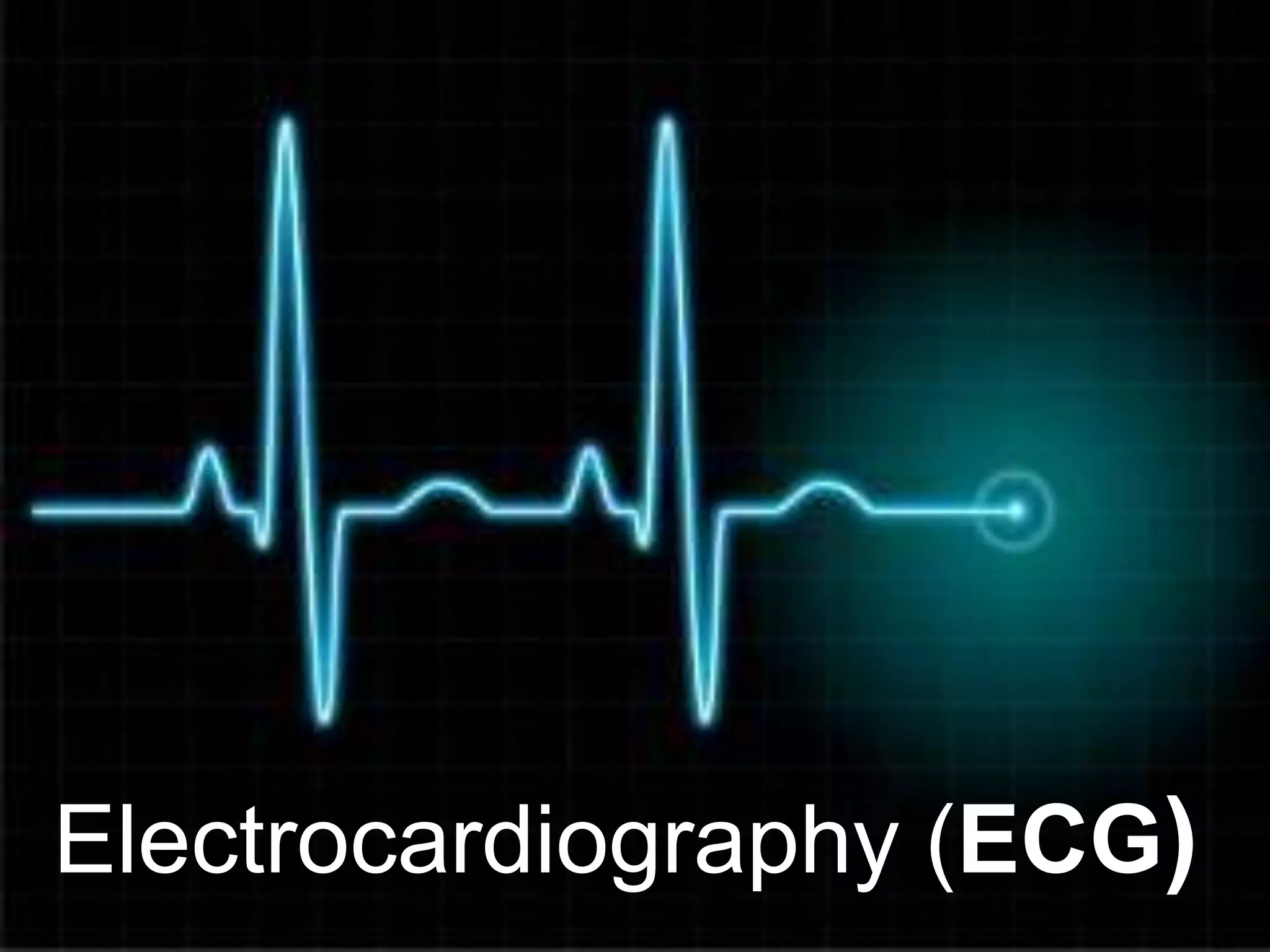
Electrocardiography (ECG)
ECG
 Simplest and most routine- test
 electrocardiogram (ECG) is a quick,
easy way to assess the heart’s
function
 By this technique the electrical
activities of the heart are studied.
 Risks associated with ECG are
minimal and rare
 No special preparation is necessary
for an electrocardiogram
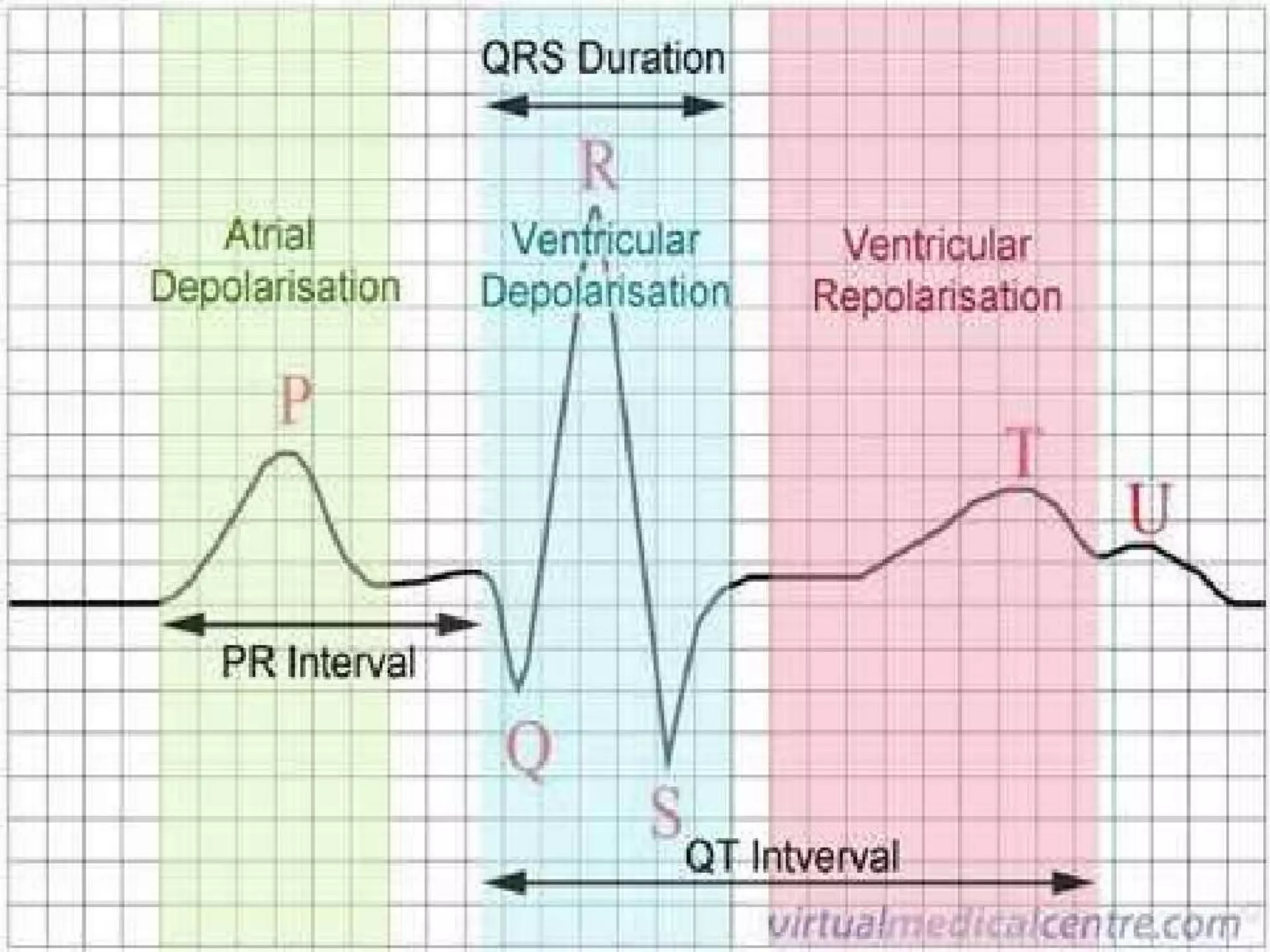
What represent ?
P wave = atrial depolarisation
QRS = ventricular depolarisation
T = repolarisation of the ventricles
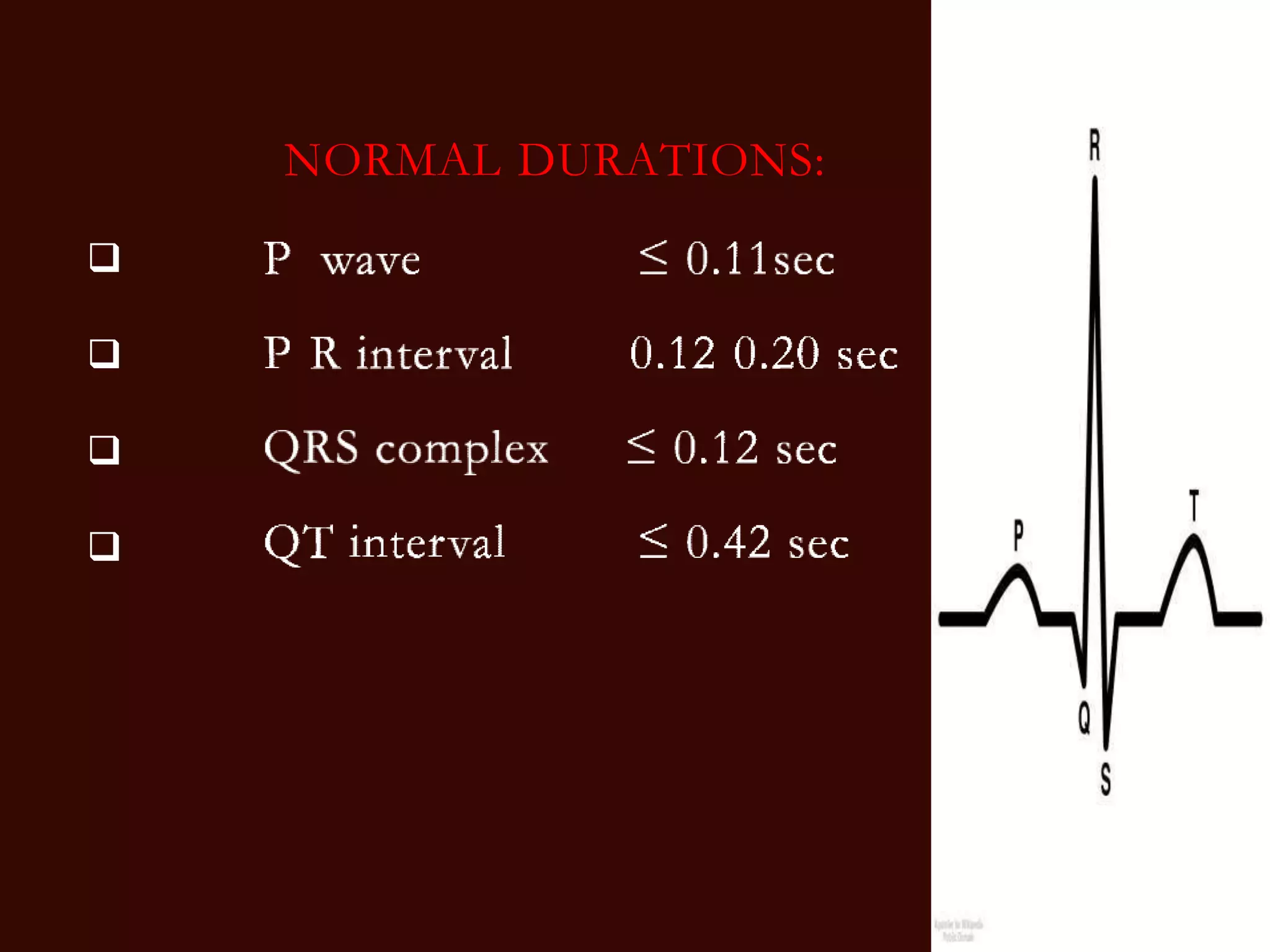
NORMAL DURATIONS:




DRUGS THAT CHANGES ECG:
o
o
o
o
o
o
o
o
o
o
o
o
o
o
o
o
o
o
o
o
o
o
o
o
Certain factors or conditions may interfere
with or affect the results of the ECG.
 Obesity
 Pregnancy
 Ascites (fluid buildup in the abdomen
[belly])
 Anatomical considerations
 Movement during the procedure
 Exercise or smoking prior to the procedure
 Certain medications
 Electrolyte imbalances, such as too much
or too little potassium, magnesium, and/or
calcium in the blood.
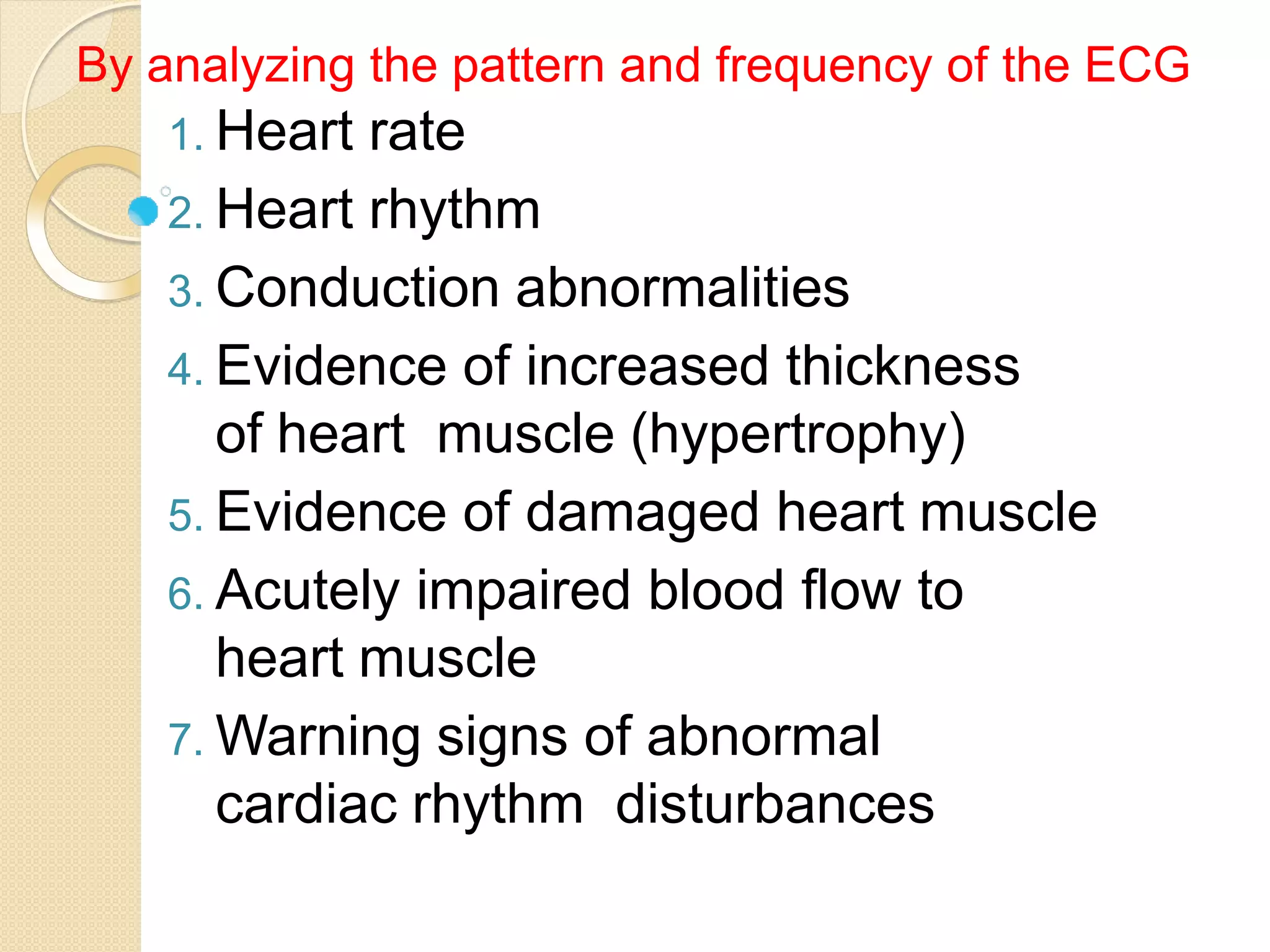
1. Heart rate
2. Heart rhythm
3. Conduction abnormalities
4. Evidence of increased thickness
of heart muscle (hypertrophy)
5. Evidence of damaged heart muscle
6. Acutely impaired blood flow to
heart muscle
7. Warning signs of abnormal
cardiac rhythm disturbances
By analyzing the pattern and frequency of the ECG
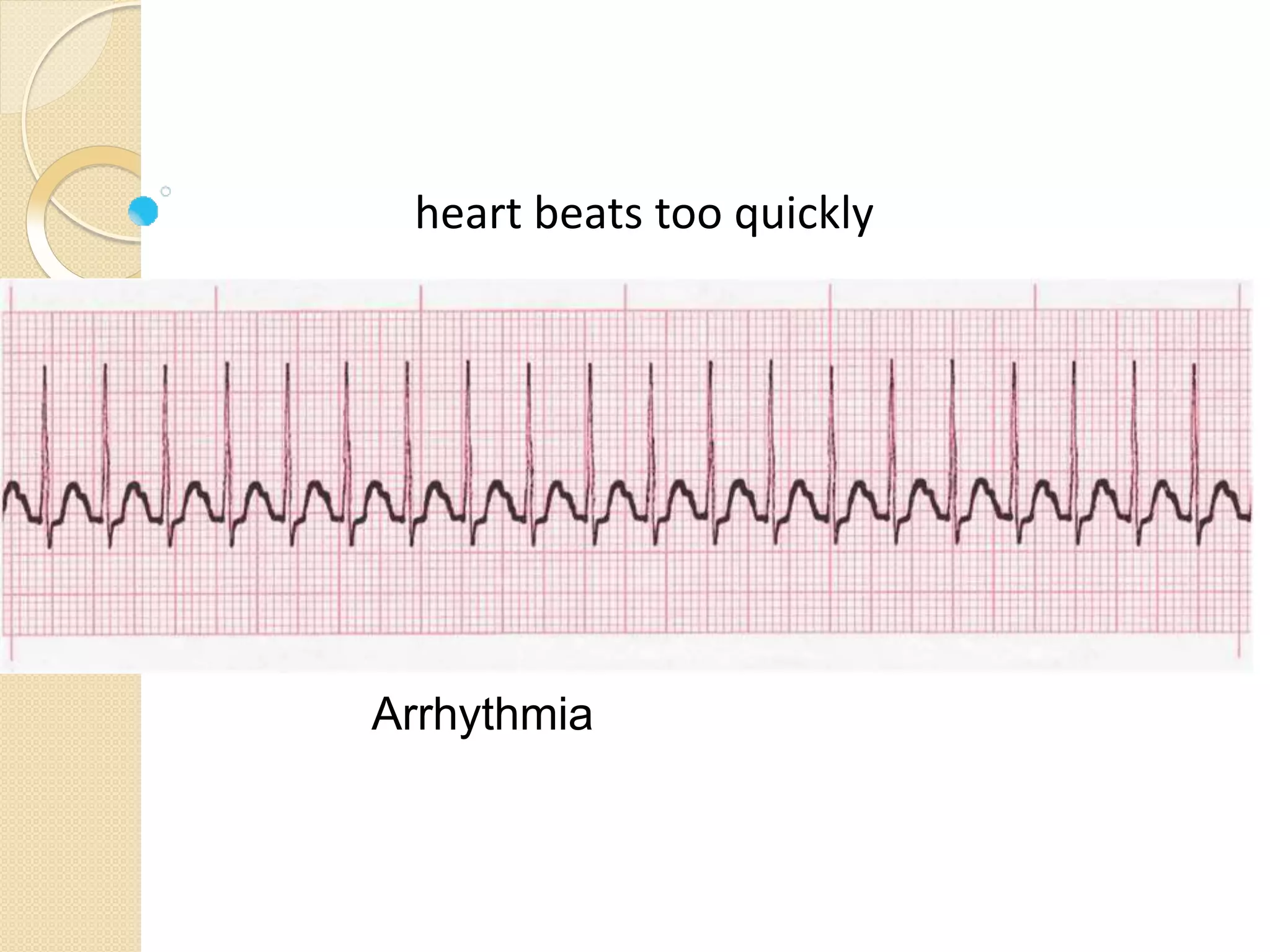
Arrhythmia
heart beats too quickly
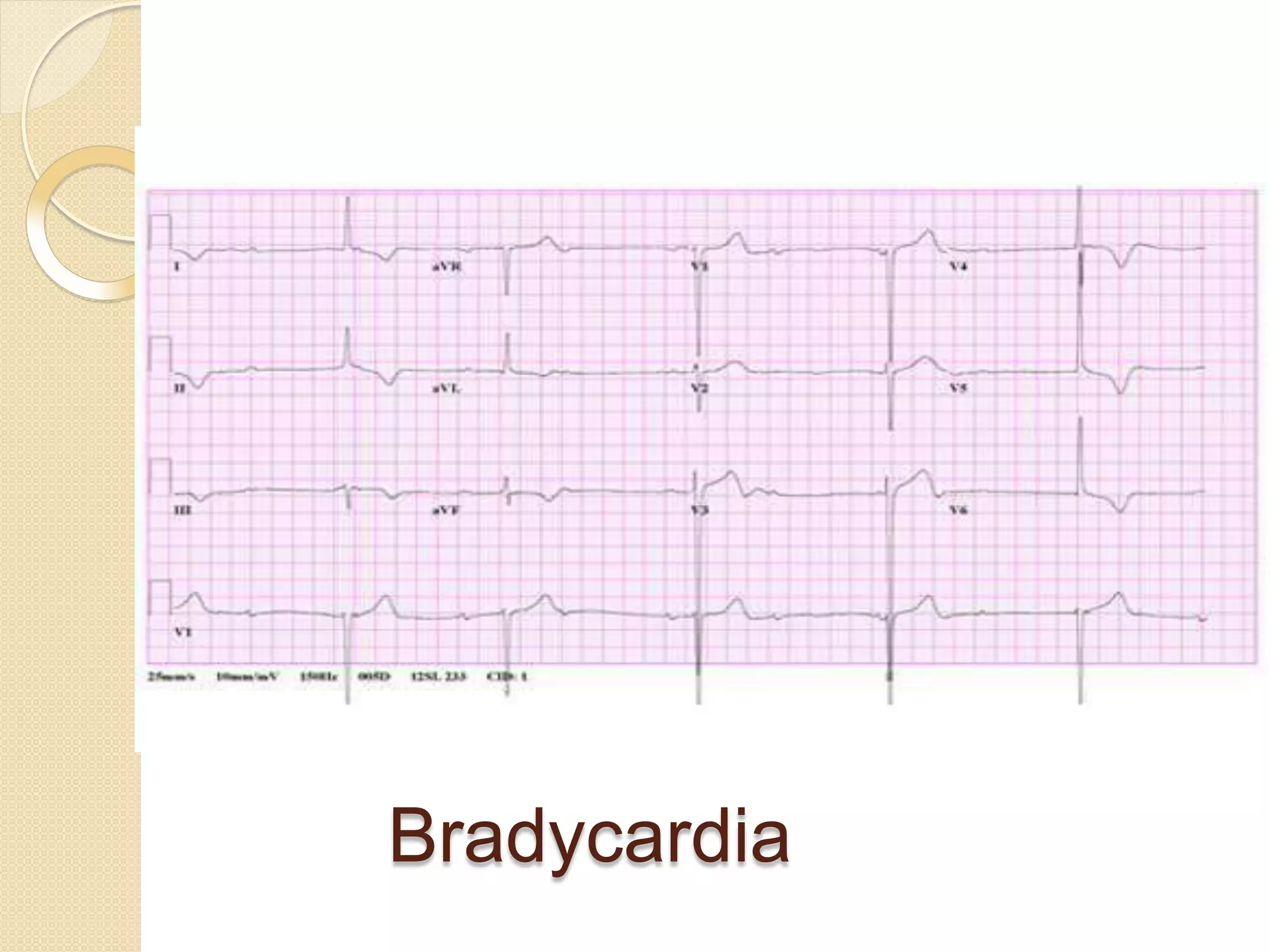
Bradycardia
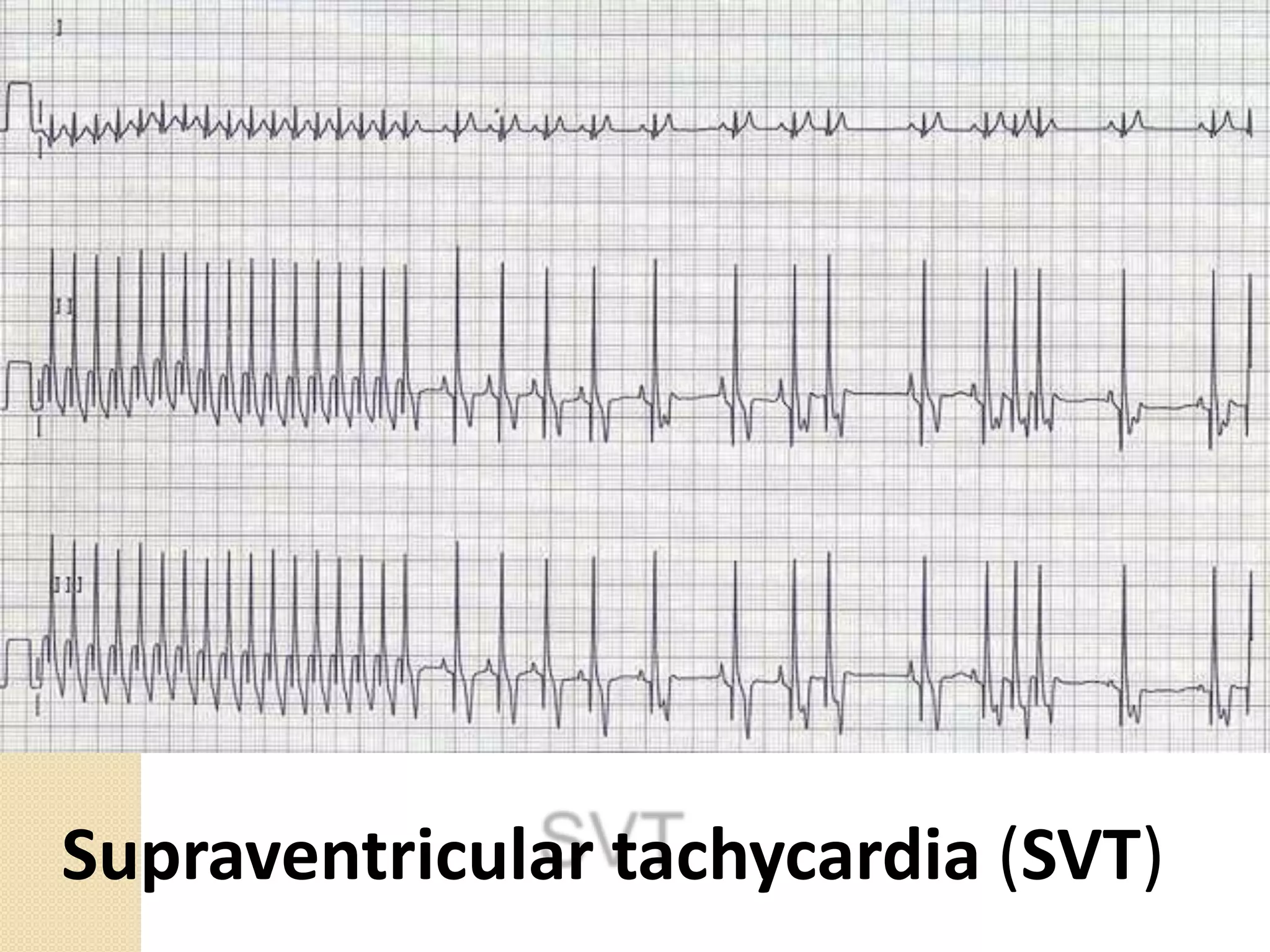
Supraventricular tachycardia (SVT)
X-ray
 A second routine test often used initially
after the medical history and physical
examination is the chest X-ray.
 There are no other risks involved in X-
rays; they are painless, fast, and relatively
inexpensive
 A chest X-ray may be ordered when an
person's symptoms include a persistent
cough, coughing up blood, chest pain, a
chest injury, or difficulty in breathing.
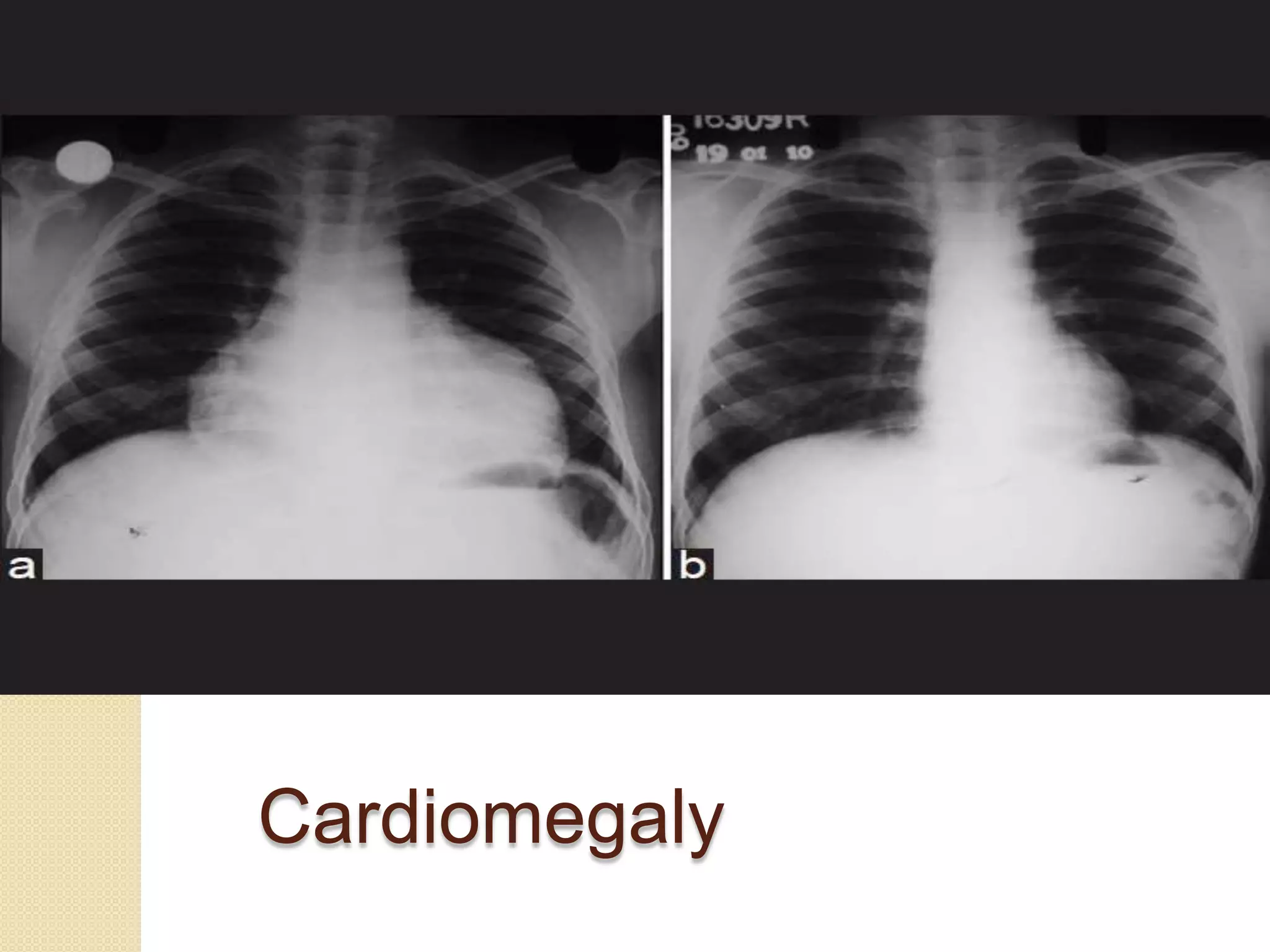
 The main advantages of the chest
X-ray are in differentiating primary
lung disease from heart disease
and in providing a clear view of
anatomical abnormalities such as
heart enlargement.
Cardiomegaly
Cardiac Enzyme tests
 Enzyme levels to assess how well the
body’s systems are functioning.
 Used to determine whether there has
been any tissue damage.
 Tests performed to help diagnose a
heart attack and to determine the
extent of damage to the heart muscle.
 The t most common cardiac
enzyme tests performed are:
Creatine kinase (CK)
Cardiac troponin
lactate dehydrogenase (LHD)
aspartate aminotransferase (AST)
(Combination of troponin and CK
levels is more specific to the heart )
Serum Creatine kinase (CK)
 The muscle cells in your body need
CK to function properly.
 Creatine phosphokinase isoenzymes
play a key role in the intracellular
energy transport from mitochondria to
myofibrils and other sites of energy
utilization
 CK is made up of three isoenzyme
forms
CK-MB, CK-MM,CK-BB.
 CK-MB is the substance that rises if
your heart muscle is damaged. CK-
MM rises with other muscle damage.
 CPK-BB found mostly in the brain and lungs
 CPK-MB found mostly in the heart
 CPK-MM found mostly in skeletal muscle
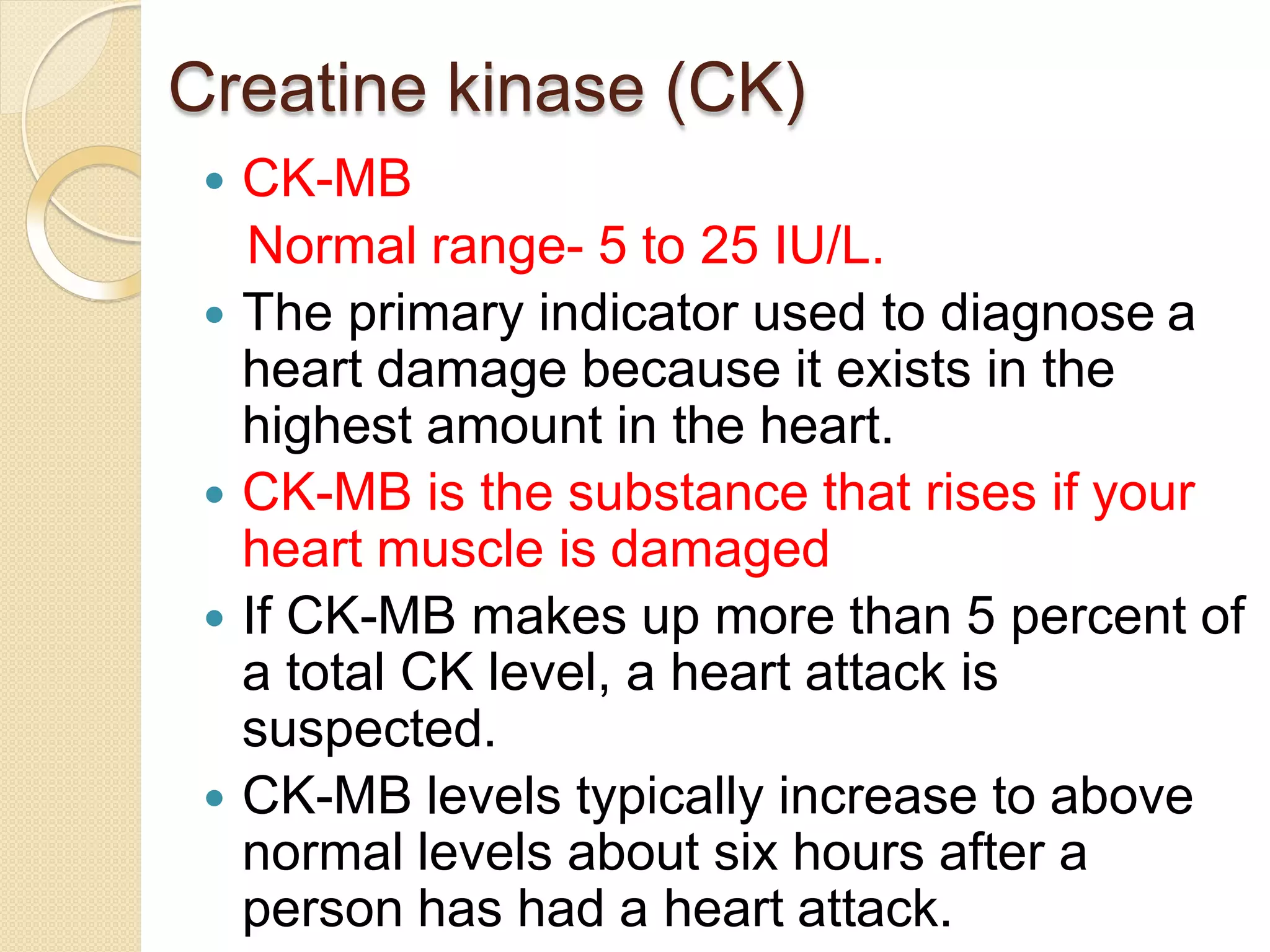
Creatine kinase (CK)
 CK-MB
Normal range- 5 to 25 IU/L.
 The primary indicator used to diagnose a
heart damage because it exists in the
highest amount in the heart.
 CK-MB is the substance that rises if your
heart muscle is damaged
 If CK-MB makes up more than 5 percent of
a total CK level, a heart attack is
suspected.
 CK-MB levels typically increase to above
normal levels about six hours after a
person has had a heart attack.
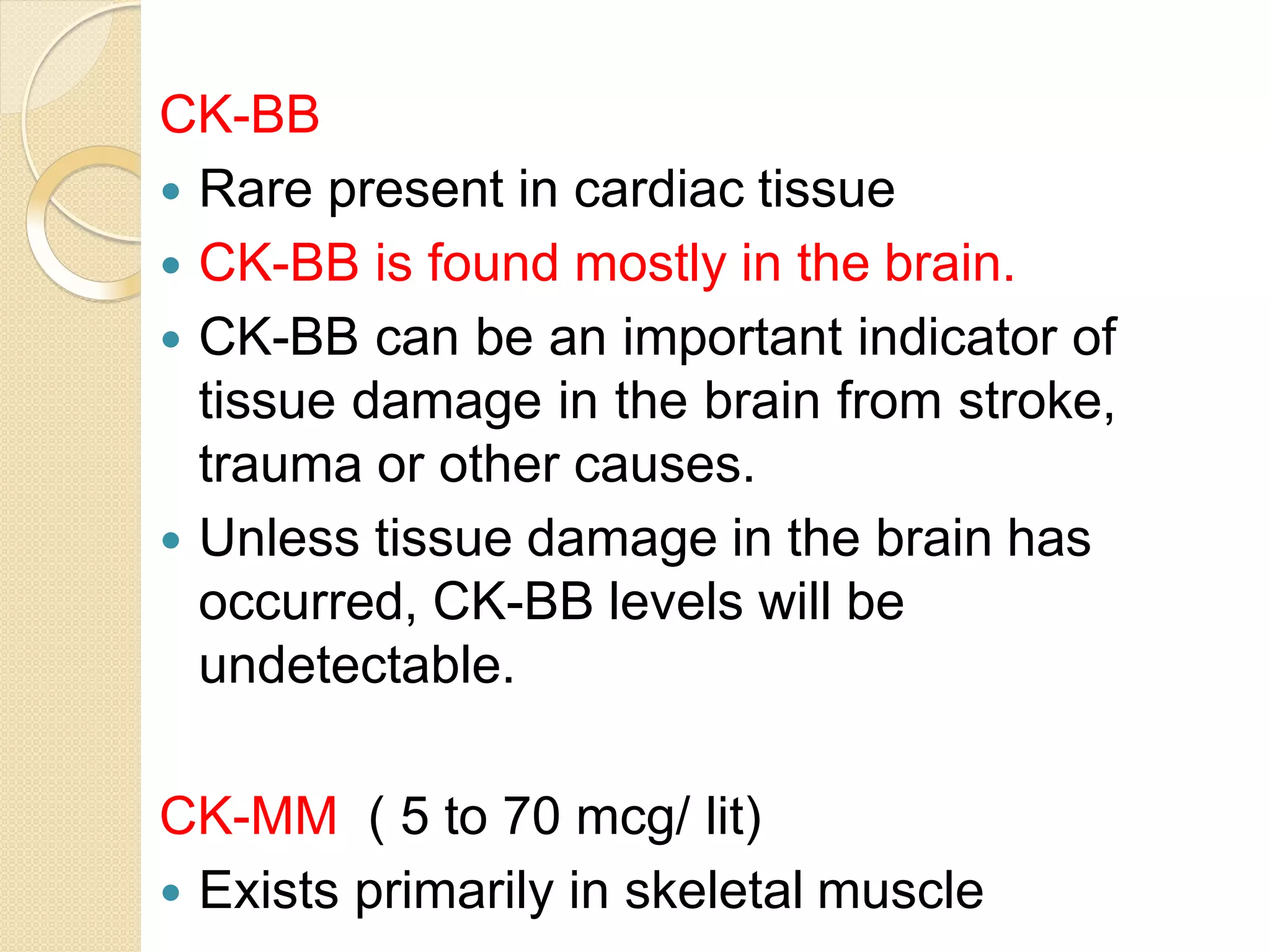
CK-BB
 Rare present in cardiac tissue
 CK-BB is found mostly in the brain.
 CK-BB can be an important indicator of
tissue damage in the brain from stroke,
trauma or other causes.
 Unless tissue damage in the brain has
occurred, CK-BB levels will be
undetectable.
CK-MM ( 5 to 70 mcg/ lit)
 Exists primarily in skeletal muscle
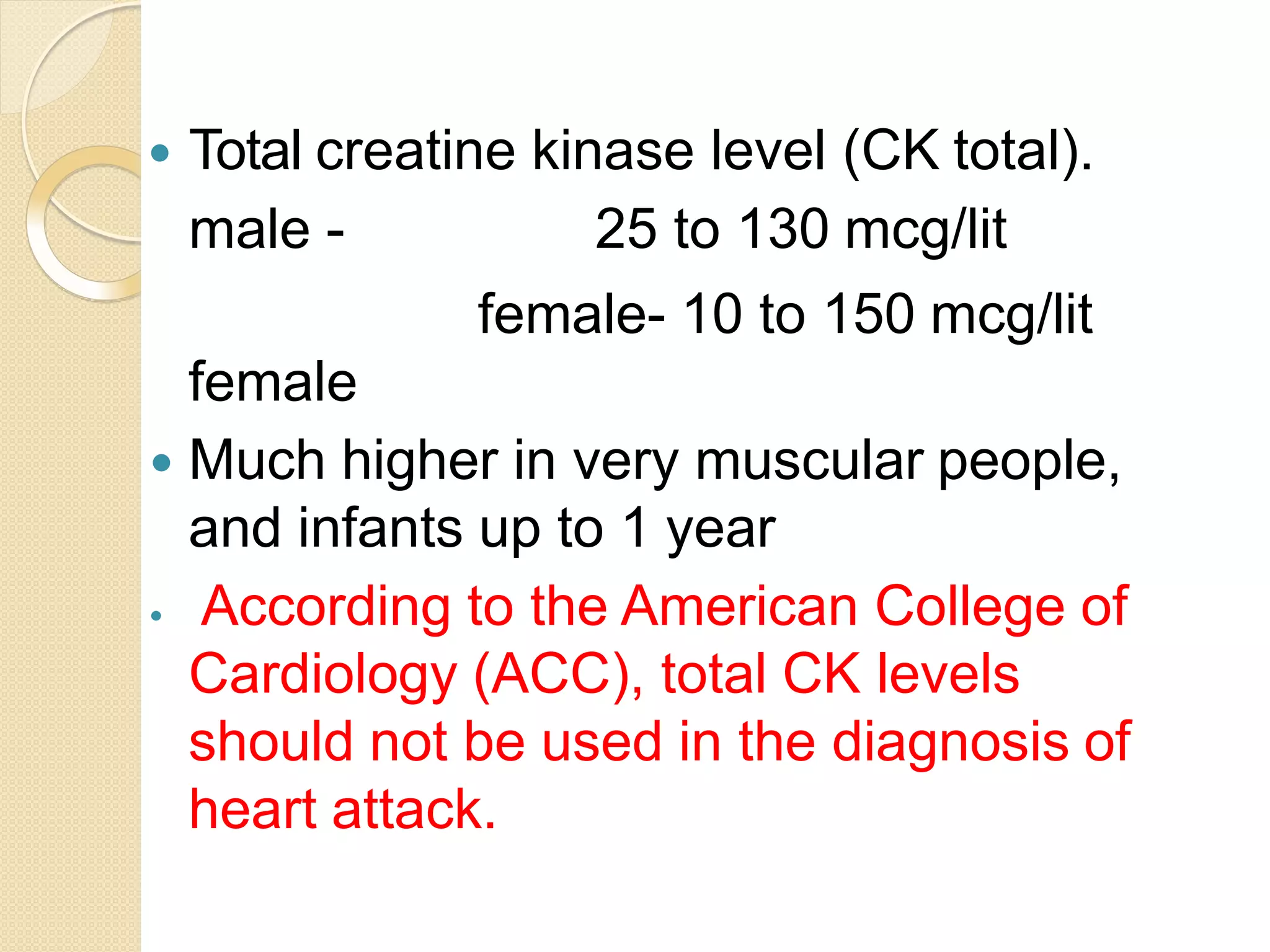
 Total creatine kinase level (CK total).
male - 25 to 130 mcg/lit
female- 10 to 150 mcg/lit
female
 Much higher in very muscular people,
and infants up to 1 year
 According to the American College of
Cardiology (ACC), total CK levels
should not be used in the diagnosis of
heart attack.
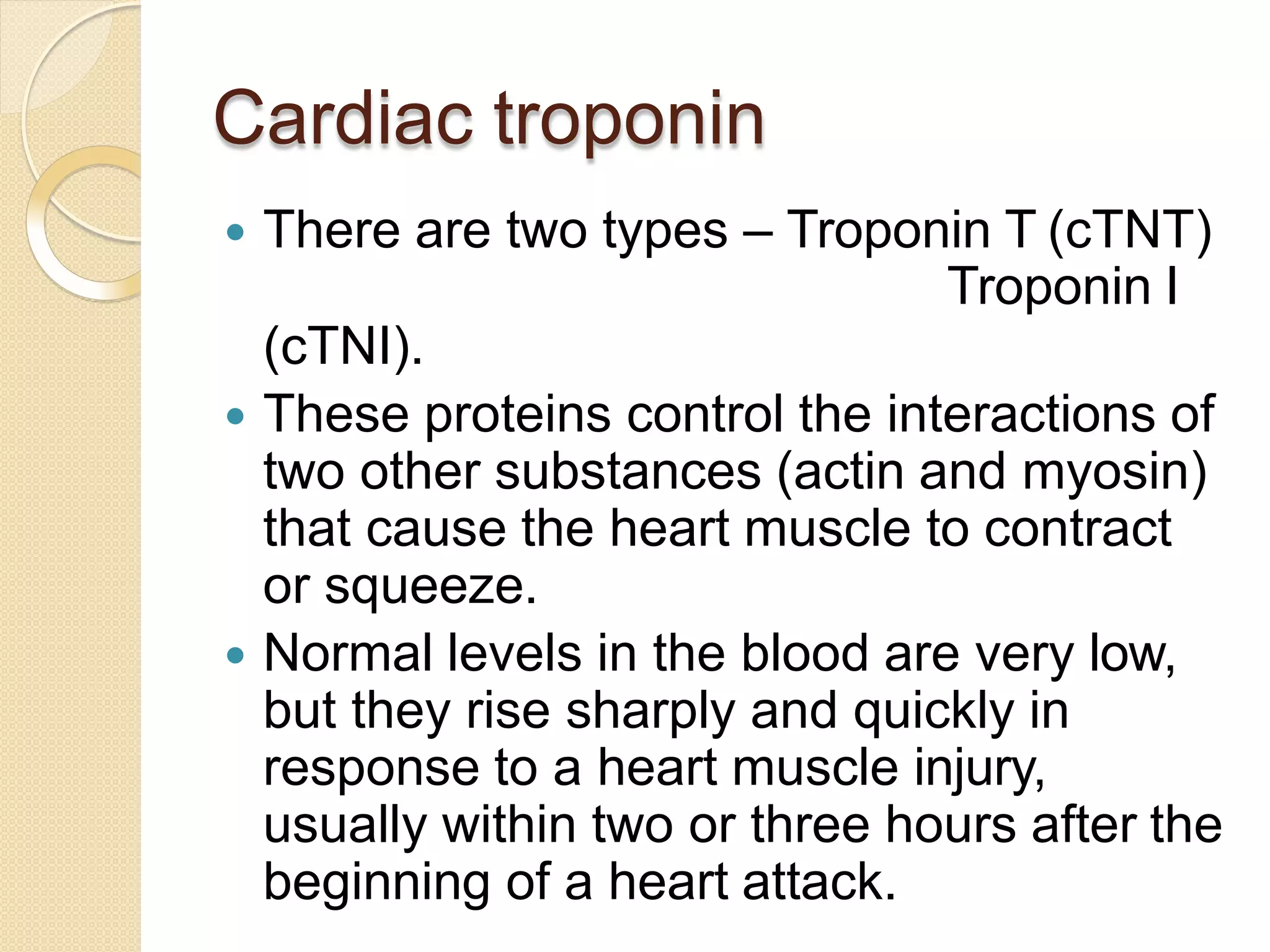
Cardiac troponin
 There are two types – Troponin T (cTNT)
Troponin I
(cTNI).
 These proteins control the interactions of
two other substances (actin and myosin)
that cause the heart muscle to contract
or squeeze.
 Normal levels in the blood are very low,
but they rise sharply and quickly in
response to a heart muscle injury,
usually within two or three hours after the
beginning of a heart attack.
 cardiac troponin will also rise in
response to angina, which is one
reason the two tests are often
performed together.
 sensitive to damage than CK, valuable
at detecting mild heart attacks and
early detection.
 elevated levels are specific to a heart
injury.
lactate dehydrogenase
 Normal LDH levels - 140-280 U/L
 lactate dehydrogenase testing is no longer
considered a diagnostic tool for heart.
 LD is an enzyme that is found in almost all
of the body's cells (as well as in bacteria)
and is released from cells into the fluid
portion of blood when cells are damaged
or destroyed.
 the blood level of LD is a general indicator
of tissue and cellular damage.
The American College of Cardiology
(ACC) does not recommend measuring
LDH in the diagnosis of heart attack.
Aspartate aminotransferase
 Normal range- 8 to 20 IU/L
 Also known as serum glutamic-oxaloacetic
transaminase (SGOT), aspartate
aminotransferase (AST)
 convert amino acids to amino acid residues,
which is vital to energy production
 Increases in AST levels are proportional to
cell damage within the body, making it an
important tool for monitoring the progression
of damage and the healing process.
Serum Cholesterol
 Not used to diagnose or monitor a
disease but is used instead to
estimate risk of developing a disease
— specifically heart disease
 High blood cholesterol has been
associated with hardening of the
arteries (atherosclerosis), heart
disease, and a raised risk of death
from heart attacks.
Coronary angiography
 Coronary angiography is a procedure
that uses a special dye (contrast
material) and x-rays to see how blood
flows through the arteries in heart.
Thank you-

Cardiac function-test

  • 1.
    By- Dipak H. Sutar(intern) Cardiac function test By- Khadga Raj Aran M.Pharm, Ph.D.
  • 2.
  • 3.
    ECG  Simplest andmost routine- test  electrocardiogram (ECG) is a quick, easy way to assess the heart’s function  By this technique the electrical activities of the heart are studied.  Risks associated with ECG are minimal and rare  No special preparation is necessary for an electrocardiogram
  • 4.
    What represent ? Pwave = atrial depolarisation QRS = ventricular depolarisation T = repolarisation of the ventricles
  • 6.
  • 7.
    DRUGS THAT CHANGESECG: o o o o o o o o o o o o o o o o o o o o o o o o
  • 8.
    Certain factors orconditions may interfere with or affect the results of the ECG.  Obesity  Pregnancy  Ascites (fluid buildup in the abdomen [belly])  Anatomical considerations  Movement during the procedure  Exercise or smoking prior to the procedure  Certain medications  Electrolyte imbalances, such as too much or too little potassium, magnesium, and/or calcium in the blood.
  • 9.
    1. Heart rate 2.Heart rhythm 3. Conduction abnormalities 4. Evidence of increased thickness of heart muscle (hypertrophy) 5. Evidence of damaged heart muscle 6. Acutely impaired blood flow to heart muscle 7. Warning signs of abnormal cardiac rhythm disturbances By analyzing the pattern and frequency of the ECG
  • 10.
  • 11.
  • 12.
  • 13.
    X-ray  A secondroutine test often used initially after the medical history and physical examination is the chest X-ray.  There are no other risks involved in X- rays; they are painless, fast, and relatively inexpensive  A chest X-ray may be ordered when an person's symptoms include a persistent cough, coughing up blood, chest pain, a chest injury, or difficulty in breathing.
  • 14.
     The mainadvantages of the chest X-ray are in differentiating primary lung disease from heart disease and in providing a clear view of anatomical abnormalities such as heart enlargement.
  • 15.
  • 16.
    Cardiac Enzyme tests Enzyme levels to assess how well the body’s systems are functioning.  Used to determine whether there has been any tissue damage.  Tests performed to help diagnose a heart attack and to determine the extent of damage to the heart muscle.
  • 17.
     The tmost common cardiac enzyme tests performed are: Creatine kinase (CK) Cardiac troponin lactate dehydrogenase (LHD) aspartate aminotransferase (AST) (Combination of troponin and CK levels is more specific to the heart )
  • 18.
    Serum Creatine kinase(CK)  The muscle cells in your body need CK to function properly.  Creatine phosphokinase isoenzymes play a key role in the intracellular energy transport from mitochondria to myofibrils and other sites of energy utilization  CK is made up of three isoenzyme forms CK-MB, CK-MM,CK-BB.
  • 19.
     CK-MB isthe substance that rises if your heart muscle is damaged. CK- MM rises with other muscle damage.  CPK-BB found mostly in the brain and lungs  CPK-MB found mostly in the heart  CPK-MM found mostly in skeletal muscle
  • 20.
    Creatine kinase (CK) CK-MB Normal range- 5 to 25 IU/L.  The primary indicator used to diagnose a heart damage because it exists in the highest amount in the heart.  CK-MB is the substance that rises if your heart muscle is damaged  If CK-MB makes up more than 5 percent of a total CK level, a heart attack is suspected.  CK-MB levels typically increase to above normal levels about six hours after a person has had a heart attack.
  • 21.
    CK-BB  Rare presentin cardiac tissue  CK-BB is found mostly in the brain.  CK-BB can be an important indicator of tissue damage in the brain from stroke, trauma or other causes.  Unless tissue damage in the brain has occurred, CK-BB levels will be undetectable. CK-MM ( 5 to 70 mcg/ lit)  Exists primarily in skeletal muscle
  • 22.
     Total creatinekinase level (CK total). male - 25 to 130 mcg/lit female- 10 to 150 mcg/lit female  Much higher in very muscular people, and infants up to 1 year  According to the American College of Cardiology (ACC), total CK levels should not be used in the diagnosis of heart attack.
  • 23.
    Cardiac troponin  Thereare two types – Troponin T (cTNT) Troponin I (cTNI).  These proteins control the interactions of two other substances (actin and myosin) that cause the heart muscle to contract or squeeze.  Normal levels in the blood are very low, but they rise sharply and quickly in response to a heart muscle injury, usually within two or three hours after the beginning of a heart attack.
  • 24.
     cardiac troponinwill also rise in response to angina, which is one reason the two tests are often performed together.  sensitive to damage than CK, valuable at detecting mild heart attacks and early detection.  elevated levels are specific to a heart injury.
  • 25.
    lactate dehydrogenase  NormalLDH levels - 140-280 U/L  lactate dehydrogenase testing is no longer considered a diagnostic tool for heart.  LD is an enzyme that is found in almost all of the body's cells (as well as in bacteria) and is released from cells into the fluid portion of blood when cells are damaged or destroyed.  the blood level of LD is a general indicator of tissue and cellular damage.
  • 26.
    The American Collegeof Cardiology (ACC) does not recommend measuring LDH in the diagnosis of heart attack.
  • 27.
    Aspartate aminotransferase  Normalrange- 8 to 20 IU/L  Also known as serum glutamic-oxaloacetic transaminase (SGOT), aspartate aminotransferase (AST)  convert amino acids to amino acid residues, which is vital to energy production  Increases in AST levels are proportional to cell damage within the body, making it an important tool for monitoring the progression of damage and the healing process.
  • 28.
    Serum Cholesterol  Notused to diagnose or monitor a disease but is used instead to estimate risk of developing a disease — specifically heart disease  High blood cholesterol has been associated with hardening of the arteries (atherosclerosis), heart disease, and a raised risk of death from heart attacks.
  • 29.
    Coronary angiography  Coronaryangiography is a procedure that uses a special dye (contrast material) and x-rays to see how blood flows through the arteries in heart.
  • 30.