Presentation on
Pharmacokinetic Models
Submitted to : Ms Lovepreet kaur mam
Submitted by : Pallavi
Pharm.D
Batch- 2017
17405014
AIPBS
Adesh University, Bathinda
Pharmacokinetic Model
Pharmacokinetic modeling is a mathematical modeling
technique for predicting the absorption, distribution,
metabolism and excretion (ADME) of synthetic or natural
chemical substances in humans and animals.
Useful in :
 Characterize the behavior of drug in patient.
 Predicting conc. of drug in various body fluids with
dosage regimen.
 Calculating optimum dosage regimen for individual
patient.
 Evaluating bioequivalence between different formulation
 Explaining drug interaction.
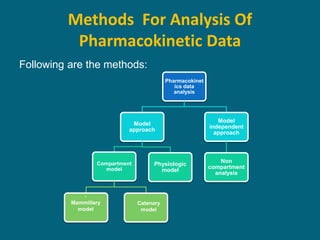
Methods For Analysis Of
Pharmacokinetic Data
Following are the methods:
Pharmacokinet
ics data
analysis
Model
approach
Compartment
model
Physiologic
model
Model
independent
approach
Non
compartment
analysis
.
Mammillary
model
Catenary
model
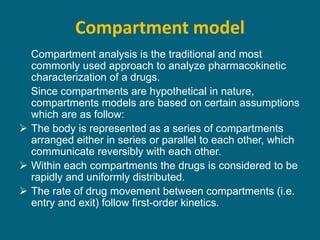
Compartment model
Compartment analysis is the traditional and most
commonly used approach to analyze pharmacokinetic
characterization of a drugs.
Since compartments are hypothetical in nature,
compartments models are based on certain assumptions
which are as follow:
 The body is represented as a series of compartments
arranged either in series or parallel to each other, which
communicate reversibly with each other.
 Within each compartments the drugs is considered to be
rapidly and uniformly distributed.
 The rate of drug movement between compartments (i.e.
entry and exit) follow first-order kinetics.
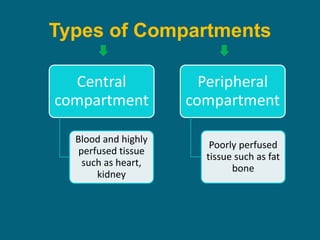
Types of Compartments
Central
compartment
Blood and highly
perfused tissue
such as heart,
kidney
Peripheral
compartment
Poorly perfused
tissue such as fat
bone
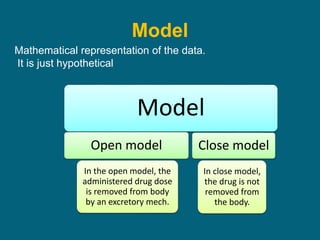
Model
Mathematical representation of the data.
It is just hypothetical
Model
Open model
In the open model, the
administered drug dose
is removed from body
by an excretory mech.
Close model
In close model,
the drug is not
removed from
the body.
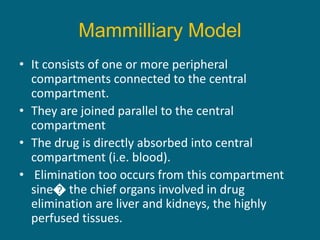
Mammilliary Model
• It consists of one or more peripheral
compartments connected to the central
compartment.
• They are joined parallel to the central
compartment
• The drug is directly absorbed into central
compartment (i.e. blood).
• Elimination too occurs from this compartment
sine� the chief organs involved in drug
elimination are liver and kidneys, the highly
perfused tissues.
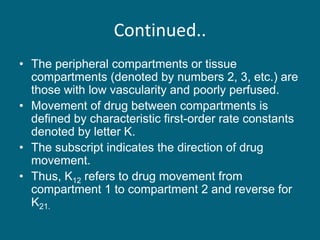
Continued..
• The peripheral compartments or tissue
compartments (denoted by numbers 2, 3, etc.) are
those with low vascularity and poorly perfused.
• Movement of drug between compartments is
defined by characteristic first-order rate constants
denoted by letter K.
• The subscript indicates the direction of drug
movement.
• Thus, K12 refers to drug movement from
compartment 1 to compartment 2 and reverse for
K21.
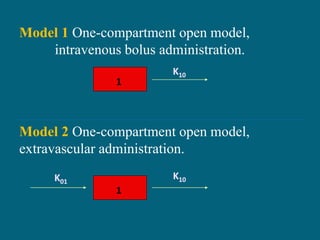
Model 1 One-compartment open model,
intravenous bolus administration.
Model 2 One-compartment open model,
extravascular administration.
1
K10
1
K10K01
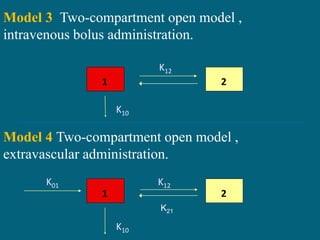
Model 3 Two-compartment open model ,
intravenous bolus administration.
Model 4 Two-compartment open model ,
extravascular administration.
1 2
K12
K10
1 2
K12
K10
K01
K21
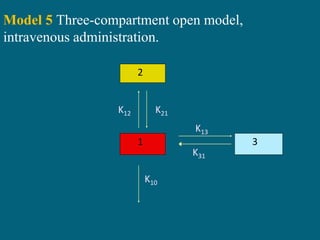
Model 5 Three-compartment open model,
intravenous administration.
2
31
K21K12
K13
K31
K10
12
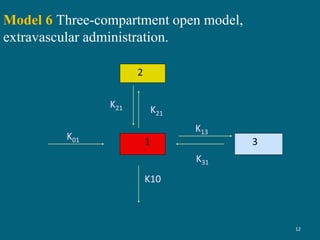
Model 6 Three-compartment open model,
extravascular administration.
2
31
K21 K21
K13
K31
K10
K01
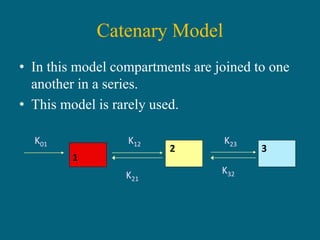
Catenary Model
• In this model compartments are joined to one
another in a series.
• This model is rarely used.
1
2 3
K01 K12
K21
K23
K32
ADVANTAGES OF
COMPARTMENT MODELING
• It is a simple and flexible approach.
• It gives a visual representation of various rate
processes involved in drug disposition.
• It is important in development of dose
regimens.
• Used for comparison of multiple therapeutic
agents.
• It show how many rate constant required for
describing these process.
14
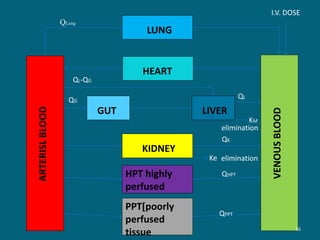
Physiologic model
 They are drawn on the basis of known anatomical and
physiological data.
 So it present more realistic picture of drug disposition.
 Number of compartments in the model depends upon
the disposition characteristics of drug.
Tissues with similar perfusion properties are grouped into
a single compartment.
 The rate of drug carried to a tissue/organ or tissue drug
uptake is dependent upon two major factors-
Rate of blood flow to the organ
Tissue/Blood partition coefficient or diffusion coefficient of
drug
LUNG
HEART
GUT LIVER
KIDNEY
HPT highly
perfused
PPT[poorly
perfused
tissue
VENOUSBLOOD
ARTERISLBLOOD
QLung
QL-QG
QG
QL
QK
QHPT
QPPT
I.V. DOSE
KM
Ke
elimination
elimination
16
Non-compartmental Model
• Also know as model-independent-method.
• Based on the assumption that the drugs or
metabolites follow linear kinetics.
• It dose not require the assumption of
specific compartment model.
• Applicable to any compartment model.
• Describe the pharmacokinetics of drug
disposition using time and concentration
parameters.
17
Continuous…
18
• Based on statistical moments theory.
• It involves collection of experimental data
following a single dose of drug.
• If one consider the time course of drug
concentration in plasma as a statistical
distribution curve,
• then
MRT= AUMC/AUC
Conti..
• Where, MRT= mean residence time
• AUMC= area under the first moment curve
• AUC= Area under the zero moment curve
• MRT= is defined as the average amount of time spent by
the drug in the body before being eliminated.
• AUMC and AUC can be calculated from the use of
trapezoidal rule.
• Non-compartmental technique is widely used to estimate
the important pharmacokinetic parameters like
bioavailability, clearance and apparent volume of
distribution.
Continuous…
• AUMC is obtained from a plot of product of drug
concentration and time (i.e. C.t) versus time t
from zero to infinity.
𝐴𝑈𝑀𝐶 = 0
∞
𝐶𝑡 𝑑𝑡
• AUC is obtained from a plot of plasma drug
concentration versus time from zero to infinity.
𝐴𝑈𝐶 =
0
∞
𝐶 𝑑𝑡
• AUMC and AUC can be calculate from a
respective graph by trapezoidal rule.
20
11/26/2020 21

Presentation on pharmacokinetic model by pallavi

  • 1.
    Presentation on Pharmacokinetic Models Submittedto : Ms Lovepreet kaur mam Submitted by : Pallavi Pharm.D Batch- 2017 17405014 AIPBS Adesh University, Bathinda
  • 2.
    Pharmacokinetic Model Pharmacokinetic modelingis a mathematical modeling technique for predicting the absorption, distribution, metabolism and excretion (ADME) of synthetic or natural chemical substances in humans and animals. Useful in :  Characterize the behavior of drug in patient.  Predicting conc. of drug in various body fluids with dosage regimen.  Calculating optimum dosage regimen for individual patient.  Evaluating bioequivalence between different formulation  Explaining drug interaction.
  • 3.
    Methods For AnalysisOf Pharmacokinetic Data Following are the methods: Pharmacokinet ics data analysis Model approach Compartment model Physiologic model Model independent approach Non compartment analysis . Mammillary model Catenary model
  • 4.
    Compartment model Compartment analysisis the traditional and most commonly used approach to analyze pharmacokinetic characterization of a drugs. Since compartments are hypothetical in nature, compartments models are based on certain assumptions which are as follow:  The body is represented as a series of compartments arranged either in series or parallel to each other, which communicate reversibly with each other.  Within each compartments the drugs is considered to be rapidly and uniformly distributed.  The rate of drug movement between compartments (i.e. entry and exit) follow first-order kinetics.
  • 5.
    Types of Compartments Central compartment Bloodand highly perfused tissue such as heart, kidney Peripheral compartment Poorly perfused tissue such as fat bone
  • 6.
    Model Mathematical representation ofthe data. It is just hypothetical Model Open model In the open model, the administered drug dose is removed from body by an excretory mech. Close model In close model, the drug is not removed from the body.
  • 7.
    Mammilliary Model • Itconsists of one or more peripheral compartments connected to the central compartment. • They are joined parallel to the central compartment • The drug is directly absorbed into central compartment (i.e. blood). • Elimination too occurs from this compartment sine� the chief organs involved in drug elimination are liver and kidneys, the highly perfused tissues.
  • 8.
    Continued.. • The peripheralcompartments or tissue compartments (denoted by numbers 2, 3, etc.) are those with low vascularity and poorly perfused. • Movement of drug between compartments is defined by characteristic first-order rate constants denoted by letter K. • The subscript indicates the direction of drug movement. • Thus, K12 refers to drug movement from compartment 1 to compartment 2 and reverse for K21.
  • 9.
    Model 1 One-compartmentopen model, intravenous bolus administration. Model 2 One-compartment open model, extravascular administration. 1 K10 1 K10K01
  • 10.
    Model 3 Two-compartmentopen model , intravenous bolus administration. Model 4 Two-compartment open model , extravascular administration. 1 2 K12 K10 1 2 K12 K10 K01 K21
  • 11.
    Model 5 Three-compartmentopen model, intravenous administration. 2 31 K21K12 K13 K31 K10
  • 12.
    12 Model 6 Three-compartmentopen model, extravascular administration. 2 31 K21 K21 K13 K31 K10 K01
  • 13.
    Catenary Model • Inthis model compartments are joined to one another in a series. • This model is rarely used. 1 2 3 K01 K12 K21 K23 K32
  • 14.
    ADVANTAGES OF COMPARTMENT MODELING •It is a simple and flexible approach. • It gives a visual representation of various rate processes involved in drug disposition. • It is important in development of dose regimens. • Used for comparison of multiple therapeutic agents. • It show how many rate constant required for describing these process. 14
  • 15.
    Physiologic model  Theyare drawn on the basis of known anatomical and physiological data.  So it present more realistic picture of drug disposition.  Number of compartments in the model depends upon the disposition characteristics of drug. Tissues with similar perfusion properties are grouped into a single compartment.  The rate of drug carried to a tissue/organ or tissue drug uptake is dependent upon two major factors- Rate of blood flow to the organ Tissue/Blood partition coefficient or diffusion coefficient of drug
  • 16.
  • 17.
    Non-compartmental Model • Alsoknow as model-independent-method. • Based on the assumption that the drugs or metabolites follow linear kinetics. • It dose not require the assumption of specific compartment model. • Applicable to any compartment model. • Describe the pharmacokinetics of drug disposition using time and concentration parameters. 17
  • 18.
    Continuous… 18 • Based onstatistical moments theory. • It involves collection of experimental data following a single dose of drug. • If one consider the time course of drug concentration in plasma as a statistical distribution curve, • then MRT= AUMC/AUC
  • 19.
    Conti.. • Where, MRT=mean residence time • AUMC= area under the first moment curve • AUC= Area under the zero moment curve • MRT= is defined as the average amount of time spent by the drug in the body before being eliminated. • AUMC and AUC can be calculated from the use of trapezoidal rule. • Non-compartmental technique is widely used to estimate the important pharmacokinetic parameters like bioavailability, clearance and apparent volume of distribution.
  • 20.
    Continuous… • AUMC isobtained from a plot of product of drug concentration and time (i.e. C.t) versus time t from zero to infinity. 𝐴𝑈𝑀𝐶 = 0 ∞ 𝐶𝑡 𝑑𝑡 • AUC is obtained from a plot of plasma drug concentration versus time from zero to infinity. 𝐴𝑈𝐶 = 0 ∞ 𝐶 𝑑𝑡 • AUMC and AUC can be calculate from a respective graph by trapezoidal rule. 20
  • 21.