By
Dr. Ram D. Bawankar
Ph. D., M. Pharm, MBA
Assistant Professor,
Department of Pharmaceutics
Agnihotri College of Pharmacy, Wardha.
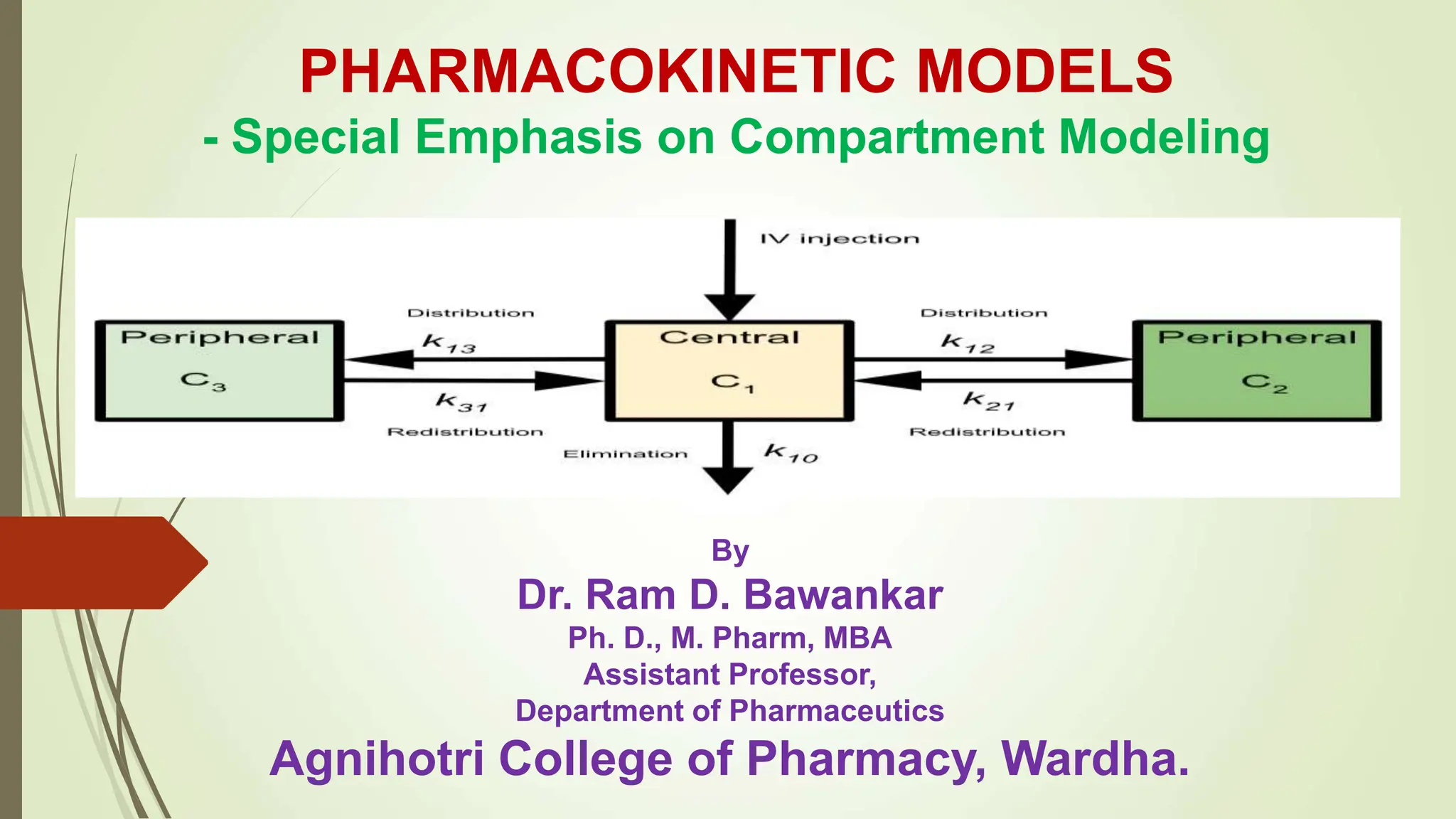
PHARMACOKINETIC MODELS
- Special Emphasis on Compartment Modeling
Content…….
According to Syllabus (BP 604 T)…UNIT-III
 Pharmacokinetics: Definition and introduction to Pharmacokinetics
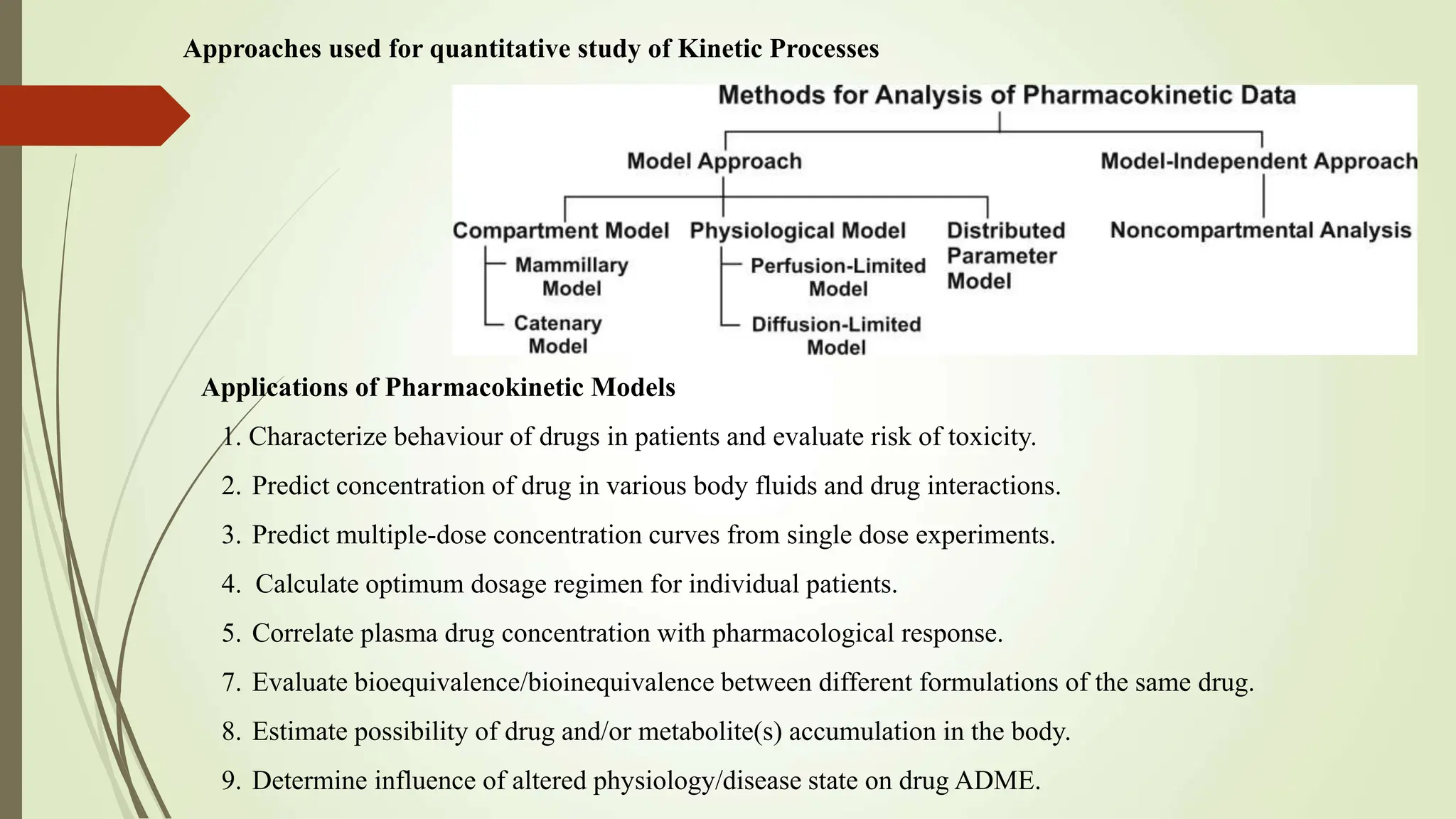
 Compartment models,
Non compartment models
Physiological models
One compartment open model:-
(Pharmacokinetics parameters - KE ,t1/2,Vd,AUC,Ka, Clt and CLR- definitions
methods of eliminations, understanding of their significance and applications)
(a) Intravenous Injection (Bolus)
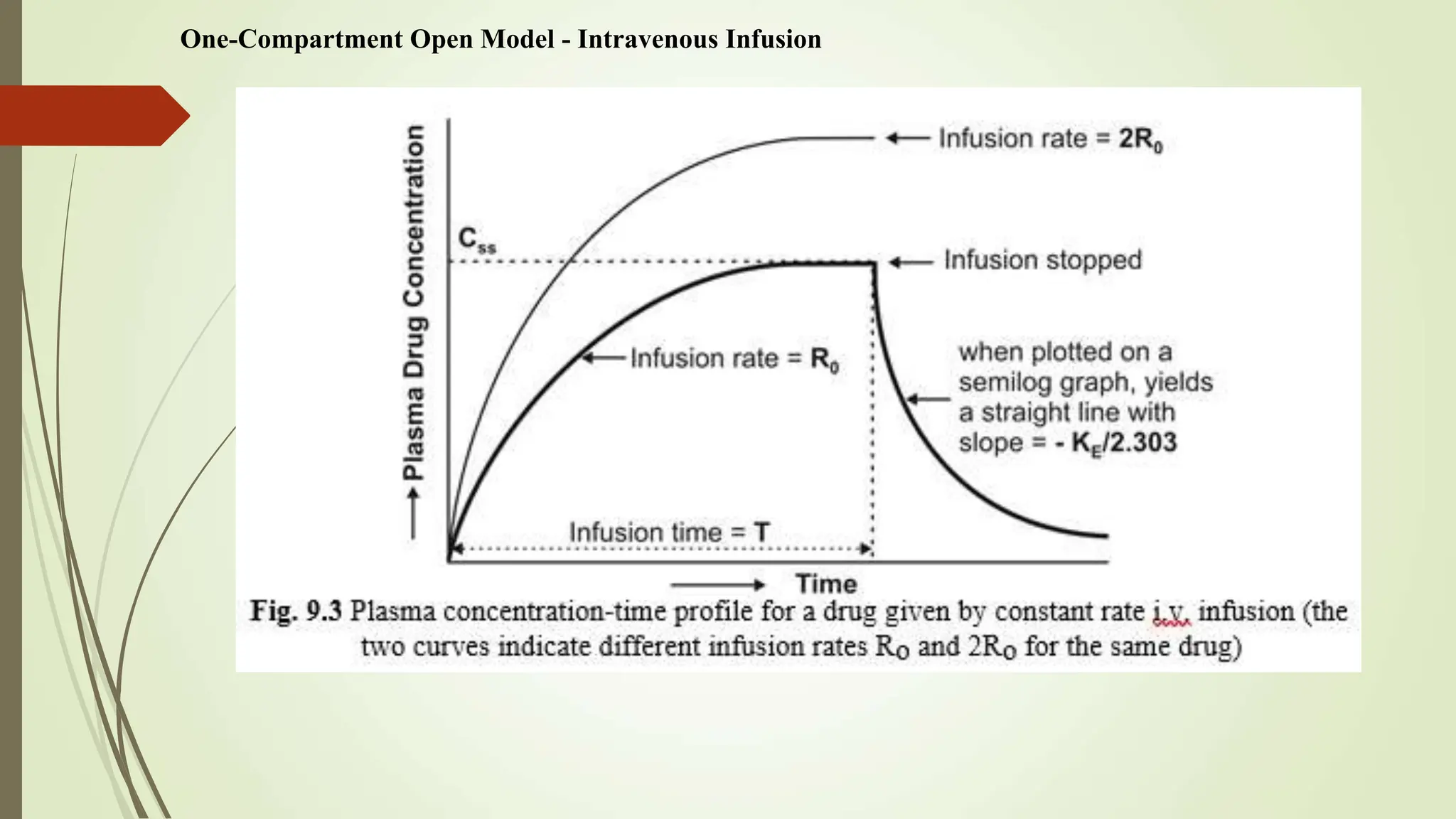
(b) Intravenous infusion
(c) Extra vascular administrations.
Some Repeatedly Asked Questions
 Define Pharmacokinetics
 Discuss significance of Compartmental modeling in Pharmacokinetics studies.
 Explain types of compartmental models in detail.
 Write disadvantages of compartmental modeling.
 Define Pharmacokinetics. Discuss in detail one compartment open model for single dose administration.
 Give an account of different models to study transfer of drug in body.
 Deduce absorption rate & elimination rate constant for the drug given by i.v. infusion.
 Propose a compartmental model for study undergoing instantaneous distribution and given by i.v bolus. Derive various
equations to compute pharmacokinetic parameters such as KE, t1/2, Vd & ClT.
 What is the criteria for obtaining valid urinary excretion data.
 Discuss, “Wagner Nelson method for Ka estimation.”
 Explain, “Sigma Minus method for Ke estimation.”
 What are compartmental model? Derive mathematical expression for determination of Ka, KE, Cmax and Tmax for a drug
following one compartment model kinetics after single oral dose administration
Pharmacokinetics
Mathematical Analysis of Process of ADME.
Pharmacokinetic Parameters
Generally, describe the plasma level-time curve and useful in assessing the bioavailability of a drug from its
formulation.
1. Peak Plasma Concentration (Cmax)
2. Time of Peak Concentration (tmax)
3. Area Under the Curve (AUC)
Pharmacodynamic Parameters
Generally, describe the plasma level-time curve and useful in assessing the bioavailability of a drug from its
formulation.
1. Minimum Effective Concentration (MEC)
2. Maximum Safe Concentration (MSC)
3. Area Under the Curve (AUC)
4. Onset of Action
5. Duration of Action
6. Intensity of Action
7. Therapeutic Range
8. Therapeutic Index
 Rate,
 Rate Constants and
 Orders of Reactions (Zero-order, First – order, Mixed
order process)
Approaches used for quantitative study of Kinetic Processes
Applications of Pharmacokinetic Models
1. Characterize behaviour of drugs in patients and evaluate risk of toxicity.
2. Predict concentration of drug in various body fluids and drug interactions.
3. Predict multiple-dose concentration curves from single dose experiments.
4. Calculate optimum dosage regimen for individual patients.
5. Correlate plasma drug concentration with pharmacological response.
7. Evaluate bioequivalence/bioinequivalence between different formulations of the same drug.
8. Estimate possibility of drug and/or metabolite(s) accumulation in the body.
9. Determine influence of altered physiology/disease state on drug ADME.
Pharmacokinetic Model /Empirical models Approach
 A model
 Pharmacokinetic models
Compartment Models
Traditional and most commonly used approach to pharmacokinetic characterization of a drug.
Assumptions
Body is represented as a series of compartments arranged
 Either in series or parallel to each other.
 Each compartment is not a real physiological or anatomical region but a fictitious or virtual one, the body
will comprise of infinite number of compartments and mathematical description of such a model will be
too complex.
 Within each compartment, the drug is considered to be rapidly and uniformly distributed i.e. the
compartment is well-stirred.
 The rate of drug movement between compartments (i.e. entry and exit) is described by first-order kinetics.
 Rate constants are used to represent rate of entry into and exit from the compartment.
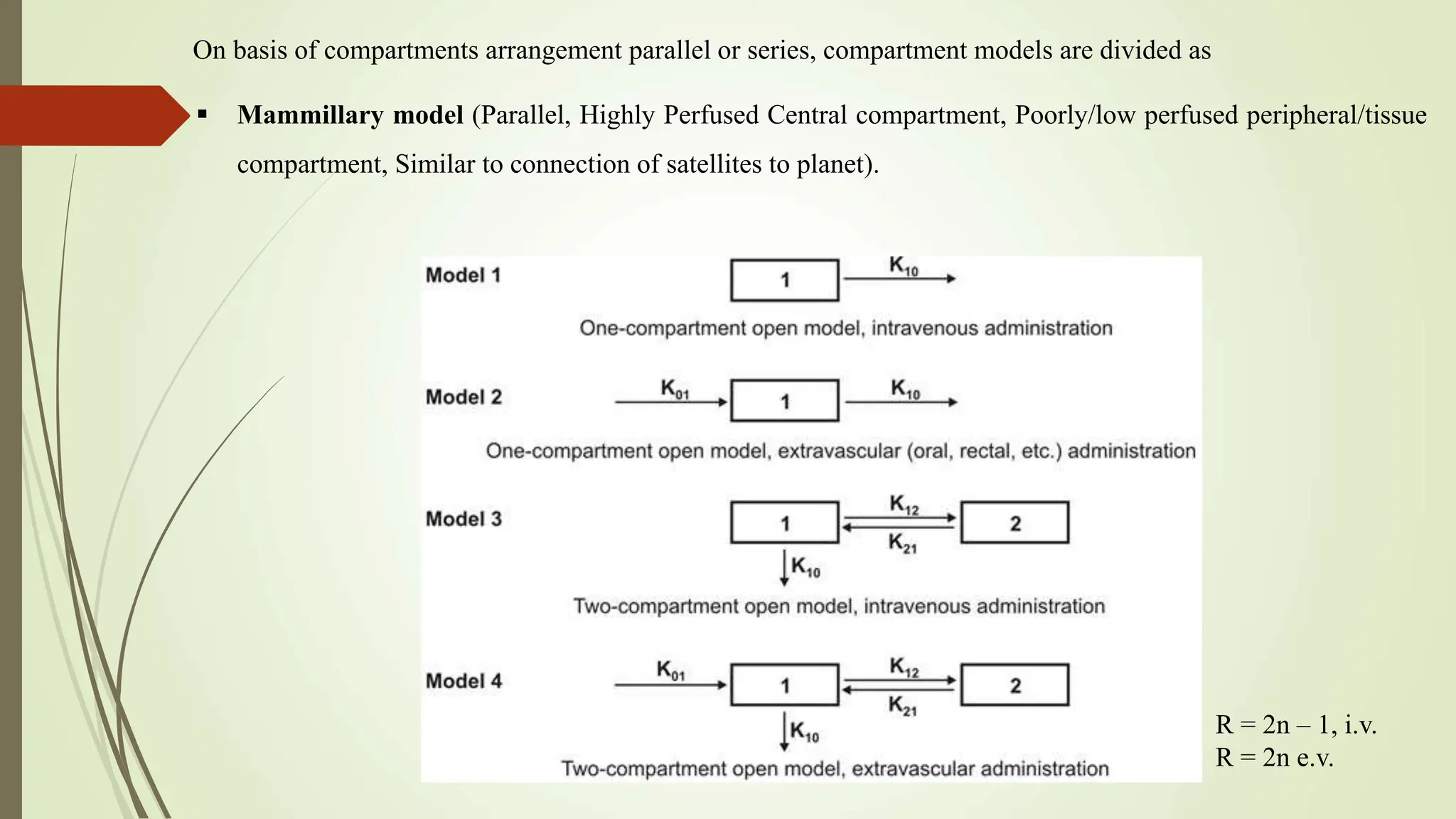
On basis of compartments arrangement parallel or series, compartment models are divided as
 Mammillary model (Parallel, Highly Perfused Central compartment, Poorly/low perfused peripheral/tissue
compartment, Similar to connection of satellites to planet).
R = 2n – 1, i.v.
R = 2n e.v.
 Catenary model (Like compartments of a train)
Advantages/Applications of Compartmental Modelling
1. Simple, flexible approach widely used.
2. It gives a visual representation of various rate processes involved in drug disposition.
3. It shows how many rate constants are necessary to describe these processes.
4. It enables the pharmacokineticist to write differential equations for each of the rate processes in order to
describe drug-concentration changes in each compartment.
5. It enables monitoring of drug concentration change with time with a limited amount of data. Only plasma
concentration data or urinary excretion data is sufficient.
Disadvantages of Compartmental Modelling
1. The compartments and parameters bear no relationship with the physiological functions or the anatomical
structure of the species; several assumptions have to be made to facilitate data interpretation.
2. Extensive efforts are required in the development of an exact model that predicts and describes correctly
the ADME of a certain drug.
3. The model is based on curve fitting of plasma concentration with complex multiexponential
mathematical equations.
4. The model may vary within a study population.
5. The approach can be applied only to a specific drug under study.
6. The drug behaviour within the body may fit different compartmental models depending upon the route of
administration.
7. Difficulties generally arise when using models to interpret the differences between results from human and
animal experiments.
8. Owing to their simplicity, compartmental models are often misunderstood, overstretched or even abused.
Advantages/Applications of Compartmental Modelling………… Contd……
6. Useful in predicting drug concentration-time profile in both normal physiological and in pathological
conditions.
7. Important in the development of dosage regimens.
8. Useful in relating plasma drug levels to therapeutic and toxic-effects in the body.
9. Useful when several therapeutic agents are compared. Clinically, drug data comparisons are based on
compartment models.
10. Its simplicity allows for easy tabulation of parameters such as Vd, t½, etc.
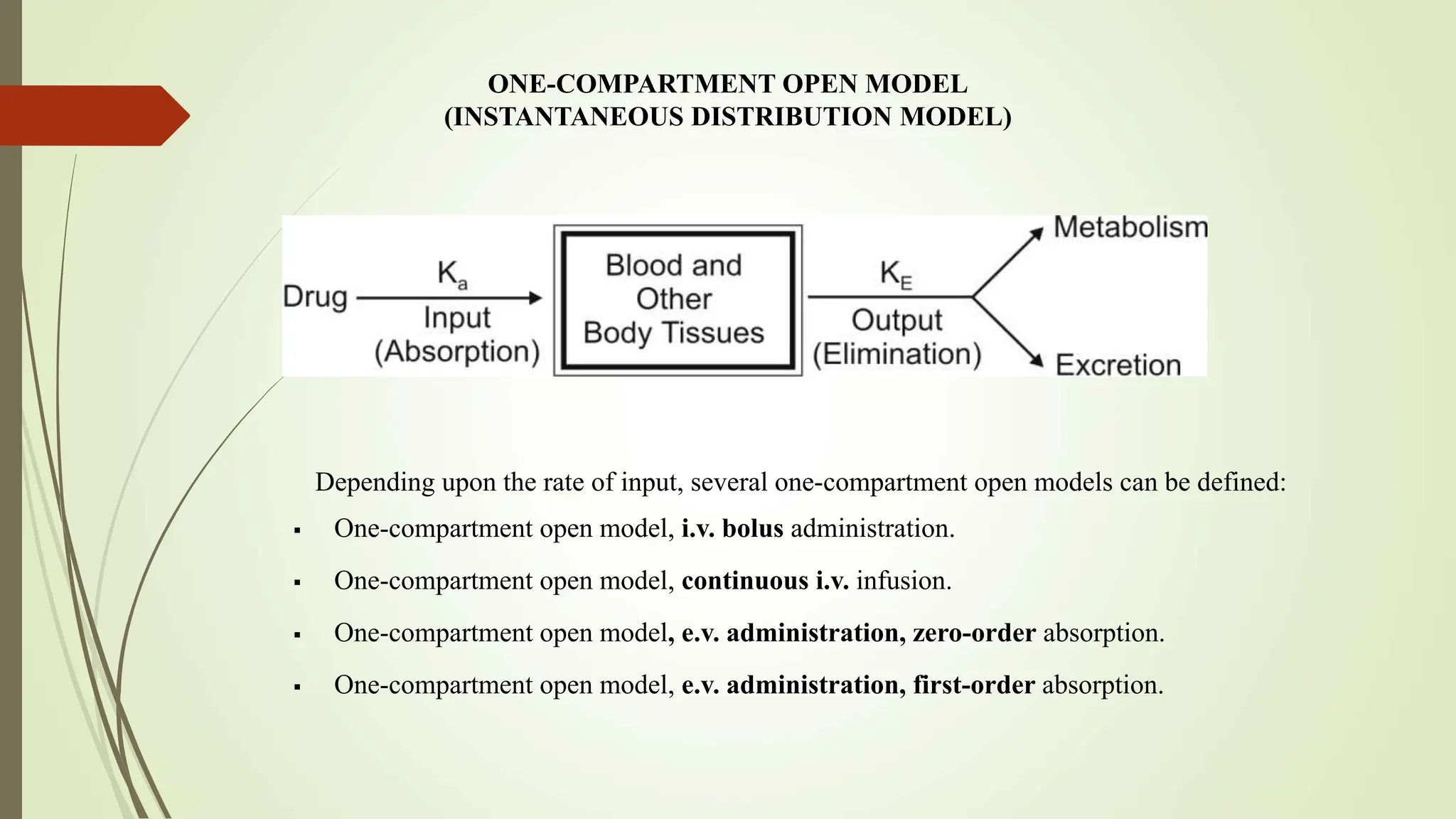
Depending upon the rate of input, several one-compartment open models can be defined:
 One-compartment open model, i.v. bolus administration.
 One-compartment open model, continuous i.v. infusion.
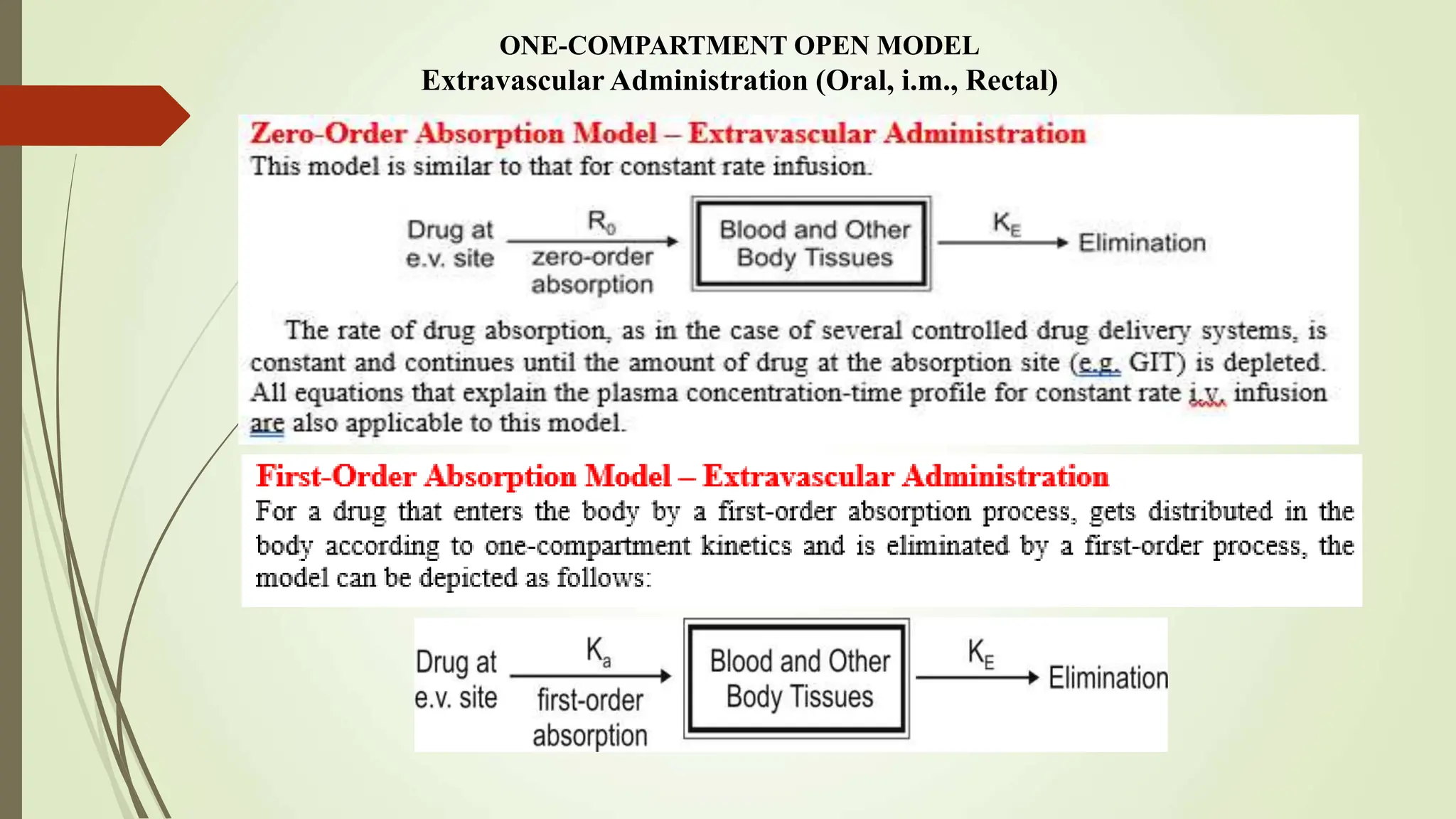
 One-compartment open model, e.v. administration, zero-order absorption.
 One-compartment open model, e.v. administration, first-order absorption.
ONE-COMPARTMENT OPEN MODEL
(INSTANTANEOUS DISTRIBUTION MODEL)
ONE-COMPARTMENT OPEN MODEL
Intravenous Bolus Administration
Takes about one to three minutes for complete circulation and therefore the rate of absorption is neglected in
calculations.
on)
(eliminati
out
Rate
-
ity)
(availabil
in
Rate
dt
dX

out
Rate
dt
dX


X
K
dt
dX
Ε


The general expression for rate of drug presentation to the body is:
Since rate in or absorption is absent, the equation becomes:
If the rate out or elimination follows first-order kinetics, then:
where, KE = first-order elimination rate constant, and
X = amount of drug in the body at any time t remaining to be eliminated. Negative sign indicates that the drug is being lost from the body.
Estimation of Pharmacokinetic Parameters
Elimination phase can be characterized by 3 parameters—
1. Elimination rate constant
2. Elimination half-life
3. Clearance
Elimination Rate Constant: On Integration of above equation
Overall elimination Rate Constant:
KE = Ke + Km + Kb + Kl + ... (9.9)
Fraction of drug excreted unchanged in urine Fe and fraction of drug metabolized Fm can be given as
E
e
e
K
K
F 
E
m
m
K
K
F 
Elimination Half-Life/Biological half-life:
Time taken for the amount of drug in the body as well as plasma concentration to decline by one-half or 50%
its initial value.
Clearance:
 Its an hypothetical volume of body fluid
 Important parameter in clinical drug applications and is useful in evaluating the mechanism by which a
drug is eliminated by the whole organism or by a particular organ.
E
1/2
K
0.693
t 
T
d
1/2
Cl
V
0.693
t 
ion
concentrat
drug
Plasma
n
eliminatio
of
Rate
Clearance 
C
dt
dX
Cl
or 
ONE-COMPARTMENT OPEN MODEL
Extravascular Administration (Oral, i.m., Rectal)
Extravascular administration of a single dose of a drug
Absorption Rate Constant, Ka:
 Method of peeling/striping/feathering
 Wagnor Nelson Method
Elimination Rate Constant, KE:
 Rate of Excretion Method
 Sigma Minus Method
Ka & KE Calculation can be done by
One-Compartment Open Model - Intravenous Infusion
References:
 Applied Biopharmaceutics and Pharmacokinetics, Leon Shargel and Andrew B.C.YU 4th edition,
Prentice-Hall International edition. USA.
 Biopharmaceutics and Pharmacokinetics-A Treatise, By D. M. Brahmankar and Sunil B. Jaiswal,
Vallabh Prakashan, Pitampura, Delhi.
THANK YOU

Pharmacokinetic Models by Dr. Ram D. Bawankar.ppt

  • 1.
    By Dr. Ram D.Bawankar Ph. D., M. Pharm, MBA Assistant Professor, Department of Pharmaceutics Agnihotri College of Pharmacy, Wardha. PHARMACOKINETIC MODELS - Special Emphasis on Compartment Modeling
  • 2.
    Content……. According to Syllabus(BP 604 T)…UNIT-III  Pharmacokinetics: Definition and introduction to Pharmacokinetics  Compartment models, Non compartment models Physiological models One compartment open model:- (Pharmacokinetics parameters - KE ,t1/2,Vd,AUC,Ka, Clt and CLR- definitions methods of eliminations, understanding of their significance and applications) (a) Intravenous Injection (Bolus) (b) Intravenous infusion (c) Extra vascular administrations.
  • 3.
    Some Repeatedly AskedQuestions  Define Pharmacokinetics  Discuss significance of Compartmental modeling in Pharmacokinetics studies.  Explain types of compartmental models in detail.  Write disadvantages of compartmental modeling.  Define Pharmacokinetics. Discuss in detail one compartment open model for single dose administration.  Give an account of different models to study transfer of drug in body.  Deduce absorption rate & elimination rate constant for the drug given by i.v. infusion.  Propose a compartmental model for study undergoing instantaneous distribution and given by i.v bolus. Derive various equations to compute pharmacokinetic parameters such as KE, t1/2, Vd & ClT.  What is the criteria for obtaining valid urinary excretion data.  Discuss, “Wagner Nelson method for Ka estimation.”  Explain, “Sigma Minus method for Ke estimation.”  What are compartmental model? Derive mathematical expression for determination of Ka, KE, Cmax and Tmax for a drug following one compartment model kinetics after single oral dose administration
  • 4.
    Pharmacokinetics Mathematical Analysis ofProcess of ADME. Pharmacokinetic Parameters Generally, describe the plasma level-time curve and useful in assessing the bioavailability of a drug from its formulation. 1. Peak Plasma Concentration (Cmax) 2. Time of Peak Concentration (tmax) 3. Area Under the Curve (AUC) Pharmacodynamic Parameters Generally, describe the plasma level-time curve and useful in assessing the bioavailability of a drug from its formulation. 1. Minimum Effective Concentration (MEC) 2. Maximum Safe Concentration (MSC) 3. Area Under the Curve (AUC) 4. Onset of Action 5. Duration of Action 6. Intensity of Action 7. Therapeutic Range 8. Therapeutic Index  Rate,  Rate Constants and  Orders of Reactions (Zero-order, First – order, Mixed order process)
  • 5.
    Approaches used forquantitative study of Kinetic Processes Applications of Pharmacokinetic Models 1. Characterize behaviour of drugs in patients and evaluate risk of toxicity. 2. Predict concentration of drug in various body fluids and drug interactions. 3. Predict multiple-dose concentration curves from single dose experiments. 4. Calculate optimum dosage regimen for individual patients. 5. Correlate plasma drug concentration with pharmacological response. 7. Evaluate bioequivalence/bioinequivalence between different formulations of the same drug. 8. Estimate possibility of drug and/or metabolite(s) accumulation in the body. 9. Determine influence of altered physiology/disease state on drug ADME.
  • 6.
    Pharmacokinetic Model /Empiricalmodels Approach  A model  Pharmacokinetic models Compartment Models Traditional and most commonly used approach to pharmacokinetic characterization of a drug. Assumptions Body is represented as a series of compartments arranged  Either in series or parallel to each other.  Each compartment is not a real physiological or anatomical region but a fictitious or virtual one, the body will comprise of infinite number of compartments and mathematical description of such a model will be too complex.  Within each compartment, the drug is considered to be rapidly and uniformly distributed i.e. the compartment is well-stirred.  The rate of drug movement between compartments (i.e. entry and exit) is described by first-order kinetics.  Rate constants are used to represent rate of entry into and exit from the compartment.
  • 7.
    On basis ofcompartments arrangement parallel or series, compartment models are divided as  Mammillary model (Parallel, Highly Perfused Central compartment, Poorly/low perfused peripheral/tissue compartment, Similar to connection of satellites to planet). R = 2n – 1, i.v. R = 2n e.v.
  • 8.
     Catenary model(Like compartments of a train) Advantages/Applications of Compartmental Modelling 1. Simple, flexible approach widely used. 2. It gives a visual representation of various rate processes involved in drug disposition. 3. It shows how many rate constants are necessary to describe these processes. 4. It enables the pharmacokineticist to write differential equations for each of the rate processes in order to describe drug-concentration changes in each compartment. 5. It enables monitoring of drug concentration change with time with a limited amount of data. Only plasma concentration data or urinary excretion data is sufficient.
  • 9.
    Disadvantages of CompartmentalModelling 1. The compartments and parameters bear no relationship with the physiological functions or the anatomical structure of the species; several assumptions have to be made to facilitate data interpretation. 2. Extensive efforts are required in the development of an exact model that predicts and describes correctly the ADME of a certain drug. 3. The model is based on curve fitting of plasma concentration with complex multiexponential mathematical equations. 4. The model may vary within a study population. 5. The approach can be applied only to a specific drug under study. 6. The drug behaviour within the body may fit different compartmental models depending upon the route of administration. 7. Difficulties generally arise when using models to interpret the differences between results from human and animal experiments. 8. Owing to their simplicity, compartmental models are often misunderstood, overstretched or even abused. Advantages/Applications of Compartmental Modelling………… Contd…… 6. Useful in predicting drug concentration-time profile in both normal physiological and in pathological conditions. 7. Important in the development of dosage regimens. 8. Useful in relating plasma drug levels to therapeutic and toxic-effects in the body. 9. Useful when several therapeutic agents are compared. Clinically, drug data comparisons are based on compartment models. 10. Its simplicity allows for easy tabulation of parameters such as Vd, t½, etc.
  • 10.
    Depending upon therate of input, several one-compartment open models can be defined:  One-compartment open model, i.v. bolus administration.  One-compartment open model, continuous i.v. infusion.  One-compartment open model, e.v. administration, zero-order absorption.  One-compartment open model, e.v. administration, first-order absorption. ONE-COMPARTMENT OPEN MODEL (INSTANTANEOUS DISTRIBUTION MODEL)
  • 11.
    ONE-COMPARTMENT OPEN MODEL IntravenousBolus Administration Takes about one to three minutes for complete circulation and therefore the rate of absorption is neglected in calculations. on) (eliminati out Rate - ity) (availabil in Rate dt dX  out Rate dt dX   X K dt dX Ε   The general expression for rate of drug presentation to the body is: Since rate in or absorption is absent, the equation becomes: If the rate out or elimination follows first-order kinetics, then: where, KE = first-order elimination rate constant, and X = amount of drug in the body at any time t remaining to be eliminated. Negative sign indicates that the drug is being lost from the body. Estimation of Pharmacokinetic Parameters Elimination phase can be characterized by 3 parameters— 1. Elimination rate constant 2. Elimination half-life 3. Clearance
  • 12.
    Elimination Rate Constant:On Integration of above equation
  • 13.
    Overall elimination RateConstant: KE = Ke + Km + Kb + Kl + ... (9.9) Fraction of drug excreted unchanged in urine Fe and fraction of drug metabolized Fm can be given as E e e K K F  E m m K K F 
  • 14.
    Elimination Half-Life/Biological half-life: Timetaken for the amount of drug in the body as well as plasma concentration to decline by one-half or 50% its initial value. Clearance:  Its an hypothetical volume of body fluid  Important parameter in clinical drug applications and is useful in evaluating the mechanism by which a drug is eliminated by the whole organism or by a particular organ. E 1/2 K 0.693 t  T d 1/2 Cl V 0.693 t  ion concentrat drug Plasma n eliminatio of Rate Clearance  C dt dX Cl or 
  • 15.
    ONE-COMPARTMENT OPEN MODEL ExtravascularAdministration (Oral, i.m., Rectal)
  • 16.
    Extravascular administration ofa single dose of a drug
  • 20.
    Absorption Rate Constant,Ka:  Method of peeling/striping/feathering  Wagnor Nelson Method Elimination Rate Constant, KE:  Rate of Excretion Method  Sigma Minus Method Ka & KE Calculation can be done by
  • 21.
    One-Compartment Open Model- Intravenous Infusion
  • 22.
    One-Compartment Open Model- Intravenous Infusion
  • 23.
    One-Compartment Open Model- Intravenous Infusion
  • 24.
    One-Compartment Open Model- Intravenous Infusion
  • 25.
    References:  Applied Biopharmaceuticsand Pharmacokinetics, Leon Shargel and Andrew B.C.YU 4th edition, Prentice-Hall International edition. USA.  Biopharmaceutics and Pharmacokinetics-A Treatise, By D. M. Brahmankar and Sunil B. Jaiswal, Vallabh Prakashan, Pitampura, Delhi.
  • 26.