



PHARMACOGENOMICS
SHAHEEN BEGUM
Roll No: 1500-4P-1001
M.Pharm (Pharmacology)
Univesity College of Pharmaceutical Sciences
KAKATIYA UNIVERSITY, WARANGAL.
1
Outline
• Introduction and definitions
• Basic concepts
• Case studies
• Applications
• Conclusions
2
INTRODUCTION:
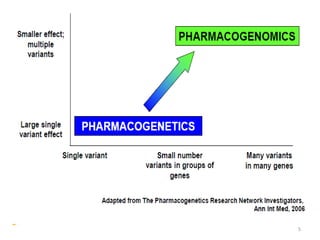
• Often used interchangeably with pharmacogenetics
• Pharmacogenetics denote the science about how
heritability affects the response to drugs.
• Pharmacogenomics is new science about how the
systematic identification of all the human genes,
their products, interindividual variation,
intraindividual variation in expression and function
over time affects drug response/metabolism etc.
3
Pharmacogenetics(omics)
• “Pharmacogenetics is the study of how genetic
variations affect the disposition of drugs, including
their metabolism and transport and their safety and
efficacy”
4
5
Some basic concepts.....
• Interracial variability in drug response and
metabolism
• Individual variability in drug response and
metabolism
• Variation in drug response and metabolism is due to
two main factors
1. Variation in number of recurring small sequences which
occur among the non-coding junk DNA called as VNTR’s
(Variable number tandem repeats)
2. SNP’s (Single nucleotide polymorphisms)
These variations can be understod by
a) Pharmacokinetic variability
b) Pharmacodynamic variability
6
PK varibility:
• It refers to variability in drug disposition
• As of know pharmacogenomics allows us to concentrate
on interracial and individual variability solely.
• But previously it was believed that changes in
metabolism was involved in PK variability
• Now various insights such as SNP’s led to think us that
SNP’s affect receptors resulting in altered drug efficacy
• Since SNP’s are ever incrasing ,it can be concluded that
1. Every individual handles drug differently
2. And optimisation of such therapy is done only by prior genetic
testing
3. This refers to PERSONALIZED MEDICINE
7
Example-several variants in single gene
• over 70 variants in the CYP2D6 gene have been described, some of
which lead to loss of function.
• Homozygotes, which comprise 7% of Caucasian and African-
American populations, are rendered so-called 'poor metabolizers'
• Such loss-of-function are very uncommon among Asian populations
• At the other end of the catalytic spectrum are individuals with
multiple functional copies of the gene, known as 'hyper-extensive
metabolizers', who constitute up to 20% of some African
populations.
• Drugs whose biotransformation to inactive metabolites is CYP2D6
dependent cause side effects more often among poor
metabolizers, and lack of efficacy among hyperextensive
metabolizers.
• This is one of the challenges in contemporary pharmacogenomic
analysis. 8
PD variability
• pharmacodynamic mechanisms could contribute a second important
component to variable drug actions
• pharmacodynamic variability can arise from two distinct mechanisms
1. Drug exerts a variable effect
Example :
a) the APOE GENOTYPE determines the extent of choline acetyltransferase expression, and has
been linked to the response to therapy with tacrine
b) A similar phenomenon is observed in patients who are exposed to drugs that prolong the QT
INTERVAL on a surface electrocardiogram (an effect that, if exaggerated, can lead to fatal cardiac
arrhythmias)
2. The second, more generic, form of pharmacodynamic variability is
the variability of the broader biological context
Example :-beta blockers have been shown to be especially beneficial in a
group of patients at high risk of heart failure who are homozygous for an intronic
deletion in the (ACE) gene (the DD genotype), which encodes a key enzyme in the
renin–angiotensin system50,51
, even though -blockers do not act directly on the ACE
gene
9
10
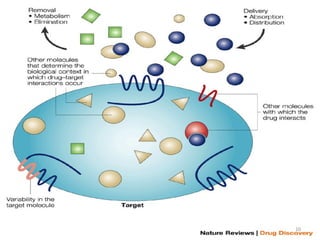
• Variability in drug action can also arise through the
pharmacodynamic mechanisms :
• first, the drug might interact with several other targets;
• second, there might be variability in the function or
expression level of the drug target;
• or third, other molecules might modulate the biological
context within which the drug–target interaction takes
place.
• DNA variants in elements that control each of these
processes can lead to variable drug actions
• More generally, each POLYMORPHISM that mediates
the development or severity of a human disease can be
viewed as a candidate for modulating the responses of
drugs that are used to treat that disease. 11
Goals of Pharmacogen(etics)omics
• Maximize drug efficacy
• Minimize drug toxicity
• Predict patients who will respond to
intervention
• Aid in new drug development
12
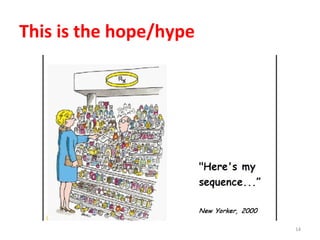
The Hope of Pharmacogenomics
• Individuals genetic makeup with allow
selective use of medications such that
– Efficacy maximized
– Side effect minimized
13
This is the hope/hype
14
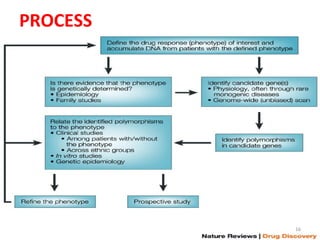
HOW STUDY IS DONE???
• The first step is to identify a phenotype of interest
• This is ordinarily a clinically important end point
— which can be a beneficial drug effect or a serious adverse effect
— that has considerable inter-individual variability with no 'obvious' cause
• When the phenotype is a variable physiological trait or expression of
disease, the next step is often to conduct epidemiological studies
• The second step is to accumulate patients (and their DNA) with the
defined phenotype, along with control subjects.
• The third step in the algorithm is to identify genes, or sets of genes
• Finally identifying the polymorphism in the candidate gene and refining
the phenotype
• The main advantage of such an approach is that genes or pathways that
are unidentified at present may be implicated in mediating drug
responses.
15
PROCESS
16
Challanges of
Pharmacogenetics in Oncology
TPMT
17
TPMT:
• Thiopurine-methyltransferase deficiency (TPMT)
predicts BONE MARROW APLASIA during exposure to 6-
mercaptopurine ,a treatment for childhood leukaemia.
• Although many variants that can cause this adverse drug
effect have been identified, they are rare
• In this instance, a clinically important but rare allelic
variant was identified
• There are considerable ethical issues involved in large-
scale attempts to characterize the genetic basis of
human physiology, pathology and response to drugs
• For instance, characterizing drug responses in defined
ethnic groups might carry with it a risk of stigmatization.18
HAPMAP PROJECT
19
• HapMap data provides a rich source of highly
differentiated SNPs for design of admixture panels
• The International HapMap Project was aimed to
develop a haplotype map(HapMap) of the human
genome, to describe the common patterns of human
genetic variation.
• used to find genetic variants affecting health, disease
and responses to drugs and environmental factors
• Haplotypes are generally shared between populations,
but their frequency can differ widely. Four populations
were selected for inclusion in the HapMap:
20
• 30 adult-and both parent, Nigeria (YRI),
• 30 trios of Utah residents of northern and western
European ancestry (CEU),
• 44 unrelated Japanese individuals from Tokyo, Japan
(JPT) and
• 45 unrelated Han Chinese individuals from Beijing,
China (CHB)
• To obtain enough SNPs to create the Map, they discover
millions of additional SNPs.
• By comparison, at the start of the project, fewer than 3
million SNPs were identified, and no more than 10% of
them were known to be polymorphic
21
CASE STUDIES
22
Tamoxifen use and
CYP2D6
23
Tamoxifen Metabolism
• Needs to be converted to endoxifen to be active
– catalysed by the polymorphic enzyme cytochrome P450
2D6 (CYP2D6)
– 6-10% European population deficient in this enzyme
– Efficacy of tamoxifen likely low in this population
• Suggests consider alterative treatments
24
Alcohol use and ALDH*2
25
Alcohol Metabolism
• Alcohol gets metabolised into acetaldehyde amd acetate
• When the concentration of acetaldehyde builds up in the body it leads to
serious adverse effects
• The enzyme Acetaldehyde dehydrogenase(ALDH*2) converts alcohol into
acetaldehyde
• But in some asian origins its seen that alcoholism leads to flushing
• When a detailed study was conducted it was found that humans have a
gene called ALDH*2 which codes specifically for enzyme ALDH*2
• The enzymatic polymorphisms of this enzyme are responsible for variable
effects of alcohol in different populations
• Also if patient is homozygous ,the enzyme will be non functional and leads
to serious effects
• If heterozygous then poor metabolism of alcohol followed by some
flushing response
26
Why is pharmacogenomics not widely
utilized in the clinic
• It requires a shift in clinician attitude and beliefs “not
one dose fits all”
• Paucity of studies demonstrating improved clinical
benefit from use of pharmacogenomic data
– Still much to be learned
• Even some of the black block warnings
currently on drug labels may be overcalls of
importance
• Genome wide interrogation will likely be important
to get the entire picture
27
APPLICATIONS
• Used in aproval and evaluation of various
drugs
• Drug interactions
• In estimations of labelling implications
• Personalized medicine
28
Conclusion
• Genetic variation contributes to inter-individual
differences in drug response phenotype at every
pharmacologic step
• Through individualized treatments, pharmacogenetics and
pharmacogenomics are expected to lead to:
• Better, safer drugs the first time
• More accurate methods of determining appropriate
drug dosages
• Pharmacogenomics offers unprecedented opportunities to
understand the genetic architecture of drug response
• HOWEVER IN MANY CASES NOT YET READY FOR PRIME
TIME!!!
29
REFERENCES
• Phillips, K. A., Veenstra, D. L., Oren, E., Lee, J. K. & Sadee, W. Potential role of
pharmacogenomics in reducing adverse drug reactions: a systematic review.
JAMA 286, 2270–2279 (2001).
• Motulsky, A. G., Harper, P. S., Bobrow, M. & Scriver, C. in Pharmacogenetics
1st edn (ed. Weber, W. W.) 1–20 (Oxford Univ. Press, New York, 1997).
• Evans, W. E. & Relling, M. V. Pharmacogenomics: translating functional
genomics into rational therapeutics. Science 286, 487–491 (1999).
• Roses, A. D. Pharmacogenetics and the practice of medicine. Nature 405, 857–
865 (2000).
• Meyer, U. A. Pharmacogenetics and adverse drug reactions. Lancet 356, 1667–
1671 (2000).
• Kim, R. B. et al. Identification of functionally variant MDR1 alleles among
European Americans and African Americans. Clin. Pharmacol. Ther. 70, 189–
199 (2001).
• Rigat, B. et al. An insertion/deletion polymorphism in the angiotensin I-
converting enzyme gene accounting for half the variance of serum enzyme
levels. J. Clin. Invest. 86, 1343–1346 (1990). 30
• Rigat, B. et al. An insertion/deletion polymorphism in the angiotensin I-
converting enzyme gene accounting for half the variance of serum
enzyme levels. J. Clin. Invest. 86, 1343–1346 (1990).
• Evans WE & Relling MV. Moving towards individualized medicine with
pharmacogenomics. Nature 2004; 429: 464−468
• Ingelman-Sundberg M. Pharmacogenetics: an opportunity for a safer and
more efficient pharmacotherapy. J Intern Med 2001; 250: 186−200
• Meyer UA. Pharmacogenetics and adverse drug reactions. Lancet 2000;
356: 1667−1671.
• Weinshilboum R. Inheritance and drug response. New Engl J Med 2003;
348: 529−537
• Barclay ML, Sawyers SM, Begg EJ, Zhang M, Roberts RL & Kennedy MA et
al. Correlation of CYP2D6 genotype with perhexiline phenotypic
metabolizer status. Pharmacogenetics 2003; 13: 627−632.
• Kawanishi C, Lundgren S, Agren H & Bertilsson L. Increased incidence of
CYP2D6 gene duplication in patients with persistent mood disorders:
ultrarapid metabolism of antidepressants as a cause of nonresponse. A
pilot study. Eur J Clin Pharmacol 2004; 59: 803−807
31
32

pharmacogenomics

  • 1.
    PHARMACOGENOMICS SHAHEEN BEGUM Roll No:1500-4P-1001 M.Pharm (Pharmacology) Univesity College of Pharmaceutical Sciences KAKATIYA UNIVERSITY, WARANGAL. 1
  • 2.
    Outline • Introduction anddefinitions • Basic concepts • Case studies • Applications • Conclusions 2
  • 3.
    INTRODUCTION: • Often usedinterchangeably with pharmacogenetics • Pharmacogenetics denote the science about how heritability affects the response to drugs. • Pharmacogenomics is new science about how the systematic identification of all the human genes, their products, interindividual variation, intraindividual variation in expression and function over time affects drug response/metabolism etc. 3
  • 4.
    Pharmacogenetics(omics) • “Pharmacogenetics isthe study of how genetic variations affect the disposition of drugs, including their metabolism and transport and their safety and efficacy” 4
  • 5.
  • 6.
    Some basic concepts..... •Interracial variability in drug response and metabolism • Individual variability in drug response and metabolism • Variation in drug response and metabolism is due to two main factors 1. Variation in number of recurring small sequences which occur among the non-coding junk DNA called as VNTR’s (Variable number tandem repeats) 2. SNP’s (Single nucleotide polymorphisms) These variations can be understod by a) Pharmacokinetic variability b) Pharmacodynamic variability 6
  • 7.
    PK varibility: • Itrefers to variability in drug disposition • As of know pharmacogenomics allows us to concentrate on interracial and individual variability solely. • But previously it was believed that changes in metabolism was involved in PK variability • Now various insights such as SNP’s led to think us that SNP’s affect receptors resulting in altered drug efficacy • Since SNP’s are ever incrasing ,it can be concluded that 1. Every individual handles drug differently 2. And optimisation of such therapy is done only by prior genetic testing 3. This refers to PERSONALIZED MEDICINE 7
  • 8.
    Example-several variants insingle gene • over 70 variants in the CYP2D6 gene have been described, some of which lead to loss of function. • Homozygotes, which comprise 7% of Caucasian and African- American populations, are rendered so-called 'poor metabolizers' • Such loss-of-function are very uncommon among Asian populations • At the other end of the catalytic spectrum are individuals with multiple functional copies of the gene, known as 'hyper-extensive metabolizers', who constitute up to 20% of some African populations. • Drugs whose biotransformation to inactive metabolites is CYP2D6 dependent cause side effects more often among poor metabolizers, and lack of efficacy among hyperextensive metabolizers. • This is one of the challenges in contemporary pharmacogenomic analysis. 8
  • 9.
    PD variability • pharmacodynamicmechanisms could contribute a second important component to variable drug actions • pharmacodynamic variability can arise from two distinct mechanisms 1. Drug exerts a variable effect Example : a) the APOE GENOTYPE determines the extent of choline acetyltransferase expression, and has been linked to the response to therapy with tacrine b) A similar phenomenon is observed in patients who are exposed to drugs that prolong the QT INTERVAL on a surface electrocardiogram (an effect that, if exaggerated, can lead to fatal cardiac arrhythmias) 2. The second, more generic, form of pharmacodynamic variability is the variability of the broader biological context Example :-beta blockers have been shown to be especially beneficial in a group of patients at high risk of heart failure who are homozygous for an intronic deletion in the (ACE) gene (the DD genotype), which encodes a key enzyme in the renin–angiotensin system50,51 , even though -blockers do not act directly on the ACE gene 9
  • 10.
  • 11.
    • Variability indrug action can also arise through the pharmacodynamic mechanisms : • first, the drug might interact with several other targets; • second, there might be variability in the function or expression level of the drug target; • or third, other molecules might modulate the biological context within which the drug–target interaction takes place. • DNA variants in elements that control each of these processes can lead to variable drug actions • More generally, each POLYMORPHISM that mediates the development or severity of a human disease can be viewed as a candidate for modulating the responses of drugs that are used to treat that disease. 11
  • 12.
    Goals of Pharmacogen(etics)omics •Maximize drug efficacy • Minimize drug toxicity • Predict patients who will respond to intervention • Aid in new drug development 12
  • 13.
    The Hope ofPharmacogenomics • Individuals genetic makeup with allow selective use of medications such that – Efficacy maximized – Side effect minimized 13
  • 14.
    This is thehope/hype 14
  • 15.
    HOW STUDY ISDONE??? • The first step is to identify a phenotype of interest • This is ordinarily a clinically important end point — which can be a beneficial drug effect or a serious adverse effect — that has considerable inter-individual variability with no 'obvious' cause • When the phenotype is a variable physiological trait or expression of disease, the next step is often to conduct epidemiological studies • The second step is to accumulate patients (and their DNA) with the defined phenotype, along with control subjects. • The third step in the algorithm is to identify genes, or sets of genes • Finally identifying the polymorphism in the candidate gene and refining the phenotype • The main advantage of such an approach is that genes or pathways that are unidentified at present may be implicated in mediating drug responses. 15
  • 16.
  • 17.
  • 18.
    TPMT: • Thiopurine-methyltransferase deficiency(TPMT) predicts BONE MARROW APLASIA during exposure to 6- mercaptopurine ,a treatment for childhood leukaemia. • Although many variants that can cause this adverse drug effect have been identified, they are rare • In this instance, a clinically important but rare allelic variant was identified • There are considerable ethical issues involved in large- scale attempts to characterize the genetic basis of human physiology, pathology and response to drugs • For instance, characterizing drug responses in defined ethnic groups might carry with it a risk of stigmatization.18
  • 19.
  • 20.
    • HapMap dataprovides a rich source of highly differentiated SNPs for design of admixture panels • The International HapMap Project was aimed to develop a haplotype map(HapMap) of the human genome, to describe the common patterns of human genetic variation. • used to find genetic variants affecting health, disease and responses to drugs and environmental factors • Haplotypes are generally shared between populations, but their frequency can differ widely. Four populations were selected for inclusion in the HapMap: 20
  • 21.
    • 30 adult-andboth parent, Nigeria (YRI), • 30 trios of Utah residents of northern and western European ancestry (CEU), • 44 unrelated Japanese individuals from Tokyo, Japan (JPT) and • 45 unrelated Han Chinese individuals from Beijing, China (CHB) • To obtain enough SNPs to create the Map, they discover millions of additional SNPs. • By comparison, at the start of the project, fewer than 3 million SNPs were identified, and no more than 10% of them were known to be polymorphic 21
  • 22.
  • 23.
  • 24.
    Tamoxifen Metabolism • Needsto be converted to endoxifen to be active – catalysed by the polymorphic enzyme cytochrome P450 2D6 (CYP2D6) – 6-10% European population deficient in this enzyme – Efficacy of tamoxifen likely low in this population • Suggests consider alterative treatments 24
  • 25.
    Alcohol use andALDH*2 25
  • 26.
    Alcohol Metabolism • Alcoholgets metabolised into acetaldehyde amd acetate • When the concentration of acetaldehyde builds up in the body it leads to serious adverse effects • The enzyme Acetaldehyde dehydrogenase(ALDH*2) converts alcohol into acetaldehyde • But in some asian origins its seen that alcoholism leads to flushing • When a detailed study was conducted it was found that humans have a gene called ALDH*2 which codes specifically for enzyme ALDH*2 • The enzymatic polymorphisms of this enzyme are responsible for variable effects of alcohol in different populations • Also if patient is homozygous ,the enzyme will be non functional and leads to serious effects • If heterozygous then poor metabolism of alcohol followed by some flushing response 26
  • 27.
    Why is pharmacogenomicsnot widely utilized in the clinic • It requires a shift in clinician attitude and beliefs “not one dose fits all” • Paucity of studies demonstrating improved clinical benefit from use of pharmacogenomic data – Still much to be learned • Even some of the black block warnings currently on drug labels may be overcalls of importance • Genome wide interrogation will likely be important to get the entire picture 27
  • 28.
    APPLICATIONS • Used inaproval and evaluation of various drugs • Drug interactions • In estimations of labelling implications • Personalized medicine 28
  • 29.
    Conclusion • Genetic variationcontributes to inter-individual differences in drug response phenotype at every pharmacologic step • Through individualized treatments, pharmacogenetics and pharmacogenomics are expected to lead to: • Better, safer drugs the first time • More accurate methods of determining appropriate drug dosages • Pharmacogenomics offers unprecedented opportunities to understand the genetic architecture of drug response • HOWEVER IN MANY CASES NOT YET READY FOR PRIME TIME!!! 29
  • 30.
    REFERENCES • Phillips, K.A., Veenstra, D. L., Oren, E., Lee, J. K. & Sadee, W. Potential role of pharmacogenomics in reducing adverse drug reactions: a systematic review. JAMA 286, 2270–2279 (2001). • Motulsky, A. G., Harper, P. S., Bobrow, M. & Scriver, C. in Pharmacogenetics 1st edn (ed. Weber, W. W.) 1–20 (Oxford Univ. Press, New York, 1997). • Evans, W. E. & Relling, M. V. Pharmacogenomics: translating functional genomics into rational therapeutics. Science 286, 487–491 (1999). • Roses, A. D. Pharmacogenetics and the practice of medicine. Nature 405, 857– 865 (2000). • Meyer, U. A. Pharmacogenetics and adverse drug reactions. Lancet 356, 1667– 1671 (2000). • Kim, R. B. et al. Identification of functionally variant MDR1 alleles among European Americans and African Americans. Clin. Pharmacol. Ther. 70, 189– 199 (2001). • Rigat, B. et al. An insertion/deletion polymorphism in the angiotensin I- converting enzyme gene accounting for half the variance of serum enzyme levels. J. Clin. Invest. 86, 1343–1346 (1990). 30
  • 31.
    • Rigat, B.et al. An insertion/deletion polymorphism in the angiotensin I- converting enzyme gene accounting for half the variance of serum enzyme levels. J. Clin. Invest. 86, 1343–1346 (1990). • Evans WE & Relling MV. Moving towards individualized medicine with pharmacogenomics. Nature 2004; 429: 464−468 • Ingelman-Sundberg M. Pharmacogenetics: an opportunity for a safer and more efficient pharmacotherapy. J Intern Med 2001; 250: 186−200 • Meyer UA. Pharmacogenetics and adverse drug reactions. Lancet 2000; 356: 1667−1671. • Weinshilboum R. Inheritance and drug response. New Engl J Med 2003; 348: 529−537 • Barclay ML, Sawyers SM, Begg EJ, Zhang M, Roberts RL & Kennedy MA et al. Correlation of CYP2D6 genotype with perhexiline phenotypic metabolizer status. Pharmacogenetics 2003; 13: 627−632. • Kawanishi C, Lundgren S, Agren H & Bertilsson L. Increased incidence of CYP2D6 gene duplication in patients with persistent mood disorders: ultrarapid metabolism of antidepressants as a cause of nonresponse. A pilot study. Eur J Clin Pharmacol 2004; 59: 803−807 31
  • 32.