
1
A Seminar on
PHARMACOGENOMICS
Presented by
Mr. Madhan Mohan Elsani
M.Pharm., (Ph.D)
Asso. Professor
Departmenof Pharmacology
SCHOOL OF PHARMACY, NNRGI.
HYDERABAD, TELANGANA, INDIA.
2
What is Pharmacogenomics?
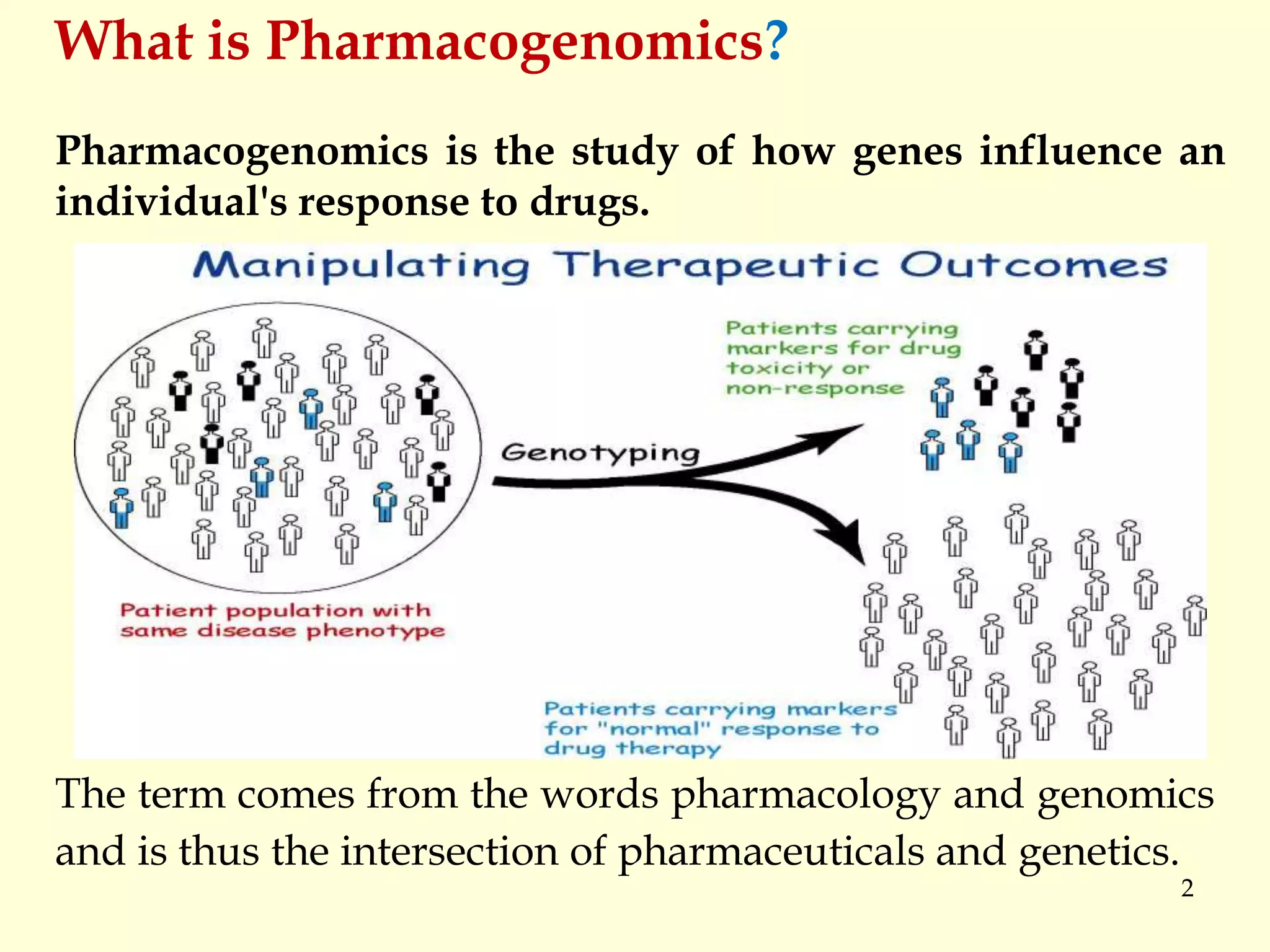
Pharmacogenomics is the study of how genes influence an
individual's response to drugs.
The term comes from the words pharmacology and genomics
and is thus the intersection of pharmaceuticals and genetics.
3
This information becomes even more crucial when you consider the fact
that Adverse reactions to prescription drugs are killing about 106,000
Americans each year – roughly three times as many as are killed by
automobiles.
This makes
PRESCRIPTION DRUGS THE FOURTH LEADING KILLER after
HEART DISEASE, CANCER and STROKE.
4
Examples:
Patients with different genetic variations may require
different amounts of a drug to achieve the same effect
(e.g. cytochrome p450s, ).
Drugs may be toxic in patients of one genotype and
helpful to patients of another
5
Understanding the basics to fully appreciate the scope of
pharmacogenomics, one must understand the basic principles of
genetic inheritance and
gene expression.
6
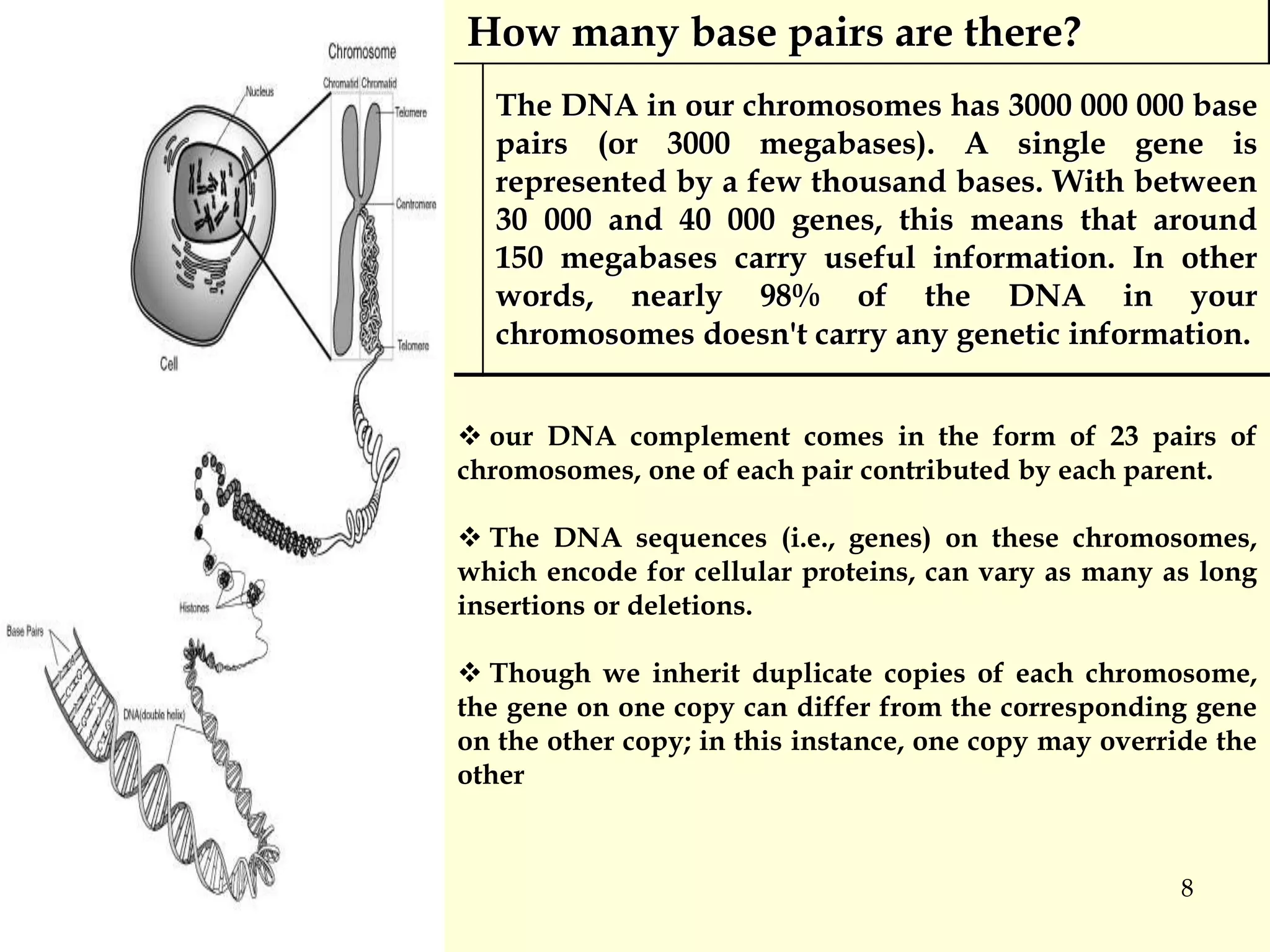
Cells
Cells are the basic building blocks of all living things. The bulk of a human cell
is made from cytoplasm and in the centre is the nucleus.
7
Inside the nucleus of nearly all types of cell are chromosomes.
The nucleus of a human cell contains 23 pairs of
chromosomes.
The chromosomes contain the genes that carry the
information that determines a person's characteristics. Each
chromosome consists of one piece of DNA about 4 cm long.
This is a coiled, double stranded molecule.
COILS OF COILS:
A chromosome is about 0.004 mm long and contains a single
piece of DNA that is about 4 cm long. This is about 10 000
times longer than the chromosome. So it has to twist and coil
to fit inside.
There are four bases:
a. adenine (A)
b. thymine (T)
c. cytosine (C)
d. guanine (G)
Each base pairs with its complementary base:
•A pairs with T
•G pairs with C
8
How many base pairs are there?
The DNA in our chromosomes has 3000 000 000 base
pairs (or 3000 megabases). A single gene is
represented by a few thousand bases. With between
30 000 and 40 000 genes, this means that around
150 megabases carry useful information. In other
words, nearly 98% of the DNA in your
chromosomes doesn't carry any genetic information.
 our DNA complement comes in the form of 23 pairs of
chromosomes, one of each pair contributed by each parent.
 The DNA sequences (i.e., genes) on these chromosomes,
which encode for cellular proteins, can vary as many as long
insertions or deletions.
 Though we inherit duplicate copies of each chromosome,
the gene on one copy can differ from the corresponding gene
on the other copy; in this instance, one copy may override the
other
9
WHAT MAKES THE
DIFFERENCE IN
DRUG RESPONSE ?
10
Single Nucleotide Polymorphisms (SNPs) are associated with
sensitivities or resistances to chemical compounds.
A Single Nucleotide Polymorphism, or SNP (pronounced "snip"), is a small
genetic change, or variation, that can occur within a person's DNA sequence.
The genetic code is specified by the four nucleotide "letters" A (adenine), C
(cytosine), T (thymine), and G (guanine).
SNP variation occurs when a single nucleotide, such as an A, replaces one of
the other three nucleotide letters—C, G, or T.
SNPs occur in human DNA at a frequency of 1 per 1000 bases as there are
about 10 million SNPs in the human genome.
11
USES
Scientists are now rushing to not only identify common SNPs, but to
determine what drug effects can be correlated to them.
Scientists believe SNP maps will help them identify the multiple genes
associated with such complex diseases as
Cancer,
Diabetes,
Vascular disease, and
Some forms of mental illness.
12
What is the technology behind finding
out the SNP pattern?
13
Micro arrays are a new way of studying how large numbers of genes
interact with each other and how a cell's regulatory networks control
vast batteries of genes simultaneously.
Forefront Technology : Pharmacogenomics relies on
High-throughput genetic analysis.
14
1.More Powerful Medicines
Pharmaceutical companies will be able to create drugs based on the
proteins,
enzymes, and
RNA molecules
associated with genes and diseases.
This will facilitate drug discovery and allow drug makers to produce
a therapy more targeted to specific diseases. This accuracy not only
will maximize therapeutic effects but also decrease damage to nearby
healthy cells.
.
15
2 .Better, Safer Drugs the First Time
Instead of the standard trial-and-error method of matching patients with
the right drugs, doctors will be able to analyze a patient's genetic profile
and prescribe the best available drug therapy from the beginning.
Not only will this take the guesswork out of finding the right drug, it
will speed recovery time and increase safety as the likelihood of adverse
reactions is eliminated.
Pharmacogenomics has the potential to dramatically reduce the estimated
100,000 deaths and 2 million hospitalizations that occur each year in the
United States as the result of adverse drug response .
16
3. More Accurate Methods of Determining
Appropriate Drug Dosages
Current methods of basing dosages on weight and age will be
replaced with dosages based on a person's genetics -- how well
the body processes the medicine and the time it takes to
metabolize it. This will maximize the therapy's value and
decrease the likelihood of overdose.
17
4. Advanced Screening for Disease
Knowing one's genetic code will allow a person to make adequate
lifestyle and environmental changes at an early age so as to avoid
or lessen the severity of a genetic disease. Likewise, advance
knowledge of a particular disease susceptibility will allow careful
monitoring, and treatments can be introduced at the most
appropriate stage to maximize their therapy.
18
5. Better Vaccines
Vaccines made of genetic material, either DNA or RNA, promise
all the benefits of existing vaccines without all the risks.
They will activate the immune system but will be unable to
cause infections. They will be inexpensive, stable, easy to store,
and capable of being engineered to carry several strains of a
pathogen at once.
19
1. Pharmacogenomics, in particular, offers enormous potential for
clinical benefits to patients
2. The arguments in favor include:
In the U.S. alone, adverse drug reactions are thought to KILL about
100,000 hospitalized patients annually. Another 2.2 million incur
serious, but non-fatal, reactions.
3. At present, physicians, generally have no way of knowing in advance
whether the drug they prescribe will or will not cause an adverse
effect in their patients. This situation is further compounded by the
fact that most adverse drug reactions result from the fact that
medicines are "a one-size-fits-all."
20
OPPORTUNITY FOR THE PHARMACIST
 The wealth of information derived from these genetic evaluations
represents a fantastic opportunity for pharmacists in all practice settings to
contribute significantly to the clinical decision-making process.
 As physicians already have too little time to evaluate medications
comparatively, pharmacists will increasingly be called upon to recommend
appropriate therapy in light of these diagnostic advances.
 Pharmacists should embrace this opportunity by becoming educated on the
spectrum of medication effects, and potential interactions, which are likely
influenced by certain genetic traits.
21
T-H=A-N=K-S.
22
REFERENCES
• AN INTRODUCTION TO GENETIC ENGINEERING BY
DESMOND S.T. NICHOLL
www.oupjournals.org
www.codelinkbioarrays.com
www.universalprobelibrary.com
www.annualreviews.org
www.nature.com
www.bioline.org
www.indmed.nic.in
www.icme.org
www.journalsonweb.com
www.liebertonline.com
www.pharmpress.com
www.pharmgkb.com
www.biooncology.com
www.schoolscience.com
www.roche-diagnostics.com
www.medilexicon.com
www.medicalnewstoday.com
www.patienthealthinternational.com

Pharmacogenomics

  • 1.
    1 A Seminar on PHARMACOGENOMICS Presentedby Mr. Madhan Mohan Elsani M.Pharm., (Ph.D) Asso. Professor Departmenof Pharmacology SCHOOL OF PHARMACY, NNRGI. HYDERABAD, TELANGANA, INDIA.
  • 2.
    2 What is Pharmacogenomics? Pharmacogenomicsis the study of how genes influence an individual's response to drugs. The term comes from the words pharmacology and genomics and is thus the intersection of pharmaceuticals and genetics.
  • 3.
    3 This information becomeseven more crucial when you consider the fact that Adverse reactions to prescription drugs are killing about 106,000 Americans each year – roughly three times as many as are killed by automobiles. This makes PRESCRIPTION DRUGS THE FOURTH LEADING KILLER after HEART DISEASE, CANCER and STROKE.
  • 4.
    4 Examples: Patients with differentgenetic variations may require different amounts of a drug to achieve the same effect (e.g. cytochrome p450s, ). Drugs may be toxic in patients of one genotype and helpful to patients of another
  • 5.
    5 Understanding the basicsto fully appreciate the scope of pharmacogenomics, one must understand the basic principles of genetic inheritance and gene expression.
  • 6.
    6 Cells Cells are thebasic building blocks of all living things. The bulk of a human cell is made from cytoplasm and in the centre is the nucleus.
  • 7.
    7 Inside the nucleusof nearly all types of cell are chromosomes. The nucleus of a human cell contains 23 pairs of chromosomes. The chromosomes contain the genes that carry the information that determines a person's characteristics. Each chromosome consists of one piece of DNA about 4 cm long. This is a coiled, double stranded molecule. COILS OF COILS: A chromosome is about 0.004 mm long and contains a single piece of DNA that is about 4 cm long. This is about 10 000 times longer than the chromosome. So it has to twist and coil to fit inside. There are four bases: a. adenine (A) b. thymine (T) c. cytosine (C) d. guanine (G) Each base pairs with its complementary base: •A pairs with T •G pairs with C
  • 8.
    8 How many basepairs are there? The DNA in our chromosomes has 3000 000 000 base pairs (or 3000 megabases). A single gene is represented by a few thousand bases. With between 30 000 and 40 000 genes, this means that around 150 megabases carry useful information. In other words, nearly 98% of the DNA in your chromosomes doesn't carry any genetic information.  our DNA complement comes in the form of 23 pairs of chromosomes, one of each pair contributed by each parent.  The DNA sequences (i.e., genes) on these chromosomes, which encode for cellular proteins, can vary as many as long insertions or deletions.  Though we inherit duplicate copies of each chromosome, the gene on one copy can differ from the corresponding gene on the other copy; in this instance, one copy may override the other
  • 9.
    9 WHAT MAKES THE DIFFERENCEIN DRUG RESPONSE ?
  • 10.
    10 Single Nucleotide Polymorphisms(SNPs) are associated with sensitivities or resistances to chemical compounds. A Single Nucleotide Polymorphism, or SNP (pronounced "snip"), is a small genetic change, or variation, that can occur within a person's DNA sequence. The genetic code is specified by the four nucleotide "letters" A (adenine), C (cytosine), T (thymine), and G (guanine). SNP variation occurs when a single nucleotide, such as an A, replaces one of the other three nucleotide letters—C, G, or T. SNPs occur in human DNA at a frequency of 1 per 1000 bases as there are about 10 million SNPs in the human genome.
  • 11.
    11 USES Scientists are nowrushing to not only identify common SNPs, but to determine what drug effects can be correlated to them. Scientists believe SNP maps will help them identify the multiple genes associated with such complex diseases as Cancer, Diabetes, Vascular disease, and Some forms of mental illness.
  • 12.
    12 What is thetechnology behind finding out the SNP pattern?
  • 13.
    13 Micro arrays area new way of studying how large numbers of genes interact with each other and how a cell's regulatory networks control vast batteries of genes simultaneously. Forefront Technology : Pharmacogenomics relies on High-throughput genetic analysis.
  • 14.
    14 1.More Powerful Medicines Pharmaceuticalcompanies will be able to create drugs based on the proteins, enzymes, and RNA molecules associated with genes and diseases. This will facilitate drug discovery and allow drug makers to produce a therapy more targeted to specific diseases. This accuracy not only will maximize therapeutic effects but also decrease damage to nearby healthy cells. .
  • 15.
    15 2 .Better, SaferDrugs the First Time Instead of the standard trial-and-error method of matching patients with the right drugs, doctors will be able to analyze a patient's genetic profile and prescribe the best available drug therapy from the beginning. Not only will this take the guesswork out of finding the right drug, it will speed recovery time and increase safety as the likelihood of adverse reactions is eliminated. Pharmacogenomics has the potential to dramatically reduce the estimated 100,000 deaths and 2 million hospitalizations that occur each year in the United States as the result of adverse drug response .
  • 16.
    16 3. More AccurateMethods of Determining Appropriate Drug Dosages Current methods of basing dosages on weight and age will be replaced with dosages based on a person's genetics -- how well the body processes the medicine and the time it takes to metabolize it. This will maximize the therapy's value and decrease the likelihood of overdose.
  • 17.
    17 4. Advanced Screeningfor Disease Knowing one's genetic code will allow a person to make adequate lifestyle and environmental changes at an early age so as to avoid or lessen the severity of a genetic disease. Likewise, advance knowledge of a particular disease susceptibility will allow careful monitoring, and treatments can be introduced at the most appropriate stage to maximize their therapy.
  • 18.
    18 5. Better Vaccines Vaccinesmade of genetic material, either DNA or RNA, promise all the benefits of existing vaccines without all the risks. They will activate the immune system but will be unable to cause infections. They will be inexpensive, stable, easy to store, and capable of being engineered to carry several strains of a pathogen at once.
  • 19.
    19 1. Pharmacogenomics, inparticular, offers enormous potential for clinical benefits to patients 2. The arguments in favor include: In the U.S. alone, adverse drug reactions are thought to KILL about 100,000 hospitalized patients annually. Another 2.2 million incur serious, but non-fatal, reactions. 3. At present, physicians, generally have no way of knowing in advance whether the drug they prescribe will or will not cause an adverse effect in their patients. This situation is further compounded by the fact that most adverse drug reactions result from the fact that medicines are "a one-size-fits-all."
  • 20.
    20 OPPORTUNITY FOR THEPHARMACIST  The wealth of information derived from these genetic evaluations represents a fantastic opportunity for pharmacists in all practice settings to contribute significantly to the clinical decision-making process.  As physicians already have too little time to evaluate medications comparatively, pharmacists will increasingly be called upon to recommend appropriate therapy in light of these diagnostic advances.  Pharmacists should embrace this opportunity by becoming educated on the spectrum of medication effects, and potential interactions, which are likely influenced by certain genetic traits.
  • 21.
  • 22.
    22 REFERENCES • AN INTRODUCTIONTO GENETIC ENGINEERING BY DESMOND S.T. NICHOLL www.oupjournals.org www.codelinkbioarrays.com www.universalprobelibrary.com www.annualreviews.org www.nature.com www.bioline.org www.indmed.nic.in www.icme.org www.journalsonweb.com www.liebertonline.com www.pharmpress.com www.pharmgkb.com www.biooncology.com www.schoolscience.com www.roche-diagnostics.com www.medilexicon.com www.medicalnewstoday.com www.patienthealthinternational.com