DRUG ELIMINATION
Prepared By
Girijesh Kumar Pandey
M.Pharm. (Pharmaceutics)
Contents
• Elimination: Introduction
• Elimination Kinetics
• Drug metabolism and metabolic pathways
• Renal Excretion of drugs,
• Factors affecting renal excretion of drugs,
• Renal clearance,
• Non renal routes of drug excretion
Elimination: Introduction
• Elimination is the major process for removal of
a drug from the body and termination of its
action
• Irreversible loss of drug from the body.
• Duration and intensity of action depend upon
elimination and tissue re-distribution of drug.
• Eliminjation occurs by two processes:
– Biotramsformation (Metabolism) and
– Excretion
Elimination Kinetics
• Definition Zero-order elimination kinetics
: "Elimination of a constant quantity per time
unit of the drug quantity present in the
organism."
• Definition First order elimination kinetics
: "Elimination of a constant fraction per time
unit of the drug quantity present in the
organism. The elimination is proportional to
the drug concentration.”
Elimination Kinetics
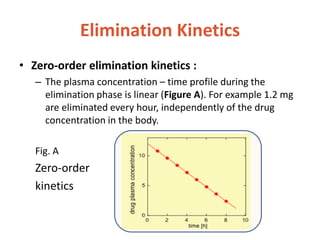
• Zero-order elimination kinetics :
– The plasma concentration – time profile during the
elimination phase is linear (Figure A). For example 1.2 mg
are eliminated every hour, independently of the drug
concentration in the body.
Fig. A
Zero-order
kinetics
Elimination Kinetics
– Order 0 elimination is rather rare, mostly occurring
when the elimination system is saturated. An example
is the elimination of Ethanol.
• First-order elimination kinetics :
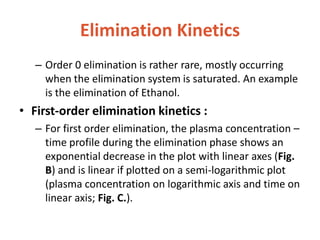
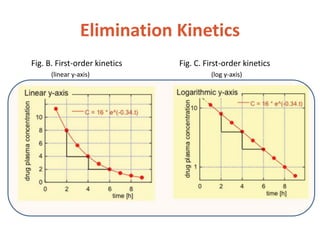
– For first order elimination, the plasma concentration –
time profile during the elimination phase shows an
exponential decrease in the plot with linear axes (Fig.
B) and is linear if plotted on a semi-logarithmic plot
(plasma concentration on logarithmic axis and time on
linear axis; Fig. C.).
Elimination Kinetics
Fig. B. First-order kinetics Fig. C. First-order kinetics
(linear y-axis) (log y-axis)
Elimination Kinetics
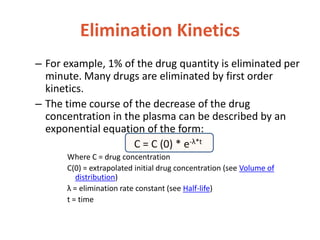
– For example, 1% of the drug quantity is eliminated per
minute. Many drugs are eliminated by first order
kinetics.
– The time course of the decrease of the drug
concentration in the plasma can be described by an
exponential equation of the form:
C = C (0) * e-Îť*t
Where C = drug concentration
C(0) = extrapolated initial drug concentration (see Volume of
distribution)
Îť = elimination rate constant (see Half-life)
t = time
Elimination Kinetics
• The elimination rate constant λ can be
calculated by fitting the data points during the
elimination phase to a single exponential;
yielding in this example a Îť of 0.34 h-1.
• An alternative method (see Fig. C.) consists in
plotting the logarithm of the drug plasma
concentration as a function of time, which will
yield a straight line. The steepness of this line
equals –λ.
Drug metabolism and metabolic
pathways
• Biotransformation (Metabolism): Chemical
alteration of the drug in body that converts
nonpolar or lipid soluble compounds to polar
or lipid insoluble compounds
• Consequences of biotransformation:
– Active drug Inactive metabolite :
– e.g. Pentobarbitone, Morphine, Chloramphenicol
– Active drug Active metabolite:
– e.g. Phenacetin
– Inactive drug Active metabolite:
– e.g. Levodopa
Drug metabolism and metabolic
pathways
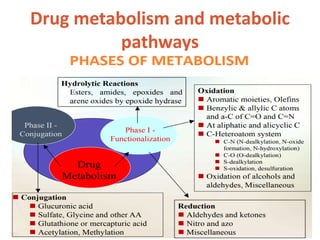
• Phases of Metabolism:
– Phase I
• Functionalization reactions
• Converts the parent drug to a more polar metabolite by
introducing or unmasking a functional group (-OH, -NH2, -
SH).
– Phase II
• Conjugation reactions
• Subsequent reaction in which a covalent linkage is formed
between a functional group on the parent compound or
Phase I metabolite and an endogenous substrate such as
glucuronic acid, sulfate, acetate, or an amino acid
Drug metabolism and metabolic
pathways
Drug metabolism and metabolic
pathways
• Hofmann elimination (Hofmann Degradation)
• Inactivation of the drug in the body fluids by
spontaneous molecular re arrangement
without the agency of any enzyme e.g.
Atracurium.
• This elimination reaction of alkyl trimethyl
amines proceeds with anti-stereochemistry,
and is generally suitable for producing alkenes
with one or two substituents. The reaction
follows the Hofmann Rule.
Drug metabolism and metabolic
pathways
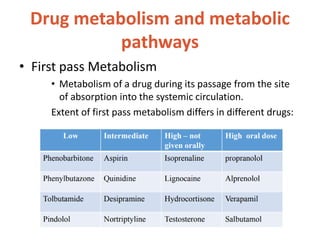
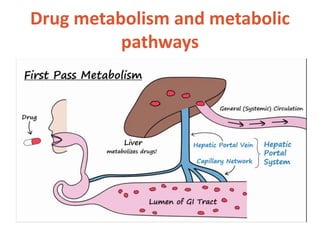
• First pass Metabolism
• Metabolism of a drug during its passage from the site
of absorption into the systemic circulation.
Extent of first pass metabolism differs in different drugs:
Drug metabolism and metabolic
pathways
Drug metabolism and metabolic
pathways
• Attributes of drugs with high first pass
metabolism:
– Oral dose is considerably higher then sublingual or
parenteral dose
– Marked individual variation in the oral dose due to
differences in the extent of first pass metabolism
– Oral bioavailability is apparently increased in patients
with severe liver disease
– Oral bioavailability of a drug is increased if another
drug competing with it. E.G. Chloropromazine and
Propranolol
Drug metabolism and metabolic
pathways
• Inhibition of Metabolism:
– Competitively inhibit the metabolism of another drug
if it utilizes the same enzyme or co factors.
– A drug may inhibit one isoenzyme while being itself a
substrate of another isoenzyme e.g. quinidine is
metabolized by CYP3A4 but inhibits CYP2D6
– Inhibition of drug metabolism occurs in a dose related
manner and can precipitate toxicity of the object drug.
– Blood flow limited metabolism e.g. Propranolol
reduces rate of lignocaine metabolism by decreasing
hepatic blood flow.
Renal Excretion of drugs
• Definition : "Irreversible transfer of drug or
drug metabolites from the plasma into the
urine.“
• Drug or drug metabolites must be
hydrosoluble to be excreted in the urine.
Factors that influence renal excretion include
plasma drug concentration, plasma protein
binding and renal function.
Renal Excretion of drugs
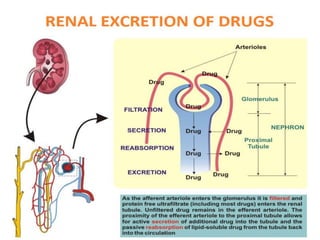
• Drugs are transferred from the plasma into the
urine by:
– Glomerular filtration: Unbound drug molecules of less
than 20'000 Da are filtered through the glomerulus
with the primary urine.
– Active tubular secretion: This mechanism is
predominant in the proximal tubule. Several
transportors are responsible for the tubular secretion
of drugs:
• the P-glycoproteins (PGps), the multidrug resistance-
associated proteins (MRPs), the organic anion transportors
(OATs), the oragnic cation transportors (OCTs), etc.
• These transporters are not highly specific and may become
saturated at high drug concentrations.
Renal Excretion of drugs
• Drugs may be reabsorbed from the tubular lumen
by passive diffusion. The extent of reabsorption
depends on the lipophilic properties of the drug,
on urine flow, urine pH and chelating agents.
Concentrated urine favors reabsorption.
• Depending on the urine pH, a weak acid or base
can be more or less ionised in the urine and
therefore for more or less reabsorbed (urine ion
trapping). Active reabsorption occurs mainly for
endogenous products such as vitamins, glucose
and amino acids and similar substances.
Renal Excretion of drugs
• Clinical implications
• Changes in renal function affect filtration, secretion
and tubular reabsorption. Impairment of renal
function, due to disease, leads to decrease in renal
drug clearance.
• In such situations the dosage regimen must be
adapted, specially for drugs with a low extrarenal
fraction (Qo). Reduced clearance can also result from
competition between drugs or endogenous substances
for the tubular secretion transporter sites (renal drug
interactions).
• Following intoxication, forced diuresis and urine pH
control can be useful to increase the renal excretion of
certain drugs and toxics.
Factors affecting renal excretion of
drugs
• 1. Physiochemical properties of drug
• 2. Plasma concentration of drug
• 3. Distribution and binding characteristics of drug
• 4. Urine pH
• 5. Blood flow to the kidney
• 6. Biological factors
• 7. Drug interactions
• 8. Disease state
Renal clearance
• Clearance is defined as “the hypothetical volume
of body fluids containing drug from which the
drug is removed or cleared completely in a
specific period of time”.
Clearance (Cl) = Elimination rate / Plasma drug concentration
• It is expressed in ml/min.
• Applied to all organs involved in drug elimination
and referred to as renal clearance, hepatic
clearance, pulmonary clearance, biliary clearance
and so on.
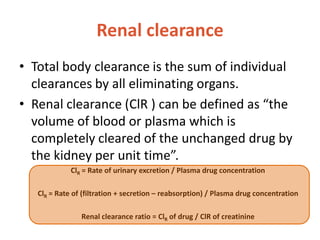
Renal clearance
• Total body clearance is the sum of individual
clearances by all eliminating organs.
• Renal clearance (ClR ) can be defined as “the
volume of blood or plasma which is
completely cleared of the unchanged drug by
the kidney per unit time”.
ClR = Rate of urinary excretion / Plasma drug concentration
ClR = Rate of (filtration + secretion – reabsorption) / Plasma drug concentration
Renal clearance ratio = ClR of drug / ClR of creatinine
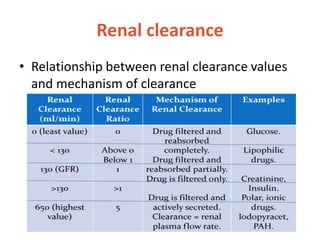
Renal clearance
• Relationship between renal clearance values
and mechanism of clearance
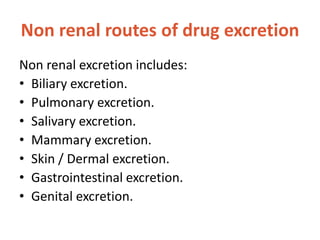
Non renal routes of drug excretion
Non renal excretion includes:
• Biliary excretion.
• Pulmonary excretion.
• Salivary excretion.
• Mammary excretion.
• Skin / Dermal excretion.
• Gastrointestinal excretion.
• Genital excretion.
References
• Biopharmaceutics and Pharmacokinetics - A treatise 2nd Edition by D. M.
Brahmankar and Sunil B. Jaiswal, Vallabh Prakashan, New Delhi.
• R. Urso, P. Blardi, G. Giorgi, A short introduction to pharmacokinetics,
Europ. Rev. for Med. and Pharmacol. Scs, 2002; 6: 33-44
• https://www.mc.vanderbilt.edu/diabetes/msshortcourse/presentations/7
242012_Daniels.pdf
• https://sepia.unil.ch/pharmacology/index.php?id=94
• https://www.slideshare.net/swaroophassan/drug-metabolism-40740005
• https://sepia.unil.ch/pharmacology/index.php?id=58
• https://www.organic-chemistry.org/namedreactions /hofmann-
elimination.shtm
• https://www.slideshare.net/Vijaykumar1919/excretionofdrug-vk
• https://www.slideshare.net/chiranjibi68/concept-of-clearance-factors-
affecting-renal-excretion

Drug Elimination

  • 1.
    DRUG ELIMINATION Prepared By GirijeshKumar Pandey M.Pharm. (Pharmaceutics)
  • 2.
    Contents • Elimination: Introduction •Elimination Kinetics • Drug metabolism and metabolic pathways • Renal Excretion of drugs, • Factors affecting renal excretion of drugs, • Renal clearance, • Non renal routes of drug excretion
  • 3.
    Elimination: Introduction • Eliminationis the major process for removal of a drug from the body and termination of its action • Irreversible loss of drug from the body. • Duration and intensity of action depend upon elimination and tissue re-distribution of drug. • Eliminjation occurs by two processes: – Biotramsformation (Metabolism) and – Excretion
  • 4.
    Elimination Kinetics • DefinitionZero-order elimination kinetics : "Elimination of a constant quantity per time unit of the drug quantity present in the organism." • Definition First order elimination kinetics : "Elimination of a constant fraction per time unit of the drug quantity present in the organism. The elimination is proportional to the drug concentration.”
  • 5.
    Elimination Kinetics • Zero-orderelimination kinetics : – The plasma concentration – time profile during the elimination phase is linear (Figure A). For example 1.2 mg are eliminated every hour, independently of the drug concentration in the body. Fig. A Zero-order kinetics
  • 6.
    Elimination Kinetics – Order0 elimination is rather rare, mostly occurring when the elimination system is saturated. An example is the elimination of Ethanol. • First-order elimination kinetics : – For first order elimination, the plasma concentration – time profile during the elimination phase shows an exponential decrease in the plot with linear axes (Fig. B) and is linear if plotted on a semi-logarithmic plot (plasma concentration on logarithmic axis and time on linear axis; Fig. C.).
  • 7.
    Elimination Kinetics Fig. B.First-order kinetics Fig. C. First-order kinetics (linear y-axis) (log y-axis)
  • 8.
    Elimination Kinetics – Forexample, 1% of the drug quantity is eliminated per minute. Many drugs are eliminated by first order kinetics. – The time course of the decrease of the drug concentration in the plasma can be described by an exponential equation of the form: C = C (0) * e-λ*t Where C = drug concentration C(0) = extrapolated initial drug concentration (see Volume of distribution) λ = elimination rate constant (see Half-life) t = time
  • 9.
    Elimination Kinetics • Theelimination rate constant λ can be calculated by fitting the data points during the elimination phase to a single exponential; yielding in this example a λ of 0.34 h-1. • An alternative method (see Fig. C.) consists in plotting the logarithm of the drug plasma concentration as a function of time, which will yield a straight line. The steepness of this line equals –λ.
  • 10.
    Drug metabolism andmetabolic pathways • Biotransformation (Metabolism): Chemical alteration of the drug in body that converts nonpolar or lipid soluble compounds to polar or lipid insoluble compounds • Consequences of biotransformation: – Active drug Inactive metabolite : – e.g. Pentobarbitone, Morphine, Chloramphenicol – Active drug Active metabolite: – e.g. Phenacetin – Inactive drug Active metabolite: – e.g. Levodopa
  • 11.
    Drug metabolism andmetabolic pathways • Phases of Metabolism: – Phase I • Functionalization reactions • Converts the parent drug to a more polar metabolite by introducing or unmasking a functional group (-OH, -NH2, - SH). – Phase II • Conjugation reactions • Subsequent reaction in which a covalent linkage is formed between a functional group on the parent compound or Phase I metabolite and an endogenous substrate such as glucuronic acid, sulfate, acetate, or an amino acid
  • 12.
    Drug metabolism andmetabolic pathways
  • 13.
    Drug metabolism andmetabolic pathways • Hofmann elimination (Hofmann Degradation) • Inactivation of the drug in the body fluids by spontaneous molecular re arrangement without the agency of any enzyme e.g. Atracurium. • This elimination reaction of alkyl trimethyl amines proceeds with anti-stereochemistry, and is generally suitable for producing alkenes with one or two substituents. The reaction follows the Hofmann Rule.
  • 14.
    Drug metabolism andmetabolic pathways • First pass Metabolism • Metabolism of a drug during its passage from the site of absorption into the systemic circulation. Extent of first pass metabolism differs in different drugs:
  • 15.
    Drug metabolism andmetabolic pathways
  • 16.
    Drug metabolism andmetabolic pathways • Attributes of drugs with high first pass metabolism: – Oral dose is considerably higher then sublingual or parenteral dose – Marked individual variation in the oral dose due to differences in the extent of first pass metabolism – Oral bioavailability is apparently increased in patients with severe liver disease – Oral bioavailability of a drug is increased if another drug competing with it. E.G. Chloropromazine and Propranolol
  • 17.
    Drug metabolism andmetabolic pathways • Inhibition of Metabolism: – Competitively inhibit the metabolism of another drug if it utilizes the same enzyme or co factors. – A drug may inhibit one isoenzyme while being itself a substrate of another isoenzyme e.g. quinidine is metabolized by CYP3A4 but inhibits CYP2D6 – Inhibition of drug metabolism occurs in a dose related manner and can precipitate toxicity of the object drug. – Blood flow limited metabolism e.g. Propranolol reduces rate of lignocaine metabolism by decreasing hepatic blood flow.
  • 18.
    Renal Excretion ofdrugs • Definition : "Irreversible transfer of drug or drug metabolites from the plasma into the urine.“ • Drug or drug metabolites must be hydrosoluble to be excreted in the urine. Factors that influence renal excretion include plasma drug concentration, plasma protein binding and renal function.
  • 19.
    Renal Excretion ofdrugs • Drugs are transferred from the plasma into the urine by: – Glomerular filtration: Unbound drug molecules of less than 20'000 Da are filtered through the glomerulus with the primary urine. – Active tubular secretion: This mechanism is predominant in the proximal tubule. Several transportors are responsible for the tubular secretion of drugs: • the P-glycoproteins (PGps), the multidrug resistance- associated proteins (MRPs), the organic anion transportors (OATs), the oragnic cation transportors (OCTs), etc. • These transporters are not highly specific and may become saturated at high drug concentrations.
  • 21.
    Renal Excretion ofdrugs • Drugs may be reabsorbed from the tubular lumen by passive diffusion. The extent of reabsorption depends on the lipophilic properties of the drug, on urine flow, urine pH and chelating agents. Concentrated urine favors reabsorption. • Depending on the urine pH, a weak acid or base can be more or less ionised in the urine and therefore for more or less reabsorbed (urine ion trapping). Active reabsorption occurs mainly for endogenous products such as vitamins, glucose and amino acids and similar substances.
  • 22.
    Renal Excretion ofdrugs • Clinical implications • Changes in renal function affect filtration, secretion and tubular reabsorption. Impairment of renal function, due to disease, leads to decrease in renal drug clearance. • In such situations the dosage regimen must be adapted, specially for drugs with a low extrarenal fraction (Qo). Reduced clearance can also result from competition between drugs or endogenous substances for the tubular secretion transporter sites (renal drug interactions). • Following intoxication, forced diuresis and urine pH control can be useful to increase the renal excretion of certain drugs and toxics.
  • 23.
    Factors affecting renalexcretion of drugs • 1. Physiochemical properties of drug • 2. Plasma concentration of drug • 3. Distribution and binding characteristics of drug • 4. Urine pH • 5. Blood flow to the kidney • 6. Biological factors • 7. Drug interactions • 8. Disease state
  • 24.
    Renal clearance • Clearanceis defined as “the hypothetical volume of body fluids containing drug from which the drug is removed or cleared completely in a specific period of time”. Clearance (Cl) = Elimination rate / Plasma drug concentration • It is expressed in ml/min. • Applied to all organs involved in drug elimination and referred to as renal clearance, hepatic clearance, pulmonary clearance, biliary clearance and so on.
  • 25.
    Renal clearance • Totalbody clearance is the sum of individual clearances by all eliminating organs. • Renal clearance (ClR ) can be defined as “the volume of blood or plasma which is completely cleared of the unchanged drug by the kidney per unit time”. ClR = Rate of urinary excretion / Plasma drug concentration ClR = Rate of (filtration + secretion – reabsorption) / Plasma drug concentration Renal clearance ratio = ClR of drug / ClR of creatinine
  • 26.
    Renal clearance • Relationshipbetween renal clearance values and mechanism of clearance
  • 27.
    Non renal routesof drug excretion Non renal excretion includes: • Biliary excretion. • Pulmonary excretion. • Salivary excretion. • Mammary excretion. • Skin / Dermal excretion. • Gastrointestinal excretion. • Genital excretion.
  • 28.
    References • Biopharmaceutics andPharmacokinetics - A treatise 2nd Edition by D. M. Brahmankar and Sunil B. Jaiswal, Vallabh Prakashan, New Delhi. • R. Urso, P. Blardi, G. Giorgi, A short introduction to pharmacokinetics, Europ. Rev. for Med. and Pharmacol. Scs, 2002; 6: 33-44 • https://www.mc.vanderbilt.edu/diabetes/msshortcourse/presentations/7 242012_Daniels.pdf • https://sepia.unil.ch/pharmacology/index.php?id=94 • https://www.slideshare.net/swaroophassan/drug-metabolism-40740005 • https://sepia.unil.ch/pharmacology/index.php?id=58 • https://www.organic-chemistry.org/namedreactions /hofmann- elimination.shtm • https://www.slideshare.net/Vijaykumar1919/excretionofdrug-vk • https://www.slideshare.net/chiranjibi68/concept-of-clearance-factors- affecting-renal-excretion