PH Meter
Stephen C Pramod
Asst Prof., Dept of EIE,
CVR College of Engineering,
Vasthunagar, Mangalpalli,
Ibrahimpatnam, Hyderabad – 501510
Ph:9885819803, Mail ID: pramod.kumar@cvr.ac.in
PH Meter
Principle
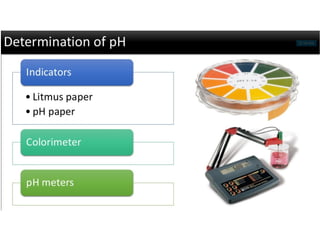
pH is defined as the negative logarithm of hydrogen ion concentration.
pH= -log [ H+ ]
p = power
H = hydrogen
[H+ ] = hydrogen ion concentration
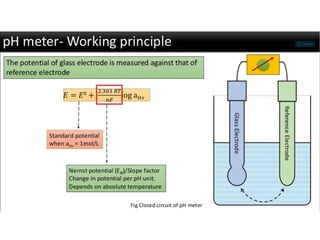
The pH of a solution can be measured by the pH meter. The glass
electrode is an half cell and the calomel electrode is another half cell.
Electrodes and Potentiometry
Reference Electrodes
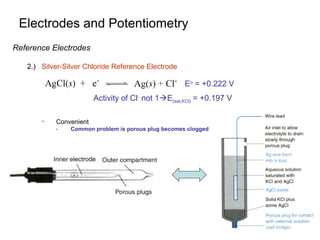
2.) Silver-Silver Chloride Reference Electrode
 Convenient
- Common problem is porous plug becomes clogged
Eo
= +0.222 V
Activity of Cl-
not 1E(sat,KCl) = +0.197 V
0
Electrodes and Potentiometry
Reference Electrodes
3.) Saturated Calomel Reference Electrode (S.C.E)
 Saturated KCl maintains constant [Cl-
] even with
some evaporation
 Standard hydrogen electrodes are cumbersome
- Requires H2 gas and freshly prepared Pt surface
Eo
= +0.268 V
Activity of Cl-
not 1E(sat,KCl) = +0.241 V
Electrodes and Potentiometry
pH Electrodes
1.) pH Measurement with a Glass Electrode
 Glass electrode is most common ion-selective electrode
 Combination electrode incorporates both glass and reference
electrode in one body
Ag(s)|AgCl(s)|Cl-
(aq)||H+
(aq,outside) H+
(aq,inside),Cl-
(aq)|AgCl(s)|Ag(s)
Outer reference
electrode
[H+
] outside
(analyte solution)
[H+
] inside Inner reference
electrode
Glass membrane
Selectively binds H+
Electric potential is generated by [H+
] difference across glass membrane
Electrodes and Potentiometry
pH Electrodes
1.) pH Measurement with a Glass Electrode
 Glass electrode is most common ion-selective electrode
 Combination electrode incorporates both glass and reference
electrode in one body
Ag(s)|AgCl(s)|Cl-
(aq)||H+
(aq,outside) H+
(aq,inside),Cl-
(aq)|AgCl(s)|Ag(s)
Outer reference
electrode
[H+
] outside
(analyte solution)
[H+
] inside Inner reference
electrode
Glass membrane
Selectively binds H+
Electric potential is generated by [H+
] difference across glass membrane
Following reactions take place in the electrodes
● The glass electrode contains Ag, AgCl, and HCL. All these remain in the
ionized state.
Ag <—————> Ag+ + e–
AgCl <—————> Ag+ + Cl-
HCL <—————> H+ + Cl–
All the above three equilibrium reactions are balanced. In the glass electrode, H+
is generated.
● The calomel electrode contains Hg, Hg2Cl2 , and KCL.
Here also the following series of ionizations take place.
Hg <————> Hg+ + e-
Hg2Cl2 <————> 2Hg+ + 2Cl-
KCL <————> K+ + Cl-
The above equilibrium reactions are balanced. In the calomel electrode, H+ is not
generated.
Different pH values
Applications of pH meter
● For the diagnosis of various disorders in human
body
● Agriculture
● Brewing
● Corrosion Prevention
● Dyeing
● Jam and Jelly Manufacturing
● Printing
● Pharmaceuticals
pH Meter

pH Meter

  • 1.
    PH Meter Stephen CPramod Asst Prof., Dept of EIE, CVR College of Engineering, Vasthunagar, Mangalpalli, Ibrahimpatnam, Hyderabad – 501510 Ph:9885819803, Mail ID: pramod.kumar@cvr.ac.in
  • 3.
    PH Meter Principle pH isdefined as the negative logarithm of hydrogen ion concentration. pH= -log [ H+ ] p = power H = hydrogen [H+ ] = hydrogen ion concentration The pH of a solution can be measured by the pH meter. The glass electrode is an half cell and the calomel electrode is another half cell.
  • 8.
    Electrodes and Potentiometry ReferenceElectrodes 2.) Silver-Silver Chloride Reference Electrode  Convenient - Common problem is porous plug becomes clogged Eo = +0.222 V Activity of Cl- not 1E(sat,KCl) = +0.197 V
  • 9.
  • 10.
    Electrodes and Potentiometry ReferenceElectrodes 3.) Saturated Calomel Reference Electrode (S.C.E)  Saturated KCl maintains constant [Cl- ] even with some evaporation  Standard hydrogen electrodes are cumbersome - Requires H2 gas and freshly prepared Pt surface Eo = +0.268 V Activity of Cl- not 1E(sat,KCl) = +0.241 V
  • 11.
    Electrodes and Potentiometry pHElectrodes 1.) pH Measurement with a Glass Electrode  Glass electrode is most common ion-selective electrode  Combination electrode incorporates both glass and reference electrode in one body Ag(s)|AgCl(s)|Cl- (aq)||H+ (aq,outside) H+ (aq,inside),Cl- (aq)|AgCl(s)|Ag(s) Outer reference electrode [H+ ] outside (analyte solution) [H+ ] inside Inner reference electrode Glass membrane Selectively binds H+ Electric potential is generated by [H+ ] difference across glass membrane
  • 12.
    Electrodes and Potentiometry pHElectrodes 1.) pH Measurement with a Glass Electrode  Glass electrode is most common ion-selective electrode  Combination electrode incorporates both glass and reference electrode in one body Ag(s)|AgCl(s)|Cl- (aq)||H+ (aq,outside) H+ (aq,inside),Cl- (aq)|AgCl(s)|Ag(s) Outer reference electrode [H+ ] outside (analyte solution) [H+ ] inside Inner reference electrode Glass membrane Selectively binds H+ Electric potential is generated by [H+ ] difference across glass membrane
  • 13.
    Following reactions takeplace in the electrodes ● The glass electrode contains Ag, AgCl, and HCL. All these remain in the ionized state. Ag <—————> Ag+ + e– AgCl <—————> Ag+ + Cl- HCL <—————> H+ + Cl– All the above three equilibrium reactions are balanced. In the glass electrode, H+ is generated. ● The calomel electrode contains Hg, Hg2Cl2 , and KCL. Here also the following series of ionizations take place. Hg <————> Hg+ + e- Hg2Cl2 <————> 2Hg+ + 2Cl- KCL <————> K+ + Cl- The above equilibrium reactions are balanced. In the calomel electrode, H+ is not generated.
  • 19.
  • 21.
    Applications of pHmeter ● For the diagnosis of various disorders in human body ● Agriculture ● Brewing ● Corrosion Prevention ● Dyeing ● Jam and Jelly Manufacturing ● Printing ● Pharmaceuticals