Rock
Rock or stone is a natural substance, a solid aggregate of one
or more minerals combined together in an orderly manner.
Petrography deals with the descriptive part of rocks.
Petrogeny deals with the mode of formation of rocks.
1
Petrology means “STUDY OF ROCKS”
Petro = Rock
Logy = Study
The branch of geology deals with the various aspects of rocks
such as, Origin, Association, Occurrence, Mineral
composition, Chemical composition, Texture,Structure,
Physical properties of rocks.
2
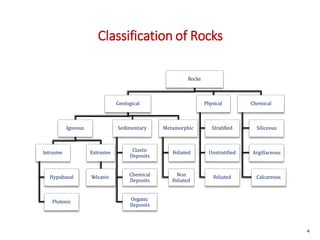
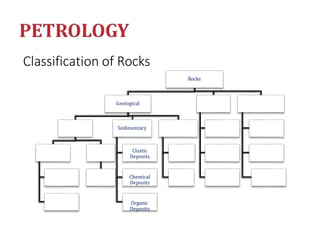
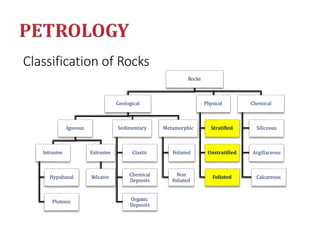
Classification of Rocks
Rocks
Geological
Igneous
Intrusive
Hypabasal
Plutonic
Extrusive
V
olcanic
Sedimentary
Clastic
Deposits
Chemical
Deposits
Organic
Deposits
Metamorphic
Foliated
Non
Foliated
Physical
Stratified
Unstratified
Foliated
Chemical
Siliceous
Argillaceous
Calcareous
4
Igneous Rock
Igneous rocks are the primary rocks, which are formed due to
cooling and solidification of magma.
Magma is a hot viscous, siliceous melt, containing water
vapour and gases.
Magma comes out from the greater depth below the earth
surface, such magma is called LAVA.
4
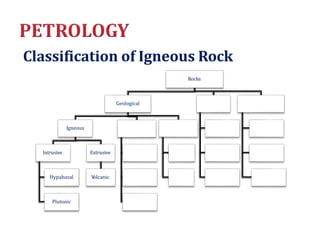
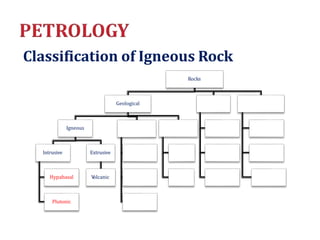
Classification of Igneous Rock
Rocks
Geological
Igneous
Intrusive
Hypabasal
Plutonic
Extrusive
V
olcanic
Igneous Rock
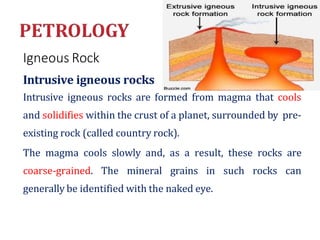
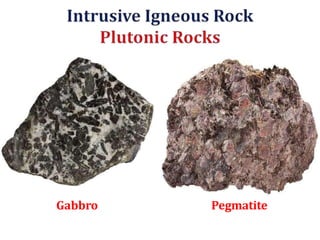
Intrusive igneous rocks
Intrusive igneous rocks are formed from magma that cools
and solidifies within the crust of a planet, surrounded by pre-
existing rock (called country rock).
The magma cools slowly and, as a result, these rocks are
coarse-grained. The mineral grains in such rocks can
generally be identified with the naked eye.
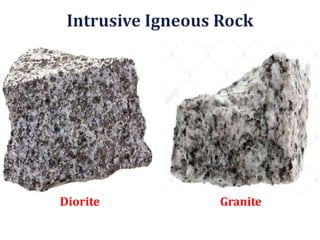
Diorite Granite
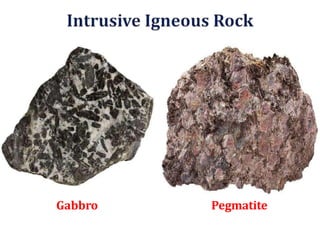
Gabbro Pegmatite
Classification of Igneous Rock
Rocks
Geological
Igneous
Intrusive
Hypabasal
Plutonic
Extrusive
V
olcanic
Igneous Rock
Intrusive igneous rocks
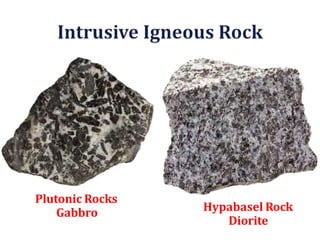
Hypabasel Rock
These Rocks are formed at intermediate depth generally up
to 2 km below the earth surface and exhibits mixed
characteristics of volcanic and plutonic.
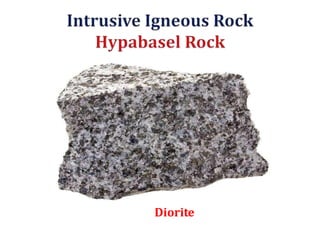
Diorite
Igneous Rock
Intrusive igneous rocks
Plutonic Rock
These Rocks are formed at considerable depth generally up to
7-10 km below the earth surface. Because of very slow rate of
cooling at these depth coarse grained rocks are formed.
Gabbro Pegmatite
Plutonic Rocks
Gabbro Hypabasel Rock
Diorite
Igneous Rock
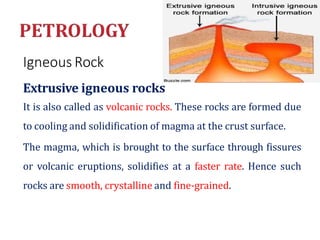
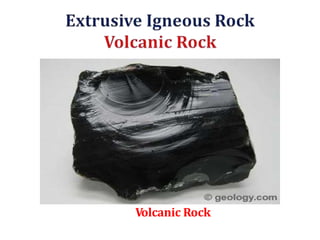
Extrusive igneous rocks
It is also called as volcanic rocks. These rocks are formed due
to cooling and solidification of magma at the crust surface.
The magma, which is brought to the surface through fissures
or volcanic eruptions, solidifies at a faster rate. Hence such
rocks are smooth, crystalline and fine-grained.
Igneous Rock
Extrusive igneous rocks
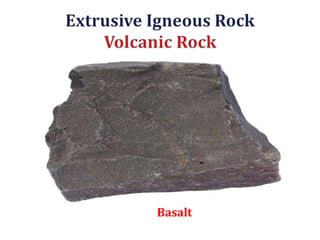
Volcanic Rocks
These rocks are formed due to cooling and solidification of
lava erupted from volcanoes. since lava cools down very fast
rate. The grain size of the crystal formed in these rock is fine.
Volcanic Rock
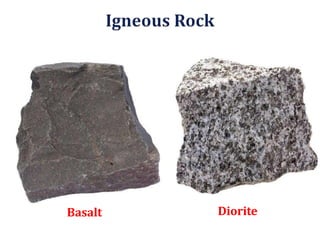
Basalt
Basalt Diorite
Classification of Rocks
Rocks
Geological
Sedimentary
Clastic
Deposits
Chemical
Deposits
Organic
Deposits
Sedimentary Rock
Eng- Geo [6K473]-Unit1
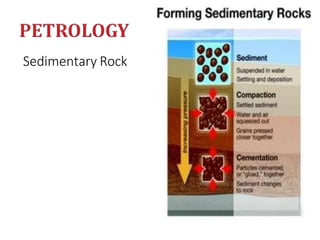
Sedimentary rocks are those, which are formed by the
accumulation, compaction and consolidation of sediments.
The sediments are the particles produced from the
disintegration of pre-existing rocks (Igneous/metamorphic
rocks) through the process of transportation and deposition
by various natural agencies like wind, water and glaciers .
21
Sedimentary Rock
Eng- Geo [6K473]-Unit1 24
Sedimentary Rock
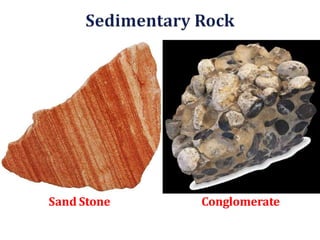
Sand Stone Conglomerate
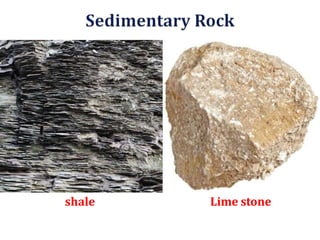
shale Lime stone
Sedimentary Rock
Clastic deposit rock
They are mechanically formed rocks. These are formed due
to the process of weathering, erosion, transportation and
deposition of pre-existing rocks.
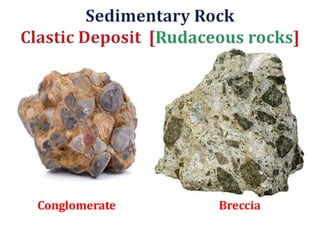
Rudaceous rocks-If the grain size are more than 2 mm in dia,
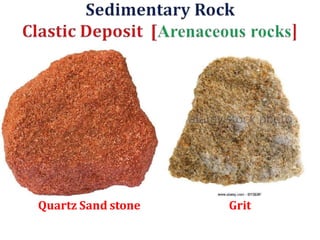
Arenaceous rocks-If the grain size is in between 1 and 2 mm.
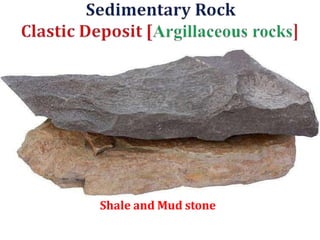
Argillaceous rocks-If the size of the particle is < 1mm in dia,
Conglomerate Breccia
Quartz Sand stone Grit
Shale and Mud stone
Sedimentary Rock
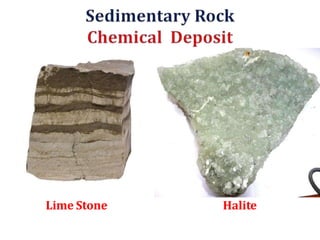
Chemical deposit rock
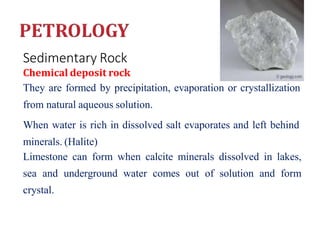
They are formed by precipitation, evaporation or crystallization
from natural aqueous solution.
When water is rich in dissolved salt evaporates and left behind
minerals. (Halite)
Limestone can form when calcite minerals dissolved in lakes,
sea and underground water comes out of solution and form
crystal.
Lime Stone Halite
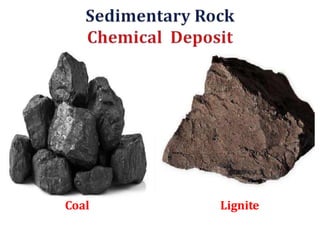
Sedimentary Rock
Organic deposit rock
Sedimentary rocks which are formed exclusively from remains
of organisms like plant / animals deposited in a thick layer.
Eng- Geo [6K473]-Unit1 35
Coal Lignite
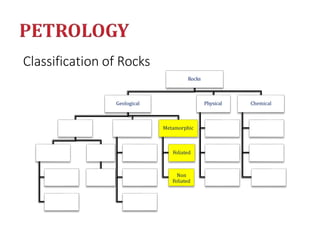
Classification of Rocks
Rocks
Geological
Metamorphic
Foliated
Non
Foliated
Physical Chemical
Metamorphic Rock
 The word "Metamorphism" comes from the Greek:
 Meta = change, Morph = form,
 so metamorphism means to change form.
 Metamorphic rocks are those rocks that are formed as a
result of transformation that takes place in the pre-existing
rocks (Igneous/sedimentary rocks).
 When the pre-existing rocks are subjected to higher
temperature, pressure and chemically active liquids and
gases, the minerals present in the original rocks changes to
new environmental condition.
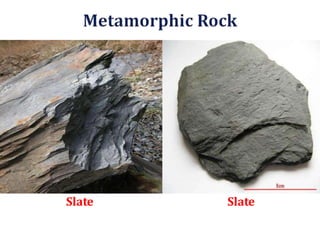
Slate Slate
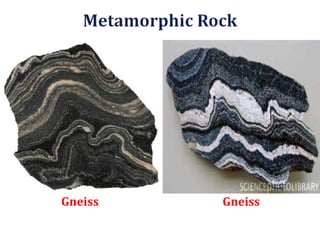
Gneiss Gneiss
Metamorphic Rock
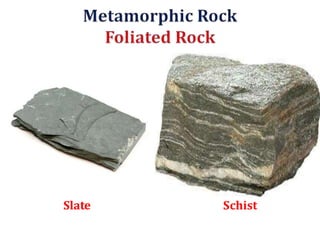
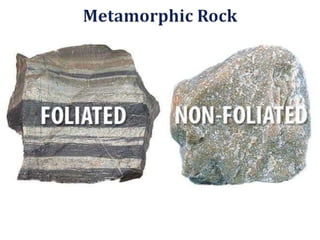
Foliated
 When pressure squeezes the flat or elongate minerals within a
rock so they become aligned. These rocks develop a platy or
sheet-like structure that reflects the direction that pressure
was applied in.
 Slate, schist, and gneiss are all foliated metamorphic rocks.
Slate Schist
Metamorphic Rock
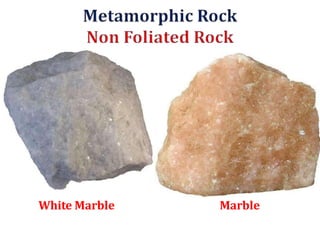
Non Foliated
Non foliated metamorphic rocks are formed around igneous
intrusions where the temperatures are high but the
pressures are relatively low and equal in all directions
White Marble Marble
Classification of Rocks
Rocks
Geological
Igneous
Intrusive
Hypabasal
Plutonic
Extrusive
V
olcanic
Sedimentary
Clastic
Chemical
Deposits
Organic
Deposits
Metamorphic
Foliated
Non
Foliated
Physical
Stratified
Unstratified
Foliated
Chemical
Siliceous
Argillaceous
Calcareous
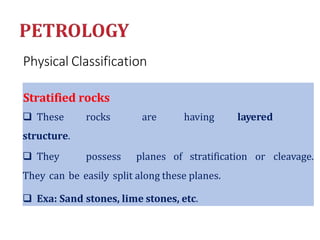
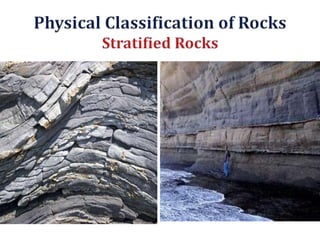
Physical Classification
Stratified rocks
 These
structure.
rocks are having layered
 They possess planes of stratification or cleavage.
They can be easily split along these planes.
 Exa: Sand stones, lime stones, etc.
Physical Classification
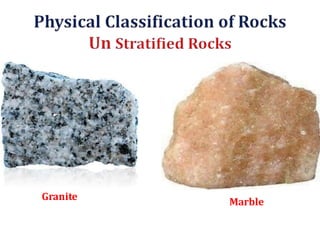
Un-stratified rocks
 These rocks are not stratified. They possess crystalline and
compact grains. They cannot be split in to thin slab.
 Exa: Granite, trap, marble
Granite
Marble
Physical Classification
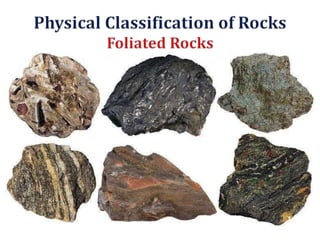
Foliated Rocks
 These rocks have a tendency to split along a definite
direction only.
 The direction need not be parallel to each other as in case of
stratified rocks.
 This type of structure is very common in case of
metamorphic rocks.
Chemical Classification
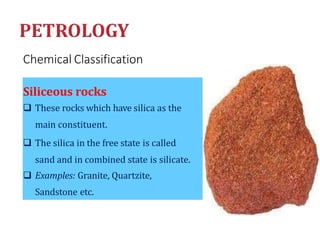
Siliceous rocks
 These rocks which have silica as the
main constituent.
 The silica in the free state is called
sand and in combined state is silicate.
 Examples: Granite, Quartzite,
Sandstone etc.
Chemical Classification
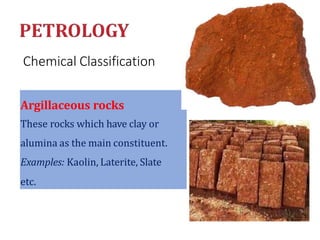
Argillaceous rocks
These rocks which have clay or
alumina as the main constituent.
Examples: Kaolin, Laterite, Slate
etc.
Chemical Classification
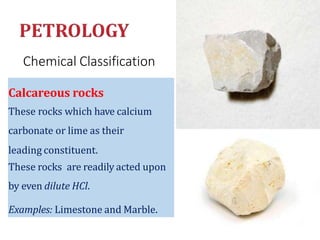
Calcareous rocks
These rocks which have calcium
carbonate or lime as their
leading constituent.
These rocks are readily acted upon
by even dilute HCl.
Examples: Limestone and Marble.
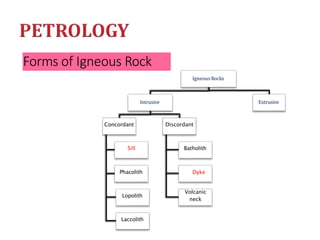
Forms of Igneous Rock
IgneousRocks
Intrusive
Concordant
Sill
Phacolith
Lopolith
Laccolith
Discordant
Batholith
Dyke
Volcanic
neck
Extrusive
Forms of Igneous Rock
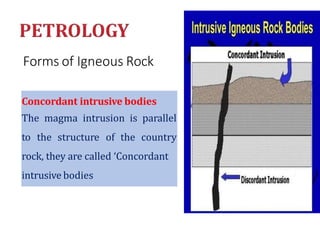
Concordant intrusive bodies
The magma intrusion is parallel
to the structure of the country
rock, they are called ‘Concordant
intrusive bodies
Forms of Igneous Rock
Concordant intrusive bodies Sill
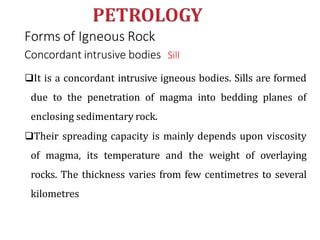
It is a concordant intrusive igneous bodies. Sills are formed
due to the penetration of magma into bedding planes of
enclosing sedimentary rock.
Their spreading capacity is mainly depends upon viscosity
of magma, its temperature and the weight of overlaying
rocks. The thickness varies from few centimetres to several
kilometres
Eng- Geo [6K473]-Unit1 59
Sill
Forms of Igneous Rock Concordant
intrusive bodies Phacolith
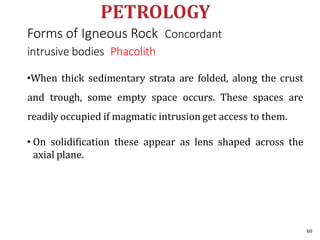
•When thick sedimentary strata are folded, along the crust
and trough, some empty space occurs. These spaces are
readily occupied if magmatic intrusion get access to them.
• On solidification these appear as lens shaped across the
axial plane.
60
Eng- Geo [6K473]-Unit1 61
Phacolith
Forms of Igneous Rock
• Concordant intrusive bodies Lopolith
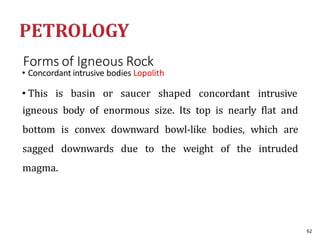
• This is basin or saucer shaped concordant intrusive
igneous body of enormous size. Its top is nearly flat and
bottom is convex downward bowl-like bodies, which are
sagged downwards due to the weight of the intruded
magma.
62
Eng- Geo [6K473]-Unit1 63
Lopolith
Forms of Igneous Rock
Concordant intrusive bodies
Laccolith
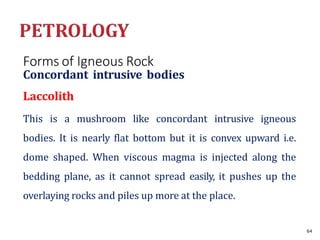
This is a mushroom like concordant intrusive igneous
bodies. It is nearly flat bottom but it is convex upward i.e.
dome shaped. When viscous magma is injected along the
bedding plane, as it cannot spread easily, it pushes up the
overlaying rocks and piles up more at the place.
64
Forms of Igneous Rock
Concordant intrusive bodies
Laccolith
Eng- Geo [6K473]-Unit1 65
Laccolith
Eng- Geo [6K473]-Unit1 66
Forms of Igneous Rock
intrusive igneous
 Discordant intrusive bodies Batholith
These are the largest known discordant
bodies mainly occurring in mountain ranges.
Batholiths have side sloping away from each other which makes
them larger and larger downwards and they have extended to
very great depths covering several kilometres.
67
Batholith
Eng- Geo [6K473]-Unit1 68
Forms of Igneous Rock
• Discordant intrusive bodies Dyke
•Dykes are discordant igneous body of more or less tabular
shape and exhibit a cross –cutting relationship with the
country rocks they occur commonly n the forms of wall like
masses of exactly or nearly vertical attitude.
•If the rocks constituting the dyke are hard and compact, they
can resist weathering and Erosional process.
69
Dyke
Eng- Geo [6K473]-Unit1 70
Dyke
Eng- Geo [6K473]-Unit1 71
Forms of Igneous Rock
Discordant intrusive bodies
Volcanic neck
The vents of quiet volcanoes have become sealed with the
igneous intrusions and is called volcanic necks/plugs.
These forms may be circular, semi circular or irregular and
in varying diameter.
72
Volcanic neck
Eng- Geo [6K473]-Unit1 73
Structure
72
 Structure are physical features associated with the rocks.
They are primary in nature they occurs along with the
formation of rocks
 Structure contribute the strength and weakness of the rock.
 Structure helps to distinguishing features of rock group.
 Structure reveals the mode of formation.
Structure of Igneous Rock
73
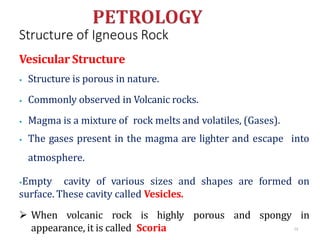
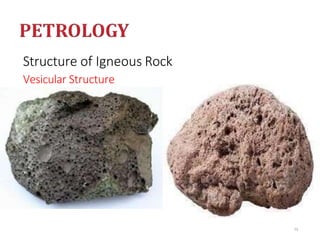
Vesicular Structure
⦁ Structure is porous in nature.
⦁ Commonly observed in Volcanic rocks.
⦁ Magma is a mixture of rock melts and volatiles, (Gases).
⦁ The gases present in the magma are lighter and escape into
atmosphere.
⦁Empty cavity of various sizes and shapes are formed on
surface. These cavity called Vesicles.
 When volcanic rock is highly porous and spongy in
appearance, it is called Scoria
Structure of Igneous Rock
Vesicular Structure
74
Structure of Igneous Rock
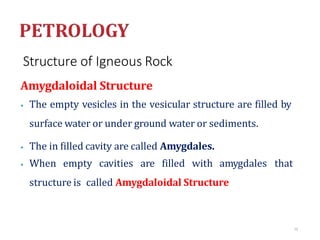
Amygdaloidal Structure
⦁ The empty vesicles in the vesicular structure are filled by
surface water or under ground water or sediments.
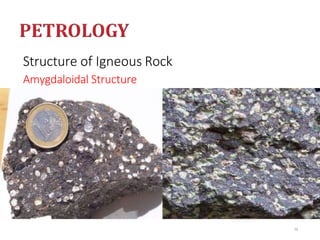
⦁ The in filled cavity are called Amygdales.
⦁ When empty cavities are filled with amygdales that
structure is called Amygdaloidal Structure
75
Structure of Igneous Rock
Amygdaloidal Structure
76
Structure of Igneous Rock
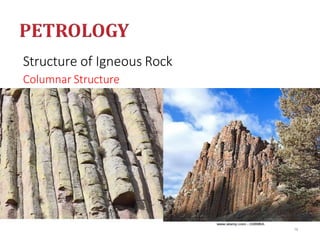
Columnar Structure
The volcanic igneous rock appears to be made up of
numerous parallel polygon prismatic column bundled
together. This results of the contraction of lava during
cooling.
77
Structure of Igneous Rock
Columnar Structure
78
Structure of Igneous Rock
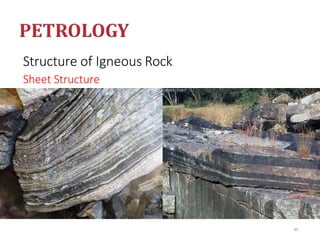
Sheet Structure
 The rocks appears to be made up of a number of sheets,
because of the development of nearly horizontal crack .
 Plutonic rocks are formed at a great depth which means
under the great pressures.
 When erosion takes place in the over laying strata
gradually dis appear ultimately exposing of plutonic rock
in the form sheet.
79
Structure of Igneous Rock
Sheet Structure
80
Structure of Igneous Rock
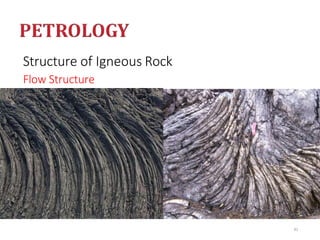
Flow Structure
These structures are linear and nearly parallel features
occurring in volcanic rocks which develops as a
consequence of the flow of lava.
81
Structure of Igneous Rock
Flow Structure
82
Structure of Igneous Rock
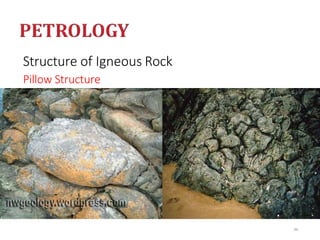
Pillow Structure
The Volcanic igneous body appears as a pile of numerous
overlapping pillows.
It occurs only in soda rich basalt rock.
The pillows are generally interconnected vesicular and
glassy tops.
83
Structure of Igneous Rock
Pillow Structure
84
Structures of Metamorphic rocks
1. Cataclastic structure
2. Schistose structure
3. Gneissose structure
4. Maculose structure
5. Granulose structure
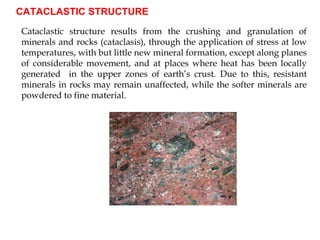
CATACLASTIC STRUCTURE
Cataclastic structure results from the crushing and granulation of
minerals and rocks (cataclasis), through the application of stress at low
temperatures, with but little new mineral formation, except along planes
of considerable movement, and at places where heat has been locally
generated in the upper zones of earth’s crust. Due to this, resistant
minerals in rocks may remain unaffected, while the softer minerals are
powdered to fine material.
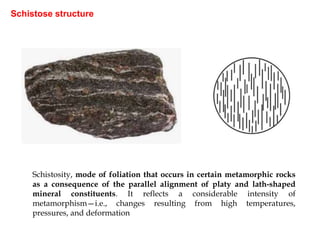
Schistose structure
Schistosity, mode of foliation that occurs in certain metamorphic rocks
as a consequence of the parallel alignment of platy and lath-shaped
mineral constituents. It reflects a considerable intensity of
metamorphism—i.e., changes resulting from high temperatures,
pressures, and deformation
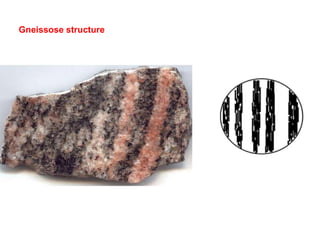
GNEISSOSE STRUCTURE
Gneissose structure This is a banded structure in which the
minerals have been segregated into discontinuous bands, each
of which is dominated by one or two minerals.
 These bands range in thickness from 1 mm to several
centimeters.
The individual mineral grains are macroscopic and impart a
striped appearance to a hand specimen.
Light-colored bands commonly contain quartz and feldspar.
and the dark hands are commonly composed of hornblende
and biotite.
 Accessory minerals are common and are useful in applying
specific names to these rocks. A rock with a gneissic structure is
called a gneiss.
Gneissose structure
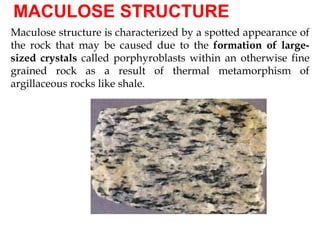
MACULOSE STRUCTURE
Maculose structure is characterized by a spotted appearance of
the rock that may be caused due to the formation of large-
sized crystals called porphyroblasts within an otherwise fine
grained rock as a result of thermal metamorphism of
argillaceous rocks like shale.
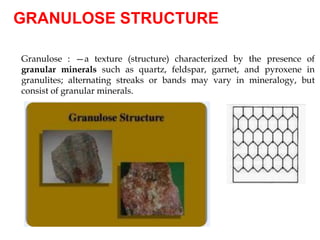
GRANULOSE STRUCTURE
Granulose : —a texture (structure) characterized by the presence of
granular minerals such as quartz, feldspar, garnet, and pyroxene in
granulites; alternating streaks or bands may vary in mineralogy, but
consist of granular minerals.
Structures of Sedimentary Rock
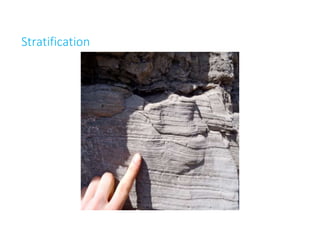
1. Stratification
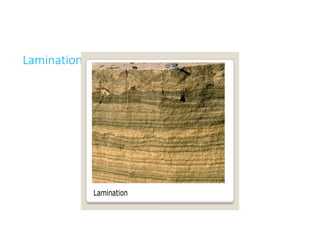
2. Lamination
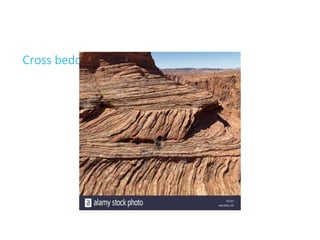
3. Cross bedding
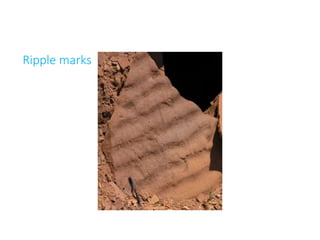
4. Ripple marks
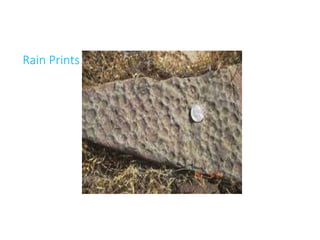
5. Rain Prints
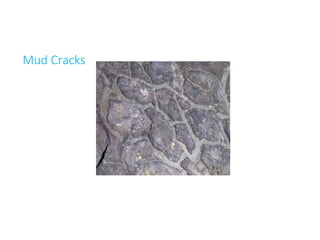
6. Mud Cracks
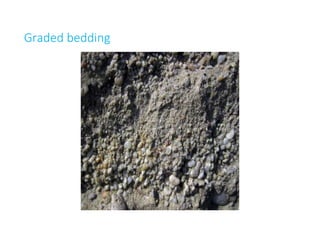
7. Graded bedding
Stratification
Lamination
Cross bedding
Ripple marks
Rain Prints
Mud Cracks
Graded bedding

Rocks_geology_engineering_gati_shakti.pptx

  • 1.
    Rock Rock or stoneis a natural substance, a solid aggregate of one or more minerals combined together in an orderly manner. Petrography deals with the descriptive part of rocks. Petrogeny deals with the mode of formation of rocks. 1
  • 2.
    Petrology means “STUDYOF ROCKS” Petro = Rock Logy = Study The branch of geology deals with the various aspects of rocks such as, Origin, Association, Occurrence, Mineral composition, Chemical composition, Texture,Structure, Physical properties of rocks. 2
  • 3.
  • 4.
    Igneous Rock Igneous rocksare the primary rocks, which are formed due to cooling and solidification of magma. Magma is a hot viscous, siliceous melt, containing water vapour and gases. Magma comes out from the greater depth below the earth surface, such magma is called LAVA. 4
  • 5.
    Classification of IgneousRock Rocks Geological Igneous Intrusive Hypabasal Plutonic Extrusive V olcanic
  • 6.
    Igneous Rock Intrusive igneousrocks Intrusive igneous rocks are formed from magma that cools and solidifies within the crust of a planet, surrounded by pre- existing rock (called country rock). The magma cools slowly and, as a result, these rocks are coarse-grained. The mineral grains in such rocks can generally be identified with the naked eye.
  • 7.
  • 8.
  • 9.
    Classification of IgneousRock Rocks Geological Igneous Intrusive Hypabasal Plutonic Extrusive V olcanic
  • 10.
    Igneous Rock Intrusive igneousrocks Hypabasel Rock These Rocks are formed at intermediate depth generally up to 2 km below the earth surface and exhibits mixed characteristics of volcanic and plutonic.
  • 11.
  • 12.
    Igneous Rock Intrusive igneousrocks Plutonic Rock These Rocks are formed at considerable depth generally up to 7-10 km below the earth surface. Because of very slow rate of cooling at these depth coarse grained rocks are formed.
  • 13.
  • 14.
  • 15.
    Igneous Rock Extrusive igneousrocks It is also called as volcanic rocks. These rocks are formed due to cooling and solidification of magma at the crust surface. The magma, which is brought to the surface through fissures or volcanic eruptions, solidifies at a faster rate. Hence such rocks are smooth, crystalline and fine-grained.
  • 16.
    Igneous Rock Extrusive igneousrocks Volcanic Rocks These rocks are formed due to cooling and solidification of lava erupted from volcanoes. since lava cools down very fast rate. The grain size of the crystal formed in these rock is fine.
  • 17.
  • 18.
  • 19.
  • 20.
  • 21.
    Sedimentary Rock Eng- Geo[6K473]-Unit1 Sedimentary rocks are those, which are formed by the accumulation, compaction and consolidation of sediments. The sediments are the particles produced from the disintegration of pre-existing rocks (Igneous/metamorphic rocks) through the process of transportation and deposition by various natural agencies like wind, water and glaciers . 21
  • 22.
    Sedimentary Rock Eng- Geo[6K473]-Unit1 24
  • 23.
  • 24.
  • 25.
  • 26.
    Sedimentary Rock Clastic depositrock They are mechanically formed rocks. These are formed due to the process of weathering, erosion, transportation and deposition of pre-existing rocks. Rudaceous rocks-If the grain size are more than 2 mm in dia, Arenaceous rocks-If the grain size is in between 1 and 2 mm. Argillaceous rocks-If the size of the particle is < 1mm in dia,
  • 27.
  • 28.
  • 29.
  • 30.
    Sedimentary Rock Chemical depositrock They are formed by precipitation, evaporation or crystallization from natural aqueous solution. When water is rich in dissolved salt evaporates and left behind minerals. (Halite) Limestone can form when calcite minerals dissolved in lakes, sea and underground water comes out of solution and form crystal.
  • 31.
  • 32.
    Sedimentary Rock Organic depositrock Sedimentary rocks which are formed exclusively from remains of organisms like plant / animals deposited in a thick layer.
  • 33.
  • 34.
  • 35.
  • 36.
    Metamorphic Rock  Theword "Metamorphism" comes from the Greek:  Meta = change, Morph = form,  so metamorphism means to change form.  Metamorphic rocks are those rocks that are formed as a result of transformation that takes place in the pre-existing rocks (Igneous/sedimentary rocks).  When the pre-existing rocks are subjected to higher temperature, pressure and chemically active liquids and gases, the minerals present in the original rocks changes to new environmental condition.
  • 37.
  • 38.
  • 39.
    Metamorphic Rock Foliated  Whenpressure squeezes the flat or elongate minerals within a rock so they become aligned. These rocks develop a platy or sheet-like structure that reflects the direction that pressure was applied in.  Slate, schist, and gneiss are all foliated metamorphic rocks.
  • 40.
  • 41.
    Metamorphic Rock Non Foliated Nonfoliated metamorphic rocks are formed around igneous intrusions where the temperatures are high but the pressures are relatively low and equal in all directions
  • 42.
  • 44.
  • 45.
    Physical Classification Stratified rocks These structure. rocks are having layered  They possess planes of stratification or cleavage. They can be easily split along these planes.  Exa: Sand stones, lime stones, etc.
  • 47.
    Physical Classification Un-stratified rocks These rocks are not stratified. They possess crystalline and compact grains. They cannot be split in to thin slab.  Exa: Granite, trap, marble
  • 48.
  • 49.
    Physical Classification Foliated Rocks These rocks have a tendency to split along a definite direction only.  The direction need not be parallel to each other as in case of stratified rocks.  This type of structure is very common in case of metamorphic rocks.
  • 51.
    Chemical Classification Siliceous rocks These rocks which have silica as the main constituent.  The silica in the free state is called sand and in combined state is silicate.  Examples: Granite, Quartzite, Sandstone etc.
  • 52.
    Chemical Classification Argillaceous rocks Theserocks which have clay or alumina as the main constituent. Examples: Kaolin, Laterite, Slate etc.
  • 53.
    Chemical Classification Calcareous rocks Theserocks which have calcium carbonate or lime as their leading constituent. These rocks are readily acted upon by even dilute HCl. Examples: Limestone and Marble.
  • 54.
    Forms of IgneousRock IgneousRocks Intrusive Concordant Sill Phacolith Lopolith Laccolith Discordant Batholith Dyke Volcanic neck Extrusive
  • 55.
    Forms of IgneousRock Concordant intrusive bodies The magma intrusion is parallel to the structure of the country rock, they are called ‘Concordant intrusive bodies
  • 56.
    Forms of IgneousRock Concordant intrusive bodies Sill It is a concordant intrusive igneous bodies. Sills are formed due to the penetration of magma into bedding planes of enclosing sedimentary rock. Their spreading capacity is mainly depends upon viscosity of magma, its temperature and the weight of overlaying rocks. The thickness varies from few centimetres to several kilometres
  • 57.
  • 58.
    Forms of IgneousRock Concordant intrusive bodies Phacolith •When thick sedimentary strata are folded, along the crust and trough, some empty space occurs. These spaces are readily occupied if magmatic intrusion get access to them. • On solidification these appear as lens shaped across the axial plane. 60
  • 59.
  • 60.
    Forms of IgneousRock • Concordant intrusive bodies Lopolith • This is basin or saucer shaped concordant intrusive igneous body of enormous size. Its top is nearly flat and bottom is convex downward bowl-like bodies, which are sagged downwards due to the weight of the intruded magma. 62
  • 61.
  • 62.
    Forms of IgneousRock Concordant intrusive bodies Laccolith This is a mushroom like concordant intrusive igneous bodies. It is nearly flat bottom but it is convex upward i.e. dome shaped. When viscous magma is injected along the bedding plane, as it cannot spread easily, it pushes up the overlaying rocks and piles up more at the place. 64
  • 63.
    Forms of IgneousRock Concordant intrusive bodies Laccolith Eng- Geo [6K473]-Unit1 65
  • 64.
  • 65.
    Forms of IgneousRock intrusive igneous  Discordant intrusive bodies Batholith These are the largest known discordant bodies mainly occurring in mountain ranges. Batholiths have side sloping away from each other which makes them larger and larger downwards and they have extended to very great depths covering several kilometres. 67
  • 66.
  • 67.
    Forms of IgneousRock • Discordant intrusive bodies Dyke •Dykes are discordant igneous body of more or less tabular shape and exhibit a cross –cutting relationship with the country rocks they occur commonly n the forms of wall like masses of exactly or nearly vertical attitude. •If the rocks constituting the dyke are hard and compact, they can resist weathering and Erosional process. 69
  • 68.
  • 69.
  • 70.
    Forms of IgneousRock Discordant intrusive bodies Volcanic neck The vents of quiet volcanoes have become sealed with the igneous intrusions and is called volcanic necks/plugs. These forms may be circular, semi circular or irregular and in varying diameter. 72
  • 71.
    Volcanic neck Eng- Geo[6K473]-Unit1 73
  • 72.
    Structure 72  Structure arephysical features associated with the rocks. They are primary in nature they occurs along with the formation of rocks  Structure contribute the strength and weakness of the rock.  Structure helps to distinguishing features of rock group.  Structure reveals the mode of formation.
  • 73.
    Structure of IgneousRock 73 Vesicular Structure ⦁ Structure is porous in nature. ⦁ Commonly observed in Volcanic rocks. ⦁ Magma is a mixture of rock melts and volatiles, (Gases). ⦁ The gases present in the magma are lighter and escape into atmosphere. ⦁Empty cavity of various sizes and shapes are formed on surface. These cavity called Vesicles.  When volcanic rock is highly porous and spongy in appearance, it is called Scoria
  • 74.
    Structure of IgneousRock Vesicular Structure 74
  • 75.
    Structure of IgneousRock Amygdaloidal Structure ⦁ The empty vesicles in the vesicular structure are filled by surface water or under ground water or sediments. ⦁ The in filled cavity are called Amygdales. ⦁ When empty cavities are filled with amygdales that structure is called Amygdaloidal Structure 75
  • 76.
    Structure of IgneousRock Amygdaloidal Structure 76
  • 77.
    Structure of IgneousRock Columnar Structure The volcanic igneous rock appears to be made up of numerous parallel polygon prismatic column bundled together. This results of the contraction of lava during cooling. 77
  • 78.
    Structure of IgneousRock Columnar Structure 78
  • 79.
    Structure of IgneousRock Sheet Structure  The rocks appears to be made up of a number of sheets, because of the development of nearly horizontal crack .  Plutonic rocks are formed at a great depth which means under the great pressures.  When erosion takes place in the over laying strata gradually dis appear ultimately exposing of plutonic rock in the form sheet. 79
  • 80.
    Structure of IgneousRock Sheet Structure 80
  • 81.
    Structure of IgneousRock Flow Structure These structures are linear and nearly parallel features occurring in volcanic rocks which develops as a consequence of the flow of lava. 81
  • 82.
    Structure of IgneousRock Flow Structure 82
  • 83.
    Structure of IgneousRock Pillow Structure The Volcanic igneous body appears as a pile of numerous overlapping pillows. It occurs only in soda rich basalt rock. The pillows are generally interconnected vesicular and glassy tops. 83
  • 84.
    Structure of IgneousRock Pillow Structure 84
  • 85.
    Structures of Metamorphicrocks 1. Cataclastic structure 2. Schistose structure 3. Gneissose structure 4. Maculose structure 5. Granulose structure
  • 86.
    CATACLASTIC STRUCTURE Cataclastic structureresults from the crushing and granulation of minerals and rocks (cataclasis), through the application of stress at low temperatures, with but little new mineral formation, except along planes of considerable movement, and at places where heat has been locally generated in the upper zones of earth’s crust. Due to this, resistant minerals in rocks may remain unaffected, while the softer minerals are powdered to fine material.
  • 87.
    Schistose structure Schistosity, modeof foliation that occurs in certain metamorphic rocks as a consequence of the parallel alignment of platy and lath-shaped mineral constituents. It reflects a considerable intensity of metamorphism—i.e., changes resulting from high temperatures, pressures, and deformation
  • 88.
    GNEISSOSE STRUCTURE Gneissose structureThis is a banded structure in which the minerals have been segregated into discontinuous bands, each of which is dominated by one or two minerals.  These bands range in thickness from 1 mm to several centimeters. The individual mineral grains are macroscopic and impart a striped appearance to a hand specimen. Light-colored bands commonly contain quartz and feldspar. and the dark hands are commonly composed of hornblende and biotite.  Accessory minerals are common and are useful in applying specific names to these rocks. A rock with a gneissic structure is called a gneiss.
  • 89.
  • 90.
    MACULOSE STRUCTURE Maculose structureis characterized by a spotted appearance of the rock that may be caused due to the formation of large- sized crystals called porphyroblasts within an otherwise fine grained rock as a result of thermal metamorphism of argillaceous rocks like shale.
  • 91.
    GRANULOSE STRUCTURE Granulose :—a texture (structure) characterized by the presence of granular minerals such as quartz, feldspar, garnet, and pyroxene in granulites; alternating streaks or bands may vary in mineralogy, but consist of granular minerals.
  • 92.
    Structures of SedimentaryRock 1. Stratification 2. Lamination 3. Cross bedding 4. Ripple marks 5. Rain Prints 6. Mud Cracks 7. Graded bedding
  • 93.
  • 94.
  • 95.
  • 96.
  • 97.
  • 98.
  • 99.