PERVIOUS
CONCRETE
1
PerviousConcrete
PRESENTED BY
AGLAIA
INTRODUCTION
 It is a special type of concrete with a high porosity used for
concrete flatwork applications that allows water to pass
directly.
 It reduces the runoff and allowing groundwater recharge
 The high porosity is attained by a highly interconnected
void content.
 Recognized as the best management practice by US
Environment Protection agency (EPA)
2
PerviousConcrete
PERVIOUS CONCRETE
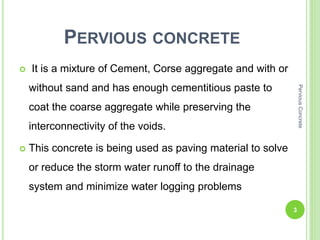
 It is a mixture of Cement, Corse aggregate and with or
without sand and has enough cementitious paste to
coat the coarse aggregate while preserving the
interconnectivity of the voids.
 This concrete is being used as paving material to solve
or reduce the storm water runoff to the drainage
system and minimize water logging problems
3
PerviousConcrete
 It is an important application for sustainable construction
 It is one of many low impact development techniques used
by builders to protect water quality.
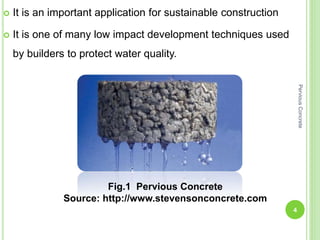
Fig.1 Pervious Concrete
Source: http://www.stevensonconcrete.com
4
PerviousConcrete
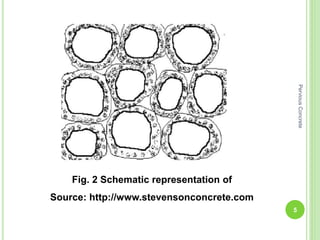
Fig. 2 Schematic representation of
Source: http://www.stevensonconcrete.com
5
PerviousConcrete
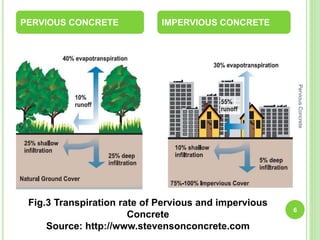
PERVIOUS CONCRETE IMPERVIOUS CONCRETE
Fig.3 Transpiration rate of Pervious and impervious
Concrete
Source: http://www.stevensonconcrete.com
6
PerviousConcrete
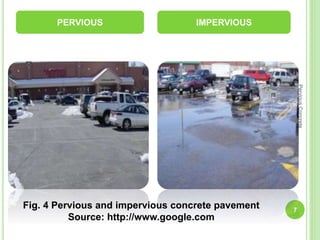
PERVIOUS IMPERVIOUS
Fig. 4 Pervious and impervious concrete pavement
Source: http://www.google.com
7
PerviousConcrete
HISTORY OF PERVIOUS CONCRETE
 It was first used in 1852. Pervious Concrete was first
used in 1852.
 It has been employed in European countries Pervious
concrete has been employed in European countries since
the nineteenth century.
 The earliest usage of pervious concrete in modern history
was for two houses in England.
 Over 900 houses were built from for two houses in
England.
 Most houses using pervious concrete are in the United
Most houses using pervious concrete are in the United
Kingdom
8
PerviousConcrete
PROPERTIES OF PERVIOUS
CONCRETE: CONCRETE:
 Fresh Properties
 The plastic pervious concrete mixture is stiff compared
to The plastic pervious concrete mixture is stiff
compared to traditional concrete. traditional concrete.
 Slumps, when measured, are generally less than ¾
inches (20 mm), although slumps as high as 2 inches
(50 mm) have been used
9
PerviousConcrete
HARDENED PROPERTIES
 Density and Porosity
 The densities are in the order of 1600 kg/m3 to
2000kg/m3. 2000kg/m3.
 The void contents of the pervious concrete ranges from 20
to 25%. to 25%.
 Permeability
 Typical flow rates for water through pervious concrete are
120 L/m²/min. 120 L/m²/min and 3.8 MPa.
10
PerviousConcrete
 Compressive Strength
 Pervious concrete mixtures can develop compressive
strengths in the range of 3.5 MPa to 28 Mpa.
 Typical values are about 17 MPa.
 Flexural strength
 Flexural strength in pervious concretes generally ranges
between about 1 MPa
11
PerviousConcrete
MATERIALS USED
 Aggregates
 Cementious Materials
 Water
 Admixtures
12
PerviousConcrete
AGGREGATES
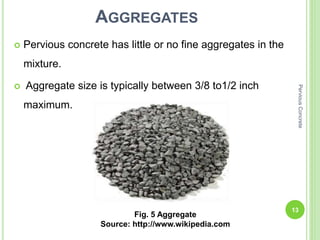
 Pervious concrete has little or no fine aggregates in the
mixture.
 Aggregate size is typically between 3/8 to1/2 inch
maximum.
Fig. 5 Aggregate
Source: http://www.wikipedia.com
13
PerviousConcrete
CEMENTIOUS MATERIALS
 Typically type-I cement is used for the production of
pervious concrete.
 Supplementary cementious materials such as fly ash or
slag can be used in
 Exchange up to about 25% (fly ash) and up to about
50%(slag) of cement.
14
PerviousConcrete
Table 1 Physical properties of Cement
Source:[1]
15
PerviousConcrete
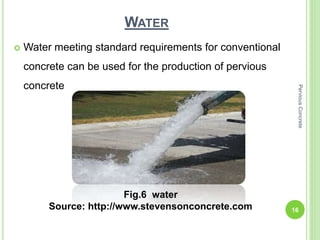
WATER
 Water meeting standard requirements for conventional
concrete can be used for the production of pervious
concrete
Fig.6 water
Source: http://www.stevensonconcrete.com 16
PerviousConcrete
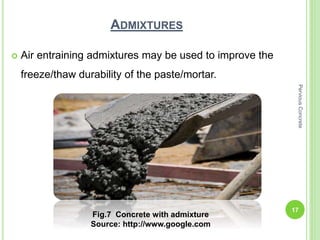
ADMIXTURES
 Air entraining admixtures may be used to improve the
freeze/thaw durability of the paste/mortar.
Fig.7 Concrete with admixture
Source: http://www.google.com
17
PerviousConcrete
Table 2: Typical Pervious Concrete Materials Proportions
Source :[1]
18
PerviousConcrete
MAINTENANCE
 Maintenance of pervious concrete pavement consists
primarily of prevention of clogging of the void structure.
 Cleaning options may include power blowing and pressure
washing.
 Pressure washing of a clogged pervious concrete
pavement has restored 80% to 90% of the permeability in
some cases.
19
PerviousConcrete
ENVIRONMENTAL BENEFITS
 Reduces storm water runoff
 Eliminates need for detention ponds
 Replenishes water tables and aquifers.
 Allows for more efficient land development.
 Minimizes flash flooding and standing water.
 Prevents warm and polluted water from entering streams.
 Mitigates surface pollutants.
 Light reflectivity is higher than with asphalt surfaces, reducing
any heat island effect. 20
PerviousConcrete
DISADVANTAGES
 Runoff from adjacent areas onto pervious concrete needs to be
prevented.
 The parking areas are generally limited to auto parking and
occasional trucks.
 If reinforcement is required, epoxy coated bars should be used.
 Concrete is variable in permeability; over vibration significantly
reduces permeability.
 It is still a new material that requires acceptance from cities and
states.
21
PerviousConcrete
APPLICATIONS
 Pervious pavement for parking lots.
 Alleys and driveways.
 Trees gates in sidewalk .
 Swimming pool decks.
 Tennis court.
 Greenhouse floors.
22
PerviousConcrete
CONCLUSION
 The pervious concrete helps the water to infiltrate
 Cities with pervious pavements would be safer for traffic, be
cleaner and less pollution.
23
PerviousConcrete
REFERENCES
 Hisar ,Vikram1, Mahla R.P(2015) “Experimental Study of
Pervious Concrete Pavement” International Journal for
Research in Applied Science & Engineering Technology
(IJRASET) .
 Shri, S. Deepa and R. Thenmozhi. (2012). "Flexural behavior
of hybrid fibrocement slabs with micro concrete and fibers." Int
J Emerg Trends Eng Dev 4(2): 165-177.
 Jing Yang, guoliang jiang. (2003). “Experimental study on
properties of pervious concrete pavement materials”, Cement
and Concrete research 33(2003) Pg No 381-386.
 Krishnaraj, C., Mohanasundram, K. M. and S. Navaneetha
santhakumar.(2012). “Implementation Study Analysis of Ft
fmea Model in Indian Foundry Industry”. Journal of Applied
Sciences Research, 8(2): 1009-1017. 24
PerviousConcrete
THANK YOU
For more…. Mail to
aglaiaconnect2018@gmail.com

Pervious concrete

  • 1.
  • 2.
    INTRODUCTION  It isa special type of concrete with a high porosity used for concrete flatwork applications that allows water to pass directly.  It reduces the runoff and allowing groundwater recharge  The high porosity is attained by a highly interconnected void content.  Recognized as the best management practice by US Environment Protection agency (EPA) 2 PerviousConcrete
  • 3.
    PERVIOUS CONCRETE  Itis a mixture of Cement, Corse aggregate and with or without sand and has enough cementitious paste to coat the coarse aggregate while preserving the interconnectivity of the voids.  This concrete is being used as paving material to solve or reduce the storm water runoff to the drainage system and minimize water logging problems 3 PerviousConcrete
  • 4.
     It isan important application for sustainable construction  It is one of many low impact development techniques used by builders to protect water quality. Fig.1 Pervious Concrete Source: http://www.stevensonconcrete.com 4 PerviousConcrete
  • 5.
    Fig. 2 Schematicrepresentation of Source: http://www.stevensonconcrete.com 5 PerviousConcrete
  • 6.
    PERVIOUS CONCRETE IMPERVIOUSCONCRETE Fig.3 Transpiration rate of Pervious and impervious Concrete Source: http://www.stevensonconcrete.com 6 PerviousConcrete
  • 7.
    PERVIOUS IMPERVIOUS Fig. 4Pervious and impervious concrete pavement Source: http://www.google.com 7 PerviousConcrete
  • 8.
    HISTORY OF PERVIOUSCONCRETE  It was first used in 1852. Pervious Concrete was first used in 1852.  It has been employed in European countries Pervious concrete has been employed in European countries since the nineteenth century.  The earliest usage of pervious concrete in modern history was for two houses in England.  Over 900 houses were built from for two houses in England.  Most houses using pervious concrete are in the United Most houses using pervious concrete are in the United Kingdom 8 PerviousConcrete
  • 9.
    PROPERTIES OF PERVIOUS CONCRETE:CONCRETE:  Fresh Properties  The plastic pervious concrete mixture is stiff compared to The plastic pervious concrete mixture is stiff compared to traditional concrete. traditional concrete.  Slumps, when measured, are generally less than ¾ inches (20 mm), although slumps as high as 2 inches (50 mm) have been used 9 PerviousConcrete
  • 10.
    HARDENED PROPERTIES  Densityand Porosity  The densities are in the order of 1600 kg/m3 to 2000kg/m3. 2000kg/m3.  The void contents of the pervious concrete ranges from 20 to 25%. to 25%.  Permeability  Typical flow rates for water through pervious concrete are 120 L/m²/min. 120 L/m²/min and 3.8 MPa. 10 PerviousConcrete
  • 11.
     Compressive Strength Pervious concrete mixtures can develop compressive strengths in the range of 3.5 MPa to 28 Mpa.  Typical values are about 17 MPa.  Flexural strength  Flexural strength in pervious concretes generally ranges between about 1 MPa 11 PerviousConcrete
  • 12.
    MATERIALS USED  Aggregates Cementious Materials  Water  Admixtures 12 PerviousConcrete
  • 13.
    AGGREGATES  Pervious concretehas little or no fine aggregates in the mixture.  Aggregate size is typically between 3/8 to1/2 inch maximum. Fig. 5 Aggregate Source: http://www.wikipedia.com 13 PerviousConcrete
  • 14.
    CEMENTIOUS MATERIALS  Typicallytype-I cement is used for the production of pervious concrete.  Supplementary cementious materials such as fly ash or slag can be used in  Exchange up to about 25% (fly ash) and up to about 50%(slag) of cement. 14 PerviousConcrete
  • 15.
    Table 1 Physicalproperties of Cement Source:[1] 15 PerviousConcrete
  • 16.
    WATER  Water meetingstandard requirements for conventional concrete can be used for the production of pervious concrete Fig.6 water Source: http://www.stevensonconcrete.com 16 PerviousConcrete
  • 17.
    ADMIXTURES  Air entrainingadmixtures may be used to improve the freeze/thaw durability of the paste/mortar. Fig.7 Concrete with admixture Source: http://www.google.com 17 PerviousConcrete
  • 18.
    Table 2: TypicalPervious Concrete Materials Proportions Source :[1] 18 PerviousConcrete
  • 19.
    MAINTENANCE  Maintenance ofpervious concrete pavement consists primarily of prevention of clogging of the void structure.  Cleaning options may include power blowing and pressure washing.  Pressure washing of a clogged pervious concrete pavement has restored 80% to 90% of the permeability in some cases. 19 PerviousConcrete
  • 20.
    ENVIRONMENTAL BENEFITS  Reducesstorm water runoff  Eliminates need for detention ponds  Replenishes water tables and aquifers.  Allows for more efficient land development.  Minimizes flash flooding and standing water.  Prevents warm and polluted water from entering streams.  Mitigates surface pollutants.  Light reflectivity is higher than with asphalt surfaces, reducing any heat island effect. 20 PerviousConcrete
  • 21.
    DISADVANTAGES  Runoff fromadjacent areas onto pervious concrete needs to be prevented.  The parking areas are generally limited to auto parking and occasional trucks.  If reinforcement is required, epoxy coated bars should be used.  Concrete is variable in permeability; over vibration significantly reduces permeability.  It is still a new material that requires acceptance from cities and states. 21 PerviousConcrete
  • 22.
    APPLICATIONS  Pervious pavementfor parking lots.  Alleys and driveways.  Trees gates in sidewalk .  Swimming pool decks.  Tennis court.  Greenhouse floors. 22 PerviousConcrete
  • 23.
    CONCLUSION  The perviousconcrete helps the water to infiltrate  Cities with pervious pavements would be safer for traffic, be cleaner and less pollution. 23 PerviousConcrete
  • 24.
    REFERENCES  Hisar ,Vikram1,Mahla R.P(2015) “Experimental Study of Pervious Concrete Pavement” International Journal for Research in Applied Science & Engineering Technology (IJRASET) .  Shri, S. Deepa and R. Thenmozhi. (2012). "Flexural behavior of hybrid fibrocement slabs with micro concrete and fibers." Int J Emerg Trends Eng Dev 4(2): 165-177.  Jing Yang, guoliang jiang. (2003). “Experimental study on properties of pervious concrete pavement materials”, Cement and Concrete research 33(2003) Pg No 381-386.  Krishnaraj, C., Mohanasundram, K. M. and S. Navaneetha santhakumar.(2012). “Implementation Study Analysis of Ft fmea Model in Indian Foundry Industry”. Journal of Applied Sciences Research, 8(2): 1009-1017. 24 PerviousConcrete
  • 25.
    THANK YOU For more….Mail to aglaiaconnect2018@gmail.com