PERVIOUS CEMENT
CONCRETE
PAVEMENT
when it rains it drains….
Submitted to: Dr. Kanish Kapoor
Pavements
 Road transport is considered to be one of the cost-effective and
preferred modes of transport for both freight and passengers.
 India has an extensive road network of 4.24 million km– the
second largest in the world.
 The National Highways have a total length of 70,934 km and
serve as the arterial road network of the country.
 While Highways/ Expressways constitute only about 2 percent of
the length of all roads, rest are state highways, major district
roads, district roads and rural and other roads, which are
considered as low volume roads.
 Rural roads consist over 85 percent of the road network.
Pervious vs Impervious pavement
Pervious concretepavement
Impervious concrete
pavement
Pervious pavement
 Pervious pavements are designed to infiltrate
stormwater, reduce peak flows and promote
groundwater recharge.
 Pervious pavement systems consist of a surface
with joints and/or openings that will freely allow
water to infiltrate the system.
 On an average, it can take 36,000 mm water per hour.
 The level of water absorption may vary from country-
to-country based on its climatic conditions.
 It can take more than 100-year storm and even if it
gets blocked with dirt, it can absorb 95 per cent of the
water.
Applications of pervious pavement
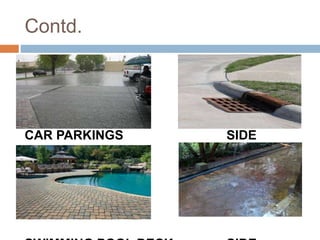
 pervious concrete pavement is mostly used in low
volume low speed roads, with personal vehicle at
a speed 50 km/hour or less.
 Such examples for its application includes:
• Sidewalks
• Parking lots
• Walkways
• Driveways
• Shoulders
• Residential Streets
Contd.
CAR PARKINGS SIDE
DRAINS
Types of pervious pavement
 Pervious cement concrete pavement.
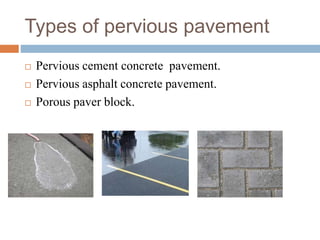
 Pervious asphalt concrete pavement.
 Porous paver block.
Pervious cement concrete
pavement.
 A mixture of coarse aggregate, Portland cement,
water and little or no sand.
 Controlled amounts of water and cementitious
materials creates a paste that forms a thick coating
around aggregate particles without flowing off
during mixing and placing
 Has a 15-25% void structure, hence lightweight.
Materials
 Portland cement
 Coarse aggregate
 Water
 Cementitious material
 admixture
Materials Proportions
Cementitious materials 270-415
Narrowly graded aggregate
(gravel/crushed stone)
1190-1480
w/c ratio 0.28-0.35 (with chemical admixtures)
0.34-0.40 (without chemical
admixtures)
Cementitious materials/Aggregate
ratio
1:0.21-1:0.25
Fine aggregate: Coarse aggregate
ratio
0 to 1:1
Polypropylene fiber (optional when
no fine aggregate is present)
0.1% by volume or 0.9 kg/𝒎 𝟑
Properties
1. Gradation of aggregate
 Aggregate gradings used in pervious concrete
are typically either single-sized coarse aggregate
or
grading 3/4 and 3/8 in (between 19 and 9.5 mm).
 A wide aggregate grading is to be avoided as
that will reduce the void content of the pervious
concrete.
Contd.
2. Compressive strength
 Falls in the range of 3.5 MPa to 28 Mpa .
Typical values are about 17 Mpa.
3. Flexural strength
 Ranges between about 1 and 3.8 Mpa.
 Influenced by degree of compaction, porosity,
and the aggregate-to-cement (A/C) ratio.
Contd
4. Density
 Depends on
-The properties and proportions of the
materials used
-Compaction procedures used in the
placement
 In-place densities in the order of 1600 to 2000
kg/m3
(falls in upper range of lightweight concretes)
Contd.
5. Durability: freeze-thaw resistance
 It depend on the saturation level of the voids in
the concrete.
 at the time of freezing Voids are saturated,
complete freezing can cause severe damage.
6. Abrasion resistance
 Open and rough structure- abrasion and raveling
of aggregate on the surface can be a problem
 Hence Highways are generally not suitable for
pervious concretes
Design considerations of pervious
cement concrete pavement
Two primary considerations enter into the
determination of the thickness of pervious
concrete pavements.
1) hydrologic design to meet environmental
requirements.
2) structural design to withstand the
anticipated traffic loading applications.
Construction
Sub grade –can be native material or imported
fill and properly compacted to achieve Density
90-95%.
surface -Uniform and stable
Sub base – clean gravel or crushed stone.
Sub grade and sub-base - moistened before
placement of pervious concrete layer.
Final layer –compacted by manually operated
roller
Mixing and transportation
 Conventional concrete mixing equipment is
used - mixing times may be extended.
 Cement may be replaced by about 10-30%
of fly ash, 20-50% of blast furnace slag and
5% of silica fume.
 Discharged completely within one hour after
initial mixing.
 Retarding admixtures - increase the
discharge time
Placement
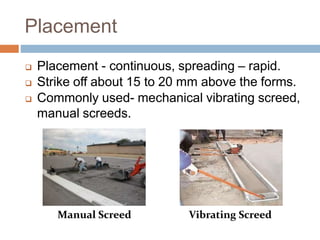
 Placement - continuous, spreading – rapid.
 Strike off about 15 to 20 mm above the forms.
 Commonly used- mechanical vibrating screed,
manual screeds.
Vibrating ScreedManual Screed
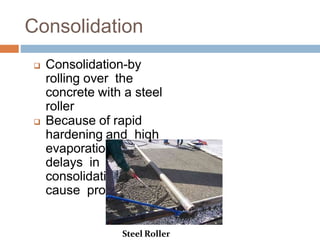
Consolidation
 Consolidation-by
rolling over the
concrete with a steel
roller
 Because of rapid
hardening and high
evaporation rates,
delays in
consolidation can
cause problems
Steel Roller
Curing
 As pervious concrete
pavements do not bleed,
they have a high tendency
for plastic shrinkage
cracking.
 Recommended curing
procedure -fog misting
followed by plastic
sheeting for 7 days.
Maintenance
 Consists of prevention of
clogging and surface
raveling.
 Cleaning by
 Power blowing
 Pressure washing
 Broom sweeping
Raveling
Broom sweeping
Environmental benefits
 Reduces storm water runoff.
 Replenishes water tables and aquifers.
 Eliminates - detention ponds - other costly
storm water management practices.
 Allows for more efficient land development.
 Prevents warm and polluted water from
entering streams.
Safety benefits
 Reduces storm water runoff.
 Replenishes water tables and aquifers.
 Eliminates - detention ponds - other costly
storm water management practices.
 Allows for more efficient land development.
 Prevents warm and polluted water from
entering streams.
Pervious concrete projects
Parking for prime outlets mallin
Williamsburg, Virginia (7.6acres)
Walkway in Beijing, Chinabuilt
for 2008 Olympics
Thank you

Pervious pavement

  • 1.
    PERVIOUS CEMENT CONCRETE PAVEMENT when itrains it drains…. Submitted to: Dr. Kanish Kapoor
  • 2.
    Pavements  Road transportis considered to be one of the cost-effective and preferred modes of transport for both freight and passengers.  India has an extensive road network of 4.24 million km– the second largest in the world.  The National Highways have a total length of 70,934 km and serve as the arterial road network of the country.  While Highways/ Expressways constitute only about 2 percent of the length of all roads, rest are state highways, major district roads, district roads and rural and other roads, which are considered as low volume roads.  Rural roads consist over 85 percent of the road network.
  • 3.
    Pervious vs Imperviouspavement Pervious concretepavement Impervious concrete pavement
  • 4.
    Pervious pavement  Perviouspavements are designed to infiltrate stormwater, reduce peak flows and promote groundwater recharge.  Pervious pavement systems consist of a surface with joints and/or openings that will freely allow water to infiltrate the system.  On an average, it can take 36,000 mm water per hour.  The level of water absorption may vary from country- to-country based on its climatic conditions.  It can take more than 100-year storm and even if it gets blocked with dirt, it can absorb 95 per cent of the water.
  • 5.
    Applications of perviouspavement  pervious concrete pavement is mostly used in low volume low speed roads, with personal vehicle at a speed 50 km/hour or less.  Such examples for its application includes: • Sidewalks • Parking lots • Walkways • Driveways • Shoulders • Residential Streets
  • 6.
  • 7.
    Types of perviouspavement  Pervious cement concrete pavement.  Pervious asphalt concrete pavement.  Porous paver block.
  • 8.
    Pervious cement concrete pavement. A mixture of coarse aggregate, Portland cement, water and little or no sand.  Controlled amounts of water and cementitious materials creates a paste that forms a thick coating around aggregate particles without flowing off during mixing and placing  Has a 15-25% void structure, hence lightweight.
  • 9.
    Materials  Portland cement Coarse aggregate  Water  Cementitious material  admixture
  • 10.
    Materials Proportions Cementitious materials270-415 Narrowly graded aggregate (gravel/crushed stone) 1190-1480 w/c ratio 0.28-0.35 (with chemical admixtures) 0.34-0.40 (without chemical admixtures) Cementitious materials/Aggregate ratio 1:0.21-1:0.25 Fine aggregate: Coarse aggregate ratio 0 to 1:1 Polypropylene fiber (optional when no fine aggregate is present) 0.1% by volume or 0.9 kg/𝒎 𝟑
  • 11.
    Properties 1. Gradation ofaggregate  Aggregate gradings used in pervious concrete are typically either single-sized coarse aggregate or grading 3/4 and 3/8 in (between 19 and 9.5 mm).  A wide aggregate grading is to be avoided as that will reduce the void content of the pervious concrete.
  • 12.
    Contd. 2. Compressive strength Falls in the range of 3.5 MPa to 28 Mpa . Typical values are about 17 Mpa. 3. Flexural strength  Ranges between about 1 and 3.8 Mpa.  Influenced by degree of compaction, porosity, and the aggregate-to-cement (A/C) ratio.
  • 13.
    Contd 4. Density  Dependson -The properties and proportions of the materials used -Compaction procedures used in the placement  In-place densities in the order of 1600 to 2000 kg/m3 (falls in upper range of lightweight concretes)
  • 14.
    Contd. 5. Durability: freeze-thawresistance  It depend on the saturation level of the voids in the concrete.  at the time of freezing Voids are saturated, complete freezing can cause severe damage. 6. Abrasion resistance  Open and rough structure- abrasion and raveling of aggregate on the surface can be a problem  Hence Highways are generally not suitable for pervious concretes
  • 15.
    Design considerations ofpervious cement concrete pavement Two primary considerations enter into the determination of the thickness of pervious concrete pavements. 1) hydrologic design to meet environmental requirements. 2) structural design to withstand the anticipated traffic loading applications.
  • 16.
    Construction Sub grade –canbe native material or imported fill and properly compacted to achieve Density 90-95%. surface -Uniform and stable Sub base – clean gravel or crushed stone. Sub grade and sub-base - moistened before placement of pervious concrete layer. Final layer –compacted by manually operated roller
  • 17.
    Mixing and transportation Conventional concrete mixing equipment is used - mixing times may be extended.  Cement may be replaced by about 10-30% of fly ash, 20-50% of blast furnace slag and 5% of silica fume.  Discharged completely within one hour after initial mixing.  Retarding admixtures - increase the discharge time
  • 18.
    Placement  Placement -continuous, spreading – rapid.  Strike off about 15 to 20 mm above the forms.  Commonly used- mechanical vibrating screed, manual screeds. Vibrating ScreedManual Screed
  • 19.
    Consolidation  Consolidation-by rolling overthe concrete with a steel roller  Because of rapid hardening and high evaporation rates, delays in consolidation can cause problems Steel Roller
  • 20.
    Curing  As perviousconcrete pavements do not bleed, they have a high tendency for plastic shrinkage cracking.  Recommended curing procedure -fog misting followed by plastic sheeting for 7 days.
  • 21.
    Maintenance  Consists ofprevention of clogging and surface raveling.  Cleaning by  Power blowing  Pressure washing  Broom sweeping Raveling Broom sweeping
  • 22.
    Environmental benefits  Reducesstorm water runoff.  Replenishes water tables and aquifers.  Eliminates - detention ponds - other costly storm water management practices.  Allows for more efficient land development.  Prevents warm and polluted water from entering streams.
  • 23.
    Safety benefits  Reducesstorm water runoff.  Replenishes water tables and aquifers.  Eliminates - detention ponds - other costly storm water management practices.  Allows for more efficient land development.  Prevents warm and polluted water from entering streams.
  • 24.
    Pervious concrete projects Parkingfor prime outlets mallin Williamsburg, Virginia (7.6acres) Walkway in Beijing, Chinabuilt for 2008 Olympics
  • 25.