Pervious concrete
Presented by
Anwer m. ali
What is pervious concrete ?
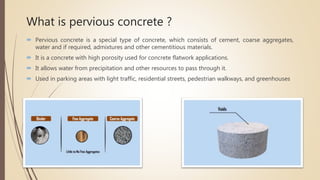
 Pervious concrete is a special type of concrete, which consists of cement, coarse aggregates,
water and if required, admixtures and other cementitious materials.
 It is a concrete with high porosity used for concrete flatwork applications.
 It allows water from precipitation and other resources to pass through it.
 Used in parking areas with light traffic, residential streets, pedestrian walkways, and greenhouses
PERVIOUS CONCRETE PAVEMETS
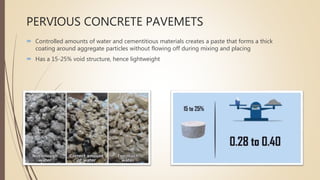
 Controlled amounts of water and cementitious materials creates a paste that forms a thick
coating around aggregate particles without flowing off during mixing and placing
 Has a 15-25% void structure, hence lightweight
Need of pervious concrete
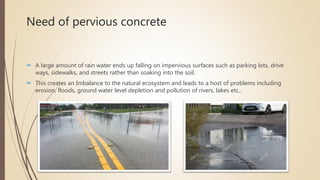
 A large amount of rain water ends up falling on impervious surfaces such as parking lots, drive
ways, sidewalks, and streets rather than soaking into the soil.
 This creates an Imbalance to the natural ecosystem and leads to a host of problems including
erosion, floods, ground water level depletion and pollution of rivers, lakes etc..
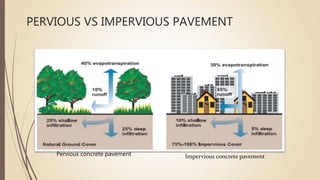
PERVIOUS VS IMPERVIOUS PAVEMENT
Pervious concrete pavement Impervious concrete pavement
PROPERTIES
 1. COMPRESSIVE STRENGTH : Falls in the range of 3.5 MPa to 28 Mpa . Typical values are about
17 Mpa
 2. FLEXURAL STRENGTH : Ranges between about 1 and 3.8 Mpa
 Influenced by degree of compaction, porosity, and the aggregate-to-cement (A/C) ratio
 3. DENSITY: Depends on
 The properties and proportions of the materials used
 Compaction procedures used in the placement
 In-place densities in the order of 1600 to 2000 kg/m3 –falls in upper range of lightweight
concretes
 4. DURABILITY : FREEZE-THAW RESISTANCE
 It depend on the saturation level of the voids in the concrete at the time of freezing
 Voids are saturated, complete freezing can cause severe damage
 5. ABRASION RESISTANCE
 Open and rough structure- abrasion and raveling of aggregate on the surface can be a problem
 Hence Highways are generally not suitable for pervious concretes
APPLICATIONS
 Residential roads , alleys and driveways
 • Low volume pavements.
 • Sidewalks and pavements.
 • Parking areas
 • Tennis courts
 • Swimming pool decks
 • Noise barriers
ADVANTAGES
 It recharges ground water directly.
 It Protects streams, watersheds, and ecosystems.
 It Reduces surface temperatures and heat island effects.
 It Eliminates need of expensive collection and
detention systems.
 It Eliminates the cost of curb and gutter installations.
DISADVANTAGES
 Extended curing time.
 It is more expensive to install as compared to traditional pavements.
 Limited use in heavy vehicle traffic areas.
 Frequent maintenance is required because it is prone to clogging.
 Compressive strength is low.
 It is not ideal for building , airport runways and highways.
WAYS OF IMPROVEMENT OF STRENGTH OF
PERVIOUS CONCRETE
 Addition of small quantity of fine aggregates
 Addition of small quantities of cementitious materials.
 Usage of small sized coarse aggregates.
 Using low w/c ratio.
Recycling of disposal Polypropylene Blister Tablets and Strapping
ties as fiber reinforcement for Pervious concrete
Mix proportion
Mixtures proportions
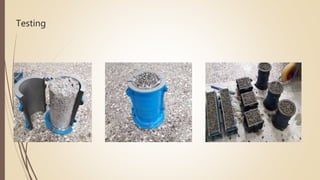
Testing
results
CONCLUSION
 In the past due to the scarcity of cement, the pervious concrete has been used extensively.
 The pervious concrete has lost its importance after successful production of cement in large quantities.
 But now-a-days, the usage pervious concrete has gained its popularity due to many advantages.
 The urban areas all over the world have become CONCRETE JUNGLES. The discharge of storm water is
very difficult problem in the present conditions.
 By using the pervious concrete we can able to recharge the ground water table and the storm water
disposal can also be done.
 So, in future it can tackle the aforesaid problems.
Pervious concrete

Pervious concrete

  • 1.
  • 2.
    What is perviousconcrete ?  Pervious concrete is a special type of concrete, which consists of cement, coarse aggregates, water and if required, admixtures and other cementitious materials.  It is a concrete with high porosity used for concrete flatwork applications.  It allows water from precipitation and other resources to pass through it.  Used in parking areas with light traffic, residential streets, pedestrian walkways, and greenhouses
  • 3.
    PERVIOUS CONCRETE PAVEMETS Controlled amounts of water and cementitious materials creates a paste that forms a thick coating around aggregate particles without flowing off during mixing and placing  Has a 15-25% void structure, hence lightweight
  • 5.
    Need of perviousconcrete  A large amount of rain water ends up falling on impervious surfaces such as parking lots, drive ways, sidewalks, and streets rather than soaking into the soil.  This creates an Imbalance to the natural ecosystem and leads to a host of problems including erosion, floods, ground water level depletion and pollution of rivers, lakes etc..
  • 6.
    PERVIOUS VS IMPERVIOUSPAVEMENT Pervious concrete pavement Impervious concrete pavement
  • 7.
    PROPERTIES  1. COMPRESSIVESTRENGTH : Falls in the range of 3.5 MPa to 28 Mpa . Typical values are about 17 Mpa  2. FLEXURAL STRENGTH : Ranges between about 1 and 3.8 Mpa  Influenced by degree of compaction, porosity, and the aggregate-to-cement (A/C) ratio  3. DENSITY: Depends on  The properties and proportions of the materials used  Compaction procedures used in the placement  In-place densities in the order of 1600 to 2000 kg/m3 –falls in upper range of lightweight concretes
  • 8.
     4. DURABILITY: FREEZE-THAW RESISTANCE  It depend on the saturation level of the voids in the concrete at the time of freezing  Voids are saturated, complete freezing can cause severe damage  5. ABRASION RESISTANCE  Open and rough structure- abrasion and raveling of aggregate on the surface can be a problem  Hence Highways are generally not suitable for pervious concretes
  • 9.
    APPLICATIONS  Residential roads, alleys and driveways  • Low volume pavements.  • Sidewalks and pavements.  • Parking areas  • Tennis courts  • Swimming pool decks  • Noise barriers
  • 10.
    ADVANTAGES  It rechargesground water directly.  It Protects streams, watersheds, and ecosystems.  It Reduces surface temperatures and heat island effects.  It Eliminates need of expensive collection and detention systems.  It Eliminates the cost of curb and gutter installations.
  • 11.
    DISADVANTAGES  Extended curingtime.  It is more expensive to install as compared to traditional pavements.  Limited use in heavy vehicle traffic areas.  Frequent maintenance is required because it is prone to clogging.  Compressive strength is low.  It is not ideal for building , airport runways and highways.
  • 12.
    WAYS OF IMPROVEMENTOF STRENGTH OF PERVIOUS CONCRETE  Addition of small quantity of fine aggregates  Addition of small quantities of cementitious materials.  Usage of small sized coarse aggregates.  Using low w/c ratio.
  • 13.
    Recycling of disposalPolypropylene Blister Tablets and Strapping ties as fiber reinforcement for Pervious concrete
  • 14.
  • 15.
  • 16.
  • 17.
  • 19.
    CONCLUSION  In thepast due to the scarcity of cement, the pervious concrete has been used extensively.  The pervious concrete has lost its importance after successful production of cement in large quantities.  But now-a-days, the usage pervious concrete has gained its popularity due to many advantages.  The urban areas all over the world have become CONCRETE JUNGLES. The discharge of storm water is very difficult problem in the present conditions.  By using the pervious concrete we can able to recharge the ground water table and the storm water disposal can also be done.  So, in future it can tackle the aforesaid problems.