Pervious Concrete Getting Down to the Details Sean Van Delist Cement Council of Texas
Permeable Pavements Pervious Concrete: What & Why? Pervious Concrete: How? Design & Construction Pervious Concrete: Other Considerations Questions & Answers Outline
  Permeable Pavements: Applying the Technology
Porous Pavements Bruce K. Ferguson
 
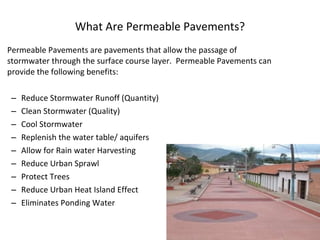
Permeable Pavements are pavements that allow the passage of stormwater through the surface course layer.  Permeable Pavements can provide the following benefits:   Reduce Stormwater Runoff (Quantity) Clean Stormwater (Quality) Cool Stormwater Replenish the water table/ aquifers Allow for Rain water Harvesting Reduce Urban Sprawl Protect Trees Reduce Urban Heat Island Effect Eliminates Ponding Water What Are Permeable Pavements?
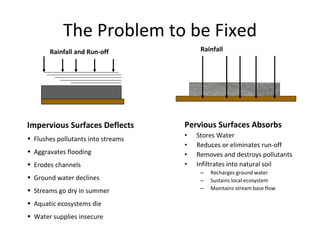
The Problem to be Fixed Pervious Surfaces Absorbs Stores Water Reduces or eliminates run-off Removes and destroys pollutants Infiltrates into natural soil Recharges ground water Sustains local ecosystem Maintains stream base flow Rainfall Impervious Surfaces Deflects Flushes pollutants into streams Aggravates flooding Erodes channels Ground water declines Streams go dry in summer Aquatic ecosystems die Water supplies insecure Rainfall and Run-off
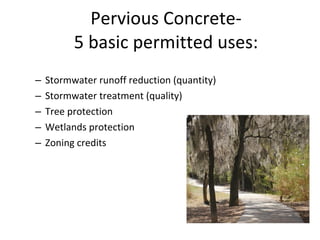
Pervious Concrete- 5 basic permitted uses: Stormwater runoff reduction (quantity) Stormwater treatment (quality) Tree protection Wetlands protection Zoning credits
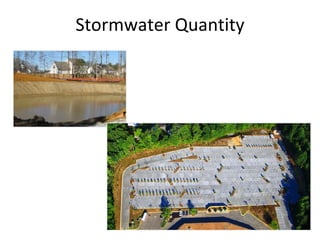
Stormwater Quantity
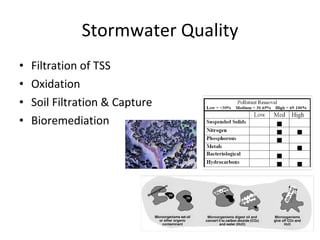
Filtration of TSS Oxidation Soil Filtration & Capture Bioremediation Stormwater Quality
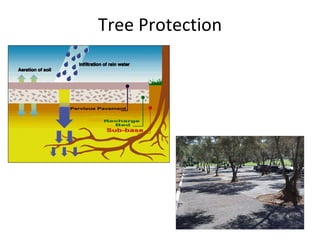
Tree Protection
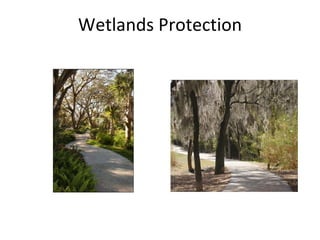
Wetlands Protection
Austin 0% credit for vehicular applications 100% credit for pedestrian applications LCRA Highland Lakes 90% credit for all applications San Antonio Required for exceeding maximum parking limits TCEQ- Edward’s Aquifer Not currently allowed over  recharge  w/o special consideration ZoningCredits
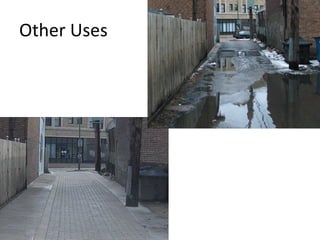
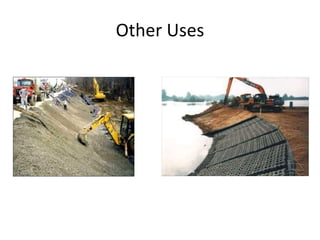
Other Uses
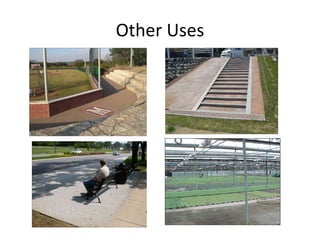
Other Uses
 
Other Uses
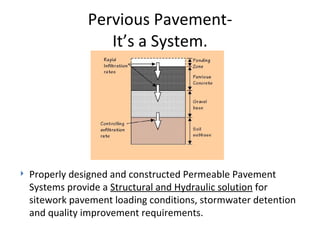
Pervious Pavement- It’s a System. Properly designed and constructed Permeable Pavement Systems provide a  Structural and Hydraulic solution  for sitework pavement loading conditions, stormwater detention and quality improvement requirements.
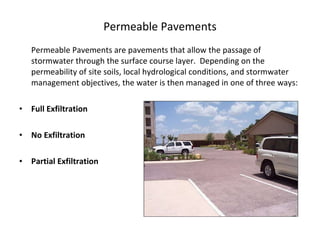
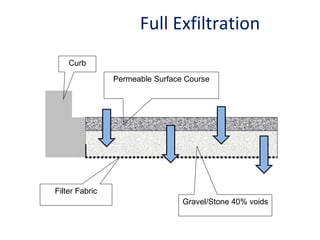
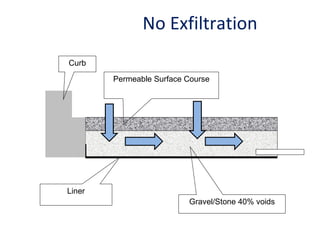
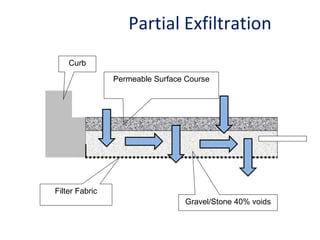
Permeable Pavements are pavements that allow the passage of stormwater through the surface course layer.  Depending on the permeability of site soils, local hydrological conditions, and stormwater management objectives, the water is then managed in one of three ways:   Full Exfiltration No Exfiltration Partial Exfiltration Permeable Pavements
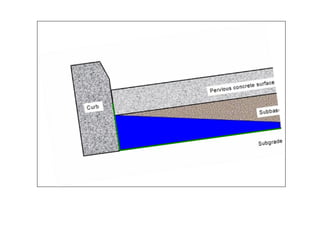
Full Exfiltration Permeable Surface Course Gravel/Stone 40% voids Filter Fabric Curb
No Exfiltration Permeable Surface Course Gravel/Stone 40% voids Liner Curb
Partial Exfiltration Permeable Surface Course Gravel/Stone 40% voids Filter Fabric Curb
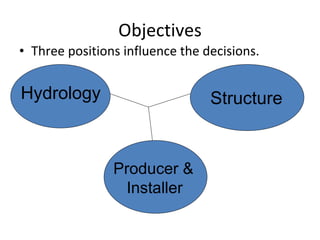
Objectives Three positions influence the decisions. Producer & Installer Hydrology Structure
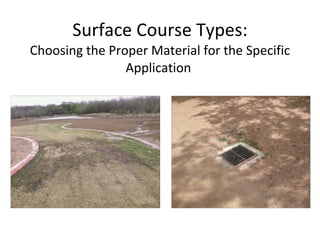
Surface Course Types: Choosing the Proper Material for the Specific Application
Dubai Initiative “ It is a very good initiative as long as it does not consume too much water, and does not need much maintenance,
Considerations All systems function hydrologically All systems require some type of maintenance Match surface course for site conditions: Climate Type of Traffic Quantity of Traffic
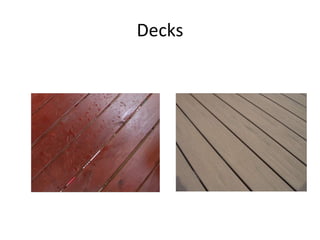
Decks
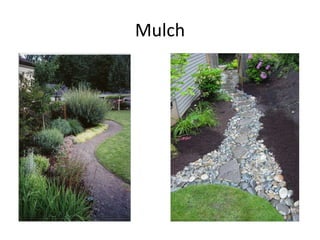
Mulch
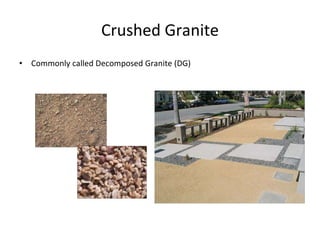
Commonly called Decomposed Granite (DG) Crushed Granite
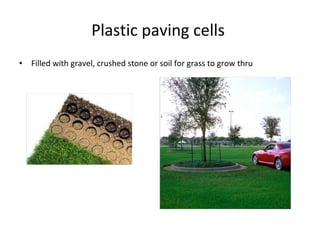
Filled with gravel, crushed stone or soil for grass to grow thru Plastic paving cells
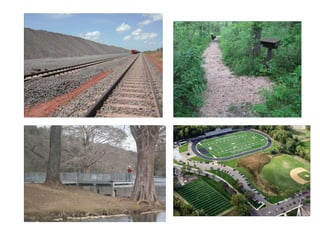
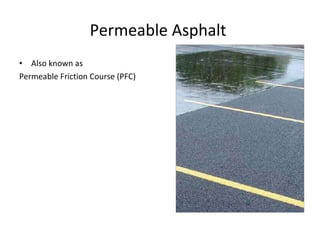
Also known as  Permeable Friction Course (PFC) Permeable Asphalt
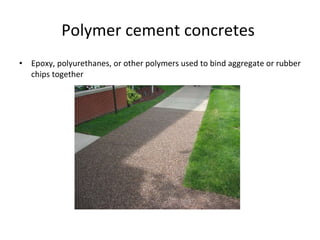
Epoxy, polyurethanes, or other polymers used to bind aggregate or rubber chips together Polymer cement concretes
 
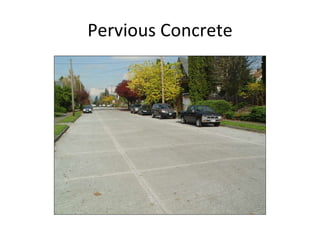
Pervious Concrete
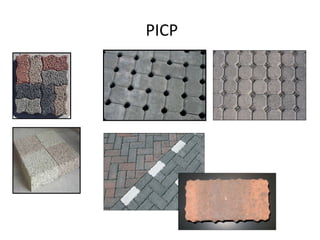
  PICP
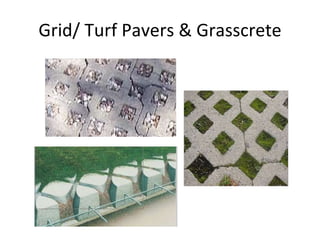
Grid/ Turf Pavers & Grasscrete
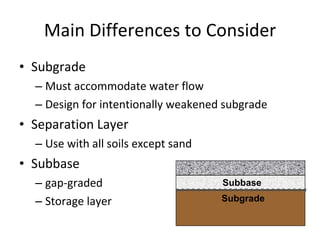
Main Differences to Consider Subgrade Must accommodate water flow Design for intentionally weakened subgrade Separation Layer Use with all soils except sand Subbase gap-graded Storage layer Subbase Subgrade
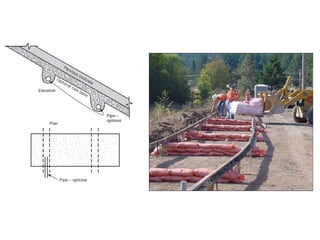
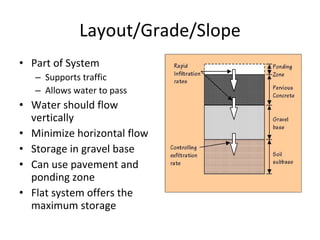
Layout/Grade/Slope Part of System Supports traffic Allows water to pass Water should flow vertically Minimize horizontal flow Storage in gravel base Can use pavement and ponding zone Flat system offers the maximum storage


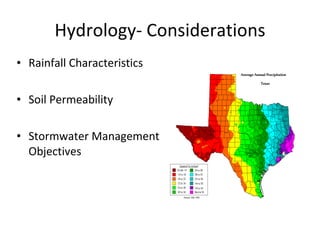
Hydrology- Considerations Rainfall Characteristics Soil Permeability Stormwater Management Objectives
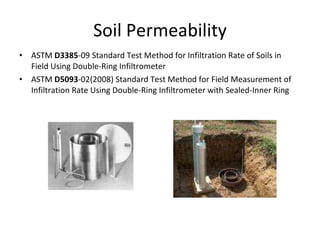
Soil Permeability ASTM  D3385 -09 Standard Test Method for Infiltration Rate of Soils in Field Using Double-Ring Infiltrometer ASTM  D5093 -02(2008) Standard Test Method for Field Measurement of Infiltration Rate Using Double-Ring Infiltrometer with Sealed-Inner Ring
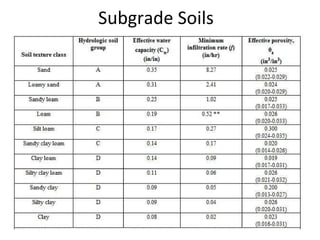
Subgrade Soils
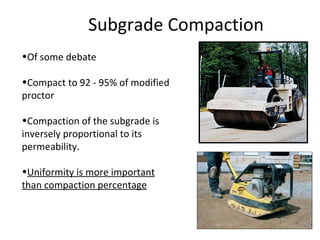
Subgrade Compaction Of some debate Compact to 92 - 95% of modified proctor Compaction of the subgrade is inversely proportional to its permeability.  Uniformity is more important than compaction percentage
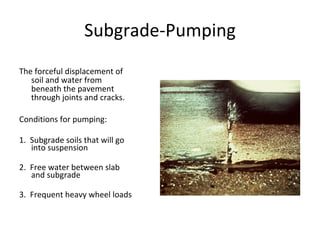
Subgrade-Pumping The forceful displacement of soil and water from beneath the pavement through joints and cracks. Conditions for pumping: 1.  Subgrade soils that will go into suspension 2.  Free water between slab and subgrade 3.  Frequent heavy wheel loads insert photo from winpump.ppt
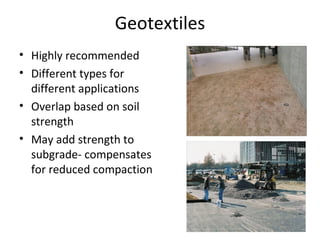
Geotextiles Highly recommended Different types for different applications Overlap based on soil strength May add strength to subgrade- compensates for reduced compaction
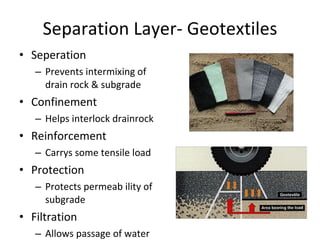
Separation Layer- Geotextiles Seperation Prevents intermixing of drain rock & subgrade Confinement Helps interlock drainrock Reinforcement Carrys some tensile load Protection Protects permeab ility of subgrade Filtration Allows passage of water
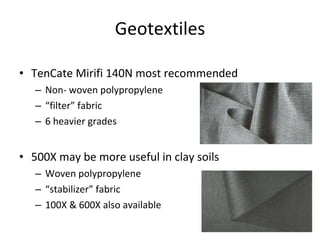
Geotextiles TenCate Mirifi 140N most recommended Non- woven polypropylene “ filter” fabric 6 heavier grades 500X may be more useful in clay soils Woven polypropylene “ stabilizer” fabric 100X & 600X also available
 
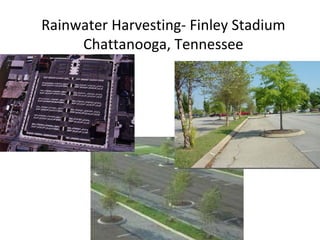
Rainwater Harvesting- Finley Stadium Chattanooga, Tennessee
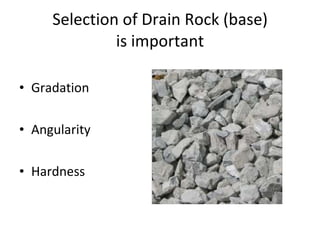
Gradation Angularity Hardness Selection of Drain Rock (base) is important
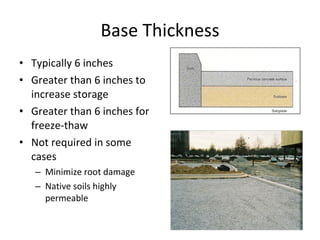
Base Thickness Typically 6 inches Greater than 6 inches to increase storage Greater than 6 inches for freeze-thaw Not required in some cases Minimize root damage Native soils highly permeable
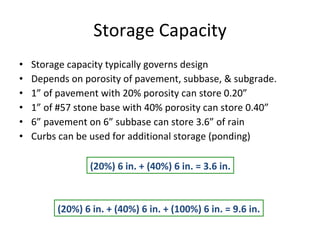
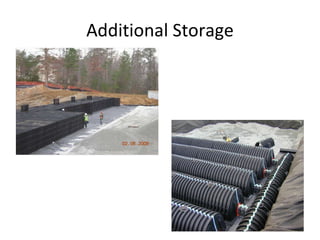
Storage Capacity Storage capacity typically governs design Depends on porosity of pavement, subbase, & subgrade. 1” of pavement with 20% porosity can store 0.20” 1” of #57 stone base with 40% porosity can store 0.40” 6” pavement on 6” subbase can store 3.6” of rain Curbs can be used for additional storage (ponding) (20%) 6 in. + (40%) 6 in. = 3.6 in. (20%) 6 in. + (40%) 6 in. + (100%) 6 in. = 9.6 in.
Additional Storage
  Pervious Concrete: What & Why?
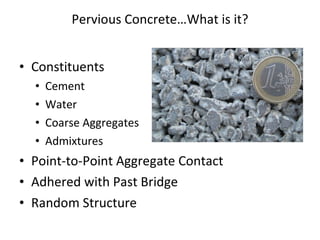
Pervious Concrete…What is it? Constituents Cement Water Coarse Aggregates Admixtures Point-to-Point Aggregate Contact Adhered with Past Bridge Random Structure
Mixture Proportions 2400-2600 lbs.- #89 stone 100-400 lbs.- silica sand (<#16- >#200) 400-650 lbs.- portland cement 0.27-0.32 w/c ratio admixtures
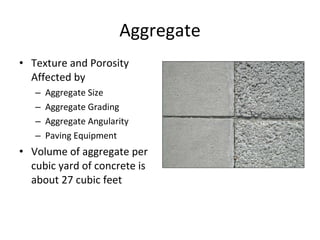
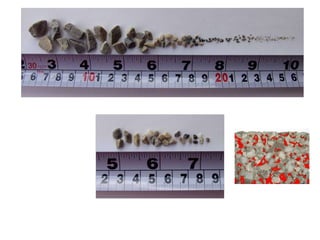
Aggregate Texture and Porosity Affected by Aggregate Size Aggregate Grading Aggregate Angularity Paving Equipment Volume of aggregate per cubic yard of concrete is about 27 cubic feet
 
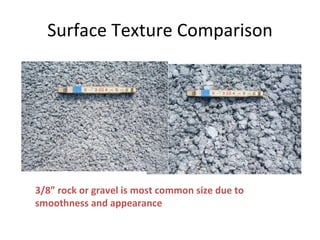
Surface Texture Comparison 3/8” rock or gravel is most common size due to smoothness and appearance
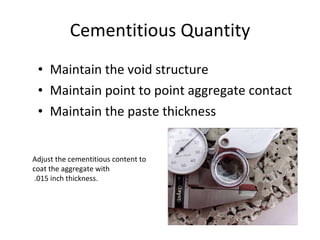
Cementitious Quantity Maintain the void structure Maintain point to point aggregate contact Maintain the paste thickness Adjust the cementitious content to coat the aggregate with .015 inch thickness.
Water Content Water/ Cement Ratio: 0.27-0.32  Contractor Controls Water Content to Match: Equipment Weather Water may be added at the jobsite
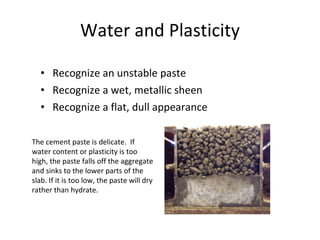
Water and Plasticity Recognize an unstable paste Recognize a wet, metallic sheen Recognize a flat, dull appearance The cement paste is delicate.  If water content or plasticity is too high, the paste falls off the aggregate and sinks to the lower parts of the slab. If it is too low, the paste will dry rather than hydrate.
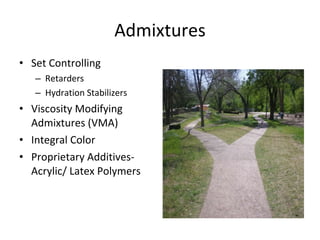
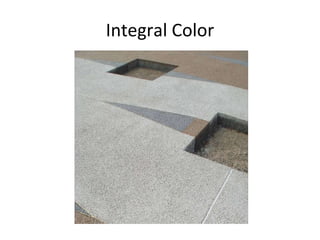
Admixtures Set Controlling Retarders Hydration Stabilizers Viscosity Modifying Admixtures (VMA) Integral Color Proprietary Additives- Acrylic/ Latex Polymers
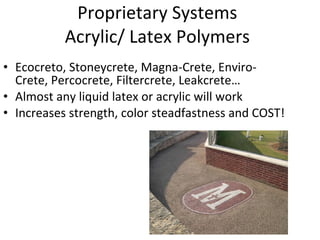
Proprietary Systems Acrylic/ Latex Polymers Ecocreto, Stoneycrete, Magna-Crete, Enviro-Crete, Percocrete, Filtercrete, Leakcrete… Almost any liquid latex or acrylic will work Increases strength, color steadfastness and COST!
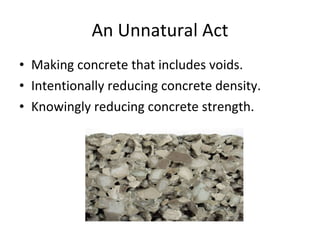
An Unnatural Act Making concrete that includes voids.  Intentionally reducing concrete density.  Knowingly reducing concrete strength.
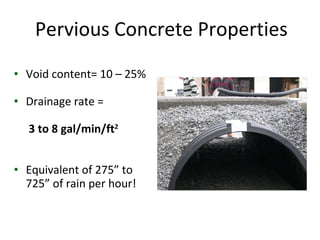
Void content= 10 – 25% Drainage rate =   3 to 8 gal/min/ft 2 Equivalent of 275” to 725” of rain per hour! Pervious Concrete Properties
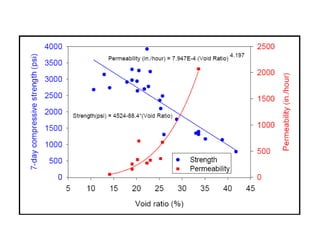
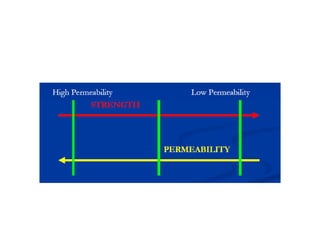
110 to 130 lbs/ft 3  unit weight Corresponds to void content 1000 to 4000 psi strength Introduction of small amount of fine aggregate and/ or polymers help can increase strength. Pervious Concrete Properties
 
Properties Testing- Quality Control Conventional concrete testing methods do NOT apply No/ Low slump concrete Compressive/ Flexural strength  testing of lab & field samples has high variability and less accuracy  Density & Void Content and Field Permeability are only tests for acceptance other ASTM Standards & Testing Methods are currently under development
ASTM C09.49 Standards & Work Groups Fresh density and void content-  C1688 Field Permeability-  C1701 Compressive Strength/ Flexural Strength  Hardened Density and Voids  Surface Durability
Designation: C 1688/ C 1688M – 08 0.25 cubic ft. bowl & standard proctor hammer 20 blows per 2 layers D ensity=  M ass/  V olume Void content ( U )=  T heoretical-  D ensity T heoretical Standard Test Method for Density and Void Content of Freshly Mixed Pervious Concrete
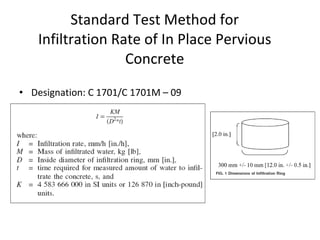
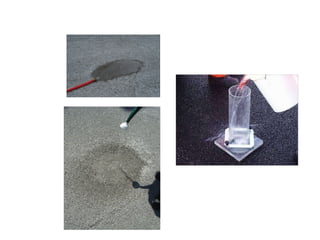
Designation: C 1701/C 1701M – 09 Standard Test Method for Infiltration Rate of In Place Pervious Concrete
High variability with standard procedures  Partially due to inconsistent modification of test Partially due to nature of materials Will always be difficult to match placement conditions Current Proposal 4X8 cylinders- 2 layers- 5 drops of proctor hammer Strength Testing
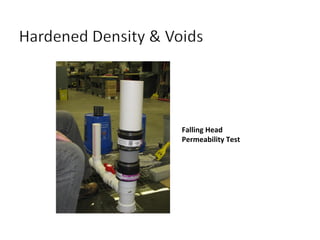
Falling Head Permeability Test
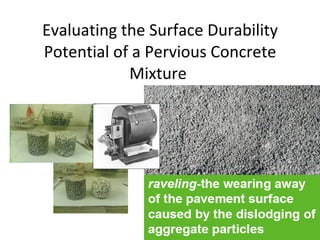
Evaluating the Surface Durability Potential of a Pervious Concrete Mixture
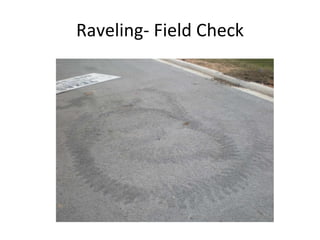
Raveling- Field Check
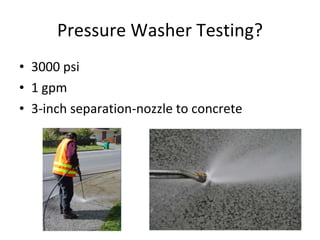
Pressure Washer Testing? 3000 psi 1 gpm 3-inch separation-nozzle to concrete
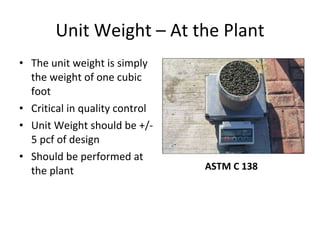
Unit Weight – At the Plant The unit weight is simply the weight of one cubic foot Critical in quality control Unit Weight should be +/- 5 pcf of design Should be performed at the plant ASTM C 138
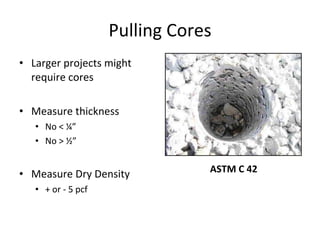
Pulling Cores Larger projects might require cores Measure thickness No < ¼” No > ½” Measure Dry Density + or - 5 pcf ASTM C 42
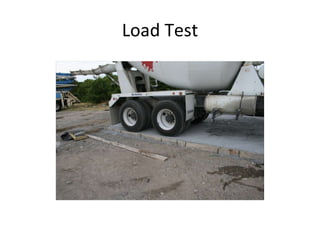
Load Test
  Pervious Concrete: How? Design & Construction
How? Relatively new technology (in Texas) Few established standards and methods Little collected data on properties Design and construct conservatively!
Pervious Concrete Truths •  You have to select, design, and build it right •  You can design it to fail •  You can design it to succeed •  It requires your knowledge & care Pervious concrete is distinct and different •  Every installation is site-specific
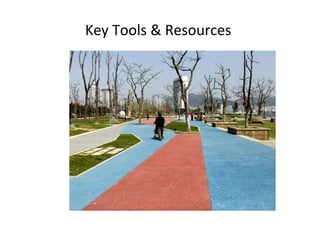
Key Tools & Resources  
 
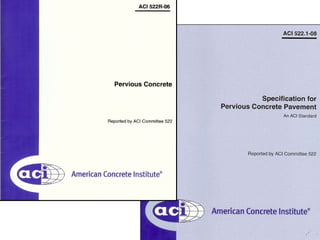
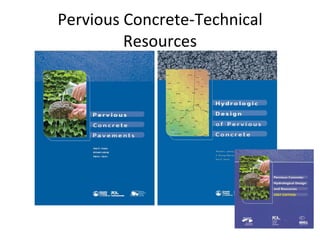
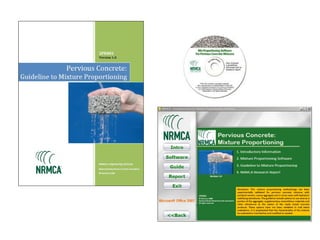
Pervious Concrete-Technical Resources
 
Administered by Texas Aggregates & Concrete Assoc. Several classes offered annually across the state Private training classes available upon request  
National Network Portland Cement Association National Ready Mixed Concrete Association American Society of Concrete Contractors American Concrete Institute American Society for Testing and Materials
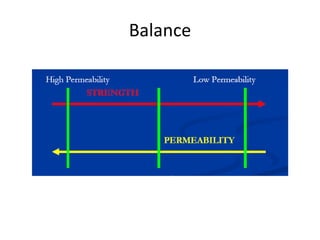
Balance
Structural Design Procedures ACI 522 Chapter 6 – AASHTO or PCA if strength falls within limits (usually doesn’t) PCA Pervious Concrete Pavements suggests AASHTO, WinPas, PCAPAV, ACI 325, or ACI 330R, or using flexible pavement structural numbers ACI 325.12R and 330.1R tables require minimum flexural strength of 500 psi Bruce K. Ferguson “Porous Pavements” – p. 420, “Six inches probably minimum thickness…” and “Heavier traffic loads require thicker slabs.” We need a proper engineering procedure
Further Research Needed–  Design and Performance Field performance studies under heavy traffic Fatigue relationship for pervious concrete Performance of aggregate interlock joints over time (faulting progression) Feasibility of using dowels – diameter, bearing stress
Further Research – Materials Structural grades Different aggregate gradations Small amount of fine aggregate Tradeoff between strength and permeability
In the Interim… Increase Attention to Detail Increase Emphasis on Construction Quality Reduce Emphasis on Strength Design Conservatively
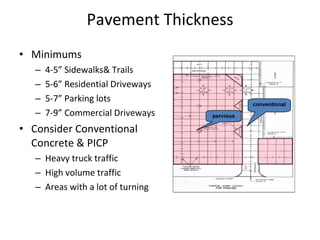
Pavement Thickness Minimums 4-5” Sidewalks& Trails 5-6” Residential Driveways 5-7” Parking lots 7-9” Commercial Driveways Consider Conventional Concrete & PICP Heavy truck traffic High volume traffic Areas with a lot of turning pervious conventional
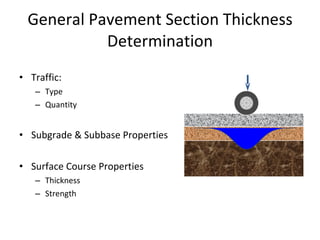
Traffic: Type  Quantity Subgrade & Subbase Properties Surface Course Properties Thickness Strength General Pavement Section Thickness Determination
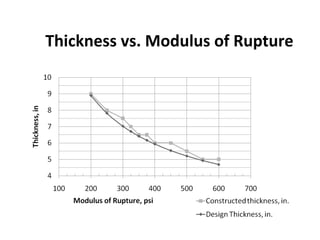
Strength vs. Thickness Section strength – proportionate to: Square of the thickness Material Strength So, if you want a stronger pavement, you can  Use a LOT stronger concrete Use a little more concrete If the concrete has to be weaker (and in this case, it does) You can make the section as strong by making it thicker A Little thicker…
Thickness vs. Modulus of Rupture
Thickness… Turns out to be the answer to a number of questions Poor Subgrade? Increases Thickness More traffic? Increase Thickness Heavier Loads? Increase Thickness Lower Flexural Strength? Increases Thickness
What does this say about strength? If you can’t have strength Make it thicker A little thicker If you can’t affirm strength Make it thicker A little thicker If you need strength Make it thicker Don’t make the materials stronger Unless you don’t need pervious.
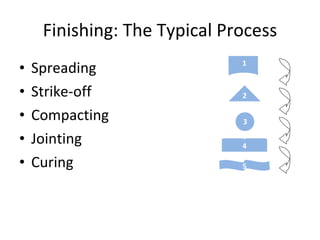
Finishing: The Typical Process Spreading Strike-off Compacting Jointing Curing 1 2 3 4 5
“ Each builder has a style; a favorite way to assemble his method, his setup, and his crew. Some will perform their flatwork as though they were building pianos. Others will slap it down, any way that gets them paid. Such is the difference between craftsmen and henchmen. There seems to be room for everyone…” Ken Bunyan (Dave Mitchell) inventor of the Bunyan hydraulic roller screed.
Finishing Qualifications Require a Contractor who has successfully completed the NRMCA Pervious Concrete Contractor Certification Course is required.  Specified # of Technicians, Installers, & Craftsmen In addition to this requirement, the placing contractor shall furnish: A minimum of 2 completed projects with addresses Unit weight acceptance data In-situ pavement test results including void  content and unit weight Sample of product Proposed equipment to be used
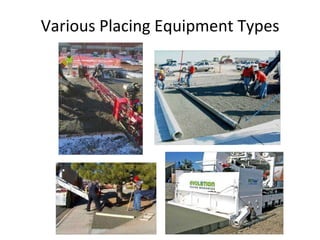
Various Placing Equipment Types
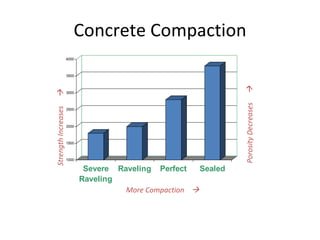
Concrete Compaction More Compaction = Less Porosity Strength Increases   Porosity Decreases   More Compaction  
 
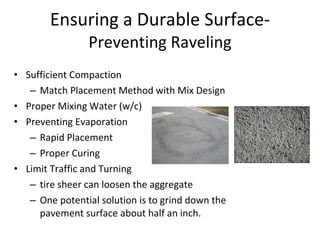
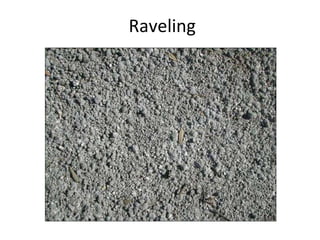
Ensuring a Durable Surface- Preventing Raveling Sufficient Compaction Match Placement Method with Mix Design Proper Mixing Water (w/c) Preventing Evaporation  Rapid Placement Proper Curing Limit Traffic and Turning tire sheer can loosen the aggregate  One potential solution is to grind down the pavement surface about half an inch.
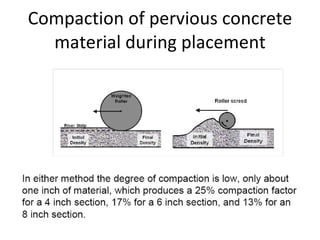
Compaction of pervious concrete material during placement
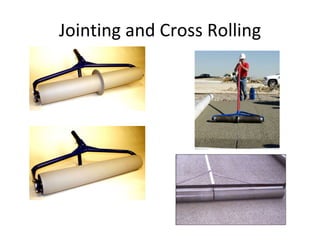
Jointing and Cross Rolling
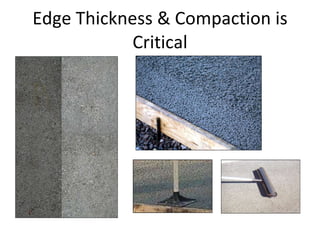
Edge Thickness & Compaction is Critical
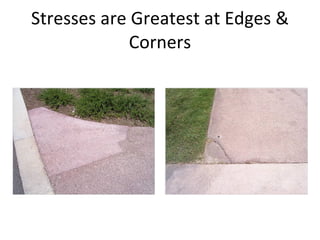
Stresses are Greatest at Edges & Corners
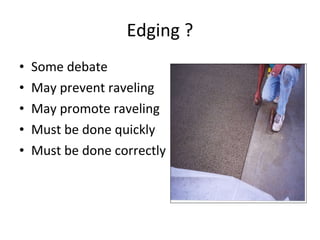
Edging ? Some debate May prevent raveling May promote raveling Must be done quickly Must be done correctly
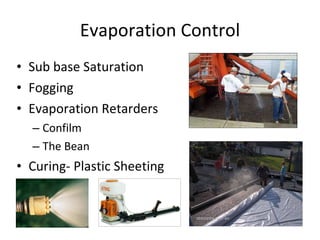
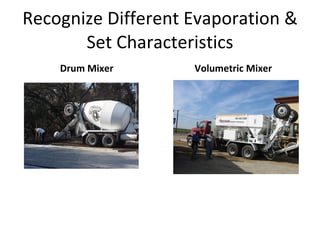
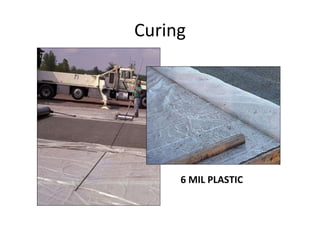
Evaporation Control Sub base Saturation Fogging Evaporation Retarders Confilm The Bean Curing- Plastic Sheeting
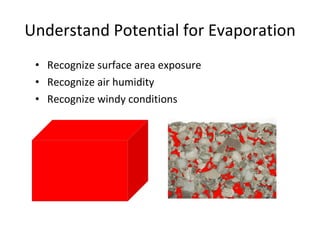
Understand Potential for Evaporation Recognize surface area exposure Recognize air humidity Recognize windy conditions
Cement Hydration Recognize low water traits Recognize early hydration process Recognize evaporation Water / Cement ratio is about ½ the water of conventional concrete. The low water cement ratio causes hydration to flash. Normal pervious materials require more mixing. Batch water and add water must be more closely controlled. Mixer discharge is slower and may batter the inside of the drum.
Cement Hydration Launch The first fifteen minutes Tricalcium Aluminate The first two hours Tricalcium Silicate The rich cement content and low water content is prone to flash. the hydration, starting during the first fifteen minutes.  The clock begins ticking when the ingredients are combined. Load 80% of the water and all the admixtures before introducing the cement and aggregate.
Recognize Different Evaporation & Set Characteristics Drum Mixer Volumetric Mixer
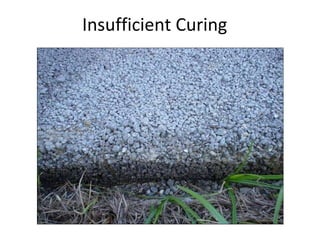
Insufficient Curing
Raveling
Curing 6 MIL PLASTIC
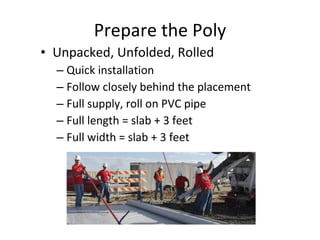
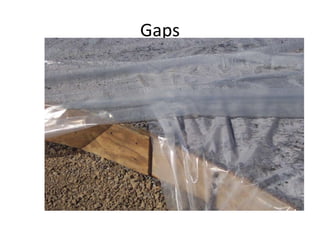
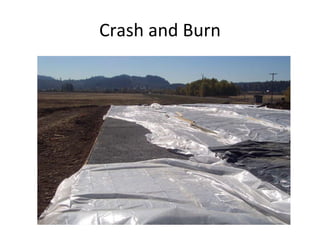
Prepare the Poly Unpacked, Unfolded, Rolled Quick installation Follow closely behind the placement Full supply, roll on PVC pipe Full length = slab + 3 feet Full width = slab + 3 feet
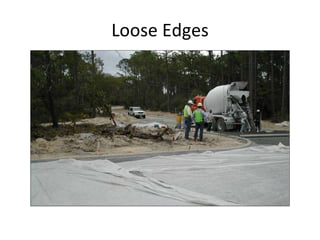
Loose Edges
Gaps
Crash and Burn
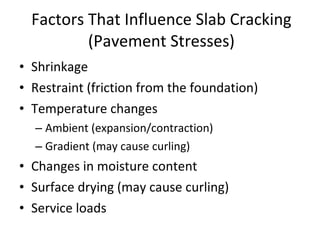
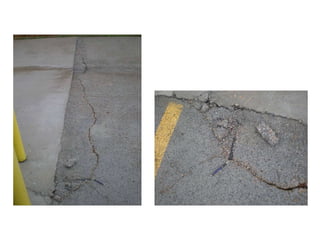
Shrinkage Restraint (friction from the foundation) Temperature changes Ambient (expansion/contraction) Gradient (may cause curling) Changes in moisture content Surface drying (may cause curling) Service loads Factors That Influence Slab Cracking (Pavement Stresses)
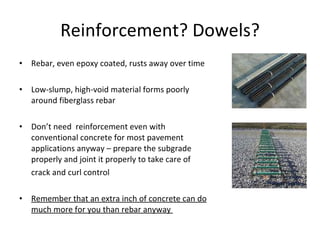
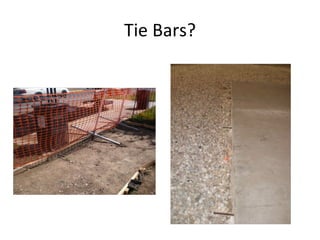
Rebar, even epoxy coated, rusts away over time Low-slump, high-void material forms poorly around fiberglass rebar Don’t need  reinforcement even with conventional concrete for most pavement applications anyway – prepare the subgrade properly and joint it properly to take care of crack and curl control Remember that an extra inch of concrete can do much more for you than rebar anyway  Reinforcement? Dowels?
Tie Bars?
 
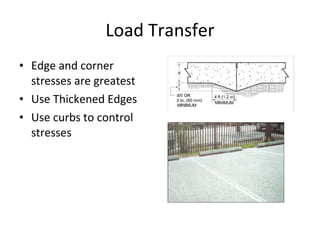
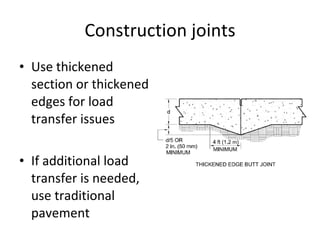
Load Transfer Edge and corner stresses are greatest Use Thickened Edges Use curbs to control stresses
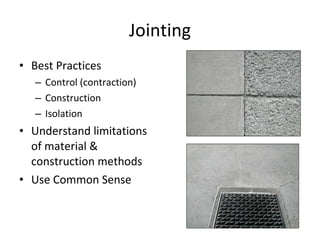
Jointing Best Practices Control (contraction) Construction Isolation Understand limitations of material & construction methods Use Common Sense
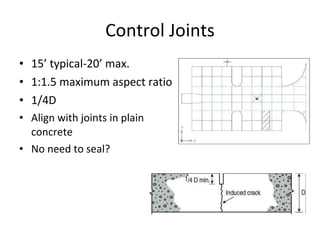
Control Joints 15’ typical-20’ max. 1:1.5 maximum aspect ratio  1/4D Align with joints in plain concrete No need to seal?
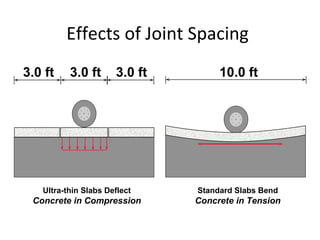
Effects of Joint Spacing  10.0 ft 3.0 ft 3.0 ft 3.0 ft Ultra-thin Slabs Deflect Concrete in Compression Standard Slabs Bend Concrete in Tension
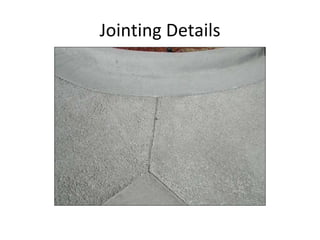
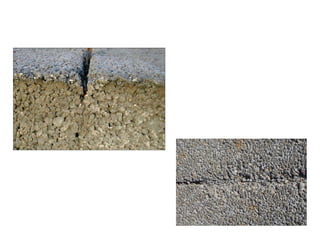
Jointing Details
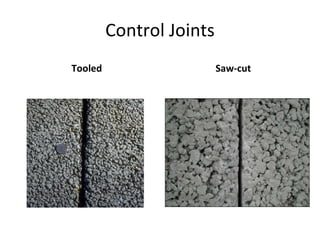
Control Joints Tooled Saw-cut
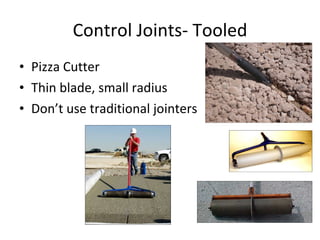
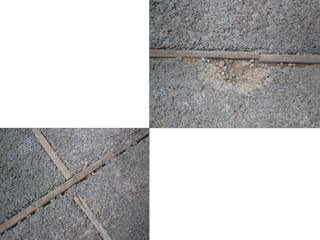
Control Joints- Tooled Pizza Cutter Thin blade, small radius Don’t use traditional jointers
 
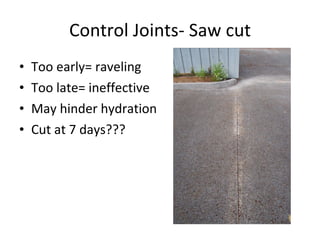
Control Joints- Saw cut Too early= raveling Too late= ineffective May hinder hydration Cut at 7 days???
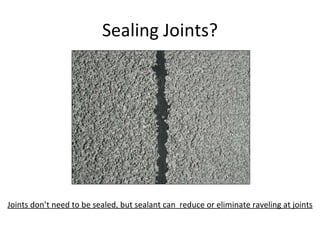
Sealing Joints? Joints don’t need to be sealed, but sealant can  reduce or eliminate raveling at joints
Construction joints Use thickened section or thickened edges for load transfer issues If additional load transfer is needed, use traditional pavement
 
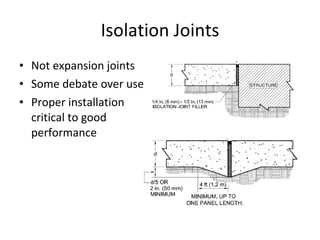
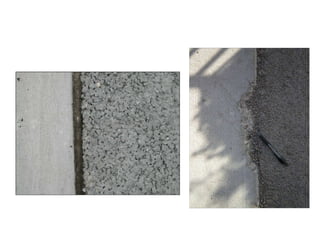
Isolation Joints Not expansion joints Some debate over use Proper installation critical to good performance
 
 
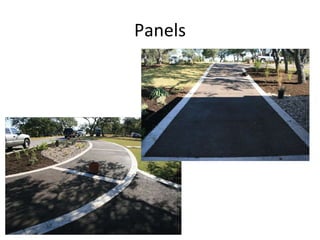
Panels
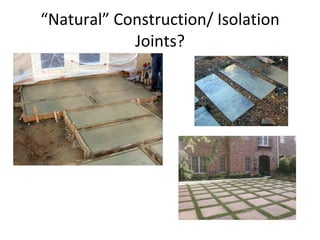
“ Natural” Construction/ Isolation Joints?
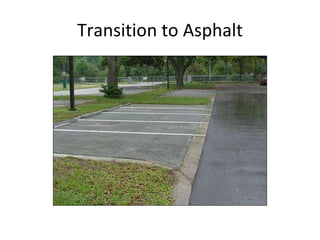
Transition to Asphalt
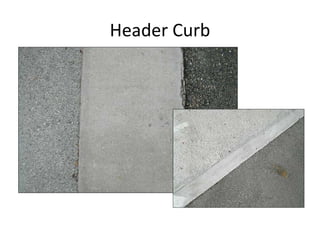
Header Curb
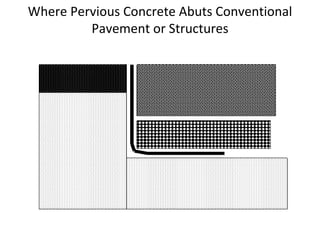
Where Pervious Concrete Abuts Conventional Pavement or Structures
Important Points for Design & Construction of Pervious Concrete Get a soils report Determine thickness design based on usage, ADTT and soil type. Determine base thickness based on design storm, soil type and flow concentration Pay close attention to detail in methods and materials. Use a contractor with NRMCA certified pervious concrete technicians. Utilize industry resources – they are free!!
  Pervious Concrete: Other Considerations
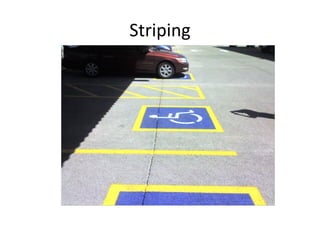
Striping
Integral Color
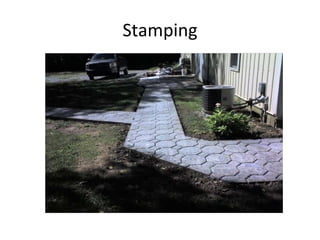
Stamping
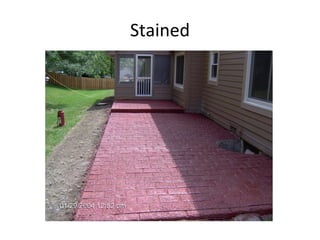
Stained
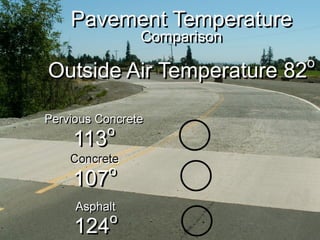
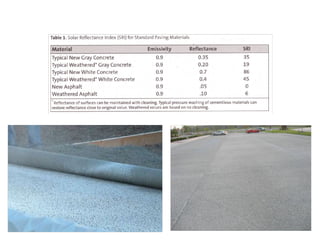
Pervious Concrete- LEED 3.0 Considerations May Contribute to: SS Credit 6.1 Stormwater Design—Quantity Control (1) SS Credit 6.2 Stormwater Design—Quality Control (1) WE Credit 1 Water Efficient Landscaping (1-4) MR Credit 4 Recycled Content (1-2) MR Credit 5 Regional Materials (1-2) Regional Priority Credits for SS 6.1 & 6.2 (1-2) May Detract from: SS Credit 7.1 Heat Island Effect—Nonroof
 
 
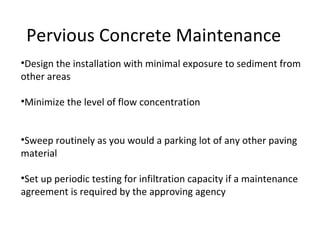
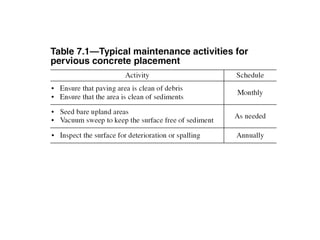
Pervious Concrete Maintenance Design the installation with minimal exposure to sediment from other areas Minimize the level of flow concentration Sweep routinely as you would a parking lot of any other paving material Set up periodic testing for infiltration capacity if a maintenance agreement is required by the approving agency
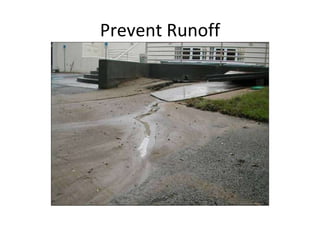
Prevent Runoff
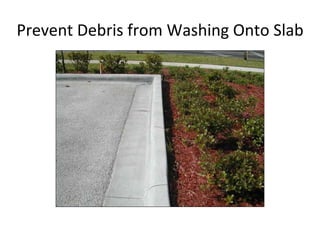
Prevent Debris from Washing Onto Slab
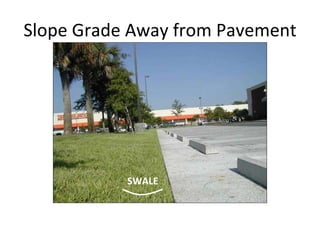
Slope Grade Away from Pavement SWALE
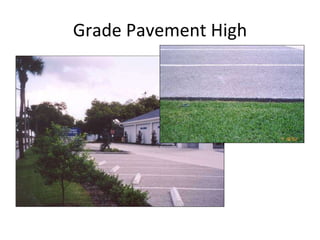
Grade Pavement High
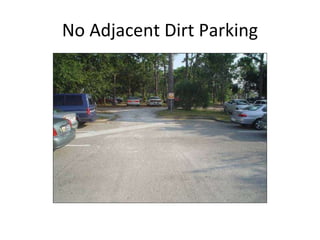
No Adjacent Dirt Parking
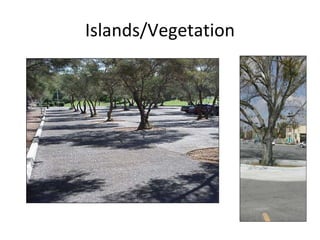
Islands/Vegetation
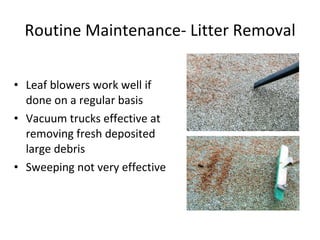
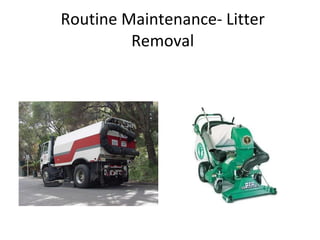
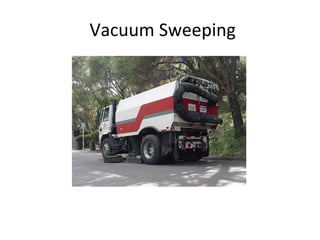
Routine Maintenance- Litter Removal Leaf blowers work well if done on a regular basis Vacuum trucks effective at removing fresh deposited large debris Sweeping not very effective
Routine Maintenance- Litter Removal
Vacuum Sweeping
Vacuum Sweeping
 
 
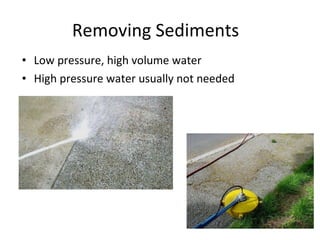
Removing Sediments  Low pressure, high volume water High pressure water usually not needed
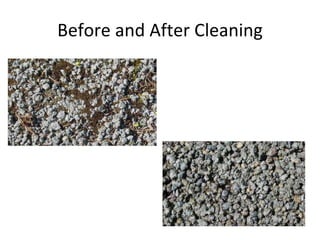
Before and After Cleaning
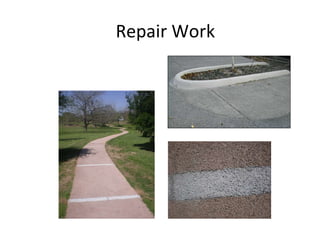
Repair Work
Questions? For additional information or assistance, Please call or email: Sean Van Delist 210-883-8060 [email_address]

Pervious Concrete: Getting Down to the Details

  • 1.
    Pervious Concrete GettingDown to the Details Sean Van Delist Cement Council of Texas
  • 2.
    Permeable Pavements PerviousConcrete: What & Why? Pervious Concrete: How? Design & Construction Pervious Concrete: Other Considerations Questions & Answers Outline
  • 3.
    PermeablePavements: Applying the Technology
  • 4.
  • 5.
  • 6.
    Permeable Pavements arepavements that allow the passage of stormwater through the surface course layer. Permeable Pavements can provide the following benefits:   Reduce Stormwater Runoff (Quantity) Clean Stormwater (Quality) Cool Stormwater Replenish the water table/ aquifers Allow for Rain water Harvesting Reduce Urban Sprawl Protect Trees Reduce Urban Heat Island Effect Eliminates Ponding Water What Are Permeable Pavements?
  • 7.
    The Problem tobe Fixed Pervious Surfaces Absorbs Stores Water Reduces or eliminates run-off Removes and destroys pollutants Infiltrates into natural soil Recharges ground water Sustains local ecosystem Maintains stream base flow Rainfall Impervious Surfaces Deflects Flushes pollutants into streams Aggravates flooding Erodes channels Ground water declines Streams go dry in summer Aquatic ecosystems die Water supplies insecure Rainfall and Run-off
  • 8.
    Pervious Concrete- 5basic permitted uses: Stormwater runoff reduction (quantity) Stormwater treatment (quality) Tree protection Wetlands protection Zoning credits
  • 9.
  • 10.
    Filtration of TSSOxidation Soil Filtration & Capture Bioremediation Stormwater Quality
  • 11.
  • 12.
  • 13.
    Austin 0% creditfor vehicular applications 100% credit for pedestrian applications LCRA Highland Lakes 90% credit for all applications San Antonio Required for exceeding maximum parking limits TCEQ- Edward’s Aquifer Not currently allowed over recharge w/o special consideration ZoningCredits
  • 14.
  • 15.
  • 16.
  • 17.
  • 18.
    Pervious Pavement- It’sa System. Properly designed and constructed Permeable Pavement Systems provide a Structural and Hydraulic solution for sitework pavement loading conditions, stormwater detention and quality improvement requirements.
  • 19.
    Permeable Pavements arepavements that allow the passage of stormwater through the surface course layer. Depending on the permeability of site soils, local hydrological conditions, and stormwater management objectives, the water is then managed in one of three ways:   Full Exfiltration No Exfiltration Partial Exfiltration Permeable Pavements
  • 20.
    Full Exfiltration PermeableSurface Course Gravel/Stone 40% voids Filter Fabric Curb
  • 21.
    No Exfiltration PermeableSurface Course Gravel/Stone 40% voids Liner Curb
  • 22.
    Partial Exfiltration PermeableSurface Course Gravel/Stone 40% voids Filter Fabric Curb
  • 23.
    Objectives Three positionsinfluence the decisions. Producer & Installer Hydrology Structure
  • 24.
    Surface Course Types:Choosing the Proper Material for the Specific Application
  • 25.
    Dubai Initiative “It is a very good initiative as long as it does not consume too much water, and does not need much maintenance,
  • 26.
    Considerations All systemsfunction hydrologically All systems require some type of maintenance Match surface course for site conditions: Climate Type of Traffic Quantity of Traffic
  • 27.
  • 28.
  • 29.
    Commonly called DecomposedGranite (DG) Crushed Granite
  • 30.
    Filled with gravel,crushed stone or soil for grass to grow thru Plastic paving cells
  • 31.
    Also known as Permeable Friction Course (PFC) Permeable Asphalt
  • 32.
    Epoxy, polyurethanes, orother polymers used to bind aggregate or rubber chips together Polymer cement concretes
  • 33.
  • 34.
  • 35.
  • 36.
    Grid/ Turf Pavers& Grasscrete
  • 37.
    Main Differences toConsider Subgrade Must accommodate water flow Design for intentionally weakened subgrade Separation Layer Use with all soils except sand Subbase gap-graded Storage layer Subbase Subgrade
  • 38.
    Layout/Grade/Slope Part ofSystem Supports traffic Allows water to pass Water should flow vertically Minimize horizontal flow Storage in gravel base Can use pavement and ponding zone Flat system offers the maximum storage
  • 39.
  • 40.
  • 41.
  • 42.
    Hydrology- Considerations RainfallCharacteristics Soil Permeability Stormwater Management Objectives
  • 43.
    Soil Permeability ASTM D3385 -09 Standard Test Method for Infiltration Rate of Soils in Field Using Double-Ring Infiltrometer ASTM D5093 -02(2008) Standard Test Method for Field Measurement of Infiltration Rate Using Double-Ring Infiltrometer with Sealed-Inner Ring
  • 44.
  • 45.
    Subgrade Compaction Ofsome debate Compact to 92 - 95% of modified proctor Compaction of the subgrade is inversely proportional to its permeability. Uniformity is more important than compaction percentage
  • 46.
    Subgrade-Pumping The forcefuldisplacement of soil and water from beneath the pavement through joints and cracks. Conditions for pumping: 1. Subgrade soils that will go into suspension 2. Free water between slab and subgrade 3. Frequent heavy wheel loads insert photo from winpump.ppt
  • 47.
    Geotextiles Highly recommendedDifferent types for different applications Overlap based on soil strength May add strength to subgrade- compensates for reduced compaction
  • 48.
    Separation Layer- GeotextilesSeperation Prevents intermixing of drain rock & subgrade Confinement Helps interlock drainrock Reinforcement Carrys some tensile load Protection Protects permeab ility of subgrade Filtration Allows passage of water
  • 49.
    Geotextiles TenCate Mirifi140N most recommended Non- woven polypropylene “ filter” fabric 6 heavier grades 500X may be more useful in clay soils Woven polypropylene “ stabilizer” fabric 100X & 600X also available
  • 50.
  • 51.
    Rainwater Harvesting- FinleyStadium Chattanooga, Tennessee
  • 52.
    Gradation Angularity HardnessSelection of Drain Rock (base) is important
  • 53.
    Base Thickness Typically6 inches Greater than 6 inches to increase storage Greater than 6 inches for freeze-thaw Not required in some cases Minimize root damage Native soils highly permeable
  • 54.
    Storage Capacity Storagecapacity typically governs design Depends on porosity of pavement, subbase, & subgrade. 1” of pavement with 20% porosity can store 0.20” 1” of #57 stone base with 40% porosity can store 0.40” 6” pavement on 6” subbase can store 3.6” of rain Curbs can be used for additional storage (ponding) (20%) 6 in. + (40%) 6 in. = 3.6 in. (20%) 6 in. + (40%) 6 in. + (100%) 6 in. = 9.6 in.
  • 55.
  • 56.
    PerviousConcrete: What & Why?
  • 57.
    Pervious Concrete…What isit? Constituents Cement Water Coarse Aggregates Admixtures Point-to-Point Aggregate Contact Adhered with Past Bridge Random Structure
  • 58.
    Mixture Proportions 2400-2600lbs.- #89 stone 100-400 lbs.- silica sand (<#16- >#200) 400-650 lbs.- portland cement 0.27-0.32 w/c ratio admixtures
  • 59.
    Aggregate Texture andPorosity Affected by Aggregate Size Aggregate Grading Aggregate Angularity Paving Equipment Volume of aggregate per cubic yard of concrete is about 27 cubic feet
  • 60.
  • 61.
    Surface Texture Comparison3/8” rock or gravel is most common size due to smoothness and appearance
  • 62.
    Cementitious Quantity Maintainthe void structure Maintain point to point aggregate contact Maintain the paste thickness Adjust the cementitious content to coat the aggregate with .015 inch thickness.
  • 63.
    Water Content Water/Cement Ratio: 0.27-0.32 Contractor Controls Water Content to Match: Equipment Weather Water may be added at the jobsite
  • 64.
    Water and PlasticityRecognize an unstable paste Recognize a wet, metallic sheen Recognize a flat, dull appearance The cement paste is delicate. If water content or plasticity is too high, the paste falls off the aggregate and sinks to the lower parts of the slab. If it is too low, the paste will dry rather than hydrate.
  • 65.
    Admixtures Set ControllingRetarders Hydration Stabilizers Viscosity Modifying Admixtures (VMA) Integral Color Proprietary Additives- Acrylic/ Latex Polymers
  • 66.
    Proprietary Systems Acrylic/Latex Polymers Ecocreto, Stoneycrete, Magna-Crete, Enviro-Crete, Percocrete, Filtercrete, Leakcrete… Almost any liquid latex or acrylic will work Increases strength, color steadfastness and COST!
  • 67.
    An Unnatural ActMaking concrete that includes voids. Intentionally reducing concrete density. Knowingly reducing concrete strength.
  • 68.
    Void content= 10– 25% Drainage rate = 3 to 8 gal/min/ft 2 Equivalent of 275” to 725” of rain per hour! Pervious Concrete Properties
  • 69.
    110 to 130lbs/ft 3 unit weight Corresponds to void content 1000 to 4000 psi strength Introduction of small amount of fine aggregate and/ or polymers help can increase strength. Pervious Concrete Properties
  • 70.
  • 71.
    Properties Testing- QualityControl Conventional concrete testing methods do NOT apply No/ Low slump concrete Compressive/ Flexural strength testing of lab & field samples has high variability and less accuracy Density & Void Content and Field Permeability are only tests for acceptance other ASTM Standards & Testing Methods are currently under development
  • 72.
    ASTM C09.49 Standards& Work Groups Fresh density and void content- C1688 Field Permeability- C1701 Compressive Strength/ Flexural Strength Hardened Density and Voids Surface Durability
  • 73.
    Designation: C 1688/C 1688M – 08 0.25 cubic ft. bowl & standard proctor hammer 20 blows per 2 layers D ensity= M ass/ V olume Void content ( U )= T heoretical- D ensity T heoretical Standard Test Method for Density and Void Content of Freshly Mixed Pervious Concrete
  • 74.
    Designation: C 1701/C1701M – 09 Standard Test Method for Infiltration Rate of In Place Pervious Concrete
  • 75.
    High variability withstandard procedures Partially due to inconsistent modification of test Partially due to nature of materials Will always be difficult to match placement conditions Current Proposal 4X8 cylinders- 2 layers- 5 drops of proctor hammer Strength Testing
  • 76.
  • 77.
    Evaluating the SurfaceDurability Potential of a Pervious Concrete Mixture
  • 78.
  • 79.
    Pressure Washer Testing?3000 psi 1 gpm 3-inch separation-nozzle to concrete
  • 80.
    Unit Weight –At the Plant The unit weight is simply the weight of one cubic foot Critical in quality control Unit Weight should be +/- 5 pcf of design Should be performed at the plant ASTM C 138
  • 81.
    Pulling Cores Largerprojects might require cores Measure thickness No < ¼” No > ½” Measure Dry Density + or - 5 pcf ASTM C 42
  • 82.
  • 83.
    PerviousConcrete: How? Design & Construction
  • 84.
    How? Relatively newtechnology (in Texas) Few established standards and methods Little collected data on properties Design and construct conservatively!
  • 85.
    Pervious Concrete Truths• You have to select, design, and build it right • You can design it to fail • You can design it to succeed • It requires your knowledge & care Pervious concrete is distinct and different • Every installation is site-specific
  • 86.
    Key Tools &Resources  
  • 87.
  • 88.
  • 89.
  • 90.
    Administered by TexasAggregates & Concrete Assoc. Several classes offered annually across the state Private training classes available upon request  
  • 91.
    National Network PortlandCement Association National Ready Mixed Concrete Association American Society of Concrete Contractors American Concrete Institute American Society for Testing and Materials
  • 92.
  • 93.
    Structural Design ProceduresACI 522 Chapter 6 – AASHTO or PCA if strength falls within limits (usually doesn’t) PCA Pervious Concrete Pavements suggests AASHTO, WinPas, PCAPAV, ACI 325, or ACI 330R, or using flexible pavement structural numbers ACI 325.12R and 330.1R tables require minimum flexural strength of 500 psi Bruce K. Ferguson “Porous Pavements” – p. 420, “Six inches probably minimum thickness…” and “Heavier traffic loads require thicker slabs.” We need a proper engineering procedure
  • 94.
    Further Research Needed– Design and Performance Field performance studies under heavy traffic Fatigue relationship for pervious concrete Performance of aggregate interlock joints over time (faulting progression) Feasibility of using dowels – diameter, bearing stress
  • 95.
    Further Research –Materials Structural grades Different aggregate gradations Small amount of fine aggregate Tradeoff between strength and permeability
  • 96.
    In the Interim…Increase Attention to Detail Increase Emphasis on Construction Quality Reduce Emphasis on Strength Design Conservatively
  • 97.
    Pavement Thickness Minimums4-5” Sidewalks& Trails 5-6” Residential Driveways 5-7” Parking lots 7-9” Commercial Driveways Consider Conventional Concrete & PICP Heavy truck traffic High volume traffic Areas with a lot of turning pervious conventional
  • 98.
    Traffic: Type Quantity Subgrade & Subbase Properties Surface Course Properties Thickness Strength General Pavement Section Thickness Determination
  • 99.
    Strength vs. ThicknessSection strength – proportionate to: Square of the thickness Material Strength So, if you want a stronger pavement, you can Use a LOT stronger concrete Use a little more concrete If the concrete has to be weaker (and in this case, it does) You can make the section as strong by making it thicker A Little thicker…
  • 100.
  • 101.
    Thickness… Turns outto be the answer to a number of questions Poor Subgrade? Increases Thickness More traffic? Increase Thickness Heavier Loads? Increase Thickness Lower Flexural Strength? Increases Thickness
  • 102.
    What does thissay about strength? If you can’t have strength Make it thicker A little thicker If you can’t affirm strength Make it thicker A little thicker If you need strength Make it thicker Don’t make the materials stronger Unless you don’t need pervious.
  • 103.
    Finishing: The TypicalProcess Spreading Strike-off Compacting Jointing Curing 1 2 3 4 5
  • 104.
    “ Each builderhas a style; a favorite way to assemble his method, his setup, and his crew. Some will perform their flatwork as though they were building pianos. Others will slap it down, any way that gets them paid. Such is the difference between craftsmen and henchmen. There seems to be room for everyone…” Ken Bunyan (Dave Mitchell) inventor of the Bunyan hydraulic roller screed.
  • 105.
    Finishing Qualifications Requirea Contractor who has successfully completed the NRMCA Pervious Concrete Contractor Certification Course is required. Specified # of Technicians, Installers, & Craftsmen In addition to this requirement, the placing contractor shall furnish: A minimum of 2 completed projects with addresses Unit weight acceptance data In-situ pavement test results including void content and unit weight Sample of product Proposed equipment to be used
  • 106.
  • 107.
    Concrete Compaction MoreCompaction = Less Porosity Strength Increases  Porosity Decreases  More Compaction 
  • 108.
  • 109.
    Ensuring a DurableSurface- Preventing Raveling Sufficient Compaction Match Placement Method with Mix Design Proper Mixing Water (w/c) Preventing Evaporation Rapid Placement Proper Curing Limit Traffic and Turning tire sheer can loosen the aggregate One potential solution is to grind down the pavement surface about half an inch.
  • 110.
    Compaction of perviousconcrete material during placement
  • 111.
  • 112.
    Edge Thickness &Compaction is Critical
  • 113.
    Stresses are Greatestat Edges & Corners
  • 114.
    Edging ? Somedebate May prevent raveling May promote raveling Must be done quickly Must be done correctly
  • 115.
    Evaporation Control Subbase Saturation Fogging Evaporation Retarders Confilm The Bean Curing- Plastic Sheeting
  • 116.
    Understand Potential forEvaporation Recognize surface area exposure Recognize air humidity Recognize windy conditions
  • 117.
    Cement Hydration Recognizelow water traits Recognize early hydration process Recognize evaporation Water / Cement ratio is about ½ the water of conventional concrete. The low water cement ratio causes hydration to flash. Normal pervious materials require more mixing. Batch water and add water must be more closely controlled. Mixer discharge is slower and may batter the inside of the drum.
  • 118.
    Cement Hydration LaunchThe first fifteen minutes Tricalcium Aluminate The first two hours Tricalcium Silicate The rich cement content and low water content is prone to flash. the hydration, starting during the first fifteen minutes. The clock begins ticking when the ingredients are combined. Load 80% of the water and all the admixtures before introducing the cement and aggregate.
  • 119.
    Recognize Different Evaporation& Set Characteristics Drum Mixer Volumetric Mixer
  • 120.
  • 121.
  • 122.
    Curing 6 MILPLASTIC
  • 123.
    Prepare the PolyUnpacked, Unfolded, Rolled Quick installation Follow closely behind the placement Full supply, roll on PVC pipe Full length = slab + 3 feet Full width = slab + 3 feet
  • 124.
  • 125.
  • 126.
  • 127.
    Shrinkage Restraint (frictionfrom the foundation) Temperature changes Ambient (expansion/contraction) Gradient (may cause curling) Changes in moisture content Surface drying (may cause curling) Service loads Factors That Influence Slab Cracking (Pavement Stresses)
  • 128.
    Rebar, even epoxycoated, rusts away over time Low-slump, high-void material forms poorly around fiberglass rebar Don’t need reinforcement even with conventional concrete for most pavement applications anyway – prepare the subgrade properly and joint it properly to take care of crack and curl control Remember that an extra inch of concrete can do much more for you than rebar anyway Reinforcement? Dowels?
  • 129.
  • 130.
  • 131.
    Load Transfer Edgeand corner stresses are greatest Use Thickened Edges Use curbs to control stresses
  • 132.
    Jointing Best PracticesControl (contraction) Construction Isolation Understand limitations of material & construction methods Use Common Sense
  • 133.
    Control Joints 15’typical-20’ max. 1:1.5 maximum aspect ratio 1/4D Align with joints in plain concrete No need to seal?
  • 134.
    Effects of JointSpacing 10.0 ft 3.0 ft 3.0 ft 3.0 ft Ultra-thin Slabs Deflect Concrete in Compression Standard Slabs Bend Concrete in Tension
  • 135.
  • 136.
  • 137.
    Control Joints- TooledPizza Cutter Thin blade, small radius Don’t use traditional jointers
  • 138.
  • 139.
    Control Joints- Sawcut Too early= raveling Too late= ineffective May hinder hydration Cut at 7 days???
  • 140.
    Sealing Joints? Jointsdon’t need to be sealed, but sealant can reduce or eliminate raveling at joints
  • 141.
    Construction joints Usethickened section or thickened edges for load transfer issues If additional load transfer is needed, use traditional pavement
  • 142.
  • 143.
    Isolation Joints Notexpansion joints Some debate over use Proper installation critical to good performance
  • 144.
  • 145.
  • 146.
  • 147.
  • 148.
  • 149.
  • 150.
    Where Pervious ConcreteAbuts Conventional Pavement or Structures
  • 151.
    Important Points forDesign & Construction of Pervious Concrete Get a soils report Determine thickness design based on usage, ADTT and soil type. Determine base thickness based on design storm, soil type and flow concentration Pay close attention to detail in methods and materials. Use a contractor with NRMCA certified pervious concrete technicians. Utilize industry resources – they are free!!
  • 152.
    PerviousConcrete: Other Considerations
  • 153.
  • 154.
  • 155.
  • 156.
  • 157.
    Pervious Concrete- LEED3.0 Considerations May Contribute to: SS Credit 6.1 Stormwater Design—Quantity Control (1) SS Credit 6.2 Stormwater Design—Quality Control (1) WE Credit 1 Water Efficient Landscaping (1-4) MR Credit 4 Recycled Content (1-2) MR Credit 5 Regional Materials (1-2) Regional Priority Credits for SS 6.1 & 6.2 (1-2) May Detract from: SS Credit 7.1 Heat Island Effect—Nonroof
  • 158.
  • 159.
  • 160.
    Pervious Concrete MaintenanceDesign the installation with minimal exposure to sediment from other areas Minimize the level of flow concentration Sweep routinely as you would a parking lot of any other paving material Set up periodic testing for infiltration capacity if a maintenance agreement is required by the approving agency
  • 161.
  • 162.
    Prevent Debris fromWashing Onto Slab
  • 163.
    Slope Grade Awayfrom Pavement SWALE
  • 164.
  • 165.
  • 166.
  • 167.
    Routine Maintenance- LitterRemoval Leaf blowers work well if done on a regular basis Vacuum trucks effective at removing fresh deposited large debris Sweeping not very effective
  • 168.
  • 169.
  • 170.
  • 171.
  • 172.
  • 173.
    Removing Sediments Low pressure, high volume water High pressure water usually not needed
  • 174.
  • 175.
  • 176.
    Questions? For additionalinformation or assistance, Please call or email: Sean Van Delist 210-883-8060 [email_address]

Editor's Notes

  • #11 “ Big Three” pollutants in urban runoff Sediment (dirt and debris) Heavy Metals - brake linings Hydrocarbons Hydrocarbon sources Asphalt pavement – Primary source Surface treatments and sealers Middle Tennessee State studies – 90 – 95% of hydrocarbons from binder and sealers Oil that drips onto pavements from vehicles Pervious concrete provides more than 80% reduction of “Big Three”
  • #18 Other uses for pervious concrete include erosion protection and greenhouse floors.
  • #24 Some of the images used in this presentation shows worker that are not using the proper safety equipment or clothing.
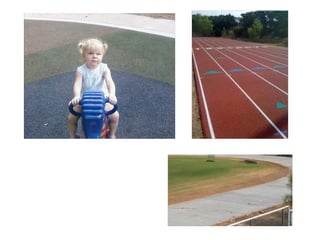
  • #34 Outdoor synthetic tracks. Nike Grind
  • #39 A pervious concrete pavement in a stormwater management design is a part of a system, and not just a pavement in itself. The pavement supports traffic loading while allowing water to pass through the concrete surface. For better effectiveness water should flow vertically through the pavement runoff from the pavement should be minimized. The base, the material under the pavement, acts as temporary storage while supporting the pavement. Grade or slope in the design will affect the storage capacity of the system. A flat pervious concrete pavement system offers the maximum storage capacity. However site conditions and other project constraints may not allow for a flat pervious concrete pavement system to be an economically viable option.
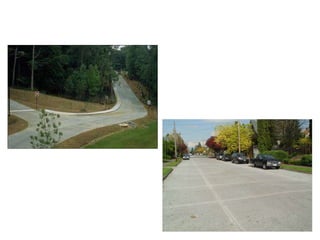
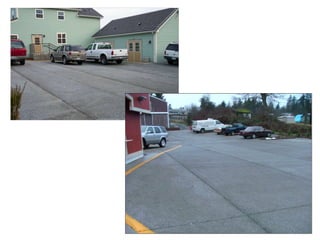
  • #41 Here are examples of a residential street and a roadway through a park.
  • #46 As the compaction is increased, the permeability is decreased and a compromise has to be reached. Experience has shown that a compaction of the base/subgrade should be in a range of 92 to 95% of the modified proctor compaction. A uniform compaction of 92% seems to give good results of pavement support and permeability. A value of 95% gives good results for the aggregate base. These values will change depending on the subgrade materials and local codes. The concept is to have sufficient pavement support while maintaining sufficient permeability.
  • #54 No standards have been developed for the design of the thickness of base materials below pervious concrete pavements. The design thickness has been based on prior experience of performance. Most base thicknesses, for parking area designs, have been at least a 6-inch section. Some designs may indicate a section greater than 6 inches if required to meet stormwater volume storage. Base thickness requirements may also include considerations as to whether the pavement will be subject to deep frost line conditions. In some cases a separate base material may not be required. The pervious concrete may be placed directly on a uniformly compacted soil. This may be the case if pervious concrete is used in areas around trees where the tree roots should not be disturbed. This is also possible in areas where the native soils are highly permeable, and with minimal compaction make a good base for the pavement.
  • #55 The total storage capacity of the pervious concrete system includes the capacity of the pervious concrete pavement, the storage capacity of the aggregate subbase, and the amount of water which leaves the system by infiltration into the underlying subgrade. If the pervious concrete has 20% porosity then every inch of pavement can store 0.20 inches of water. If the subbase, number 67 stone for example, has a porosity of 40% then every inch of pavement can store 0.40 inches of rain. Therefore, a 6 inch pervious concrete pavement on 6 inches of #67 stone can store 3.6 inches of water.
  • #60 Texture and Porosity are affected by aggregate size, grading, angularity, and the paving equipment you use.
  • #62 3/8” rock or gravel is most common size due to smoothness and appearance.
  • #64 The water content must match two things. One is the equipment being used and the other is the weather. The heavier the equipment the lower the water to cement ratio could be. The hotter the weather the higher the water to cement ratio has to be. You can always add water to the concrete at the jobsite to get the correct water to cement ratio.
  • #66 Pervious concrete mixtures are stiff mixtures with low water content, and tend to stiffen up faster than higher slump conventional concrete. Set retarding admixtures are often used. Hydration stabilizing admixtures are also used. Air entraining admixtures are used to increase the resistance to damage from freezing and thawing. Viscosity modifying admixtures are gum-based products that improve the cohesivity (stickiness and bonding potential) of cement paste. Their use in pervious concrete mixtures has been seen to provide benefits to the consistency of the mixture during installation. Integral color can be added to pervious concrete in liquid or powdered form. The type, and color, of the aggregate may also influence the decision of using color. Broadcast, dry-shake color, applied to the surface of concrete flatwork is not recommended.
  • #69 A typical pervious concrete mix will have anywhere from 15 to 30 percent voids, depending largely on the size of the aggregate used. Field studies have shown that a pervious concrete made with 3/8” aggregate exhibits an average void content of 20 to 25 percent. Because there is no fine aggregate, the density (unit weight) of pervious concrete is slightly less than conventional concrete, weighing in at about 100 to 120 pcf. Compressive strength of pervious concrete averages from 2,500 to 3,500 psi under typical conditions. For applications where higher strengths are deemed necessary, a small amount of fine aggregate (about 500 lbs per CY) can increase the compressive strength. Realize, however, that this will decrease the percentage of voids in the mix. In most cases, we recommend that compressive strength should not be used as acceptance criteria. Rather, you should use density and void content. For acceptance criteria, the density (unit weight) of the plastic pervious concrete should be within 5 lbs (+/-) of the approved mix design.
  • #70 A typical pervious concrete mix will have anywhere from 15 to 30 percent voids, depending largely on the size of the aggregate used. Field studies have shown that a pervious concrete made with 3/8” aggregate exhibits an average void content of 20 to 25 percent. Because there is no fine aggregate, the density (unit weight) of pervious concrete is slightly less than conventional concrete, weighing in at about 100 to 120 pcf. Compressive strength of pervious concrete averages from 2,500 to 3,500 psi under typical conditions. For applications where higher strengths are deemed necessary, a small amount of fine aggregate (about 500 lbs per CY) can increase the compressive strength. Realize, however, that this will decrease the percentage of voids in the mix. In most cases, we recommend that compressive strength should not be used as acceptance criteria. Rather, you should use density and void content. For acceptance criteria, the density (unit weight) of the plastic pervious concrete should be within 5 lbs (+/-) of the approved mix design.
  • #81 The concrete producer should perform a density (unit weight) test on the first few loads of concrete each production day to verify the plant is running properly. The unit weight is simply the weight of one cubic foot. It is critical in quality control. The Unit Weight should be +/- 5 pcf of specified.
  • #82 For larger projects, the engineer might require core test to check for stab thickness and dry density. If necessary, core samples can be obtained from the pavement in accordance ASTM C 42, Test Method for Obtaining and Testing Drilled Cores and Sawed Beams of Concrete, to measure the in-place density and other properties as needed. The density of cores after trimming can be determined by determining the calculated volume of the core from its dimensions or by procedures described in ASTM C 140, Test Methods for Sampling and Testing Concrete Masonry Units and Related Units . ASTM is in the process of standardizing test procedures for pervious concrete.
  • #92 History: Nearly 750,000 sq. ft. in Texas (all &lt; 10 years old) Almost 500,000 sq. ft. in Austin area alone No known structural failures Some edge failures Mostly all “failures” due to improper installation Surface sealing Raveling Local History: Nearly 750,000 sq. ft. in Texas (all &lt; 10 years old) Almost 500,000 sq. ft. in Austin area alone No known structural failures Some edge failures Mostly all “failures” due to improper installation Surface sealing Raveling
  • #98 For parking lot designs, a 6-inch section has been shown to be successful under automobile traffic, with occasional truck traffic. An 8-inch section is normally used for residential streets and heavier truck traffic areas such as delivery lanes.
  • #104 The typical process of finishing pervious concrete has five basic steps. Spreading the concrete means raking it off of the truck. Striking off the pavement a little high. Then compact the concrete down to the right elevation. Jointing and edging occurs next followed immediately by curing.
  • #108 The more compaction you have the stronger the concrete the less porosity. With pervious poured out of the truck with not compaction you can get severe raveling of the surface, that is the surface will deteriorate. It has very little strength but a great amount of porosity. The perfect amount of compaction will optimize strength and porosity. If you over compact you can seal the surface. You have great strength but no porosity which mean no drainage and the system will fail.
  • #110 Critical issues of construction that can lead to failure if not done properly are subgrade compaction, proper mixing water, sufficient compaction, and preventing evaporation.
  • #123 Use 6 mil plastic for curing. A few points when securing with plastic sheeting: do not use dirt; use 2x4s or reinforcing bars. Keep in place for at least 7 days; and make sure it is cut and ready before discharge begins and maybe even before the trucks arrive.
  • #134 When joints are placed in pervious concrete pavements, it should be jointed when the pavement dimensions are greater than 20 feet in any direction. In some places a 15-foot joint spacing is standard practice. Drying shrinkage in pervious concrete is not as severe as in conventional concrete, and therefore will have a reduced chance of cracking. Experience should dictate the typical joint spacing in a local region. Joints can be placed closer together if the layout warrants. The panels between the joints should be made as square as possible, and the length to width ratio should not exceed 1.5.
  • #136 Here’s an example of the joint perpendicular to the curb.
  • #137 You can joint the concrete in two ways. You can tool the joint or cut the joint. Tooled joints are preferred. The use of pavement saws for cutting joints are discouraged because the dust residue from the sawing operation can settle into the pores of the pavement. If care is taken to vacuum the dust during the sawing operation then this method of cutting joints is acceptable. Alternatively, water may be used in the sawing operation to flush the pores of the pavement immediately after sawing.
  • #141 There is no need to seal joints.
  • #144 Consider isolation joint between pervious and conventional pavement.
  • #147 Here’s an example of a pervious concrete driveway.
  • #149 When placing a pervious concrete pavement adjacent to an asphalt pavement, for example, curbing could be used to prevent water from seeping into the base of the asphalt pavement. This is called a header curb.
  • #150 Here are other examples of Header Curbs.
  • #151 15 mil Stego wrap, wrapped underneath the drain rock 12 -24” in
  • #154 Pervious concrete can be striped.
  • #162 Here’s an example of how pervious pavement should not be treated.
  • #163 Curbs can also be used to prevent unpaved areas from draining onto the pavement by controlling the flow path of storm water during a storm event. These areas, allowed to drain onto the pervious concrete, could bring soil or debris that could impact the performance of the pavement/stormwater system.
  • #164 Slope surrounding grade away from pervious pavement to avoid debris from clogging the slab.
  • #165 Make sure the pavement is graded higher than the surrounding landscaping.
  • #166 Avoid having dirt parking next to a pervious pavement.
  • #167 Vegetated swales, as defined in Low Impact Development (LID), can be used as separators between parking areas. These areas are designed to be below the top of pavement, and become a part of the overall stormwater management design. Trees, or shrubs, may also be planted in the vegetated swales.
  • #168 No standards have been developed for the design of the thickness of base materials below pervious concrete pavements. The design thickness has been based on prior experience of performance. Most base thicknesses, for parking area designs, have been at least a 6-inch section. Some designs may indicate a section greater than 6 inches if required to meet stormwater volume storage. Base thickness requirements may also include considerations as to whether the pavement will be subject to deep frost line conditions. In some cases a separate base material may not be required. The pervious concrete may be placed directly on a uniformly compacted soil. This may be the case if pervious concrete is used in areas around trees where the tree roots should not be disturbed. This is also possible in areas where the native soils are highly permeable, and with minimal compaction make a good base for the pavement.
  • #174 No standards have been developed for the design of the thickness of base materials below pervious concrete pavements. The design thickness has been based on prior experience of performance. Most base thicknesses, for parking area designs, have been at least a 6-inch section. Some designs may indicate a section greater than 6 inches if required to meet stormwater volume storage. Base thickness requirements may also include considerations as to whether the pavement will be subject to deep frost line conditions. In some cases a separate base material may not be required. The pervious concrete may be placed directly on a uniformly compacted soil. This may be the case if pervious concrete is used in areas around trees where the tree roots should not be disturbed. This is also possible in areas where the native soils are highly permeable, and with minimal compaction make a good base for the pavement.
  • #175 Removing debris from the surface of the pavement is important in maintaining the porosity of the pervious concrete pavements. Trash, such as leaves or paper, may degrade into small particles that may migrate into the void structure of the pavement and reduce the porosity. Periodic sweeping, or a combination of a vacuuming and sweeping, can help reduce the infiltration of materials into the pavement. Here’s an example of pervious before cleaning and after cleaning.
  • #176 You will see color variation if you try to repair a slab. In this case the island was moved and new pervious was placed. Naturally it didn’t match the existing slab.