Writing a Mini
Critique
Writing a Critique (Critical Analysis)
A critique is a careful analysis of an
argument to determine what is said, how
well the points are made, what assumptions
underlie the argument, what issues are
overlooked, and what implications are drawn
from such observations. It is a systematic,
yet personal response and evaluation of
what you read.
Why do we write Critiques?
Writing a critique helps us to:
• Know the work’s subject area or related works.
• Understand the work’s purpose, intended
audience, development of argument, structure
of evidence or creative style.
How do we write Critiques?
Before writing, it is important to have a thorough
understanding of the literary work to be evaluated. The
following are the guidelines:
• Study the work under discussion.
• Make notes on important parts of the work.
• Develop an understanding of the main argument or
purpose being expressed in the work.
• Consider how the work relates to a bigger issue or
context.
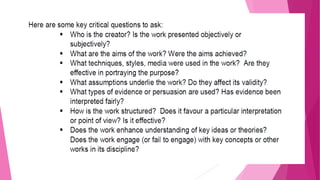
Consider asking the following questions:
▪ What is the nature of the piece?
▪ Who wrote it, why, and what are his/her qualifications?
▪ What is the significance of the piece?
▪ What are its objectives? How well are they achieved?
▪ What is the design or method of the piece?
▪ Does the design help the piece achieve its objectives?
▪ What is the particular appeal or lack of appeal?
▪ What assumptions underlie the piece? Are they
offensive? Are they obvious?
▪ How do the assumptions and biases affect the validity of
the piece?
What is the template/ format for writing a
critique1?
Just like any composition that we have learned
throughout this lesson, the basic format of writing
the critique is composed of an Introduction, the
Body and the Conclusion. But of course, to match
the purpose of a critique, there are some
modifications and additions. It is also possible for
the content of your composition’s body to change
based on the nature of the literary work being
reviewed.
I. INTRODUCTION:
The introduction, typically is short (less than 1%
of the word length). Remember the following:
1. Introduce the subject of your critique – the
reading under analysis. Make sure to name the
work being reviewed, as well as the date when it
was created, as well as the name of the creator.
Writing a Critique.pptx

Writing a Critique.pptx

  • 1.
  • 2.
    Writing a Critique(Critical Analysis) A critique is a careful analysis of an argument to determine what is said, how well the points are made, what assumptions underlie the argument, what issues are overlooked, and what implications are drawn from such observations. It is a systematic, yet personal response and evaluation of what you read.
  • 3.
    Why do wewrite Critiques? Writing a critique helps us to: • Know the work’s subject area or related works. • Understand the work’s purpose, intended audience, development of argument, structure of evidence or creative style.
  • 4.
    How do wewrite Critiques? Before writing, it is important to have a thorough understanding of the literary work to be evaluated. The following are the guidelines: • Study the work under discussion. • Make notes on important parts of the work. • Develop an understanding of the main argument or purpose being expressed in the work. • Consider how the work relates to a bigger issue or context.
  • 5.
    Consider asking thefollowing questions: ▪ What is the nature of the piece? ▪ Who wrote it, why, and what are his/her qualifications? ▪ What is the significance of the piece? ▪ What are its objectives? How well are they achieved? ▪ What is the design or method of the piece? ▪ Does the design help the piece achieve its objectives? ▪ What is the particular appeal or lack of appeal? ▪ What assumptions underlie the piece? Are they offensive? Are they obvious? ▪ How do the assumptions and biases affect the validity of the piece?
  • 6.
    What is thetemplate/ format for writing a critique1? Just like any composition that we have learned throughout this lesson, the basic format of writing the critique is composed of an Introduction, the Body and the Conclusion. But of course, to match the purpose of a critique, there are some modifications and additions. It is also possible for the content of your composition’s body to change based on the nature of the literary work being reviewed.
  • 7.
    I. INTRODUCTION: The introduction,typically is short (less than 1% of the word length). Remember the following: 1. Introduce the subject of your critique – the reading under analysis. Make sure to name the work being reviewed, as well as the date when it was created, as well as the name of the creator.