Main Focus:
...learn how the legacies of the past shaped
the way you are now and how your legacy
could dictate the future of others.
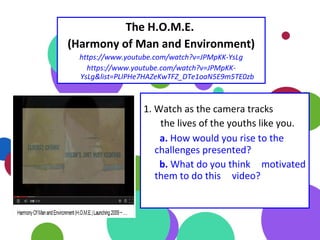
1. Watch as the camera tracks
the lives of the youths like you.
a. How would you rise to the
challenges presented?
b. What do you think motivated
them to do this video?
The H.O.M.E.
(Harmony of Man and Environment)
https://www.youtube.com/watch?v=JPMpKK‐YsLg
https://www.youtube.com/watch?v=JPMpKK‐
YsLg&list=PLIPHe7HAZeKwTFZ_DTe1oaN5E9m5TE0zb
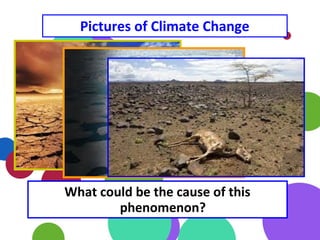
Pictures of Climate Change
What could be the cause of this
phenomenon?
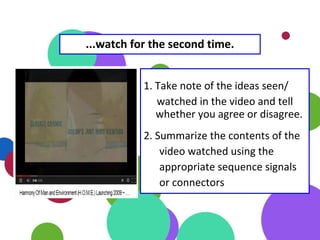
1. Take note of the ideas seen/
watched in the video and tell
whether you agree or disagree.
2. Summarize the contents of the
video watched using the
appropriate sequence signals
or connectors
...watch for the second time.
A life well lived cannot be easily forgotten. Not,
when you have left a mark so
noteworthy that enables people to make a
difference not only in their lives but more so
in the lives of others.
1. How would you like to be remembered?
2. What legacy would you like to leave behind?
Finding Connections...
Prepared by:
Sir Ike Medallo Arlos
Literature
Time
Let's unlock the unfamiliar
words in the text...
Copy the vocabulary words on your notebook
Write the letter before the number to match the words in
Column A with their correct meaning in Column B. Be
ready to use the words in sentences.
Column A Column B
1. betwixt (ME) a. to signify ; to indicate
2. holden (ME) b. that is to say; namely
3. betokens (ME) c. between
4. tomorn (ME) d. to think of; to expect;to hope
5. weened (OE) e. Jesus
6. Jesu (LL) f. tomorrow
 Use the words in sentences.
a
c
f
e
d
b
What does it take
to be a great man?
Let's read the short background
of the text...
“The Day of Destiny”
from Morte D’Arthur by Sir Thomas Malory
Sir Thomas Malory’s Morte D’Arthur is the most complete
single version of the tales of King Arthur and his court that
has been written in English.
“The Day of Destiny,” an excerpt from this work, describes
the end of King Arthur’s reign and the dissolution of the
order which he, along with his Knights of the Round Table,
has established. This end grows out of the corruption
within the royal court itself. Arthur’s illegitimate son
Mordred knows of the secret love affair between Arthur’s
wife, Queen Guinevere, and his best friend, Sir Lancelot.
One night Mordred leads a band of knights to Guinevere’s
chamber, where they find the Queen with Lancelot.
Although he is reluctant, Arthur feels obligated to
obey the law of the land and burn his wife at the
stake. However, at the last minute Lancelot rescues
her, killing two knights who are guarding her.
Lancelot subsequently flees to a castle in France and
Arthur forgives Guinevere. Sir Gawain, the brother of
the dead knights, demands vengeance on Lancelot.
His hatred forces Arthur to lead his men on an attack
against Lancelot’s French fortress. In the ensuing
battles Lancelot seriously wounds Gawain but refuses
to kill him.
TEXT: Handout of “The Day of Destiny”
or
Movie: King Arthur
https://www.youtube.com/watch?v=sRIvTC8LIKs
Reference Book: pages 32-36
...Just read until the day Arthur was
crowned.
Audiobook: King Arthur's Destiny
https://www.youtube.com/watch?v=w1JLjQd‐Siw
Jot down notes while you
listen to the story.
Comprehension Questions:
______ 1. He was the father of Prince Arthur.
______ 2. He was the wise man and magician.
______ 3. Sir Kay was the son of ___.
______ 4. He pulled off the sword from the stone.
______ 5. Who were commanded by the king to hand the
baby to Merlin?
______ 6. Who has left the sword?
______ 7. It is where the sword located in the church.
______ 8. How old was Arthur when his father died?
Direction: Answer the questions in complete sentences.
______ 9. The king died because of __.
______ 10. Where did the magician live?
______ 11. What was the name of the sword?
______ 12. What is the name of Arthur's mother?
______ 13. Who was the wife of Arthur?
______ 14. What was the name of Arthur's palace?
______ 15. Who did Arthur meet when they landed in France?
______ 16. How many kings were vanquished by the giant?
______ 17. What did King Arthur use to kill the giant?
______ 18. How many people attempted to rescue the
duchess?
______ 19. Where did Arthur plan or conduct a meeting in
the palace together with his kinghts?
______ 20. Who was the emperor of Rome that time?
Mull Over in Groups!
1. How would you describe King Arthur as a king? Locate a
part in the story that will support your answer.
2. What hope is given to people in his tomb saying Arthur is
the “once king and king that will be?
3. Why do you think some men say in many parts of England
that King Arthur is not dead, but carried by the will of our
Lord Jesus into another place; and that he shall come
again, and he shall win the Holy Cross?
Direction: Discuss and answer the questions below in groups.
Write your answer on one whole sheet of paper.
Mull Over in Groups!
4. What great deed did King Arthur as he lived his life?
What was his greatest legacy?
5. What pattern is used to develop the idea of the text?
Point out the sequence signals or connectors in the text.
6. How do images or word pictures help you experience a
scene in the excerpt, The Day of Destiny?
Direction: Discuss and answer the questions below in groups.
Write your answer on one whole sheet of paper.
Recapitulation...
Informative text: Serves to inform; provides or
discloses information; instructive;
instructional
Journalistic text: radio, print, television, and online
journalism that presents information.
Literary Text: is defined as a wide variety of
imaginative and creative writing that leads
to the appreciation of the cultural
heritages of students. Literary is defined as
something related or associated with
literature or scholarly learning and writing.
Group Activity
Group the students into three (3).
Each group shall read the assigned article for
10 minutes.
Examine how the three (3) articles were
written.
Accomplish the chart by writing down how
these articles were written given the
specified criteria.
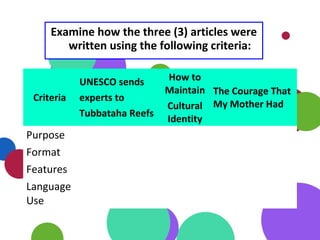
Examine how the three (3) articles were
written using the following criteria:
Criteria
UNESCO sends
experts to
Tubbataha Reefs
How to
Maintain
Cultural
Identity
The Courage That
My Mother Had
Purpose
Format
Features
Language
Use
1. Do you consider the Tubbataha Reefs as nature’s legacy
to mankind? What connections do you share with
Tubbataha Reefs? ____________________________
___________________________________________
2. Do you consider cultural heritage as your forefathers’
legacy? What is your role in the preservation of culture
in the country? ______________________________
___________________________________________
3. What is your mother’s greatest legacy? Do you consider
this legacy worthy of passing to your children?______
____________________________________________
One with the Others
Weigh Up!
1. Men in great places are thrice servants:
servants of the sovereign or state,
servants of fame, and servants of business
“Of Great Place”
2. NASA is proposing another space project. The agency’s
budget request, announced today, included a plan to send
another person to the moon.
Direction: Examine the following examples of texts. Indicate
the type of reading text they are...
(Informative, Journalistic, or Literary)
Weigh Up!
3. Those that have tenacity will not quit when confronted by
obstacles or when failing. In a game or in life, tenacity
wants to win, and tenacity lives by the credo,
“Failure is not an option."
4. Three passions (simple but overwhelmingly strong) have
governed my life: the longing for love, the search for
knowledge, and the unbearable pity for the suffering of
mankind.
Direction: Examine the following examples of texts. Indicate
the type of reading text they are.
Weigh Up!
5. Director Steven Spielberg launched a Germany-wide
contest Sunday designed to promote tolerance through
students’ intercultural interaction
6. If you can dream – and not make your dreams your
master;
7. An earthquake is a shaking or rolling movement of great
masses of rocks on the earth’s uppermost layer or crust.
Direction: Examine the following examples of texts. Indicate
the type of reading text they are.
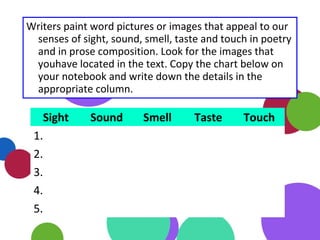
Writers paint word pictures or images that appeal to our
senses of sight, sound, smell, taste and touch in poetry
and in prose composition. Look for the images that
youhave located in the text. Copy the chart below on
your notebook and write down the details in the
appropriate column.
Sight Sound Smell Taste Touch
1.
2.
3.
4.
5.
Prepared by:
Sir Ike Medallo Arlos
Grammar Time
1. They can indicate chronological order, or order of
importance (e.g. first ...secondly ... thirdly; to begin
with .... next ... to conclude).
2. They can add to or reinforce what has already been said
(e.g. furthermore; in addition; what is more).
3. They can indicate that two propositions have equal
status (likewise; similarly).
Sequence markers can signal how to interpret the
relationship between sentences in a number of
different ways. For example:
4. They can indicate cause-result relationships
(e.g. consequently; so; as a result).
5. They can indicate that a given proposition contradicts
an earlier one (e.g. conversely; on the contrary;by way
of contrast).
6. They can indicate concession (e.g. nevertheless; in any
case; for all that; all the same).
7. Sometimes a distinction is made between internal
and external sequencers, i.e. the use of these
markers to indicate ‘real world’ events (external), or
‘rhetorical organization’ (internal). For example, First
of all .... then .... finally can indicate chronological
sequence (external), or order of importance
(internal).
http://www.arts.gla.ac.uk/STELLA/LILT/seqmark.htm
Article
Reading
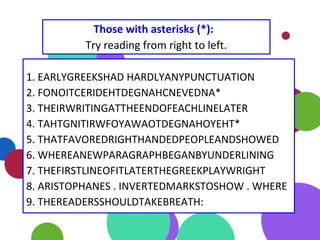
1. EARLYGREEKSHAD HARDLYANYPUNCTUATION
2. FONOITCERIDEHTDEGNAHCNEVEDNA*
3. THEIRWRITINGATTHEENDOFEACHLINELATER
4. TAHTGNITIRWFOYAWAOTDEGNAHOYEHT*
5. THATFAVOREDRIGHTHANDEDPEOPLEANDSHOWED
6. WHEREANEWPARAGRAPHBEGANBYUNDERLINING
7. THEFIRSTLINEOFITLATERTHEGREEKPLAYWRIGHT
8. ARISTOPHANES . INVERTEDMARKSTOSHOW . WHERE
9. THEREADERSSHOULDTAKEBREATH:
Those with asterisks (*):
Try reading from right to left.
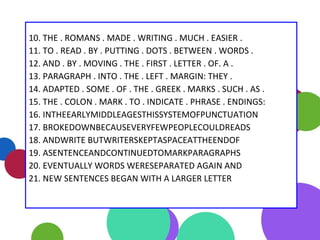
10. THE . ROMANS . MADE . WRITING . MUCH . EASIER .
11. TO . READ . BY . PUTTING . DOTS . BETWEEN . WORDS .
12. AND . BY . MOVING . THE . FIRST . LETTER . OF. A .
13. PARAGRAPH . INTO . THE . LEFT . MARGIN: THEY .
14. ADAPTED . SOME . OF . THE . GREEK . MARKS . SUCH . AS .
15. THE . COLON . MARK . TO . INDICATE . PHRASE . ENDINGS:
16. INTHEEARLYMIDDLEAGESTHISSYSTEMOFPUNCTUATION
17. BROKEDOWNBECAUSEVERYFEWPEOPLECOULDREADS
18. ANDWRITE BUTWRITERSKEPTASPACEATTHEENDOF
19. ASENTENCEANDCONTINUEDTOMARKPARAGRAPHS
20. EVENTUALLY WORDS WERESEPARATED AGAIN AND
21. NEW SENTENCES BEGAN WITH A LARGER LETTER
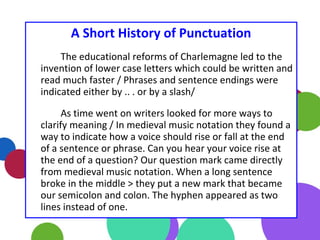
A Short History of Punctuation
The educational reforms of Charlemagne led to the
invention of lower case letters which could be written and
read much faster / Phrases and sentence endings were
indicated either by .. . or by a slash/
As time went on writers looked for more ways to
clarify meaning / In medieval music notation they found a
way to indicate how a voice should rise or fall at the end
of a sentence or phrase. Can you hear your voice rise at
the end of a question? Our question mark came directly
from medieval music notation. When a long sentence
broke in the middle > they put a new mark that became
our semicolon and colon. The hyphen appeared as two
lines instead of one.
Around A.D. 1500 the indented paragraph appeared,
as did the comma and period as we know them. Printers
of the Renaissance invented new marks like the exclama-
tion points and quotation marks.
By that time, people were commonly reading silently,
and punctuation came to depend more on grammatical
groups than breath groups.(Parentheses and dashes
appeared with the advent of printing.)
By the end of the seventeenth century, our punctua-
tion system was in place for the most part, though
sometimes details varied. Just think, though: After only a
few lessons in school—and with lots of practice reading
and writing—you can boast that you’ve mastered a
system that took westerners many centuries to develop.
 What have you observed as unusual in the
informative article?
What punctuation marks are described in
the article?
 What problems in writing and reading are caused
by improper use ofcapitalization and
punctuation marks?
 Are these problems applicable even in today’s
world?
 How do we solve such problems?
When you read poems, you don’t pause or
stop at the end of the lines, but you watch out for
commas or period to guide you. Use punctuation
marks to help you find the sensible meaning of
what you’re reading. Clarity of expressions in
poetry or prose composition exists if the sentences
are appropriately punctuated and the words are
properly capitalized.
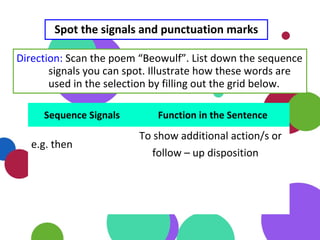
Spot the signals and punctuation marks
Sequence Signals Function in the Sentence
e.g. then
To show additional action/s or
follow – up disposition
Direction: Scan the poem “Beowulf”. List down the sequence
signals you can spot. Illustrate how these words are
used in the selection by filling out the grid below.
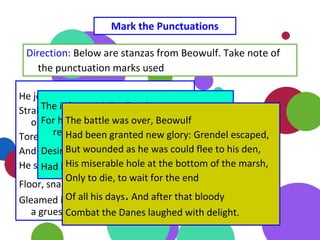
Mark the Punctuations
He journeyed, forever joyless,
Straight to the door, then snapped it
open,
Tore its iron fasteners with a touch,
And rushed angrily over the threshold.
He strode quickly across the inlaid
Floor, snarling and fierce: His eyes
Gleamed in the darkness, burned with
a gruesome Light.
Direction: Below are stanzas from Beowulf. Take note of
the punctuation marks used
The infamous killer fought
For his freedom, wanting no flesh but
retreat,
Desiring nothing but escape;his claws
Had been caught, he was trapped.
The battle was over, Beowulf
Had been granted new glory: Grendel escaped,
But wounded as he was could flee to his den,
His miserable hole at the bottom of the marsh,
Only to die, to wait for the end
Of all his days. And after that bloody
Combat the Danes laughed with delight.
Questions:
1. What punctuation marks are highlighted in
the given stanzas?
2. What is the meaning conveyed when these
punctuation marks are used?
3. When do we use them?
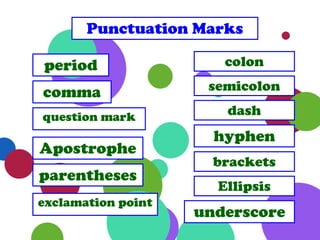
Punctuation Marks
period
comma
question mark
exclamation point
Apostrophe
colon
semicolon
dash
hyphen
brackets
Ellipsis
parentheses
underscore
I. COLON
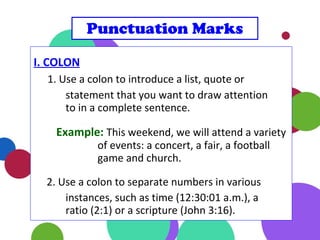
1. Use a colon to introduce a list, quote or
statement that you want to draw attention
to in a complete sentence.
Example: This weekend, we will attend a variety
of events: a concert, a fair, a football
game and church.
2. Use a colon to separate numbers in various
instances, such as time (12:30:01 a.m.), a
ratio (2:1) or a scripture (John 3:16).
Punctuation Marks
I. COLON
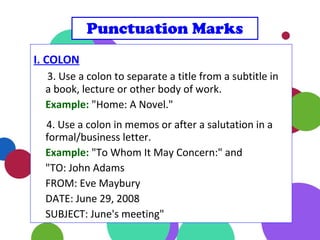
3. Use a colon to separate a title from a subtitle in
a book, lecture or other body of work.
Example: "Home: A Novel."
4. Use a colon in memos or after a salutation in a
formal/business letter.
Example: "To Whom It May Concern:" and
"TO: John Adams
FROM: Eve Maybury
DATE: June 29, 2008
SUBJECT: June's meeting"
Punctuation Marks
I. COLON
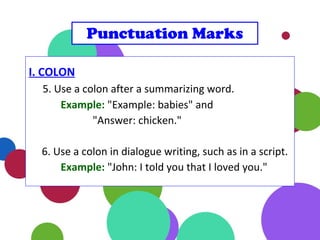
5. Use a colon after a summarizing word.
Example: "Example: babies" and
"Answer: chicken."
6. Use a colon in dialogue writing, such as in a script.
Example: "John: I told you that I loved you."
Punctuation Marks
II. SEMICOLON
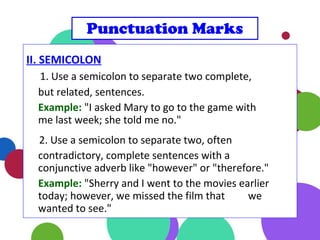
1. Use a semicolon to separate two complete,
but related, sentences.
Example: "I asked Mary to go to the game with
me last week; she told me no."
2. Use a semicolon to separate two, often
contradictory, complete sentences with a
conjunctive adverb like "however" or "therefore."
Example: "Sherry and I went to the movies earlier
today; however, we missed the film that we
wanted to see."
Punctuation Marks
II. SEMICOLON
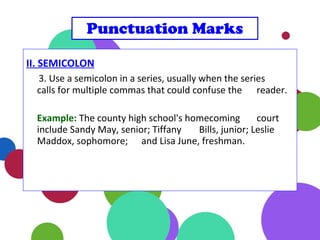
3. Use a semicolon in a series, usually when the series
calls for multiple commas that could confuse the reader.
Example: The county high school's homecoming court
include Sandy May, senior; Tiffany Bills, junior; Leslie
Maddox, sophomore; and Lisa June, freshman.
Punctuation Marks
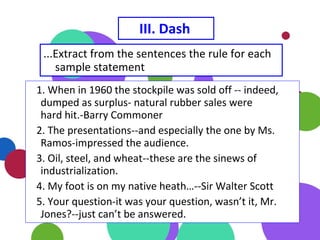
III. Dash
...Extract from the sentences the rule for each
sample statement
1. When in 1960 the stockpile was sold off -- indeed,
dumped as surplus- natural rubber sales were
hard hit.-Barry Commoner
2. The presentations--and especially the one by Ms.
Ramos-impressed the audience.
3. Oil, steel, and wheat--these are the sinews of
industrialization.
4. My foot is on my native heath…--Sir Walter Scott
5. Your question-it was your question, wasn’t it, Mr.
Jones?--just can’t be answered.
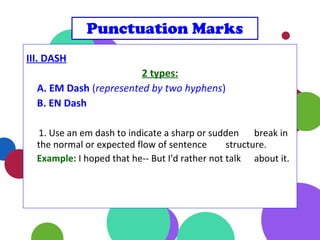
III. DASH
2 types:
A. EM Dash (represented by two hyphens)
B. EN Dash
1. Use an em dash to indicate a sharp or sudden break in
the normal or expected flow of sentence structure.
Example: I hoped that he-- But I'd rather not talk about it.
Punctuation Marks
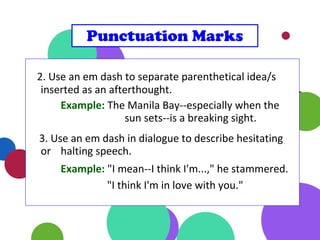
2. Use an em dash to separate parenthetical idea/s
inserted as an afterthought.
Example: The Manila Bay--especially when the
sun sets--is a breaking sight.
3. Use an em dash in dialogue to describe hesitating
or halting speech.
Example: "I mean--I think I'm...," he stammered.
"I think I'm in love with you."
Punctuation Marks
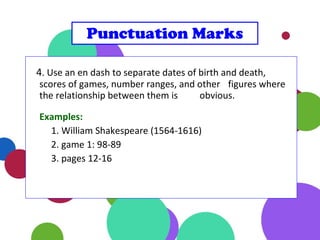
4. Use an en dash to separate dates of birth and death,
scores of games, number ranges, and other figures where
the relationship between them is obvious.
Examples:
1. William Shakespeare (1564-1616)
2. game 1: 98-89
3. pages 12-16
Punctuation Marks
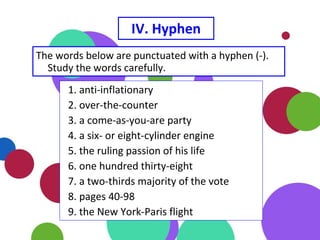
IV. Hyphen
The words below are punctuated with a hyphen (-).
Study the words carefully.
1. anti-inflationary
2. over-the-counter
3. a come-as-you-are party
4. a six- or eight-cylinder engine
5. the ruling passion of his life
6. one hundred thirty-eight
7. a two-thirds majority of the vote
8. pages 40-98
9. the New York-Paris flight
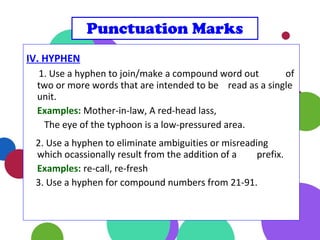
IV. HYPHEN
1. Use a hyphen to join/make a compound word out of
two or more words that are intended to be read as a single
unit.
Examples: Mother-in-law, A red-head lass,
The eye of the typhoon is a low-pressured area.
2. Use a hyphen to eliminate ambiguities or misreading
which ocassionally result from the addition of a prefix.
Examples: re-call, re-fresh
3. Use a hyphen for compound numbers from 21-91.
Punctuation Marks
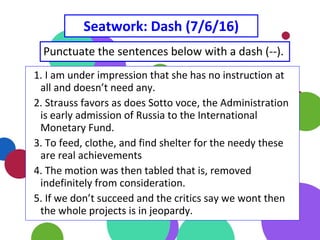
Seatwork: Dash (7/6/16)
Punctuate the sentences below with a dash (--).
1. I am under impression that she has no instruction at
all and doesn’t need any.
2. Strauss favors as does Sotto voce, the Administration
is early admission of Russia to the International
Monetary Fund.
3. To feed, clothe, and find shelter for the needy these
are real achievements
4. The motion was then tabled that is, removed
indefinitely from consideration.
5. If we don’t succeed and the critics say we wont then
the whole projects is in jeopardy.
Seatwork: Hyphen (7/6/16)
Punctuate the words/phrases below with a hyphen.
1. coopted
2. good for nothing
3. She has gray green eyes
4. Pre and postadolescent trauma
5. Forty five
My Legacies
What would your legacy be? Accomplish the chart below.
My Legacy to
Mother Earth
My Legacy to
My People
My Legacy to
My Family
1. _________________________
_________________________
_________________________
2. _________________________
_________________________
_________________________
3. _________________________
_________________________
_________________________
“We learn much from the past to understand
the present. We shape and live the present
to send a message to the future – a LEGACY –
which could be a key to understanding the
SELF”
MY TREASURE
1. My journey through this lesson enabled me to learn
____________________________________________
2. It made me realize that _________________________
____________________________________________
3. I therefore commit to __________________________
____________________________________________
Direction: Complete the following items applying the four
punctuation marks learned (minimum of 3
sentences per item).
MY TREASURE

English 9 l3

  • 1.
    Main Focus: ...learn howthe legacies of the past shaped the way you are now and how your legacy could dictate the future of others.
  • 2.
    1. Watch asthe camera tracks the lives of the youths like you. a. How would you rise to the challenges presented? b. What do you think motivated them to do this video? The H.O.M.E. (Harmony of Man and Environment) https://www.youtube.com/watch?v=JPMpKK‐YsLg https://www.youtube.com/watch?v=JPMpKK‐ YsLg&list=PLIPHe7HAZeKwTFZ_DTe1oaN5E9m5TE0zb
  • 3.
    Pictures of ClimateChange What could be the cause of this phenomenon?
  • 4.
    1. Take noteof the ideas seen/ watched in the video and tell whether you agree or disagree. 2. Summarize the contents of the video watched using the appropriate sequence signals or connectors ...watch for the second time.
  • 5.
    A life welllived cannot be easily forgotten. Not, when you have left a mark so noteworthy that enables people to make a difference not only in their lives but more so in the lives of others. 1. How would you like to be remembered? 2. What legacy would you like to leave behind? Finding Connections...
  • 6.
    Prepared by: Sir IkeMedallo Arlos Literature Time
  • 7.
    Let's unlock theunfamiliar words in the text...
  • 8.
    Copy the vocabularywords on your notebook Write the letter before the number to match the words in Column A with their correct meaning in Column B. Be ready to use the words in sentences. Column A Column B 1. betwixt (ME) a. to signify ; to indicate 2. holden (ME) b. that is to say; namely 3. betokens (ME) c. between 4. tomorn (ME) d. to think of; to expect;to hope 5. weened (OE) e. Jesus 6. Jesu (LL) f. tomorrow  Use the words in sentences. a c f e d b
  • 9.
    What does ittake to be a great man?
  • 10.
    Let's read theshort background of the text...
  • 11.
    “The Day ofDestiny” from Morte D’Arthur by Sir Thomas Malory Sir Thomas Malory’s Morte D’Arthur is the most complete single version of the tales of King Arthur and his court that has been written in English. “The Day of Destiny,” an excerpt from this work, describes the end of King Arthur’s reign and the dissolution of the order which he, along with his Knights of the Round Table, has established. This end grows out of the corruption within the royal court itself. Arthur’s illegitimate son Mordred knows of the secret love affair between Arthur’s wife, Queen Guinevere, and his best friend, Sir Lancelot. One night Mordred leads a band of knights to Guinevere’s chamber, where they find the Queen with Lancelot.
  • 12.
    Although he isreluctant, Arthur feels obligated to obey the law of the land and burn his wife at the stake. However, at the last minute Lancelot rescues her, killing two knights who are guarding her. Lancelot subsequently flees to a castle in France and Arthur forgives Guinevere. Sir Gawain, the brother of the dead knights, demands vengeance on Lancelot. His hatred forces Arthur to lead his men on an attack against Lancelot’s French fortress. In the ensuing battles Lancelot seriously wounds Gawain but refuses to kill him.
  • 13.
    TEXT: Handout of“The Day of Destiny” or Movie: King Arthur https://www.youtube.com/watch?v=sRIvTC8LIKs Reference Book: pages 32-36 ...Just read until the day Arthur was crowned.
  • 14.
    Audiobook: King Arthur'sDestiny https://www.youtube.com/watch?v=w1JLjQd‐Siw Jot down notes while you listen to the story.
  • 15.
    Comprehension Questions: ______ 1.He was the father of Prince Arthur. ______ 2. He was the wise man and magician. ______ 3. Sir Kay was the son of ___. ______ 4. He pulled off the sword from the stone. ______ 5. Who were commanded by the king to hand the baby to Merlin? ______ 6. Who has left the sword? ______ 7. It is where the sword located in the church. ______ 8. How old was Arthur when his father died? Direction: Answer the questions in complete sentences.
  • 16.
    ______ 9. Theking died because of __. ______ 10. Where did the magician live? ______ 11. What was the name of the sword? ______ 12. What is the name of Arthur's mother? ______ 13. Who was the wife of Arthur? ______ 14. What was the name of Arthur's palace? ______ 15. Who did Arthur meet when they landed in France? ______ 16. How many kings were vanquished by the giant? ______ 17. What did King Arthur use to kill the giant? ______ 18. How many people attempted to rescue the duchess? ______ 19. Where did Arthur plan or conduct a meeting in the palace together with his kinghts? ______ 20. Who was the emperor of Rome that time?
  • 17.
    Mull Over inGroups! 1. How would you describe King Arthur as a king? Locate a part in the story that will support your answer. 2. What hope is given to people in his tomb saying Arthur is the “once king and king that will be? 3. Why do you think some men say in many parts of England that King Arthur is not dead, but carried by the will of our Lord Jesus into another place; and that he shall come again, and he shall win the Holy Cross? Direction: Discuss and answer the questions below in groups. Write your answer on one whole sheet of paper.
  • 18.
    Mull Over inGroups! 4. What great deed did King Arthur as he lived his life? What was his greatest legacy? 5. What pattern is used to develop the idea of the text? Point out the sequence signals or connectors in the text. 6. How do images or word pictures help you experience a scene in the excerpt, The Day of Destiny? Direction: Discuss and answer the questions below in groups. Write your answer on one whole sheet of paper.
  • 19.
    Recapitulation... Informative text: Servesto inform; provides or discloses information; instructive; instructional Journalistic text: radio, print, television, and online journalism that presents information. Literary Text: is defined as a wide variety of imaginative and creative writing that leads to the appreciation of the cultural heritages of students. Literary is defined as something related or associated with literature or scholarly learning and writing.
  • 20.
    Group Activity Group thestudents into three (3). Each group shall read the assigned article for 10 minutes. Examine how the three (3) articles were written. Accomplish the chart by writing down how these articles were written given the specified criteria.
  • 21.
    Examine how thethree (3) articles were written using the following criteria: Criteria UNESCO sends experts to Tubbataha Reefs How to Maintain Cultural Identity The Courage That My Mother Had Purpose Format Features Language Use
  • 22.
    1. Do youconsider the Tubbataha Reefs as nature’s legacy to mankind? What connections do you share with Tubbataha Reefs? ____________________________ ___________________________________________ 2. Do you consider cultural heritage as your forefathers’ legacy? What is your role in the preservation of culture in the country? ______________________________ ___________________________________________ 3. What is your mother’s greatest legacy? Do you consider this legacy worthy of passing to your children?______ ____________________________________________ One with the Others
  • 23.
    Weigh Up! 1. Menin great places are thrice servants: servants of the sovereign or state, servants of fame, and servants of business “Of Great Place” 2. NASA is proposing another space project. The agency’s budget request, announced today, included a plan to send another person to the moon. Direction: Examine the following examples of texts. Indicate the type of reading text they are... (Informative, Journalistic, or Literary)
  • 24.
    Weigh Up! 3. Thosethat have tenacity will not quit when confronted by obstacles or when failing. In a game or in life, tenacity wants to win, and tenacity lives by the credo, “Failure is not an option." 4. Three passions (simple but overwhelmingly strong) have governed my life: the longing for love, the search for knowledge, and the unbearable pity for the suffering of mankind. Direction: Examine the following examples of texts. Indicate the type of reading text they are.
  • 25.
    Weigh Up! 5. DirectorSteven Spielberg launched a Germany-wide contest Sunday designed to promote tolerance through students’ intercultural interaction 6. If you can dream – and not make your dreams your master; 7. An earthquake is a shaking or rolling movement of great masses of rocks on the earth’s uppermost layer or crust. Direction: Examine the following examples of texts. Indicate the type of reading text they are.
  • 26.
    Writers paint wordpictures or images that appeal to our senses of sight, sound, smell, taste and touch in poetry and in prose composition. Look for the images that youhave located in the text. Copy the chart below on your notebook and write down the details in the appropriate column. Sight Sound Smell Taste Touch 1. 2. 3. 4. 5.
  • 27.
    Prepared by: Sir IkeMedallo Arlos Grammar Time
  • 28.
    1. They canindicate chronological order, or order of importance (e.g. first ...secondly ... thirdly; to begin with .... next ... to conclude). 2. They can add to or reinforce what has already been said (e.g. furthermore; in addition; what is more). 3. They can indicate that two propositions have equal status (likewise; similarly). Sequence markers can signal how to interpret the relationship between sentences in a number of different ways. For example:
  • 29.
    4. They canindicate cause-result relationships (e.g. consequently; so; as a result). 5. They can indicate that a given proposition contradicts an earlier one (e.g. conversely; on the contrary;by way of contrast). 6. They can indicate concession (e.g. nevertheless; in any case; for all that; all the same).
  • 30.
    7. Sometimes adistinction is made between internal and external sequencers, i.e. the use of these markers to indicate ‘real world’ events (external), or ‘rhetorical organization’ (internal). For example, First of all .... then .... finally can indicate chronological sequence (external), or order of importance (internal). http://www.arts.gla.ac.uk/STELLA/LILT/seqmark.htm
  • 31.
  • 32.
    1. EARLYGREEKSHAD HARDLYANYPUNCTUATION 2.FONOITCERIDEHTDEGNAHCNEVEDNA* 3. THEIRWRITINGATTHEENDOFEACHLINELATER 4. TAHTGNITIRWFOYAWAOTDEGNAHOYEHT* 5. THATFAVOREDRIGHTHANDEDPEOPLEANDSHOWED 6. WHEREANEWPARAGRAPHBEGANBYUNDERLINING 7. THEFIRSTLINEOFITLATERTHEGREEKPLAYWRIGHT 8. ARISTOPHANES . INVERTEDMARKSTOSHOW . WHERE 9. THEREADERSSHOULDTAKEBREATH: Those with asterisks (*): Try reading from right to left.
  • 33.
    10. THE .ROMANS . MADE . WRITING . MUCH . EASIER . 11. TO . READ . BY . PUTTING . DOTS . BETWEEN . WORDS . 12. AND . BY . MOVING . THE . FIRST . LETTER . OF. A . 13. PARAGRAPH . INTO . THE . LEFT . MARGIN: THEY . 14. ADAPTED . SOME . OF . THE . GREEK . MARKS . SUCH . AS . 15. THE . COLON . MARK . TO . INDICATE . PHRASE . ENDINGS: 16. INTHEEARLYMIDDLEAGESTHISSYSTEMOFPUNCTUATION 17. BROKEDOWNBECAUSEVERYFEWPEOPLECOULDREADS 18. ANDWRITE BUTWRITERSKEPTASPACEATTHEENDOF 19. ASENTENCEANDCONTINUEDTOMARKPARAGRAPHS 20. EVENTUALLY WORDS WERESEPARATED AGAIN AND 21. NEW SENTENCES BEGAN WITH A LARGER LETTER
  • 34.
    A Short Historyof Punctuation The educational reforms of Charlemagne led to the invention of lower case letters which could be written and read much faster / Phrases and sentence endings were indicated either by .. . or by a slash/ As time went on writers looked for more ways to clarify meaning / In medieval music notation they found a way to indicate how a voice should rise or fall at the end of a sentence or phrase. Can you hear your voice rise at the end of a question? Our question mark came directly from medieval music notation. When a long sentence broke in the middle > they put a new mark that became our semicolon and colon. The hyphen appeared as two lines instead of one.
  • 35.
    Around A.D. 1500the indented paragraph appeared, as did the comma and period as we know them. Printers of the Renaissance invented new marks like the exclama- tion points and quotation marks. By that time, people were commonly reading silently, and punctuation came to depend more on grammatical groups than breath groups.(Parentheses and dashes appeared with the advent of printing.) By the end of the seventeenth century, our punctua- tion system was in place for the most part, though sometimes details varied. Just think, though: After only a few lessons in school—and with lots of practice reading and writing—you can boast that you’ve mastered a system that took westerners many centuries to develop.
  • 36.
     What haveyou observed as unusual in the informative article? What punctuation marks are described in the article?  What problems in writing and reading are caused by improper use ofcapitalization and punctuation marks?  Are these problems applicable even in today’s world?  How do we solve such problems?
  • 37.
    When you readpoems, you don’t pause or stop at the end of the lines, but you watch out for commas or period to guide you. Use punctuation marks to help you find the sensible meaning of what you’re reading. Clarity of expressions in poetry or prose composition exists if the sentences are appropriately punctuated and the words are properly capitalized.
  • 38.
    Spot the signalsand punctuation marks Sequence Signals Function in the Sentence e.g. then To show additional action/s or follow – up disposition Direction: Scan the poem “Beowulf”. List down the sequence signals you can spot. Illustrate how these words are used in the selection by filling out the grid below.
  • 39.
    Mark the Punctuations Hejourneyed, forever joyless, Straight to the door, then snapped it open, Tore its iron fasteners with a touch, And rushed angrily over the threshold. He strode quickly across the inlaid Floor, snarling and fierce: His eyes Gleamed in the darkness, burned with a gruesome Light. Direction: Below are stanzas from Beowulf. Take note of the punctuation marks used The infamous killer fought For his freedom, wanting no flesh but retreat, Desiring nothing but escape;his claws Had been caught, he was trapped. The battle was over, Beowulf Had been granted new glory: Grendel escaped, But wounded as he was could flee to his den, His miserable hole at the bottom of the marsh, Only to die, to wait for the end Of all his days. And after that bloody Combat the Danes laughed with delight.
  • 40.
    Questions: 1. What punctuationmarks are highlighted in the given stanzas? 2. What is the meaning conveyed when these punctuation marks are used? 3. When do we use them?
  • 41.
    Punctuation Marks period comma question mark exclamationpoint Apostrophe colon semicolon dash hyphen brackets Ellipsis parentheses underscore
  • 42.
    I. COLON 1. Usea colon to introduce a list, quote or statement that you want to draw attention to in a complete sentence. Example: This weekend, we will attend a variety of events: a concert, a fair, a football game and church. 2. Use a colon to separate numbers in various instances, such as time (12:30:01 a.m.), a ratio (2:1) or a scripture (John 3:16). Punctuation Marks
  • 43.
    I. COLON 3. Usea colon to separate a title from a subtitle in a book, lecture or other body of work. Example: "Home: A Novel." 4. Use a colon in memos or after a salutation in a formal/business letter. Example: "To Whom It May Concern:" and "TO: John Adams FROM: Eve Maybury DATE: June 29, 2008 SUBJECT: June's meeting" Punctuation Marks
  • 44.
    I. COLON 5. Usea colon after a summarizing word. Example: "Example: babies" and "Answer: chicken." 6. Use a colon in dialogue writing, such as in a script. Example: "John: I told you that I loved you." Punctuation Marks
  • 45.
    II. SEMICOLON 1. Usea semicolon to separate two complete, but related, sentences. Example: "I asked Mary to go to the game with me last week; she told me no." 2. Use a semicolon to separate two, often contradictory, complete sentences with a conjunctive adverb like "however" or "therefore." Example: "Sherry and I went to the movies earlier today; however, we missed the film that we wanted to see." Punctuation Marks
  • 46.
    II. SEMICOLON 3. Usea semicolon in a series, usually when the series calls for multiple commas that could confuse the reader. Example: The county high school's homecoming court include Sandy May, senior; Tiffany Bills, junior; Leslie Maddox, sophomore; and Lisa June, freshman. Punctuation Marks
  • 47.
    III. Dash ...Extract fromthe sentences the rule for each sample statement 1. When in 1960 the stockpile was sold off -- indeed, dumped as surplus- natural rubber sales were hard hit.-Barry Commoner 2. The presentations--and especially the one by Ms. Ramos-impressed the audience. 3. Oil, steel, and wheat--these are the sinews of industrialization. 4. My foot is on my native heath…--Sir Walter Scott 5. Your question-it was your question, wasn’t it, Mr. Jones?--just can’t be answered.
  • 48.
    III. DASH 2 types: A.EM Dash (represented by two hyphens) B. EN Dash 1. Use an em dash to indicate a sharp or sudden break in the normal or expected flow of sentence structure. Example: I hoped that he-- But I'd rather not talk about it. Punctuation Marks
  • 49.
    2. Use anem dash to separate parenthetical idea/s inserted as an afterthought. Example: The Manila Bay--especially when the sun sets--is a breaking sight. 3. Use an em dash in dialogue to describe hesitating or halting speech. Example: "I mean--I think I'm...," he stammered. "I think I'm in love with you." Punctuation Marks
  • 50.
    4. Use anen dash to separate dates of birth and death, scores of games, number ranges, and other figures where the relationship between them is obvious. Examples: 1. William Shakespeare (1564-1616) 2. game 1: 98-89 3. pages 12-16 Punctuation Marks
  • 51.
    IV. Hyphen The wordsbelow are punctuated with a hyphen (-). Study the words carefully. 1. anti-inflationary 2. over-the-counter 3. a come-as-you-are party 4. a six- or eight-cylinder engine 5. the ruling passion of his life 6. one hundred thirty-eight 7. a two-thirds majority of the vote 8. pages 40-98 9. the New York-Paris flight
  • 52.
    IV. HYPHEN 1. Usea hyphen to join/make a compound word out of two or more words that are intended to be read as a single unit. Examples: Mother-in-law, A red-head lass, The eye of the typhoon is a low-pressured area. 2. Use a hyphen to eliminate ambiguities or misreading which ocassionally result from the addition of a prefix. Examples: re-call, re-fresh 3. Use a hyphen for compound numbers from 21-91. Punctuation Marks
  • 53.
    Seatwork: Dash (7/6/16) Punctuatethe sentences below with a dash (--). 1. I am under impression that she has no instruction at all and doesn’t need any. 2. Strauss favors as does Sotto voce, the Administration is early admission of Russia to the International Monetary Fund. 3. To feed, clothe, and find shelter for the needy these are real achievements 4. The motion was then tabled that is, removed indefinitely from consideration. 5. If we don’t succeed and the critics say we wont then the whole projects is in jeopardy.
  • 54.
    Seatwork: Hyphen (7/6/16) Punctuatethe words/phrases below with a hyphen. 1. coopted 2. good for nothing 3. She has gray green eyes 4. Pre and postadolescent trauma 5. Forty five
  • 55.
    My Legacies What wouldyour legacy be? Accomplish the chart below. My Legacy to Mother Earth My Legacy to My People My Legacy to My Family 1. _________________________ _________________________ _________________________ 2. _________________________ _________________________ _________________________ 3. _________________________ _________________________ _________________________
  • 56.
    “We learn muchfrom the past to understand the present. We shape and live the present to send a message to the future – a LEGACY – which could be a key to understanding the SELF” MY TREASURE
  • 57.
    1. My journeythrough this lesson enabled me to learn ____________________________________________ 2. It made me realize that _________________________ ____________________________________________ 3. I therefore commit to __________________________ ____________________________________________ Direction: Complete the following items applying the four punctuation marks learned (minimum of 3 sentences per item). MY TREASURE