

Persuasive Design
___________________________
                                    >
       Influencing Choice
        (without drugs or serums)
Agenda
___________________________
                                               >
ü I will rant (1 hora)
ü I will go out for a cigarette and you may
   watch (10 mins)
ü You will put together something fabularse
   (45 mins)
ü You will present your brilliant ideas
   (whatever time is left – but you’re not
   getting out of it)
Your challenge
___________________________
                                      >

1. Help Philippa save for a holiday
2. Help me quit smoking
The Rules
___________________________
                                           >
ü This is an open forum
ü If I’m boring you – let me know
   > throw a pen at my head
ü Questions at any time
   > Raise your left hand and right foot
ü I will circulate the deck afterwards
Persuādēre
   (lat) verb
   1.  Persuade, convince
   2.  Prevail upon or induce to do something


What is Persuasive Design?
___________________________
                           >
                         Beyond interaction design
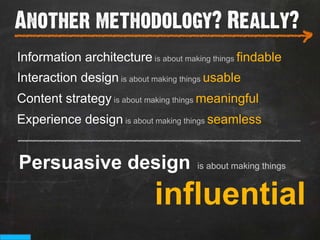
Another methodology? Really?
___________________________
                                                               >
Information architecture is about making things findable
Interaction design is about making things usable
Content strategy is about making things meaningful
Experience design is about making things seamless
_______________________________________

Persuasive design                     is about making things


                             influential
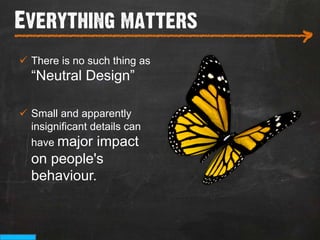
Everything matters
___________________________
                                >
ü  There is no such thing as
  “Neutral Design”

ü  Small and apparently
    insignificant details can
    have major impact
  on people's
  behaviour.
Deeper meaning
___________________________
                                                                        >
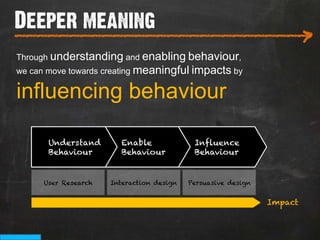
Through understanding and enabling behaviour,
we can move towards creating meaningful impacts by

influencing behaviour

       Understand        Enable             Influence
       Behaviour         Behaviour          Behaviour


      User Research   Interaction design   Persuasive design


                                                               Impact
Changing behaviour
___________________________
                                                >
Persuasive technology is about
automating behaviour change.
_______________________________________

To effectively encode experiences that change
behaviours, we have to
understand human psychology
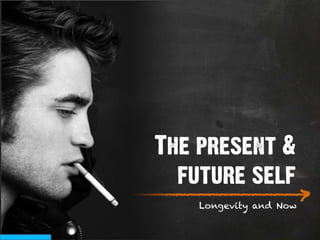
The present &
               future self
___________________________
                           >
                 Longevity and Now
The Now Factor
___________________________
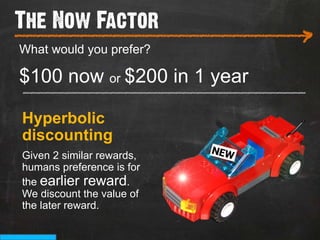
What would you prefer?
                                      >
$100 now or $200 in 1 year
_______________________________________

Hyperbolic
discounting
Given 2 similar rewards,
humans preference is for
the earlier reward.
We discount the value of
the later reward.
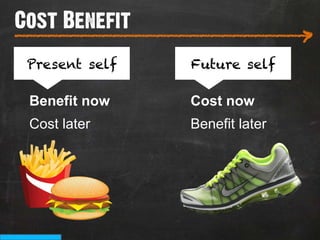
Cost Benefit
___________________________
                                >
 Present self   Future self

 Benefit now    Cost now
 Cost later     Benefit later
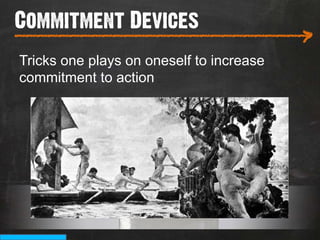
Commitment Devices
___________________________
                                          >
Tricks one plays on oneself to increase
commitment to action
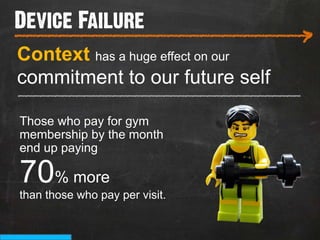
Device Failure
___________________________
                                          >
Context has a huge effect on our
commitment to our future self
_______________________________________

Those who pay for gym
membership by the month
end up paying

70% more
than those who pay per visit.
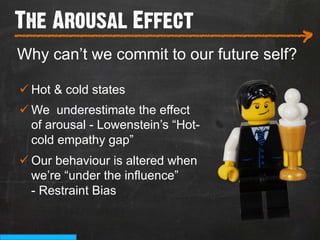
The Arousal Effect
___________________________
                                          >
Why can’t we commit to our future self?

ü Hot & cold states
ü We underestimate the effect
   of arousal - Lowenstein’s “Hot-
   cold empathy gap”
ü Our behaviour is altered when
   we’re “under the influence”
   - Restraint Bias
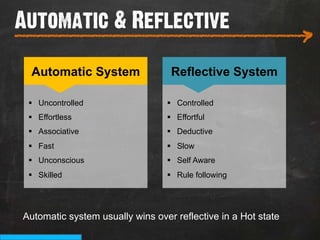
Automatic & Reflective
___________________________
                                                               >
  Automatic System                Reflective System

 §  Uncontrolled                §  Controlled
 §  Effortless                  §  Effortful
 §  Associative                 §  Deductive
 §  Fast                        §  Slow
 §  Unconscious                 §  Self Aware
 §  Skilled                     §  Rule following


Automatic system usually wins over reflective in a Hot state
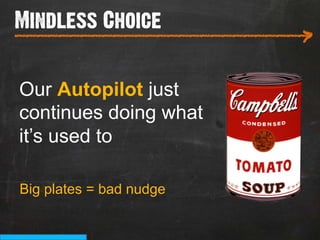
Mindless Choice
___________________________
                          >

Our Autopilot just
continues doing what
it’s used to

Big plates = bad nudge
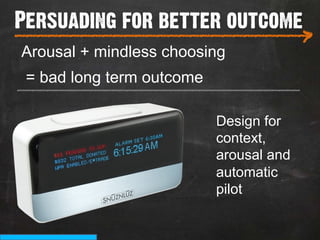
Persuading for better outcome
___________________________
                                          >
Arousal + mindless choosing
 = bad long term outcome
_______________________________________


                           Design for
                           context,
                           arousal and
                           automatic
                           pilot
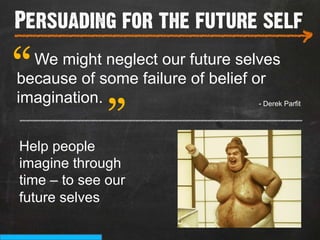
Persuading for the future self
___________________________
                                                    >
“ We might neglect our future selves
               “
because of some failure of belief or
imagination.                       - Derek Parfit
_______________________________________

Help people
imagine through
time – to see our
future selves
MOTIVATION
___________________________
                          >
    Understanding what drives us human peeps…
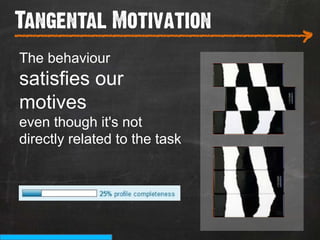
Tangental Motivation
___________________________
                               >
The behaviour
satisfies our
motives
even though it's not
directly related to the task
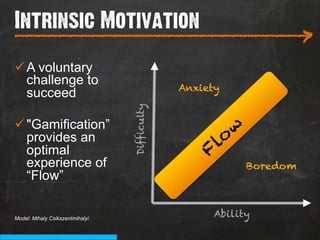
Intrinsic Motivation
___________________________
                                                                    >
ü A voluntary
   challenge to
                                              Anxiety
   succeed


                                 Difficulty
ü "Gamification”
   provides an
   optimal
   experience of                                          Boredom
   “Flow”


Model: Mihaly Csikszentmihalyi
                                                    Ability
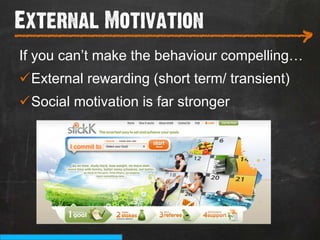
External Motivation
___________________________
                                                >
If you can’t make the behaviour compelling…
ü External rewarding (short term/ transient)
ü Social motivation is far stronger
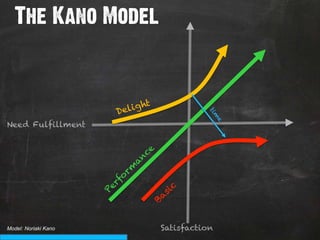
The Kano Model


                              t
                      Del ig h
Need Fulfillment


Model: Noriaki Kano               Satisfaction
Bi-as
   noun
   a particular tendency or inclination,
   especially one that prevents unprejudiced
   consideration of a question; prejudice.


Bias
___________________________
                          >
  Psychological tendencies that effect our decisions
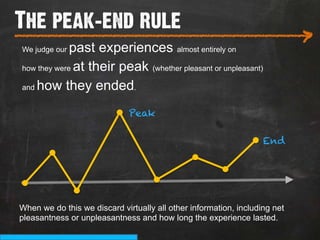
The peak-end rule
___________________________
We judge our past experiences almost entirely on
                                                                            >
how they were at their peak (whether pleasant or unpleasant)

and how they ended.


                              Peak

                                                                   End


When we do this we discard virtually all other information, including net
pleasantness or unpleasantness and how long the experience lasted.
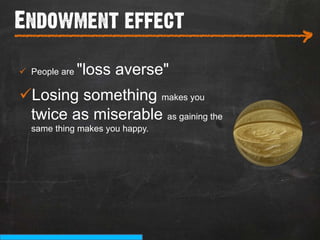
Endowment effect
___________________________
                                      >
ü  People are   "loss averse"
ü Losing something makes you
  twice as miserable as gaining the
   same thing makes you happy.
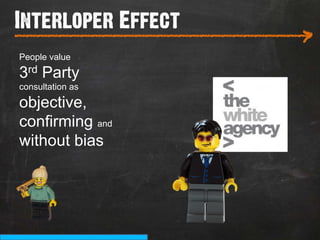
Interloper Effect
___________________________
                          >
People value

3rd Party
consultation as
objective,
confirming and
without bias
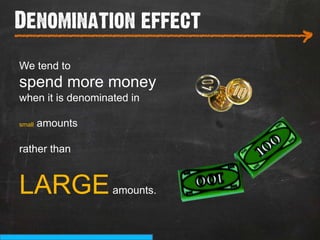
Denomination effect
___________________________
                              >
We tend to
spend more money
when it is denominated in

small   amounts

rather than


LARGE              amounts.
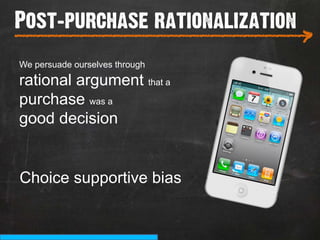
Post-purchase rationalization
___________________________
                                >
We persuade ourselves through

rational argument that a
purchase was a
good decision


Choice supportive bias
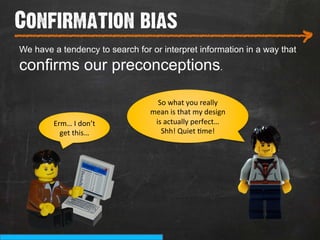
Confirmation bias
___________________________
We have a tendency to search for or interpret information in a way that
                                                                          >
confirms our preconceptions.

                                   So	
  what	
  you	
  really	
  
                                 mean	
  is	
  that	
  my	
  design	
  
        Erm…	
  I	
  don’t	
      is	
  actually	
  perfect…	
  	
  
          get	
  this…	
            Shh!	
  Quiet	
  9me!	
  
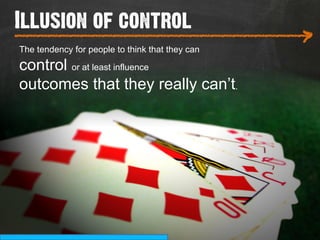
Illusion of control
___________________________
The tendency for people to think that they can
                                                 >
control or at least influence
outcomes that they really can’t.
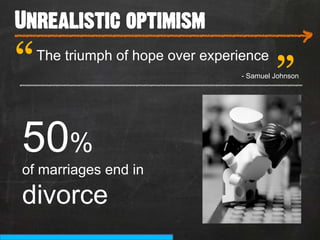
Unrealistic optimism
___________________________                “         >
“   The triumph of hope over experience
                                  - Samuel Johnson
_______________________________________


50%
of marriages end in

divorce
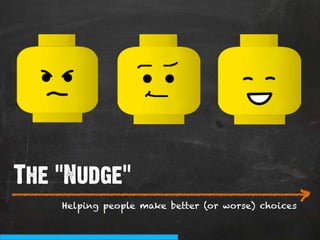
The “Nudge”
___________________________
                          >
    Helping people make better (or worse) choices
What is a “Nudge”?
___________________________
                                                   >
A "Nudge" is anything that significantly

alters           the   behaviour
of humans.


Nudging gives us the power to

improve decisions                          about


life
stimulus response compatibility
___________________________
                                   >
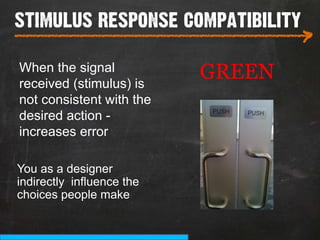
When the signal
received (stimulus) is
                           GREEN
not consistent with the
desired action -
increases error

You as a designer
indirectly influence the
choices people make
The Status Quo Bias
___________________________
The
                                  >
"Yeah
whatever”
heuristic


Inertia
- a strong desire to
stick with what you have
even when change is in our best
interest.
Defaults
___________________________
                                                   >
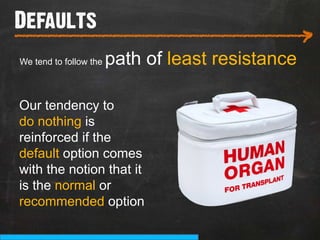
We tend to follow the   path of least resistance

Our tendency to
do nothing is
reinforced if the
default option comes
with the notion that it
is the normal or
recommended option
Social Proof
___________________________
                                                 >
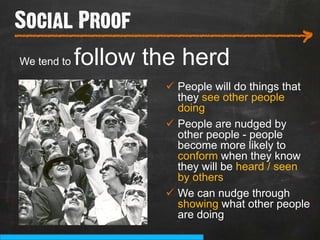
We tend to   follow the herd
                     ü  People will do things that
                         they see other people
                         doing
                     ü  People are nudged by
                         other people - people
                         become more likely to
                         conform when they know
                         they will be heard / seen
                         by others
                     ü  We can nudge through
                         showing what other people
                         are doing
Framing
___________________________
                                                        >
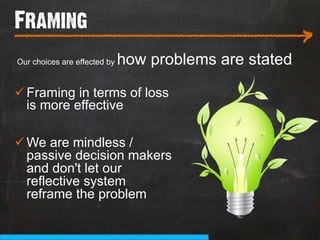
Our choices are effected by   how problems are stated

ü Framing in terms of loss
   is more effective

ü We are mindless /
   passive decision makers
   and don't let our
   reflective system
   reframe the problem
Priming
___________________________
                                                      >
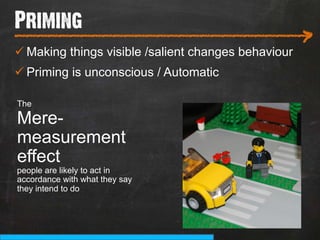
ü Making things visible /salient changes behaviour
ü Priming is unconscious / Automatic

The

Mere-
measurement
effect
people are likely to act in
accordance with what they say
they intend to do
Anchoring & Adjustment
___________________________
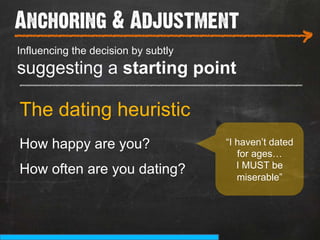
Influencing the decision by subtly
                                                        >
suggesting a starting point
_______________________________________

The dating heuristic
How happy are you?                   “I haven’t dated
                                        for ages…
                                        I MUST be
How often are you dating?               miserable”
Availability
___________________________
                                                   >
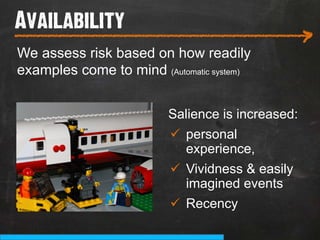
We assess risk based on how readily
examples come to mind (Automatic system)


                         Salience is increased:
                          ü  personal
                              experience,
                          ü  Vividness & easily
                              imagined events
                          ü  Recency
Representativeness
___________________________
                            >
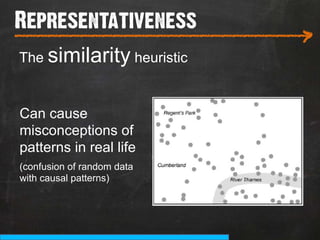
The similarity heuristic


Can cause
misconceptions of
patterns in real life
(confusion of random data
with causal patterns)
Nudging in action
___________________________
                                          >
ü Quit smoking without a patch
  (quit or lose your cash)

ü Gambling self ban
  (Reflective over Auto)

ü Dollar a day keeps the baby away
  (reduce subsequent teenage pregnancy)

ü Disulfiram
  (the incredible hangover)

ü Civility check
  (abusive email delay)
My favourite nudge
___________________________
                                                   >
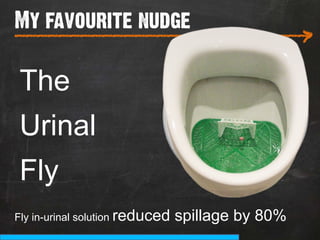
The
Urinal
Fly
Fly in-urinal solution reduced   spillage by 80%
The Fabulous Fogg
___________________________
                          >
           Motivation, ability and triggers
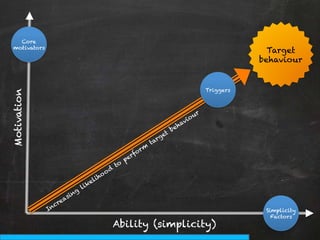
Core
 motivators
                                            Target
                                          behaviour


                               Triggers
Motivation


                                           Simplicity
                                             Factors
              Ability (simplicity)
Core Motivators
___________________________
                                              >
ü Pleasure / Pain
 immediate, in-the-moment, primal


ü Hope / Fear
 Anticipation of an outcome


ü Social acceptance / rejection
 behave to get accepted and avoid rejection
Simplicity factors (Ability)
___________________________
                           >
ü Time
ü money
ü physical effort
ü brain cycles
ü social deviance
ü non-routine
Behaviour triggers
___________________________
                                                      >
ü Spark
 motivates a behaviour


ü Facilitator
 makes behaviour easier

ü Signal
 reminds or indicates – doesn’t seek to motivate or
 simplify
3 factors of behaviour
___________________________
                                           >

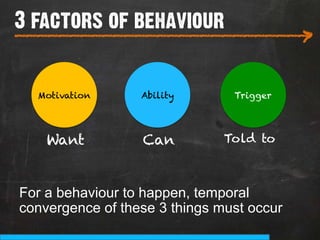
  Motivation      Ability       Trigger


    Want          Can          Told to


For a behaviour to happen, temporal
convergence of these 3 things must occur
Kairos
___________________________
                                               >
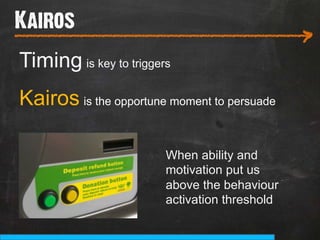
Timing is key to triggers
Kairos is the opportune moment to persuade

                        When ability and
                        motivation put us
                        above the behaviour
                        activation threshold
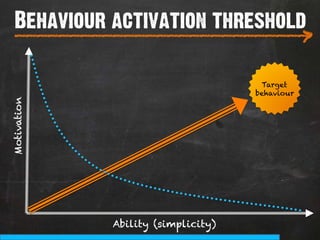
Behaviour activation threshold
  ___________________________
                                                >
                                     Target
                                    behaviour
Motivation


             Ability (simplicity)
Changing behaviour
___________________________
                                 >
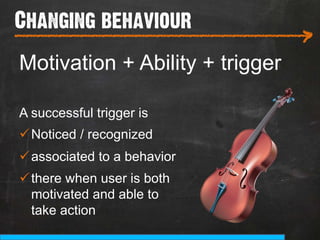
Motivation + Ability + trigger

A successful trigger is
ü Noticed / recognized
ü associated to a behavior
ü there when user is both
   motivated and able to
   take action
Persuading with Fogg
___________________________
                                             >
ü Help to motivate
ü Make it easier to do
ü Provide triggers in context

Persuasion design increases motivation
and /or makes something easier – but there
must be a trigger.
Conclusion
___________________________
                          >
       Check it I’m nearly done with the rant
We have the power
___________________________
                                             >
The idea that "Everything matters" is both
paralysing & empowering
We should try and influence choice to
make people better off
(as judged by themselves)
Use power for good
___________________________
                                         >
To fix the world - you have to first

understand it
"Persuasion" refers to attempts to

influence behavior
Choice Architecture should be used for

social good not evil.
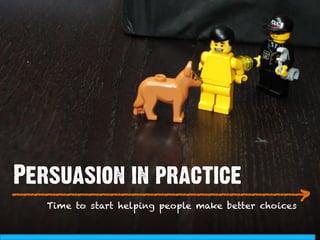
Persuasion in practice
___________________________
                          >
   Time to start helping people make better choices
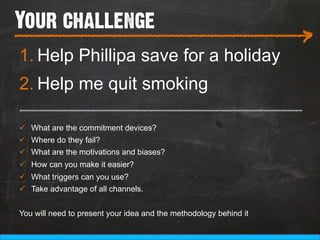
Your challenge
___________________________
                                                                   >
1. Help Phillipa save for a holiday
2. Help me quit smoking
_______________________________________
ü  What are the commitment devices?
ü  Where do they fail?
ü  What are the motivations and biases?
ü  How can you make it easier?
ü  What triggers can you use?
ü  Take advantage of all channels.


You will need to present your idea and the methodology behind it

Persuasive design

  • 1.
    Persuasive Design ___________________________ > Influencing Choice (without drugs or serums)
  • 2.
    Agenda ___________________________ > ü I will rant (1 hora) ü I will go out for a cigarette and you may watch (10 mins) ü You will put together something fabularse (45 mins) ü You will present your brilliant ideas (whatever time is left – but you’re not getting out of it)
  • 3.
    Your challenge ___________________________ > 1. Help Philippa save for a holiday 2. Help me quit smoking
  • 4.
    The Rules ___________________________ > ü This is an open forum ü If I’m boring you – let me know > throw a pen at my head ü Questions at any time > Raise your left hand and right foot ü I will circulate the deck afterwards
  • 5.
    Persuādēre (lat) verb 1.  Persuade, convince 2.  Prevail upon or induce to do something What is Persuasive Design? ___________________________ > Beyond interaction design
  • 6.
    Another methodology? Really? ___________________________ > Information architecture is about making things findable Interaction design is about making things usable Content strategy is about making things meaningful Experience design is about making things seamless _______________________________________ Persuasive design is about making things influential
  • 7.
    Everything matters ___________________________ > ü  There is no such thing as “Neutral Design” ü  Small and apparently insignificant details can have major impact on people's behaviour.
  • 8.
    Deeper meaning ___________________________ > Through understanding and enabling behaviour, we can move towards creating meaningful impacts by influencing behaviour Understand Enable Influence Behaviour Behaviour Behaviour User Research Interaction design Persuasive design Impact
  • 9.
    Changing behaviour ___________________________ > Persuasive technology is about automating behaviour change. _______________________________________ To effectively encode experiences that change behaviours, we have to understand human psychology
  • 10.
    The present & future self ___________________________ > Longevity and Now
  • 11.
    The Now Factor ___________________________ Whatwould you prefer? > $100 now or $200 in 1 year _______________________________________ Hyperbolic discounting Given 2 similar rewards, humans preference is for the earlier reward. We discount the value of the later reward.
  • 12.
    Cost Benefit ___________________________ > Present self Future self Benefit now Cost now Cost later Benefit later
  • 13.
    Commitment Devices ___________________________ > Tricks one plays on oneself to increase commitment to action
  • 14.
    Device Failure ___________________________ > Context has a huge effect on our commitment to our future self _______________________________________ Those who pay for gym membership by the month end up paying 70% more than those who pay per visit.
  • 15.
    The Arousal Effect ___________________________ > Why can’t we commit to our future self? ü Hot & cold states ü We underestimate the effect of arousal - Lowenstein’s “Hot- cold empathy gap” ü Our behaviour is altered when we’re “under the influence” - Restraint Bias
  • 16.
    Automatic & Reflective ___________________________ > Automatic System Reflective System §  Uncontrolled §  Controlled §  Effortless §  Effortful §  Associative §  Deductive §  Fast §  Slow §  Unconscious §  Self Aware §  Skilled §  Rule following Automatic system usually wins over reflective in a Hot state
  • 17.
    Mindless Choice ___________________________ > Our Autopilot just continues doing what it’s used to Big plates = bad nudge
  • 19.
    Persuading for betteroutcome ___________________________ > Arousal + mindless choosing = bad long term outcome _______________________________________ Design for context, arousal and automatic pilot
  • 20.
    Persuading for thefuture self ___________________________ > “ We might neglect our future selves “ because of some failure of belief or imagination. - Derek Parfit _______________________________________ Help people imagine through time – to see our future selves
  • 21.
    MOTIVATION ___________________________ > Understanding what drives us human peeps…
  • 22.
    Tangental Motivation ___________________________ > The behaviour satisfies our motives even though it's not directly related to the task
  • 23.
    Intrinsic Motivation ___________________________ > ü A voluntary challenge to Anxiety succeed Difficulty ü "Gamification” provides an optimal experience of Boredom “Flow” Model: Mihaly Csikszentmihalyi Ability
  • 24.
    External Motivation ___________________________ > If you can’t make the behaviour compelling… ü External rewarding (short term/ transient) ü Social motivation is far stronger
  • 25.
    The Kano Model t Del ig h Need Fulfillment Model: Noriaki Kano Satisfaction
  • 26.
    Bi-as noun a particular tendency or inclination, especially one that prevents unprejudiced consideration of a question; prejudice. Bias ___________________________ > Psychological tendencies that effect our decisions
  • 27.
    The peak-end rule ___________________________ Wejudge our past experiences almost entirely on > how they were at their peak (whether pleasant or unpleasant) and how they ended. Peak End When we do this we discard virtually all other information, including net pleasantness or unpleasantness and how long the experience lasted.
  • 28.
    Endowment effect ___________________________ > ü  People are "loss averse" ü Losing something makes you twice as miserable as gaining the same thing makes you happy.
  • 29.
    Interloper Effect ___________________________ > People value 3rd Party consultation as objective, confirming and without bias
  • 30.
    Denomination effect ___________________________ > We tend to spend more money when it is denominated in small amounts rather than LARGE amounts.
  • 31.
    Post-purchase rationalization ___________________________ > We persuade ourselves through rational argument that a purchase was a good decision Choice supportive bias
  • 32.
    Confirmation bias ___________________________ We havea tendency to search for or interpret information in a way that > confirms our preconceptions. So  what  you  really   mean  is  that  my  design   Erm…  I  don’t   is  actually  perfect…     get  this…   Shh!  Quiet  9me!  
  • 33.
    Illusion of control ___________________________ Thetendency for people to think that they can > control or at least influence outcomes that they really can’t.
  • 34.
    Unrealistic optimism ___________________________ “ > “ The triumph of hope over experience - Samuel Johnson _______________________________________ 50% of marriages end in divorce
  • 35.
    The “Nudge” ___________________________ > Helping people make better (or worse) choices
  • 36.
    What is a“Nudge”? ___________________________ > A "Nudge" is anything that significantly alters the behaviour of humans. Nudging gives us the power to improve decisions about life
  • 37.
    stimulus response compatibility ___________________________ > When the signal received (stimulus) is GREEN not consistent with the desired action - increases error You as a designer indirectly influence the choices people make
  • 38.
    The Status QuoBias ___________________________ The > "Yeah whatever” heuristic Inertia - a strong desire to stick with what you have even when change is in our best interest.
  • 39.
    Defaults ___________________________ > We tend to follow the path of least resistance Our tendency to do nothing is reinforced if the default option comes with the notion that it is the normal or recommended option
  • 40.
    Social Proof ___________________________ > We tend to follow the herd ü  People will do things that they see other people doing ü  People are nudged by other people - people become more likely to conform when they know they will be heard / seen by others ü  We can nudge through showing what other people are doing
  • 41.
    Framing ___________________________ > Our choices are effected by how problems are stated ü Framing in terms of loss is more effective ü We are mindless / passive decision makers and don't let our reflective system reframe the problem
  • 42.
    Priming ___________________________ > ü Making things visible /salient changes behaviour ü Priming is unconscious / Automatic The Mere- measurement effect people are likely to act in accordance with what they say they intend to do
  • 43.
    Anchoring & Adjustment ___________________________ Influencingthe decision by subtly > suggesting a starting point _______________________________________ The dating heuristic How happy are you? “I haven’t dated for ages… I MUST be How often are you dating? miserable”
  • 44.
    Availability ___________________________ > We assess risk based on how readily examples come to mind (Automatic system) Salience is increased: ü  personal experience, ü  Vividness & easily imagined events ü  Recency
  • 45.
    Representativeness ___________________________ > The similarity heuristic Can cause misconceptions of patterns in real life (confusion of random data with causal patterns)
  • 46.
    Nudging in action ___________________________ > ü Quit smoking without a patch (quit or lose your cash) ü Gambling self ban (Reflective over Auto) ü Dollar a day keeps the baby away (reduce subsequent teenage pregnancy) ü Disulfiram (the incredible hangover) ü Civility check (abusive email delay)
  • 47.
    My favourite nudge ___________________________ > The Urinal Fly Fly in-urinal solution reduced spillage by 80%
  • 48.
    The Fabulous Fogg ___________________________ > Motivation, ability and triggers
  • 49.
    Core motivators Target behaviour Triggers Motivation Simplicity Factors Ability (simplicity)
  • 50.
    Core Motivators ___________________________ > ü Pleasure / Pain immediate, in-the-moment, primal ü Hope / Fear Anticipation of an outcome ü Social acceptance / rejection behave to get accepted and avoid rejection
  • 51.
    Simplicity factors (Ability) ___________________________ > ü Time ü money ü physical effort ü brain cycles ü social deviance ü non-routine
  • 52.
    Behaviour triggers ___________________________ > ü Spark motivates a behaviour ü Facilitator makes behaviour easier ü Signal reminds or indicates – doesn’t seek to motivate or simplify
  • 53.
    3 factors ofbehaviour ___________________________ > Motivation Ability Trigger Want Can Told to For a behaviour to happen, temporal convergence of these 3 things must occur
  • 54.
    Kairos ___________________________ > Timing is key to triggers Kairos is the opportune moment to persuade When ability and motivation put us above the behaviour activation threshold
  • 55.
    Behaviour activation threshold ___________________________ > Target behaviour Motivation Ability (simplicity)
  • 56.
    Changing behaviour ___________________________ > Motivation + Ability + trigger A successful trigger is ü Noticed / recognized ü associated to a behavior ü there when user is both motivated and able to take action
  • 57.
    Persuading with Fogg ___________________________ > ü Help to motivate ü Make it easier to do ü Provide triggers in context Persuasion design increases motivation and /or makes something easier – but there must be a trigger.
  • 58.
    Conclusion ___________________________ > Check it I’m nearly done with the rant
  • 59.
    We have thepower ___________________________ > The idea that "Everything matters" is both paralysing & empowering We should try and influence choice to make people better off (as judged by themselves)
  • 60.
    Use power forgood ___________________________ > To fix the world - you have to first understand it "Persuasion" refers to attempts to influence behavior Choice Architecture should be used for social good not evil.
  • 62.
    Persuasion in practice ___________________________ > Time to start helping people make better choices
  • 63.
    Your challenge ___________________________ > 1. Help Phillipa save for a holiday 2. Help me quit smoking _______________________________________ ü  What are the commitment devices? ü  Where do they fail? ü  What are the motivations and biases? ü  How can you make it easier? ü  What triggers can you use? ü  Take advantage of all channels. You will need to present your idea and the methodology behind it