Design for Behavior Change

           Think about:

What behaviors would you like to see
            changed?


       Julie Dirksen, Usable Learning
There’s a question I’ve been thinking
about most of my professional life…
Why do people do the wrong*
                    things?
                  It’s a simple question, but it has
                        a complicated answer.


*By wrong, I don’t mean morally wrong…
Why do people do the wrong*
                    things?
                 It’s a simple question, but it has
                 a      complicated answer .


*By wrong, I don’t mean morally wrong…
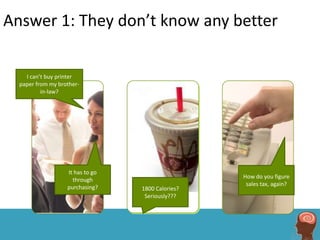
Answer 1: They don’t know any better

    I can’t buy printer
  paper from my brother-
          in-law?


                   It has to go
                                                   How do you figure
                     through
                                                    sales tax, again?
                   purchasing?    1800 Calories?
                                   Seriously???
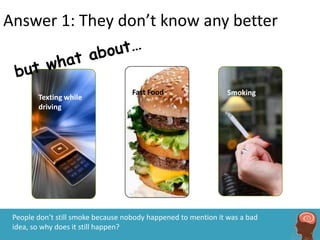
Answer 1: They don’t know any better


                                    Fast Food                   Smoking
        Texting while
        driving


 People don’t still smoke because nobody happened to mention it was a bad
 idea, so why does it still happen?
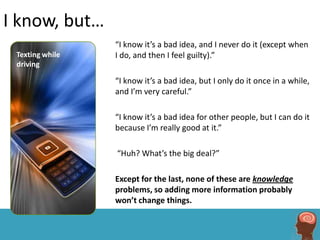
I know, but…
                 “I know it’s a bad idea, and I never do it (except when
 Texting while   I do, and then I feel guilty).”
 driving

                 “I know it’s a bad idea, but I only do it once in a while,
                 and I’m very careful.”

                 “I know it’s a bad idea for other people, but I can do it
                 because I’m really good at it.”

                 “Huh? What’s the big deal?”

                 Except for the last, none of these are knowledge
                 problems, so adding more information probably
                 won’t change things.
So, why?
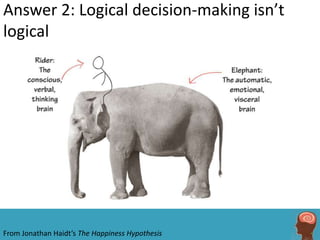
Answer 2: Logical decision-making isn’t
logical


From Jonathan Haidt’s The Happiness Hypothesis
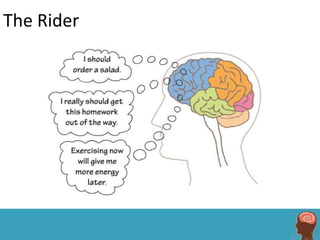
The Rider
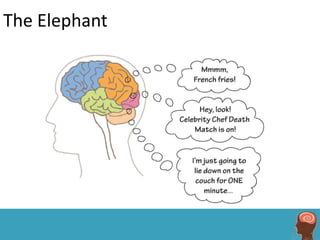
The Elephant
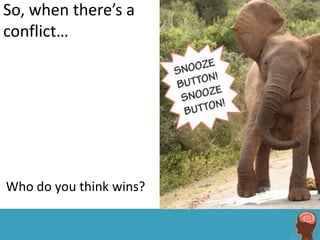
So, when there’s a
conflict…


Who do you think wins?
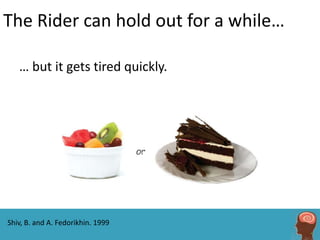
The Rider can hold out for a while…

   … but it gets tired quickly.


Shiv, B. and A. Fedorikhin. 1999
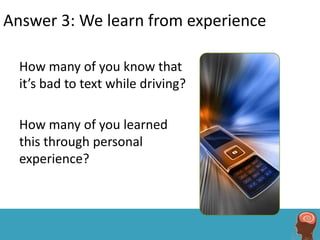
Answer 3: We learn from experience

  How many of you know that
  it’s bad to text while driving?

  How many of you learned
  this through personal
  experience?
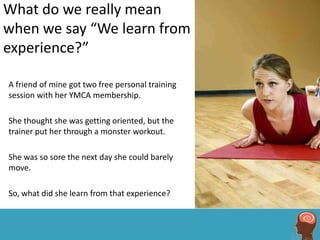
What do we really mean
when we say “We learn from
experience?”

A friend of mine got two free personal training
session with her YMCA membership.

She thought she was getting oriented, but the
trainer put her through a monster workout.

She was so sore the next day she could barely
move.

So, what did she learn from that experience?
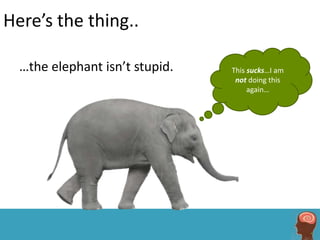
Here’s the thing..

  …the elephant isn’t stupid.   This sucks…I am
                                 not doing this
                                     again…
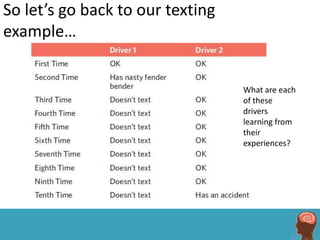
So let’s go back to our texting
example…


                                  What are each
                                  of these
                                  drivers
                                  learning from
                                  their
                                  experiences?
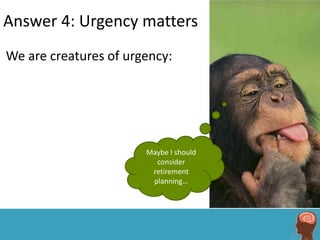
Answer 4: Urgency matters
We are creatures of urgency:


                       Maybe I should
                         consider
                        retirement
                        planning…
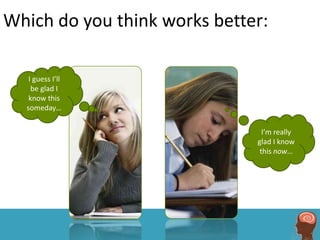
Which do you think works better:

   I guess I’ll
    be glad I
   know this
  someday…


                                I’m really
                              glad I know
                               this now…
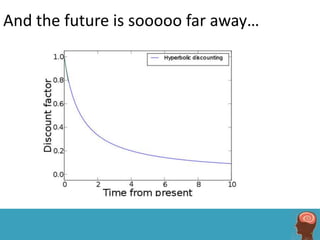
And the future is sooooo far away…
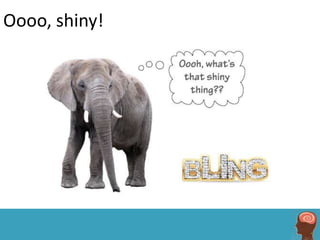
Oooo, shiny!
Visceral Matters
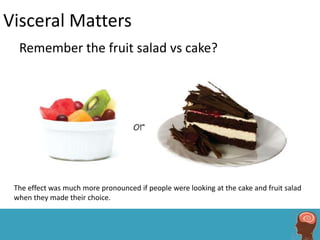
  Remember the fruit salad vs cake?


 The effect was much more pronounced if people were looking at the cake and fruit salad
 when they made their choice.
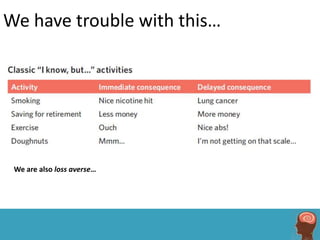
We have trouble with this…


 We are also loss averse…
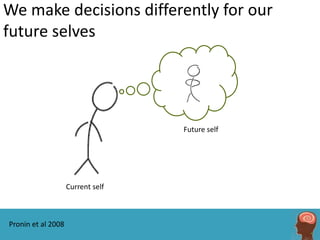
We make decisions differently for our
future selves


                                   Future self


                    Current self


Pronin et al 2008
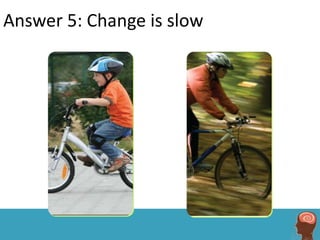
Answer 5: Change is slow
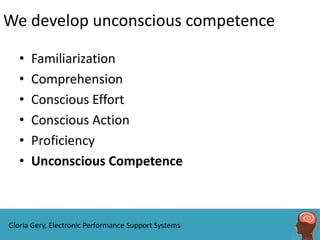
We develop unconscious competence

   •   Familiarization
   •   Comprehension
   •   Conscious Effort
   •   Conscious Action
   •   Proficiency
   •   Unconscious Competence


Gloria Gery, Electronic Performance Support Systems
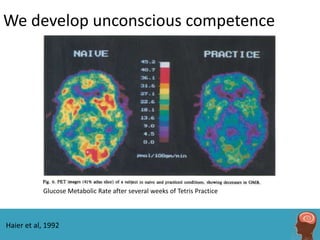
We develop unconscious competence


           Glucose Metabolic Rate after several weeks of Tetris Practice


Haier et al, 1992
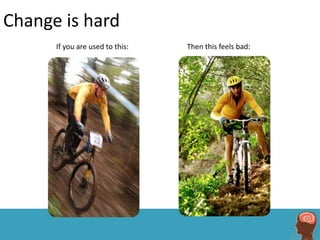
Change is hard
      If you are used to this:   Then this feels bad:
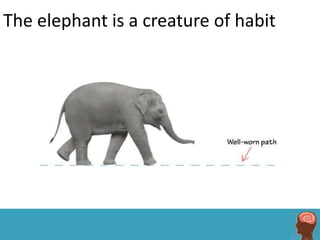
The elephant is a creature of habit
Repeat after me:

   Change is a process, not
         an event.
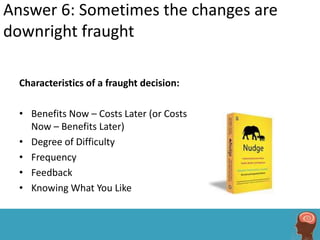
Answer 6: Sometimes the changes are
downright fraught

  Characteristics of a fraught decision:

  • Benefits Now – Costs Later (or Costs
    Now – Benefits Later)
  • Degree of Difficulty
  • Frequency
  • Feedback
  • Knowing What You Like
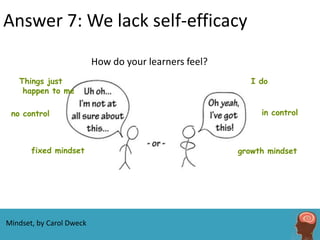
Answer 7: We lack self-efficacy
                          How do your learners feel?
   Things just                                            I do
    happen to me

 no control                                                 in control


       fixed mindset                                   growth mindset


Mindset, by Carol Dweck
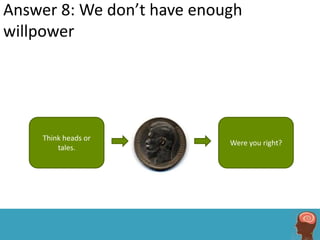
Answer 8: We don’t have enough
willpower


    Think heads or
                            Were you right?
        tales.
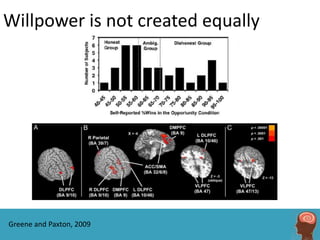
Willpower is not created equally


Greene and Paxton, 2009
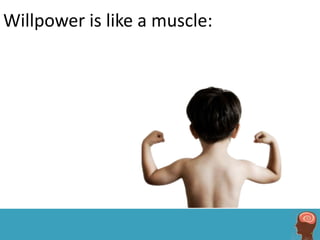
Willpower is like a muscle:
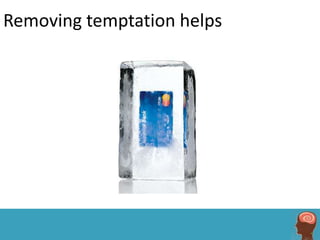
Removing temptation helps
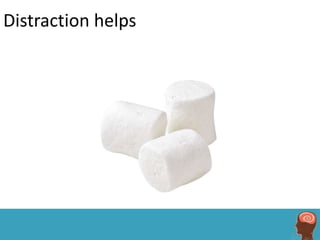
Distraction helps
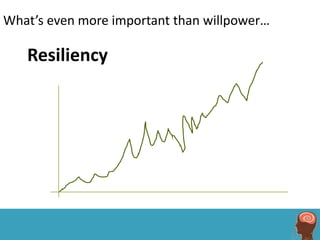
What’s even more important than willpower…

   Resiliency
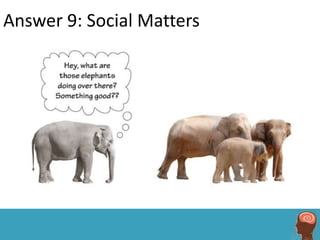
Answer 9: Social Matters
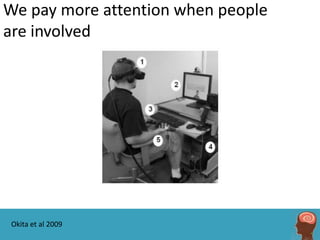
We pay more attention when people
are involved


Okita et al 2009
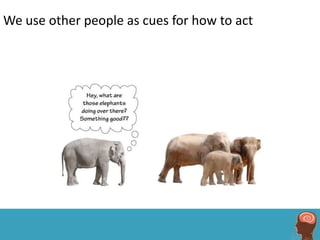
We use other people as cues for how to act
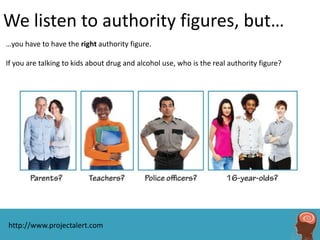
We listen to authority figures, but…
…you have to have the right authority figure.

If you are talking to kids about drug and alcohol use, who is the real authority figure?


http://www.projectalert.com
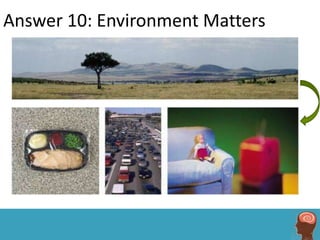
Answer 10: Environment Matters
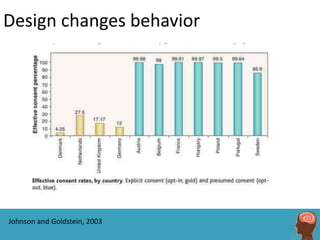
Design changes behavior


Johnson and Goldstein, 2003
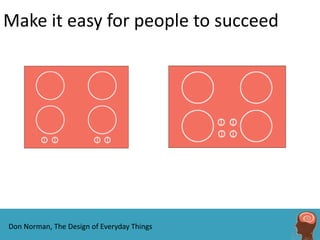
Make it easy for people to succeed


Don Norman, The Design of Everyday Things
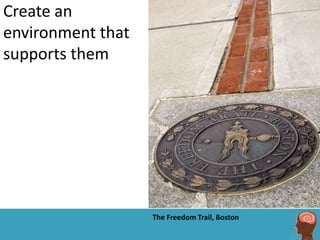
Create an
environment that
supports them


                   The Freedom Trail, Boston
So what do we do about it?
Make things immediate

 • How can we create a sense of urgency?
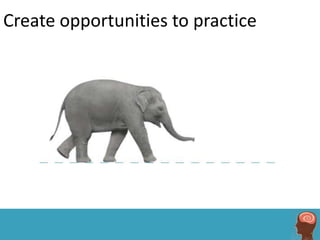
Create opportunities to practice
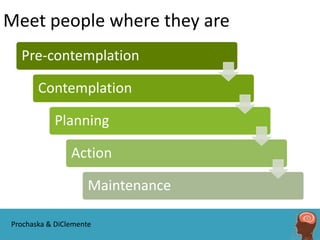
Meet people where they are
  Pre-contemplation

       Contemplation

           Planning

                Action

                     Maintenance

Prochaska & DiClemente
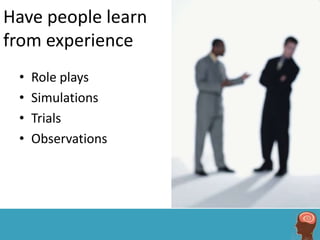
Have people learn
from experience
 •   Role plays
 •   Simulations
 •   Trials
 •   Observations
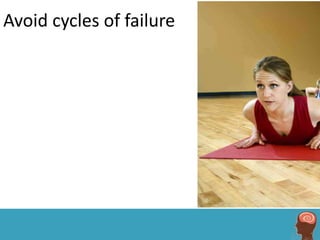
Avoid cycles of failure
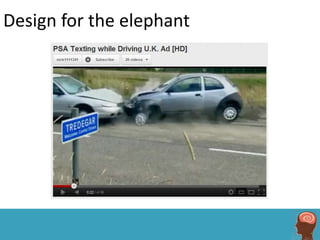
Design for the elephant
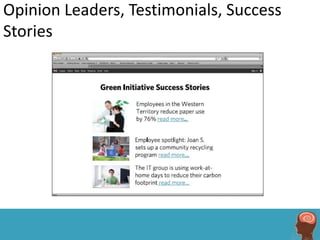
Opinion Leaders, Testimonials, Success
Stories
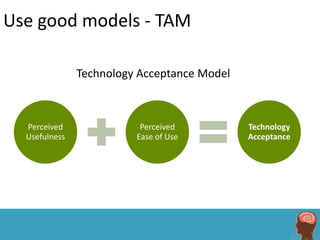
Use good models - TAM

               Technology Acceptance Model


  Perceived               Perceived          Technology
  Usefulness             Ease of Use         Acceptance
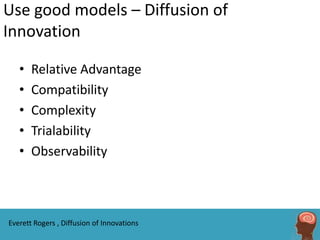
Use good models – Diffusion of
Innovation

   •   Relative Advantage
   •   Compatibility
   •   Complexity
   •   Trialability
   •   Observability


Everett Rogers , Diffusion of Innovations
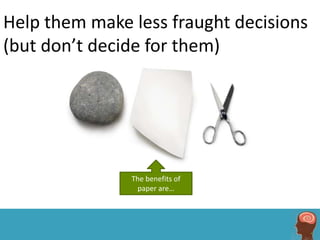
Help them make less fraught decisions
(but don’t decide for them)


               The benefits of
                paper are…
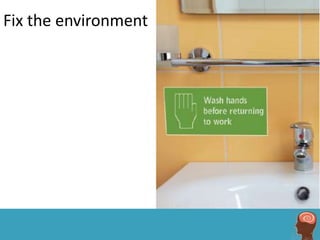
Fix the environment
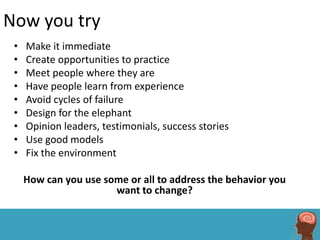
Now you try
 •   Make it immediate
 •   Create opportunities to practice
 •   Meet people where they are
 •   Have people learn from experience
 •   Avoid cycles of failure
 •   Design for the elephant
 •   Opinion leaders, testimonials, success stories
 •   Use good models
 •   Fix the environment

     How can you use some or all to address the behavior you
                       want to change?
Questions?


Julie Dirksen
julie@usablelearning.com
Twitter: usablelearning

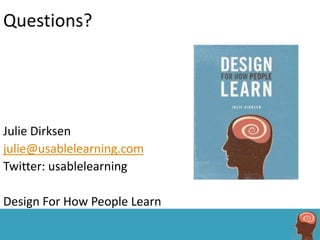
Design For How People Learn
References
 •   Shiv, B. and A. Fedorikhin. 1999. Heart and Mind in Conflict: Interplay of Affect and Cognition in Consumer
     Decision Making. Journal of Consumer Research 26 (December): 278–282.
 •   Haidt, Jonathan, The Happiness Hypothesis (book)
 •   Gery, Gloria, Electronic Performance Support Systems (book)
 •   Haier, R.J., B.V. Siegel Jr., A. MacLachlan, E. Soderling, S. Lottenberg, and M.S. Buchsbaum. 1992 Regional
     glucose metabolic changes after learning a complex visuospatial/motor task: a positron emission
     tomographic study. Brain Research 570: 134–14.
 •   Thaler, Richard and Sustein, Cass. Nudge (book)
 •   Okita, S.Y., J. Bailenson, and D.L. Schwartz. 2008. Mere Belief of Social Action Improves Complex Learning.
     Proceedings of the 8th International Conference for the Learning Sciences.
 •   Johnson, Eric J. and Goldstein, Daniel G., Do Defaults Save Lives? (Nov 21, 2003). Science, Vol. 302, pp.
     1338-1339, 2003. Available at SSRN: http://ssrn.com/abstract=1324774
 •   Norman, Donald, The Design of Everyday Things (book)
 •   Greene and Paxton, Patterns of Neural Activity Associated with Honest and Dishonest Moral Decisions,
     PNAS 106:12506-12511 (July 28, 2009).
 •   Prochaska, JO; Norcross, JC; DiClemente, CC. Changing for good: the revolutionary program that explains
     the six stages of change and teaches you how to free yourself from bad habits. New York: W. Morrow;
     1994
 •   Rogers, Everett Diffusion of Innovations (book)
 •   Pronin E, Olivola CY, & Kennedy KA. (2008) Doing unto future selves as you would do unto others:
     psychological distance and decision making. Personality and social psychology bulletin, 34(2), 224-36.

Design for Behavior Change

  • 1.
    Design for BehaviorChange Think about: What behaviors would you like to see changed? Julie Dirksen, Usable Learning
  • 2.
    There’s a questionI’ve been thinking about most of my professional life…
  • 3.
    Why do peopledo the wrong* things? It’s a simple question, but it has a complicated answer. *By wrong, I don’t mean morally wrong…
  • 4.
    Why do peopledo the wrong* things? It’s a simple question, but it has a complicated answer . *By wrong, I don’t mean morally wrong…
  • 5.
    Answer 1: Theydon’t know any better I can’t buy printer paper from my brother- in-law? It has to go How do you figure through sales tax, again? purchasing? 1800 Calories? Seriously???
  • 6.
    Answer 1: Theydon’t know any better Fast Food Smoking Texting while driving People don’t still smoke because nobody happened to mention it was a bad idea, so why does it still happen?
  • 7.
    I know, but… “I know it’s a bad idea, and I never do it (except when Texting while I do, and then I feel guilty).” driving “I know it’s a bad idea, but I only do it once in a while, and I’m very careful.” “I know it’s a bad idea for other people, but I can do it because I’m really good at it.” “Huh? What’s the big deal?” Except for the last, none of these are knowledge problems, so adding more information probably won’t change things.
  • 8.
  • 9.
    Answer 2: Logicaldecision-making isn’t logical From Jonathan Haidt’s The Happiness Hypothesis
  • 10.
  • 11.
  • 12.
    So, when there’sa conflict… Who do you think wins?
  • 13.
    The Rider canhold out for a while… … but it gets tired quickly. Shiv, B. and A. Fedorikhin. 1999
  • 14.
    Answer 3: Welearn from experience How many of you know that it’s bad to text while driving? How many of you learned this through personal experience?
  • 15.
    What do wereally mean when we say “We learn from experience?” A friend of mine got two free personal training session with her YMCA membership. She thought she was getting oriented, but the trainer put her through a monster workout. She was so sore the next day she could barely move. So, what did she learn from that experience?
  • 16.
    Here’s the thing.. …the elephant isn’t stupid. This sucks…I am not doing this again…
  • 17.
    So let’s goback to our texting example… What are each of these drivers learning from their experiences?
  • 18.
    Answer 4: Urgencymatters We are creatures of urgency: Maybe I should consider retirement planning…
  • 19.
    Which do youthink works better: I guess I’ll be glad I know this someday… I’m really glad I know this now…
  • 20.
    And the futureis sooooo far away…
  • 21.
  • 22.
    Visceral Matters Remember the fruit salad vs cake? The effect was much more pronounced if people were looking at the cake and fruit salad when they made their choice.
  • 23.
    We have troublewith this… We are also loss averse…
  • 24.
    We make decisionsdifferently for our future selves Future self Current self Pronin et al 2008
  • 25.
  • 26.
    We develop unconsciouscompetence • Familiarization • Comprehension • Conscious Effort • Conscious Action • Proficiency • Unconscious Competence Gloria Gery, Electronic Performance Support Systems
  • 27.
    We develop unconsciouscompetence Glucose Metabolic Rate after several weeks of Tetris Practice Haier et al, 1992
  • 28.
    Change is hard If you are used to this: Then this feels bad:
  • 29.
    The elephant isa creature of habit
  • 30.
    Repeat after me: Change is a process, not an event.
  • 31.
    Answer 6: Sometimesthe changes are downright fraught Characteristics of a fraught decision: • Benefits Now – Costs Later (or Costs Now – Benefits Later) • Degree of Difficulty • Frequency • Feedback • Knowing What You Like
  • 32.
    Answer 7: Welack self-efficacy How do your learners feel? Things just I do happen to me no control in control fixed mindset growth mindset Mindset, by Carol Dweck
  • 33.
    Answer 8: Wedon’t have enough willpower Think heads or Were you right? tales.
  • 34.
    Willpower is notcreated equally Greene and Paxton, 2009
  • 35.
  • 36.
  • 37.
  • 38.
    What’s even moreimportant than willpower… Resiliency
  • 39.
  • 40.
    We pay moreattention when people are involved Okita et al 2009
  • 41.
    We use otherpeople as cues for how to act
  • 42.
    We listen toauthority figures, but… …you have to have the right authority figure. If you are talking to kids about drug and alcohol use, who is the real authority figure? http://www.projectalert.com
  • 43.
  • 44.
  • 45.
    Make it easyfor people to succeed Don Norman, The Design of Everyday Things
  • 46.
    Create an environment that supportsthem The Freedom Trail, Boston
  • 47.
    So what dowe do about it?
  • 48.
    Make things immediate • How can we create a sense of urgency?
  • 49.
  • 50.
    Meet people wherethey are Pre-contemplation Contemplation Planning Action Maintenance Prochaska & DiClemente
  • 51.
    Have people learn fromexperience • Role plays • Simulations • Trials • Observations
  • 52.
  • 53.
  • 54.
  • 55.
    Use good models- TAM Technology Acceptance Model Perceived Perceived Technology Usefulness Ease of Use Acceptance
  • 56.
    Use good models– Diffusion of Innovation • Relative Advantage • Compatibility • Complexity • Trialability • Observability Everett Rogers , Diffusion of Innovations
  • 57.
    Help them makeless fraught decisions (but don’t decide for them) The benefits of paper are…
  • 58.
  • 59.
    Now you try • Make it immediate • Create opportunities to practice • Meet people where they are • Have people learn from experience • Avoid cycles of failure • Design for the elephant • Opinion leaders, testimonials, success stories • Use good models • Fix the environment How can you use some or all to address the behavior you want to change?
  • 60.
  • 61.
    References • Shiv, B. and A. Fedorikhin. 1999. Heart and Mind in Conflict: Interplay of Affect and Cognition in Consumer Decision Making. Journal of Consumer Research 26 (December): 278–282. • Haidt, Jonathan, The Happiness Hypothesis (book) • Gery, Gloria, Electronic Performance Support Systems (book) • Haier, R.J., B.V. Siegel Jr., A. MacLachlan, E. Soderling, S. Lottenberg, and M.S. Buchsbaum. 1992 Regional glucose metabolic changes after learning a complex visuospatial/motor task: a positron emission tomographic study. Brain Research 570: 134–14. • Thaler, Richard and Sustein, Cass. Nudge (book) • Okita, S.Y., J. Bailenson, and D.L. Schwartz. 2008. Mere Belief of Social Action Improves Complex Learning. Proceedings of the 8th International Conference for the Learning Sciences. • Johnson, Eric J. and Goldstein, Daniel G., Do Defaults Save Lives? (Nov 21, 2003). Science, Vol. 302, pp. 1338-1339, 2003. Available at SSRN: http://ssrn.com/abstract=1324774 • Norman, Donald, The Design of Everyday Things (book) • Greene and Paxton, Patterns of Neural Activity Associated with Honest and Dishonest Moral Decisions, PNAS 106:12506-12511 (July 28, 2009). • Prochaska, JO; Norcross, JC; DiClemente, CC. Changing for good: the revolutionary program that explains the six stages of change and teaches you how to free yourself from bad habits. New York: W. Morrow; 1994 • Rogers, Everett Diffusion of Innovations (book) • Pronin E, Olivola CY, & Kennedy KA. (2008) Doing unto future selves as you would do unto others: psychological distance and decision making. Personality and social psychology bulletin, 34(2), 224-36.