

StrategicPlanning:Concepts,
TheoriesandPractices
WYN-LOVE NATINO CAAMPUED-MPA STUDENT
DR. JOSEFINA B. BITONIO
PROFESSOR
TREY
research
WENEEDAPLAN,WORKONTHATPLANANDSTART IT NOW.
2
TREY
research
Theories of Planning
Concepts of Strategic
Planning
Rationale of Strategic
Planning
Purposes and Functions of
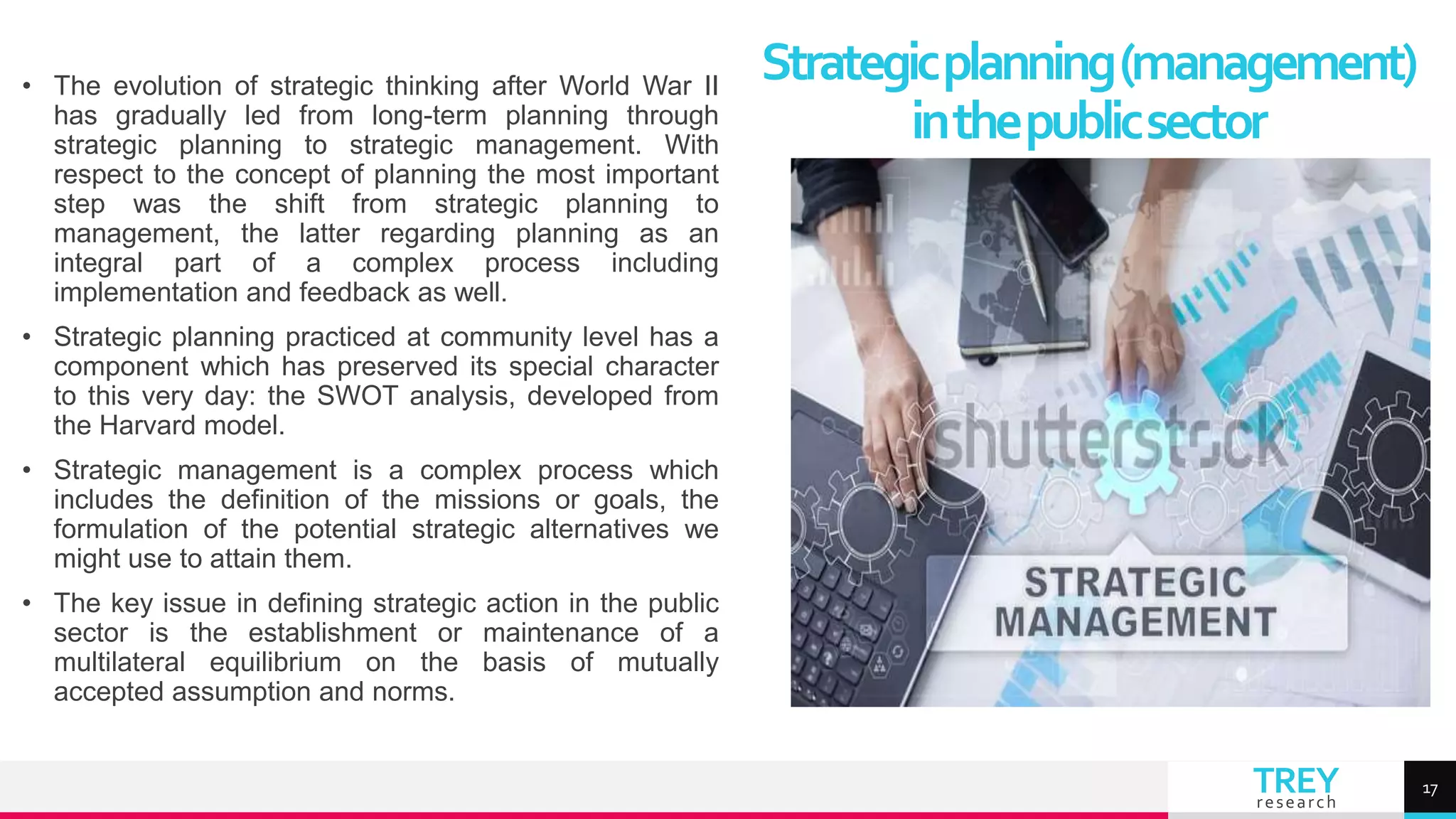
Strategic Planning
StrategicPlanning:
Concepts,Theoriesand
Practices
3
TREY
research
PLANNING
• is one of the fundamentals of
modern life. We all practice it to a
greater or lesser extent. In our
personal lives we plan holidays,
careers, the acquisition of assets.
• In essence such plans are
organizational 'route maps' to get
us from 'where we are at now' to
'where we want to get to' at some
defined point, or points, in the
future.
WHATISPLANNING?
4
TREY
research
• Planning is not an end in
itself. It is a purposive
action.
• Ultimate aim of planning
is to promote human
growth or development ,
that is , planning is a
means and a process to
achieve development.
(Faludi, A: 1973)
WHYISPLANNING
NECESSARY?
5
TREY
research
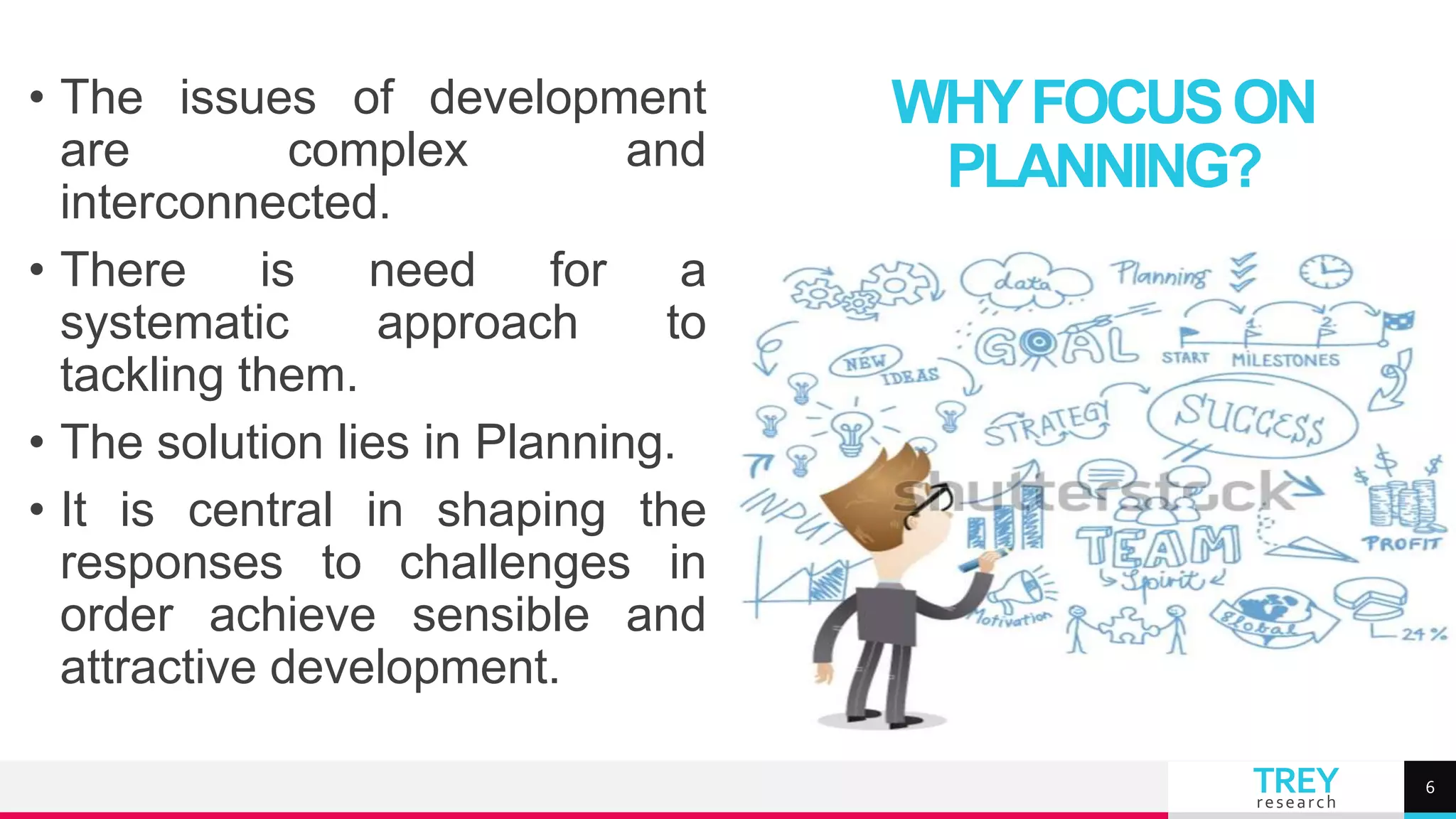
• The issues of development
are complex and
interconnected.
• There is need for a
systematic approach to
tackling them.
• The solution lies in Planning.
• It is central in shaping the
responses to challenges in
order achieve sensible and
attractive development.
WHYFOCUSON
PLANNING?
6
TREY
research
• Planning practice is influenced by
theory and theory can be
structured in accordance with
planning practice.
• Early planning theories emerged
out of practice planning codified
as a professional activity.
• Efforts to develop a coherent
theory emerged in the 1950s and
60s that need to rationalize the
interests and activities of planning
under conditions of social foment.
Whatistheroleoftheoryin
understandingPlanning?
7
TREY
research
Theories of
Planning
8
TREY
research
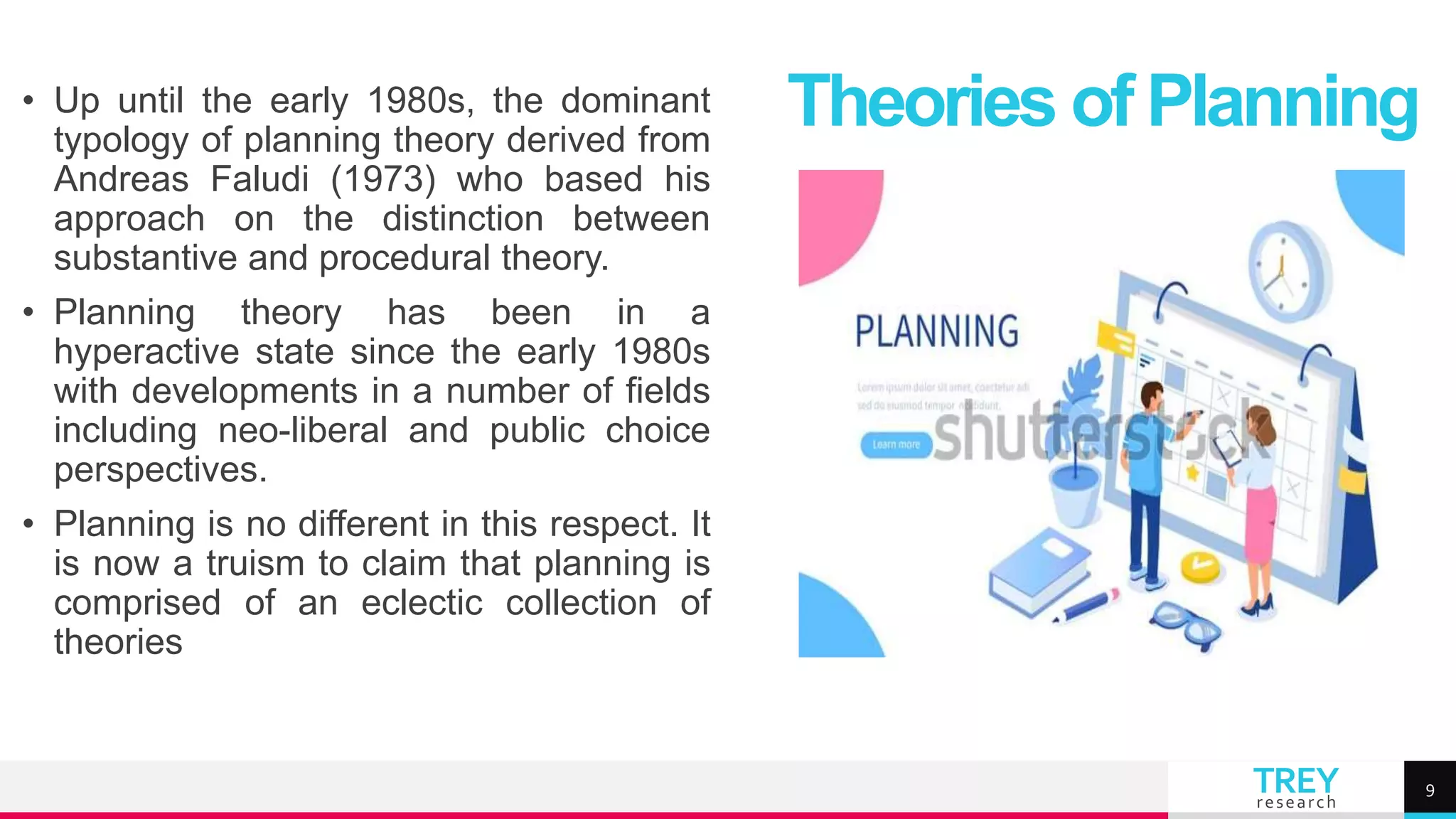
• Up until the early 1980s, the dominant
typology of planning theory derived from
Andreas Faludi (1973) who based his
approach on the distinction between
substantive and procedural theory.
• Planning theory has been in a
hyperactive state since the early 1980s
with developments in a number of fields
including neo-liberal and public choice
perspectives.
• Planning is no different in this respect. It
is now a truism to claim that planning is
comprised of an eclectic collection of
theories
Theories of Planning
9
TREY
research
• Theory of Planning helps
planners to understand
themselves and their
operating methods.
• Theory of planning is
synonymous with procedural
theory.
• ‘Theory of Planning’ which is
concerned with organization
of planning agencies and
planners.
Theories of Planning
10
TREY
research
• The substantive theory (theory
of planning) seeks to explain the
essence of teleological or purpose
action and to give a better
understanding of planning itself.
• The procedural theory (theory in
planning), focusing more on the
practice of planning, describes the
various phases and techniques
used in designing the future,
clarifies the role of planners and
other actors involved, and
recommends various tools for the
solution of the problems/tasks.
Theories of Planning
11
TREY
research
• The first and most widely used typology
of planning is the Procedural Theory
which explains the procedure of planning
per se, irrespective of what we plan for.
• Furthermore, Falludi strongly believed
that procedural theory is the area of
specialization of planners rather than
substantive, which has its own specialists
(economists, sociologists etc.).
• Procedural theories define and justify
preferred methods of decision-making
whereas substantive theories pertain to
interdisciplinary knowledge relevant to
the content of planning.
• Consequently, it is overwhelmingly
focused on the means of planning and
not the ends.
Theories of Planning
12
TREY
research
• (Pseudo-)positivist Functional
Planning
• Rational Comprehensive Planning
• Pragmatist incrementalism
• Strategic planning (management)
in the public sector
• Communicative-collaborative
planning
• Post-modern modernity in
planning: Pragmatic eclectics
Basic cases in
Theories of Planning
13
TREY
research
• Functional plan making and purposive
actions usually have a rational justification,
and can be judged in a more exact way
than the other planning processes. The
choice of means at a given time can be
justified with rational arguments and even
the incidental failure of the means chosen
can be explained after the intervention,
when the facts have come to be known.
• A functionalist planner with a positivist
attitude would not have the chance to
choose among competing planning
theories, modes or styles, because these
choices involve values because different
means produce different results,
consequently they affect the various
interest groups in different ways.
(Pseudo-)positivist
functionalplanning
14
TREY
research
• In the 1960s rational comprehensive
planning was the most frequently applied
method, which greatly contributed to the
general acceptance of planning and is
still highly recommended in our days.
• The adjective comprehensive refers to
the complex handling of the system and
a multi-disciplinary approach. It actually
means a multilateral approach, because
manageability sets a limitation to the
depth of problem solving.
• Representatives of rational-
comprehensive planning often tend to
ignore the duality of facts and decisions
and have a penchant for presenting the
ends/goals as if they were the findings of
comprehensive analysis.
RationaleComprehensive
Planning
15
TREY
research
• Pragmatism and incrementalism have a lot in
common. Both tend to avoid radical changes,
follow liberal-democratic ideas, and besides
the traditional technical instrumental
rationality they take into account power
related issues as well.
• Every kind of planning is pragmatist to some
extent, but in this special case it is
particularly justified to emphasize it in the
name as well, because this theory of
planning focuses decidedly on solving
practical problems.
• Incrementalism also implies that a program
promising measurable benefits should be
carried out only if it does not involve damage
to the environment; the method actually
prefers solutions which contribute to the
improvement of the environment besides
pursuing a particular interest.
Pragmatist
Incrementalism
16
TREY
research
• The evolution of strategic thinking after World War II
has gradually led from long-term planning through
strategic planning to strategic management. With
respect to the concept of planning the most important
step was the shift from strategic planning to
management, the latter regarding planning as an
integral part of a complex process including
implementation and feedback as well.
• Strategic planning practiced at community level has a
component which has preserved its special character
to this very day: the SWOT analysis, developed from
the Harvard model.
• Strategic management is a complex process which
includes the definition of the missions or goals, the
formulation of the potential strategic alternatives we
might use to attain them.
• The key issue in defining strategic action in the public
sector is the establishment or maintenance of a
multilateral equilibrium on the basis of mutually
accepted assumption and norms.
Strategicplanning(management)
inthepublicsector
17
TREY
research
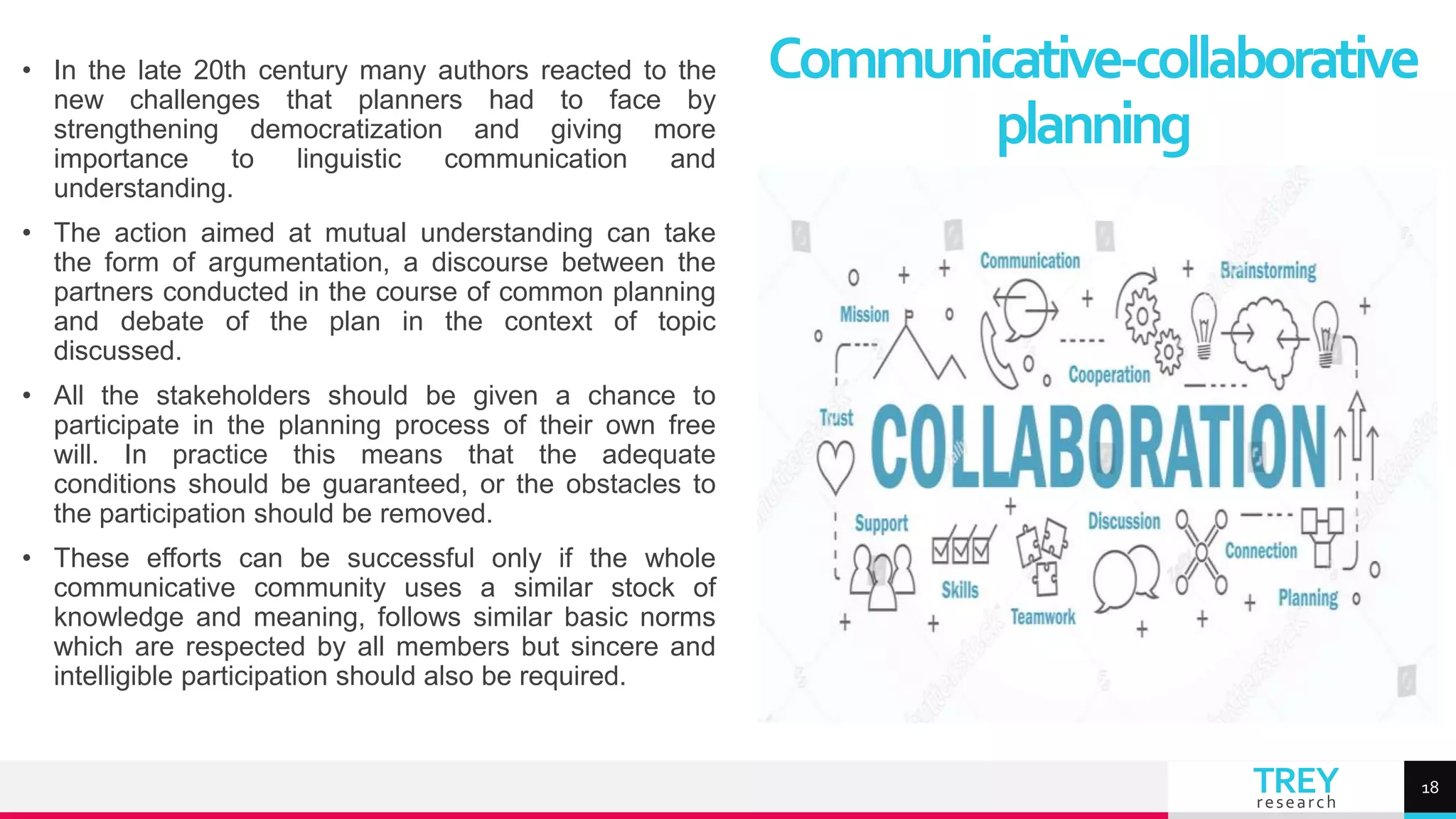
• In the late 20th century many authors reacted to the
new challenges that planners had to face by
strengthening democratization and giving more
importance to linguistic communication and
understanding.
• The action aimed at mutual understanding can take
the form of argumentation, a discourse between the
partners conducted in the course of common planning
and debate of the plan in the context of topic
discussed.
• All the stakeholders should be given a chance to
participate in the planning process of their own free
will. In practice this means that the adequate
conditions should be guaranteed, or the obstacles to
the participation should be removed.
• These efforts can be successful only if the whole
communicative community uses a similar stock of
knowledge and meaning, follows similar basic norms
which are respected by all members but sincere and
intelligible participation should also be required.
Communicative-collaborative
planning
18
TREY
research
• In the new power space the fight will be carried on for
access to information, new knowledge, the opportunity
to express and enforce one’s standpoint, and the right
to engage in planning, instead of land or raw
materials.
• A planner who uses post-modern arguments as well
does not believe in absolute, resolvable truth, he
knows only norms that are accepted in a specific place
at a given time.
• In the course of the discourses planners should
explore the prevailing values and – through mutual
understanding – seek solutions which produce no
losers but promise the best possible output in the
given operative situation, and help to secure the
highest number of winning positions.
• The idea that post-modern modern community
planning has taken over from modernity is that its
mission is to serve public interest redefined as being
constructed from autonomous elements that are not in
conflict but in a synergic relation; it is not technical
rationality any longer, but uniquely the privileged
means of enhancing economic growth.
Post-modernmodernityin
planning:PragmaticEclectics
19
TREY
research
• In 1980, Nigel Taylor recognized two classes
of theories related to planning: sociological
and philosophical.
• In fact he coined these two terms, he tried to
distinguish between descriptive theoretical
statements and statements with prescriptive
nature.
• Planning theories have commonly embodied a
mixture of sociological assumptions about
human and social behavior and philosophical
assumptions about the nature, purposes and
premises of planning.
• Both the sociological and philosophical
assumptions of planning warrant thorough
examination.
TypologiesofPlanning
20
TREY
research
Six types of planning theory
1) analytical-explanative
2) formal-explanative
3) procedural-explanative
4) analytical prescriptive
5) formal-prescriptive
6) procedural-prescriptive
TypologiesofPlanning
21
TREY
research
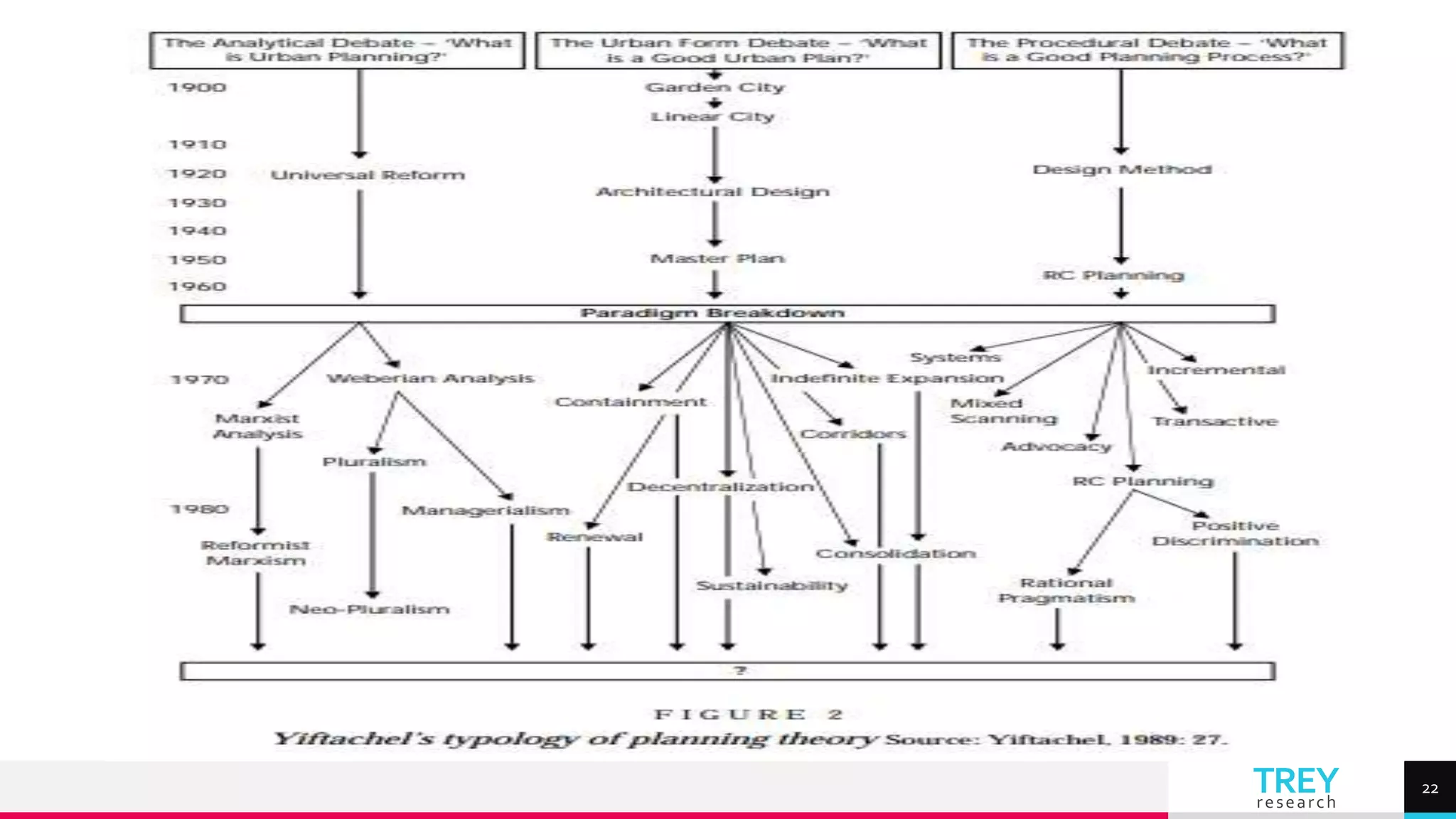
Yiftachel‘sTypologyofplanningTheory
22
TREY
research
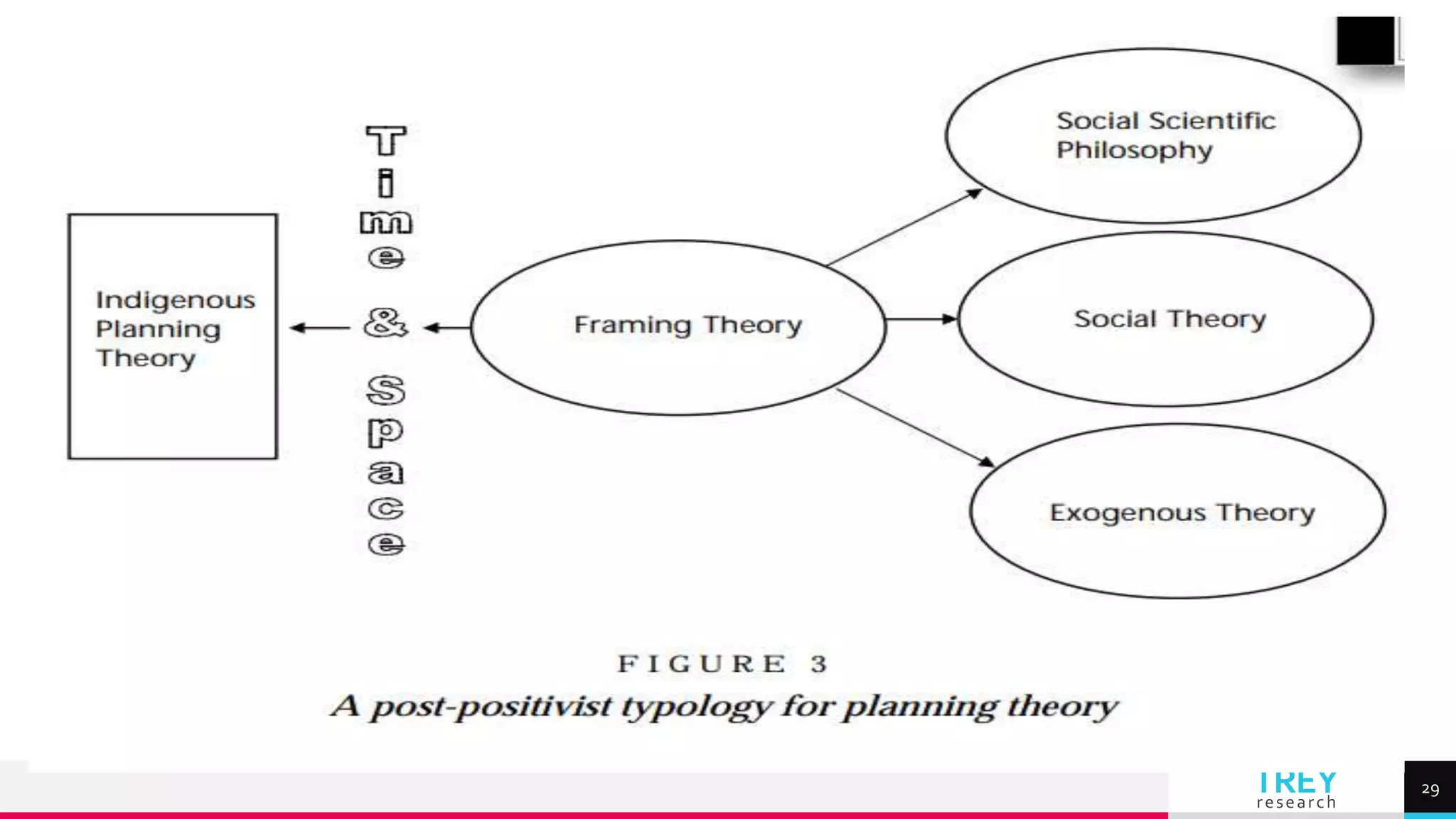
Five types of planning
theories
• Social scientific
philosophy
• Social theory
• exogenous theory
• framing theory and
• indigenous theory
TypologiesofPlanning
23
TREY
research
• This indicates broad approaches, such as
positivism, Marxism, idealism, or
phenomenology, seen by Allmendinger as
underlying different social theories.
• Consequently, a philosophical
understanding and perspective on social
science can reveal the foundations of
social theory.
• Some aspects of social theory appear very
similar and proponents of each may
appear to be arguing past each other or
about aspects that have little relevance.
One example of this is the understanding
of the relationship between structure and
agency within collaborative planning
theory.
SocialScientificPhilosophical
Understandings
24
TREY
research
Two broad categories of social
theory exist:
• the ‘top-down’ approaches which
examine the structuring forces
upon individuals.
• the ‘bottom-up’ interpretative
understandings that emphasize
the reflective nature of
individuals and their ability to
choose.
SocialTheory
25
TREY
research
• Exogenous theories include, for example,
theories of democracy, cognitive
psychology, regime and regulation theory,
implementation theory, central–local
relations, nationalism and a host of other
‘meso-level’ theoretical constructs.
• Exogenous theories do not provide a holistic
or general theoretical understanding of
society but focus instead on a particular
element of society.
• These are “meso-level” theories, that is, not
general theories of society, but focused on a
particular aspect of it; they are not
specifically concerned with planning, but are
relevant to it.
ExogenousTheory
26
TREY
research
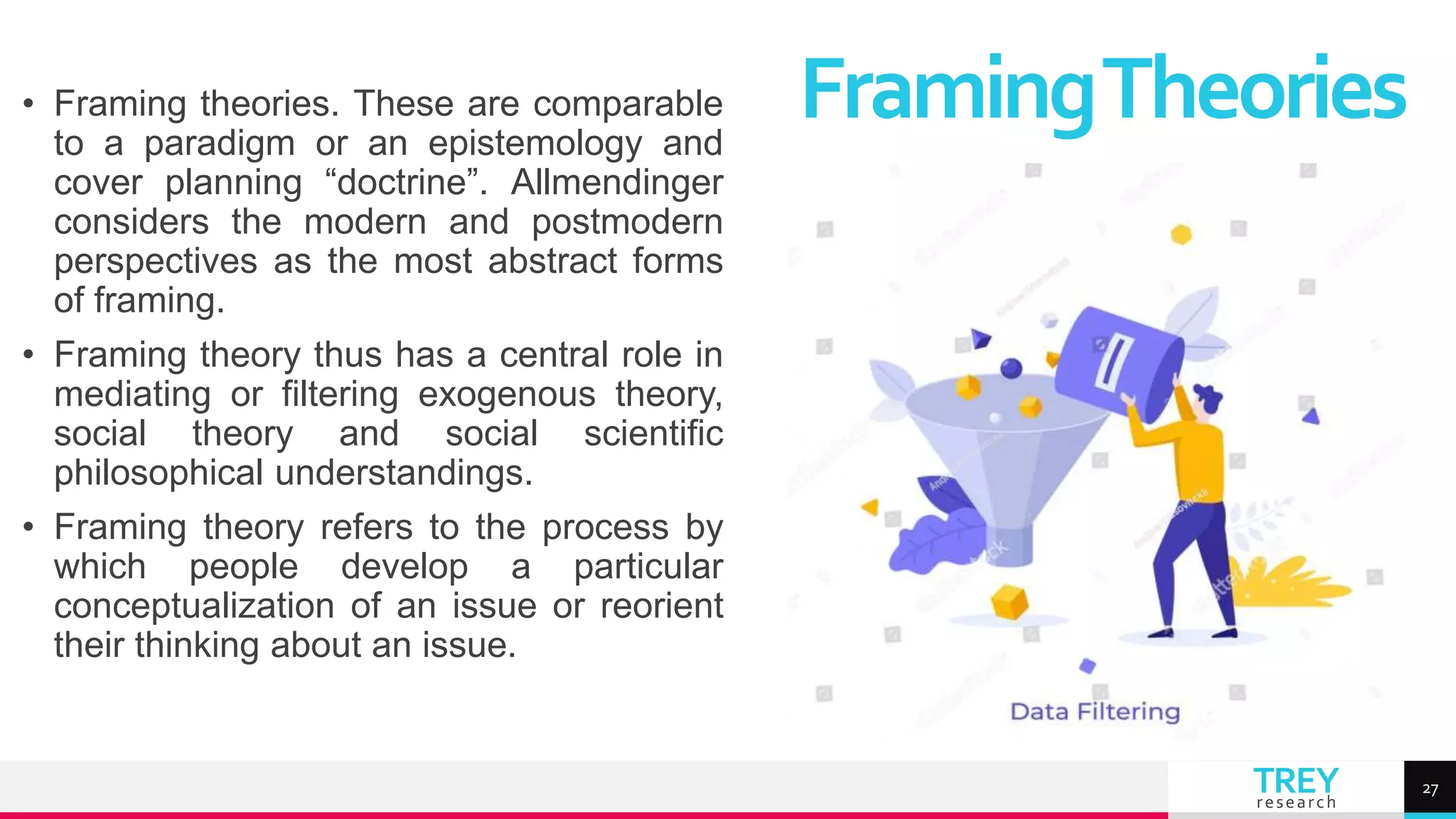
• Framing theories. These are comparable
to a paradigm or an epistemology and
cover planning “doctrine”. Allmendinger
considers the modern and postmodern
perspectives as the most abstract forms
of framing.
• Framing theory thus has a central role in
mediating or filtering exogenous theory,
social theory and social scientific
philosophical understandings.
• Framing theory refers to the process by
which people develop a particular
conceptualization of an issue or reorient
their thinking about an issue.
FramingTheories
27
TREY
research
• These are planning-specific, derive from
the above forms of theory and are
politically and generally socially situated.
• Indigenous planning (or Indigenous
community planning) is an ideological
approach to the field of regional
planning where planning is done
by Indigenous people for Indigenous
communities.
• Indigenous planning theory cannot be
simply ‘read off’ from a combination of
other kinds of theoretical understanding in
a post-empirical perspective.
IndigenousPlanningTheory
28
TREY
research
29
TREY
research
Four Major Planning
Theories
30
• Philosophical Synthesis
• Rationalism
• Organizational
Development
• Empiricism
TREY
research
• Philosophical synthesis
emphasizes a broad
approach to planning which
considers information on
social, economic and
ethical conditions as well
as the environmental
background of the
institution or organization
for which planning will be
undertaken.
Philosophical
Synthesis
31
TREY
research
• Strategy is about making
choices (Porter, 1985).
Because the systematic
collection of relevant
information concerning the
organization’s environment is
at best an inexact science,
strategic managers are
inevitably left with varying
amounts of uncertainty
associated with each strategic
alternative they possess.
Philosophical
Synthesis
32
TREY
research
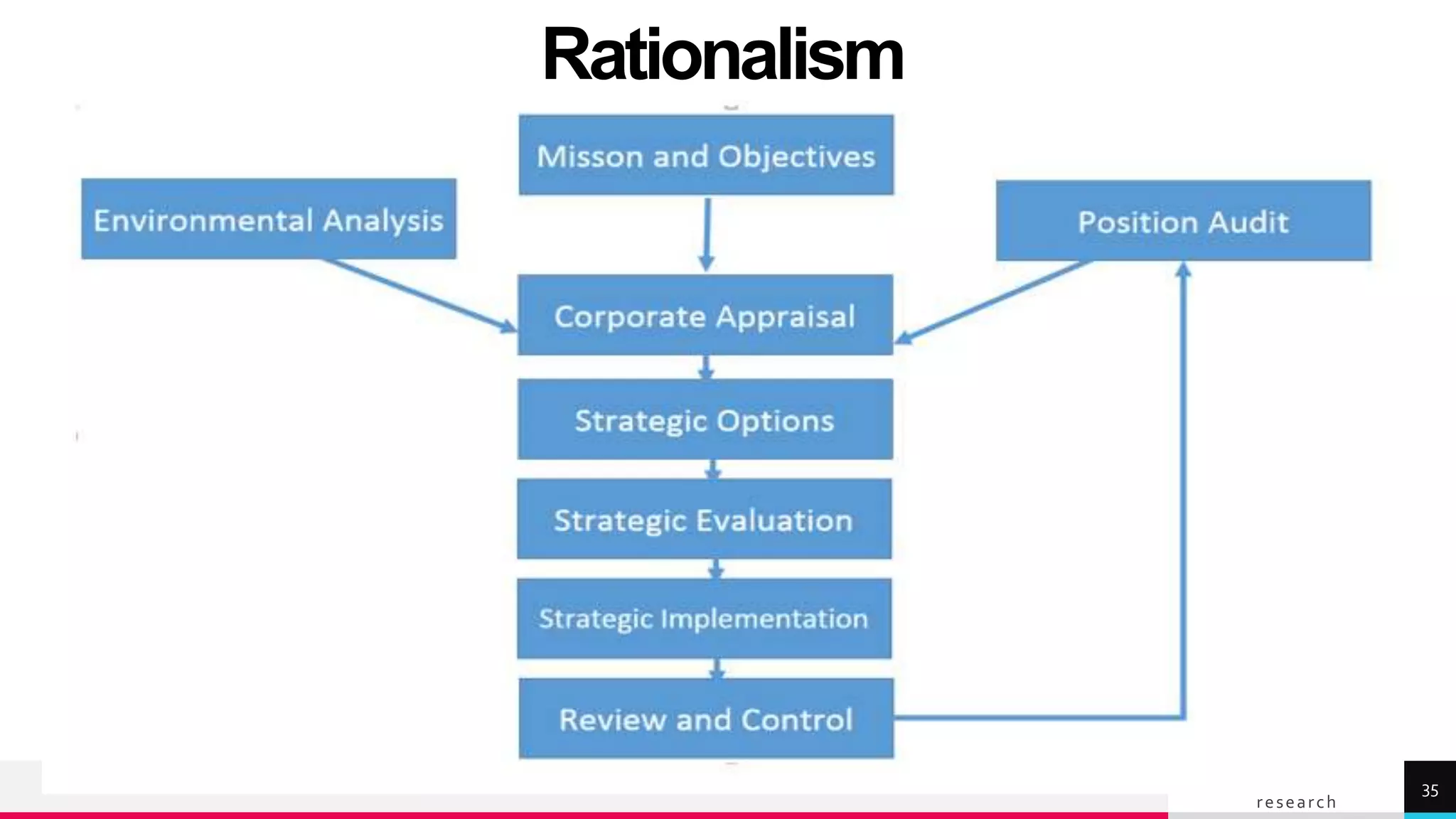
• Rationalism looks at people
as a utility and defines
human relations in
instrumental terms.
• Rational planning models
assume a sequential,
observable cycle that
includes setting of goals,
determining objectives,
making plans, implementing
the plans, and reviewing
results.
Rationalism
33
TREY
research
FOUR MAIN AREAS
• Strategic Analysis – can use PESTELI or
Porters 5 forces to analyze the external
environment whole SWOT analysis can
be used for corporate appraisal.
• Strategic Choice – models like NPV, IRR
and payback evaluation can be used to
choose when strategic option to take.
• Strategic Implementation – need to
consider policies and strategies to
implement for ALL areas of the
business.
• Strategy Evaluation and Control –
measuring the performance against the
objectives.
Rationalism
34
TREY
research
Rationalism
35
TREY
research
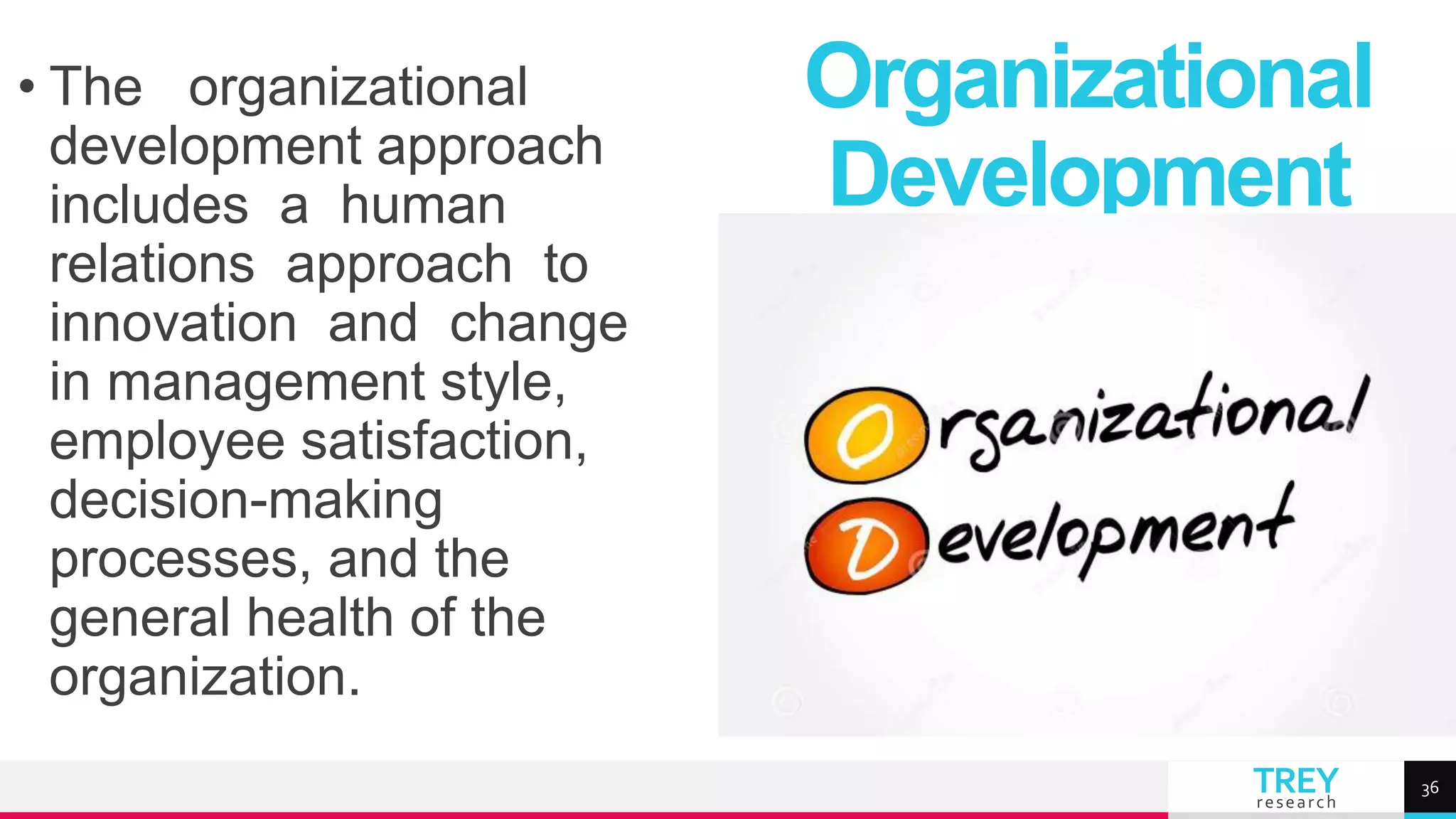
• The organizational
development approach
includes a human
relations approach to
innovation and change
in management style,
employee satisfaction,
decision-making
processes, and the
general health of the
organization.
Organizational
Development
36
TREY
research
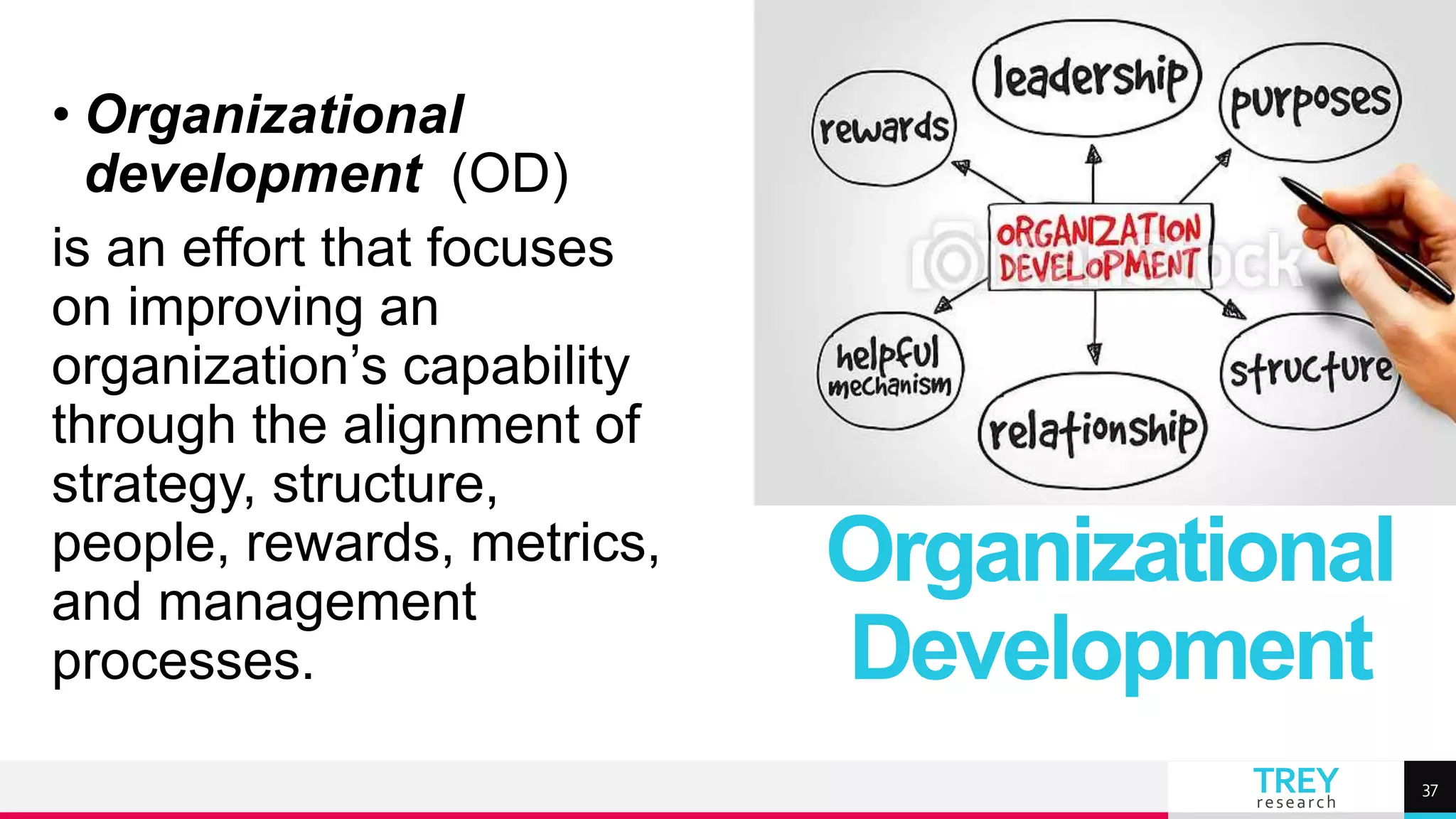
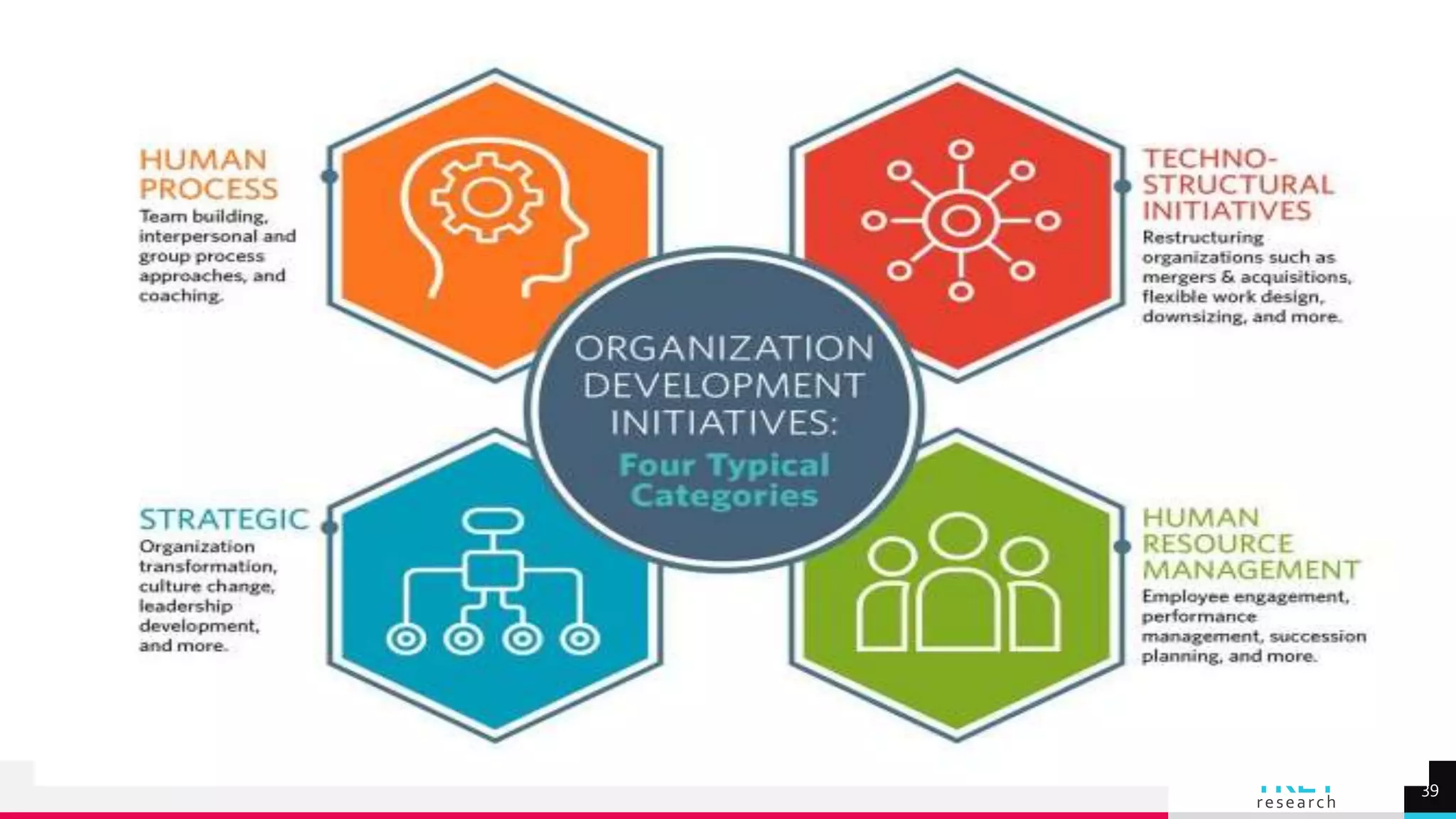
• Organizational
development (OD)
is an effort that focuses
on improving an
organization’s capability
through the alignment of
strategy, structure,
people, rewards, metrics,
and management
processes.
Organizational
Development
37
TREY
research
38
TREY
research
39
TREY
research
• Empiricism acknowledges
the importance of studies
on system behavior by
public administrators,
economists and other
social scientists concerned
with planning theory.
• Empiricism is less
normative, less concerned
with planned social change,
and uses a positivistic
framework for analysis.
Empiricism
40
TREY
research
• The empiricist approach believes
in certainty, in undeniable facts. It
believes that data collection and
information are vitally important to
make any decision.
• Empiricists work by reducing a
problem to a manageable size.
They then use the data that is
available (or collect some more
where needed) to define the
problem. That information should
then point out exactly what the
right solution is.
Empiricism
41
TREY
research
Concepts of
Strategic Planning
42
TREY
research
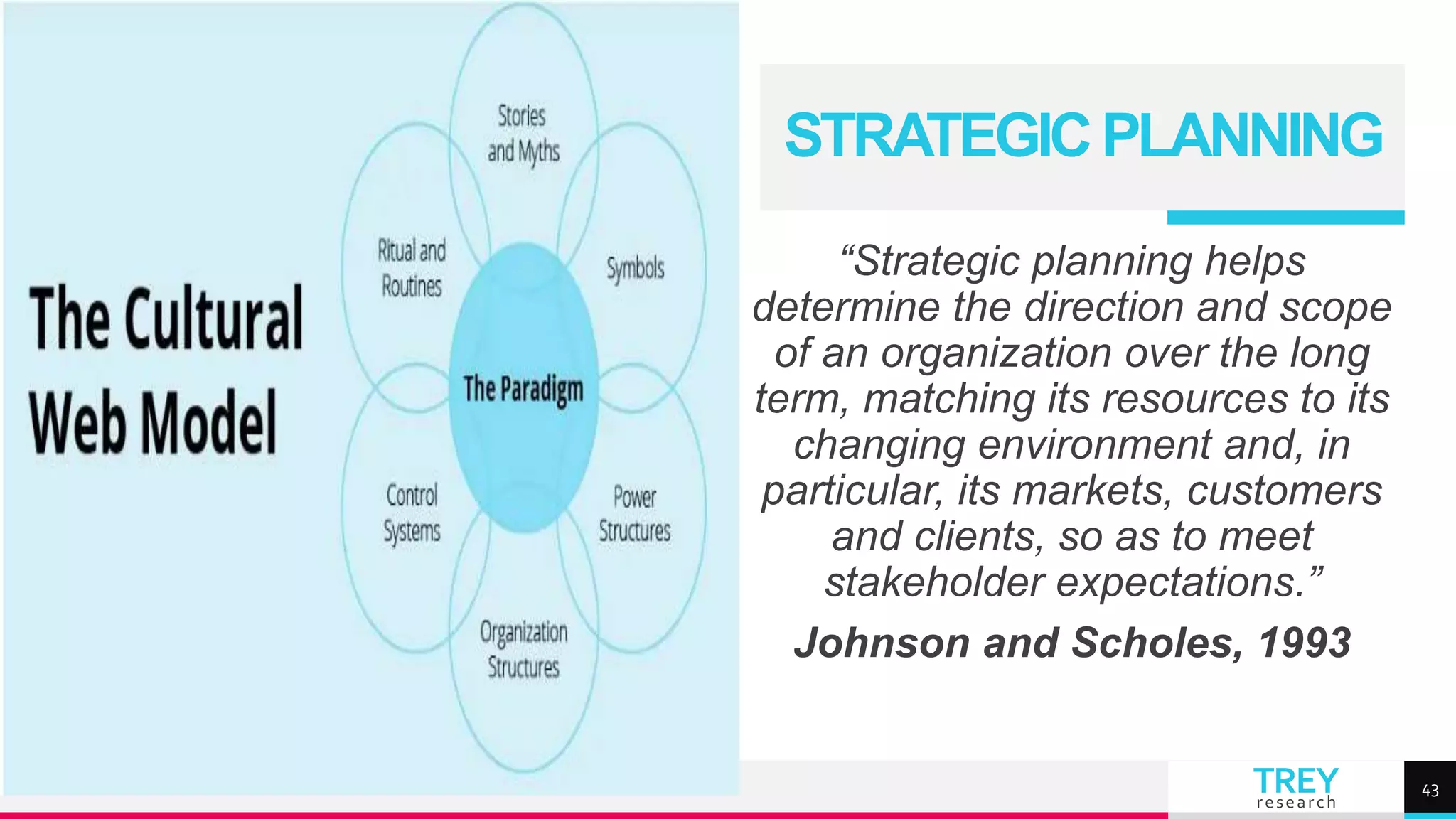
STRATEGICPLANNING
“Strategic planning helps
determine the direction and scope
of an organization over the long
term, matching its resources to its
changing environment and, in
particular, its markets, customers
and clients, so as to meet
stakeholder expectations.”
Johnson and Scholes, 1993
43
TREY
research
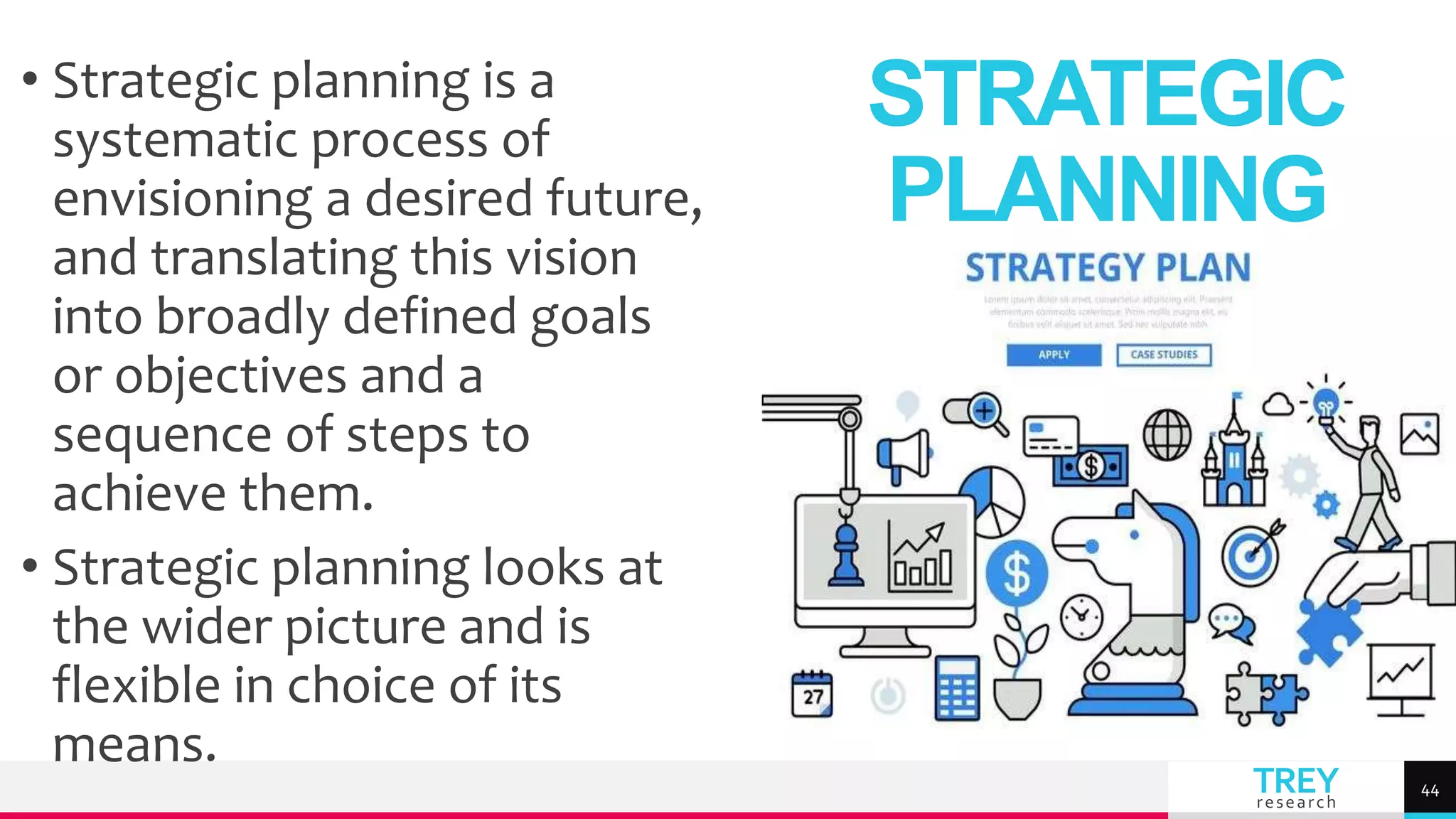
• Strategic planning is a
systematic process of
envisioning a desired future,
and translating this vision
into broadly defined goals
or objectives and a
sequence of steps to
achieve them.
• Strategic planning looks at
the wider picture and is
flexible in choice of its
means.
STRATEGIC
PLANNING
44
TREY
research
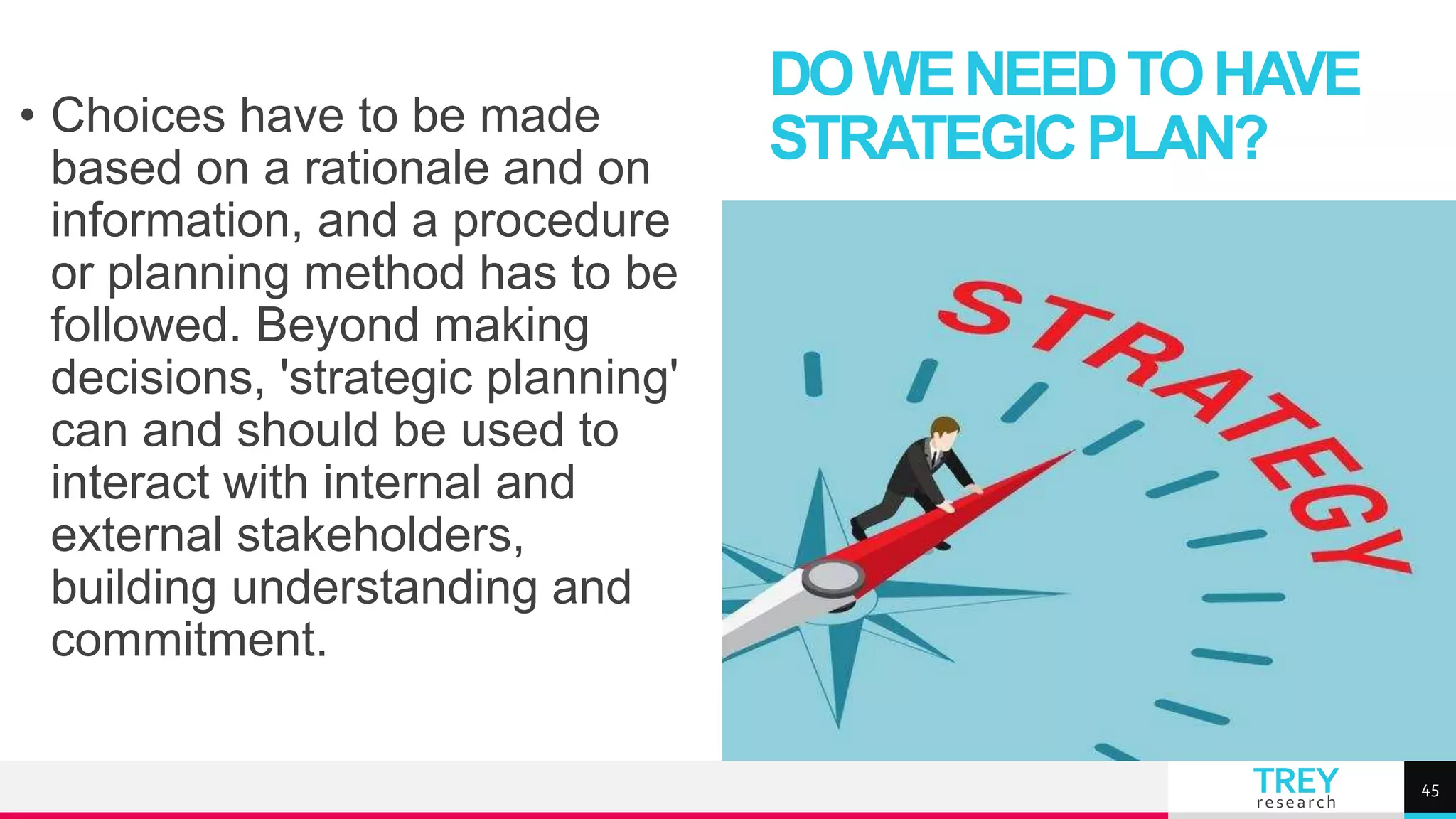
• Choices have to be made
based on a rationale and on
information, and a procedure
or planning method has to be
followed. Beyond making
decisions, 'strategic planning'
can and should be used to
interact with internal and
external stakeholders,
building understanding and
commitment.
DOWENEEDTOHAVE
STRATEGICPLAN?
45
TREY
research
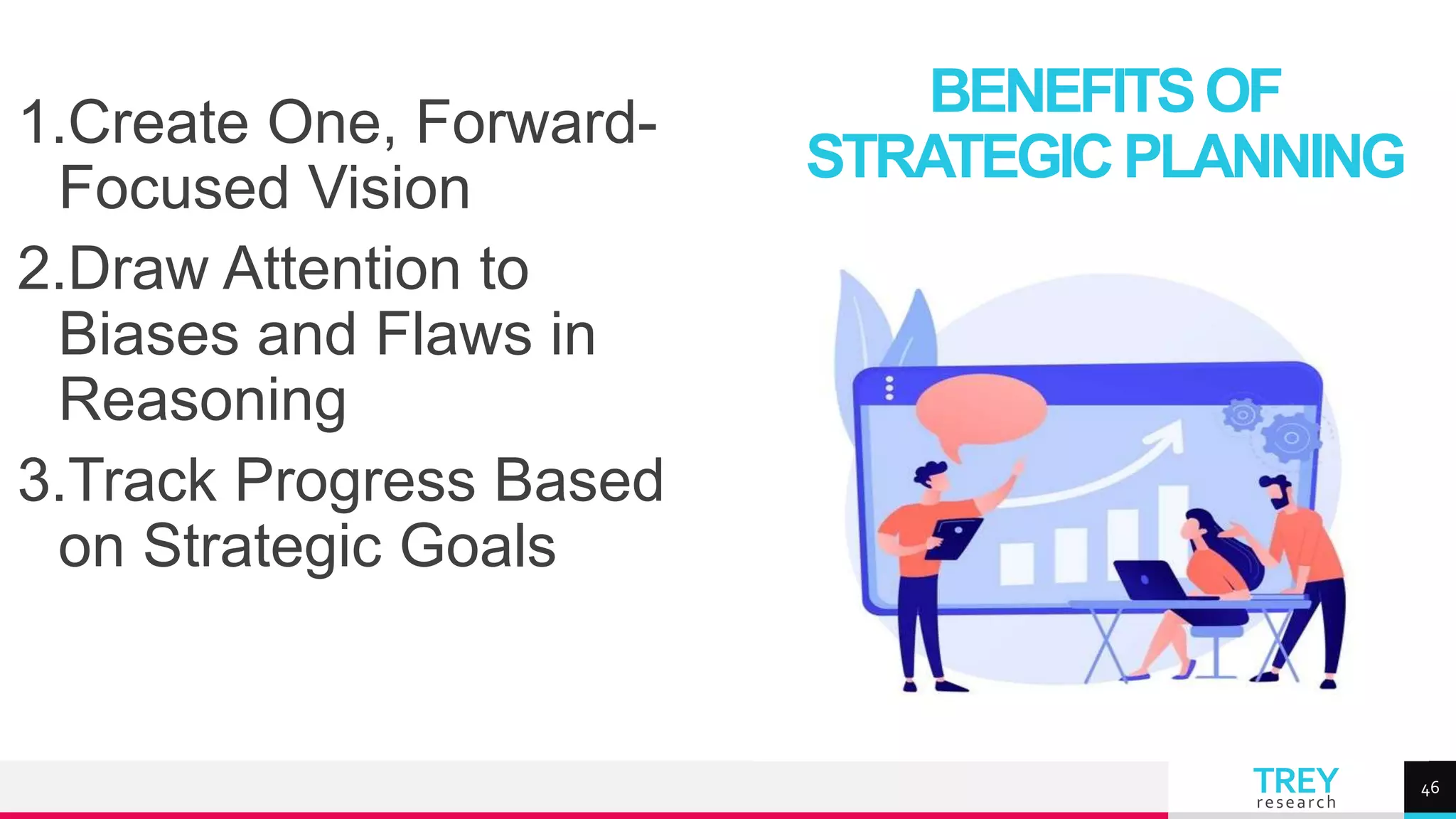
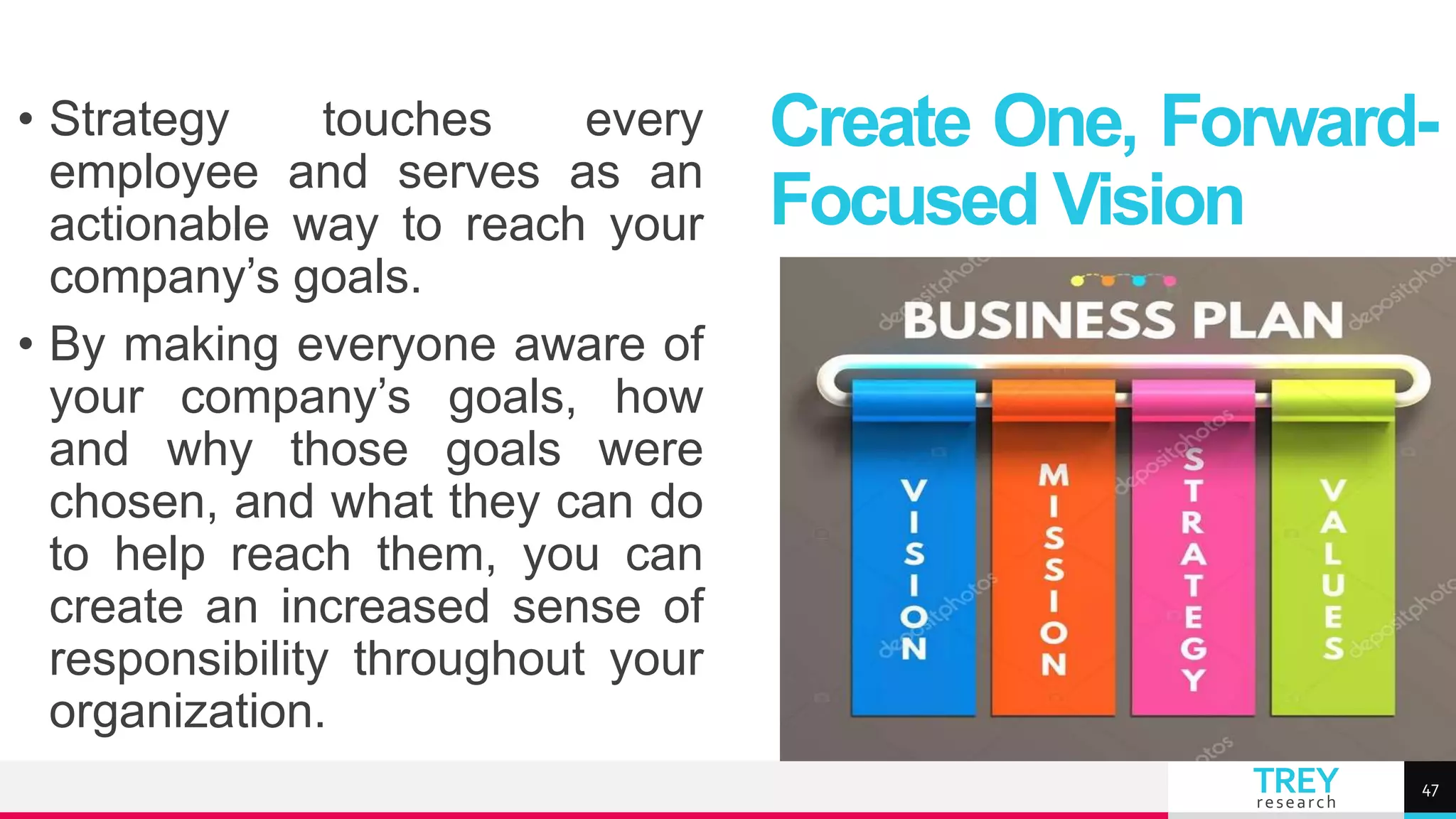
1.Create One, Forward-
Focused Vision
2.Draw Attention to
Biases and Flaws in
Reasoning
3.Track Progress Based
on Strategic Goals
BENEFITSOF
STRATEGICPLANNING
46
TREY
research
• Strategy touches every
employee and serves as an
actionable way to reach your
company’s goals.
• By making everyone aware of
your company’s goals, how
and why those goals were
chosen, and what they can do
to help reach them, you can
create an increased sense of
responsibility throughout your
organization.
Create One, Forward-
Focused Vision
47
TREY
research
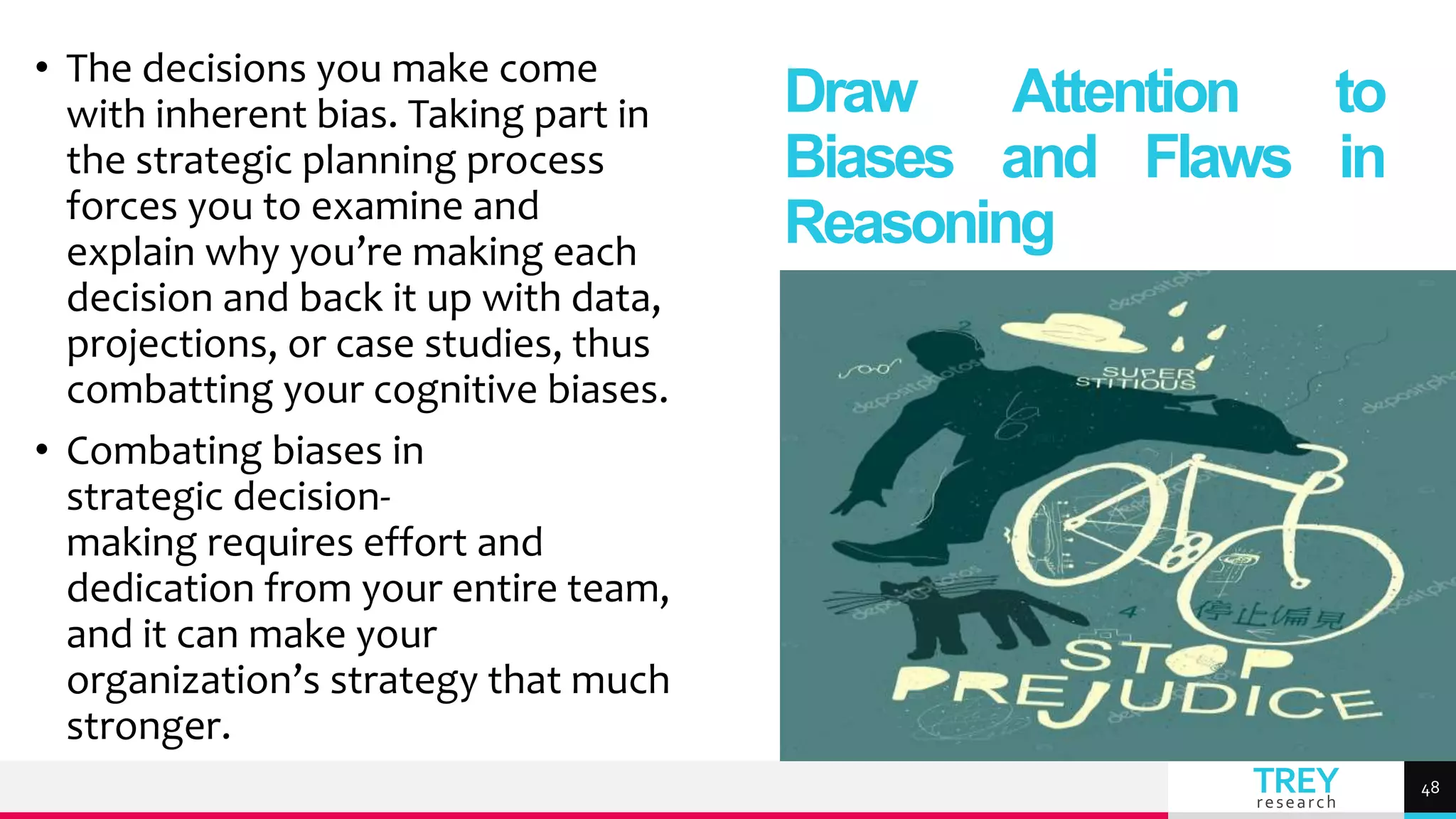
• The decisions you make come
with inherent bias. Taking part in
the strategic planning process
forces you to examine and
explain why you’re making each
decision and back it up with data,
projections, or case studies, thus
combatting your cognitive biases.
• Combating biases in
strategic decision-
making requires effort and
dedication from your entire team,
and it can make your
organization’s strategy that much
stronger.
Draw Attention to
Biases and Flaws in
Reasoning
48
TREY
research
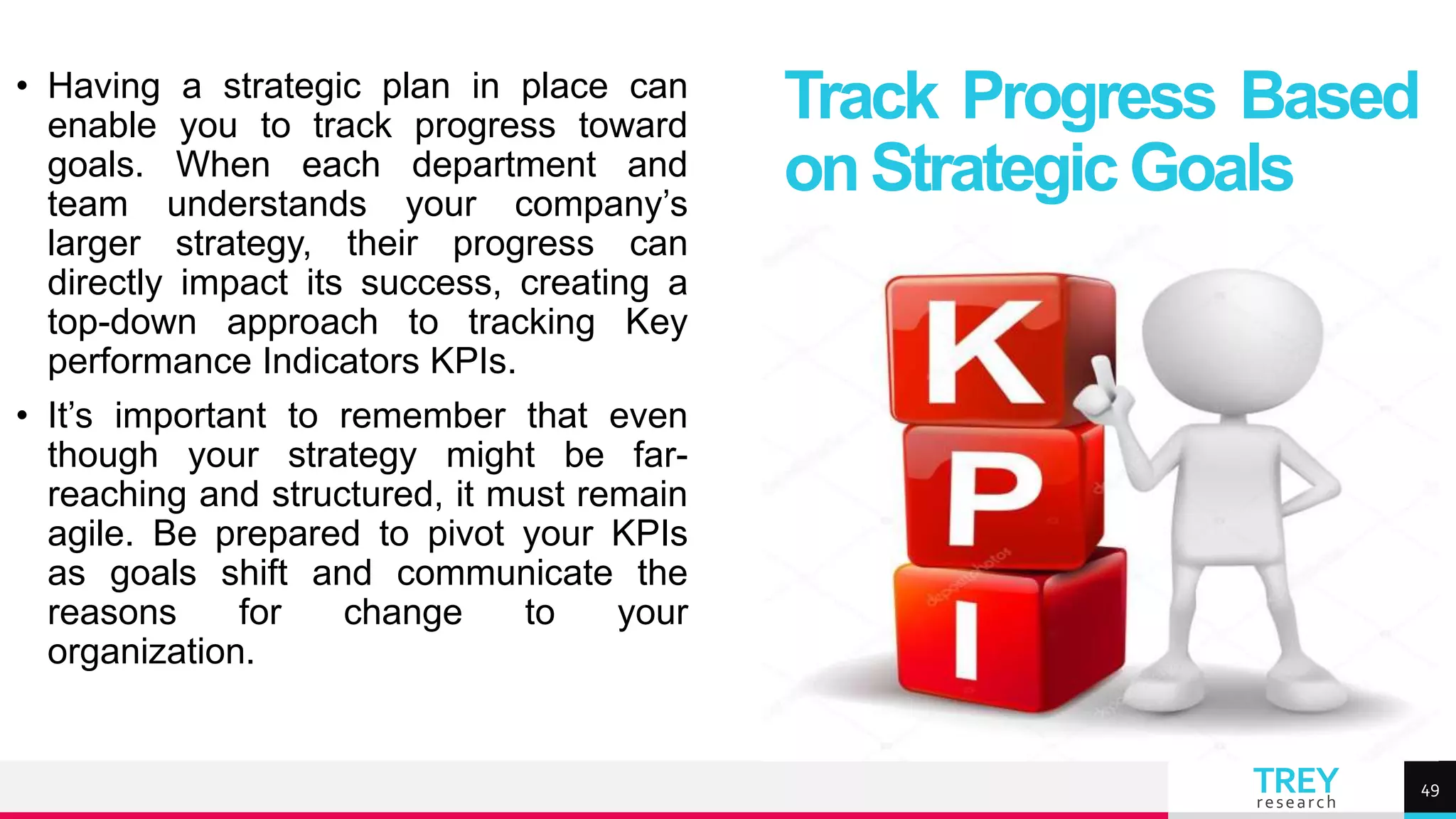
• Having a strategic plan in place can
enable you to track progress toward
goals. When each department and
team understands your company’s
larger strategy, their progress can
directly impact its success, creating a
top-down approach to tracking Key
performance Indicators KPIs.
• It’s important to remember that even
though your strategy might be far-
reaching and structured, it must remain
agile. Be prepared to pivot your KPIs
as goals shift and communicate the
reasons for change to your
organization.
Track Progress Based
onStrategicGoals
49
TREY
research
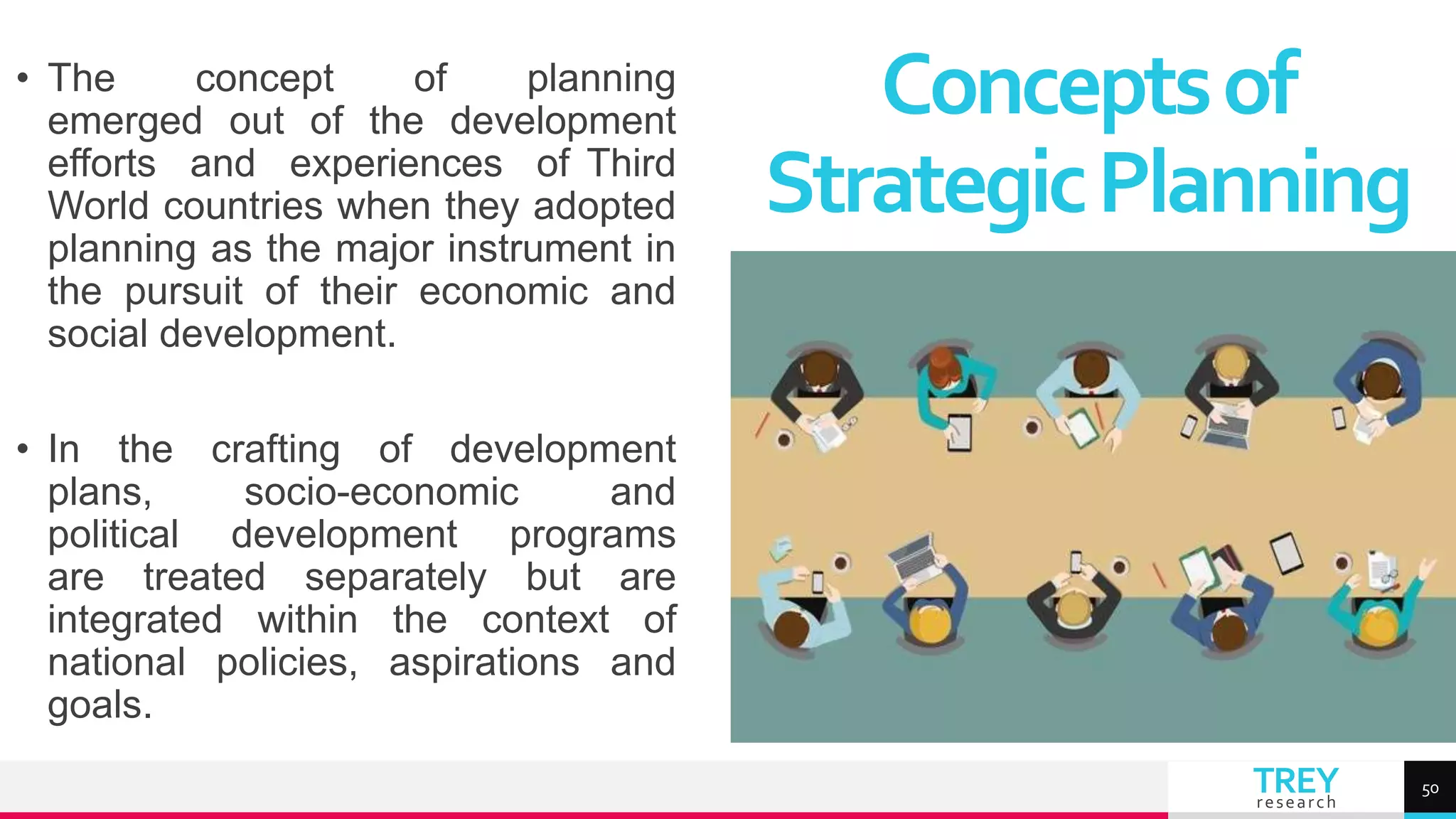
• The concept of planning
emerged out of the development
efforts and experiences of Third
World countries when they adopted
planning as the major instrument in
the pursuit of their economic and
social development.
• In the crafting of development
plans, socio-economic and
political development programs
are treated separately but are
integrated within the context of
national policies, aspirations and
goals.
Conceptsof
StrategicPlanning
50
TREY
research
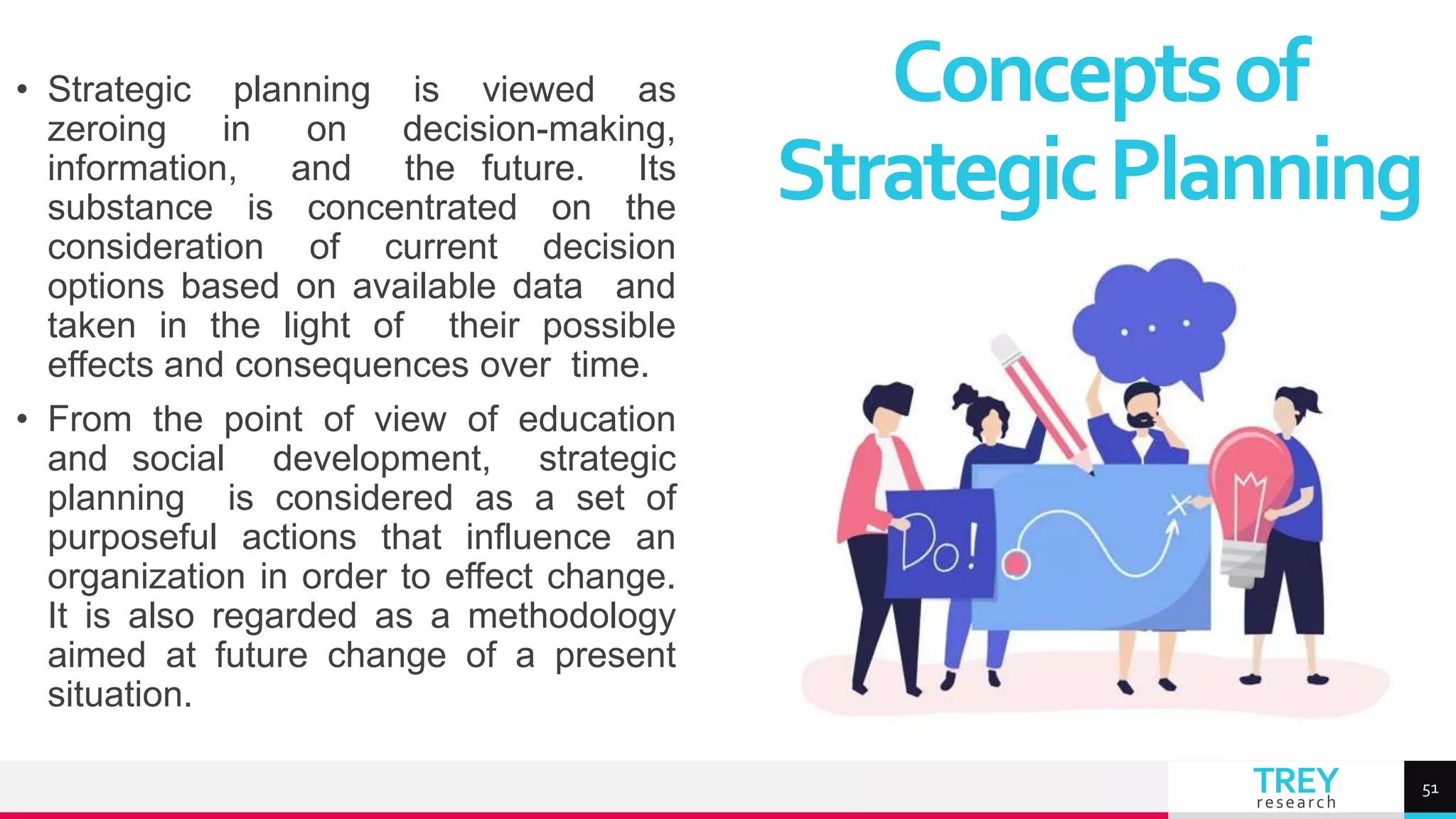
• Strategic planning is viewed as
zeroing in on decision-making,
information, and the future. Its
substance is concentrated on the
consideration of current decision
options based on available data and
taken in the light of their possible
effects and consequences over time.
• From the point of view of education
and social development, strategic
planning is considered as a set of
purposeful actions that influence an
organization in order to effect change.
It is also regarded as a methodology
aimed at future change of a present
situation.
Conceptsof
StrategicPlanning
51
TREY
research
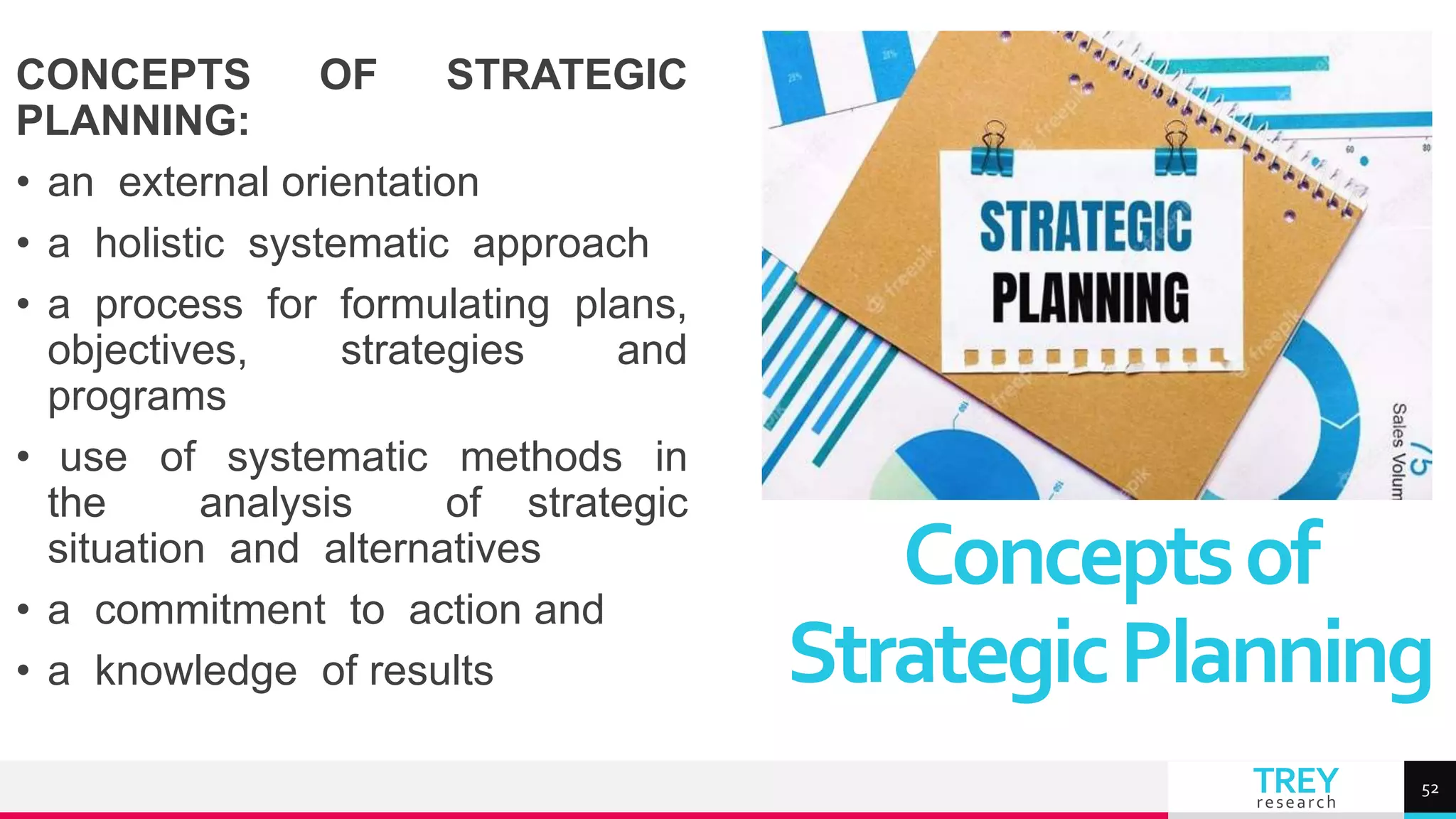
CONCEPTS OF STRATEGIC
PLANNING:
• an external orientation
• a holistic systematic approach
• a process for formulating plans,
objectives, strategies and
programs
• use of systematic methods in
the analysis of strategic
situation and alternatives
• a commitment to action and
• a knowledge of results
Conceptsof
StrategicPlanning
52
TREY
research
Process of
Strategic Planning
53
TREY
research
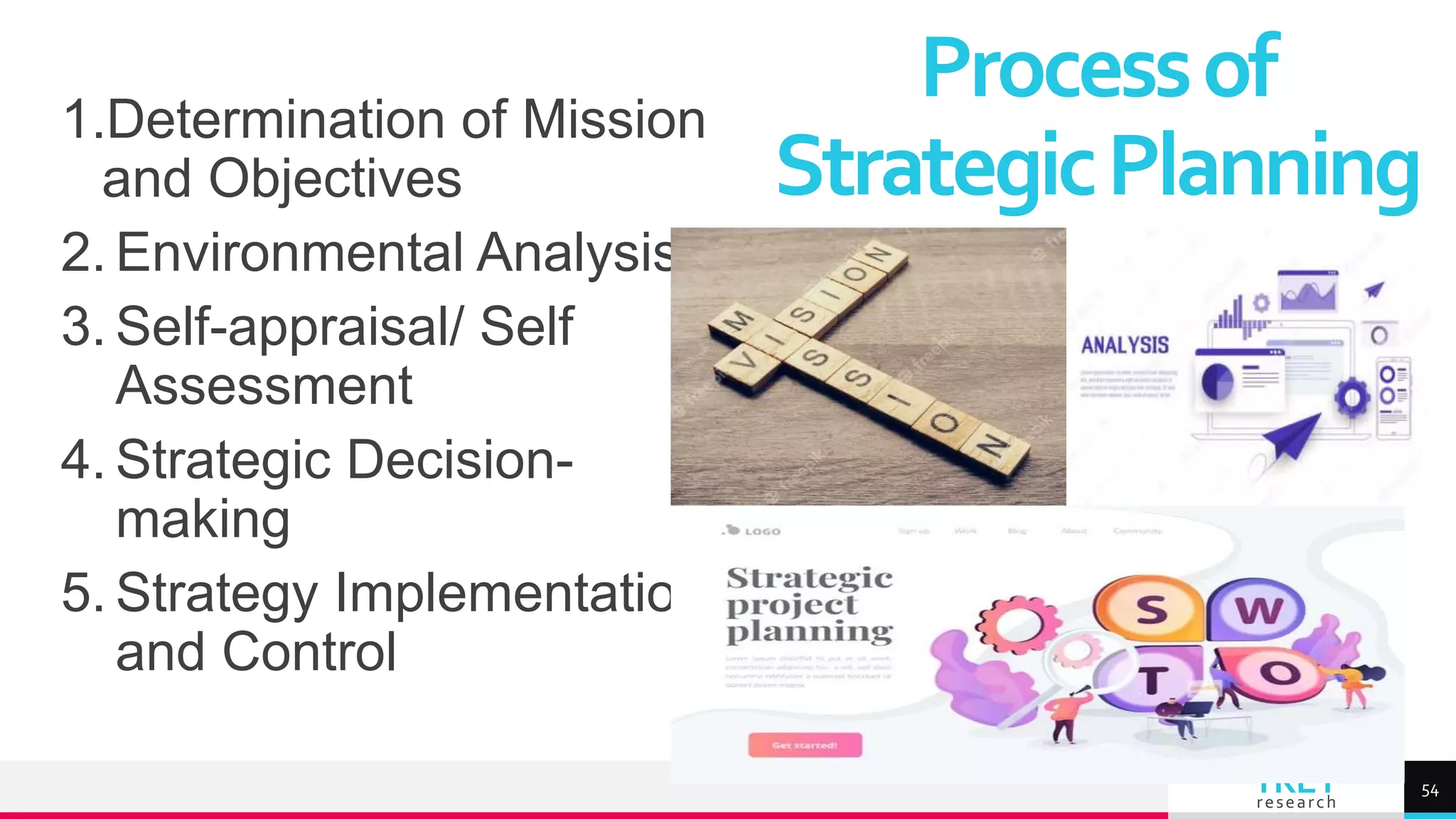
1.Determination of Mission
and Objectives
2. Environmental Analysis
3. Self-appraisal/ Self
Assessment
4. Strategic Decision-
making
5. Strategy Implementation
and Control
Processof
StrategicPlanning
54
TREY
research
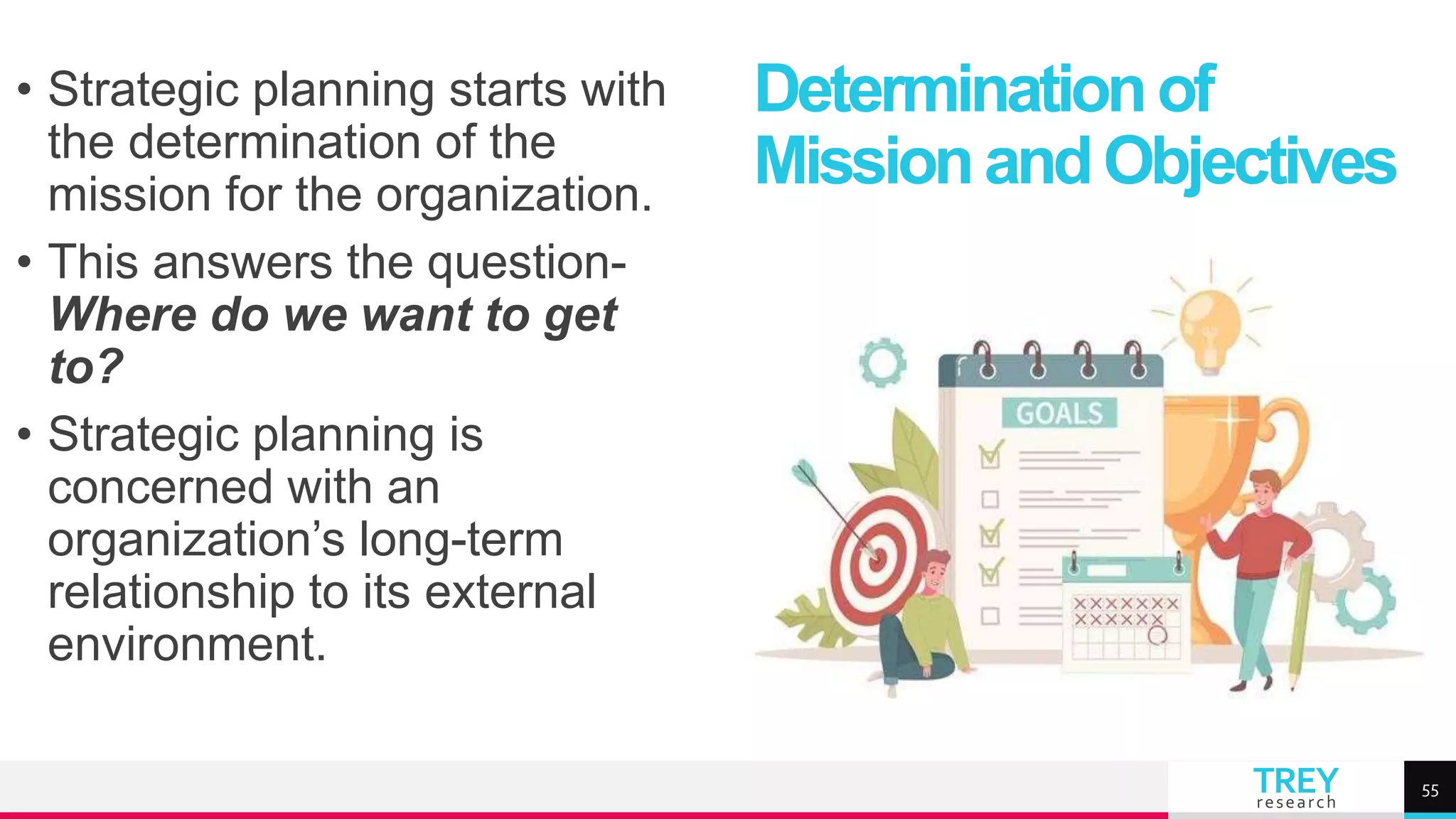
• Strategic planning starts with
the determination of the
mission for the organization.
• This answers the question-
Where do we want to get
to?
• Strategic planning is
concerned with an
organization’s long-term
relationship to its external
environment.
Determinationof
MissionandObjectives
55
TREY
research
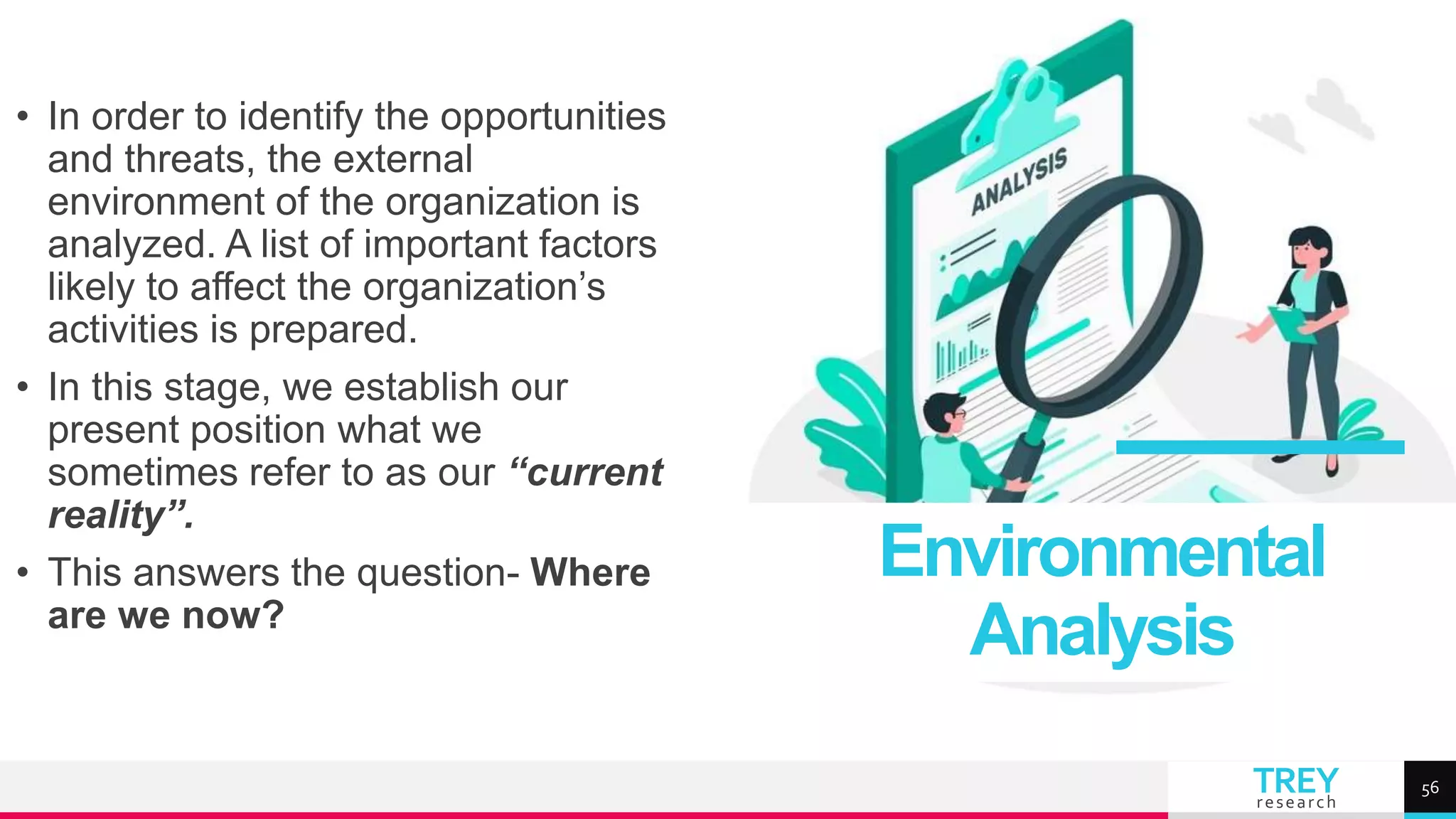
• In order to identify the opportunities
and threats, the external
environment of the organization is
analyzed. A list of important factors
likely to affect the organization’s
activities is prepared.
• In this stage, we establish our
present position what we
sometimes refer to as our “current
reality”.
• This answers the question- Where
are we now?
Environmental
Analysis
56
TREY
research
• In the next step, the strengths
and weaknesses of the
organization are analyzed. Such
an analysis will enable the
enterprise to capitalize on its
strengths and to minimize its
weaknesses.
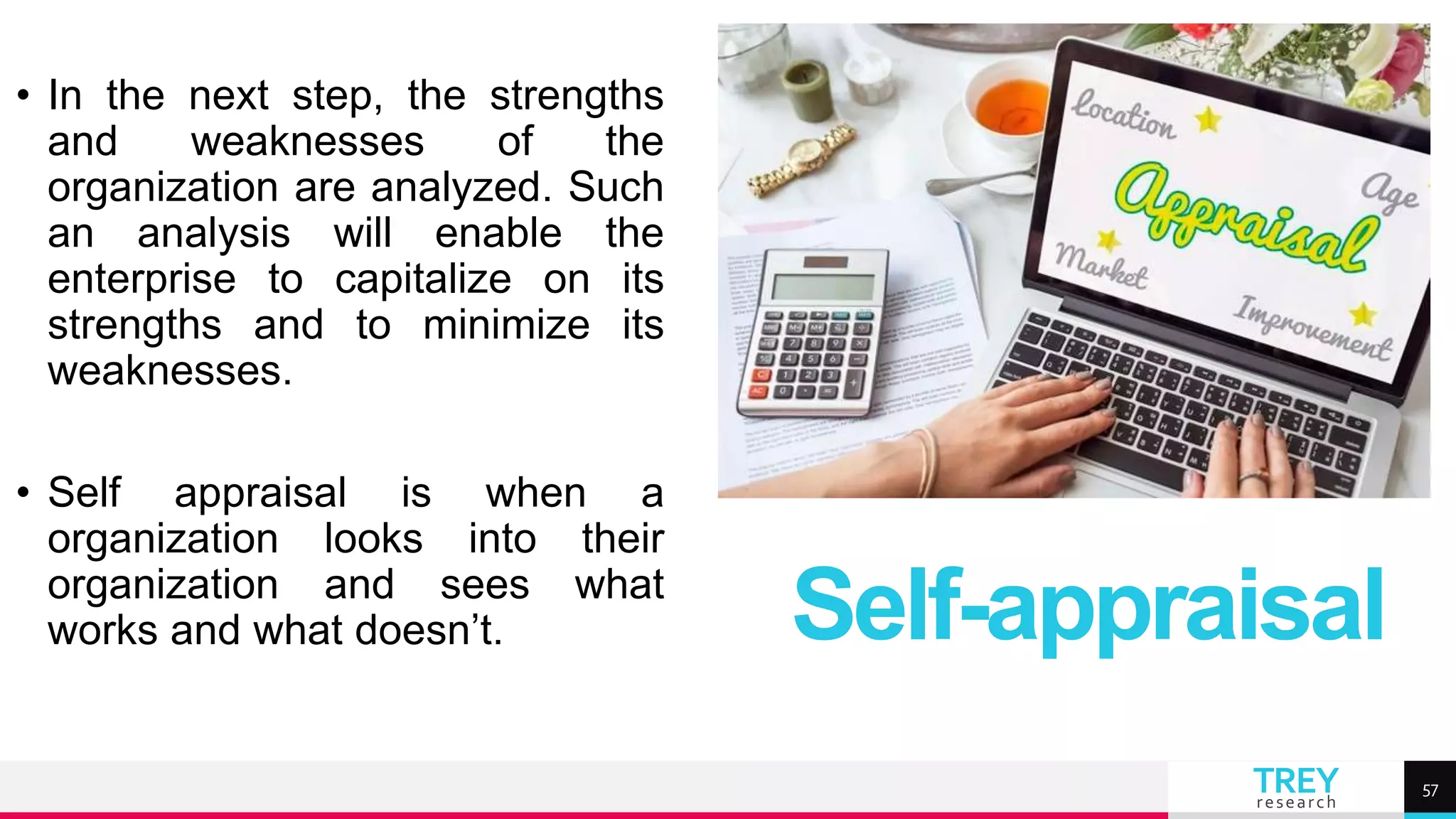
• Self appraisal is when a
organization looks into their
organization and sees what
works and what doesn’t. Self-appraisal
57
TREY
research
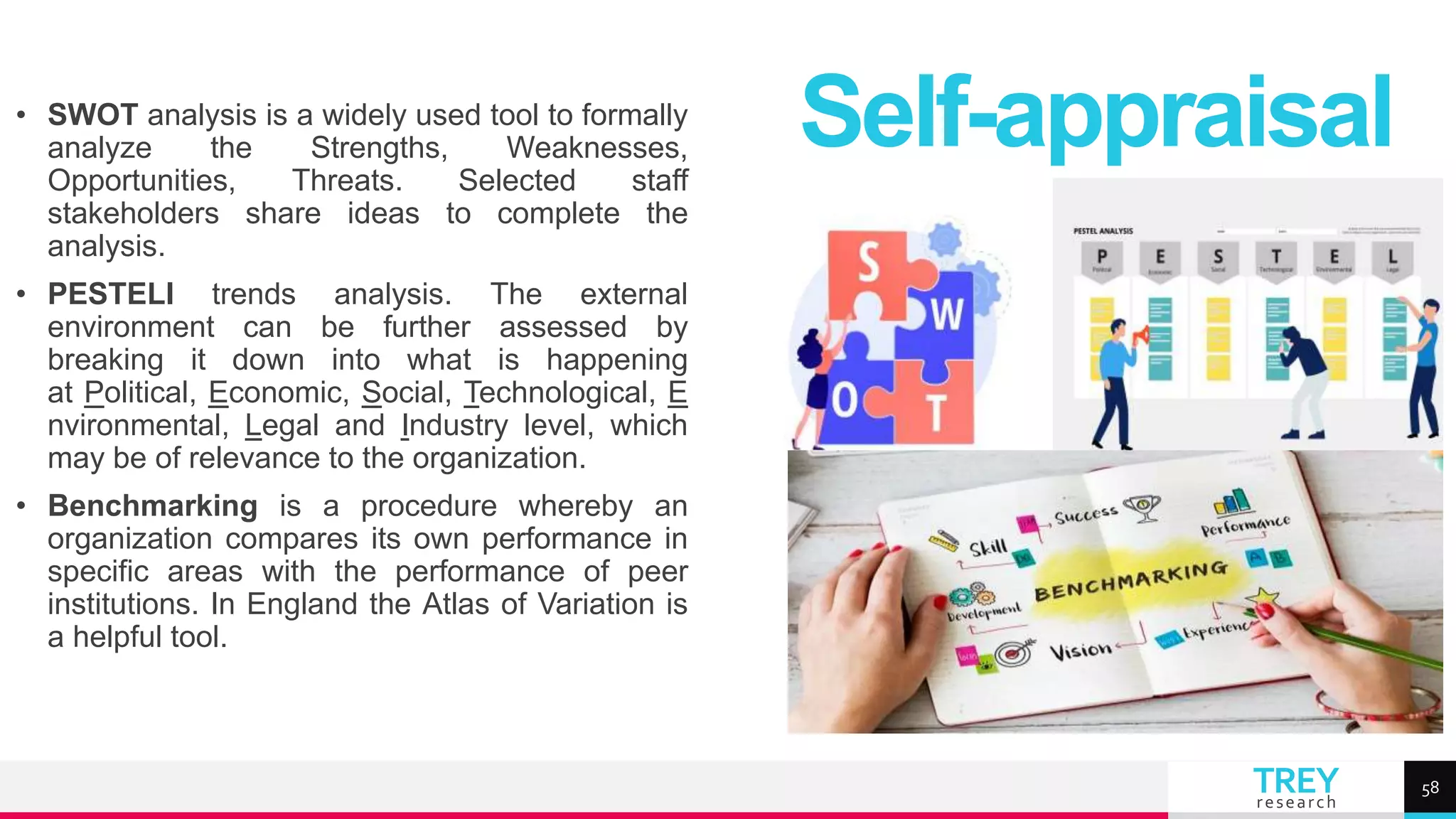
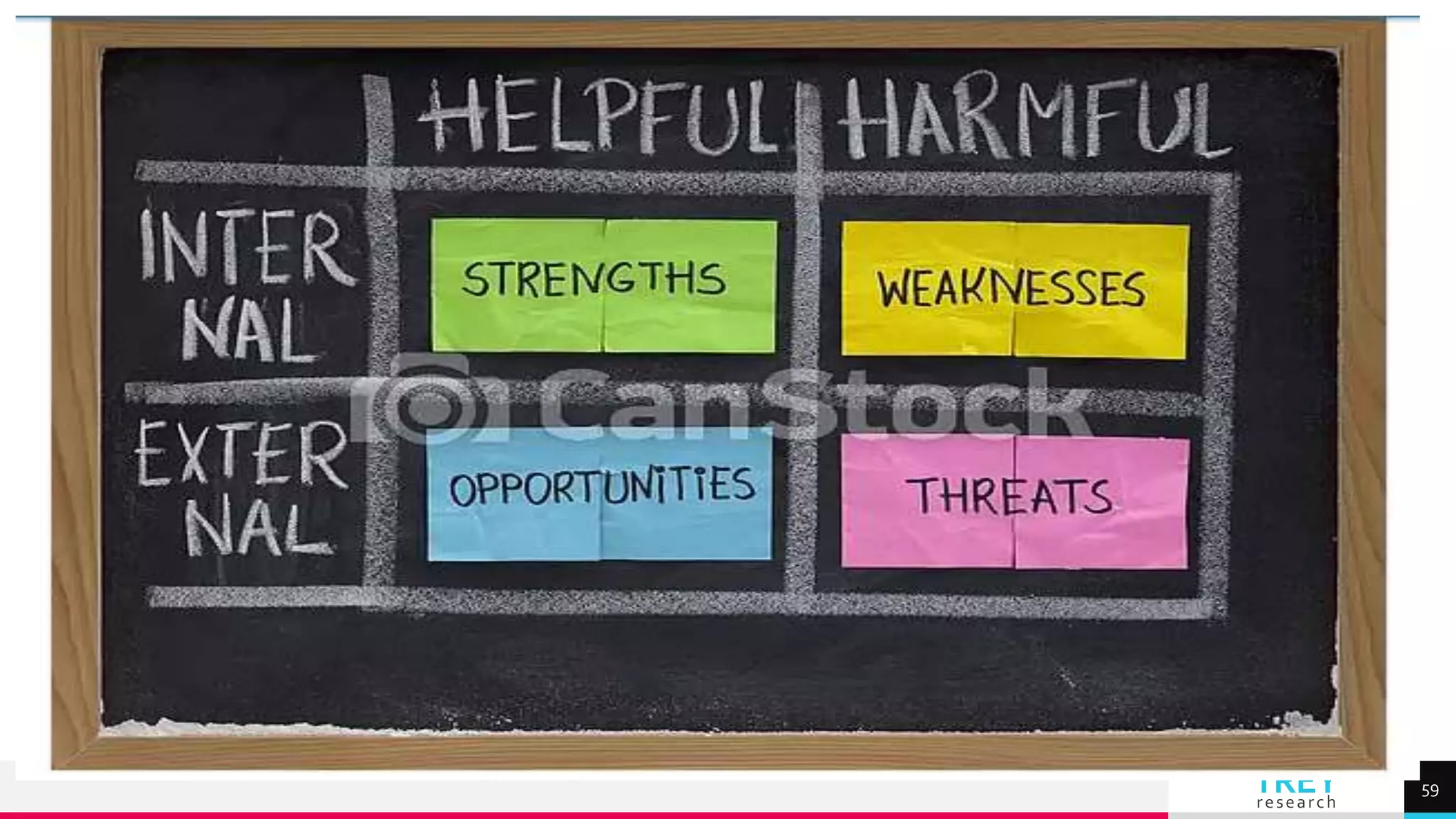
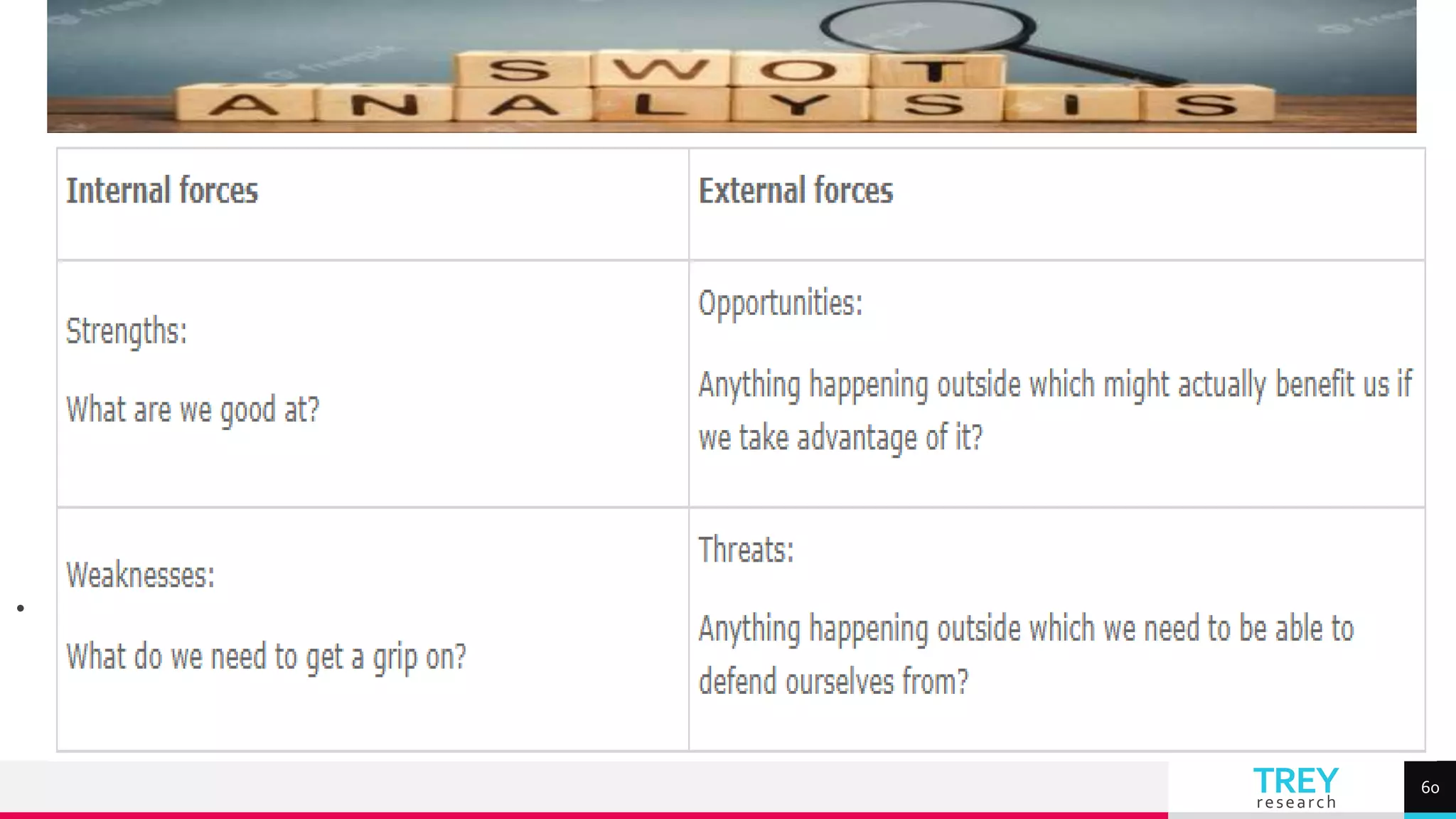
• SWOT analysis is a widely used tool to formally
analyze the Strengths, Weaknesses,
Opportunities, Threats. Selected staff
stakeholders share ideas to complete the
analysis.
• PESTELI trends analysis. The external
environment can be further assessed by
breaking it down into what is happening
at Political, Economic, Social, Technological, E
nvironmental, Legal and Industry level, which
may be of relevance to the organization.
• Benchmarking is a procedure whereby an
organization compares its own performance in
specific areas with the performance of peer
institutions. In England the Atlas of Variation is
a helpful tool.
Self-appraisal
58
TREY
research
•
59
TREY
research
•
60
TREY
research
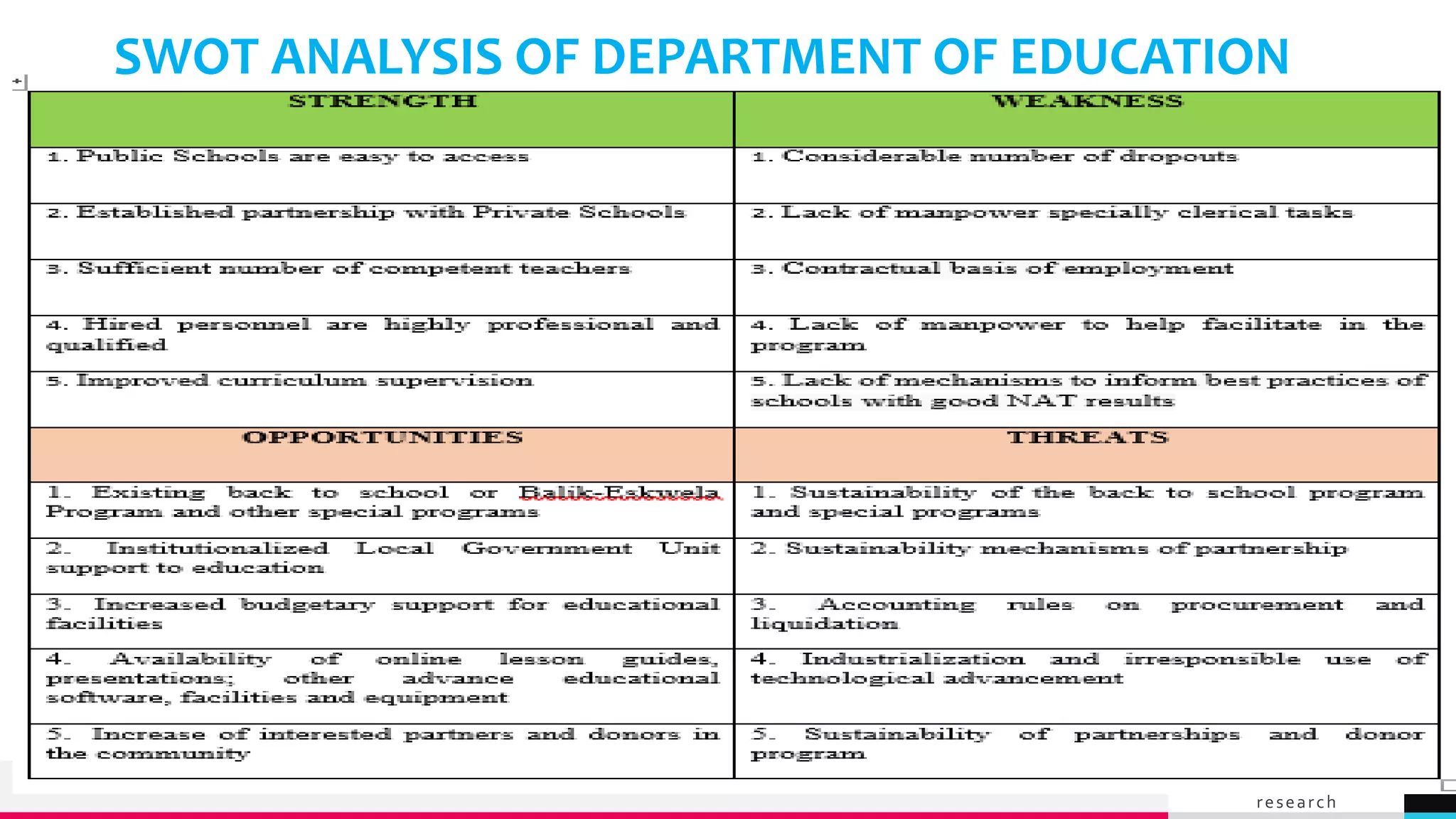
SWOT ANALYSIS OF DEPARTMENT OF EDUCATION
61
TREY
research
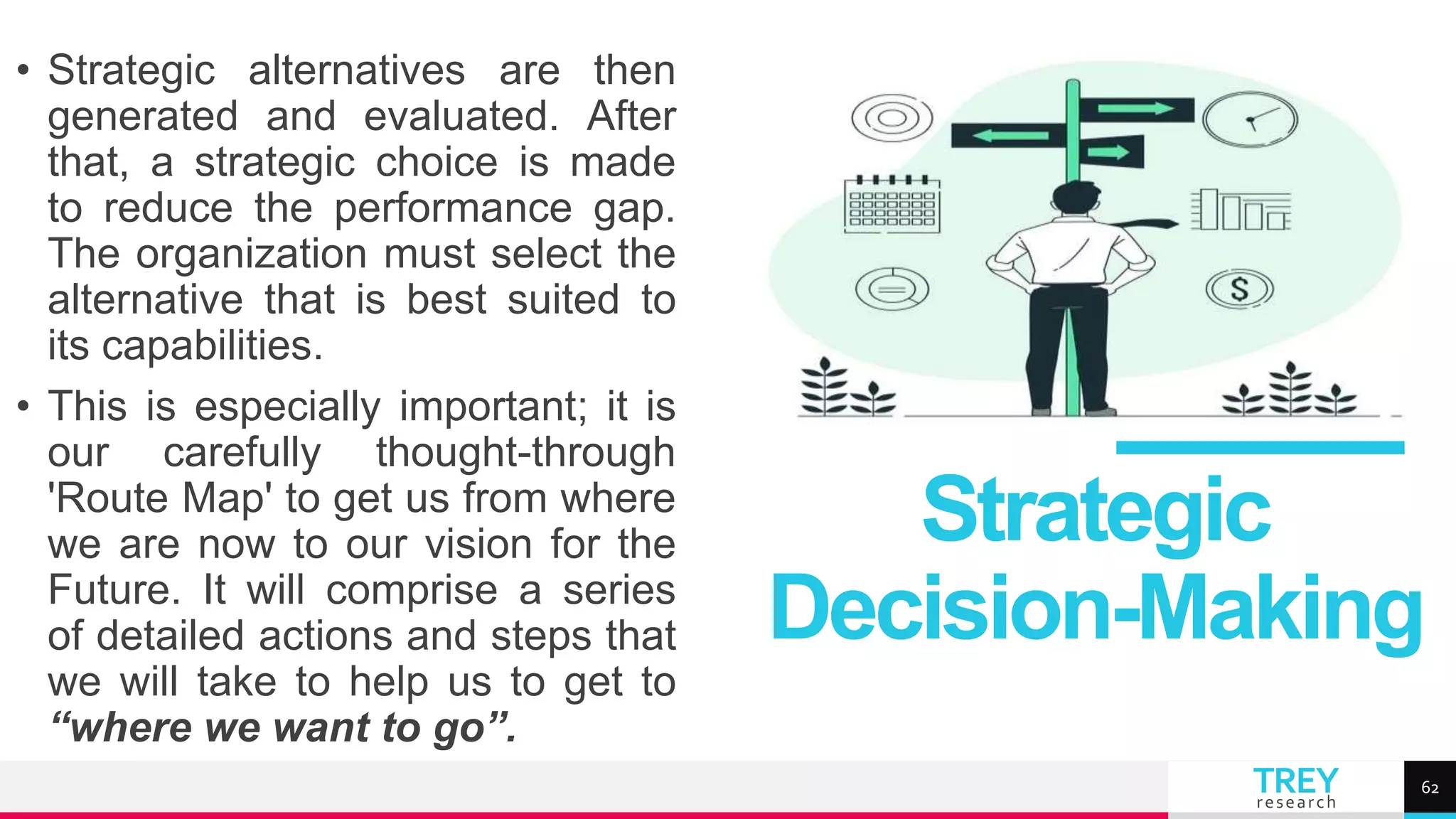
• Strategic alternatives are then
generated and evaluated. After
that, a strategic choice is made
to reduce the performance gap.
The organization must select the
alternative that is best suited to
its capabilities.
• This is especially important; it is
our carefully thought-through
'Route Map' to get us from where
we are now to our vision for the
Future. It will comprise a series
of detailed actions and steps that
we will take to help us to get to
“where we want to go”.
Strategic
Decision-Making
62
TREY
research
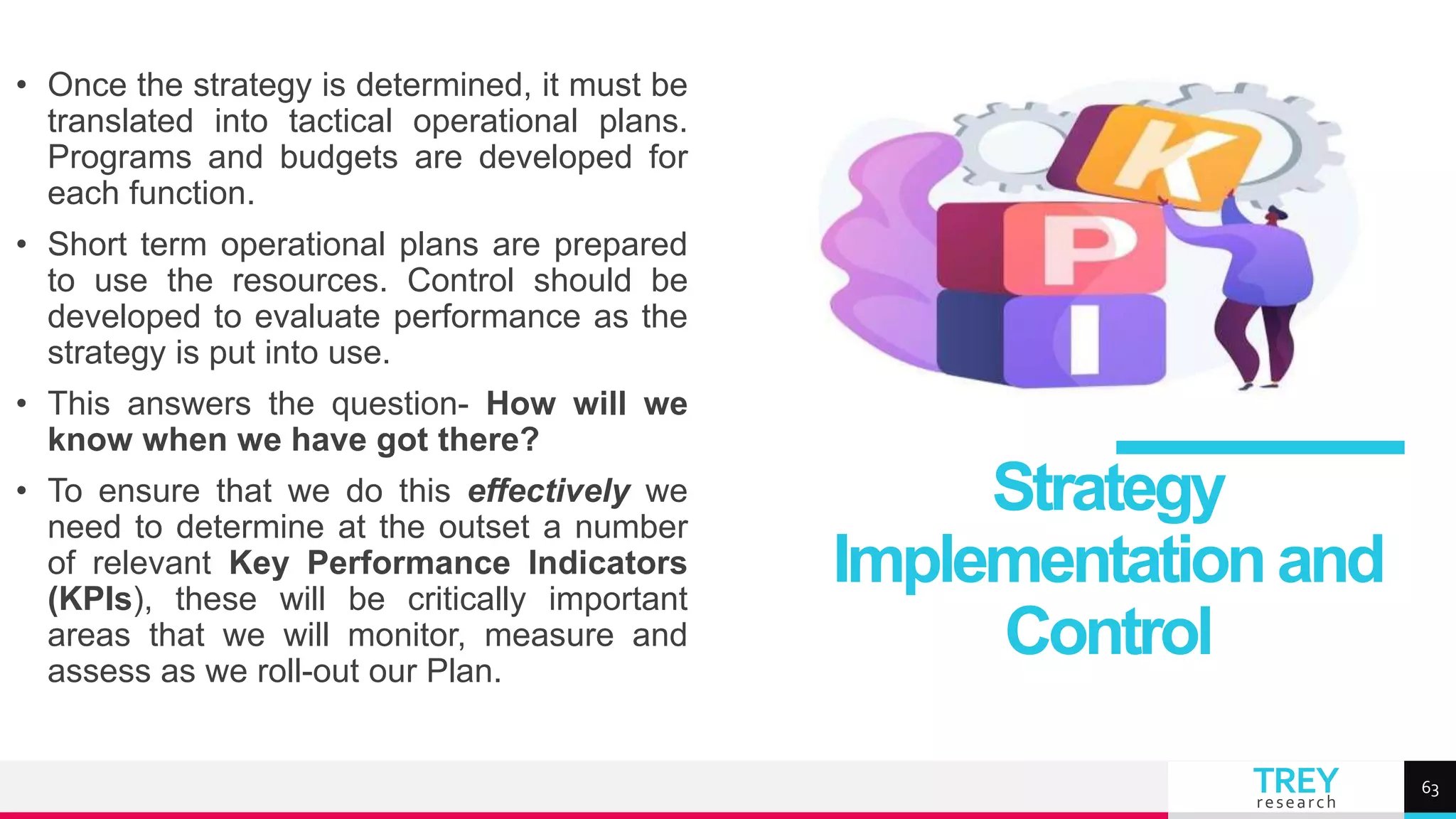
• Once the strategy is determined, it must be
translated into tactical operational plans.
Programs and budgets are developed for
each function.
• Short term operational plans are prepared
to use the resources. Control should be
developed to evaluate performance as the
strategy is put into use.
• This answers the question- How will we
know when we have got there?
• To ensure that we do this effectively we
need to determine at the outset a number
of relevant Key Performance Indicators
(KPIs), these will be critically important
areas that we will monitor, measure and
assess as we roll-out our Plan.
Strategy
Implementationand
Control
63
TREY
research
• It is especially in times of high
levels of change that strategic
planning places an organization in
a more agile state, a stated of
'preparedness', more attuned to
market and other external
conditions and therefore the better
prepared to flex or even
substantially change their strategic
thrusts and operational plans at
local as well as at higher levels
when fundamental, sometimes
structural economic, political and
social change occurs.
Conclusion
64
TREY
research
65
“Remember your audience and your stakeholders when
performing your strategic planning. The result should be
a document that everyone involved in the planning
process understands and supports. If nothing else, it
should be user friendly and provide clear picture of the
organization and where it is heading”
TREY
research
66
WYN-LOVE NATINO CAAMPUED-MPA STUDENT
DR. JOSEFINA B.BITONIO- PROFESSOR
TREY
research
• [i] http://www.businessdictionary.com/definition/
• [ii] http://www.dh.gov.uk/en/Healthcare/Secondarycare/
• [iii] http://www.dh.gov.uk/en/Publicationsandstatistics/Publications/
• [iv] Ashridge Mission Model, in Andrew Campbell and Sally Yeung, Creating a
Sense of Mission, Long Range Planning, Vol.24, No.4, pp10-20, 1991
• [v] Richard Koch, The Financial Times Guide to Strategy, FT Prentice Hall, 3rd edition 2006
• [vi] http://www.nice.org.uk/aboutnice/whoweare
• [vii]http://www.dh.gov.uk/en/Publicationsandstatistics/Publications/
• [viii] WHO European Centre for Health Policy and WHO Regional Office for Europes; see as well http://www.liv.ac.uk/ihia/,
• and http://www.who.int/hia/en/
• [ix] Public Health Resource Unit (PHRU), at http://www.phru.org.uk/~casp/
• [x] OECD – 2002b (Focus newsletter #13)
• [xi] European Commission, Project Cycle Management Guidelines, at http://ec.europa.eu/
• https://www.aesop-planning.eu/uploads/faludi-introducing-a-theory-of-planning.pdf
• Alexander, E.R. (1997) ‘A Mile or a Millimeter? Measuring the “Planning Theory– Practice Gap” ’ , Environment and Planning B: Planning and Design 24: 3–6
• Alexander, E.R. and Faludi, A. (1996) ‘Planning Doctrine: Its Uses and Implications’, Planning Theory 16: 11–61.
• Allmendinger, P. (2001) Planning in Postmodern Times. London: Routledge.
• Faludi, A. (1973) Planning Theory. Oxford: Pergamon
• Yiftachel, O. (1989) ‘Towards a New Typology of Urban Planning Theories’, Environment and Planning B: Planning and Design 16: 23–39
References:
67

Strategic Planning Concepts: Theories and Practices

  • 1.
  • 2.
  • 3.
    TREY research Theories of Planning Conceptsof Strategic Planning Rationale of Strategic Planning Purposes and Functions of Strategic Planning StrategicPlanning: Concepts,Theoriesand Practices 3
  • 4.
    TREY research PLANNING • is oneof the fundamentals of modern life. We all practice it to a greater or lesser extent. In our personal lives we plan holidays, careers, the acquisition of assets. • In essence such plans are organizational 'route maps' to get us from 'where we are at now' to 'where we want to get to' at some defined point, or points, in the future. WHATISPLANNING? 4
  • 5.
    TREY research • Planning isnot an end in itself. It is a purposive action. • Ultimate aim of planning is to promote human growth or development , that is , planning is a means and a process to achieve development. (Faludi, A: 1973) WHYISPLANNING NECESSARY? 5
  • 6.
    TREY research • The issuesof development are complex and interconnected. • There is need for a systematic approach to tackling them. • The solution lies in Planning. • It is central in shaping the responses to challenges in order achieve sensible and attractive development. WHYFOCUSON PLANNING? 6
  • 7.
    TREY research • Planning practiceis influenced by theory and theory can be structured in accordance with planning practice. • Early planning theories emerged out of practice planning codified as a professional activity. • Efforts to develop a coherent theory emerged in the 1950s and 60s that need to rationalize the interests and activities of planning under conditions of social foment. Whatistheroleoftheoryin understandingPlanning? 7
  • 8.
  • 9.
    TREY research • Up untilthe early 1980s, the dominant typology of planning theory derived from Andreas Faludi (1973) who based his approach on the distinction between substantive and procedural theory. • Planning theory has been in a hyperactive state since the early 1980s with developments in a number of fields including neo-liberal and public choice perspectives. • Planning is no different in this respect. It is now a truism to claim that planning is comprised of an eclectic collection of theories Theories of Planning 9
  • 10.
    TREY research • Theory ofPlanning helps planners to understand themselves and their operating methods. • Theory of planning is synonymous with procedural theory. • ‘Theory of Planning’ which is concerned with organization of planning agencies and planners. Theories of Planning 10
  • 11.
    TREY research • The substantivetheory (theory of planning) seeks to explain the essence of teleological or purpose action and to give a better understanding of planning itself. • The procedural theory (theory in planning), focusing more on the practice of planning, describes the various phases and techniques used in designing the future, clarifies the role of planners and other actors involved, and recommends various tools for the solution of the problems/tasks. Theories of Planning 11
  • 12.
    TREY research • The firstand most widely used typology of planning is the Procedural Theory which explains the procedure of planning per se, irrespective of what we plan for. • Furthermore, Falludi strongly believed that procedural theory is the area of specialization of planners rather than substantive, which has its own specialists (economists, sociologists etc.). • Procedural theories define and justify preferred methods of decision-making whereas substantive theories pertain to interdisciplinary knowledge relevant to the content of planning. • Consequently, it is overwhelmingly focused on the means of planning and not the ends. Theories of Planning 12
  • 13.
    TREY research • (Pseudo-)positivist Functional Planning •Rational Comprehensive Planning • Pragmatist incrementalism • Strategic planning (management) in the public sector • Communicative-collaborative planning • Post-modern modernity in planning: Pragmatic eclectics Basic cases in Theories of Planning 13
  • 14.
    TREY research • Functional planmaking and purposive actions usually have a rational justification, and can be judged in a more exact way than the other planning processes. The choice of means at a given time can be justified with rational arguments and even the incidental failure of the means chosen can be explained after the intervention, when the facts have come to be known. • A functionalist planner with a positivist attitude would not have the chance to choose among competing planning theories, modes or styles, because these choices involve values because different means produce different results, consequently they affect the various interest groups in different ways. (Pseudo-)positivist functionalplanning 14
  • 15.
    TREY research • In the1960s rational comprehensive planning was the most frequently applied method, which greatly contributed to the general acceptance of planning and is still highly recommended in our days. • The adjective comprehensive refers to the complex handling of the system and a multi-disciplinary approach. It actually means a multilateral approach, because manageability sets a limitation to the depth of problem solving. • Representatives of rational- comprehensive planning often tend to ignore the duality of facts and decisions and have a penchant for presenting the ends/goals as if they were the findings of comprehensive analysis. RationaleComprehensive Planning 15
  • 16.
    TREY research • Pragmatism andincrementalism have a lot in common. Both tend to avoid radical changes, follow liberal-democratic ideas, and besides the traditional technical instrumental rationality they take into account power related issues as well. • Every kind of planning is pragmatist to some extent, but in this special case it is particularly justified to emphasize it in the name as well, because this theory of planning focuses decidedly on solving practical problems. • Incrementalism also implies that a program promising measurable benefits should be carried out only if it does not involve damage to the environment; the method actually prefers solutions which contribute to the improvement of the environment besides pursuing a particular interest. Pragmatist Incrementalism 16
  • 17.
    TREY research • The evolutionof strategic thinking after World War II has gradually led from long-term planning through strategic planning to strategic management. With respect to the concept of planning the most important step was the shift from strategic planning to management, the latter regarding planning as an integral part of a complex process including implementation and feedback as well. • Strategic planning practiced at community level has a component which has preserved its special character to this very day: the SWOT analysis, developed from the Harvard model. • Strategic management is a complex process which includes the definition of the missions or goals, the formulation of the potential strategic alternatives we might use to attain them. • The key issue in defining strategic action in the public sector is the establishment or maintenance of a multilateral equilibrium on the basis of mutually accepted assumption and norms. Strategicplanning(management) inthepublicsector 17
  • 18.
    TREY research • In thelate 20th century many authors reacted to the new challenges that planners had to face by strengthening democratization and giving more importance to linguistic communication and understanding. • The action aimed at mutual understanding can take the form of argumentation, a discourse between the partners conducted in the course of common planning and debate of the plan in the context of topic discussed. • All the stakeholders should be given a chance to participate in the planning process of their own free will. In practice this means that the adequate conditions should be guaranteed, or the obstacles to the participation should be removed. • These efforts can be successful only if the whole communicative community uses a similar stock of knowledge and meaning, follows similar basic norms which are respected by all members but sincere and intelligible participation should also be required. Communicative-collaborative planning 18
  • 19.
    TREY research • In thenew power space the fight will be carried on for access to information, new knowledge, the opportunity to express and enforce one’s standpoint, and the right to engage in planning, instead of land or raw materials. • A planner who uses post-modern arguments as well does not believe in absolute, resolvable truth, he knows only norms that are accepted in a specific place at a given time. • In the course of the discourses planners should explore the prevailing values and – through mutual understanding – seek solutions which produce no losers but promise the best possible output in the given operative situation, and help to secure the highest number of winning positions. • The idea that post-modern modern community planning has taken over from modernity is that its mission is to serve public interest redefined as being constructed from autonomous elements that are not in conflict but in a synergic relation; it is not technical rationality any longer, but uniquely the privileged means of enhancing economic growth. Post-modernmodernityin planning:PragmaticEclectics 19
  • 20.
    TREY research • In 1980,Nigel Taylor recognized two classes of theories related to planning: sociological and philosophical. • In fact he coined these two terms, he tried to distinguish between descriptive theoretical statements and statements with prescriptive nature. • Planning theories have commonly embodied a mixture of sociological assumptions about human and social behavior and philosophical assumptions about the nature, purposes and premises of planning. • Both the sociological and philosophical assumptions of planning warrant thorough examination. TypologiesofPlanning 20
  • 21.
    TREY research Six types ofplanning theory 1) analytical-explanative 2) formal-explanative 3) procedural-explanative 4) analytical prescriptive 5) formal-prescriptive 6) procedural-prescriptive TypologiesofPlanning 21
  • 22.
  • 23.
    TREY research Five types ofplanning theories • Social scientific philosophy • Social theory • exogenous theory • framing theory and • indigenous theory TypologiesofPlanning 23
  • 24.
    TREY research • This indicatesbroad approaches, such as positivism, Marxism, idealism, or phenomenology, seen by Allmendinger as underlying different social theories. • Consequently, a philosophical understanding and perspective on social science can reveal the foundations of social theory. • Some aspects of social theory appear very similar and proponents of each may appear to be arguing past each other or about aspects that have little relevance. One example of this is the understanding of the relationship between structure and agency within collaborative planning theory. SocialScientificPhilosophical Understandings 24
  • 25.
    TREY research Two broad categoriesof social theory exist: • the ‘top-down’ approaches which examine the structuring forces upon individuals. • the ‘bottom-up’ interpretative understandings that emphasize the reflective nature of individuals and their ability to choose. SocialTheory 25
  • 26.
    TREY research • Exogenous theoriesinclude, for example, theories of democracy, cognitive psychology, regime and regulation theory, implementation theory, central–local relations, nationalism and a host of other ‘meso-level’ theoretical constructs. • Exogenous theories do not provide a holistic or general theoretical understanding of society but focus instead on a particular element of society. • These are “meso-level” theories, that is, not general theories of society, but focused on a particular aspect of it; they are not specifically concerned with planning, but are relevant to it. ExogenousTheory 26
  • 27.
    TREY research • Framing theories.These are comparable to a paradigm or an epistemology and cover planning “doctrine”. Allmendinger considers the modern and postmodern perspectives as the most abstract forms of framing. • Framing theory thus has a central role in mediating or filtering exogenous theory, social theory and social scientific philosophical understandings. • Framing theory refers to the process by which people develop a particular conceptualization of an issue or reorient their thinking about an issue. FramingTheories 27
  • 28.
    TREY research • These areplanning-specific, derive from the above forms of theory and are politically and generally socially situated. • Indigenous planning (or Indigenous community planning) is an ideological approach to the field of regional planning where planning is done by Indigenous people for Indigenous communities. • Indigenous planning theory cannot be simply ‘read off’ from a combination of other kinds of theoretical understanding in a post-empirical perspective. IndigenousPlanningTheory 28
  • 29.
  • 30.
    TREY research Four Major Planning Theories 30 •Philosophical Synthesis • Rationalism • Organizational Development • Empiricism
  • 31.
    TREY research • Philosophical synthesis emphasizesa broad approach to planning which considers information on social, economic and ethical conditions as well as the environmental background of the institution or organization for which planning will be undertaken. Philosophical Synthesis 31
  • 32.
    TREY research • Strategy isabout making choices (Porter, 1985). Because the systematic collection of relevant information concerning the organization’s environment is at best an inexact science, strategic managers are inevitably left with varying amounts of uncertainty associated with each strategic alternative they possess. Philosophical Synthesis 32
  • 33.
    TREY research • Rationalism looksat people as a utility and defines human relations in instrumental terms. • Rational planning models assume a sequential, observable cycle that includes setting of goals, determining objectives, making plans, implementing the plans, and reviewing results. Rationalism 33
  • 34.
    TREY research FOUR MAIN AREAS •Strategic Analysis – can use PESTELI or Porters 5 forces to analyze the external environment whole SWOT analysis can be used for corporate appraisal. • Strategic Choice – models like NPV, IRR and payback evaluation can be used to choose when strategic option to take. • Strategic Implementation – need to consider policies and strategies to implement for ALL areas of the business. • Strategy Evaluation and Control – measuring the performance against the objectives. Rationalism 34
  • 35.
  • 36.
    TREY research • The organizational developmentapproach includes a human relations approach to innovation and change in management style, employee satisfaction, decision-making processes, and the general health of the organization. Organizational Development 36
  • 37.
    TREY research • Organizational development (OD) isan effort that focuses on improving an organization’s capability through the alignment of strategy, structure, people, rewards, metrics, and management processes. Organizational Development 37
  • 38.
  • 39.
  • 40.
    TREY research • Empiricism acknowledges theimportance of studies on system behavior by public administrators, economists and other social scientists concerned with planning theory. • Empiricism is less normative, less concerned with planned social change, and uses a positivistic framework for analysis. Empiricism 40
  • 41.
    TREY research • The empiricistapproach believes in certainty, in undeniable facts. It believes that data collection and information are vitally important to make any decision. • Empiricists work by reducing a problem to a manageable size. They then use the data that is available (or collect some more where needed) to define the problem. That information should then point out exactly what the right solution is. Empiricism 41
  • 42.
  • 43.
    TREY research STRATEGICPLANNING “Strategic planning helps determinethe direction and scope of an organization over the long term, matching its resources to its changing environment and, in particular, its markets, customers and clients, so as to meet stakeholder expectations.” Johnson and Scholes, 1993 43
  • 44.
    TREY research • Strategic planningis a systematic process of envisioning a desired future, and translating this vision into broadly defined goals or objectives and a sequence of steps to achieve them. • Strategic planning looks at the wider picture and is flexible in choice of its means. STRATEGIC PLANNING 44
  • 45.
    TREY research • Choices haveto be made based on a rationale and on information, and a procedure or planning method has to be followed. Beyond making decisions, 'strategic planning' can and should be used to interact with internal and external stakeholders, building understanding and commitment. DOWENEEDTOHAVE STRATEGICPLAN? 45
  • 46.
    TREY research 1.Create One, Forward- FocusedVision 2.Draw Attention to Biases and Flaws in Reasoning 3.Track Progress Based on Strategic Goals BENEFITSOF STRATEGICPLANNING 46
  • 47.
    TREY research • Strategy touchesevery employee and serves as an actionable way to reach your company’s goals. • By making everyone aware of your company’s goals, how and why those goals were chosen, and what they can do to help reach them, you can create an increased sense of responsibility throughout your organization. Create One, Forward- Focused Vision 47
  • 48.
    TREY research • The decisionsyou make come with inherent bias. Taking part in the strategic planning process forces you to examine and explain why you’re making each decision and back it up with data, projections, or case studies, thus combatting your cognitive biases. • Combating biases in strategic decision- making requires effort and dedication from your entire team, and it can make your organization’s strategy that much stronger. Draw Attention to Biases and Flaws in Reasoning 48
  • 49.
    TREY research • Having astrategic plan in place can enable you to track progress toward goals. When each department and team understands your company’s larger strategy, their progress can directly impact its success, creating a top-down approach to tracking Key performance Indicators KPIs. • It’s important to remember that even though your strategy might be far- reaching and structured, it must remain agile. Be prepared to pivot your KPIs as goals shift and communicate the reasons for change to your organization. Track Progress Based onStrategicGoals 49
  • 50.
    TREY research • The conceptof planning emerged out of the development efforts and experiences of Third World countries when they adopted planning as the major instrument in the pursuit of their economic and social development. • In the crafting of development plans, socio-economic and political development programs are treated separately but are integrated within the context of national policies, aspirations and goals. Conceptsof StrategicPlanning 50
  • 51.
    TREY research • Strategic planningis viewed as zeroing in on decision-making, information, and the future. Its substance is concentrated on the consideration of current decision options based on available data and taken in the light of their possible effects and consequences over time. • From the point of view of education and social development, strategic planning is considered as a set of purposeful actions that influence an organization in order to effect change. It is also regarded as a methodology aimed at future change of a present situation. Conceptsof StrategicPlanning 51
  • 52.
    TREY research CONCEPTS OF STRATEGIC PLANNING: •an external orientation • a holistic systematic approach • a process for formulating plans, objectives, strategies and programs • use of systematic methods in the analysis of strategic situation and alternatives • a commitment to action and • a knowledge of results Conceptsof StrategicPlanning 52
  • 53.
  • 54.
    TREY research 1.Determination of Mission andObjectives 2. Environmental Analysis 3. Self-appraisal/ Self Assessment 4. Strategic Decision- making 5. Strategy Implementation and Control Processof StrategicPlanning 54
  • 55.
    TREY research • Strategic planningstarts with the determination of the mission for the organization. • This answers the question- Where do we want to get to? • Strategic planning is concerned with an organization’s long-term relationship to its external environment. Determinationof MissionandObjectives 55
  • 56.
    TREY research • In orderto identify the opportunities and threats, the external environment of the organization is analyzed. A list of important factors likely to affect the organization’s activities is prepared. • In this stage, we establish our present position what we sometimes refer to as our “current reality”. • This answers the question- Where are we now? Environmental Analysis 56
  • 57.
    TREY research • In thenext step, the strengths and weaknesses of the organization are analyzed. Such an analysis will enable the enterprise to capitalize on its strengths and to minimize its weaknesses. • Self appraisal is when a organization looks into their organization and sees what works and what doesn’t. Self-appraisal 57
  • 58.
    TREY research • SWOT analysisis a widely used tool to formally analyze the Strengths, Weaknesses, Opportunities, Threats. Selected staff stakeholders share ideas to complete the analysis. • PESTELI trends analysis. The external environment can be further assessed by breaking it down into what is happening at Political, Economic, Social, Technological, E nvironmental, Legal and Industry level, which may be of relevance to the organization. • Benchmarking is a procedure whereby an organization compares its own performance in specific areas with the performance of peer institutions. In England the Atlas of Variation is a helpful tool. Self-appraisal 58
  • 59.
  • 60.
  • 61.
    TREY research SWOT ANALYSIS OFDEPARTMENT OF EDUCATION 61
  • 62.
    TREY research • Strategic alternativesare then generated and evaluated. After that, a strategic choice is made to reduce the performance gap. The organization must select the alternative that is best suited to its capabilities. • This is especially important; it is our carefully thought-through 'Route Map' to get us from where we are now to our vision for the Future. It will comprise a series of detailed actions and steps that we will take to help us to get to “where we want to go”. Strategic Decision-Making 62
  • 63.
    TREY research • Once thestrategy is determined, it must be translated into tactical operational plans. Programs and budgets are developed for each function. • Short term operational plans are prepared to use the resources. Control should be developed to evaluate performance as the strategy is put into use. • This answers the question- How will we know when we have got there? • To ensure that we do this effectively we need to determine at the outset a number of relevant Key Performance Indicators (KPIs), these will be critically important areas that we will monitor, measure and assess as we roll-out our Plan. Strategy Implementationand Control 63
  • 64.
    TREY research • It isespecially in times of high levels of change that strategic planning places an organization in a more agile state, a stated of 'preparedness', more attuned to market and other external conditions and therefore the better prepared to flex or even substantially change their strategic thrusts and operational plans at local as well as at higher levels when fundamental, sometimes structural economic, political and social change occurs. Conclusion 64
  • 65.
    TREY research 65 “Remember your audienceand your stakeholders when performing your strategic planning. The result should be a document that everyone involved in the planning process understands and supports. If nothing else, it should be user friendly and provide clear picture of the organization and where it is heading”
  • 66.
    TREY research 66 WYN-LOVE NATINO CAAMPUED-MPASTUDENT DR. JOSEFINA B.BITONIO- PROFESSOR
  • 67.
    TREY research • [i] http://www.businessdictionary.com/definition/ •[ii] http://www.dh.gov.uk/en/Healthcare/Secondarycare/ • [iii] http://www.dh.gov.uk/en/Publicationsandstatistics/Publications/ • [iv] Ashridge Mission Model, in Andrew Campbell and Sally Yeung, Creating a Sense of Mission, Long Range Planning, Vol.24, No.4, pp10-20, 1991 • [v] Richard Koch, The Financial Times Guide to Strategy, FT Prentice Hall, 3rd edition 2006 • [vi] http://www.nice.org.uk/aboutnice/whoweare • [vii]http://www.dh.gov.uk/en/Publicationsandstatistics/Publications/ • [viii] WHO European Centre for Health Policy and WHO Regional Office for Europes; see as well http://www.liv.ac.uk/ihia/, • and http://www.who.int/hia/en/ • [ix] Public Health Resource Unit (PHRU), at http://www.phru.org.uk/~casp/ • [x] OECD – 2002b (Focus newsletter #13) • [xi] European Commission, Project Cycle Management Guidelines, at http://ec.europa.eu/ • https://www.aesop-planning.eu/uploads/faludi-introducing-a-theory-of-planning.pdf • Alexander, E.R. (1997) ‘A Mile or a Millimeter? Measuring the “Planning Theory– Practice Gap” ’ , Environment and Planning B: Planning and Design 24: 3–6 • Alexander, E.R. and Faludi, A. (1996) ‘Planning Doctrine: Its Uses and Implications’, Planning Theory 16: 11–61. • Allmendinger, P. (2001) Planning in Postmodern Times. London: Routledge. • Faludi, A. (1973) Planning Theory. Oxford: Pergamon • Yiftachel, O. (1989) ‘Towards a New Typology of Urban Planning Theories’, Environment and Planning B: Planning and Design 16: 23–39 References: 67