Definition
▶management is a process of designing and
maintaining an environment in which individuals
works together in group, and accomplish aims.
▶in other words it is the accomplishment of
goals
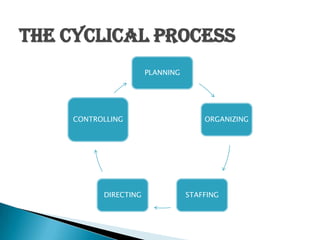
THE CYCLICAL PROCESS
PLANNING
ORGANIZING
STAFFINGDIRECTING
CONTROLLING
Nature of Management
▶Universality: Irrespective of the site nature and
local of the organization.
▶Purposeful: attainment of organization goals.
▶Social process : motivation
▶Coordinating force : orderly management and
overlapping
▶Continuous process: cycle of management
continues for achievement of objectives.
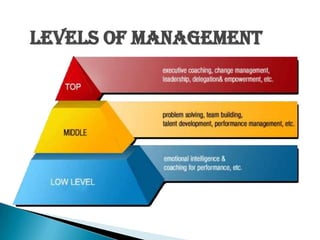
Levels of Management
IMPORTANCE OF MANGEMENT
▶Effective utilization of resources
▶Development of resources
▶Incorporate innovations
▶Integrating group interest
▶Stability in society
 Years 1910-1940
◦ Management as Science
◦ Focus on Increasing Productivity & Efficiency
◦ Strict Control Over People & Process
◦ Top down Management
Evolution of Management
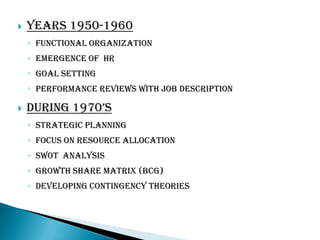
 Years 1950-1960
◦ Functional Organization
◦ Emergence of HR
◦ Goal Setting
◦ Performance reviews with Job Description
 During 1970’s
◦ Strategic Planning
◦ Focus on Resource allocation
◦ Swot analysis
◦ Growth Share Matrix (BCG)
◦ Developing contingency theories
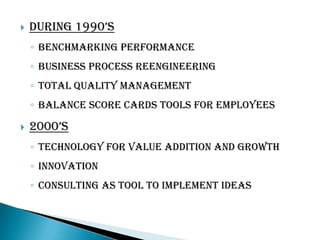
 During 1990’s
◦ Benchmarking performance
◦ Business process reengineering
◦ Total quality management
◦ Balance score cards tools for employees
 2000’s
◦ Technology for value addition and growth
◦ Innovation
◦ Consulting as tool to implement ideas
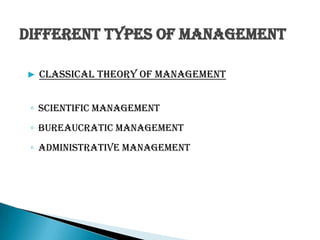
◦ Scientific Management
◦ Bureaucratic Management
◦ Administrative Management
▶ Classical Theory of Management
Different Types of Management
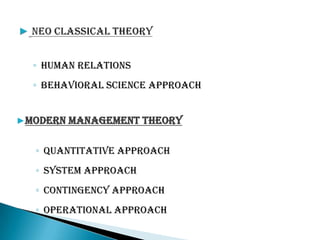
◦ Human Relations
◦ Behavioral Science Approach
▶Modern Management Theory
◦ Quantitative Approach
◦ System Approach
◦ Contingency Approach
◦ Operational Approach
 Management is a social process
 Management is an integrating process
 Continuous process
 Globalization
 Ethics and governance
 Diversity
 Career success & personal fulfillment
 Technology
 Competition
Types of managers
▶First line Managers
▶Middle line Managers
▶Top Managers
▶Functional Managers
▶General Managers
Managerial Skills
▶Technical Skills
▶Human Skills
▶Conceptual Skills
Managerial Roles
▶Interpersonal Role
▶Informational Role
▶Decisional Role
Social Responsibilities and
ethics of business
▶The organization must interact with the environment in order
to survive.
▶The organization has to find and obtain the needed resources.
▶The business organization are open system, means they make
profit to survive.
▶Balance between the desire profit against the needs of the
society.
▶Social responsibility are related to the economy, consumer,
local community and physical environment.
Meaning
 In simple terms, Planning is deciding in advance what is to be
done, when is to be done, how is to be done, and by whom it is
to be done.
 It bridges the gap from where we are and where we want to
go.
 It includes selection of objectives, policies, procedures and
programmes from among alternatives.
 A plan is a predetermined course of action to achieve a
specified goal.
 Planning is the primary function of management.
Definitions
 According to Koontz and O' Donnell, "Planning is an intellectual
process, conscious determination of course of action, the
basing of decision on purpose, facts and considered estimates.“
 According to Alford and Beatt, "Planning is the thinking
process, the organized foresight, the vision based on fact and
experience that is required for intelligent action."
 According to Theo Haimann, "Planning is deciding in advance
what is to be done. When a manager plans, he projects a course
of action for further attempting to achieve a consistent co-
ordinate structure of operations aimed at the desired
results”.
Nature/Characteristics of
Planning
 Planning is an intellectual Process
 Panning Contributes to the objectives of the firm
 It is a primary function of management
 It’s a continuous process
 Planning pervades Managerial activities
Importance of Planning
▶Planning provides directions
▶Reduces the risk of uncertainty
▶Planning reduces overlapping and wasteful activities
▶Planning promotes innovative ideas
▶Planning facilitates decision making
▶Planning establishes standards for controlling
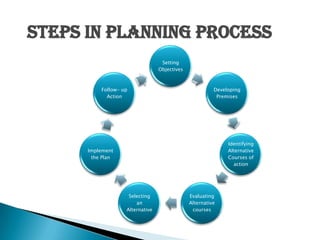
Steps in planning process
Setting
Objectives
Developing
Premises
Identifying
Alternative
Courses of
action
Evaluating
Alternative
courses
Selecting
an
Alternative
Implement
the Plan
Follow- up
Action
Types of Plans
▶Objectives
▶Strategy
▶Policy
▶Procedure
▶Method
▶Rule
▶Programme
▶Budget
Limitations of Planning
▶Planning leads to rigidity
▶Planning may not work in a dynamic
environment
▶Planning reduces creativity
▶Planning involves huge costs
▶Planning is a time consuming process
▶Planning does not guarantee success
Flexible Planning
▶Making a flexible plan is the most effective
way to achieve success.
▶Flexible planning is different from traditional
planning in many ways.
▶Traditional planning usually starts with the
objective or the goal and slowly works towards
the present, making it so rigid that there is no
room to react when unexpected events happen.
▶Flexible planning, on the other hand, begins
from the present and works forward.
▶A goal will be set but with no strict route to
it. It allows a person to take alternative
paths to lead him to his goal, giving him room
for changes and allowing him to adjust his
strategy when something unexpected occurs.
CHARACTERISTICS OF A SOUND
PLAN
▶ It should be based on clearly defined objectives.
▶ It must be simple and easily understandable
▶ It should be flexible or adaptable to changing
conditions.
▶ It must be balanced in all respects and should be
reason ably comprehensive.
▶ It should provide standards for the evaluation of
perfor-mance and actions.
▶ It should be economical i.e., permit optimum use of
available resources before creating new authorities
and new resources.
▶ It should be practicable or feasible and unambiguous.
Apian should be precise as to its nature and scope.
▶ It should be prepared with the consultation of concerned
persons.
▶ Different plans must be properly integrated and
harmonized with one another so as to ensure unity or
consistency in plans
▶ It should provide for proper analysis and classification
of actions
Management by Objectives
Management by objectives (MBO), also known
as management by results (MBR), is a process of
defining objectives within an organization so
that management and employees agree to the
objectives and understand what they need to do in the
organization in order to achieve them. The term
"management by objectives" was first popularized
by Peter Druck in his 1954 book The Practice of
Management.
Aims of Management By
Objectives
▶ greater efficiency through systematic procedures
▶ greater employee motivation and commitment
through participation in the planning process
▶ planning for results instead of planning just
for work
The objectives must meet
five criteria: they must be
▶ arranged in order of their importance
▶ expressed quantitatively, wherever
possible
▶ Realistic
▶ consistent with the organization's policies
▶ compatible with one another
Problem Solving And Decision
Making
Problem solving and decision-making are important
skills for business and life. Problem-solving often
involves decision-making, and decision-making is
especially important for management and leadership.
There are processes and techniques to improve
decision-making and the quality of decisions. Decision-
making is more natural to certain personalities, so
these people should focus more on improving the
quality of their decisions.
decision-making process
▶ Define and clarify the issue
▶ Gather all the facts and understand their causes.
▶ Think about or brainstorm possible options and
solutions.
▶ Consider and compare the pros and cons of each
option
▶ Select the best option - avoid vagueness or 'foot in
both camps' compromise.
introduction to management and planning

introduction to management and planning

  • 2.
    Definition ▶management is aprocess of designing and maintaining an environment in which individuals works together in group, and accomplish aims. ▶in other words it is the accomplishment of goals
  • 3.
  • 4.
    Nature of Management ▶Universality:Irrespective of the site nature and local of the organization. ▶Purposeful: attainment of organization goals. ▶Social process : motivation ▶Coordinating force : orderly management and overlapping ▶Continuous process: cycle of management continues for achievement of objectives.
  • 5.
  • 6.
    IMPORTANCE OF MANGEMENT ▶Effectiveutilization of resources ▶Development of resources ▶Incorporate innovations ▶Integrating group interest ▶Stability in society
  • 7.
     Years 1910-1940 ◦Management as Science ◦ Focus on Increasing Productivity & Efficiency ◦ Strict Control Over People & Process ◦ Top down Management Evolution of Management
  • 8.
     Years 1950-1960 ◦Functional Organization ◦ Emergence of HR ◦ Goal Setting ◦ Performance reviews with Job Description  During 1970’s ◦ Strategic Planning ◦ Focus on Resource allocation ◦ Swot analysis ◦ Growth Share Matrix (BCG) ◦ Developing contingency theories
  • 9.
     During 1990’s ◦Benchmarking performance ◦ Business process reengineering ◦ Total quality management ◦ Balance score cards tools for employees  2000’s ◦ Technology for value addition and growth ◦ Innovation ◦ Consulting as tool to implement ideas
  • 10.
    ◦ Scientific Management ◦Bureaucratic Management ◦ Administrative Management ▶ Classical Theory of Management Different Types of Management
  • 11.
    ◦ Human Relations ◦Behavioral Science Approach ▶Modern Management Theory ◦ Quantitative Approach ◦ System Approach ◦ Contingency Approach ◦ Operational Approach
  • 12.
     Management isa social process  Management is an integrating process  Continuous process
  • 13.
     Globalization  Ethicsand governance  Diversity  Career success & personal fulfillment  Technology  Competition
  • 14.
    Types of managers ▶Firstline Managers ▶Middle line Managers ▶Top Managers ▶Functional Managers ▶General Managers
  • 15.
  • 16.
  • 17.
    Social Responsibilities and ethicsof business ▶The organization must interact with the environment in order to survive. ▶The organization has to find and obtain the needed resources. ▶The business organization are open system, means they make profit to survive. ▶Balance between the desire profit against the needs of the society. ▶Social responsibility are related to the economy, consumer, local community and physical environment.
  • 19.
    Meaning  In simpleterms, Planning is deciding in advance what is to be done, when is to be done, how is to be done, and by whom it is to be done.  It bridges the gap from where we are and where we want to go.  It includes selection of objectives, policies, procedures and programmes from among alternatives.  A plan is a predetermined course of action to achieve a specified goal.  Planning is the primary function of management.
  • 20.
    Definitions  According toKoontz and O' Donnell, "Planning is an intellectual process, conscious determination of course of action, the basing of decision on purpose, facts and considered estimates.“  According to Alford and Beatt, "Planning is the thinking process, the organized foresight, the vision based on fact and experience that is required for intelligent action."  According to Theo Haimann, "Planning is deciding in advance what is to be done. When a manager plans, he projects a course of action for further attempting to achieve a consistent co- ordinate structure of operations aimed at the desired results”.
  • 21.
    Nature/Characteristics of Planning  Planningis an intellectual Process  Panning Contributes to the objectives of the firm  It is a primary function of management  It’s a continuous process  Planning pervades Managerial activities
  • 22.
    Importance of Planning ▶Planningprovides directions ▶Reduces the risk of uncertainty ▶Planning reduces overlapping and wasteful activities ▶Planning promotes innovative ideas ▶Planning facilitates decision making ▶Planning establishes standards for controlling
  • 23.
    Steps in planningprocess Setting Objectives Developing Premises Identifying Alternative Courses of action Evaluating Alternative courses Selecting an Alternative Implement the Plan Follow- up Action
  • 24.
  • 25.
    Limitations of Planning ▶Planningleads to rigidity ▶Planning may not work in a dynamic environment ▶Planning reduces creativity ▶Planning involves huge costs ▶Planning is a time consuming process ▶Planning does not guarantee success
  • 26.
    Flexible Planning ▶Making aflexible plan is the most effective way to achieve success. ▶Flexible planning is different from traditional planning in many ways. ▶Traditional planning usually starts with the objective or the goal and slowly works towards the present, making it so rigid that there is no room to react when unexpected events happen.
  • 27.
    ▶Flexible planning, onthe other hand, begins from the present and works forward. ▶A goal will be set but with no strict route to it. It allows a person to take alternative paths to lead him to his goal, giving him room for changes and allowing him to adjust his strategy when something unexpected occurs.
  • 28.
    CHARACTERISTICS OF ASOUND PLAN ▶ It should be based on clearly defined objectives. ▶ It must be simple and easily understandable ▶ It should be flexible or adaptable to changing conditions. ▶ It must be balanced in all respects and should be reason ably comprehensive. ▶ It should provide standards for the evaluation of perfor-mance and actions.
  • 29.
    ▶ It shouldbe economical i.e., permit optimum use of available resources before creating new authorities and new resources. ▶ It should be practicable or feasible and unambiguous. Apian should be precise as to its nature and scope. ▶ It should be prepared with the consultation of concerned persons. ▶ Different plans must be properly integrated and harmonized with one another so as to ensure unity or consistency in plans ▶ It should provide for proper analysis and classification of actions
  • 30.
    Management by Objectives Managementby objectives (MBO), also known as management by results (MBR), is a process of defining objectives within an organization so that management and employees agree to the objectives and understand what they need to do in the organization in order to achieve them. The term "management by objectives" was first popularized by Peter Druck in his 1954 book The Practice of Management.
  • 31.
    Aims of ManagementBy Objectives ▶ greater efficiency through systematic procedures ▶ greater employee motivation and commitment through participation in the planning process ▶ planning for results instead of planning just for work
  • 32.
    The objectives mustmeet five criteria: they must be ▶ arranged in order of their importance ▶ expressed quantitatively, wherever possible ▶ Realistic ▶ consistent with the organization's policies ▶ compatible with one another
  • 33.
    Problem Solving AndDecision Making Problem solving and decision-making are important skills for business and life. Problem-solving often involves decision-making, and decision-making is especially important for management and leadership. There are processes and techniques to improve decision-making and the quality of decisions. Decision- making is more natural to certain personalities, so these people should focus more on improving the quality of their decisions.
  • 34.
    decision-making process ▶ Defineand clarify the issue ▶ Gather all the facts and understand their causes. ▶ Think about or brainstorm possible options and solutions. ▶ Consider and compare the pros and cons of each option ▶ Select the best option - avoid vagueness or 'foot in both camps' compromise.