OVERVIEW OF HIV
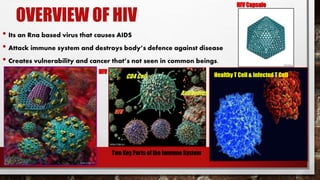
• Its an Rna based virus that causes AIDS
• Attack immune system and destroys body’s defence against disease
• Creates vulnerability and cancer that’s not seen in common beings.
HIV Capsule
HIV
Healthy T Cell & Infected T Cell
Two Key Parts of the Immune System
CD4 Cell
Antibodies
HIV
HIV TRANSMISSION
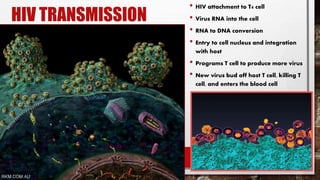
• HIV attachment to T4 cell
• Virus RNA into the cell
• RNA to DNA conversion
• Entry to cell nucleus and integration
with host
• Programs T cell to produce more virus
• New virus bud off host T cell, killing T
cell, and enters the blood cell
SOME QUESTIONS THAT BIND IN OUR MIND
•Window period??The time period between a person’s exposure & actual
infection with HIV and until antibodies are detectable in the body.
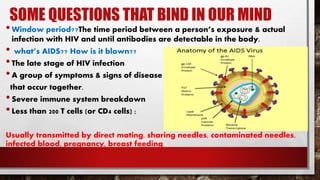
• what’s AIDS?? How is it blown??
•The late stage of HIV infection
•A group of symptoms & signs of disease
that occur together.
•Severe immune system breakdown
•Less than 200 T cells (or CD4 cells) ;
Usually transmitted by direct mating, sharing needles, contaminated needles,
infected blood, pregnancy, breast feeding
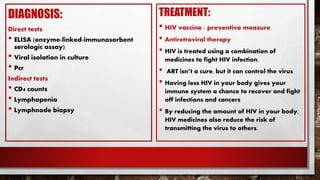
DIAGNOSIS:
Direct tests
• ELISA (enzyme-linked-immunosorbent
serologic assay)
• Viral isolation in culture
• Pcr
Indirect tests
• CD4 counts
• Lymphopenia
• Lymphnode biopsy
TREATMENT:
• HIV vaccine : preventive measure
• Antiretroviral therapy
• HIV is treated using a combination of
medicines to fight HIV infection.
• ART isn’t a cure, but it can control the virus
• Having less HIV in your body gives your
immune system a chance to recover and fight
off infections and cancers
• By reducing the amount of HIV in your body,
HIV medicines also reduce the risk of
transmitting the virus to others.
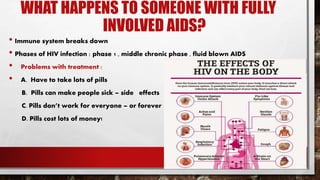
WHAT HAPPENS TO SOMEONE WITH FULLY
INVOLVED AIDS?
• Immune system breaks down
• Phases of HIV infection : phase 1 , middle chronic phase , fluid blown AIDS
• Problems with treatment :
• A. Have to take lots of pills
B. Pills can make people sick – side effects
C. Pills don’t work for everyone – or forever
D. Pills cost lots of money!
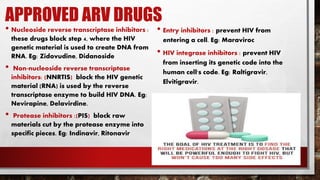
APPROVED ARV DRUGS
• Nucleoside reverse transcriptase inhibitors :
these drugs block step 4, where the HIV
genetic material is used to create DNA from
RNA. Eg: Zidovudine, Didanoside
• Non-nucleoside reverse transcriptase
inhibitors: (NNRTIS) block the HIV genetic
material (RNA) is used by the reverse
transcriptase enzyme to build HIV DNA. Eg:
Nevirapine, Delavirdine.
• Protease inhibitors :(PIS) block raw
materials cut by the protease enzyme into
specific pieces. Eg: Indinavir, Ritonavir
• Entry inhibitors : prevent HIV from
entering a cell. Eg: Maraviroc
• HIV integrase inhibitors : prevent HIV
from inserting its genetic code into the
human cell's code. Eg: Raltigravir,
Elvitigravir.
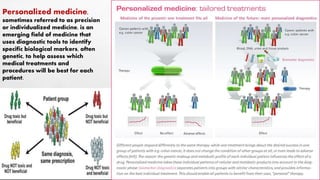
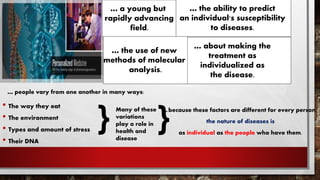
Personalized medicine,
sometimes referred to as precision
or individualized medicine, is an
emerging field of medicine that
uses diagnostic tools to identify
specific biological markers, often
genetic, to help assess which
medical treatments and
procedures will be best for each
patient.
• The way they eat
• The environment
• Types and amount of stress
• Their DNA
… about making the
treatment as
individualized as
the disease.
… the ability to predict
an individual's susceptibility
to diseases.
… a young but
rapidly advancing
field.
… the use of new
methods of molecular
analysis.
… people vary from one another in many ways:
Many of these
variations
play a role in
health and
disease
}
… because these factors are different for every person,
the nature of diseases is
as individual as the people who have them.
}
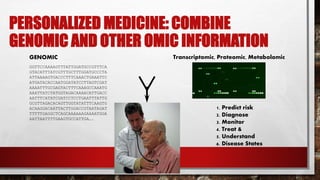
PERSONALIZED MEDICINE: COMBINE
GENOMIC AND OTHER OMIC INFORMATION
GENOMIC
GGTTCCAAAAGTTTATTGGATGCCGTTTCA
GTACATTTATCGTTTGCTTTGGATGCCCTA
ATTAAAAGTGACCCTTTCAAACTGAAATTC
ATGATACACCAATGGATATCCTTAGTCGAT
AAAATTTGCGAGTACTTTCAAAGCCAAATG
AAATTATCTATGGTAGACAAAACATTGACC
AATTTCATATCGATCCTCCTGAATTTATTG
GCGTTAGACACAGTTGGTATATTTCAAGTG
ACAAGGACAATTACTTGGACCGTAATAGAT
TTTTTGAGGCTCAGCAAAAAAGAAAATGGA
AATTAATTTTGAAGTGCCATTGA….
Transcriptomic, Proteomic, Metabolomic
1. Predict risk
2. Diagnose
3. Monitor
4. Treat &
5. Understand
6. Disease States
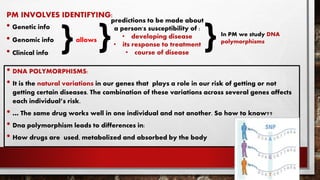
PM INVOLVES IDENTIFYING:
• Genetic info
• Genomic info allows
• Clinical info
• DNA POLYMORPHISMS:
• It is the natural variations in our genes that plays a role in our risk of getting or not
getting certain diseases. The combination of these variations across several genes affects
each individual’s risk.
• … The same drug works well in one individual and not another. So how to know??
• Dna polymorphism leads to differences in:
• How drugs are used, metabolized and absorbed by the body
}
predictions to be made about
a person's susceptibility of :
• developing disease
• its response to treatment
• course of disease
} In PM we study DNA
polymorphisms
}
PERSONISED HIV THERAPY
• HIV is one of the fastest evolving pathogens known, and
as yet, there is no vaccine for HIV
• Because the patient, once infected, cannot be cured of the
virus, the goal of therapy is to suppress virus replication,
ease symptoms, and prolong life.
• Drugs inhibit a variety of steps in the viral replication
cycle. Although a certain drug therapy can be effective for
quite a long time, even several years, the virus eventually
manages to evolve into a resistant variant, leading to
therapy failure.
• When this happens, a new drug combination has to be
selected that effectively counters the resistance profile
manifested by the virus population presently in the
patient. This is a difficult task to accomplish, but suitable
software can help to select efficient therapy options for
these patients.
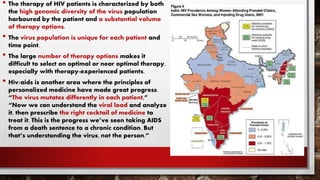
• The therapy of HIV patients is characterized by both
the high genomic diversity of the virus population
harboured by the patient and a substantial volume
of therapy options.
• The virus population is unique for each patient and
time point.
• The large number of therapy options makes it
difficult to select an optimal or near optimal therapy,
especially with therapy-experienced patients.
• Hiv/aids is another area where the principles of
personalized medicine have made great progress.
“The virus mutates differently in each patient,”
“Now we can understand the viral load and analyze
it, then prescribe the right cocktail of medicine to
treat it. This is the progress we’ve seen taking AIDS
from a death sentence to a chronic condition. But
that’s understanding the virus, not the person.”
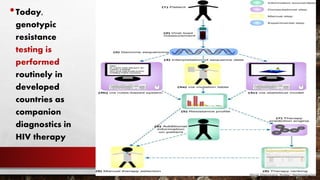
•Today,
genotypic
resistance
testing is
performed
routinely in
developed
countries as
companion
diagnostics in
HIV therapy
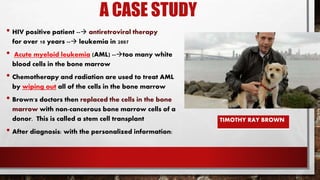
A CASE STUDY
• HIV positive patient -- antiretroviral therapy
for over 10 years -- leukemia in 2007
• Acute myeloid leukemia (AML) --too many white
blood cells in the bone marrow
• Chemotherapy and radiation are used to treat AML
by wiping out all of the cells in the bone marrow
• Brown's doctors then replaced the cells in the bone
marrow with non-cancerous bone marrow cells of a
donor. This is called a stem cell transplant
• After diagnosis: with the personalized information:
TIMOTHY RAY BROWN
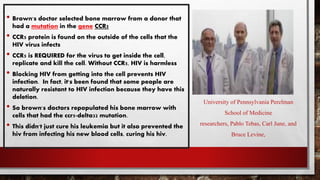
• Brown's doctor selected bone marrow from a donor that
had a mutation in the gene CCR5
• CCR5 protein is found on the outside of the cells that the
HIV virus infects
• CCR5 is REQUIRED for the virus to get inside the cell,
replicate and kill the cell. Without CCR5, HIV is harmless
• Blocking HIV from getting into the cell prevents HIV
infection. In fact, it's been found that some people are
naturally resistant to HIV infection because they have this
deletion.
• So brown's doctors repopulated his bone marrow with
cells that had the ccr5-delta32 mutation.
• This didn't just cure his leukemia but it also prevented the
hiv from infecting his new blood cells, curing his hiv.
University of Pennsylvania Perelman
School of Medicine
researchers, Pablo Tebas, Carl June, and
Bruce Levine,
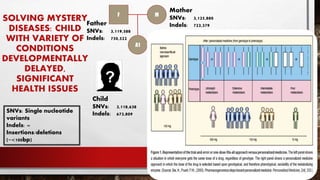
SOLVING MYSTERY
DISEASES: CHILD
WITH VARIETY OF
CONDITIONS
DEVELOPMENTALLY
DELAYED,
SIGNIFICANT
HEALTH ISSUES
F M
A1
Father
SNVs: 3,119,588
Indels: 750,522
Mother
SNVs: 3,125,880
Indels: 723,379
Child
SNVs: 3,118,638
Indels: 673,809SNVs: Single nucleotide
variants
Indels: =
Insertions/deletions
(~<100bp)
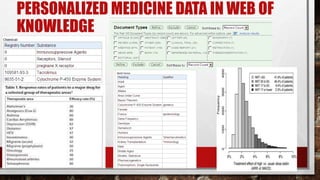
PERSONALIZED MEDICINE DATA IN WEB OF
KNOWLEDGE
REFERENCE
1.Joanne M Meyer and Geoffrey S Ginsburg ,The path to personalized medicine, 6 June 2002
2. Michael Pazzani and Ranjit Iyer, Edison Schroeder and Jeremiah Tilles, CTSHIV: A Knowledge-Based
System For the Management of HIV-infected Patients.
3. Thomas Lengauer, Nico Pfeifer, Rolf Kaiser ,Personalized HIV therapy to control drug resistance,
4. David Stein, Winson W. Tang , Ian Frank Penn, Shelley Q. Wang, Gary Lee Researchers Used Zinc
Finger Technology to Safely Build Up Army of Modified T Cells to Repel VirusMarch 5, 2014
5. Nadia Dowshen , Lisa M Kuhns, Amy Johnson, Brian James Holoyda, and Robert Garofalo ,Craig
Improving Adherence to Antiretroviral Therapy for Youth Living with HIV/AIDS: A Pilot Study Using
Personalized, Interactive -Dalsimer Division of Adolescent Medicine, March-April, 2012
Personized hiv therapy ppt

Personized hiv therapy ppt

  • 2.
    OVERVIEW OF HIV •Its an Rna based virus that causes AIDS • Attack immune system and destroys body’s defence against disease • Creates vulnerability and cancer that’s not seen in common beings. HIV Capsule HIV Healthy T Cell & Infected T Cell Two Key Parts of the Immune System CD4 Cell Antibodies HIV
  • 3.
    HIV TRANSMISSION • HIVattachment to T4 cell • Virus RNA into the cell • RNA to DNA conversion • Entry to cell nucleus and integration with host • Programs T cell to produce more virus • New virus bud off host T cell, killing T cell, and enters the blood cell
  • 4.
    SOME QUESTIONS THATBIND IN OUR MIND •Window period??The time period between a person’s exposure & actual infection with HIV and until antibodies are detectable in the body. • what’s AIDS?? How is it blown?? •The late stage of HIV infection •A group of symptoms & signs of disease that occur together. •Severe immune system breakdown •Less than 200 T cells (or CD4 cells) ; Usually transmitted by direct mating, sharing needles, contaminated needles, infected blood, pregnancy, breast feeding
  • 5.
    DIAGNOSIS: Direct tests • ELISA(enzyme-linked-immunosorbent serologic assay) • Viral isolation in culture • Pcr Indirect tests • CD4 counts • Lymphopenia • Lymphnode biopsy TREATMENT: • HIV vaccine : preventive measure • Antiretroviral therapy • HIV is treated using a combination of medicines to fight HIV infection. • ART isn’t a cure, but it can control the virus • Having less HIV in your body gives your immune system a chance to recover and fight off infections and cancers • By reducing the amount of HIV in your body, HIV medicines also reduce the risk of transmitting the virus to others.
  • 6.
    WHAT HAPPENS TOSOMEONE WITH FULLY INVOLVED AIDS? • Immune system breaks down • Phases of HIV infection : phase 1 , middle chronic phase , fluid blown AIDS • Problems with treatment : • A. Have to take lots of pills B. Pills can make people sick – side effects C. Pills don’t work for everyone – or forever D. Pills cost lots of money!
  • 7.
    APPROVED ARV DRUGS •Nucleoside reverse transcriptase inhibitors : these drugs block step 4, where the HIV genetic material is used to create DNA from RNA. Eg: Zidovudine, Didanoside • Non-nucleoside reverse transcriptase inhibitors: (NNRTIS) block the HIV genetic material (RNA) is used by the reverse transcriptase enzyme to build HIV DNA. Eg: Nevirapine, Delavirdine. • Protease inhibitors :(PIS) block raw materials cut by the protease enzyme into specific pieces. Eg: Indinavir, Ritonavir • Entry inhibitors : prevent HIV from entering a cell. Eg: Maraviroc • HIV integrase inhibitors : prevent HIV from inserting its genetic code into the human cell's code. Eg: Raltigravir, Elvitigravir.
  • 8.
    Personalized medicine, sometimes referredto as precision or individualized medicine, is an emerging field of medicine that uses diagnostic tools to identify specific biological markers, often genetic, to help assess which medical treatments and procedures will be best for each patient.
  • 9.
    • The waythey eat • The environment • Types and amount of stress • Their DNA … about making the treatment as individualized as the disease. … the ability to predict an individual's susceptibility to diseases. … a young but rapidly advancing field. … the use of new methods of molecular analysis. … people vary from one another in many ways: Many of these variations play a role in health and disease } … because these factors are different for every person, the nature of diseases is as individual as the people who have them. }
  • 10.
    PERSONALIZED MEDICINE: COMBINE GENOMICAND OTHER OMIC INFORMATION GENOMIC GGTTCCAAAAGTTTATTGGATGCCGTTTCA GTACATTTATCGTTTGCTTTGGATGCCCTA ATTAAAAGTGACCCTTTCAAACTGAAATTC ATGATACACCAATGGATATCCTTAGTCGAT AAAATTTGCGAGTACTTTCAAAGCCAAATG AAATTATCTATGGTAGACAAAACATTGACC AATTTCATATCGATCCTCCTGAATTTATTG GCGTTAGACACAGTTGGTATATTTCAAGTG ACAAGGACAATTACTTGGACCGTAATAGAT TTTTTGAGGCTCAGCAAAAAAGAAAATGGA AATTAATTTTGAAGTGCCATTGA…. Transcriptomic, Proteomic, Metabolomic 1. Predict risk 2. Diagnose 3. Monitor 4. Treat & 5. Understand 6. Disease States
  • 11.
    PM INVOLVES IDENTIFYING: •Genetic info • Genomic info allows • Clinical info • DNA POLYMORPHISMS: • It is the natural variations in our genes that plays a role in our risk of getting or not getting certain diseases. The combination of these variations across several genes affects each individual’s risk. • … The same drug works well in one individual and not another. So how to know?? • Dna polymorphism leads to differences in: • How drugs are used, metabolized and absorbed by the body } predictions to be made about a person's susceptibility of : • developing disease • its response to treatment • course of disease } In PM we study DNA polymorphisms }
  • 13.
    PERSONISED HIV THERAPY •HIV is one of the fastest evolving pathogens known, and as yet, there is no vaccine for HIV • Because the patient, once infected, cannot be cured of the virus, the goal of therapy is to suppress virus replication, ease symptoms, and prolong life. • Drugs inhibit a variety of steps in the viral replication cycle. Although a certain drug therapy can be effective for quite a long time, even several years, the virus eventually manages to evolve into a resistant variant, leading to therapy failure. • When this happens, a new drug combination has to be selected that effectively counters the resistance profile manifested by the virus population presently in the patient. This is a difficult task to accomplish, but suitable software can help to select efficient therapy options for these patients.
  • 14.
    • The therapyof HIV patients is characterized by both the high genomic diversity of the virus population harboured by the patient and a substantial volume of therapy options. • The virus population is unique for each patient and time point. • The large number of therapy options makes it difficult to select an optimal or near optimal therapy, especially with therapy-experienced patients. • Hiv/aids is another area where the principles of personalized medicine have made great progress. “The virus mutates differently in each patient,” “Now we can understand the viral load and analyze it, then prescribe the right cocktail of medicine to treat it. This is the progress we’ve seen taking AIDS from a death sentence to a chronic condition. But that’s understanding the virus, not the person.”
  • 15.
  • 16.
    A CASE STUDY •HIV positive patient -- antiretroviral therapy for over 10 years -- leukemia in 2007 • Acute myeloid leukemia (AML) --too many white blood cells in the bone marrow • Chemotherapy and radiation are used to treat AML by wiping out all of the cells in the bone marrow • Brown's doctors then replaced the cells in the bone marrow with non-cancerous bone marrow cells of a donor. This is called a stem cell transplant • After diagnosis: with the personalized information: TIMOTHY RAY BROWN
  • 17.
    • Brown's doctorselected bone marrow from a donor that had a mutation in the gene CCR5 • CCR5 protein is found on the outside of the cells that the HIV virus infects • CCR5 is REQUIRED for the virus to get inside the cell, replicate and kill the cell. Without CCR5, HIV is harmless • Blocking HIV from getting into the cell prevents HIV infection. In fact, it's been found that some people are naturally resistant to HIV infection because they have this deletion. • So brown's doctors repopulated his bone marrow with cells that had the ccr5-delta32 mutation. • This didn't just cure his leukemia but it also prevented the hiv from infecting his new blood cells, curing his hiv. University of Pennsylvania Perelman School of Medicine researchers, Pablo Tebas, Carl June, and Bruce Levine,
  • 18.
    SOLVING MYSTERY DISEASES: CHILD WITHVARIETY OF CONDITIONS DEVELOPMENTALLY DELAYED, SIGNIFICANT HEALTH ISSUES F M A1 Father SNVs: 3,119,588 Indels: 750,522 Mother SNVs: 3,125,880 Indels: 723,379 Child SNVs: 3,118,638 Indels: 673,809SNVs: Single nucleotide variants Indels: = Insertions/deletions (~<100bp)
  • 19.
    PERSONALIZED MEDICINE DATAIN WEB OF KNOWLEDGE
  • 20.
    REFERENCE 1.Joanne M Meyerand Geoffrey S Ginsburg ,The path to personalized medicine, 6 June 2002 2. Michael Pazzani and Ranjit Iyer, Edison Schroeder and Jeremiah Tilles, CTSHIV: A Knowledge-Based System For the Management of HIV-infected Patients. 3. Thomas Lengauer, Nico Pfeifer, Rolf Kaiser ,Personalized HIV therapy to control drug resistance, 4. David Stein, Winson W. Tang , Ian Frank Penn, Shelley Q. Wang, Gary Lee Researchers Used Zinc Finger Technology to Safely Build Up Army of Modified T Cells to Repel VirusMarch 5, 2014 5. Nadia Dowshen , Lisa M Kuhns, Amy Johnson, Brian James Holoyda, and Robert Garofalo ,Craig Improving Adherence to Antiretroviral Therapy for Youth Living with HIV/AIDS: A Pilot Study Using Personalized, Interactive -Dalsimer Division of Adolescent Medicine, March-April, 2012