Can we cure HIV/AIDS?: A
2014 progress report
Zeena Nackerdien
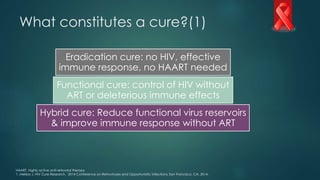
What constitutes a cure?(1)
Eradication cure: no HIV, effective
immune response, no HAART needed
Functional cure: control of HIV without
ART or deleterious immune effects
Hybrid cure: Reduce functional virus reservoirs
& improve immune response without ART
HAART, highly active anti-retroviral therapy
1. Mellors J. HIV Cure Research. 2014 Conference on Retroviruses and Opportunistic Infections; San Francisco, CA, 2014.
ART: prevention/initial treatment of
HIV+-adults & adolescents (2-3)
*CD4 counts should be done every 3 to 6 months to assess the urgency of ART initiation and the need for opportunistic infection prophylaxis. CD4 count done at baseline & repeated per tailored
management regimen; HCP, healthcare provider; mo., months; pt, patient; aPrEP candidates: when exposed to HIV e.g., through drugs /sex.
2. US Centers for Disease Control. Preexposure prophylaxis for the prevention of HIV in the United States 2014 [cited 2014 May]. : http://www.cdc.gov/hiv/pdf/guidelines/PrEPguidelines2014.pdf
3. AIDSInfo. Guidelines for the Use of Antiretroviral Agents in HIV-1-Infected Adults and Adolescents: Initiating Antiretroviral Therapy in Treatment-Naive Patients: National Institute of Health; 2014
[cited 2014 May]. http://aidsinfo.nih.gov/guidelines/html/1/adult-and-adolescent-arv-guidelines/10/initiating-art-in-treatment-na%C3%AFve-patients.
PrEP candidatesa
• Truvada® used as
PrEP
• Individuals must
commit to taking
drug daily & seeing
an HCP every 3
mo. for HIV testing
& other follow-up
• Viral load &CD4-cell count*
should guide start &
continuation of ART in HIV+-
pts to reduce risk of disease
progression
• ART is recommended in
HIV+-pts. to prevent
transmission
• Pt. education: Benefit/risk
profiles & importance of
adherence
• Tailored onset/deferral of
ART may be done on a
case-by-case basis
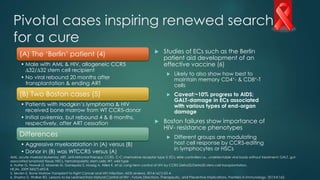
Pivotal cases inspiring renewed search
for a cure
(A) The ‘Berlin’ patient (4)
• Male with AML & HIV, allogeneic CCR5
32/32 stem cell recipient
• No viral rebound 20 months after
transplantation & ending ART
(B) Two Boston cases (5)
• Patients with Hodgkin’s lymphoma & HIV
received bone marrow from WT CCR5-donor
• Initial aviremia, but rebound 4 & 8 months,
respectively, after ART cessation
Differences
• Aggressive myeloablation in (A) versus (B)
• Donor in (B) was WTCCR5 versus (A)
 Studies of ECs such as the Berlin
patient aid development of an
effective vaccine (6)
 Likely to also show how best to
maintain memory CD4+- & CD8+-T
cells
 Caveat:~10% progress to AIDS;
GALT-damage in ECs associated
with various types of end-organ
damage
 Boston failures show importance of
HIV- resistance phenotypes
 Different groups are modulating
host cell response by CCR5-editing
in lymphocytes or HSCs
AML, acute myeloid leukemia; ART, anti-retroviral therapy; CCR5, C-C chemokine receptor type 5; ECs, elite controllers i.e., undetectable viral loads without treatment; GALT, gut-
associated lymphoid tissue; HSCs, hematopoietic stem cells; WT, wild type
4. Hutter G, Nowak D, Mossner M, Ganepola S, Mussig A, Allers K, et al. Long-term control of HIV by CCR5 Delta32/Delta32 stem-cell transplantation.
NEJM, 2009;360(7):692-8.
5. Seclen E. Bone Marrow Transplant to Fight Cancer and HIV Infection. AIDS reviews. 2014;16(1):53-4.
6. Shasha D, Walker BD. Lessons to be Learned from Natural Control of HIV - Future Directions, Therapeutic, and Preventive Implications. Frontiers in immunology. 2013;4:162.
Non-ART strategies: Gene editing
Chimeric nuclease*
deleting 32 bp
segment of CCR5
(32/32)
*Gene-editing chimeric nucleases e.g., ZFN, Zinc-finger nucleases, TALENS, transcription activator-like effector nucleases & CRISPR (clustered regularly interspaced short palindromic repeats)
/Cas-based endonucleases ;bp, base pairs
7.Tebas P, Stein D, Tang WW, Frank I, Wang SQ, Lee G, et al. Gene editing of CCR5 in autologous CD4 T cells of persons infected with HIV. NEJM. 2014;370(10):901-10.
ZFN-modified autologous CD4 T cell infusions were safe in 12
pts. with chronic aviremic HIV infection [NCT00842634](7)
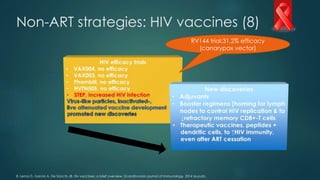
Non-ART strategies: HIV vaccines (8)
RV144 trial:31,2% efficacy
(canarypox vector)
8. Lema D, Garcia A, De Sanctis JB. Hiv vaccines: a brief overview. Scandinavian journal of immunology. 2014 (e-pub).
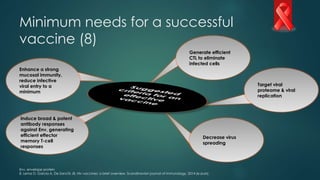
Minimum needs for a successful
vaccine (8)
Env, envelope protein
8. Lema D, Garcia A, De Sanctis JB. Hiv vaccines: a brief overview. Scandinavian journal of immunology. 2014 (e-pub).
Enhance a strong
mucosal immunity,
reduce infective
viral entry to a
minimum
Induce broad & potent
antibody responses
against Env, generating
efficient effector
memory T-cell
responses
Generate efficient
CTL to eliminate
infected cells
Target viral
proteome & viral
replication
Decrease virus
spreading
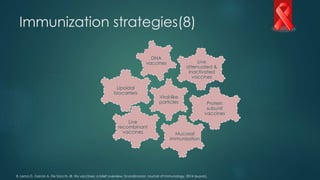
Immunization strategies(8)
8. Lema D, Garcia A, De Sanctis JB. HIv vaccines: a brief overview. Scandinavian Journal of Immunology. 2014 (e-pub).
Lipoidal
biocarriers
DNA
vaccines
Viral-like
particles
Live
recombinant
vaccines Mucosal
immunization
Live
attenuated &
inactivated
vaccines
Protein
subunit
vaccines
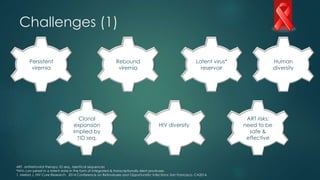
Challenges (1)
ART, antiretroviral therapy; ID seq., identical sequences
*HIVs can persist in a latent state in the form of integrated & transcriptionally silent proviruses
1. Mellors J. HIV Cure Research. 2014 Conference on Retroviruses and Opportunistic Infections; San Francisco, CA2014.
Persistent
viremia
Rebound
viremia
Latent virus*
reservoir
Clonal
expansion
implied by
↑ID seq.
HIV diversity
Human
diversity
ART risks:
need to be
safe &
effective
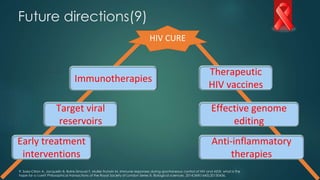
Future directions(9)
Immunotherapies
Therapeutic
HIV vaccines
Target viral
reservoirs
Effective genome
editing
Early treatment
interventions
Anti-inflammatory
therapies
HIV CURE
9. Saez-Cirion A, Jacquelin B, Barre-Sinoussi F, Muller-Trutwin M. Immune responses during spontaneous control of HIV and AIDS: what is the
hope for a cure? Philosophical transactions of the Royal Society of London Series B, Biological sciences. 2014;369(1645):20130436.
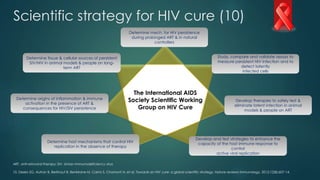
Scientific strategy for HIV cure (10)
ART, anti-retroviral therapy; SIV, simian immunodeficiency virus
10. Deeks SG, Autran B, Berkhout B, Benkirane M, Cairns S, Chomont N, et al. Towards an HIV cure: a global scientific strategy. Nature reviews Immunology. 2012;12(8):607-14.
The International AIDS
Society Scientific Working
Group on HIV Cure
Determine tissue & cellular sources of persistent
SIV/HIV in animal models & people on long-
term ART
Determine origins of inflammation & immune
activation in the presence of ART &
consequences for HIV/SIV persistence
Determine host mechanisms that control HIV
replication in the absence of therapy
Develop and test strategies to enhance the
capacity of the host immune response to
control
active viral replication
Develop therapies to safely test &
eliminate latent infection in animal
models & people on ART
Study, compare and validate assays to
measure persistent HIV infection and to
detect latently
infected cells
Determine mech. for HIV persistence
during prolonged ART & in natural
controllers

Can we cure HIV/AIDS?: A 2014 progress report

  • 1.
    Can we cureHIV/AIDS?: A 2014 progress report Zeena Nackerdien
  • 2.
    What constitutes acure?(1) Eradication cure: no HIV, effective immune response, no HAART needed Functional cure: control of HIV without ART or deleterious immune effects Hybrid cure: Reduce functional virus reservoirs & improve immune response without ART HAART, highly active anti-retroviral therapy 1. Mellors J. HIV Cure Research. 2014 Conference on Retroviruses and Opportunistic Infections; San Francisco, CA, 2014.
  • 3.
    ART: prevention/initial treatmentof HIV+-adults & adolescents (2-3) *CD4 counts should be done every 3 to 6 months to assess the urgency of ART initiation and the need for opportunistic infection prophylaxis. CD4 count done at baseline & repeated per tailored management regimen; HCP, healthcare provider; mo., months; pt, patient; aPrEP candidates: when exposed to HIV e.g., through drugs /sex. 2. US Centers for Disease Control. Preexposure prophylaxis for the prevention of HIV in the United States 2014 [cited 2014 May]. : http://www.cdc.gov/hiv/pdf/guidelines/PrEPguidelines2014.pdf 3. AIDSInfo. Guidelines for the Use of Antiretroviral Agents in HIV-1-Infected Adults and Adolescents: Initiating Antiretroviral Therapy in Treatment-Naive Patients: National Institute of Health; 2014 [cited 2014 May]. http://aidsinfo.nih.gov/guidelines/html/1/adult-and-adolescent-arv-guidelines/10/initiating-art-in-treatment-na%C3%AFve-patients. PrEP candidatesa • Truvada® used as PrEP • Individuals must commit to taking drug daily & seeing an HCP every 3 mo. for HIV testing & other follow-up • Viral load &CD4-cell count* should guide start & continuation of ART in HIV+- pts to reduce risk of disease progression • ART is recommended in HIV+-pts. to prevent transmission • Pt. education: Benefit/risk profiles & importance of adherence • Tailored onset/deferral of ART may be done on a case-by-case basis
  • 4.
    Pivotal cases inspiringrenewed search for a cure (A) The ‘Berlin’ patient (4) • Male with AML & HIV, allogeneic CCR5 32/32 stem cell recipient • No viral rebound 20 months after transplantation & ending ART (B) Two Boston cases (5) • Patients with Hodgkin’s lymphoma & HIV received bone marrow from WT CCR5-donor • Initial aviremia, but rebound 4 & 8 months, respectively, after ART cessation Differences • Aggressive myeloablation in (A) versus (B) • Donor in (B) was WTCCR5 versus (A)  Studies of ECs such as the Berlin patient aid development of an effective vaccine (6)  Likely to also show how best to maintain memory CD4+- & CD8+-T cells  Caveat:~10% progress to AIDS; GALT-damage in ECs associated with various types of end-organ damage  Boston failures show importance of HIV- resistance phenotypes  Different groups are modulating host cell response by CCR5-editing in lymphocytes or HSCs AML, acute myeloid leukemia; ART, anti-retroviral therapy; CCR5, C-C chemokine receptor type 5; ECs, elite controllers i.e., undetectable viral loads without treatment; GALT, gut- associated lymphoid tissue; HSCs, hematopoietic stem cells; WT, wild type 4. Hutter G, Nowak D, Mossner M, Ganepola S, Mussig A, Allers K, et al. Long-term control of HIV by CCR5 Delta32/Delta32 stem-cell transplantation. NEJM, 2009;360(7):692-8. 5. Seclen E. Bone Marrow Transplant to Fight Cancer and HIV Infection. AIDS reviews. 2014;16(1):53-4. 6. Shasha D, Walker BD. Lessons to be Learned from Natural Control of HIV - Future Directions, Therapeutic, and Preventive Implications. Frontiers in immunology. 2013;4:162.
  • 5.
    Non-ART strategies: Geneediting Chimeric nuclease* deleting 32 bp segment of CCR5 (32/32) *Gene-editing chimeric nucleases e.g., ZFN, Zinc-finger nucleases, TALENS, transcription activator-like effector nucleases & CRISPR (clustered regularly interspaced short palindromic repeats) /Cas-based endonucleases ;bp, base pairs 7.Tebas P, Stein D, Tang WW, Frank I, Wang SQ, Lee G, et al. Gene editing of CCR5 in autologous CD4 T cells of persons infected with HIV. NEJM. 2014;370(10):901-10. ZFN-modified autologous CD4 T cell infusions were safe in 12 pts. with chronic aviremic HIV infection [NCT00842634](7)
  • 6.
    Non-ART strategies: HIVvaccines (8) RV144 trial:31,2% efficacy (canarypox vector) 8. Lema D, Garcia A, De Sanctis JB. Hiv vaccines: a brief overview. Scandinavian journal of immunology. 2014 (e-pub).
  • 7.
    Minimum needs fora successful vaccine (8) Env, envelope protein 8. Lema D, Garcia A, De Sanctis JB. Hiv vaccines: a brief overview. Scandinavian journal of immunology. 2014 (e-pub). Enhance a strong mucosal immunity, reduce infective viral entry to a minimum Induce broad & potent antibody responses against Env, generating efficient effector memory T-cell responses Generate efficient CTL to eliminate infected cells Target viral proteome & viral replication Decrease virus spreading
  • 8.
    Immunization strategies(8) 8. LemaD, Garcia A, De Sanctis JB. HIv vaccines: a brief overview. Scandinavian Journal of Immunology. 2014 (e-pub). Lipoidal biocarriers DNA vaccines Viral-like particles Live recombinant vaccines Mucosal immunization Live attenuated & inactivated vaccines Protein subunit vaccines
  • 9.
    Challenges (1) ART, antiretroviraltherapy; ID seq., identical sequences *HIVs can persist in a latent state in the form of integrated & transcriptionally silent proviruses 1. Mellors J. HIV Cure Research. 2014 Conference on Retroviruses and Opportunistic Infections; San Francisco, CA2014. Persistent viremia Rebound viremia Latent virus* reservoir Clonal expansion implied by ↑ID seq. HIV diversity Human diversity ART risks: need to be safe & effective
  • 10.
    Future directions(9) Immunotherapies Therapeutic HIV vaccines Targetviral reservoirs Effective genome editing Early treatment interventions Anti-inflammatory therapies HIV CURE 9. Saez-Cirion A, Jacquelin B, Barre-Sinoussi F, Muller-Trutwin M. Immune responses during spontaneous control of HIV and AIDS: what is the hope for a cure? Philosophical transactions of the Royal Society of London Series B, Biological sciences. 2014;369(1645):20130436.
  • 11.
    Scientific strategy forHIV cure (10) ART, anti-retroviral therapy; SIV, simian immunodeficiency virus 10. Deeks SG, Autran B, Berkhout B, Benkirane M, Cairns S, Chomont N, et al. Towards an HIV cure: a global scientific strategy. Nature reviews Immunology. 2012;12(8):607-14. The International AIDS Society Scientific Working Group on HIV Cure Determine tissue & cellular sources of persistent SIV/HIV in animal models & people on long- term ART Determine origins of inflammation & immune activation in the presence of ART & consequences for HIV/SIV persistence Determine host mechanisms that control HIV replication in the absence of therapy Develop and test strategies to enhance the capacity of the host immune response to control active viral replication Develop therapies to safely test & eliminate latent infection in animal models & people on ART Study, compare and validate assays to measure persistent HIV infection and to detect latently infected cells Determine mech. for HIV persistence during prolonged ART & in natural controllers