OUTLINE
Introduction
Variants and SNPs
Personalized medicine
PK/ PD In pharmacogenetics
Clinical significance & practice
Benefits and limitations
Conclusion
+
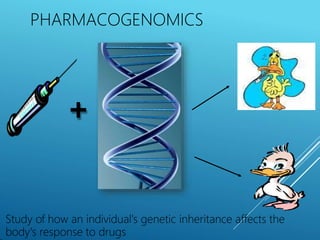
PHARMACOGENOMICS
Study of how an individual's genetic inheritance affects the
body's response to drugs
INTRODUCTION
⯈Pharmacogenomics deals with the influence of genetic
variation on drug response by co-relating gene
expression or polymorphism with a drug’s efficacy
or toxicity
⯈It intends to identify individuals who are either more
likely or less likely to respond to a drug, as well as
those who require altered dose of certain drugs
⯈Pharmacogenetics is often a study of the variations in
a targeted gene, or group of functionally related
genes for variability in drug response
⯈Refers to how variation in one single gene
influences the response to a single drug
⯈Pharmacogenomics is the use of genetic information
to guide the choice of drug and dose on an
individual basis.
⯈Broader term, which studies how all of the genes (the
genome) can influence responses to drugs
GENETICS VS. GENOMICS
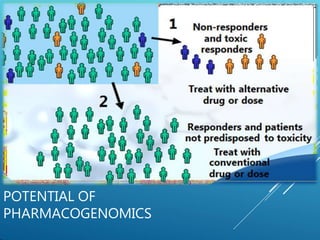
POTENTIAL OF
PHARMACOGENOMICS
THE FOUNDATION OF PHARMACOGENOMICS:
⯈Mutation: difference in the DNA code that occurs in
less than 1% of population
⯈ Often associated with rare diseases
⯈ Cystic fibrosis, sickle cell anemia, Huntington’s disease
⯈Polymorphism: difference in the DNA code that
occurs in more than 1% of the population
⯈ A single polymorphism is less likely to be the main cause of
a disease
⯈ Polymorphisms often have no visible clinical impact
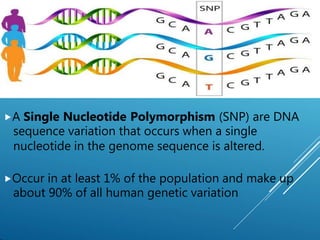
⯈A Single Nucleotide Polymorphism (SNP) are DNA
sequence variation that occurs when a single
nucleotide in the genome sequence is altered.
⯈Occur in at least 1% of the population and make up
about 90% of all human genetic variation
SNP
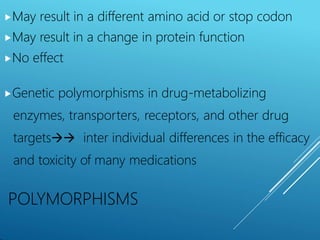
⯈May result in a different amino acid or stop codon
⯈May result in a change in protein function
⯈No effect
⯈Genetic polymorphisms in drug-metabolizing
enzymes, transporters, receptors, and other drug
targets inter individual differences in the efficacy
and toxicity of many medications
POLYMORPHISMS
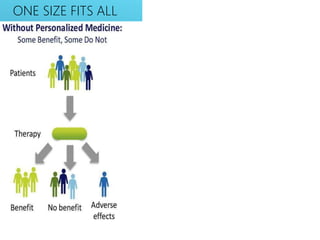
ONE SIZE FITS ALL PERSONALIZED MEDICINE
PERSONALIZED MEDICINE
⯈It refers to an approach of clinical practice where a
particular treatment is not chosen based on the
‘average patient’ but on characteristic of an individual
patient
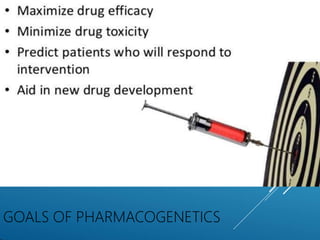
GOALS OF PHARMACOGENETICS
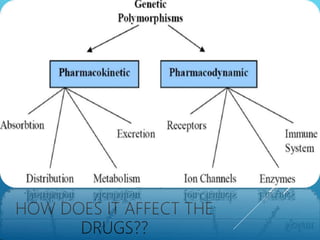
HOW DOES IT AFFECT THE
DRUGS??
 The cytochrome P-450 mixed-function oxidase (CYP)
 N-acetyltransferase (NAT1 and NAT2)
 Thiopurine-S-methyltransferase (TPMT)
 Uridine-5 diphosphate glucuronyl transferase-
Polymorphisms of UGT1A1 and UGT2B7 play important
roles in the phase II metabolism of certain drugs.
POLYMORPHISM OF ENZYMES & DRUG
METABOLISM
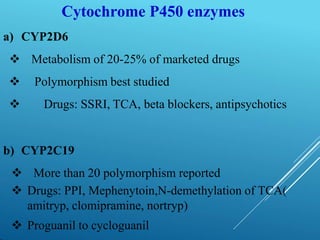
Cytochrome P450 enzymes
a) CYP2D6
 Metabolism of 20-25% of marketed drugs
 Polymorphism best studied
 Drugs: SSRI, TCA, beta blockers, antipsychotics
b) CYP2C19
 More than 20 polymorphism reported
 Drugs: PPI, Mephenytoin,N-demethylation of TCA(
amitryp, clomipramine, nortryp)
 Proguanil to cycloguanil
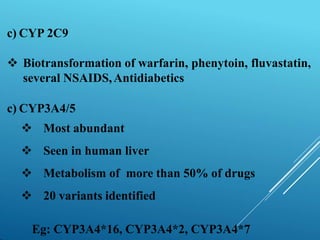
c) CYP 2C9
 Biotransformation of warfarin, phenytoin, fluvastatin,
several NSAIDS,Antidiabetics
c) CYP3A4/5
 Most abundant
 Seen in human liver
 Metabolism of more than 50% of drugs
 20 variants identified
Eg: CYP3A4*16, CYP3A4*2, CYP3A4*7
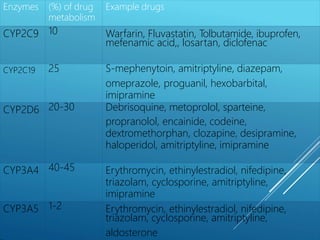
Enzymes Example drugs
CYP2C9
(%) of drug
metabolism
10 Warfarin, Fluvastatin, Tolbutamide, ibuprofen,
mefenamic acid,, losartan, diclofenac
CYP2C19 25
CYP2D6 20-30
S-mephenytoin, amitriptyline, diazepam,
omeprazole, proguanil, hexobarbital,
imipramine
Debrisoquine, metoprolol, sparteine,
propranolol, encainide, codeine,
dextromethorphan, clozapine, desipramine,
haloperidol, amitriptyline, imipramine
CYP3A4 40-45 Erythromycin, ethinylestradiol, nifedipine,
triazolam, cyclosporine, amitriptyline,
imipramine
CYP3A5 1-2 Erythromycin, ethinylestradiol, nifedipine,
triazolam, cyclosporine, amitriptyline,
aldosterone
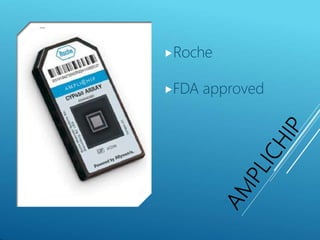
⯈Roche
⯈FDA approved
⯈The Roche AmpliChip CYP450 Test is intended to
identify a patient's CYP2D6 and CYP2C19 genotype
from genomic DNA extracted from a whole blood
sample
⯈ An aid to clinicians in determining therapeutic
strategy and treatment dose for therapeutics
ROCHE AMPLICHIP P450
TEST
⯈N-acetyltransferase (NA
T1 and NA
T2)
⯈Hepatic cytosolic NAT 2
⯈Fast & slow acetylators
⯈Drugs: Sulfapyridine, sulfamethoxypyridazine, hydralazine,
INH, procainamide, phenelzine
⯈Sch hydrolysis
⯈Pseudocholinesterases in plasma
⯈Scoline apnea
⯈Red cell enzyme defects
⯈G6PD- Sulfonamides, primaquine, dapsone,
nalidixic acid, nitrofurantoin, doxorubicin
⯈Glutathione reductase deficiency
⯈Methemoglobin reductase deficiency
⯈Porphyria
⯈Porphobilinogen deaminase defect
⯈↑ ALA synthase AIP
⯈ Barbiturates, carbamazepine,
Phenytoin, INH, dapsone
⯈Malignant hyperthermia
⯈Insulin resistance
⯈ Polygenic[ Ark-I, Atl, Minn]
⯈ Insulin receptor α subunit
⯈Arrhythmia with antiarrhythmics
⯈ T
orsades de pointes
⯈ Genetic abnormality in k+ channel(polymorphism)
⯈Resistance to drug effects
⯈ Vit D resistance rickets
⯈ Coumarin resistance( polymorphism of vit K reductase)
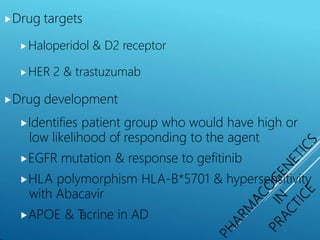
⯈Drug targets
⯈Haloperidol & D2 receptor
⯈HER 2 & trastuzumab
⯈Drug development
⯈Identifies patient group who would have high or
low likelihood of responding to the agent
⯈EGFR mutation & response to gefitinib
⯈HLA polymorphism HLA-B*5701 & hypersensitivity
with Abacavir
⯈APOE & T
acrine in AD
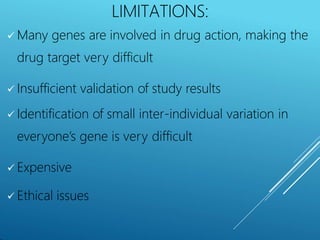
LIMITATIONS:
 Many genes are involved in drug action, making the
drug target very difficult
 Insufficient validation of study results
 Identification of small inter-individual variation in
everyone’s gene is very difficult
 Expensive
 Ethical issues
THANK YOU

pharmacogenomics-171011132627.pptx

  • 2.
    OUTLINE Introduction Variants and SNPs Personalizedmedicine PK/ PD In pharmacogenetics Clinical significance & practice Benefits and limitations Conclusion
  • 3.
    + PHARMACOGENOMICS Study of howan individual's genetic inheritance affects the body's response to drugs
  • 4.
    INTRODUCTION ⯈Pharmacogenomics deals withthe influence of genetic variation on drug response by co-relating gene expression or polymorphism with a drug’s efficacy or toxicity ⯈It intends to identify individuals who are either more likely or less likely to respond to a drug, as well as those who require altered dose of certain drugs
  • 5.
    ⯈Pharmacogenetics is oftena study of the variations in a targeted gene, or group of functionally related genes for variability in drug response ⯈Refers to how variation in one single gene influences the response to a single drug ⯈Pharmacogenomics is the use of genetic information to guide the choice of drug and dose on an individual basis. ⯈Broader term, which studies how all of the genes (the genome) can influence responses to drugs GENETICS VS. GENOMICS
  • 6.
  • 8.
    THE FOUNDATION OFPHARMACOGENOMICS: ⯈Mutation: difference in the DNA code that occurs in less than 1% of population ⯈ Often associated with rare diseases ⯈ Cystic fibrosis, sickle cell anemia, Huntington’s disease ⯈Polymorphism: difference in the DNA code that occurs in more than 1% of the population ⯈ A single polymorphism is less likely to be the main cause of a disease ⯈ Polymorphisms often have no visible clinical impact
  • 9.
    ⯈A Single NucleotidePolymorphism (SNP) are DNA sequence variation that occurs when a single nucleotide in the genome sequence is altered. ⯈Occur in at least 1% of the population and make up about 90% of all human genetic variation
  • 10.
  • 11.
    ⯈May result ina different amino acid or stop codon ⯈May result in a change in protein function ⯈No effect ⯈Genetic polymorphisms in drug-metabolizing enzymes, transporters, receptors, and other drug targets inter individual differences in the efficacy and toxicity of many medications POLYMORPHISMS
  • 12.
    ONE SIZE FITSALL PERSONALIZED MEDICINE
  • 13.
    PERSONALIZED MEDICINE ⯈It refersto an approach of clinical practice where a particular treatment is not chosen based on the ‘average patient’ but on characteristic of an individual patient
  • 14.
  • 15.
    HOW DOES ITAFFECT THE DRUGS??
  • 16.
     The cytochromeP-450 mixed-function oxidase (CYP)  N-acetyltransferase (NAT1 and NAT2)  Thiopurine-S-methyltransferase (TPMT)  Uridine-5 diphosphate glucuronyl transferase- Polymorphisms of UGT1A1 and UGT2B7 play important roles in the phase II metabolism of certain drugs. POLYMORPHISM OF ENZYMES & DRUG METABOLISM
  • 18.
    Cytochrome P450 enzymes a)CYP2D6  Metabolism of 20-25% of marketed drugs  Polymorphism best studied  Drugs: SSRI, TCA, beta blockers, antipsychotics b) CYP2C19  More than 20 polymorphism reported  Drugs: PPI, Mephenytoin,N-demethylation of TCA( amitryp, clomipramine, nortryp)  Proguanil to cycloguanil
  • 19.
    c) CYP 2C9 Biotransformation of warfarin, phenytoin, fluvastatin, several NSAIDS,Antidiabetics c) CYP3A4/5  Most abundant  Seen in human liver  Metabolism of more than 50% of drugs  20 variants identified Eg: CYP3A4*16, CYP3A4*2, CYP3A4*7
  • 20.
    Enzymes Example drugs CYP2C9 (%)of drug metabolism 10 Warfarin, Fluvastatin, Tolbutamide, ibuprofen, mefenamic acid,, losartan, diclofenac CYP2C19 25 CYP2D6 20-30 S-mephenytoin, amitriptyline, diazepam, omeprazole, proguanil, hexobarbital, imipramine Debrisoquine, metoprolol, sparteine, propranolol, encainide, codeine, dextromethorphan, clozapine, desipramine, haloperidol, amitriptyline, imipramine CYP3A4 40-45 Erythromycin, ethinylestradiol, nifedipine, triazolam, cyclosporine, amitriptyline, imipramine CYP3A5 1-2 Erythromycin, ethinylestradiol, nifedipine, triazolam, cyclosporine, amitriptyline, aldosterone
  • 21.
  • 22.
    ⯈The Roche AmpliChipCYP450 Test is intended to identify a patient's CYP2D6 and CYP2C19 genotype from genomic DNA extracted from a whole blood sample ⯈ An aid to clinicians in determining therapeutic strategy and treatment dose for therapeutics ROCHE AMPLICHIP P450 TEST
  • 23.
    ⯈N-acetyltransferase (NA T1 andNA T2) ⯈Hepatic cytosolic NAT 2 ⯈Fast & slow acetylators ⯈Drugs: Sulfapyridine, sulfamethoxypyridazine, hydralazine, INH, procainamide, phenelzine ⯈Sch hydrolysis ⯈Pseudocholinesterases in plasma ⯈Scoline apnea
  • 24.
    ⯈Red cell enzymedefects ⯈G6PD- Sulfonamides, primaquine, dapsone, nalidixic acid, nitrofurantoin, doxorubicin ⯈Glutathione reductase deficiency ⯈Methemoglobin reductase deficiency ⯈Porphyria ⯈Porphobilinogen deaminase defect ⯈↑ ALA synthase AIP ⯈ Barbiturates, carbamazepine, Phenytoin, INH, dapsone ⯈Malignant hyperthermia
  • 25.
    ⯈Insulin resistance ⯈ Polygenic[Ark-I, Atl, Minn] ⯈ Insulin receptor α subunit ⯈Arrhythmia with antiarrhythmics ⯈ T orsades de pointes ⯈ Genetic abnormality in k+ channel(polymorphism) ⯈Resistance to drug effects ⯈ Vit D resistance rickets ⯈ Coumarin resistance( polymorphism of vit K reductase)
  • 27.
    ⯈Drug targets ⯈Haloperidol &D2 receptor ⯈HER 2 & trastuzumab ⯈Drug development ⯈Identifies patient group who would have high or low likelihood of responding to the agent ⯈EGFR mutation & response to gefitinib ⯈HLA polymorphism HLA-B*5701 & hypersensitivity with Abacavir ⯈APOE & T acrine in AD
  • 29.
    LIMITATIONS:  Many genesare involved in drug action, making the drug target very difficult  Insufficient validation of study results  Identification of small inter-individual variation in everyone’s gene is very difficult  Expensive  Ethical issues
  • 30.