Personalized Medicine
A Dream or Reality??
Flow of Presentation
 Why need personalized medicine?
 What’s Pharmacogenomics?
 Genetics and Therapeutics
 On Going Research
 Future Insights
2
One Size Doesn’t Fit All..
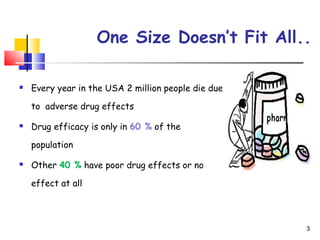
 Every year in the USA 2 million people die due
to adverse drug effects
 Drug efficacy is only in 60 % of the
population
 Other 40 % have poor drug effects or no
effect at all
3
4
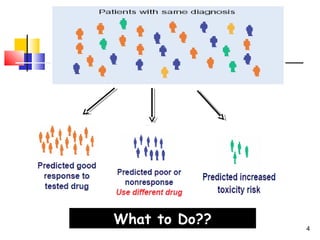
What to Do??
The answer is..
Pharmacogenomics
5
Pharmecogenomics and
Pharmecogenetics
 Pharmacogenetics
— A discrete inherited trait related to drug absorption and
disposition, as well as response
 Pharmacogenomics
— The application of genome-wide SNP scans and gene
expression analyses
6
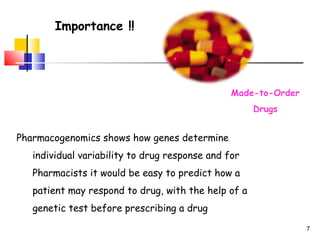
Pharmacogenomics shows how genes determine
individual variability to drug response and for
Pharmacists it would be easy to predict how a
patient may respond to drug, with the help of a
genetic test before prescribing a drug
7
Importance !!
Made-to-Order
Drugs
Drug Response..
 Same dose does not produce the same concentrations
among patients due to inter-patient differences in
absorption and metabolism
 Toxicity: Ability of a drug to make a person sick
 Genetic variations have influence on efficacy and
toxicity of drugs
8
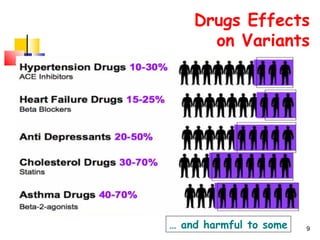
Drugs Effects
on Variants
9… and harmful to some
Human Genome Diversity
 0.1% difference in genome influences the response to
drugs
 SNPs
 SNPs are powerful Tools
 SNPs screening will help in prescription
10
“Right drug at the right dose in the right patient”
What Makes it Possible?
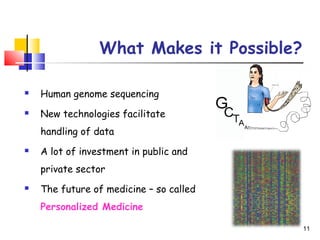
 Human genome sequencing
 New technologies facilitate
handling of data
 A lot of investment in public and
private sector
 The future of medicine – so called
Personalized Medicine
11
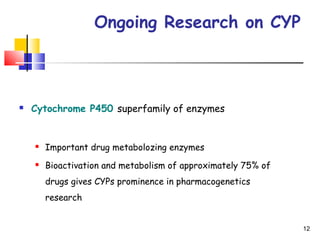
Ongoing Research on CYP
 Cytochrome P450 superfamily of enzymes
 Important drug metabolozing enzymes
 Bioactivation and metabolism of approximately 75% of
drugs gives CYPs prominence in pharmacogenetics
research
12
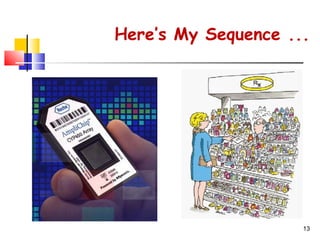
Here’s My Sequence ...
13
More Business in Future..
14
$
 Develop new therapies
 Incorporation of genetic information into the
diagnosis of disease and prescription of
drugs
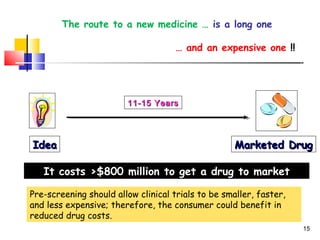
IdeaIdea
11-15 Years11-15 Years
Marketed DrugMarketed Drug
The route to a new medicine … is a long one
… and an expensive one !!
It costs >$800 million to get a drug to market
15
Pre-screening should allow clinical trials to be smaller, faster,
and less expensive; therefore, the consumer could benefit in
reduced drug costs.
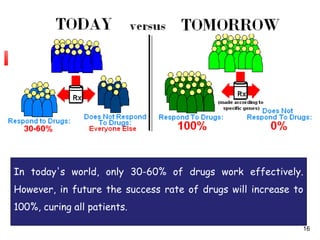
In today's world, only 30-60% of drugs work effectively.
However, in future the success rate of drugs will increase to
100%, curing all patients.
16
S M A R T C A R D
(Confidential)
17
In your wallet May be by 2050..
Bioethics
 
 Unequal distribution of
resources
 Invasion of medical privacy
 Discrimination due to the
involvement of genetic tests
18
Bottom Line !!
 The field of Pharmacogenomics is rapidly
evolving and it shows how drugs work in
different patients
 Pharmacogenomic approaches have the
potential to provide clinical benefits
 It will help in pharmaceutical industry in
future
19

Personalized medicine

  • 1.
  • 2.
    Flow of Presentation Why need personalized medicine?  What’s Pharmacogenomics?  Genetics and Therapeutics  On Going Research  Future Insights 2
  • 3.
    One Size Doesn’tFit All..  Every year in the USA 2 million people die due to adverse drug effects  Drug efficacy is only in 60 % of the population  Other 40 % have poor drug effects or no effect at all 3
  • 4.
  • 5.
  • 6.
    Pharmecogenomics and Pharmecogenetics  Pharmacogenetics —A discrete inherited trait related to drug absorption and disposition, as well as response  Pharmacogenomics — The application of genome-wide SNP scans and gene expression analyses 6
  • 7.
    Pharmacogenomics shows howgenes determine individual variability to drug response and for Pharmacists it would be easy to predict how a patient may respond to drug, with the help of a genetic test before prescribing a drug 7 Importance !! Made-to-Order Drugs
  • 8.
    Drug Response..  Samedose does not produce the same concentrations among patients due to inter-patient differences in absorption and metabolism  Toxicity: Ability of a drug to make a person sick  Genetic variations have influence on efficacy and toxicity of drugs 8
  • 9.
    Drugs Effects on Variants 9…and harmful to some
  • 10.
    Human Genome Diversity 0.1% difference in genome influences the response to drugs  SNPs  SNPs are powerful Tools  SNPs screening will help in prescription 10 “Right drug at the right dose in the right patient”
  • 11.
    What Makes itPossible?  Human genome sequencing  New technologies facilitate handling of data  A lot of investment in public and private sector  The future of medicine – so called Personalized Medicine 11
  • 12.
    Ongoing Research onCYP  Cytochrome P450 superfamily of enzymes  Important drug metabolozing enzymes  Bioactivation and metabolism of approximately 75% of drugs gives CYPs prominence in pharmacogenetics research 12
  • 13.
  • 14.
    More Business inFuture.. 14 $  Develop new therapies  Incorporation of genetic information into the diagnosis of disease and prescription of drugs
  • 15.
    IdeaIdea 11-15 Years11-15 Years MarketedDrugMarketed Drug The route to a new medicine … is a long one … and an expensive one !! It costs >$800 million to get a drug to market 15 Pre-screening should allow clinical trials to be smaller, faster, and less expensive; therefore, the consumer could benefit in reduced drug costs.
  • 16.
    In today's world,only 30-60% of drugs work effectively. However, in future the success rate of drugs will increase to 100%, curing all patients. 16
  • 17.
    S M AR T C A R D (Confidential) 17 In your wallet May be by 2050..
  • 18.
    Bioethics    Unequal distributionof resources  Invasion of medical privacy  Discrimination due to the involvement of genetic tests 18
  • 19.
    Bottom Line !! The field of Pharmacogenomics is rapidly evolving and it shows how drugs work in different patients  Pharmacogenomic approaches have the potential to provide clinical benefits  It will help in pharmaceutical industry in future 19

Editor's Notes

  • #4 What can we do to stop these adverse drug effects? How can we develop drugs that can be effective for everyone?
  • #6 • achieve optimal therapeutic response • avoid therapeutic failure • minimize side effects and toxicity
  • #7 Pharmacogenomics — The application of genome-wide SNP scans and gene expression analyses (information from the whole genome) to study variations that influence drug action (responses, new drug targets, etc)
  • #8 Combines many different fields: Genetics, genomics, molecular biology, pharmacology, pharmaceutics, toxicology, population biology, statistics.
  • #10 …and harmful to some
  • #11 Most common diseases, such as diabetes, cancer, stroke, heart disease, depression, and asthma, are affected by many genes and environmental factors. Although any two unrelated people are the same at about 99.9% of their DNA sequences, the remaining 0.1% is important because it contains the genetic variants that influence how people differ in their risk of disease or their response to drugs. Discovering the DNA sequence variants that contribute to common disease risk offers one of the best opportunities for understanding the complex causes of disease in humans.
  • #12 Sequencing of the human genome reveals 2.9 billion base pairs that are constant, narrowing down variability to about 3 million base pairs, of which 100,000 capture the full human variation and <10,000 may be pharmaceutically relevant. Advances in genome sequencing technology make possible addressing those individual base pairs. Automatization and miniaturization significantly drive down cost of DNA sequencing reaction. Computer technology and computer networks facilitate handling of data. Pharmacogenomics broadly adopted in drug discovery and development phases in the pharmaceutical industry. Pharmacogenomics research heavily invested upon by public and private companies 3. Pharmacogenomics seen as the future of medicine – so called PERSONALIZED MEDICINE
  • #14 AmpliChip CYP450 Test is a clinical test from Roche. The test aims to find the specific gene types (a genotype) of the patient that will determine how he or she metabolizes certain medicines, therefore guides the doctors to prescribe medicine for best effectiveness and least side effects. The AmpliChip CYP450 Test uses micro array technology from Affymetrix (GeneChip) to determine the genotype of the patient in terms of two cytochrome P450 enzymes: 2D6 and 2C19. CYP2D6 and CYP2C19 belong to the Cytochrome P450 oxidase family. CYP2D6 has over 90 variants, 2C19 has mainly three. They are responsible for the majority of the inter-individual variability in the ability to metabolize drugs. There are four phenotypes of CYP2D6: Poor Metabolizer (PM), Intermediate Metabolizer (IM), Extensive (normal) Metabolizer (EM) and Ultrarapid Metabolizer (UM). For CYP2C19, there are only two phenotypes: PM and EM. If a substrate of the enzyme is given to the patient as a medication, and if the patient has reduced CYP2D6 or CYP2C19 activity, the patient will have elevated drug concentration in their body, and therefore severe side effects may occur. On the other hand, for the UM patient, the drug concentration might be too low to have a therapeutic effect. So testing the phenotype of the patient is important to help determine the optimum dosage of the drug. [edit]How Does It Work The test analyzes the DNA of a patient to determine the genotype, and prediction of the phenotype can then be made. The DNA sample comes from blood (as Roche suggests) or, alternatively, comes from a mouth brush called buccal swab. The analysis has five steps after DNA is extracted from patient samples: PCR amplication of the gene. Fragmentation and labeling of the PCR product Hybridization and staining on the AmpliChip DNA microarray. Scanning the chip. Data analysis. [edit]FDA Approval FDA approved the test on December 24, 2004. The AmpliChip CYP450 test is the first FDA approved pharmacogenetic test. [edit]Applications Since a lot of the CYP2D6 substrates are psychiatric drugs (antidepressant and antipsychotics, for example), the AmpliChip CYP450 has been extensively used in psychiatry. The main criticism of the test is that the test finds out the genotype (the makeup of the gene types) of the patient, which does not necessarily cover all the phenotypes (the actual biological effect). For example, some argue that the so called ultra-rapid metaboliser, who has extra copies of the 2D6 gene expressed, cannot be reliably tested. Also, the test does not cover some rarer genotypes, nor genotypes that have not yet been discovered. Also, insurance companies still do not cover the price of the test, which can cost $600-$1300 to the patient, because the test is "experimental, investigational or unproven".
  • #15 Pharmacogenomics would develop new therapies for patients with genetic predispositions to disease Blockbuster drugs of today probably not possible if individual genetic variation becomes integrated with drug prescription, due to reduced market sizes Incorporation of genetic information into the diagnosis of disease and prescription of drugs will lead to new service industry Pharmacogenomics will foster safer, less toxic drugs
  • #17 Increase in costs      - New Techniques need to be developed      - Requires new training      - Requires new facilities      - Segmentation of market result in a reduction of revenue generated      - Post marketing surveillance cost   Benefits      - Shelved drugs coming back to life.      - Fewer legal liabilities.      - Saving lives.
  • #18 Opinion: This sort of card would initially (~2025?) include mostly information related to drug metabolizing enzymes. Around ~2050 it might include an entire individual genome (or at least, few millions SNPs..)