
Made By:
Pratik Negi
Shalini Kaushal
Pallavi majotra
Importance of Personality types
 Your personality is the essence of who you are
 Understanding oneself
 Self-improvement
 Improve relationships and choices
Myers-Briggs personality indicator
 (E) Extroverting—Introverting (I)
the way you focus your attention; your source of energy
 (S) Sensing—Intuiting (N)
the way you gather and interpret information
 (T) Thinking—Feeling (F)
the way you make decisions
 (J) Judging—Perceiving (P)
the way you live in the world; your lifestyle orientation
Type in work place
 Coaching, leadership, and management development
 Interpersonal and people skills training
 Teambuilding and succession planning
 Sales force training
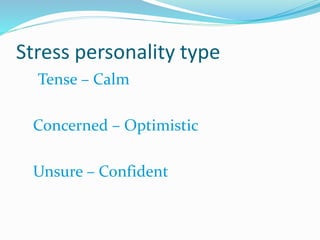
Stress personality type
Tense – Calm
Concerned – Optimistic
Unsure – Confident
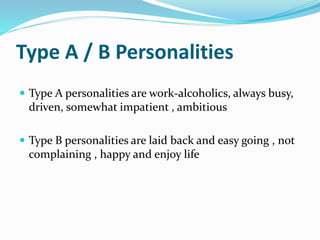
Type A / B Personalities
 Type A personalities are work-alcoholics, always busy,
driven, somewhat impatient , ambitious
 Type B personalities are laid back and easy going , not
complaining , happy and enjoy life
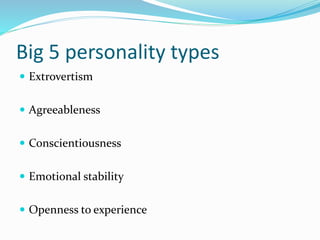
Big 5 personality types
 Extrovertism
 Agreeableness
 Conscientiousness
 Emotional stability
 Openness to experience
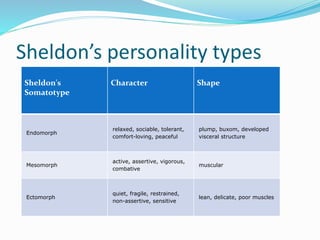
Sheldon’s personality types
Sheldon's
Somatotype
Character Shape
Endomorph
relaxed, sociable, tolerant,
comfort-loving, peaceful
plump, buxom, developed
visceral structure
Mesomorph
active, assertive, vigorous,
combative
muscular
Ectomorph
quiet, fragile, restrained,
non-assertive, sensitive
lean, delicate, poor muscles
Effective use of personality types
 Building on strengths
 Self-knowledge
 Developing balance
 Understanding differences
Thank You!!!

Personality traits ( pratik negi)

  • 1.
    Made By: Pratik Negi ShaliniKaushal Pallavi majotra
  • 2.
    Importance of Personalitytypes  Your personality is the essence of who you are  Understanding oneself  Self-improvement  Improve relationships and choices
  • 3.
    Myers-Briggs personality indicator (E) Extroverting—Introverting (I) the way you focus your attention; your source of energy  (S) Sensing—Intuiting (N) the way you gather and interpret information  (T) Thinking—Feeling (F) the way you make decisions  (J) Judging—Perceiving (P) the way you live in the world; your lifestyle orientation
  • 4.
    Type in workplace  Coaching, leadership, and management development  Interpersonal and people skills training  Teambuilding and succession planning  Sales force training
  • 5.
    Stress personality type Tense– Calm Concerned – Optimistic Unsure – Confident
  • 6.
    Type A /B Personalities  Type A personalities are work-alcoholics, always busy, driven, somewhat impatient , ambitious  Type B personalities are laid back and easy going , not complaining , happy and enjoy life
  • 7.
    Big 5 personalitytypes  Extrovertism  Agreeableness  Conscientiousness  Emotional stability  Openness to experience
  • 8.
    Sheldon’s personality types Sheldon's Somatotype CharacterShape Endomorph relaxed, sociable, tolerant, comfort-loving, peaceful plump, buxom, developed visceral structure Mesomorph active, assertive, vigorous, combative muscular Ectomorph quiet, fragile, restrained, non-assertive, sensitive lean, delicate, poor muscles
  • 9.
    Effective use ofpersonality types  Building on strengths  Self-knowledge  Developing balance  Understanding differences
  • 10.