PERSONALITY
DEVELOPMENT
What is personality ?
It is the totality of the person and not merely external looks, but character, behavioral
traits and attitude towards life.
“as consistency in a person’s way of being – that is, long-term consistency in their
particular ways of perceiving, thinking, acting and reacting as a person”
Personality development – is the improvement of
behavioral traits such as communication skills,
interpersonal relationships, attitude towards life and
restoring our ethics.
Understanding different personality
types.
Activity
Carl G. Jung & Briggs Myers
OUR ORIENTATION TOWARDS THE
WORLD AROUND US (ATTITUDE)
EXTROVERSION (E)
Extroverts relate more easily to the world of people, things & events outside
themselves. Outgoing, active & responsive to their environment.
INTROVERSION (I)
Introverts relate more easily to the ideas & concepts in their mind. These are focused
on subjective experiences that are viewed individually.
THE WAY WE PERCEIVE & GATHER
INFORMATION (FUNCTION)
SENSING (S)
You are interested in what your senses show you – what exists in the present.
Information perceived is taken as given & reality of experiences is appreciated.
INTUITION (N)
You use your imagination to see new possibilities & insights hidden from the senses.
Intuition is an unconscious process that looks to explore & gain new insights.
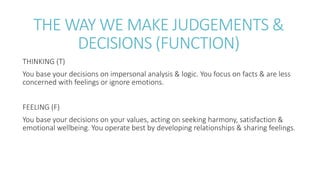
THE WAY WE MAKE JUDGEMENTS &
DECISIONS (FUNCTION)
THINKING (T)
You base your decisions on impersonal analysis & logic. You focus on facts & are less
concerned with feelings or ignore emotions.
FEELING (F)
You base your decisions on your values, acting on seeking harmony, satisfaction &
emotional wellbeing. You operate best by developing relationships & sharing feelings.
WAYS OF LIVING IN THE WORLD
AROUND US (ATTITUDE)
JUDGING (J)
You like things decided; your life is likely to be planned & orderly. Life is more
regulated & events prepared.
PERCEIVING (P)
You do not want to miss anything; your way of life is more spontaneous & flexible.
Opportunity for new experiences & to be able to adapt to changing circumstances are
sources of stimulation.
What makes a good personality?
•Self Confidence
•Positive Thinking
•Learning from failures
•Self reliance
•Selfless service
Approach for good personality
•Goal Setting
•Time Management
•Communication skills
•Leadership Qualities
Goal Setting
Immediate
Short term
Long term
"Obstacles are those frightful things you see when you take your eyes off your goal." -
Henry Ford
Time Management
Importance of Duty
Plan / schedule preparation (day plan and etc.)
Making good friends
Utilizing time for Knowledge Improvement (reading of good books / group discussions
/ knowledge sharing)
Utilizing free time for good hobbies
Making good food habits
Work for others(Giving proper guidance to next generation,..)
“The bad news is time flies. The good news is you’re the pilot."-- Michael Althsuler
Communication skills
Listening
Nonverbal Communication
Clarity and Concision
Friendliness
Confidence
Empathy
Open-Mindedness
Respect
Leadership qualities
Planning (People won’t fail, they fail to plan)
Self discipline
Know your Responsibilities
Commitment
Developing Skills
Organizing things properly
Self Motivation and motivating people
Optimum utilization of time
Help others
Health & food habits
Regular exercise
Timely food & Proper diet
Cleanliness
Drinking more water
How to take care of inner parts of body (Yoga & Meditation)
Meditation for improving concentration & memory power
Develop self-confidence
Assertiveness
Public speaking
Time management
Setting goals
Developing a Mindset of Success
Leadership Training
Reaching Your Potential
Interpersonal Relationships
Overcoming Bad Habits and Addictions
Personality Development

Personality Development

  • 1.
  • 4.
  • 5.
    It is thetotality of the person and not merely external looks, but character, behavioral traits and attitude towards life. “as consistency in a person’s way of being – that is, long-term consistency in their particular ways of perceiving, thinking, acting and reacting as a person”
  • 6.
    Personality development –is the improvement of behavioral traits such as communication skills, interpersonal relationships, attitude towards life and restoring our ethics.
  • 7.
  • 8.
    OUR ORIENTATION TOWARDSTHE WORLD AROUND US (ATTITUDE) EXTROVERSION (E) Extroverts relate more easily to the world of people, things & events outside themselves. Outgoing, active & responsive to their environment. INTROVERSION (I) Introverts relate more easily to the ideas & concepts in their mind. These are focused on subjective experiences that are viewed individually.
  • 9.
    THE WAY WEPERCEIVE & GATHER INFORMATION (FUNCTION) SENSING (S) You are interested in what your senses show you – what exists in the present. Information perceived is taken as given & reality of experiences is appreciated. INTUITION (N) You use your imagination to see new possibilities & insights hidden from the senses. Intuition is an unconscious process that looks to explore & gain new insights.
  • 10.
    THE WAY WEMAKE JUDGEMENTS & DECISIONS (FUNCTION) THINKING (T) You base your decisions on impersonal analysis & logic. You focus on facts & are less concerned with feelings or ignore emotions. FEELING (F) You base your decisions on your values, acting on seeking harmony, satisfaction & emotional wellbeing. You operate best by developing relationships & sharing feelings.
  • 11.
    WAYS OF LIVINGIN THE WORLD AROUND US (ATTITUDE) JUDGING (J) You like things decided; your life is likely to be planned & orderly. Life is more regulated & events prepared. PERCEIVING (P) You do not want to miss anything; your way of life is more spontaneous & flexible. Opportunity for new experiences & to be able to adapt to changing circumstances are sources of stimulation.
  • 17.
    What makes agood personality? •Self Confidence •Positive Thinking •Learning from failures •Self reliance •Selfless service
  • 18.
    Approach for goodpersonality •Goal Setting •Time Management •Communication skills •Leadership Qualities
  • 19.
    Goal Setting Immediate Short term Longterm "Obstacles are those frightful things you see when you take your eyes off your goal." - Henry Ford
  • 20.
    Time Management Importance ofDuty Plan / schedule preparation (day plan and etc.) Making good friends Utilizing time for Knowledge Improvement (reading of good books / group discussions / knowledge sharing) Utilizing free time for good hobbies Making good food habits Work for others(Giving proper guidance to next generation,..) “The bad news is time flies. The good news is you’re the pilot."-- Michael Althsuler
  • 21.
    Communication skills Listening Nonverbal Communication Clarityand Concision Friendliness Confidence Empathy Open-Mindedness Respect
  • 22.
    Leadership qualities Planning (Peoplewon’t fail, they fail to plan) Self discipline Know your Responsibilities Commitment Developing Skills Organizing things properly Self Motivation and motivating people Optimum utilization of time Help others
  • 23.
    Health & foodhabits Regular exercise Timely food & Proper diet Cleanliness Drinking more water How to take care of inner parts of body (Yoga & Meditation) Meditation for improving concentration & memory power
  • 24.
    Develop self-confidence Assertiveness Public speaking Timemanagement Setting goals Developing a Mindset of Success Leadership Training Reaching Your Potential Interpersonal Relationships Overcoming Bad Habits and Addictions

Editor's Notes

  • #3 Laozi was an ancient Chinese philosopher and writer. He is the reputed author of the Tao Te Ching, the founder of philosophical Taoism, and a deity in religious Taoism and traditional Chinese religions.
  • #4 What is personality ?
  • #6 the combination of characteristics or qualities that form an individual's distinctive character.
  • #8 According to Carl G. Jung's theory of psychological types [Jung, 1971], people can be characterized by their preference of general attitude: Extraverted (E) vs. Introverted (I), their preference of one of the two functions of perception: Sensing (S) vs. Intuition (N), and their preference of one of the two functions of judging: Thinking (T) vs. Feeling (F) The three areas of preferences introduced by Jung are dichotomies (i.e. bipolar dimensions where each pole represents a different preference). Jung also proposed that in a person one of the four functions above is dominant – either a function of perception or a function of judging. Isabel Briggs Myers, a researcher and practitioner of Jung’s theory, proposed to see the judging-perceiving relationship as a fourth dichotomy influencing personality type [Briggs Myers, 1980]: Judging (J) vs. Perceiving (P)
  • #9 The first criterion, Extraversion – Introversion, signifies the source and direction of a person’s energy expression. An extravert’s source and direction of energy expression is mainly in the external world, while an introvert has a source of energy mainly in their own internal world.
  • #10 The second criterion, Sensing – Intuition, represents the method by which someone perceives information. Sensing means that a person mainly believes information he or she receives directly from the external world. Intuition means that a person believes mainly information he or she receives from the internal or imaginative world.
  • #11 The third criterion, Thinking – Feeling, represents how a person processes information. Thinking means that a person makes a decision mainly through logic. Feeling means that, as a rule, he or she makes a decision based on emotion, i.e. based on what they feel they should do.
  • #12 The fourth criterion, Judging – Perceiving, reflects how a person implements the information he or she has processed. Judging means that a person organizes all of his life events and, as a rule, sticks to his plans. Perceiving means that he or she is inclined to improvise and explore alternative options.
  • #15 Dr. David Keirsey has identified humankind's four basic temperaments as the Artisan, the Guardian, the Idealist, and the Rational. Atisans (SP in common) – 38% - Madona, Trump Guardians (SJ in common) – 40% - Tradition – Warren buffet Rationals (NT in common) – 12% - Strategic thinkers – Bill Gates, Steve Jobs Idealists (NF) – 10% Harmony – Oprah, Gandhi https://www.youtube.com/watch?v=jrdZI3vJFPg
  • #16  Audacity - a willingness to take bold risks. Benevolence - the quality of being well meaning; kindness.
  • #17 https://www.youtube.com/watch?v=K33SJ9bW4rw
  • #21 https://www.slideshare.net/MehakVaswani/personality-development-presentation-9138377?next_slideshow=3