Cross-curricular extension unit 9
1PHOTOCOPIABLE © OXFORD UNIVERSITY PRESS
Civic and ethical education: Personality
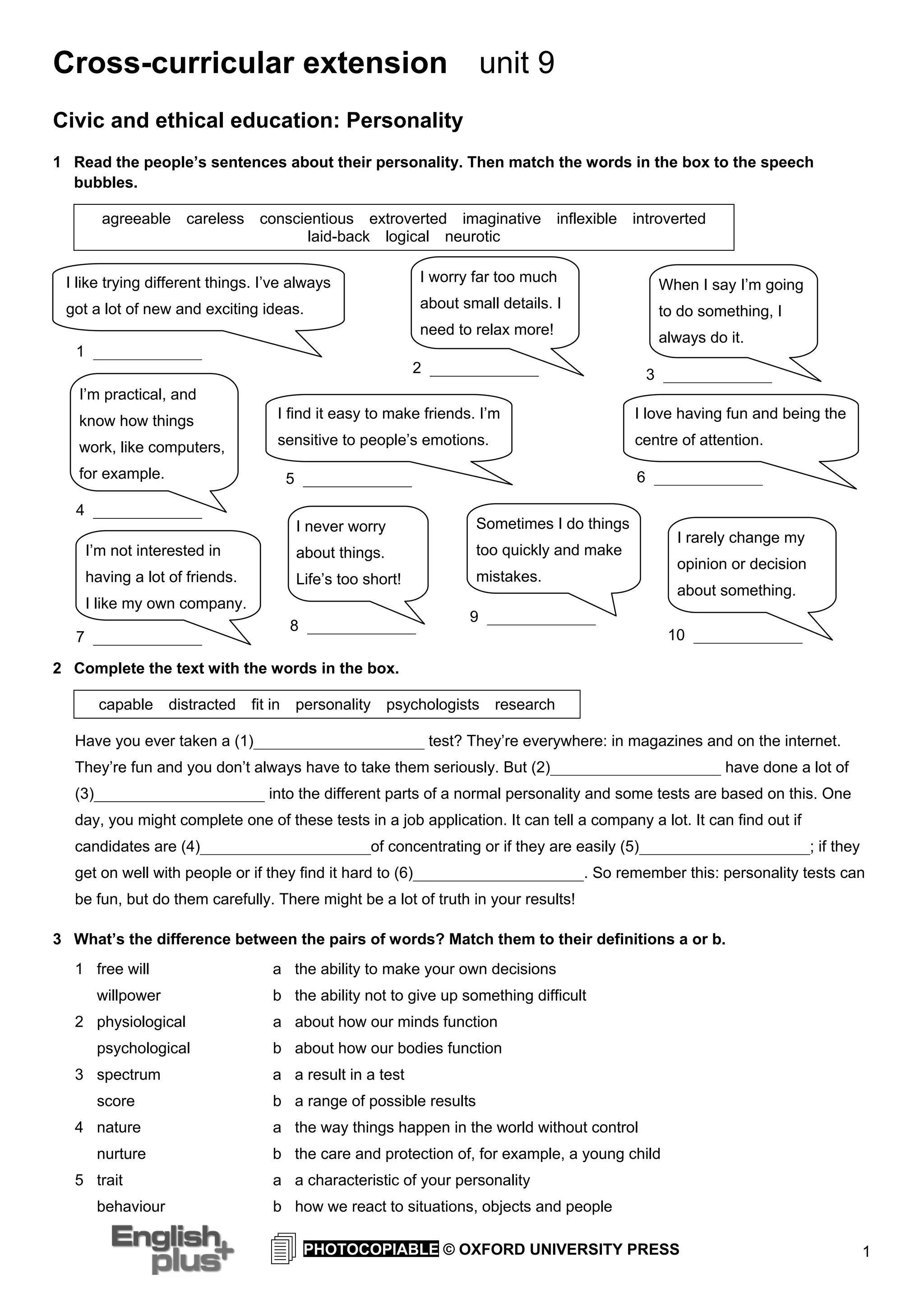
1 Read the people’s sentences about their personality. Then match the words in the box to the speech
bubbles.
agreeable careless conscientious extroverted imaginative inflexible introverted
laid-back logical neurotic
2 Complete the text with the words in the box.
capable distracted fit in personality psychologists research
Have you ever taken a (1)______________________ test? They’re everywhere: in magazines and on the internet.
They’re fun and you don’t always have to take them seriously. But (2)______________________ have done a lot of
(3)______________________ into the different parts of a normal personality and some tests are based on this. One
day, you might complete one of these tests in a job application. It can tell a company a lot. It can find out if
candidates are (4)______________________of concentrating or if they are easily (5)______________________; if they
get on well with people or if they find it hard to (6)______________________. So remember this: personality tests can
be fun, but do them carefully. There might be a lot of truth in your results!
3 What’s the difference between the pairs of words? Match them to their definitions a or b.
1 free will a the ability to make your own decisions
willpower b the ability not to give up something difficult
2 physiological a about how our minds function
psychological b about how our bodies function
3 spectrum a a result in a test
score b a range of possible results
4 nature a the way things happen in the world without control
nurture b the care and protection of, for example, a young child
5 trait a a characteristic of your personality
behaviour b how we react to situations, objects and people
I like trying different things. I’ve always
got a lot of new and exciting ideas.
I worry far too much
about small details. I
need to relax more!
When I say I’m going
to do something, I
always do it.
I find it easy to make friends. I’m
sensitive to people’s emotions.
I love having fun and being the
centre of attention.
I’m practical, and
know how things
work, like computers,
for example.
I’m not interested in
having a lot of friends.
I like my own company.
I never worry
about things.
Life’s too short!
Sometimes I do things
too quickly and make
mistakes.
I rarely change my
opinion or decision
about something.
1 ______________
2 ______________ 3 ______________
4 ______________
5 ______________ 6 ______________
7 ______________
8 ______________
9 ______________
10 ______________
2PHOTOCOPIABLE © OXFORD UNIVERSITY PRESS
4 Read the text. Then answer the questions.
1 What are the Big Five personality traits?
_______________, _______________,
_______________, _______________ and
_______________
2 Have psychologists learned everything about our
personalities yet? _______________
5 Read the text again. Then answer the questions.
1 How do psychologists measure our personalities?
__________________________________________
__________________________________________
2 Describe the good things about a low score on
the neuroticism spectrum.
__________________________________________
3 How do high scorers on the agreeability spectrum
behave towards other people?
__________________________________________
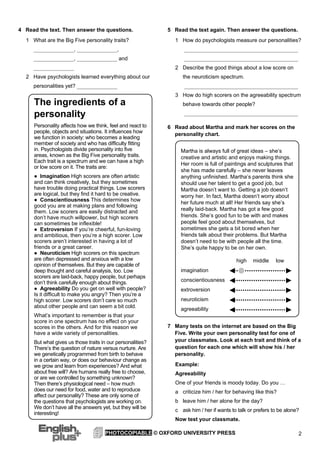
6 Read about Martha and mark her scores on the
personality chart.
7 Many tests on the internet are based on the Big
Five. Write your own personality test for one of
your classmates. Look at each trait and think of a
question for each one which will show his / her
personality.
Example:
Agreeability
One of your friends is moody today. Do you …
a criticize him / her for behaving like this?
b leave him / her alone for the day?
c ask him / her if wants to talk or prefers to be alone?
Now test your classmate.
The ingredients of a
personality
Personality affects how we think, feel and react to
people, objects and situations. It influences how
we function in society: who becomes a leading
member of society and who has difficulty fitting
in. Psychologists divide personality into five
areas, known as the Big Five personality traits.
Each trait is a spectrum and we can have a high
or low score on it. The traits are:
â—Ź Imagination High scorers are often artistic
and can think creatively, but they sometimes
have trouble doing practical things. Low scorers
are logical, but they find it hard to be creative.
â—Ź Conscientiousness This determines how
good you are at making plans and following
them. Low scorers are easily distracted and
don’t have much willpower, but high scorers
can sometimes be inflexible!
● Extroversion If you’re cheerful, fun-loving
and ambitious, then you’re a high scorer. Low
scorers aren’t interested in having a lot of
friends or a great career.
â—Ź Neuroticism High scorers on this spectrum
are often depressed and anxious with a low
opinion of themselves. But they are capable of
deep thought and careful analysis, too. Low
scorers are laid-back, happy people, but perhaps
don’t think carefully enough about things.
â—Ź Agreeability Do you get on well with people?
Is it difficult to make you angry? Then you’re a
high scorer. Low scorers don’t care so much
about other people and can seem a bit cold.
What’s important to remember is that your
score in one spectrum has no effect on your
scores in the others. And for this reason we
have a wide variety of personalities.
But what gives us those traits in our personalities?
There’s the question of nature versus nurture. Are
we genetically programmed from birth to behave
in a certain way, or does our behaviour change as
we grow and learn from experiences? And what
about free will? Are humans really free to choose,
or are we controlled by something unknown?
Then there’s physiological need – how much
does our need for food, water and to reproduce
affect our personality? These are only some of
the questions that psychologists are working on.
We don’t have all the answers yet, but they will be
interesting!
Martha is always full of great ideas – she’s
creative and artistic and enjoys making things.
Her room is full of paintings and sculptures that
she has made carefully – she never leaves
anything unfinished. Martha’s parents think she
should use her talent to get a good job, but
Martha doesn’t want to. Getting a job doesn’t
worry her. In fact, Martha doesn’t worry about
her future much at all! Her friends say she’s
really laid-back. Martha has got a few good
friends. She’s good fun to be with and makes
people feel good about themselves, but
sometimes she gets a bit bored when her
friends talk about their problems. But Martha
doesn’t need to be with people all the time.
She’s quite happy to be on her own.
high middle low
imagination
conscientiousness
extroversion
neuroticism
agreeability

Civic and ethical education

  • 1.
    Cross-curricular extension unit9 1PHOTOCOPIABLE © OXFORD UNIVERSITY PRESS Civic and ethical education: Personality 1 Read the people’s sentences about their personality. Then match the words in the box to the speech bubbles. agreeable careless conscientious extroverted imaginative inflexible introverted laid-back logical neurotic 2 Complete the text with the words in the box. capable distracted fit in personality psychologists research Have you ever taken a (1)______________________ test? They’re everywhere: in magazines and on the internet. They’re fun and you don’t always have to take them seriously. But (2)______________________ have done a lot of (3)______________________ into the different parts of a normal personality and some tests are based on this. One day, you might complete one of these tests in a job application. It can tell a company a lot. It can find out if candidates are (4)______________________of concentrating or if they are easily (5)______________________; if they get on well with people or if they find it hard to (6)______________________. So remember this: personality tests can be fun, but do them carefully. There might be a lot of truth in your results! 3 What’s the difference between the pairs of words? Match them to their definitions a or b. 1 free will a the ability to make your own decisions willpower b the ability not to give up something difficult 2 physiological a about how our minds function psychological b about how our bodies function 3 spectrum a a result in a test score b a range of possible results 4 nature a the way things happen in the world without control nurture b the care and protection of, for example, a young child 5 trait a a characteristic of your personality behaviour b how we react to situations, objects and people I like trying different things. I’ve always got a lot of new and exciting ideas. I worry far too much about small details. I need to relax more! When I say I’m going to do something, I always do it. I find it easy to make friends. I’m sensitive to people’s emotions. I love having fun and being the centre of attention. I’m practical, and know how things work, like computers, for example. I’m not interested in having a lot of friends. I like my own company. I never worry about things. Life’s too short! Sometimes I do things too quickly and make mistakes. I rarely change my opinion or decision about something. 1 ______________ 2 ______________ 3 ______________ 4 ______________ 5 ______________ 6 ______________ 7 ______________ 8 ______________ 9 ______________ 10 ______________
  • 2.
    2PHOTOCOPIABLE © OXFORDUNIVERSITY PRESS 4 Read the text. Then answer the questions. 1 What are the Big Five personality traits? _______________, _______________, _______________, _______________ and _______________ 2 Have psychologists learned everything about our personalities yet? _______________ 5 Read the text again. Then answer the questions. 1 How do psychologists measure our personalities? __________________________________________ __________________________________________ 2 Describe the good things about a low score on the neuroticism spectrum. __________________________________________ 3 How do high scorers on the agreeability spectrum behave towards other people? __________________________________________ 6 Read about Martha and mark her scores on the personality chart. 7 Many tests on the internet are based on the Big Five. Write your own personality test for one of your classmates. Look at each trait and think of a question for each one which will show his / her personality. Example: Agreeability One of your friends is moody today. Do you … a criticize him / her for behaving like this? b leave him / her alone for the day? c ask him / her if wants to talk or prefers to be alone? Now test your classmate. The ingredients of a personality Personality affects how we think, feel and react to people, objects and situations. It influences how we function in society: who becomes a leading member of society and who has difficulty fitting in. Psychologists divide personality into five areas, known as the Big Five personality traits. Each trait is a spectrum and we can have a high or low score on it. The traits are: ● Imagination High scorers are often artistic and can think creatively, but they sometimes have trouble doing practical things. Low scorers are logical, but they find it hard to be creative. ● Conscientiousness This determines how good you are at making plans and following them. Low scorers are easily distracted and don’t have much willpower, but high scorers can sometimes be inflexible! ● Extroversion If you’re cheerful, fun-loving and ambitious, then you’re a high scorer. Low scorers aren’t interested in having a lot of friends or a great career. ● Neuroticism High scorers on this spectrum are often depressed and anxious with a low opinion of themselves. But they are capable of deep thought and careful analysis, too. Low scorers are laid-back, happy people, but perhaps don’t think carefully enough about things. ● Agreeability Do you get on well with people? Is it difficult to make you angry? Then you’re a high scorer. Low scorers don’t care so much about other people and can seem a bit cold. What’s important to remember is that your score in one spectrum has no effect on your scores in the others. And for this reason we have a wide variety of personalities. But what gives us those traits in our personalities? There’s the question of nature versus nurture. Are we genetically programmed from birth to behave in a certain way, or does our behaviour change as we grow and learn from experiences? And what about free will? Are humans really free to choose, or are we controlled by something unknown? Then there’s physiological need – how much does our need for food, water and to reproduce affect our personality? These are only some of the questions that psychologists are working on. We don’t have all the answers yet, but they will be interesting! Martha is always full of great ideas – she’s creative and artistic and enjoys making things. Her room is full of paintings and sculptures that she has made carefully – she never leaves anything unfinished. Martha’s parents think she should use her talent to get a good job, but Martha doesn’t want to. Getting a job doesn’t worry her. In fact, Martha doesn’t worry about her future much at all! Her friends say she’s really laid-back. Martha has got a few good friends. She’s good fun to be with and makes people feel good about themselves, but sometimes she gets a bit bored when her friends talk about their problems. But Martha doesn’t need to be with people all the time. She’s quite happy to be on her own. high middle low imagination conscientiousness extroversion neuroticism agreeability