psychoanalysis
Psychoanalysis is a psychological theory conceived in the
late 19th and early 20th centuries by famous neurologist
Sigmund Freud.

In addition to being a specialized type of therapy,
psychoanalysis is also a comprehensive, in-depth theory of
the mind. It has many applications. Using the uniquely
psychoanalytic explanatory tools of the unconscious,
transference and development, among others,
psychoanalytic insight can enrich the understanding of
human beings, their behaviors and motivations in a wide
range of arenas from business to politics to sports, the arts,
education, advertising, the law, literature, family relations,
and popular culture.
THE BASIC TENETS OF PSYCHOANALYSIS
INCLUDE THE FOLLOWING:

           human behavior, experience, and cognition are largely determined by
    irrational drives;

   those drives are largely unconscious

          attempts to bring those drives into awareness meet psychological
    resistance in the form of defense mechanisms;

        beside the inherited constitution of personality, one's development is
    determined by events in early childhood;

       conflicts between conscious view of reality and unconscious (repressed)
    material can result in mental disturbances such as neurosis, neurotic traits,
    anxiety, depression etc.;
                                                                                       .
PSYCHOANALYTIC TECHNIQUES
   Free Association
      Client reports immediately without censoring any
       feelings or thoughts
   Interpretation
      Therapist points out, explains, and teaches the
       meanings of whatever is revealed
   Dream Analysis
     Therapist uses the “royal road to the unconscious”
       to bring unconscious material to light
FIVE PSYCHOSEXUAL STAGES

     Oral stage
         lasts for the first 18 months
         pleasure seeking activities include: sucking, chewing,
          and biting
         Fixation
              adults who continue to engage in oral activities, such as
               overeating, gum chewing, or smoking; oral activities can be
               symbolic as well, such as being overly demanding or
               “mouthing off”
   Anal stage
       late infancy: one and a half to three years
       a time when the infant’s pleasure seeking is centered
        on the anus and its functions of elimination
       Fixation
       results in adults who continue to engage in activities
        of retention or elimination
       retention: very neat, stingy, or behaviorally rigid
       elimination: generous, messy, or behaving very loose
        or carefree
   Phallic stage
       early childhood: 3 to 6 years
       infant’s pleasure seeking is centered on the genitals
       Oedipus complex
            process in which a child competes with the parent of the
             same sex for the affections and pleasures of the parent of
             the opposite sex
   Latency stage
       middle to late childhood: 6 to puberty
       time when the child represses sexual thoughts and
        engages in nonsexual activities, such as developing
        social and intellectual skills
       puberty
       sexuality reappears
   Genital stage
       puberty through adulthood
       time when the individual has renewed sexual desires
        that he or she seeks to fulfill through relationships
        with other people
       conflict resolution depends on how conflicts in the first
        three stages were resolved
ID,EGO,SUPER EGO

       Freud divided the mind into three separate processes. ie;
       id , ego and super ego
       each has a different function


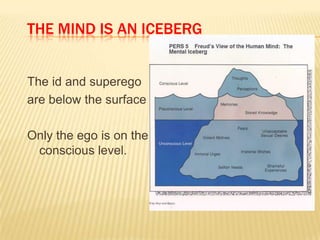
   Freud believed that the human mind was like
    an iceberg.
THE MIND IS AN ICEBERG


The id and superego
are below the surface

Only the ego is on the
 conscious level.
Id
•The id demands immediate satisfaction
•The id does not care what society thinks
     •ID isn’t bound by logic or reality; it follows the
     “pleasure principle”;
     • it’s aims are to avoid pain, reduce tension, and indulge;
     it is made of urges, wishes, needs, and wants; it is the
     original source of the personality.
Ego
•Ego emerges from the id to satisfy the demands of society;
•it is the part of the mind that balances personal needs with
available resources
• its goal is to ensure the health and survival of the self. It
uses reason, planning, and delayed gratification
• it operates according to the “reality principle”
• it operates according to the “reality
principle


 •    The ego is logical
 •     it is the most ideal stage
 •      The ego is the decision maker
 •      The ego compromises between
         Id and super ego
     • Ego is Rational, logical, waking
     part of mind.
     Its job:
     • To regulate the instinctual
     desires of the ID
     • Allow those desires to be
     released in some
     nondestructive way
SUPEREGO
  Acts as an internal censor
  Causes one to make moral judgments in
 light of social pressures.
  Operates according to the Morality society
 and us from ID.
  Suppresses desires and instincts
 forbidden by society
  Puts them back into unconscious
  Manifests itself through punishment.
 If allowed to operate at its own discretion, will
 create an unconscious sense of guilt and fear
Objections to Freud's Theory
Some of the objections typically raised in response to
Freudian theory are:

• Freud's hypotheses are neither verifiable nor falsifiable. It is not clear
what would count as evidence sufficient to confirm or refute theoretical
claims.

• The theory is based on an inadequate conceptualization of the
experience of women.

• The theory overemphasizes the role of sexuality in human
psychological development and experience.

Psycho analysis

  • 1.
  • 2.
    Psychoanalysis is apsychological theory conceived in the late 19th and early 20th centuries by famous neurologist Sigmund Freud. In addition to being a specialized type of therapy, psychoanalysis is also a comprehensive, in-depth theory of the mind. It has many applications. Using the uniquely psychoanalytic explanatory tools of the unconscious, transference and development, among others, psychoanalytic insight can enrich the understanding of human beings, their behaviors and motivations in a wide range of arenas from business to politics to sports, the arts, education, advertising, the law, literature, family relations, and popular culture.
  • 3.
    THE BASIC TENETSOF PSYCHOANALYSIS INCLUDE THE FOLLOWING:  human behavior, experience, and cognition are largely determined by irrational drives;  those drives are largely unconscious  attempts to bring those drives into awareness meet psychological resistance in the form of defense mechanisms;  beside the inherited constitution of personality, one's development is determined by events in early childhood;  conflicts between conscious view of reality and unconscious (repressed) material can result in mental disturbances such as neurosis, neurotic traits, anxiety, depression etc.;  .
  • 4.
    PSYCHOANALYTIC TECHNIQUES  Free Association  Client reports immediately without censoring any feelings or thoughts  Interpretation  Therapist points out, explains, and teaches the meanings of whatever is revealed  Dream Analysis Therapist uses the “royal road to the unconscious” to bring unconscious material to light
  • 5.
    FIVE PSYCHOSEXUAL STAGES  Oral stage  lasts for the first 18 months  pleasure seeking activities include: sucking, chewing, and biting  Fixation  adults who continue to engage in oral activities, such as overeating, gum chewing, or smoking; oral activities can be symbolic as well, such as being overly demanding or “mouthing off”
  • 6.
    Anal stage  late infancy: one and a half to three years  a time when the infant’s pleasure seeking is centered on the anus and its functions of elimination  Fixation  results in adults who continue to engage in activities of retention or elimination  retention: very neat, stingy, or behaviorally rigid  elimination: generous, messy, or behaving very loose or carefree
  • 7.
    Phallic stage  early childhood: 3 to 6 years  infant’s pleasure seeking is centered on the genitals  Oedipus complex  process in which a child competes with the parent of the same sex for the affections and pleasures of the parent of the opposite sex
  • 8.
    Latency stage  middle to late childhood: 6 to puberty  time when the child represses sexual thoughts and engages in nonsexual activities, such as developing social and intellectual skills  puberty  sexuality reappears
  • 9.
    Genital stage  puberty through adulthood  time when the individual has renewed sexual desires that he or she seeks to fulfill through relationships with other people  conflict resolution depends on how conflicts in the first three stages were resolved
  • 10.
    ID,EGO,SUPER EGO  Freud divided the mind into three separate processes. ie;  id , ego and super ego  each has a different function  Freud believed that the human mind was like an iceberg.
  • 11.
    THE MIND ISAN ICEBERG The id and superego are below the surface Only the ego is on the conscious level.
  • 12.
    Id •The id demandsimmediate satisfaction •The id does not care what society thinks •ID isn’t bound by logic or reality; it follows the “pleasure principle”; • it’s aims are to avoid pain, reduce tension, and indulge; it is made of urges, wishes, needs, and wants; it is the original source of the personality. Ego •Ego emerges from the id to satisfy the demands of society; •it is the part of the mind that balances personal needs with available resources • its goal is to ensure the health and survival of the self. It uses reason, planning, and delayed gratification • it operates according to the “reality principle”
  • 13.
    • it operatesaccording to the “reality principle • The ego is logical • it is the most ideal stage • The ego is the decision maker • The ego compromises between Id and super ego • Ego is Rational, logical, waking part of mind. Its job: • To regulate the instinctual desires of the ID • Allow those desires to be released in some nondestructive way
  • 14.
    SUPEREGO  Actsas an internal censor  Causes one to make moral judgments in light of social pressures.  Operates according to the Morality society and us from ID.  Suppresses desires and instincts forbidden by society  Puts them back into unconscious  Manifests itself through punishment. If allowed to operate at its own discretion, will create an unconscious sense of guilt and fear
  • 15.
    Objections to Freud'sTheory Some of the objections typically raised in response to Freudian theory are: • Freud's hypotheses are neither verifiable nor falsifiable. It is not clear what would count as evidence sufficient to confirm or refute theoretical claims. • The theory is based on an inadequate conceptualization of the experience of women. • The theory overemphasizes the role of sexuality in human psychological development and experience.