Personal 
Productivity 
5/22/2014 
Nitin Julka 
(http://www.linkedin.com/in/nitinjulka)
What personal 
productivity challenges 
do you face?
Information 
Overload
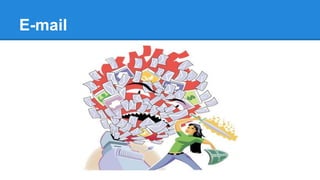
E-mail
What is your personal 
productivity 
philosophy?
My Answer: Get 
everything out of 
your head and 
into your trusted 
systems
Productivity Tools
Productivity Tactics 
● 100% consistent with 100% follow through 
● Single task, but multi-project (with minimal 
task-switching and MITs) 
● Outsource, delegate, unsubscribe, filter, 
cancel, or delete (until you are comfortable 
with your scope) 
● Inbox 0 
● Facilitate and attend good meetings
Task and Project Management 
● Define 1-3 Most Important Tasks (MITs) each 
day, week, and quarter 
● Review active projects and next steps each 
week 
● Review “some day” projects at a recurring 
interval of your choice 
I try to get my MITs done in the morning before anyone gets into 
the office. 
I have turned off popups, buzzes, etc.
Inbox 0 
Overarching Goals: 
● Bring your inbox down to 0 each day or 
week 
● Only touch an e-mail once 
● Schedule time for e-mail (eg. 11:00AM and 
4:00PM each day) 
● Do not multi-task 
The following pages are a step by step plan
Inbox 0 
● Step 1: Delete or consolidate all labels. 
Mine: 
o Account Info 
o Newsletters 
● Step 2: Set up auto-filters
Inbox 0 
● Step 3: Unsubscribe to all newsletters, 
mailing lists, etc. that you don’t read 
● Step 4: When e-mailing, batch process e-mails 
in focused chunks of time. Try not to 
skim during the day. 
● Step 5: Weekly review. Each week, 
schedule a significant amount of time (4 
hours?) to clear your inbox (if it’s not at 0).
How to Run a Meeting 
● Keep a list/agenda with expected outcomes, links 
to detailed docs, and share it in advance 
● Ask if anyone has any thoughts “top of mind” 
● Go through the list, keeping it action-oriented, and 
updating the follow ups, owners, and expected 
timelines 
● Ask everyone for feedback 
● E-mail debrief (unless everything is captured in 
shared doc)
Scope, Memory, Schedules, and Creativity 
People often struggle with too much information is coming in. 
● Cal Newport on “Treat your mind as you would a private garden,” “Hard 
Focus,” and “Fixed Schedule Productivity.” 
● Piotr Wozniak on “spaced repetition.” 
● John Halamka proposes “open access scheduling,” and “only handle it 
once.” 
● Paul Graham proposes a “Maker’s schedule” 
● Tim Ferriss “takes notes like some people take drugs” and doesn’t skim e-mails 
● Jerry Senfield suggests “don’t break the chain.” 
● Maneesh Sethi on how to hire an assistant on Craigslist
Treat Your Mind As You Would a 
Private Garden 
“Living the focused life is not about trying to feel happy all the time…rather, it’s 
about treating your mind as you would a private garden and being as 
careful as possible about what you introduce and allow to grow there.” 
Winifred Gallagher 
“I’ll start with an admission: I spend time, every day, tending to my mind. For 
example, I practice walking meditation each morning, and I use a shutdown 
routine, backed by extensive organization systems, to free my thoughts 
from work-related rumination during the evenings. These are just two 
examples from a large and aggressive collection of strategies I dedicate to 
cultivating my focus — a collection I review and polish once a week.” - Cal 
Newport
On the Value of Hard Focus 
“If I’m asked what the next most important quality is for a novelist, that’s easy 
too: focus — the ability to concentrate all your limited talents on whatever’s 
critical at the moment. Without that you can’t accomplish anything of 
value...Fortunately [sustaining focus for a long period of time] can be acquired 
and sharpened through training.” - Haruki Marukami 
“As my graduate student experience progressed, I systematically increased 
the amount of time I would force myself to work continuously without a 
break to seek unrelated stimulation.” - Cal Newport, author of Be So Good 
They Can’t Ignore You
Spaced Repetition 
http://www.wired.com/medtech/health/magazine/16- 
05/ff_wozniak?currentPage=all 
His advice was straightforward yet strangely terrible: You must clarify your goals, gain 
knowledge through spaced repetition, preserve health, work steadily, minimize 
stress, refuse interruption, and never resist sleep when tired. This should lead to 
radically improved intelligence and creativity. The only cost: turning your back on every 
convention of social life.
Maker vs. Manager 
http://www.paulgraham.com/makersschedule.html 
There are two types of schedule, which I'll call the manager's schedule and the maker's schedule. The 
manager's schedule is for bosses. It's embodied in the traditional appointment book, with each day 
cut into one hour intervals. You can block off several hours for a single task if you need to, but by default you 
change what you're doing every hour... 
Most powerful people are on the manager's schedule. It's the schedule of command. But there's another way of 
using time that's common among people who make things, like programmers and writers. They [makers] 
generally prefer to use time in units of half a day at least. You can't write or program well in units of an 
hour. That's barely enough time to get started. 
When you're operating on the maker's schedule, meetings are a disaster. A single meeting can blow a 
whole afternoon, by breaking it into two pieces each too small to do anything hard in. Plus you have to 
remember to go to the meeting... 
For someone on the maker's schedule, having a meeting is like throwing an exception. It doesn't merely cause 
you to switch from one task to another; it changes the mode in which you work. 
... If I know the afternoon is going to be broken up, I'm slightly less likely to start something 
ambitious in the morning.
Open Access Scheduling 
http://geekdoctor.blogspot.com/2009/11/open-access-scheduling-model-for.html 
Every day I receive over 1000 emails. A small number of those emails are complex problems that 
require multi-stakeholder coordination. Although I can try to solve such problems via email, my rule is 
that if more than 3 rounds of emails go back and forth about an issue, it's time to pick up the phone or 
have a meeting. 
However, scheduling a meeting among senior managers in a large organization can take a month. By that 
time, the issue has either become a much larger problem or the opportunity to rapidly move forward has been 
lost. So much for nimble decisionmaking. 
How can we improve this situation? 
I suggest we learn from the Open Access Scheduling model used in primary care. 
Patients who are sick today do not want an appointment in three weeks - they need to be seen today. 
In the past, clinicians noted they were so busy that their calendars were backlogged weeks to months. 
But wait - if you see 15 patients a per day, a backlogged calendar does not imply you are seeing more 
patients. Why not work through the backlog and then leave 50% of the calendar open each day for the 
patients who are sick each day - solve today's problems today. 
The same thing can be applied to our administrative lives. Each day there are challenges created by 
customers, employees, and the external world. If we left 50% of our calendars open each day for solving 
today's problems today, we would reduce stress, enhance communication, and improve efficiency.
Fixed Schedule Productivity 
http://calnewport.com/blog/2008/02/15/fixed-schedule-productivity-how-i-accomplish-a-large-amount-of-work-in-a-small-number- 
of-work-hours/ 
The system work as follows: 
1. Choose a schedule of work hours that you think provides the ideal balance of effort and relaxation. 
2. Do whatever it takes to avoid violating this schedule. 
Here’s a simple truth: to stick to your ideal schedule will require some drastic actions. For example, you may have to: 
● Dramatically cut back on the number of projects you are working on. 
● Ruthlessly cull inefficient habits from your daily schedule. 
● Risk mildly annoying or upsetting some people in exchange for large gains in time freedom. 
● Stop procrastinating.
Only Handle it Once 
http://geekdoctor.blogspot.com/2012/01/only-handle-it-once-ohio.html 
The end result is that for every document I'm asked to read, every report I'm ask to write, and 
every situation I'm asked to management, I only handle the materials once… 
It's processed and it's done without delay or a growing inbox. I work hard not to be the rate limiting 
step to any process. 
Yes, it can be difficult to juggle the Only Handle it Once (OHIO) approach during a day packed with 
meetings. Given that unplanned work and the management of email has become 50% of our 
jobs, I try to structure my day with no more than 5 hours of planned meetings, leaving the rest of 
the time to bring closure to the issues discussed in the meetings and complete the other work that 
arrives.
Mental “Overhead” from Skimming E-mail 
http://www.fourhourworkweek.com/blog/2007/10/25/weapons-of-mass-distractions- 
and-the-art-of-letting-bad-things-happen/ 
As tempting as it is to “just check e-mail for one minute,” I didn’t do it. I know 
from experience that any problem found in the inbox will linger on the brain 
for hours or days after you shut-down the computer, rendering “free 
time” useless with preoccupation. It’s the worst of states, where you 
experience neither relaxation nor productivity. Be focused on work or focused 
on something else, never in-between.
I Take Notes like Some People Take Drugs 
http://www.fourhourworkweek.com/blog/2007/12/05/how-to-take-notes-like-an-alpha- 
geek-plus-my-2600-date-challenge/ 
I trust the weakest pen more than the strongest memory, and note taking 
is—in my experience—one of the most important skills for converting 
excessive information into precise action and follow-up.
Jerry Seinfeld Suggests “Don’t 
break the Chain” 
http://lifehacker.com/281626/jerry-seinfelds-productivity-secret 
He revealed a unique calendar system he uses to pressure himself to write. Here's how it works. 
He told me to get a big wall calendar that has a whole year on one page and hang it on a 
prominent wall. The next step was to get a big red magic marker. 
He said for each day that I do my task of writing, I get to put a big red X over that day. 
"After a few days you'll have a chain. Just keep at it and the chain will grow longer every 
day. You'll like seeing that chain, especially when you get a few weeks under your belt. Your 
only job next is to not break the chain." 
"Don't break the chain," he said again for emphasis.
How to Hire an Assistant on Craigslist 
https://www.youtube.com/watch?v=R7sfaysj9b 
s
Resources 
● Getting Things Done: The Art of Stress-Free 
Productivity by David Allen 
● 4 Hour Work Week by Tim Ferriss 
● Power of Less by Leo Babauta 
● One Small Step Can Change Your Life: The 
Kaizen Way by Robert Maurer 
● So Good They Can’t Ignore You by Cal 
Newport

Personal Productivity

  • 1.
    Personal Productivity 5/22/2014 Nitin Julka (http://www.linkedin.com/in/nitinjulka)
  • 2.
    What personal productivitychallenges do you face?
  • 3.
  • 6.
  • 8.
    What is yourpersonal productivity philosophy?
  • 9.
    My Answer: Get everything out of your head and into your trusted systems
  • 10.
  • 11.
    Productivity Tactics ●100% consistent with 100% follow through ● Single task, but multi-project (with minimal task-switching and MITs) ● Outsource, delegate, unsubscribe, filter, cancel, or delete (until you are comfortable with your scope) ● Inbox 0 ● Facilitate and attend good meetings
  • 12.
    Task and ProjectManagement ● Define 1-3 Most Important Tasks (MITs) each day, week, and quarter ● Review active projects and next steps each week ● Review “some day” projects at a recurring interval of your choice I try to get my MITs done in the morning before anyone gets into the office. I have turned off popups, buzzes, etc.
  • 13.
    Inbox 0 OverarchingGoals: ● Bring your inbox down to 0 each day or week ● Only touch an e-mail once ● Schedule time for e-mail (eg. 11:00AM and 4:00PM each day) ● Do not multi-task The following pages are a step by step plan
  • 14.
    Inbox 0 ●Step 1: Delete or consolidate all labels. Mine: o Account Info o Newsletters ● Step 2: Set up auto-filters
  • 15.
    Inbox 0 ●Step 3: Unsubscribe to all newsletters, mailing lists, etc. that you don’t read ● Step 4: When e-mailing, batch process e-mails in focused chunks of time. Try not to skim during the day. ● Step 5: Weekly review. Each week, schedule a significant amount of time (4 hours?) to clear your inbox (if it’s not at 0).
  • 16.
    How to Runa Meeting ● Keep a list/agenda with expected outcomes, links to detailed docs, and share it in advance ● Ask if anyone has any thoughts “top of mind” ● Go through the list, keeping it action-oriented, and updating the follow ups, owners, and expected timelines ● Ask everyone for feedback ● E-mail debrief (unless everything is captured in shared doc)
  • 17.
    Scope, Memory, Schedules,and Creativity People often struggle with too much information is coming in. ● Cal Newport on “Treat your mind as you would a private garden,” “Hard Focus,” and “Fixed Schedule Productivity.” ● Piotr Wozniak on “spaced repetition.” ● John Halamka proposes “open access scheduling,” and “only handle it once.” ● Paul Graham proposes a “Maker’s schedule” ● Tim Ferriss “takes notes like some people take drugs” and doesn’t skim e-mails ● Jerry Senfield suggests “don’t break the chain.” ● Maneesh Sethi on how to hire an assistant on Craigslist
  • 18.
    Treat Your MindAs You Would a Private Garden “Living the focused life is not about trying to feel happy all the time…rather, it’s about treating your mind as you would a private garden and being as careful as possible about what you introduce and allow to grow there.” Winifred Gallagher “I’ll start with an admission: I spend time, every day, tending to my mind. For example, I practice walking meditation each morning, and I use a shutdown routine, backed by extensive organization systems, to free my thoughts from work-related rumination during the evenings. These are just two examples from a large and aggressive collection of strategies I dedicate to cultivating my focus — a collection I review and polish once a week.” - Cal Newport
  • 19.
    On the Valueof Hard Focus “If I’m asked what the next most important quality is for a novelist, that’s easy too: focus — the ability to concentrate all your limited talents on whatever’s critical at the moment. Without that you can’t accomplish anything of value...Fortunately [sustaining focus for a long period of time] can be acquired and sharpened through training.” - Haruki Marukami “As my graduate student experience progressed, I systematically increased the amount of time I would force myself to work continuously without a break to seek unrelated stimulation.” - Cal Newport, author of Be So Good They Can’t Ignore You
  • 20.
    Spaced Repetition http://www.wired.com/medtech/health/magazine/16- 05/ff_wozniak?currentPage=all His advice was straightforward yet strangely terrible: You must clarify your goals, gain knowledge through spaced repetition, preserve health, work steadily, minimize stress, refuse interruption, and never resist sleep when tired. This should lead to radically improved intelligence and creativity. The only cost: turning your back on every convention of social life.
  • 21.
    Maker vs. Manager http://www.paulgraham.com/makersschedule.html There are two types of schedule, which I'll call the manager's schedule and the maker's schedule. The manager's schedule is for bosses. It's embodied in the traditional appointment book, with each day cut into one hour intervals. You can block off several hours for a single task if you need to, but by default you change what you're doing every hour... Most powerful people are on the manager's schedule. It's the schedule of command. But there's another way of using time that's common among people who make things, like programmers and writers. They [makers] generally prefer to use time in units of half a day at least. You can't write or program well in units of an hour. That's barely enough time to get started. When you're operating on the maker's schedule, meetings are a disaster. A single meeting can blow a whole afternoon, by breaking it into two pieces each too small to do anything hard in. Plus you have to remember to go to the meeting... For someone on the maker's schedule, having a meeting is like throwing an exception. It doesn't merely cause you to switch from one task to another; it changes the mode in which you work. ... If I know the afternoon is going to be broken up, I'm slightly less likely to start something ambitious in the morning.
  • 22.
    Open Access Scheduling http://geekdoctor.blogspot.com/2009/11/open-access-scheduling-model-for.html Every day I receive over 1000 emails. A small number of those emails are complex problems that require multi-stakeholder coordination. Although I can try to solve such problems via email, my rule is that if more than 3 rounds of emails go back and forth about an issue, it's time to pick up the phone or have a meeting. However, scheduling a meeting among senior managers in a large organization can take a month. By that time, the issue has either become a much larger problem or the opportunity to rapidly move forward has been lost. So much for nimble decisionmaking. How can we improve this situation? I suggest we learn from the Open Access Scheduling model used in primary care. Patients who are sick today do not want an appointment in three weeks - they need to be seen today. In the past, clinicians noted they were so busy that their calendars were backlogged weeks to months. But wait - if you see 15 patients a per day, a backlogged calendar does not imply you are seeing more patients. Why not work through the backlog and then leave 50% of the calendar open each day for the patients who are sick each day - solve today's problems today. The same thing can be applied to our administrative lives. Each day there are challenges created by customers, employees, and the external world. If we left 50% of our calendars open each day for solving today's problems today, we would reduce stress, enhance communication, and improve efficiency.
  • 23.
    Fixed Schedule Productivity http://calnewport.com/blog/2008/02/15/fixed-schedule-productivity-how-i-accomplish-a-large-amount-of-work-in-a-small-number- of-work-hours/ The system work as follows: 1. Choose a schedule of work hours that you think provides the ideal balance of effort and relaxation. 2. Do whatever it takes to avoid violating this schedule. Here’s a simple truth: to stick to your ideal schedule will require some drastic actions. For example, you may have to: ● Dramatically cut back on the number of projects you are working on. ● Ruthlessly cull inefficient habits from your daily schedule. ● Risk mildly annoying or upsetting some people in exchange for large gains in time freedom. ● Stop procrastinating.
  • 24.
    Only Handle itOnce http://geekdoctor.blogspot.com/2012/01/only-handle-it-once-ohio.html The end result is that for every document I'm asked to read, every report I'm ask to write, and every situation I'm asked to management, I only handle the materials once… It's processed and it's done without delay or a growing inbox. I work hard not to be the rate limiting step to any process. Yes, it can be difficult to juggle the Only Handle it Once (OHIO) approach during a day packed with meetings. Given that unplanned work and the management of email has become 50% of our jobs, I try to structure my day with no more than 5 hours of planned meetings, leaving the rest of the time to bring closure to the issues discussed in the meetings and complete the other work that arrives.
  • 25.
    Mental “Overhead” fromSkimming E-mail http://www.fourhourworkweek.com/blog/2007/10/25/weapons-of-mass-distractions- and-the-art-of-letting-bad-things-happen/ As tempting as it is to “just check e-mail for one minute,” I didn’t do it. I know from experience that any problem found in the inbox will linger on the brain for hours or days after you shut-down the computer, rendering “free time” useless with preoccupation. It’s the worst of states, where you experience neither relaxation nor productivity. Be focused on work or focused on something else, never in-between.
  • 26.
    I Take Noteslike Some People Take Drugs http://www.fourhourworkweek.com/blog/2007/12/05/how-to-take-notes-like-an-alpha- geek-plus-my-2600-date-challenge/ I trust the weakest pen more than the strongest memory, and note taking is—in my experience—one of the most important skills for converting excessive information into precise action and follow-up.
  • 27.
    Jerry Seinfeld Suggests“Don’t break the Chain” http://lifehacker.com/281626/jerry-seinfelds-productivity-secret He revealed a unique calendar system he uses to pressure himself to write. Here's how it works. He told me to get a big wall calendar that has a whole year on one page and hang it on a prominent wall. The next step was to get a big red magic marker. He said for each day that I do my task of writing, I get to put a big red X over that day. "After a few days you'll have a chain. Just keep at it and the chain will grow longer every day. You'll like seeing that chain, especially when you get a few weeks under your belt. Your only job next is to not break the chain." "Don't break the chain," he said again for emphasis.
  • 28.
    How to Hirean Assistant on Craigslist https://www.youtube.com/watch?v=R7sfaysj9b s
  • 29.
    Resources ● GettingThings Done: The Art of Stress-Free Productivity by David Allen ● 4 Hour Work Week by Tim Ferriss ● Power of Less by Leo Babauta ● One Small Step Can Change Your Life: The Kaizen Way by Robert Maurer ● So Good They Can’t Ignore You by Cal Newport