Time Management
Ice Breaker
What is Time management ?
Time is what we want most, but... what we use worst. --William Penn
                                 Story
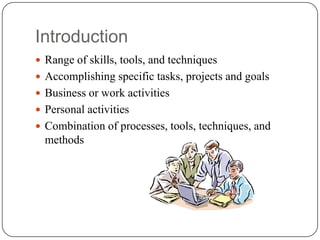
IntroductionRange of skills, tools, and techniques Accomplishing specific tasks, projects and goalsBusiness or work activitiesPersonal activitiesCombination of processes, tools, techniques, and methods
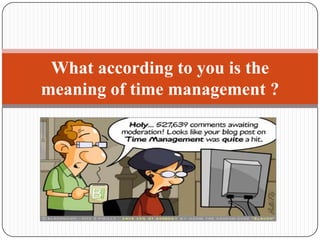
What according to you is the meaning of time management ?
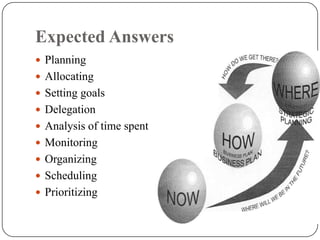
Expected AnswersPlanningAllocatingSetting goalsDelegationAnalysis of time spentMonitoringOrganizingSchedulingPrioritizing
Time Wasters
                          Activity
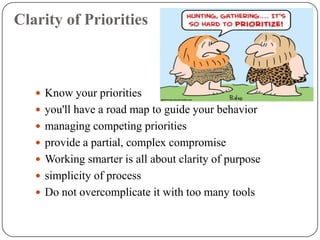
Clarity of Priorities Know your priorities you'll have a road map to guide your behaviormanaging competing prioritiesprovide a partial, complex compromiseWorking smarter is all about clarity of purposesimplicity of processDo not overcomplicate it with too many tools
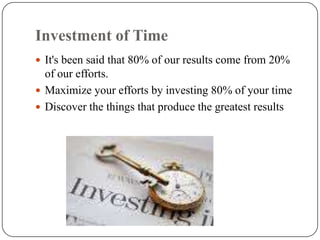
Investment of Time It's been said that 80% of our results come from 20% of our efforts. Maximize your efforts by investing 80% of your timeDiscover the things that produce the greatest results
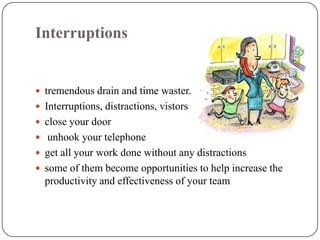
Interruptionstremendous drain and time waster. Interruptions, distractions, vistorsclose your doorunhook your telephoneget all your work done without any distractionssome of them become opportunities to help increase the productivity and effectiveness of your team
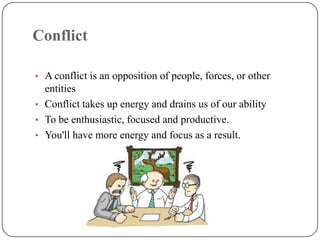
ConflictA conflict is an opposition of people, forces, or other entities
Conflict takes up energy and drains us of our ability
To be enthusiastic, focused and productive.
You'll have more energy and focus as a result.Personal Concerns During Business HoursPersonal issues including family problems, life changing situations, emotional difficulties, illness can impact your job and ultimately your ability to advance your career Try as you might to keep your private life separate from your work life Learn how to keep personal issues from negatively affecting your job Respect the boundaries between personal concerns and businessStay focused on the present task at hand while also minimizing distractions
ProcrastinationAct of replacing high-priority actions or tasks with low-priority actions Putting off important tasks to a later time May result in stress, a sense of guilt and crisis, severe loss of personal productivitySocial disapproval for not meeting responsibilities or commitments Indecision, daydreaming and delay Working with a professional
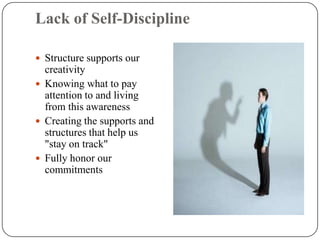
Lack of Self-DisciplineStructure supports our creativityKnowing what to pay attention to and living from this awarenessCreating the supports and structures that help us "stay on track" Fully honor our commitments
Unfinished ProjectsJumping from project to projectleaving tasks partly doneconstantly switching priorities tie up loose endsReview your financesIf you're desperate to finish these projects to make money, fear may be blocking your intuitionYou'll have trouble thinking clearly and setting priorities“Idea board" near your desk
SocializingHaving a welcoming attitudecan lead to disturbances and disruptionssocial visits that take up too much timevisits can come from superiors, peers, subordinates, or even personal friendssolution is to be strategic and manage by exceptionSend out a clear message that you are not available Postpone all socialization until office hours are overstand up as soon as somebody comes to your desk and keep standing until he or she leavesFine line and balance between the two
Guilt and Shoulds"Shoulds" come from the unexamined beliefs that unconsciously guide our behaviorguilt is the outcome of these "shoulds.“Identify your pre-existing beliefs Unexamined beliefs create guiltExplore what's really important to you NOW
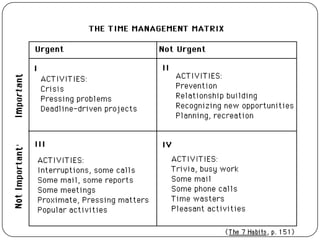
Techniques in Time Management
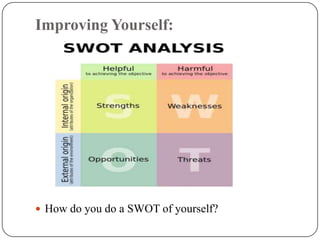
Improving Yourself:How do you do a SWOT of yourself?
Strengths: What advantages do you have? What do you do well? What relevant resources do you have access to? What do other people see as your strengths?
Weaknesses: What could you improve? What do you do badly? What should you avoid?Are You not qualified fully for the future opportunities?
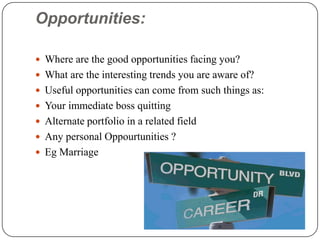
Opportunities:Where are the good opportunities facing you? What are the interesting trends you are aware of?Useful opportunities can come from such things as:Your immediate boss quittingAlternate portfolio in a related fieldAny personal Oppourtunities ?Eg Marriage
ThreatsWhat obstacles do you face? Are the required specifications for your job changing? Is changing technology threatening your position? Could any of your weaknesses seriously threaten your job?Is there any threat to you which will force you not to take the “Opportunity” when it comes along?
6 simple Time Management tips
Email‘Ping' goes or the duck pops up Stop doing thatPostman arrived once a dayMute or disable whatever 'you have mail' signal you useDisable the automatic check and do it manually Four times a dayWhen you do open upRead
Action
Delegate
File or bin immediately, each email in turn
Be strict - you can do thisSubscriptionsMailing lists, blogs, feeds, social networking sitesMultiply like rabbitsTake time to readReduce the numbersUn-subscribe from ALL of them Re-subscribe only to the ones that you absolutely have to haveBetween two and three hours a week
TVTurn off the TV. Turn it on only when you want to watch somethingWhen you are done watching turn it off againBe selective about what you want to watch
Make a listMake a list of everythingYou would like to accomplishSort the prioritiesAnything that is geared towards generating income naturally outranks Schedule everything on the list
ScheduleBreak the whole day down, from start to finishProven to workTry not to allot more than two consecutive time chunksFinish each task within the allotted timeLiteral two or three minutesRe-schedule it Download a countdown timer and use itYou really strive to finish a given task within the allotted timeYou become aware of how and on what, your time is being spent in general
PhonesPut your cell phone on silent let it take messagesEvery time you find yourself distractedcheck yourself and focus again on the task at hand.simply make a note of it attend to it when appropriatehttp://www.youtube.com/watch?v=gc2Ks3lQew8

Time management

  • 1.
  • 2.
  • 3.
    What is Timemanagement ?
  • 4.
    Time is whatwe want most, but... what we use worst. --William Penn
  • 5.
    Story
  • 6.
    IntroductionRange of skills,tools, and techniques Accomplishing specific tasks, projects and goalsBusiness or work activitiesPersonal activitiesCombination of processes, tools, techniques, and methods
  • 7.
    What according toyou is the meaning of time management ?
  • 8.
    Expected AnswersPlanningAllocatingSetting goalsDelegationAnalysisof time spentMonitoringOrganizingSchedulingPrioritizing
  • 9.
  • 10.
    Activity
  • 11.
    Clarity of PrioritiesKnow your priorities you'll have a road map to guide your behaviormanaging competing prioritiesprovide a partial, complex compromiseWorking smarter is all about clarity of purposesimplicity of processDo not overcomplicate it with too many tools
  • 12.
    Investment of TimeIt's been said that 80% of our results come from 20% of our efforts. Maximize your efforts by investing 80% of your timeDiscover the things that produce the greatest results
  • 13.
    Interruptionstremendous drain andtime waster. Interruptions, distractions, vistorsclose your doorunhook your telephoneget all your work done without any distractionssome of them become opportunities to help increase the productivity and effectiveness of your team
  • 14.
    ConflictA conflict isan opposition of people, forces, or other entities
  • 15.
    Conflict takes upenergy and drains us of our ability
  • 16.
    To be enthusiastic,focused and productive.
  • 17.
    You'll have moreenergy and focus as a result.Personal Concerns During Business HoursPersonal issues including family problems, life changing situations, emotional difficulties, illness can impact your job and ultimately your ability to advance your career Try as you might to keep your private life separate from your work life Learn how to keep personal issues from negatively affecting your job Respect the boundaries between personal concerns and businessStay focused on the present task at hand while also minimizing distractions
  • 18.
    ProcrastinationAct of replacinghigh-priority actions or tasks with low-priority actions Putting off important tasks to a later time May result in stress, a sense of guilt and crisis, severe loss of personal productivitySocial disapproval for not meeting responsibilities or commitments Indecision, daydreaming and delay Working with a professional
  • 19.
    Lack of Self-DisciplineStructuresupports our creativityKnowing what to pay attention to and living from this awarenessCreating the supports and structures that help us "stay on track" Fully honor our commitments
  • 20.
    Unfinished ProjectsJumping fromproject to projectleaving tasks partly doneconstantly switching priorities tie up loose endsReview your financesIf you're desperate to finish these projects to make money, fear may be blocking your intuitionYou'll have trouble thinking clearly and setting priorities“Idea board" near your desk
  • 21.
    SocializingHaving a welcomingattitudecan lead to disturbances and disruptionssocial visits that take up too much timevisits can come from superiors, peers, subordinates, or even personal friendssolution is to be strategic and manage by exceptionSend out a clear message that you are not available Postpone all socialization until office hours are overstand up as soon as somebody comes to your desk and keep standing until he or she leavesFine line and balance between the two
  • 22.
    Guilt and Shoulds"Shoulds"come from the unexamined beliefs that unconsciously guide our behaviorguilt is the outcome of these "shoulds.“Identify your pre-existing beliefs Unexamined beliefs create guiltExplore what's really important to you NOW
  • 23.
  • 25.
    Improving Yourself:How doyou do a SWOT of yourself?
  • 26.
    Strengths: What advantagesdo you have? What do you do well? What relevant resources do you have access to? What do other people see as your strengths?
  • 27.
    Weaknesses: What couldyou improve? What do you do badly? What should you avoid?Are You not qualified fully for the future opportunities?
  • 28.
    Opportunities:Where are thegood opportunities facing you? What are the interesting trends you are aware of?Useful opportunities can come from such things as:Your immediate boss quittingAlternate portfolio in a related fieldAny personal Oppourtunities ?Eg Marriage
  • 29.
    ThreatsWhat obstacles doyou face? Are the required specifications for your job changing? Is changing technology threatening your position? Could any of your weaknesses seriously threaten your job?Is there any threat to you which will force you not to take the “Opportunity” when it comes along?
  • 30.
    6 simple TimeManagement tips
  • 31.
    Email‘Ping' goes orthe duck pops up Stop doing thatPostman arrived once a dayMute or disable whatever 'you have mail' signal you useDisable the automatic check and do it manually Four times a dayWhen you do open upRead
  • 32.
  • 33.
  • 34.
    File or binimmediately, each email in turn
  • 35.
    Be strict -you can do thisSubscriptionsMailing lists, blogs, feeds, social networking sitesMultiply like rabbitsTake time to readReduce the numbersUn-subscribe from ALL of them Re-subscribe only to the ones that you absolutely have to haveBetween two and three hours a week
  • 36.
    TVTurn off theTV. Turn it on only when you want to watch somethingWhen you are done watching turn it off againBe selective about what you want to watch
  • 37.
    Make a listMakea list of everythingYou would like to accomplishSort the prioritiesAnything that is geared towards generating income naturally outranks Schedule everything on the list
  • 38.
    ScheduleBreak the wholeday down, from start to finishProven to workTry not to allot more than two consecutive time chunksFinish each task within the allotted timeLiteral two or three minutesRe-schedule it Download a countdown timer and use itYou really strive to finish a given task within the allotted timeYou become aware of how and on what, your time is being spent in general
  • 39.
    PhonesPut your cellphone on silent let it take messagesEvery time you find yourself distractedcheck yourself and focus again on the task at hand.simply make a note of it attend to it when appropriatehttp://www.youtube.com/watch?v=gc2Ks3lQew8