








CHRIS HYLTON
CG HYLTON INC.
Financial Planning
Workshop
Disclaimer
2
The information presented to you today is considered
to be general best practices for personal financial
planning. This is not intended to replace qualified
advice specific to your situation.
Learning objectives
 Identifying the 12 things that EVERYONE gets
wrong about financial planning
 Understanding insurance
 Demystifying savings and investments
 Wading through the banking and lending
challenges
 Effective tax and estate planning
3
This is your show
4
 Are there any questions that you have now that I can
blend in to today’s presentation please?
 1.
 2.
 3.
 4.
 5.
 If you think of anything as we go along please ask!
5
6
Twelve financial mistakes
EVERYONE makes
Critical financial planning mistakes
7
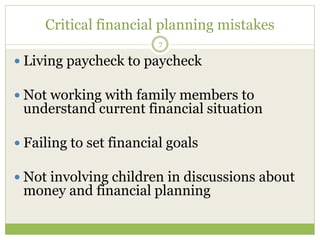
 Living paycheck to paycheck
 Not working with family members to
understand current financial situation
 Failing to set financial goals
 Not involving children in discussions about
money and financial planning
Critical financial planning mistakes
8
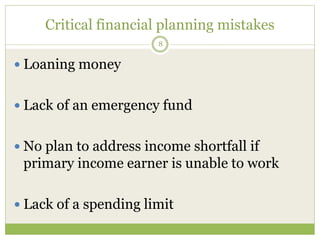
 Loaning money
 Lack of an emergency fund
 No plan to address income shortfall if
primary income earner is unable to work
 Lack of a spending limit
Critical financial planning mistakes
 Spending to keep up appearances
 Under utilizing employee benefits
 Financing major purchases with credit
 A lack of diversified investments
10
Identifying the 12 most common
financial planning mistakes is the
key to overcoming them.
• Identify these
patterns in
your own
financial
planning
process
• Begin to create
systems or
habits to
eliminate these
12 common
mistakes
11
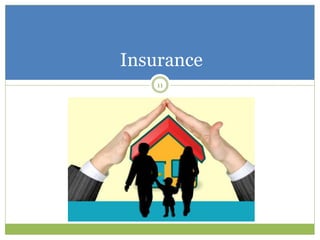
Insurance
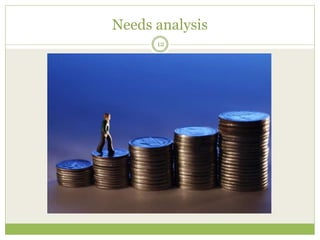
Needs analysis
12
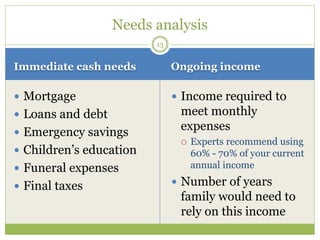
Immediate cash needs Ongoing income
 Mortgage
 Loans and debt
 Emergency savings
 Children’s education
 Funeral expenses
 Final taxes
 Income required to
meet monthly
expenses
 Experts recommend using
60% - 70% of your current
annual income
 Number of years
family would need to
rely on this income
13
Needs analysis
Types of life insurance
14
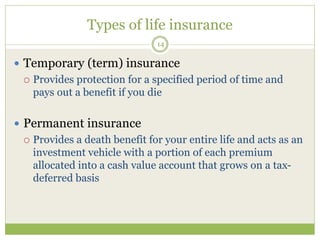
 Temporary (term) insurance
 Provides protection for a specified period of time and
pays out a benefit if you die
 Permanent insurance
 Provides a death benefit for your entire life and acts as an
investment vehicle with a portion of each premium
allocated into a cash value account that grows on a tax-
deferred basis
Pros Cons
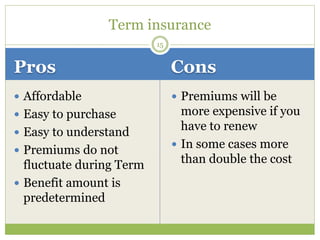
 Affordable
 Easy to purchase
 Easy to understand
 Premiums do not
fluctuate during Term
 Benefit amount is
predetermined
 Premiums will be
more expensive if you
have to renew
 In some cases more
than double the cost
15
Term insurance
Pros Cons
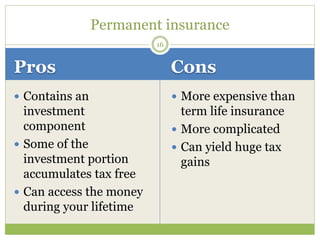
 Contains an
investment
component
 Some of the
investment portion
accumulates tax free
 Can access the money
during your lifetime
 More expensive than
term life insurance
 More complicated
 Can yield huge tax
gains
16
Permanent insurance
Types of permanent life insurance
17
 Whole life
 Offers a guaranteed death benefit, fixed annual premium,
and guaranteed rate of return on the cash value
 Universal life
 Similar to whole life but this option does not guarantee
the rate of return on the cash value
Mortgage protection insurance
18
Pros Cons
 Can help alleviate
financial hardship
caused by critical
illness or death
 Premiums decrease as
mortgage balance
decreases
 May lose coverage if
you change mortgage
lenders
 Value declines over
time
 Policy exclusions may
affect eligibility to
claim this benefit
19
Mortgage insurance
PROS CONS
 Simple and easy to sign
up
 You just tick one more
box on the application
 If you buy thru
mortgage lender you
may be paying too
much
 Shop from
independent insurance
broker
20
Mortgage Insurance
21
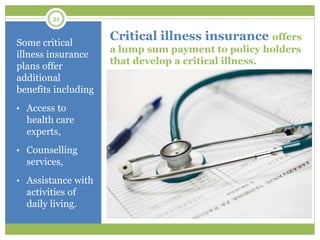
Critical illness insurance offers
a lump sum payment to policy holders
that develop a critical illness.
Some critical
illness insurance
plans offer
additional
benefits including
• Access to
health care
experts,
• Counselling
services,
• Assistance with
activities of
daily living.
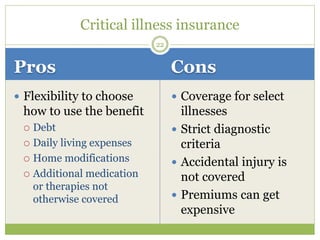
Pros Cons
 Flexibility to choose
how to use the benefit
 Debt
 Daily living expenses
 Home modifications
 Additional medication
or therapies not
otherwise covered
 Coverage for select
illnesses
 Strict diagnostic
criteria
 Accidental injury is
not covered
 Premiums can get
expensive
22
Critical illness insurance
Disability insurance
23
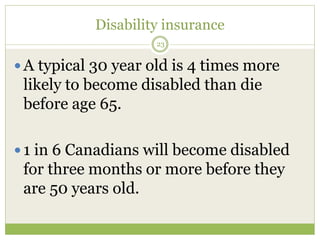
 A typical 30 year old is 4 times more
likely to become disabled than die
before age 65.
 1 in 6 Canadians will become disabled
for three months or more before they
are 50 years old.
Types of disability insurance
24
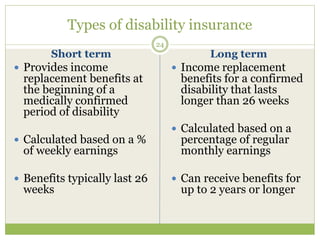
Short term
 Provides income
replacement benefits at
the beginning of a
medically confirmed
period of disability
 Calculated based on a %
of weekly earnings
 Benefits typically last 26
weeks
Long term
 Income replacement
benefits for a confirmed
disability that lasts
longer than 26 weeks
 Calculated based on a
percentage of regular
monthly earnings
 Can receive benefits for
up to 2 years or longer
Pros of disability insurance
25
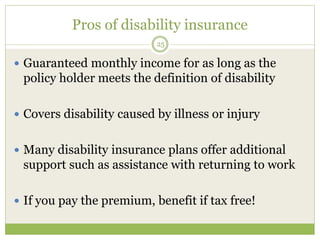
 Guaranteed monthly income for as long as the
policy holder meets the definition of disability
 Covers disability caused by illness or injury
 Many disability insurance plans offer additional
support such as assistance with returning to work
 If you pay the premium, benefit if tax free!
Cons of disability insurance
26
 Monthly benefit is only a portion of regular monthly
earnings
 There may be a waiting period during which no
benefits are payable
 Benefits may be reduced by other forms of income
such as CPP disability payments
 Policy may have a maximum benefit period
 Most policies automatically terminate coverage at
age 65, even if you planned to work beyond that age
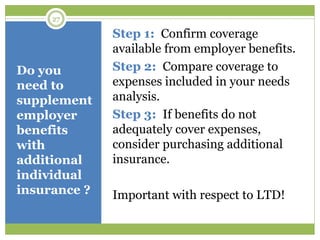
Do you
need to
supplement
employer
benefits
with
additional
individual
insurance ?
Step 1: Confirm coverage
available from employer benefits.
Step 2: Compare coverage to
expenses included in your needs
analysis.
Step 3: If benefits do not
adequately cover expenses,
consider purchasing additional
insurance.
Important with respect to LTD!
27
28
Savings and investments
Registered investments
29
 Registered with the federal government for tax
purposes
 Offer the opportunity for tax-deferred growth
 Often subject to annual contribution maximums
 Examples include
 RRSP
 Tax Free Savings Account
Non registered investments
30
 Not required to be registered with the federal
government
 Contributions do not ease tax burden by lowering
annual taxable income
 Interest earned is taxable
 No annual contribution maximums
Registered Retirement Savings Plan
31
 Anyone under the age of 72 that earns income can
contribute to an RRSP
 RRSP contributions are tax deductible up to an
annual maximum amount
 RRSPs can contain a variety of different
investments
 Savings deposits
 Guaranteed investment certificates (GICs)
 Mutual funds
 Equities
Registered Retirement Savings Plan
32
RRSP and debt repayment
 Some people use RRSPs to repay outstanding debt
 In many cases, a financial penalty is applied to
withdrawals from an RRSP
 Withholding tax
 Income becomes taxable and must be reported to federal
government
 Contribution room is permanently forfeited once the
money is withdrawn
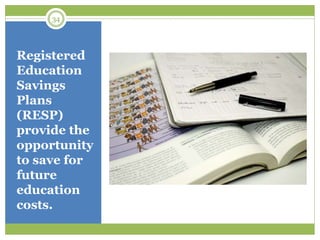
Registered
Education
Savings
Plans
(RESP)
provide the
opportunity
to save for
future
education
costs.
34
Registered Education Savings Plan
35
 Contributions are not tax deductible by the
contributor does not pay tax on earned interest
 If the RESP is not used by the designated
beneficiary, the contributor can use the RESP
contributions without having to declare that
money as additional income
 Interest earned is taxable
 Lifetime contribution limit of $50,000
Registered Education Savings Plan
36
 Government contributes, too!
 RESP contributions may be eligible for additional
government grants via the Canada Education Savings
Grant, Canada Learning Bond, or designated provincial
education savings program
 If the beneficiary does not pursue post secondary
education, the government contributions must be
repaid
Tax Free Savings Account
37
 Individuals 18 years and older can set aside money
that grows tax free
 Annual contribution maximum of $5500
 Can still realize contribution limits from past
years, even if you are just starting your TSFA now
 Contribution limits began accumulating in 2009
Risk tolerance
38
Risk tolerance is the
amount of risk or degree of
uncertainty that you are
willing to take in order to
meet your financial goals.
Risk capacity
39
Risk capacity is an
assessment of how much
risk you must take in order
to achieve your financial
goals.
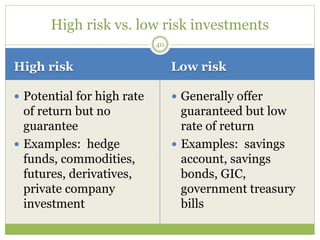
High risk Low risk
 Potential for high rate
of return but no
guarantee
 Examples: hedge
funds, commodities,
futures, derivatives,
private company
investment
 Generally offer
guaranteed but low
rate of return
 Examples: savings
account, savings
bonds, GIC,
government treasury
bills
40
High risk vs. low risk investments
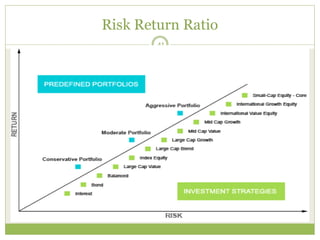
Risk Return Ratio
41
Ideal investment portfolio
42
Attributes of an ideal investment portfolio
43
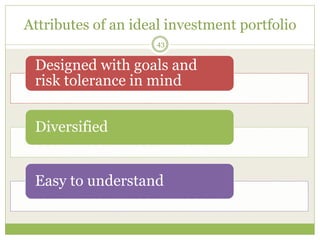
Designed with goals and
risk tolerance in mind
Diversified
Easy to understand
Banking
and
Lending
44
Interest rates
 Two types of interest rates that can affect your
financial plans
 Interest on savings
 Interest on debt
 Interest rates on debt are usually more important
to people because it directly affects how quickly the
debt is paid and the actual cost of the debt
 Interest rates are typically negotiable
Cash flow
46
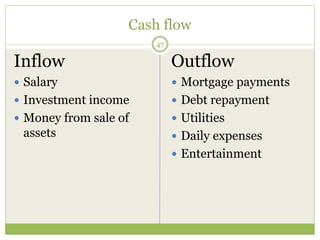
Personal cash flow is a reflection of your money in
and your money out. Ideally, cash flow should
remain positive meaning you have more money
coming in than money going out.
Cash flow
47
Inflow
 Salary
 Investment income
 Money from sale of
assets
Outflow
 Mortgage payments
 Debt repayment
 Utilities
 Daily expenses
 Entertainment
Calculate your personal cash flow
48
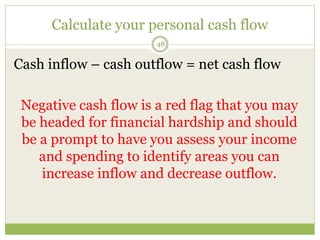
Cash inflow – cash outflow = net cash flow
Negative cash flow is a red flag that you may
be headed for financial hardship and should
be a prompt to have you assess your income
and spending to identify areas you can
increase inflow and decrease outflow.
Debt management
49
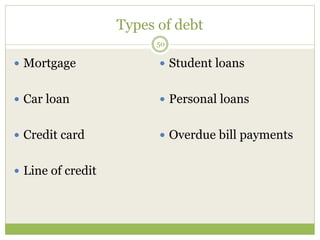
Types of debt
50
 Mortgage
 Car loan
 Credit card
 Line of credit
 Student loans
 Personal loans
 Overdue bill payments
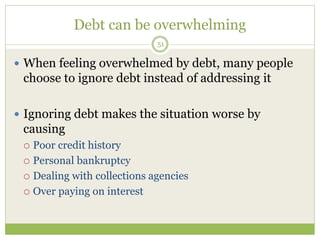
Debt can be overwhelming
51
 When feeling overwhelmed by debt, many people
choose to ignore debt instead of addressing it
 Ignoring debt makes the situation worse by
causing
 Poor credit history
 Personal bankruptcy
 Dealing with collections agencies
 Over paying on interest
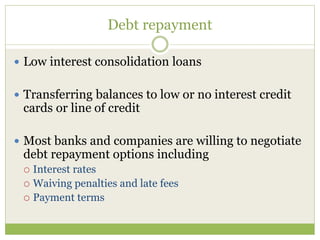
Debt repayment
 Low interest consolidation loans
 Transferring balances to low or no interest credit
cards or line of credit
 Most banks and companies are willing to negotiate
debt repayment options including
 Interest rates
 Waiving penalties and late fees
 Payment terms
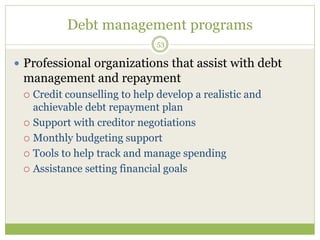
Debt management programs
53
 Professional organizations that assist with debt
management and repayment
 Credit counselling to help develop a realistic and
achievable debt repayment plan
 Support with creditor negotiations
 Monthly budgeting support
 Tools to help track and manage spending
 Assistance setting financial goals
54
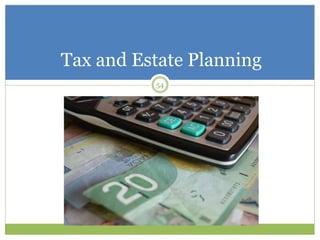
Tax and Estate Planning
Wills
55
 This legally binding document ensures that your
estate is allocated to family, friends, and charities
as per your wishes and protects some of your
assets from taxation
 When drafted properly, a will can allow you to
transfer RRSP and RRIF accounts tax-free to a
spouse as well as to a child or grandchild who is
under 18 years of age
Testamentary Spouse Trust
56
 Allows for the transfer of assets to a surviving
spouse on a tax-deferred basis
 When the spouse passes away, remaining assets
are distributed to beneficiaries named in the
original will
 This type of trust remains unaffected by new
marriages or family quarrels
Allocating resources to family
57
 If your spouse is the sole beneficiary of your
healthy RRSP, you can consider making other
family members the beneficiary of life
insurance policies or other accounts
 Money from different sources may be subject to
different tax rules and an account can help you
allocate resources so that your family members,
and not the CRA, are the sole beneficiaries
Sharing property
58
 Property that has joint ownership will automatically
transfer to the surviving owner upon your death
 Depending on your individual situation, it may make
the most financial sense for you to enter into a joint
ownership agreement with a spouse, family member,
or even a business partner
59
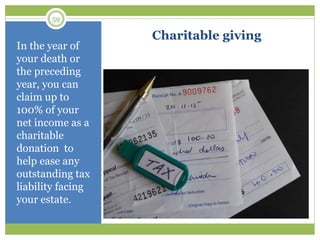
Charitable giving
In the year of
your death or
the preceding
year, you can
claim up to
100% of your
net income as a
charitable
donation to
help ease any
outstanding tax
liability facing
your estate.
60
Questions?
THANK YOU!
61
Thank you for the opportunity to
present to you today!
About us
62
Our services
 Employer benefit plans
 Travel insurance
 Health spending
accounts
 Salary grids
 Policy review and writing
 Pension plans
 Employee wellness
 Employer of choice
 Charitable giving
 Charitable tax
information
 Employee mental health
Contact us
63
#517-7620 Elbow Drive SW
Calgary, AB T2V 1K2
403-264-5288 www.hylton.ca
800-449-5866 chris@hylton.ca
Let’s get social!
64
Facebook facebook.com/pages/cghylton
Twitter @HyltonYYC
Google + plus.google.com/u/0/109237546846077340442/posts
YouTube youtube.com/user/CGHylton
LinkedIn ca.linkedin.com/in/cghylton

Financial planning 1

  • 1.
    CHRIS HYLTON CG HYLTONINC. Financial Planning Workshop
  • 2.
    Disclaimer 2 The information presentedto you today is considered to be general best practices for personal financial planning. This is not intended to replace qualified advice specific to your situation.
  • 3.
    Learning objectives  Identifyingthe 12 things that EVERYONE gets wrong about financial planning  Understanding insurance  Demystifying savings and investments  Wading through the banking and lending challenges  Effective tax and estate planning 3
  • 4.
    This is yourshow 4  Are there any questions that you have now that I can blend in to today’s presentation please?  1.  2.  3.  4.  5.  If you think of anything as we go along please ask!
  • 5.
  • 6.
  • 7.
    Critical financial planningmistakes 7  Living paycheck to paycheck  Not working with family members to understand current financial situation  Failing to set financial goals  Not involving children in discussions about money and financial planning
  • 8.
    Critical financial planningmistakes 8  Loaning money  Lack of an emergency fund  No plan to address income shortfall if primary income earner is unable to work  Lack of a spending limit
  • 9.
    Critical financial planningmistakes  Spending to keep up appearances  Under utilizing employee benefits  Financing major purchases with credit  A lack of diversified investments
  • 10.
    10 Identifying the 12most common financial planning mistakes is the key to overcoming them. • Identify these patterns in your own financial planning process • Begin to create systems or habits to eliminate these 12 common mistakes
  • 11.
  • 12.
  • 13.
    Immediate cash needsOngoing income  Mortgage  Loans and debt  Emergency savings  Children’s education  Funeral expenses  Final taxes  Income required to meet monthly expenses  Experts recommend using 60% - 70% of your current annual income  Number of years family would need to rely on this income 13 Needs analysis
  • 14.
    Types of lifeinsurance 14  Temporary (term) insurance  Provides protection for a specified period of time and pays out a benefit if you die  Permanent insurance  Provides a death benefit for your entire life and acts as an investment vehicle with a portion of each premium allocated into a cash value account that grows on a tax- deferred basis
  • 15.
    Pros Cons  Affordable Easy to purchase  Easy to understand  Premiums do not fluctuate during Term  Benefit amount is predetermined  Premiums will be more expensive if you have to renew  In some cases more than double the cost 15 Term insurance
  • 16.
    Pros Cons  Containsan investment component  Some of the investment portion accumulates tax free  Can access the money during your lifetime  More expensive than term life insurance  More complicated  Can yield huge tax gains 16 Permanent insurance
  • 17.
    Types of permanentlife insurance 17  Whole life  Offers a guaranteed death benefit, fixed annual premium, and guaranteed rate of return on the cash value  Universal life  Similar to whole life but this option does not guarantee the rate of return on the cash value
  • 18.
  • 19.
    Pros Cons  Canhelp alleviate financial hardship caused by critical illness or death  Premiums decrease as mortgage balance decreases  May lose coverage if you change mortgage lenders  Value declines over time  Policy exclusions may affect eligibility to claim this benefit 19 Mortgage insurance
  • 20.
    PROS CONS  Simpleand easy to sign up  You just tick one more box on the application  If you buy thru mortgage lender you may be paying too much  Shop from independent insurance broker 20 Mortgage Insurance
  • 21.
    21 Critical illness insuranceoffers a lump sum payment to policy holders that develop a critical illness. Some critical illness insurance plans offer additional benefits including • Access to health care experts, • Counselling services, • Assistance with activities of daily living.
  • 22.
    Pros Cons  Flexibilityto choose how to use the benefit  Debt  Daily living expenses  Home modifications  Additional medication or therapies not otherwise covered  Coverage for select illnesses  Strict diagnostic criteria  Accidental injury is not covered  Premiums can get expensive 22 Critical illness insurance
  • 23.
    Disability insurance 23  Atypical 30 year old is 4 times more likely to become disabled than die before age 65.  1 in 6 Canadians will become disabled for three months or more before they are 50 years old.
  • 24.
    Types of disabilityinsurance 24 Short term  Provides income replacement benefits at the beginning of a medically confirmed period of disability  Calculated based on a % of weekly earnings  Benefits typically last 26 weeks Long term  Income replacement benefits for a confirmed disability that lasts longer than 26 weeks  Calculated based on a percentage of regular monthly earnings  Can receive benefits for up to 2 years or longer
  • 25.
    Pros of disabilityinsurance 25  Guaranteed monthly income for as long as the policy holder meets the definition of disability  Covers disability caused by illness or injury  Many disability insurance plans offer additional support such as assistance with returning to work  If you pay the premium, benefit if tax free!
  • 26.
    Cons of disabilityinsurance 26  Monthly benefit is only a portion of regular monthly earnings  There may be a waiting period during which no benefits are payable  Benefits may be reduced by other forms of income such as CPP disability payments  Policy may have a maximum benefit period  Most policies automatically terminate coverage at age 65, even if you planned to work beyond that age
  • 27.
    Do you need to supplement employer benefits with additional individual insurance? Step 1: Confirm coverage available from employer benefits. Step 2: Compare coverage to expenses included in your needs analysis. Step 3: If benefits do not adequately cover expenses, consider purchasing additional insurance. Important with respect to LTD! 27
  • 28.
  • 29.
    Registered investments 29  Registeredwith the federal government for tax purposes  Offer the opportunity for tax-deferred growth  Often subject to annual contribution maximums  Examples include  RRSP  Tax Free Savings Account
  • 30.
    Non registered investments 30 Not required to be registered with the federal government  Contributions do not ease tax burden by lowering annual taxable income  Interest earned is taxable  No annual contribution maximums
  • 31.
    Registered Retirement SavingsPlan 31  Anyone under the age of 72 that earns income can contribute to an RRSP  RRSP contributions are tax deductible up to an annual maximum amount  RRSPs can contain a variety of different investments  Savings deposits  Guaranteed investment certificates (GICs)  Mutual funds  Equities
  • 32.
  • 33.
    RRSP and debtrepayment  Some people use RRSPs to repay outstanding debt  In many cases, a financial penalty is applied to withdrawals from an RRSP  Withholding tax  Income becomes taxable and must be reported to federal government  Contribution room is permanently forfeited once the money is withdrawn
  • 34.
  • 35.
    Registered Education SavingsPlan 35  Contributions are not tax deductible by the contributor does not pay tax on earned interest  If the RESP is not used by the designated beneficiary, the contributor can use the RESP contributions without having to declare that money as additional income  Interest earned is taxable  Lifetime contribution limit of $50,000
  • 36.
    Registered Education SavingsPlan 36  Government contributes, too!  RESP contributions may be eligible for additional government grants via the Canada Education Savings Grant, Canada Learning Bond, or designated provincial education savings program  If the beneficiary does not pursue post secondary education, the government contributions must be repaid
  • 37.
    Tax Free SavingsAccount 37  Individuals 18 years and older can set aside money that grows tax free  Annual contribution maximum of $5500  Can still realize contribution limits from past years, even if you are just starting your TSFA now  Contribution limits began accumulating in 2009
  • 38.
    Risk tolerance 38 Risk toleranceis the amount of risk or degree of uncertainty that you are willing to take in order to meet your financial goals.
  • 39.
    Risk capacity 39 Risk capacityis an assessment of how much risk you must take in order to achieve your financial goals.
  • 40.
    High risk Lowrisk  Potential for high rate of return but no guarantee  Examples: hedge funds, commodities, futures, derivatives, private company investment  Generally offer guaranteed but low rate of return  Examples: savings account, savings bonds, GIC, government treasury bills 40 High risk vs. low risk investments
  • 41.
  • 42.
  • 43.
    Attributes of anideal investment portfolio 43 Designed with goals and risk tolerance in mind Diversified Easy to understand
  • 44.
  • 45.
    Interest rates  Twotypes of interest rates that can affect your financial plans  Interest on savings  Interest on debt  Interest rates on debt are usually more important to people because it directly affects how quickly the debt is paid and the actual cost of the debt  Interest rates are typically negotiable
  • 46.
    Cash flow 46 Personal cashflow is a reflection of your money in and your money out. Ideally, cash flow should remain positive meaning you have more money coming in than money going out.
  • 47.
    Cash flow 47 Inflow  Salary Investment income  Money from sale of assets Outflow  Mortgage payments  Debt repayment  Utilities  Daily expenses  Entertainment
  • 48.
    Calculate your personalcash flow 48 Cash inflow – cash outflow = net cash flow Negative cash flow is a red flag that you may be headed for financial hardship and should be a prompt to have you assess your income and spending to identify areas you can increase inflow and decrease outflow.
  • 49.
  • 50.
    Types of debt 50 Mortgage  Car loan  Credit card  Line of credit  Student loans  Personal loans  Overdue bill payments
  • 51.
    Debt can beoverwhelming 51  When feeling overwhelmed by debt, many people choose to ignore debt instead of addressing it  Ignoring debt makes the situation worse by causing  Poor credit history  Personal bankruptcy  Dealing with collections agencies  Over paying on interest
  • 52.
    Debt repayment  Lowinterest consolidation loans  Transferring balances to low or no interest credit cards or line of credit  Most banks and companies are willing to negotiate debt repayment options including  Interest rates  Waiving penalties and late fees  Payment terms
  • 53.
    Debt management programs 53 Professional organizations that assist with debt management and repayment  Credit counselling to help develop a realistic and achievable debt repayment plan  Support with creditor negotiations  Monthly budgeting support  Tools to help track and manage spending  Assistance setting financial goals
  • 54.
  • 55.
    Wills 55  This legallybinding document ensures that your estate is allocated to family, friends, and charities as per your wishes and protects some of your assets from taxation  When drafted properly, a will can allow you to transfer RRSP and RRIF accounts tax-free to a spouse as well as to a child or grandchild who is under 18 years of age
  • 56.
    Testamentary Spouse Trust 56 Allows for the transfer of assets to a surviving spouse on a tax-deferred basis  When the spouse passes away, remaining assets are distributed to beneficiaries named in the original will  This type of trust remains unaffected by new marriages or family quarrels
  • 57.
    Allocating resources tofamily 57  If your spouse is the sole beneficiary of your healthy RRSP, you can consider making other family members the beneficiary of life insurance policies or other accounts  Money from different sources may be subject to different tax rules and an account can help you allocate resources so that your family members, and not the CRA, are the sole beneficiaries
  • 58.
    Sharing property 58  Propertythat has joint ownership will automatically transfer to the surviving owner upon your death  Depending on your individual situation, it may make the most financial sense for you to enter into a joint ownership agreement with a spouse, family member, or even a business partner
  • 59.
    59 Charitable giving In theyear of your death or the preceding year, you can claim up to 100% of your net income as a charitable donation to help ease any outstanding tax liability facing your estate.
  • 60.
  • 61.
    THANK YOU! 61 Thank youfor the opportunity to present to you today!
  • 62.
    About us 62 Our services Employer benefit plans  Travel insurance  Health spending accounts  Salary grids  Policy review and writing  Pension plans  Employee wellness  Employer of choice  Charitable giving  Charitable tax information  Employee mental health
  • 63.
    Contact us 63 #517-7620 ElbowDrive SW Calgary, AB T2V 1K2 403-264-5288 www.hylton.ca 800-449-5866 chris@hylton.ca
  • 64.
    Let’s get social! 64 Facebookfacebook.com/pages/cghylton Twitter @HyltonYYC Google + plus.google.com/u/0/109237546846077340442/posts YouTube youtube.com/user/CGHylton LinkedIn ca.linkedin.com/in/cghylton

Editor's Notes

  • #8 - Adapted from www.thesimpledollar.com
  • #12 Insurance is one of the most critical components of any personal financial planning strategy yet it is often overlooked. Many people rely exclusively on the life and disability insurance benefits provided by their employer benefits package. Today’s insurance products offer a great deal of customization and flexibility.
  • #13 Before you decide on any type of insurance, you must do a needs analysis to determine how much and what type of coverage you need to purchase. A needs analysis helps to quantify your family’s immediate cash needs and ongoing income needs.
  • #19 Lenders offer insurance that covers the biggest debt most people have: their mortgage. Mortgage protection insurance can help to cover mortgage payments in the event of a critical illness or death of any of the individuals listed on the mortgage. The mortgage lender is the automatic beneficiary for this type of policy.
  • #24 Source: http://www.moneysense.ca/magazine-archive/disability-insurance-preparing-for-the-worst/
  • #28 Many employees think their group benefits will be sufficient to cover their financial needs should they become ill or pass away.
  • #33 RRSPs can also be used to help with the purchase of your first home or to cover off fluctuations in income due to job loss or an employment interruption such as parental leave or returning to school.
  • #39 All investments have some degree of risk, from negligible to significant. The first step when determining what type of investments are best suited to you and your financial goals is to assess your risk tolerance. You can determine your risk tolerance with online assessments or with a certified financial planner. Factors that can influence your risk tolerance include age, financial goals, and income.
  • #40 A risk capacity assessment takes into consideration your goals, the required rate of return to achieve your goals, how long you have to reach your goals, and your target income level.
  • #43 The ideal investment portfolio is highly individualized and based on the portfolio holder’s risk tolerance and capacity, their current financial situation, life circumstances, and their short and long term financial goals.
  • #45 Your bank can be an excellent source of education, support, and tools to help you realize your financial goals through banking and lending products and expert advice.
  • #50 Debt management is the process of identifying outstanding debt and putting together a reasonable plan to eliminate the debt over time.