LANGUAGE OF THE
STOCK MARKET
YES IT IS LONG –BUT INFORMATIVE
WHY LEARN ABOUT STOCK
• One hears about the stock market on a daily basis. Not necessarily because
they want to, but because it has become an integral part of American society.
The market is the core of economic stability in the United States. Stocks and
bonds represent companies which touch aspect of every person’s life.
• The stock market is a general term used to describe all transactions involving
the buying and selling of stock shares issued by a company. A stock is a share of
ownership in the assets and earnings of a company. It is represented by a piece
of paper called the stock certificate. A bond is a type of debt that a company
issues to investors for a specified amount of time. The company pays annual
interest on the loan until the maturity date is reached when the principal is
paid back to the
LEARNING ABOUT STOCK-
WHY
• When a company would like to grow, there are several methods which could be
used to raise the funds and pay for ongoing business activities. One of the most
preferred methods is to sell shares of ownership, called stock, to investors. Two
reasons why issuing stock is popular are the company does not have to repay
the money and paying dividends is optional. Investors that purchase stock earn
money from increases in the stock’s value and/or dividends.
• An individual who keeps all of his/her earnings in an ultraconservative savings
and investment option, such as a Certificate of Deposit, will have low earnings
which will barely cover taxes and inflation.
LEARNING ABOUT STOCKS-
WHY
• Therefore, the increased earning potential has made investing in the stock market an
essential element to portfolio diversification. A person with a diversified portfolio has
money invested in a variety of investment tools to decrease risk. Stocks are very
marketable because they can be bought and sold with ease.
• Investing in stocks increases an individual’s potential future earning power. There is
also an increased risk the individual will lose his/her money.
• Determining which stock to purchase can be very difficult because there are more than
7,000 companies available which offer stocks. To decrease the potential risks associated
with investing in the stock market, a person must be able to research and track stocks.
Two basic types of stock an investor may choose to put his/her money into are common
and preferred.
COMMON STOCK
• Common stock refers to shares or units of ownership in a public corporation. This is the
most typical kind of stock.
• An individual who has invested in common stock has one vote per share owned to
determine the company’s board of directors. The value of a stock can change in four
ways. The dollar value of the stock changes between the time the buyer purchases and
sells a stock. A stock split occurs. This means, if there is a 2 for 1 split and an individual
owns one share worth $100.00 after the split, the individual will own two shares worth
$50.00 each. After a split, the value of a stock generally increases. A merger (joining) of
two companies occurs causing a change in the stock price. Dividends are distributions of
earnings a corporation pays to stockholders. They are paid in the form of cash, company
products, property, discounts, and additional stocks.
PREFERRED STOCK
• Preferred stock refers to shares which pay fixed dividends and have precedence over
common stock. Because of this priority, preferred stock has less risk than a common
stock.
• Individuals do not have a vote to determine the company’s board of directors. Dividends
for each stock are stated as a percentage known as the par value. This value is a fixed
percentage stated on the stock certificate. If a $100.00 stock has a par value of 6%, the
dollar amount would be $6.00 per dividend period. The market price, amount a willing
buyer would pay a willing seller for the stock, is based upon interest rates of the
economy. If interest rates increase, the market price decreases so the stock remains
competitive with other investment options. Typically a person can find this information
in the business section of a newspaper or on the internet.
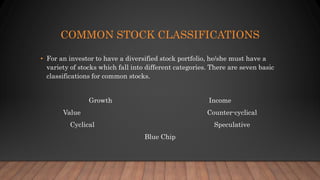
COMMON STOCK CLASSIFICATIONS
• For an investor to have a diversified stock portfolio, he/she must have a
variety of stocks which fall into different categories. There are seven basic
classifications for common stocks.
Growth Income
Value Counter-cyclical
Cyclical Speculative
Blue Chip
GROWTH
• Growth stocks are from companies who have a consistent record of
relatively rapid growth and earnings in all economic conditions. They are
generally new companies expanding their product line by retaining all
income and therefore pay no dividends. Income can be earned from an
increase in market price. The beta is 1.5 or higher.
INCOME
• Income stocks pay higher than average dividends because the company
chooses to retain only a small portion of its profits. These stocks are
attractive to investors who are interested in receiving dividends and are
not worried about selling the stock at a higher market price. These stocks
are from companies who have a steady stream of income such as utility
companies. The beta is less than 1.0.
VALUE
• Value stocks are from companies which have a low market price
considering their historical earning records and value of current assets.
They are often viewed as investment bargains. Previous examples have
included Time Warner and IBM.
COUNTERCYCLICAL
• Countercyclical stocks (defensive) are companies which give consistent
returns even when the economy is suffering because their products are
always in demand. They are good for investors who are always looking to
receive dividends. Examples include tobacco companies, utility companies
and grocery stores. The beta is 1.0 or below, even in the negative.
CYCLICAL
• Cyclical stocks are greatly influenced by changes in the economic business
cycle. If the economy is doing poorly, so is the stock. They are companies
which operate in major consumer dependent industries such as
automobiles, housing, or airlines. The beta is generally 1.0.
SPECULATIVE
• Speculative stocks are from companies with potential for substantial
earnings in the future. These stocks are very high risk, but very profitable
if the company grows. The company has a very spotty earnings pattern or
is so new an earnings pattern has not yet emerged. Internet, genetic
engineering, and video game companies are examples of speculative
companies. Microsoft was once a speculative company and is now a growth
stock. The beta is 2.0 or higher.
BLUE CHIP
• Blue-chip stocks are from nationally recognized companies which dominate
the industry often having annual revenue of $1 billion or more. They have
long records of profit, dividend payments, and a good reputation for the
company management, products, and services. These stocks are generally
higher priced but less risky because they are expected to grow at a
consistent rate. McDonalds, General Motors, and General Electric are
examples of blue-chip stock companies.
RESEARCHING A STOCK
• There are four numerical measures an investor may use to determine how
well a company’s stock is doing.
BOOK VALUE PRICE/EARNINGS RATIO (P/E ration)
EARNINGS PER SHARE BETA
BOOK VALUE
• The net worth of a company. It is determined by subtracting a company’s liabilities
from it’s assets.
• These numbers can be found in the company’s annual report. The number indicates
what would happen if a company’s assets were sold, debts paid off, and all proceeds
were distributed to those who own shares of common stock.
Formula
• Assets-Liabilities = Book value
Example
• $154,000,000—$72,000,000 = $82,000,000 is the Book Value
EARNINGS PER
SHARE (EPS)
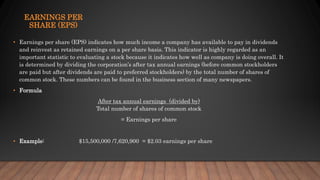
• Earnings per share (EPS) indicates how much income a company has available to pay in dividends
and reinvest as retained earnings on a per share basis. This indicator is highly regarded as an
important statistic to evaluating a stock because it indicates how well as company is doing overall. It
is determined by dividing the corporation’s after tax annual earnings (before common stockholders
are paid but after dividends are paid to preferred stockholders) by the total number of shares of
common stock. These numbers can be found in the business section of many newspapers.
• Formula
After tax annual earnings (divided by)
Total number of shares of common stock
= Earnings per share
• Example: $15,500,000 /7,620,900 = $2.03 earnings per share
PRICE/EARNINGS
RATIO
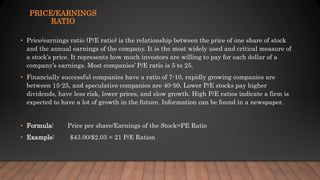
• Price/earnings ratio (P/E ratio) is the relationship between the price of one share of stock
and the annual earnings of the company. It is the most widely used and critical measure of
a stock’s price. It represents how much investors are willing to pay for each dollar of a
company’s earnings. Most companies’ P/E ratio is 5 to 25.
• Financially successful companies have a ratio of 7-10, rapidly growing companies are
between 15-25, and speculative companies are 40-50. Lower P/E stocks pay higher
dividends, have less risk, lower prices, and slow growth. High P/E ratios indicate a firm is
expected to have a lot of growth in the future. Information can be found in a newspaper.
• Formula: Price per share/Earnings of the Stock=PE Ratio
• Example: $43.00/$2.03 = 21 P/E Ration
BETA
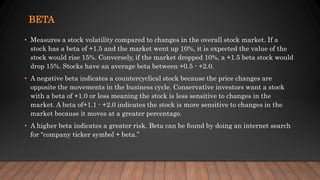
• Measures a stock volatility compared to changes in the overall stock market. If a
stock has a beta of +1.5 and the market went up 10%, it is expected the value of the
stock would rise 15%. Conversely, if the market dropped 10%, a +1.5 beta stock would
drop 15%. Stocks have an average beta between +0.5 - +2.0.
• A negative beta indicates a countercyclical stock because the price changes are
opposite the movements in the business cycle. Conservative investors want a stock
with a beta of +1.0 or less meaning the stock is less sensitive to changes in the
market. A beta of+1.1 - +2.0 indicates the stock is more sensitive to changes in the
market because it moves at a greater percentage.
• A higher beta indicates a greater risk. Beta can be found by doing an internet search
for “company ticker symbol + beta.”
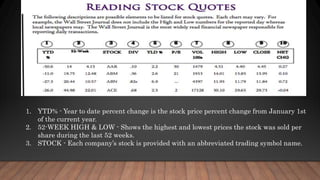
1. YTD% - Year to date percent change is the stock price percent change from January 1st
of the current year.
2. 52-WEEK HIGH & LOW - Shows the highest and lowest prices the stock was sold per
share during the last 52 weeks.
3. STOCK - Each company’s stock is provided with an abbreviated trading symbol name.
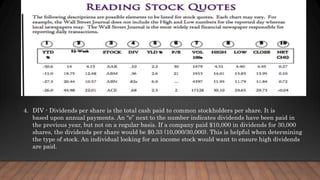
4. DIV - Dividends per share is the total cash paid to common stockholders per share. It is
based upon annual payments. An “e” next to the number indicates dividends have been paid in
the previous year, but not on a regular basis. If a company paid $10,000 in dividends for 30,000
shares, the dividends per share would be $0.33 (10,000/30,000). This is helpful when determining
the type of stock. An individual looking for an income stock would want to ensure high dividends
are paid.
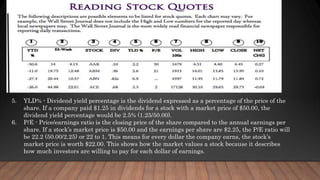
5. YLD% - Dividend yield percentage is the dividend expressed as a percentage of the price of the
share. If a company paid $1.25 in dividends for a stock with a market price of $50.00, the
dividend yield percentage would be 2.5% (1.25/50.00).
6. P/E - Price/earnings ratio is the closing price of the share compared to the annual earnings per
share. If a stock’s market price is $50.00 and the earnings per share are $2.25, the P/E ratio will
be 22.2 (50.00/2.25) or 22 to 1. This means for every dollar the company earns, the stock’s
market price is worth $22.00. This shows how the market values a stock because it describes
how much investors are willing to pay for each dollar of earnings.
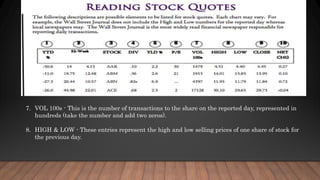
7. VOL 100s - This is the number of transactions to the share on the reported day, represented in
hundreds (take the number and add two zeros).
8. HIGH & LOW - These entries represent the high and low selling prices of one share of stock for
the previous day.
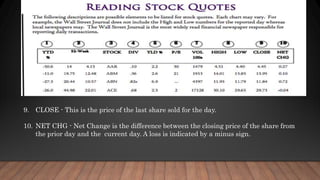
9. CLOSE - This is the price of the last share sold for the day.
10. NET CHG - Net Change is the difference between the closing price of the share from
the prior day and the current day. A loss is indicated by a minus sign.
STOCK MARKET INDICATORS
THERE ARE THREE BASIC INDEXES WHICH
TRACK STOCKS AND GIVE INDIVIDUALS A
SENSE OF THE GENERAL HEALTH OF THE
ECONOMY.
The Dow Jones Industrial Average
Began in 1884 and is the oldest indicator
of the ups and downs of the stock market.
It was named after a cofounder, Charles
H. Dow, and is nicknamed the Dow. It lists
the 30 leading industrial blue chip stocks
www.djindexes.com
The Standard & Poor’s
500 Composite Index
Covers market activity
for 500 stocks. It is more
accurate than the Dow
because it evaluates a
greater variety of stocks.
www.standardandpoors.c
om
STOCK MARKET INDICATORS
The NASDAQ (National Association of Security Dealers Automated
Quotations) monitors fast moving technology and financial services stocks. It
covers the market activity for all stocks traded on the NASDAQ. Because the
NASDAQ monitors smaller companies with a more speculative stock it
generally has more dramatic ups and downs compared to the Dow.
www.nasdaq-amex.com
BROKERS
• A broker is a person who is licensed to buy and sell stocks, provide investment advice,
and collect a commission on each purchase or sale. A broker buys and sells stocks on
the stock market (organized exchange).
• Over three-fourths of all stocks are bought and sold on an organized exchange. Each
exchange has minimum requirements for a stock to ensure only reputable companies
are used. The minimum standards include an evaluation of annual earnings before
taxes, net assets, market value, number of common shares offered to the public, and
number of stockholders owning 100 or more shares.
• Each exchange has a limited number of seats available which brokerage firms may
purchase to give them the legal right to buy and sell stocks on the exchange.
ORGANIZED EXCHANGES
The New York Stock Exchange (NYSE)
Began in 1792 and is the largest
exchange with the strictest company
standards. There are 1,366 broker seats
available to trade shares for the 2,800
companies who offer stocks on the NYSE.
The average stock price is $33.00.
www.nyse.com
The American Stock Exchange
(AMEX)
Began in 1849 and is the second largest
exchange. It differs from the NYSE because
its requirements are not as strict allowing it
to list younger, smaller companies. The
average stock price is $24.00.
Regional Stock Exchanges
Trade stocks to investors living in a
specific geographical area. Regional
exchanges include Boston,
Cincinnati, Intermountain, Midwest,
Philadelphia, and Spokane
National Association of Securities Dealers Automated
Quotations (NASDAQ)
Not all stocks are listed on a securities exchange. Some
are sold in the over-the-counter market. These stock
transactions are negotiated through a sophisticated
telecommunication network run by the NASDAQ.
The NASDAQ has more than 4,000 small United States
and foreign companies listed. The company requirements
are not strict. The NASDAQ works by having two brokers
negotiate a stock’s purchase and selling price. The price
at which a stock is sold is the lowest price any broker will
accept at the time.
The average stock price is $11.00
www.nasdaq.com
• The state of the e term bull market
describes the economy when the
market is doing well and investors
are optimistic about the economy
and are purchasing stocks. A bull
market occurs when prices have
risen 20 percent or more over time.
On average, the bull markets last
29 months at a time.
UPS AND
DOWNS The term bear market describes
the state of the economy when
the market is doing poorly and
investors are not confident in the
economy. Therefore, they are not
purchasing stocks or are selling
stocks already owned. It is
characterized by a 20 percent
decline from previous highs. On
average, the bear markets lasts 9
months at a time.
BEHIND THE SCENES
• When a person has chosen a stock he/she would like to purchase, they may
purchase it on their own, however there are some practical and legal problems
which can occur. The stock market is a highly regulated exchange allowing only
those who are properly registered and licensed to buy and sell stock.
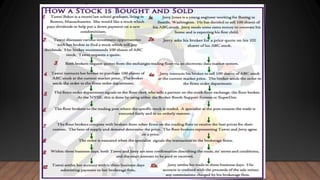
• When individuals think of a stock exchange, they imagine this scene of frantic
activity, people yelling, making strange hand signals, and papers flying.
However, the stock exchange is actually a very methodical and organized
system. Buyers and sellers are meeting to compete for the best price for their
customers. It is based upon the laws of supply and demand. A trade occurs
when the highest bid meets the lowest offer to sell.
CITATION
• Family Economics and Financial Eduction

LSM

  • 1.
    LANGUAGE OF THE STOCKMARKET YES IT IS LONG –BUT INFORMATIVE
  • 2.
    WHY LEARN ABOUTSTOCK • One hears about the stock market on a daily basis. Not necessarily because they want to, but because it has become an integral part of American society. The market is the core of economic stability in the United States. Stocks and bonds represent companies which touch aspect of every person’s life. • The stock market is a general term used to describe all transactions involving the buying and selling of stock shares issued by a company. A stock is a share of ownership in the assets and earnings of a company. It is represented by a piece of paper called the stock certificate. A bond is a type of debt that a company issues to investors for a specified amount of time. The company pays annual interest on the loan until the maturity date is reached when the principal is paid back to the
  • 3.
    LEARNING ABOUT STOCK- WHY •When a company would like to grow, there are several methods which could be used to raise the funds and pay for ongoing business activities. One of the most preferred methods is to sell shares of ownership, called stock, to investors. Two reasons why issuing stock is popular are the company does not have to repay the money and paying dividends is optional. Investors that purchase stock earn money from increases in the stock’s value and/or dividends. • An individual who keeps all of his/her earnings in an ultraconservative savings and investment option, such as a Certificate of Deposit, will have low earnings which will barely cover taxes and inflation.
  • 4.
    LEARNING ABOUT STOCKS- WHY •Therefore, the increased earning potential has made investing in the stock market an essential element to portfolio diversification. A person with a diversified portfolio has money invested in a variety of investment tools to decrease risk. Stocks are very marketable because they can be bought and sold with ease. • Investing in stocks increases an individual’s potential future earning power. There is also an increased risk the individual will lose his/her money. • Determining which stock to purchase can be very difficult because there are more than 7,000 companies available which offer stocks. To decrease the potential risks associated with investing in the stock market, a person must be able to research and track stocks. Two basic types of stock an investor may choose to put his/her money into are common and preferred.
  • 5.
    COMMON STOCK • Commonstock refers to shares or units of ownership in a public corporation. This is the most typical kind of stock. • An individual who has invested in common stock has one vote per share owned to determine the company’s board of directors. The value of a stock can change in four ways. The dollar value of the stock changes between the time the buyer purchases and sells a stock. A stock split occurs. This means, if there is a 2 for 1 split and an individual owns one share worth $100.00 after the split, the individual will own two shares worth $50.00 each. After a split, the value of a stock generally increases. A merger (joining) of two companies occurs causing a change in the stock price. Dividends are distributions of earnings a corporation pays to stockholders. They are paid in the form of cash, company products, property, discounts, and additional stocks.
  • 6.
    PREFERRED STOCK • Preferredstock refers to shares which pay fixed dividends and have precedence over common stock. Because of this priority, preferred stock has less risk than a common stock. • Individuals do not have a vote to determine the company’s board of directors. Dividends for each stock are stated as a percentage known as the par value. This value is a fixed percentage stated on the stock certificate. If a $100.00 stock has a par value of 6%, the dollar amount would be $6.00 per dividend period. The market price, amount a willing buyer would pay a willing seller for the stock, is based upon interest rates of the economy. If interest rates increase, the market price decreases so the stock remains competitive with other investment options. Typically a person can find this information in the business section of a newspaper or on the internet.
  • 7.
    COMMON STOCK CLASSIFICATIONS •For an investor to have a diversified stock portfolio, he/she must have a variety of stocks which fall into different categories. There are seven basic classifications for common stocks. Growth Income Value Counter-cyclical Cyclical Speculative Blue Chip
  • 8.
    GROWTH • Growth stocksare from companies who have a consistent record of relatively rapid growth and earnings in all economic conditions. They are generally new companies expanding their product line by retaining all income and therefore pay no dividends. Income can be earned from an increase in market price. The beta is 1.5 or higher.
  • 9.
    INCOME • Income stockspay higher than average dividends because the company chooses to retain only a small portion of its profits. These stocks are attractive to investors who are interested in receiving dividends and are not worried about selling the stock at a higher market price. These stocks are from companies who have a steady stream of income such as utility companies. The beta is less than 1.0.
  • 10.
    VALUE • Value stocksare from companies which have a low market price considering their historical earning records and value of current assets. They are often viewed as investment bargains. Previous examples have included Time Warner and IBM.
  • 11.
    COUNTERCYCLICAL • Countercyclical stocks(defensive) are companies which give consistent returns even when the economy is suffering because their products are always in demand. They are good for investors who are always looking to receive dividends. Examples include tobacco companies, utility companies and grocery stores. The beta is 1.0 or below, even in the negative.
  • 12.
    CYCLICAL • Cyclical stocksare greatly influenced by changes in the economic business cycle. If the economy is doing poorly, so is the stock. They are companies which operate in major consumer dependent industries such as automobiles, housing, or airlines. The beta is generally 1.0.
  • 13.
    SPECULATIVE • Speculative stocksare from companies with potential for substantial earnings in the future. These stocks are very high risk, but very profitable if the company grows. The company has a very spotty earnings pattern or is so new an earnings pattern has not yet emerged. Internet, genetic engineering, and video game companies are examples of speculative companies. Microsoft was once a speculative company and is now a growth stock. The beta is 2.0 or higher.
  • 14.
    BLUE CHIP • Blue-chipstocks are from nationally recognized companies which dominate the industry often having annual revenue of $1 billion or more. They have long records of profit, dividend payments, and a good reputation for the company management, products, and services. These stocks are generally higher priced but less risky because they are expected to grow at a consistent rate. McDonalds, General Motors, and General Electric are examples of blue-chip stock companies.
  • 15.
    RESEARCHING A STOCK •There are four numerical measures an investor may use to determine how well a company’s stock is doing. BOOK VALUE PRICE/EARNINGS RATIO (P/E ration) EARNINGS PER SHARE BETA
  • 16.
    BOOK VALUE • Thenet worth of a company. It is determined by subtracting a company’s liabilities from it’s assets. • These numbers can be found in the company’s annual report. The number indicates what would happen if a company’s assets were sold, debts paid off, and all proceeds were distributed to those who own shares of common stock. Formula • Assets-Liabilities = Book value Example • $154,000,000—$72,000,000 = $82,000,000 is the Book Value
  • 17.
    EARNINGS PER SHARE (EPS) •Earnings per share (EPS) indicates how much income a company has available to pay in dividends and reinvest as retained earnings on a per share basis. This indicator is highly regarded as an important statistic to evaluating a stock because it indicates how well as company is doing overall. It is determined by dividing the corporation’s after tax annual earnings (before common stockholders are paid but after dividends are paid to preferred stockholders) by the total number of shares of common stock. These numbers can be found in the business section of many newspapers. • Formula After tax annual earnings (divided by) Total number of shares of common stock = Earnings per share • Example: $15,500,000 /7,620,900 = $2.03 earnings per share
  • 18.
    PRICE/EARNINGS RATIO • Price/earnings ratio(P/E ratio) is the relationship between the price of one share of stock and the annual earnings of the company. It is the most widely used and critical measure of a stock’s price. It represents how much investors are willing to pay for each dollar of a company’s earnings. Most companies’ P/E ratio is 5 to 25. • Financially successful companies have a ratio of 7-10, rapidly growing companies are between 15-25, and speculative companies are 40-50. Lower P/E stocks pay higher dividends, have less risk, lower prices, and slow growth. High P/E ratios indicate a firm is expected to have a lot of growth in the future. Information can be found in a newspaper. • Formula: Price per share/Earnings of the Stock=PE Ratio • Example: $43.00/$2.03 = 21 P/E Ration
  • 19.
    BETA • Measures astock volatility compared to changes in the overall stock market. If a stock has a beta of +1.5 and the market went up 10%, it is expected the value of the stock would rise 15%. Conversely, if the market dropped 10%, a +1.5 beta stock would drop 15%. Stocks have an average beta between +0.5 - +2.0. • A negative beta indicates a countercyclical stock because the price changes are opposite the movements in the business cycle. Conservative investors want a stock with a beta of +1.0 or less meaning the stock is less sensitive to changes in the market. A beta of+1.1 - +2.0 indicates the stock is more sensitive to changes in the market because it moves at a greater percentage. • A higher beta indicates a greater risk. Beta can be found by doing an internet search for “company ticker symbol + beta.”
  • 20.
    1. YTD% -Year to date percent change is the stock price percent change from January 1st of the current year. 2. 52-WEEK HIGH & LOW - Shows the highest and lowest prices the stock was sold per share during the last 52 weeks. 3. STOCK - Each company’s stock is provided with an abbreviated trading symbol name.
  • 21.
    4. DIV -Dividends per share is the total cash paid to common stockholders per share. It is based upon annual payments. An “e” next to the number indicates dividends have been paid in the previous year, but not on a regular basis. If a company paid $10,000 in dividends for 30,000 shares, the dividends per share would be $0.33 (10,000/30,000). This is helpful when determining the type of stock. An individual looking for an income stock would want to ensure high dividends are paid.
  • 22.
    5. YLD% -Dividend yield percentage is the dividend expressed as a percentage of the price of the share. If a company paid $1.25 in dividends for a stock with a market price of $50.00, the dividend yield percentage would be 2.5% (1.25/50.00). 6. P/E - Price/earnings ratio is the closing price of the share compared to the annual earnings per share. If a stock’s market price is $50.00 and the earnings per share are $2.25, the P/E ratio will be 22.2 (50.00/2.25) or 22 to 1. This means for every dollar the company earns, the stock’s market price is worth $22.00. This shows how the market values a stock because it describes how much investors are willing to pay for each dollar of earnings.
  • 23.
    7. VOL 100s- This is the number of transactions to the share on the reported day, represented in hundreds (take the number and add two zeros). 8. HIGH & LOW - These entries represent the high and low selling prices of one share of stock for the previous day.
  • 24.
    9. CLOSE -This is the price of the last share sold for the day. 10. NET CHG - Net Change is the difference between the closing price of the share from the prior day and the current day. A loss is indicated by a minus sign.
  • 25.
    STOCK MARKET INDICATORS THEREARE THREE BASIC INDEXES WHICH TRACK STOCKS AND GIVE INDIVIDUALS A SENSE OF THE GENERAL HEALTH OF THE ECONOMY. The Dow Jones Industrial Average Began in 1884 and is the oldest indicator of the ups and downs of the stock market. It was named after a cofounder, Charles H. Dow, and is nicknamed the Dow. It lists the 30 leading industrial blue chip stocks www.djindexes.com The Standard & Poor’s 500 Composite Index Covers market activity for 500 stocks. It is more accurate than the Dow because it evaluates a greater variety of stocks. www.standardandpoors.c om
  • 26.
    STOCK MARKET INDICATORS TheNASDAQ (National Association of Security Dealers Automated Quotations) monitors fast moving technology and financial services stocks. It covers the market activity for all stocks traded on the NASDAQ. Because the NASDAQ monitors smaller companies with a more speculative stock it generally has more dramatic ups and downs compared to the Dow. www.nasdaq-amex.com
  • 27.
    BROKERS • A brokeris a person who is licensed to buy and sell stocks, provide investment advice, and collect a commission on each purchase or sale. A broker buys and sells stocks on the stock market (organized exchange). • Over three-fourths of all stocks are bought and sold on an organized exchange. Each exchange has minimum requirements for a stock to ensure only reputable companies are used. The minimum standards include an evaluation of annual earnings before taxes, net assets, market value, number of common shares offered to the public, and number of stockholders owning 100 or more shares. • Each exchange has a limited number of seats available which brokerage firms may purchase to give them the legal right to buy and sell stocks on the exchange.
  • 28.
    ORGANIZED EXCHANGES The NewYork Stock Exchange (NYSE) Began in 1792 and is the largest exchange with the strictest company standards. There are 1,366 broker seats available to trade shares for the 2,800 companies who offer stocks on the NYSE. The average stock price is $33.00. www.nyse.com The American Stock Exchange (AMEX) Began in 1849 and is the second largest exchange. It differs from the NYSE because its requirements are not as strict allowing it to list younger, smaller companies. The average stock price is $24.00. Regional Stock Exchanges Trade stocks to investors living in a specific geographical area. Regional exchanges include Boston, Cincinnati, Intermountain, Midwest, Philadelphia, and Spokane National Association of Securities Dealers Automated Quotations (NASDAQ) Not all stocks are listed on a securities exchange. Some are sold in the over-the-counter market. These stock transactions are negotiated through a sophisticated telecommunication network run by the NASDAQ. The NASDAQ has more than 4,000 small United States and foreign companies listed. The company requirements are not strict. The NASDAQ works by having two brokers negotiate a stock’s purchase and selling price. The price at which a stock is sold is the lowest price any broker will accept at the time. The average stock price is $11.00 www.nasdaq.com
  • 29.
    • The stateof the e term bull market describes the economy when the market is doing well and investors are optimistic about the economy and are purchasing stocks. A bull market occurs when prices have risen 20 percent or more over time. On average, the bull markets last 29 months at a time. UPS AND DOWNS The term bear market describes the state of the economy when the market is doing poorly and investors are not confident in the economy. Therefore, they are not purchasing stocks or are selling stocks already owned. It is characterized by a 20 percent decline from previous highs. On average, the bear markets lasts 9 months at a time.
  • 30.
    BEHIND THE SCENES •When a person has chosen a stock he/she would like to purchase, they may purchase it on their own, however there are some practical and legal problems which can occur. The stock market is a highly regulated exchange allowing only those who are properly registered and licensed to buy and sell stock. • When individuals think of a stock exchange, they imagine this scene of frantic activity, people yelling, making strange hand signals, and papers flying. However, the stock exchange is actually a very methodical and organized system. Buyers and sellers are meeting to compete for the best price for their customers. It is based upon the laws of supply and demand. A trade occurs when the highest bid meets the lowest offer to sell.
  • 32.
    CITATION • Family Economicsand Financial Eduction