It’s March!
Time to Think Green
HOW MONEY
$MART ARE YOU?
Test your knowledge and learn about
financial concepts in the following slides.
Once you have finished, you will create a
cartoon that teaches others about one of
these concepts.
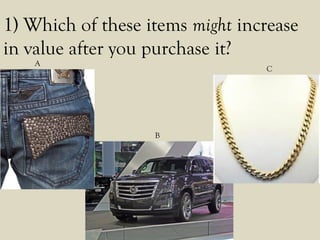
1) Which of these items might increase
in value after you purchase it?
A
B
C
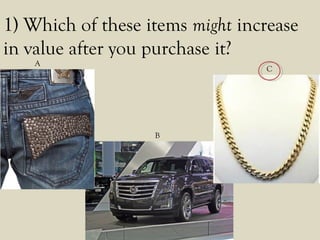
1) Which of these items might increase
in value after you purchase it?
A
B
C
Why?
Clothing and automobiles depreciate or lose
value as soon as they are used. So do items such
as computers, phones and other gadgets.
The price of gold and other precious metals
changes with the market; sometimes it decreases
but often it increases. Other items that can
appreciate or increase in value are homes, land,
and special collections (artwork, coins, etc.).
True or False: All bank accounts
offer the same features?
a. True
b. False
True or False: All bank accounts
offer the same features?
a. True
b. False
• Banks offer different types of accounts:
– Savings accounts are protected by insurance and therefore risk-free; they usually offer
low interest rates. Some might require a minimum deposit. Many allow you to use an
ATM card.
– Checking accounts are used for more frequent access to money (paying bills) and
come with paper checks and often an ATM card. Again deposits are protected by
insurance. Many checking accounts do not offer interest. There are frequently
charges for overdrawing (spending more than you have).
– Money market accounts usually pay a higher interest rate but require a large
minimum balance. They are often used for the infrequent purchase of big-ticket
(expensive items.)
– Certificates of deposit, or CDs, usually require you to keep your money in an
account for a specific amount of time, anywhere from 3 months to 10 years. They
pay a higher rate of interest but you cannot access your money during the term of the
CD.
• It’s important to do your research before you choose a
bank. Check to see what fees the bank might charge;
what interest it offers on various accounts; and what
requirements they have to open and maintain an
account.
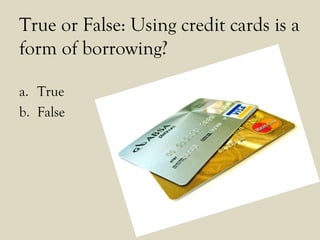
True or False: Using credit cards is a
form of borrowing?
a. True
b. False
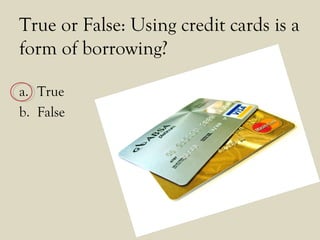
True or False: Using credit cards is a
form of borrowing?
a. True
b. False
Why?
• Credit cards are a very expensive way to borrow
money, because the interest rates (the
percentage you pay for borrowing money) are
very high and can be accompanied by other fees
–such as an annual cost for having the card,
and charges for withdrawing cash, making late
payments, etc.).
• Credit cards should only be used for purchases
that can be paid off each month.
2) Which of these long-term savings plans will
result in the largest sum by the time the
individual is 65?
a. Joe saves $1,000 per year from
age 25 to 35 in an account
earning 8 percent interest; after
35 he simply leaves his money in
the account.
b. Gina saves $1,000 per year from
age 35 to 65 in an account
earning 8 percent interest.
c. Both will have the same.
2) Which of these long-term savings plans will
result in the largest sum by the time the
individual is 65?
a. Joe saves $1,000 per year from
age 25 to 35 in an account
earning 8 percent interest; after
35 he simply leaves his money in
the account.
b. Gina saves $1,000 per year from
age 35 to 65 in an account
earning 8 percent interest.
c. Both will have the same.
Why?
• That is the beauty of compound interest! Your
money earns interest, and then you earn more
interest based on your original investment plus
that interest. Over time, compound interest can
result in significant money earned.
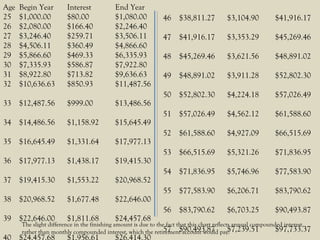
• Joe saved $10,000 but comes out ahead with
$169,000. Hard to believe? (Gina saved
$30,000 but her money did not have as much
time to grow. Still, she has $125,000 in her
account.)
• See how Joe’s interest is compounded on the
next page.
Age Begin Year Interest End Year
25 $1,000.00 $80.00 $1,080.00
26 $2,080.00 $166.40 $2,246.40
27 $3,246.40 $259.71 $3,506.11
28 $4,506.11 $360.49 $4,866.60
29 $5,866.60 $469.33 $6,335.93
30 $7,335.93 $586.87 $7,922.80
31 $8,922.80 $713.82 $9,636.63
32 $10,636.63 $850.93 $11,487.56
33 $12,487.56 $999.00 $13,486.56
34 $14,486.56 $1,158.92 $15,645.49
35 $16,645.49 $1,331.64 $17,977.13
36 $17,977.13 $1,438.17 $19,415.30
37 $19,415.30 $1,553.22 $20,968.52
38 $20,968.52 $1,677.48 $22,646.00
39 $22,646.00 $1,811.68 $24,457.68
46 $38,811.27 $3,104.90 $41,916.17
47 $41,916.17 $3,353.29 $45,269.46
48 $45,269.46 $3,621.56 $48,891.02
49 $48,891.02 $3,911.28 $52,802.30
50 $52,802.30 $4,224.18 $57,026.49
51 $57,026.49 $4,562.12 $61,588.60
52 $61,588.60 $4,927.09 $66,515.69
53 $66,515.69 $5,321.26 $71,836.95
54 $71,836.95 $5,746.96 $77,583.90
55 $77,583.90 $6,206.71 $83,790.62
56 $83,790.62 $6,703.25 $90,493.87
57 $90,493.87 $7,239.51 $97,733.37
The slight difference in the finishing amount is due to the fact that this chart reflects annual compounded interest,
rather than monthly compounded interest, which the retirement account would pay.
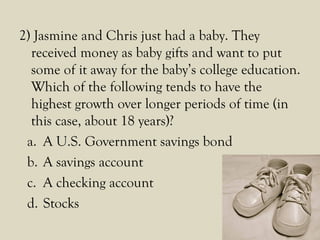
2) Jasmine and Chris just had a baby. They
received money as baby gifts and want to put
some of it away for the baby’s college education.
Which of the following tends to have the
highest growth over longer periods of time (in
this case, about 18 years)?
a. A U.S. Government savings bond
b. A savings account
c. A checking account
d. Stocks
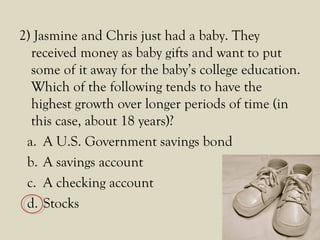
2) Jasmine and Chris just had a baby. They
received money as baby gifts and want to put
some of it away for the baby’s college education.
Which of the following tends to have the
highest growth over longer periods of time (in
this case, about 18 years)?
a. A U.S. Government savings bond
b. A savings account
c. A checking account
d. Stocks
Why?
Stocks are a RISKIER investment than bonds or
bank accounts. With greater risk (the possibility
of losing money) comes the potential for higher
returns (earnings) when the stock’s value grows.
Without expertise about the stock market, it is
better to use this type of investment for longer-
term goals and to invest in a mutual fund or
other tool that allows you to own a mix of stocks,
rather than a single stock.
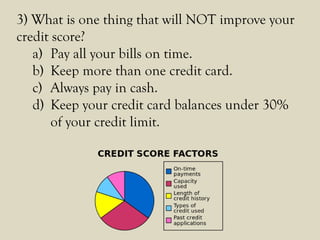
3) What is one thing that will NOT improve your
credit score?
a) Pay all your bills on time.
b) Keep more than one credit card.
c) Always pay in cash.
d) Keep your credit card balances under 30%
of your credit limit.
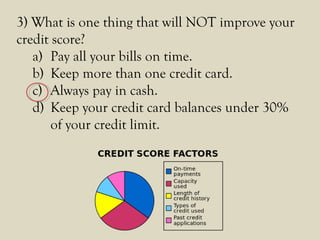
3) What is one thing that will NOT improve your
credit score?
a) Pay all your bills on time.
b) Keep more than one credit card.
c) Always pay in cash.
d) Keep your credit card balances under 30%
of your credit limit.
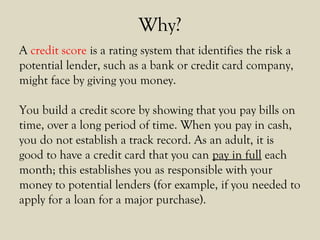
Why?
A credit score is a rating system that identifies the risk a
potential lender, such as a bank or credit card company,
might face by giving you money.
You build a credit score by showing that you pay bills on
time, over a long period of time. When you pay in cash,
you do not establish a track record. As an adult, it is
good to have a credit card that you can pay in full each
month; this establishes you as responsible with your
money to potential lenders (for example, if you needed to
apply for a loan for a major purchase).
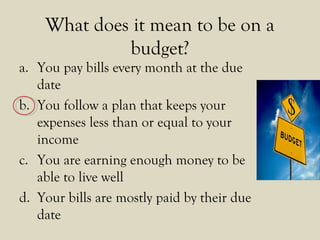
What does it mean to be on a
budget?
a. You pay bills every month at the due
date
b. You follow a plan that keeps your
expenses less than or equal to your
income
c. You are earning enough money to be
able to live well
d. Your bills are mostly paid by their due
date
What does it mean to be on a
budget?
a. You pay bills every month at the due
date
b. You follow a plan that keeps your
expenses less than or equal to your
income
c. You are earning enough money to be
able to live well
d. Your bills are mostly paid by their due
date
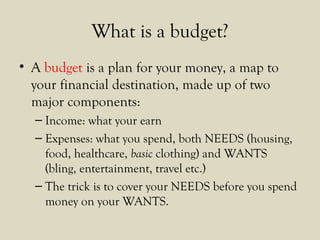
What is a budget?
• A budget is a plan for your money, a map to
your financial destination, made up of two
major components:
– Income: what your earn
– Expenses: what you spend, both NEEDS (housing,
food, healthcare, basic clothing) and WANTS
(bling, entertainment, travel etc.)
– The trick is to cover your NEEDS before you spend
money on your WANTS.
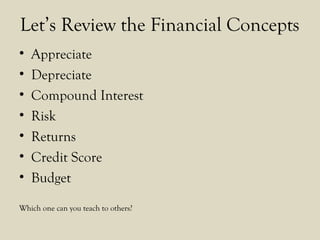
Let’s Review the Financial Concepts
• Appreciate
• Depreciate
• Compound Interest
• Risk
• Returns
• Credit Score
• Budget
Which one can you teach to others?
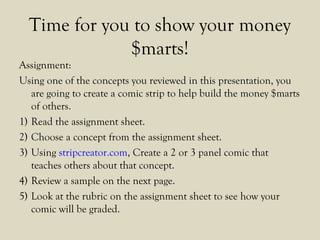
Time for you to show your money
$marts!
Assignment:
Using one of the concepts you reviewed in this presentation, you
are going to create a comic strip to help build the money $marts
of others.
1) Read the assignment sheet.
2) Choose a concept from the assignment sheet.
3) Using stripcreator.com, Create a 2 or 3 panel comic that
teaches others about that concept.
4) Review a sample on the next page.
5) Look at the rubric on the assignment sheet to see how your
comic will be graded.
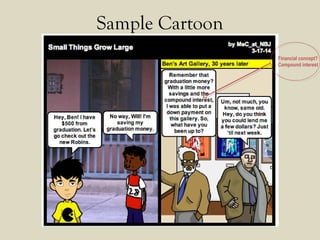
Sample Cartoon
Financial concept?
Compound interest

Think green

  • 1.
  • 2.
    HOW MONEY $MART AREYOU? Test your knowledge and learn about financial concepts in the following slides. Once you have finished, you will create a cartoon that teaches others about one of these concepts.
  • 3.
    1) Which ofthese items might increase in value after you purchase it? A B C
  • 4.
    1) Which ofthese items might increase in value after you purchase it? A B C
  • 5.
    Why? Clothing and automobilesdepreciate or lose value as soon as they are used. So do items such as computers, phones and other gadgets. The price of gold and other precious metals changes with the market; sometimes it decreases but often it increases. Other items that can appreciate or increase in value are homes, land, and special collections (artwork, coins, etc.).
  • 6.
    True or False:All bank accounts offer the same features? a. True b. False
  • 7.
    True or False:All bank accounts offer the same features? a. True b. False
  • 8.
    • Banks offerdifferent types of accounts: – Savings accounts are protected by insurance and therefore risk-free; they usually offer low interest rates. Some might require a minimum deposit. Many allow you to use an ATM card. – Checking accounts are used for more frequent access to money (paying bills) and come with paper checks and often an ATM card. Again deposits are protected by insurance. Many checking accounts do not offer interest. There are frequently charges for overdrawing (spending more than you have). – Money market accounts usually pay a higher interest rate but require a large minimum balance. They are often used for the infrequent purchase of big-ticket (expensive items.) – Certificates of deposit, or CDs, usually require you to keep your money in an account for a specific amount of time, anywhere from 3 months to 10 years. They pay a higher rate of interest but you cannot access your money during the term of the CD. • It’s important to do your research before you choose a bank. Check to see what fees the bank might charge; what interest it offers on various accounts; and what requirements they have to open and maintain an account.
  • 9.
    True or False:Using credit cards is a form of borrowing? a. True b. False
  • 10.
    True or False:Using credit cards is a form of borrowing? a. True b. False
  • 11.
    Why? • Credit cardsare a very expensive way to borrow money, because the interest rates (the percentage you pay for borrowing money) are very high and can be accompanied by other fees –such as an annual cost for having the card, and charges for withdrawing cash, making late payments, etc.). • Credit cards should only be used for purchases that can be paid off each month.
  • 12.
    2) Which ofthese long-term savings plans will result in the largest sum by the time the individual is 65? a. Joe saves $1,000 per year from age 25 to 35 in an account earning 8 percent interest; after 35 he simply leaves his money in the account. b. Gina saves $1,000 per year from age 35 to 65 in an account earning 8 percent interest. c. Both will have the same.
  • 13.
    2) Which ofthese long-term savings plans will result in the largest sum by the time the individual is 65? a. Joe saves $1,000 per year from age 25 to 35 in an account earning 8 percent interest; after 35 he simply leaves his money in the account. b. Gina saves $1,000 per year from age 35 to 65 in an account earning 8 percent interest. c. Both will have the same.
  • 14.
    Why? • That isthe beauty of compound interest! Your money earns interest, and then you earn more interest based on your original investment plus that interest. Over time, compound interest can result in significant money earned. • Joe saved $10,000 but comes out ahead with $169,000. Hard to believe? (Gina saved $30,000 but her money did not have as much time to grow. Still, she has $125,000 in her account.) • See how Joe’s interest is compounded on the next page.
  • 15.
    Age Begin YearInterest End Year 25 $1,000.00 $80.00 $1,080.00 26 $2,080.00 $166.40 $2,246.40 27 $3,246.40 $259.71 $3,506.11 28 $4,506.11 $360.49 $4,866.60 29 $5,866.60 $469.33 $6,335.93 30 $7,335.93 $586.87 $7,922.80 31 $8,922.80 $713.82 $9,636.63 32 $10,636.63 $850.93 $11,487.56 33 $12,487.56 $999.00 $13,486.56 34 $14,486.56 $1,158.92 $15,645.49 35 $16,645.49 $1,331.64 $17,977.13 36 $17,977.13 $1,438.17 $19,415.30 37 $19,415.30 $1,553.22 $20,968.52 38 $20,968.52 $1,677.48 $22,646.00 39 $22,646.00 $1,811.68 $24,457.68 46 $38,811.27 $3,104.90 $41,916.17 47 $41,916.17 $3,353.29 $45,269.46 48 $45,269.46 $3,621.56 $48,891.02 49 $48,891.02 $3,911.28 $52,802.30 50 $52,802.30 $4,224.18 $57,026.49 51 $57,026.49 $4,562.12 $61,588.60 52 $61,588.60 $4,927.09 $66,515.69 53 $66,515.69 $5,321.26 $71,836.95 54 $71,836.95 $5,746.96 $77,583.90 55 $77,583.90 $6,206.71 $83,790.62 56 $83,790.62 $6,703.25 $90,493.87 57 $90,493.87 $7,239.51 $97,733.37 The slight difference in the finishing amount is due to the fact that this chart reflects annual compounded interest, rather than monthly compounded interest, which the retirement account would pay.
  • 16.
    2) Jasmine andChris just had a baby. They received money as baby gifts and want to put some of it away for the baby’s college education. Which of the following tends to have the highest growth over longer periods of time (in this case, about 18 years)? a. A U.S. Government savings bond b. A savings account c. A checking account d. Stocks
  • 17.
    2) Jasmine andChris just had a baby. They received money as baby gifts and want to put some of it away for the baby’s college education. Which of the following tends to have the highest growth over longer periods of time (in this case, about 18 years)? a. A U.S. Government savings bond b. A savings account c. A checking account d. Stocks
  • 18.
    Why? Stocks are aRISKIER investment than bonds or bank accounts. With greater risk (the possibility of losing money) comes the potential for higher returns (earnings) when the stock’s value grows. Without expertise about the stock market, it is better to use this type of investment for longer- term goals and to invest in a mutual fund or other tool that allows you to own a mix of stocks, rather than a single stock.
  • 19.
    3) What isone thing that will NOT improve your credit score? a) Pay all your bills on time. b) Keep more than one credit card. c) Always pay in cash. d) Keep your credit card balances under 30% of your credit limit.
  • 20.
    3) What isone thing that will NOT improve your credit score? a) Pay all your bills on time. b) Keep more than one credit card. c) Always pay in cash. d) Keep your credit card balances under 30% of your credit limit.
  • 21.
    Why? A credit scoreis a rating system that identifies the risk a potential lender, such as a bank or credit card company, might face by giving you money. You build a credit score by showing that you pay bills on time, over a long period of time. When you pay in cash, you do not establish a track record. As an adult, it is good to have a credit card that you can pay in full each month; this establishes you as responsible with your money to potential lenders (for example, if you needed to apply for a loan for a major purchase).
  • 22.
    What does itmean to be on a budget? a. You pay bills every month at the due date b. You follow a plan that keeps your expenses less than or equal to your income c. You are earning enough money to be able to live well d. Your bills are mostly paid by their due date
  • 23.
    What does itmean to be on a budget? a. You pay bills every month at the due date b. You follow a plan that keeps your expenses less than or equal to your income c. You are earning enough money to be able to live well d. Your bills are mostly paid by their due date
  • 24.
    What is abudget? • A budget is a plan for your money, a map to your financial destination, made up of two major components: – Income: what your earn – Expenses: what you spend, both NEEDS (housing, food, healthcare, basic clothing) and WANTS (bling, entertainment, travel etc.) – The trick is to cover your NEEDS before you spend money on your WANTS.
  • 25.
    Let’s Review theFinancial Concepts • Appreciate • Depreciate • Compound Interest • Risk • Returns • Credit Score • Budget Which one can you teach to others?
  • 26.
    Time for youto show your money $marts! Assignment: Using one of the concepts you reviewed in this presentation, you are going to create a comic strip to help build the money $marts of others. 1) Read the assignment sheet. 2) Choose a concept from the assignment sheet. 3) Using stripcreator.com, Create a 2 or 3 panel comic that teaches others about that concept. 4) Review a sample on the next page. 5) Look at the rubric on the assignment sheet to see how your comic will be graded.
  • 27.