Muhammad Kamal (3325610) Page 1
MSc. PETROLEUM ENGINEERRING
EAB_7_152 Petro Physics
Dr. Elsa Aristodemou
Permeability and Porosity
By
Muhammad Kamal
Student ID # 3325610
SubmissionDate: 30/11/2014
Muhammad Kamal (3325610) Page 2
FORMATION PERMEABILITY
ABSTRACT:
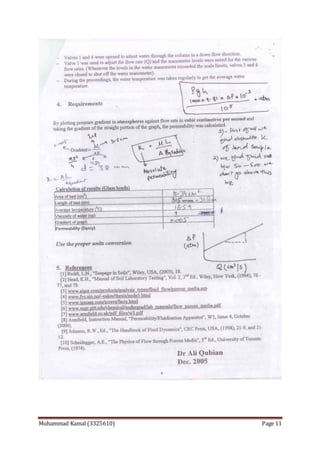
We can findAbsolute Permeabilityof the porousmediumusingDarcyEquationandbyplottinga
graph betweenpressure gradientandflow rate.The Graphshowsthe linearrelationshipbetweenQ
and DeltaP,meansthat as the flowrate increasesdeltaPalsoincreases.We can findRelative
Permeabilityof the mediumusingDarcyMethodandCoreyMethod andplotthe graphsbetween
Relative Permeabilityof oil andRelativePermeabilityof waterwithrespecttoWaterSaturation. We
can alsomeasure permeabilitybymeasuringdifferentHeightsof three differentlengthsof sand
packingfor three differentflowrates.
We can calculate the porosityof sandstone core samplesbycalculatingbulkvolumeandpore
volume.
INTRODUCTION:
Permeabilityisthe abilityof porousmediatopassa fluidthroughitsporesandit isaffectedbyGrain
Packing,GrainAngularityandGrainsize Distribution.
We have to calculate the absolute permeabilityof the porousmediumusingDarcyequationwhichis
K=QµL/A∆𝑃
Where k=Permeability,Q=FlowRate(cm3
/s),µ=viscosity, L=Length(cm),A=Area(cm2), ∆𝑃=Pressure
Drop(atm)
By puttingall the valuesinabove equationwe cangetthe value of absolute permeabilityk.
We can alsoget absolute permeabilitybyequation
K=µL/A.Gradient
All the valuesare knownexceptGradientwhichwe getbydrawingagraph betweenflowrate(cm3
/s)
vs ∆𝑃(atm).
By drawinga graph betweenQand ∆𝑃 we got a linearrelationshipbetweenthem.
Same Experimentisusedtodetermine the relative permeabilityof Oil andWater.We can use Darcy
Equationto determinerelative permeabilityof oil andwater.
Qi=[Kkri/µi]*A∆𝑃i/L
We can use CoreyEquationto determineRelative permeabilityof oil andwaterinabsence of Darcy
Equation.
Kro= [1-Sw/I-Swc]4
Muhammad Kamal (3325610) Page 3
Where Kro isRelative Permeabilityof oil.
Once we get the value of Kro ,we can findKobyusingthe formulaKo=Kro*K
SimilarlyforRelative Permeabilityof Waterwe have
Krw=[Sw-Swc/1-Swc]4
Once we get the value of Krwwe can findKw by usingthe formulaKw=Krw*K
We alsohave three samplesof sand.We can measure differentheightsof three differentsand
samplesforthree differentflowrate andmeasure the permeability.We canalsoplotthe graphs of
Q vs ∆𝑃 forthree sandsamplesandfindthe gradientof eachsample.Once we findthree gradients
thenwe can findpermeabilityeasily.
PROCEDURE:
Firstof all we closedall the valvesandswitchonthe pump.Afterthat we openthe Manometer
valvestomeasure the pressure difference atdifferentflow rates.Thermometerisplacedinabeaker
to measure the Temperature of water.We canslowlyincrease the flow ratesandmeasuresthe
correspondingpressuresandtemperatures.We continueourprocedure andtake atleast10
Readings.
Muhammad Kamal (3325610) Page 4
RESULTS & DISCUSSION:
PART A
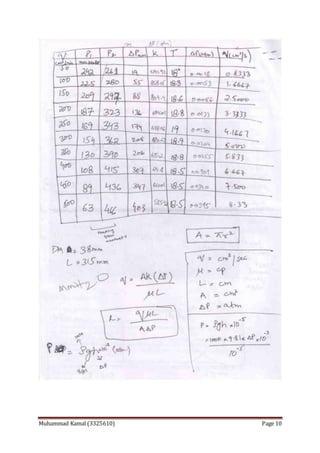
In part A we calculate twopermeability.One byDarcyLaw and secondbydrawinga graph between
∆𝑃(atm) vs Q(cm3
/s).
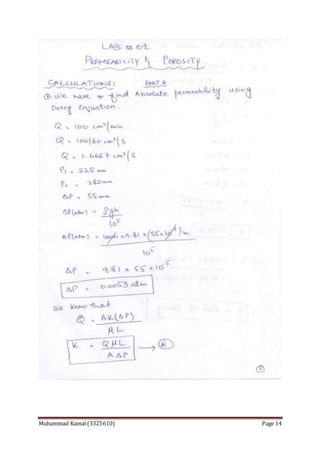
1. Calculationsfor Absolute PermeabilityusingDarcy Law
 First of all convert the flow rate cm3/min into cm3/s by dividing it with 60.
 Convert ∆𝑃(mm) into ∆𝑃(atm) by P=1000*g*h/105
 P=1000*9.81*(19*10-3)m/105
 P=0.001863 atm
 We can findpermeabilitybyDarcyLaw usingEquation
K=QµL/A∆𝑃
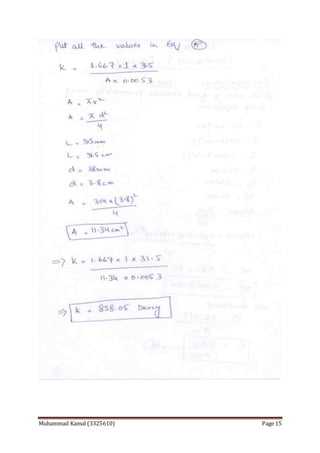
By putting the first calculation from the above table we have
K=0.8333*1*31.5/11.34*0.0018639
K=1241.92 Darcy
Flow Rate
(cm3/min)
Flow Rate
(cm3/s)
Pressure P1
(mm)
Pressure P2
(mm)
ΔP (P2-P1)
(mm)
ΔP =ρgh/10^5
(atm)
Temperature
(C°)
Permeabiltiy
(Darcy)
50 0.8333 242 261 19 0.0018639 18 1241.92
100 1.6667 225 280 55 0.0053955 18.3 858.05
150 2.5000 209 297 88 0.0086328 18.6 804.43
200 3.3333 187 323 136 0.0133416 18.8 694.01
250 4.1667 169 343 174 0.0170694 19 678.06
300 5.0000 154 362 208 0.0204048 18.9 680.67
350 5.8333 130 390 260 0.025506 18.8 635.29
400 6.6667 108 415 307 0.0301167 18.5 614.89
450 7.5000 89 436 347 0.0340407 18.5 612.01
500 8.3333 63 466 403 0.0395343 18.5 585.52
Average
permeability
740.4856137
Area of Bed (cm2) 11.34
Length of Bed (cm) 31.5
Average temperature (C°) 18.59
Viscosity of water (cp) 1
Gradient of Graph 0.005
Permeability (darcy) 555.55
Muhammad Kamal (3325610) Page 5
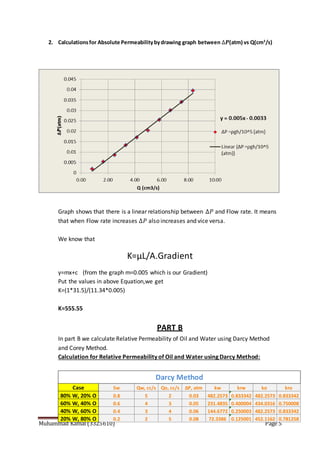
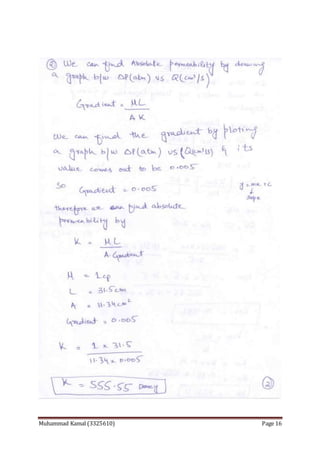
2. Calculationsfor Absolute Permeabilitybydrawing graph between ∆𝑷(atm) vs Q(cm3
/s)
Graph shows that there is a linear relationship between ∆𝑃 and Flow rate. It means
that when Flow rate increases ∆𝑃 also increases and vice versa.
We know that
K=µL/A.Gradient
y=mx+c (from the graph m=0.005 which is our Gradient)
Put the values in above Equation,we get
K=(1*31.5)/(11.34*0.005)
K=555.55
PART B
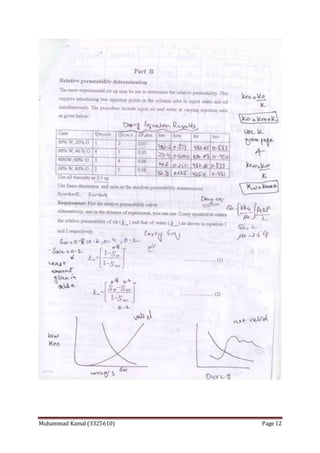
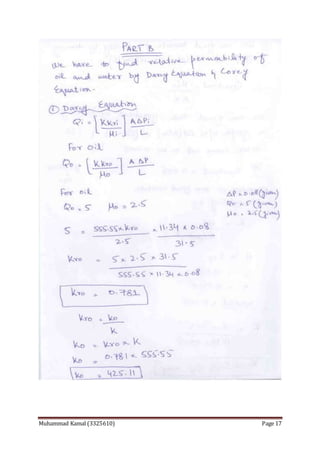
In part B we calculate Relative Permeability of Oil and Water using Darcy Method
and Corey Method.
Calculation for Relative Permeability of Oil and Water using Darcy Method:
Case Sw Qw, cc/s Qo, cc/s ΔP, atm kw krw ko kro
80% W, 20% O 0.8 5 2 0.03 482.2573 0.833342 482.2573 0.833342
60% W, 40% O 0.6 4 3 0.05 231.4835 0.400004 434.0316 0.750008
40% W, 60% O 0.4 3 4 0.06 144.6772 0.250003 482.2573 0.833342
20% W, 80% O 0.2 2 5 0.08 72.3386 0.125001 452.1162 0.781258
Darcy Method
Muhammad Kamal (3325610) Page 6
Graph shows that relative permeability of water increases as water saturation
increases, at 20 % water saturation Krw is 0.125, as the water saturation increases
Krw also increases and at 80% saturation value of Krw is maximum which is 0.8333
but relative permeability of oil is maximum at 40% and 80% of water saturation and
minimum at 60% saturation and not much depends on water saturation. We can
also see from the graph that at 80% water saturation Relative Permeability of oil and
water is same that is 0.833342
We know that
Qi=[Kkri/µi]*A∆𝑃i/L
For oil
Qo=[Kkro/µo]*A∆𝑃/L
Qo=[555.55*kro/2.5]*11.34*0.03/31.5
Qo=2 µo=2.5
Kro=0.8333
Ko=kro*K
Ko=0.8333*555.55
Ko=482.2573
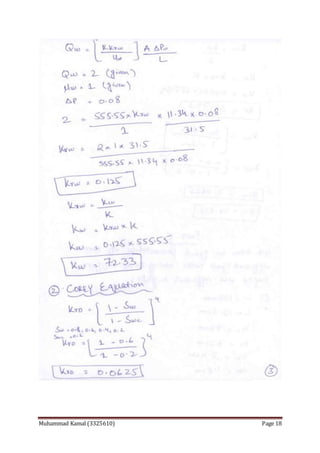
Similarly we can find rest of the readings by same method. For krw only Qw=5, µw=1
rest of the procedure is same.
Calculation for Relative Permeability of Oil and Water using Corey Method:
Muhammad Kamal (3325610) Page 7
Graph shows that relative permeability of water increases slowly and goes to maximum
when water saturation is 80%.it also shows that relative permeability of oil decreases with
the increase in water saturation. At 20% saturation Kro is maximum but its value decrease
to 0.0039 at 80% water saturation. At 60% saturation value of Krw and Kro is same which is
0.625
We know that
Kro= [1-Sw/I-Swc]4
Sw=0.8 Swc=0.2 put the values in above equation
kro=0.003909
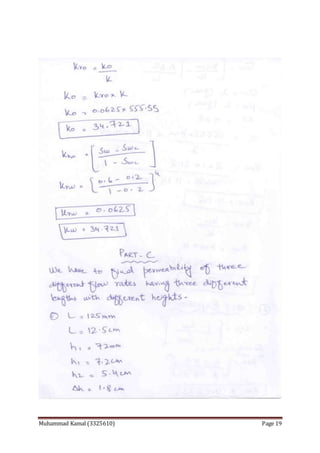
ko=kro*K
Ko=0.003909*555.55
ko=2.1701
Similarly we can calculate rest of kro by putting Sw=0.6,0.4,0.2 and Swc=0.2
We know that
Krw=[Sw-Swc/1-Swc]4
Sw=0.8 Swc=0.2 put the values in above equation
krw=0.3164
Case Sw Qw, cc/s Qo, cc/s ΔP, atm kw krw ko kro
80% W, 20% O 0.8 5 2 0.03 175.7795 0.316406 2.170117 0.003906
60% W, 40% O 0.6 4 3 0.05 34.72188 0.0625 34.72188 0.0625
40% W, 60% O 0.4 3 4 0.06 2.170117 0.003906 175.7795 0.316406
20% W, 80% O 0.2 2 5 0.08 0 0 555.55 1
Corey Method
Muhammad Kamal (3325610) Page 8
kw=krw*K
Kw=175.77
Similarly we can calculate rest of krw by putting Sw=0.6,0.4,0.2 and Swc=0.2
PART C
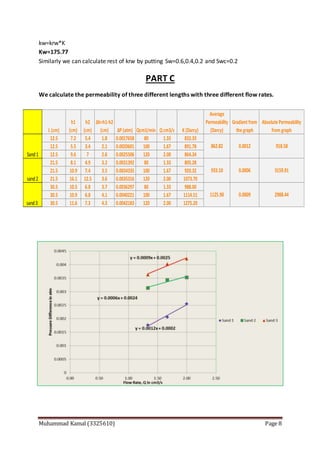
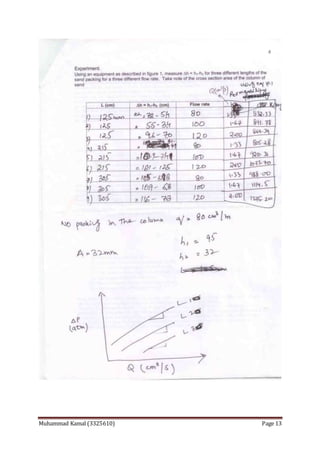
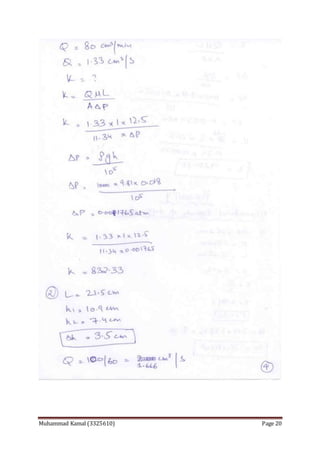
We calculate the permeability of three different lengths with three different flow rates.
L (cm)
h1
(cm)
h2
(cm)
Δh=h1-h2
(cm) ΔP (atm) Qcm3/min Qcm3/s K (Darcy)
Average
Permeability
(Darcy)
Gradientfrom
the graph
Absolute Permeability
from graph
12.5 7.2 5.4 1.8 0.0017658 80 1.33 832.33
12.5 5.5 3.4 2.1 0.0020601 100 1.67 891.78
12.5 9.6 7 2.6 0.0025506 120 2.00 864.34
21.5 8.1 4.9 3.2 0.0031392 80 1.33 805.28
21.5 10.9 7.4 3.5 0.0034335 100 1.67 920.32
21.5 16.1 12.5 3.6 0.0035316 120 2.00 1073.70
30.5 10.5 6.8 3.7 0.0036297 80 1.33 988.00
30.5 10.9 6.8 4.1 0.0040221 100 1.67 1114.51
30.5 11.6 7.3 4.3 0.0042183 120 2.00 1275.20
Sand1
sand2
sand3
918.58
3159.91
2988.44
862.82
1125.90
933.10
0.0012
0.0006
0.0009
Muhammad Kamal (3325610) Page 9
Therefore by the help of graphs we can find the gradients and by using the gradients we can
find the permeability.
CONCLUSION:
From the results that we obtain from calculations and graphs, we concluded that the
Absolute Permeability decreases by increasing the flow rates and we can find linear
relationship, if we draw a graph between ∆𝑃(atm) VsQ(cm3/s).
We also concluded that for relative permeability of oil and water, Corey method is more
accurate than Darcy method because Corey method gives accurate reading and both Kro
and Krw depends on water saturation whereas in Darcy method Kro is independent on
water saturation.
Muhammad Kamal (3325610) Page 10
Muhammad Kamal (3325610) Page 11
Muhammad Kamal (3325610) Page 12
Muhammad Kamal (3325610) Page 13
Muhammad Kamal (3325610) Page 14
Muhammad Kamal (3325610) Page 15
Muhammad Kamal (3325610) Page 16
Muhammad Kamal (3325610) Page 17
Muhammad Kamal (3325610) Page 18
Muhammad Kamal (3325610) Page 19
Muhammad Kamal (3325610) Page 20
Muhammad Kamal (3325610) Page 21
Muhammad Kamal (3325610) Page 22
POROSITY
ABSTRACT:
In the laboratory,we have three rocksamples(50,100,500 milli Darcy) made upof sandstone
material.We have tofindthe bulkvolume of these three rocksamplesfromgeometrical aswell as
buoyancypointof view.We alsohave to findthe pore volume of the rocksamplesandfrompore
volume andbulkvolume we canfind the Porosityof the rocksamples.
PROCEDURE:
 UsingVernierCalliperwe canfinddiameterandlengthof eachof the rock sample.
 We weightthe rocksamplesandsaturate themwithdistilledwaterandputin vacuum
chamberto displace the airinthe rock samples.
 We will providevacuumtothe rock samplesfor10 minutestoaccelerate the displacement
inthe core sample.
 Afterthat we can findsaturatedmassof the samplesandthe difference of saturatedmass
and dry sample massgivesthe massof water.
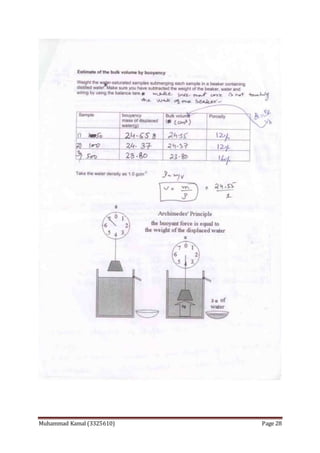
 We can findbulkvolume bybuoyancymethodasweeL.Forthiswe have tosubmerge the
rock samplesinbeakercontainingdistilledwaterandmake sure thatthe core isnot
touchingto the wallsof the beaker.
 We have to subtractthe weightof the beakerandwaterbyusingbalance tare.
Muhammad Kamal (3325610) Page 23
RESULTS AND DISCUSSION:
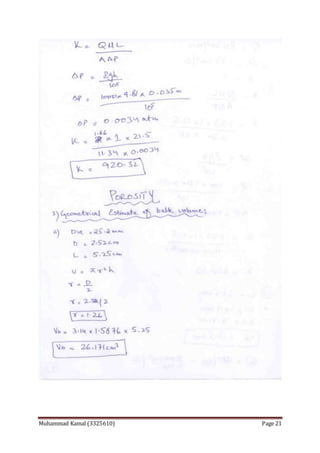
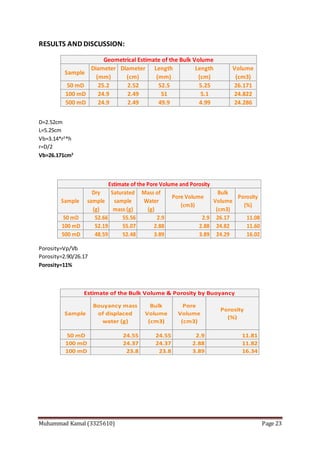
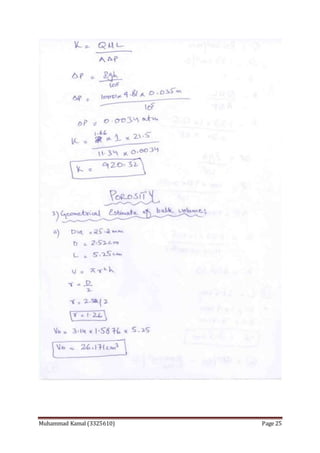
D=2.52cm
L=5.25cm
Vb=3.14*r2
*h
r=D/2
Vb=26.171cm3
Porosity=Vp/Vb
Porosity=2.90/26.17
Porosity=11%
Sample
Diameter
(mm)
Diameter
(cm)
Length
(mm)
Length
(cm)
Volume
(cm3)
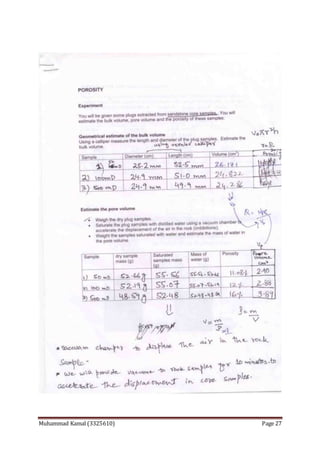
50 mD 25.2 2.52 52.5 5.25 26.171
100 mD 24.9 2.49 51 5.1 24.822
500 mD 24.9 2.49 49.9 4.99 24.286
Geometrical Estimate of the Bulk Volume
Sample
Dry
sample
(g)
Saturated
sample
mass (g)
Mass of
Water
(g)
Pore Volume
(cm3)
Bulk
Volume
(cm3)
Porosity
(%)
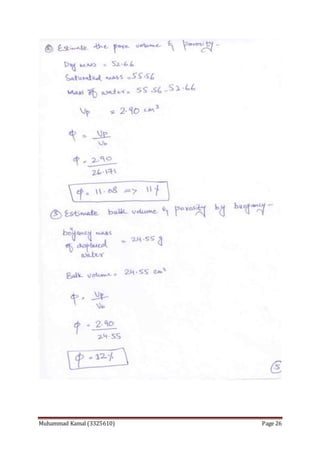
50 mD 52.66 55.56 2.9 2.9 26.17 11.08
100 mD 52.19 55.07 2.88 2.88 24.82 11.60
500 mD 48.59 52.48 3.89 3.89 24.29 16.02
Estimate of the Pore Volume and Porosity
Sample
Bouyancy mass
of displaced
water (g)
Bulk
Volume
(cm3)
Pore
Volume
(cm3)
Porosity
(%)
50 mD 24.55 24.55 2.9 11.81
100 mD 24.37 24.37 2.88 11.82
100 mD 23.8 23.8 3.89 16.34
Estimate of the Bulk Volume & Porosity by Buoyancy
Muhammad Kamal (3325610) Page 24
CONCLUSION:
After calculating Bulk volume and pore volume, We can find the porosity by using
geometrical method as well as by buoyancy method. From the calculations , we can predict
that there is a minute increase in porosity for buoyancy method.
Muhammad Kamal (3325610) Page 25
Muhammad Kamal (3325610) Page 26
Muhammad Kamal (3325610) Page 27
Muhammad Kamal (3325610) Page 28

Permebility and Porosity

  • 1.
    Muhammad Kamal (3325610)Page 1 MSc. PETROLEUM ENGINEERRING EAB_7_152 Petro Physics Dr. Elsa Aristodemou Permeability and Porosity By Muhammad Kamal Student ID # 3325610 SubmissionDate: 30/11/2014
  • 2.
    Muhammad Kamal (3325610)Page 2 FORMATION PERMEABILITY ABSTRACT: We can findAbsolute Permeabilityof the porousmediumusingDarcyEquationandbyplottinga graph betweenpressure gradientandflow rate.The Graphshowsthe linearrelationshipbetweenQ and DeltaP,meansthat as the flowrate increasesdeltaPalsoincreases.We can findRelative Permeabilityof the mediumusingDarcyMethodandCoreyMethod andplotthe graphsbetween Relative Permeabilityof oil andRelativePermeabilityof waterwithrespecttoWaterSaturation. We can alsomeasure permeabilitybymeasuringdifferentHeightsof three differentlengthsof sand packingfor three differentflowrates. We can calculate the porosityof sandstone core samplesbycalculatingbulkvolumeandpore volume. INTRODUCTION: Permeabilityisthe abilityof porousmediatopassa fluidthroughitsporesandit isaffectedbyGrain Packing,GrainAngularityandGrainsize Distribution. We have to calculate the absolute permeabilityof the porousmediumusingDarcyequationwhichis K=QµL/A∆𝑃 Where k=Permeability,Q=FlowRate(cm3 /s),µ=viscosity, L=Length(cm),A=Area(cm2), ∆𝑃=Pressure Drop(atm) By puttingall the valuesinabove equationwe cangetthe value of absolute permeabilityk. We can alsoget absolute permeabilitybyequation K=µL/A.Gradient All the valuesare knownexceptGradientwhichwe getbydrawingagraph betweenflowrate(cm3 /s) vs ∆𝑃(atm). By drawinga graph betweenQand ∆𝑃 we got a linearrelationshipbetweenthem. Same Experimentisusedtodetermine the relative permeabilityof Oil andWater.We can use Darcy Equationto determinerelative permeabilityof oil andwater. Qi=[Kkri/µi]*A∆𝑃i/L We can use CoreyEquationto determineRelative permeabilityof oil andwaterinabsence of Darcy Equation. Kro= [1-Sw/I-Swc]4
  • 3.
    Muhammad Kamal (3325610)Page 3 Where Kro isRelative Permeabilityof oil. Once we get the value of Kro ,we can findKobyusingthe formulaKo=Kro*K SimilarlyforRelative Permeabilityof Waterwe have Krw=[Sw-Swc/1-Swc]4 Once we get the value of Krwwe can findKw by usingthe formulaKw=Krw*K We alsohave three samplesof sand.We can measure differentheightsof three differentsand samplesforthree differentflowrate andmeasure the permeability.We canalsoplotthe graphs of Q vs ∆𝑃 forthree sandsamplesandfindthe gradientof eachsample.Once we findthree gradients thenwe can findpermeabilityeasily. PROCEDURE: Firstof all we closedall the valvesandswitchonthe pump.Afterthat we openthe Manometer valvestomeasure the pressure difference atdifferentflow rates.Thermometerisplacedinabeaker to measure the Temperature of water.We canslowlyincrease the flow ratesandmeasuresthe correspondingpressuresandtemperatures.We continueourprocedure andtake atleast10 Readings.
  • 4.
    Muhammad Kamal (3325610)Page 4 RESULTS & DISCUSSION: PART A In part A we calculate twopermeability.One byDarcyLaw and secondbydrawinga graph between ∆𝑃(atm) vs Q(cm3 /s). 1. Calculationsfor Absolute PermeabilityusingDarcy Law  First of all convert the flow rate cm3/min into cm3/s by dividing it with 60.  Convert ∆𝑃(mm) into ∆𝑃(atm) by P=1000*g*h/105  P=1000*9.81*(19*10-3)m/105  P=0.001863 atm  We can findpermeabilitybyDarcyLaw usingEquation K=QµL/A∆𝑃 By putting the first calculation from the above table we have K=0.8333*1*31.5/11.34*0.0018639 K=1241.92 Darcy Flow Rate (cm3/min) Flow Rate (cm3/s) Pressure P1 (mm) Pressure P2 (mm) ΔP (P2-P1) (mm) ΔP =ρgh/10^5 (atm) Temperature (C°) Permeabiltiy (Darcy) 50 0.8333 242 261 19 0.0018639 18 1241.92 100 1.6667 225 280 55 0.0053955 18.3 858.05 150 2.5000 209 297 88 0.0086328 18.6 804.43 200 3.3333 187 323 136 0.0133416 18.8 694.01 250 4.1667 169 343 174 0.0170694 19 678.06 300 5.0000 154 362 208 0.0204048 18.9 680.67 350 5.8333 130 390 260 0.025506 18.8 635.29 400 6.6667 108 415 307 0.0301167 18.5 614.89 450 7.5000 89 436 347 0.0340407 18.5 612.01 500 8.3333 63 466 403 0.0395343 18.5 585.52 Average permeability 740.4856137 Area of Bed (cm2) 11.34 Length of Bed (cm) 31.5 Average temperature (C°) 18.59 Viscosity of water (cp) 1 Gradient of Graph 0.005 Permeability (darcy) 555.55
  • 5.
    Muhammad Kamal (3325610)Page 5 2. Calculationsfor Absolute Permeabilitybydrawing graph between ∆𝑷(atm) vs Q(cm3 /s) Graph shows that there is a linear relationship between ∆𝑃 and Flow rate. It means that when Flow rate increases ∆𝑃 also increases and vice versa. We know that K=µL/A.Gradient y=mx+c (from the graph m=0.005 which is our Gradient) Put the values in above Equation,we get K=(1*31.5)/(11.34*0.005) K=555.55 PART B In part B we calculate Relative Permeability of Oil and Water using Darcy Method and Corey Method. Calculation for Relative Permeability of Oil and Water using Darcy Method: Case Sw Qw, cc/s Qo, cc/s ΔP, atm kw krw ko kro 80% W, 20% O 0.8 5 2 0.03 482.2573 0.833342 482.2573 0.833342 60% W, 40% O 0.6 4 3 0.05 231.4835 0.400004 434.0316 0.750008 40% W, 60% O 0.4 3 4 0.06 144.6772 0.250003 482.2573 0.833342 20% W, 80% O 0.2 2 5 0.08 72.3386 0.125001 452.1162 0.781258 Darcy Method
  • 6.
    Muhammad Kamal (3325610)Page 6 Graph shows that relative permeability of water increases as water saturation increases, at 20 % water saturation Krw is 0.125, as the water saturation increases Krw also increases and at 80% saturation value of Krw is maximum which is 0.8333 but relative permeability of oil is maximum at 40% and 80% of water saturation and minimum at 60% saturation and not much depends on water saturation. We can also see from the graph that at 80% water saturation Relative Permeability of oil and water is same that is 0.833342 We know that Qi=[Kkri/µi]*A∆𝑃i/L For oil Qo=[Kkro/µo]*A∆𝑃/L Qo=[555.55*kro/2.5]*11.34*0.03/31.5 Qo=2 µo=2.5 Kro=0.8333 Ko=kro*K Ko=0.8333*555.55 Ko=482.2573 Similarly we can find rest of the readings by same method. For krw only Qw=5, µw=1 rest of the procedure is same. Calculation for Relative Permeability of Oil and Water using Corey Method:
  • 7.
    Muhammad Kamal (3325610)Page 7 Graph shows that relative permeability of water increases slowly and goes to maximum when water saturation is 80%.it also shows that relative permeability of oil decreases with the increase in water saturation. At 20% saturation Kro is maximum but its value decrease to 0.0039 at 80% water saturation. At 60% saturation value of Krw and Kro is same which is 0.625 We know that Kro= [1-Sw/I-Swc]4 Sw=0.8 Swc=0.2 put the values in above equation kro=0.003909 ko=kro*K Ko=0.003909*555.55 ko=2.1701 Similarly we can calculate rest of kro by putting Sw=0.6,0.4,0.2 and Swc=0.2 We know that Krw=[Sw-Swc/1-Swc]4 Sw=0.8 Swc=0.2 put the values in above equation krw=0.3164 Case Sw Qw, cc/s Qo, cc/s ΔP, atm kw krw ko kro 80% W, 20% O 0.8 5 2 0.03 175.7795 0.316406 2.170117 0.003906 60% W, 40% O 0.6 4 3 0.05 34.72188 0.0625 34.72188 0.0625 40% W, 60% O 0.4 3 4 0.06 2.170117 0.003906 175.7795 0.316406 20% W, 80% O 0.2 2 5 0.08 0 0 555.55 1 Corey Method
  • 8.
    Muhammad Kamal (3325610)Page 8 kw=krw*K Kw=175.77 Similarly we can calculate rest of krw by putting Sw=0.6,0.4,0.2 and Swc=0.2 PART C We calculate the permeability of three different lengths with three different flow rates. L (cm) h1 (cm) h2 (cm) Δh=h1-h2 (cm) ΔP (atm) Qcm3/min Qcm3/s K (Darcy) Average Permeability (Darcy) Gradientfrom the graph Absolute Permeability from graph 12.5 7.2 5.4 1.8 0.0017658 80 1.33 832.33 12.5 5.5 3.4 2.1 0.0020601 100 1.67 891.78 12.5 9.6 7 2.6 0.0025506 120 2.00 864.34 21.5 8.1 4.9 3.2 0.0031392 80 1.33 805.28 21.5 10.9 7.4 3.5 0.0034335 100 1.67 920.32 21.5 16.1 12.5 3.6 0.0035316 120 2.00 1073.70 30.5 10.5 6.8 3.7 0.0036297 80 1.33 988.00 30.5 10.9 6.8 4.1 0.0040221 100 1.67 1114.51 30.5 11.6 7.3 4.3 0.0042183 120 2.00 1275.20 Sand1 sand2 sand3 918.58 3159.91 2988.44 862.82 1125.90 933.10 0.0012 0.0006 0.0009
  • 9.
    Muhammad Kamal (3325610)Page 9 Therefore by the help of graphs we can find the gradients and by using the gradients we can find the permeability. CONCLUSION: From the results that we obtain from calculations and graphs, we concluded that the Absolute Permeability decreases by increasing the flow rates and we can find linear relationship, if we draw a graph between ∆𝑃(atm) VsQ(cm3/s). We also concluded that for relative permeability of oil and water, Corey method is more accurate than Darcy method because Corey method gives accurate reading and both Kro and Krw depends on water saturation whereas in Darcy method Kro is independent on water saturation.
  • 10.
  • 11.
  • 12.
  • 13.
  • 14.
  • 15.
  • 16.
  • 17.
  • 18.
  • 19.
  • 20.
  • 21.
  • 22.
    Muhammad Kamal (3325610)Page 22 POROSITY ABSTRACT: In the laboratory,we have three rocksamples(50,100,500 milli Darcy) made upof sandstone material.We have tofindthe bulkvolume of these three rocksamplesfromgeometrical aswell as buoyancypointof view.We alsohave to findthe pore volume of the rocksamplesandfrompore volume andbulkvolume we canfind the Porosityof the rocksamples. PROCEDURE:  UsingVernierCalliperwe canfinddiameterandlengthof eachof the rock sample.  We weightthe rocksamplesandsaturate themwithdistilledwaterandputin vacuum chamberto displace the airinthe rock samples.  We will providevacuumtothe rock samplesfor10 minutestoaccelerate the displacement inthe core sample.  Afterthat we can findsaturatedmassof the samplesandthe difference of saturatedmass and dry sample massgivesthe massof water.  We can findbulkvolume bybuoyancymethodasweeL.Forthiswe have tosubmerge the rock samplesinbeakercontainingdistilledwaterandmake sure thatthe core isnot touchingto the wallsof the beaker.  We have to subtractthe weightof the beakerandwaterbyusingbalance tare.
  • 23.
    Muhammad Kamal (3325610)Page 23 RESULTS AND DISCUSSION: D=2.52cm L=5.25cm Vb=3.14*r2 *h r=D/2 Vb=26.171cm3 Porosity=Vp/Vb Porosity=2.90/26.17 Porosity=11% Sample Diameter (mm) Diameter (cm) Length (mm) Length (cm) Volume (cm3) 50 mD 25.2 2.52 52.5 5.25 26.171 100 mD 24.9 2.49 51 5.1 24.822 500 mD 24.9 2.49 49.9 4.99 24.286 Geometrical Estimate of the Bulk Volume Sample Dry sample (g) Saturated sample mass (g) Mass of Water (g) Pore Volume (cm3) Bulk Volume (cm3) Porosity (%) 50 mD 52.66 55.56 2.9 2.9 26.17 11.08 100 mD 52.19 55.07 2.88 2.88 24.82 11.60 500 mD 48.59 52.48 3.89 3.89 24.29 16.02 Estimate of the Pore Volume and Porosity Sample Bouyancy mass of displaced water (g) Bulk Volume (cm3) Pore Volume (cm3) Porosity (%) 50 mD 24.55 24.55 2.9 11.81 100 mD 24.37 24.37 2.88 11.82 100 mD 23.8 23.8 3.89 16.34 Estimate of the Bulk Volume & Porosity by Buoyancy
  • 24.
    Muhammad Kamal (3325610)Page 24 CONCLUSION: After calculating Bulk volume and pore volume, We can find the porosity by using geometrical method as well as by buoyancy method. From the calculations , we can predict that there is a minute increase in porosity for buoyancy method.
  • 25.
  • 26.
  • 27.
  • 28.