( Drilling Hydraulics)
Ararat Private Technical Institute
Drilling Oil Wells Department
(Marsh Funnel Viscosity)
Date of Experiment: 05/11/2018
Lab No.: (2)
Prepared by:
Hazhar Kamal Twfiq
Supervised by:
Submitted on: 17/11/2018
( Drilling Hydraulics)
Contents Chart:
PageSubject
1Aim ……………………………………
2Theory …………………………………
3Introduction to Experiment……………
4apparatus & materials…………………
5Funnel Viscosity Calibration ………….
6Procedure ………………………………
7Discussion I…………………………….
8Discussion II……………………………
References
( Drilling Hydraulics)
Aim of the experiment:
The aim of this experiment is to determine the change in the viscosity of drilling fluid.
1
( Drilling Hydraulics)
Theory:
Viscosity is the internal resistance of a fluid to flow. This phenomenon is attributed to the
attraction between molecules of a liquid and is a measure of the combined effects of adhesion
and cohesion on suspended particles and the liquid environment. The greater this resistance is,
the higher will be the viscosity. In other words, it is the resistance offered by a liquid to the
forces trying to make it flow.
The most familiar device for the checking of viscosity is the Marsh funnel, which measures
viscosity qualitatively in seconds per quart. To determine Marsh funnel viscosity, the funnel is
filled to the bottom of the screen.
The funnel holds 1,500 cubic centimeters (cc).The time in seconds required for a quart (946 cc)
to flow out the bottom of the funnel is recorded as the Marsh funnel viscosity. The funnel must
be calibrated so that the viscosity of water is 26 ± 0.5 s/quart at 65-75°F. It should be kept in
mind that the funnel viscosity is only a relative value and cannot be used for correlations or
calculations of flow regimes. Its primary function is to monitor the viscosity trend. A definite
recorded continuous increase or decrease in funnel viscosity means that there are mud problems
and should be checked with an instrument such as the rotational viscometer to determine the
exact problem and its cause.
2
( Drilling Hydraulics)
Introduction to Experiment:
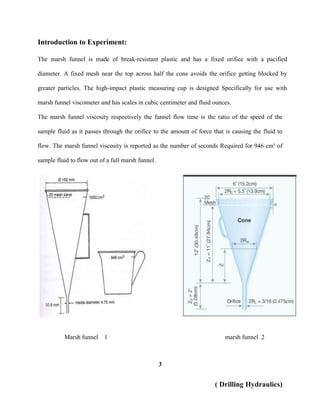
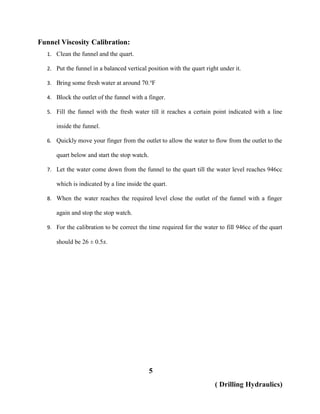
The marsh funnel is made of break-resistant plastic and has a fixed orifice with a pacified
diameter. A fixed mesh near the top across half the cone avoids the orifice getting blocked by
greater particles. The high-impact plastic measuring cup is designed Specifically for use with
marsh funnel viscometer and has scales in cubic centimeter and fluid ounces.
The marsh funnel viscosity respectively the funnel flow time is the ratio of the speed of the
sample fluid as it passes through the orifice to the amount of force that is causing the fluid to
flow. The marsh funnel viscosity is reported as the number of seconds Required for 946 cm³ of
sample fluid to flow out of a full marsh funnel.
Marsh funnel 1 marsh funnel 2
3
( Drilling Hydraulics)
Apparatus & materials:
Box Marsh Funnel Marsh Funnel and quart
Electric mixer & steel vessels bentonite
Start and stop watch water
4
( Drilling Hydraulics)
Funnel Viscosity Calibration:
1. Clean the funnel and the quart.
2. Put the funnel in a balanced vertical position with the quart right under it.
3. Bring some fresh water at around 70.℉
4. Block the outlet of the funnel with a finger.
5. Fill the funnel with the fresh water till it reaches a certain point indicated with a line
inside the funnel.
6. Quickly move your finger from the outlet to allow the water to flow from the outlet to the
quart below and start the stop watch.
7. Let the water come down from the funnel to the quart till the water level reaches 946cc
which is indicated by a line inside the quart.
8. When the water reaches the required level close the outlet of the funnel with a finger
again and stop the stop watch.
9. For the calibration to be correct the time required for the water to fill 946cc of the quart
should be 26 ± 0.5𝑠.
5
( Drilling Hydraulics)
Procedure:
1. Prepare a mud that made from water and bentonite.
2. Hold one finger over the orifice at the tip of the funnel. Pour the mud sample through the
funnel screen until mud reaches the bottom of the screen (1500 cm3). Place viscosity cup
beneath funnel tip. Remove finger and start (stop watch).
3. Stop the watch when the mud level reaches the 1-qt (946ml) mark on the viscosity cup.
4. Record the number of seconds required to outflow 1-qt of mud. And the unit of Funnel
Viscosity is (sec/qt) API.
5. Measure and record temperature of mud sample to ±1°F.
6
( Drilling Hydraulics)
Discussion:
Q1/What are the errors that we faced in this lab experiment?
1. qualitative of mud
Avoid/ get a best quality of mud
2. humans errors like wrong in recording time
Avoid/ use a good device to record time and will do it accurately.
Q2/ what is the difference between n viscosity and apparent viscosity?
Ans/the viscosity of a fluid is a measure of its resistance to gradual deformation
by shear stress and tensile stress.... for a Newtonian fluid, the apparent viscosity is
constant, and equal to the Newtonian viscosity of the fluid, the apparent viscosity
depend on the shear.
Q3/ what are the advantages of this experiment?
Ans/This test has the advantage of being quick, simple, and requiring Very little equipment.
Q4/what are the factors that affect viscosity?
Ans/fluid viscosity changes with temperature, pressure has a small impact on gas viscosity and
the pressure impact on the viscosity of a liquid is very small, when studying multiphase liquids
(a mixture of gas, liquid and solids).
Q5/what the units of marsh funnel?
Ans/its measurements is the time (in second) required for one quart of mud to flow out of a
marsh funnel into a graduated mud cup (measuring jug).
7
( Drilling Hydraulics)
Q6/what is a use of measuring jug?
Ans/measuring jug is a demarcated vessel used to measure liquid ingredient, especially hold
Volumes about 946mL, measuring jug or measuring cup may be made of plastic, glass, or metal.
Q7/where is the location of marsh funnel in well site?
Ans/ The location of the marsh funnel in well site is right on the mixed tank.
Q8/ what is the application of Mesh?
The application of Mesh is to hold any cutting or solid impurities that may we have inside the
mud
Q9/can we use a measuring jug for dry ingredients?
Ans/Dry measuring cups are meant to be filled to the brim so you can sweep off the excess.
If you tried to use a liquid cup, you couldn’t sweep off the excess because of that extra below the
rim. So to measure it, you’d have to the ingredient down or shake the cup to level it out.
Q10/is marsh funnel field unit or lab unit?
Ans / the marsh funnel is field unit not in lab unit
8
( Drilling Hydraulics)
References

Marsh funnel viscosity2

  • 1.
    ( Drilling Hydraulics) AraratPrivate Technical Institute Drilling Oil Wells Department (Marsh Funnel Viscosity) Date of Experiment: 05/11/2018 Lab No.: (2) Prepared by: Hazhar Kamal Twfiq Supervised by: Submitted on: 17/11/2018
  • 2.
    ( Drilling Hydraulics) ContentsChart: PageSubject 1Aim …………………………………… 2Theory ………………………………… 3Introduction to Experiment…………… 4apparatus & materials………………… 5Funnel Viscosity Calibration …………. 6Procedure ……………………………… 7Discussion I……………………………. 8Discussion II…………………………… References
  • 3.
    ( Drilling Hydraulics) Aimof the experiment: The aim of this experiment is to determine the change in the viscosity of drilling fluid. 1
  • 4.
    ( Drilling Hydraulics) Theory: Viscosityis the internal resistance of a fluid to flow. This phenomenon is attributed to the attraction between molecules of a liquid and is a measure of the combined effects of adhesion and cohesion on suspended particles and the liquid environment. The greater this resistance is, the higher will be the viscosity. In other words, it is the resistance offered by a liquid to the forces trying to make it flow. The most familiar device for the checking of viscosity is the Marsh funnel, which measures viscosity qualitatively in seconds per quart. To determine Marsh funnel viscosity, the funnel is filled to the bottom of the screen. The funnel holds 1,500 cubic centimeters (cc).The time in seconds required for a quart (946 cc) to flow out the bottom of the funnel is recorded as the Marsh funnel viscosity. The funnel must be calibrated so that the viscosity of water is 26 ± 0.5 s/quart at 65-75°F. It should be kept in mind that the funnel viscosity is only a relative value and cannot be used for correlations or calculations of flow regimes. Its primary function is to monitor the viscosity trend. A definite recorded continuous increase or decrease in funnel viscosity means that there are mud problems and should be checked with an instrument such as the rotational viscometer to determine the exact problem and its cause. 2
  • 5.
    ( Drilling Hydraulics) Introductionto Experiment: The marsh funnel is made of break-resistant plastic and has a fixed orifice with a pacified diameter. A fixed mesh near the top across half the cone avoids the orifice getting blocked by greater particles. The high-impact plastic measuring cup is designed Specifically for use with marsh funnel viscometer and has scales in cubic centimeter and fluid ounces. The marsh funnel viscosity respectively the funnel flow time is the ratio of the speed of the sample fluid as it passes through the orifice to the amount of force that is causing the fluid to flow. The marsh funnel viscosity is reported as the number of seconds Required for 946 cm³ of sample fluid to flow out of a full marsh funnel. Marsh funnel 1 marsh funnel 2 3
  • 6.
    ( Drilling Hydraulics) Apparatus& materials: Box Marsh Funnel Marsh Funnel and quart Electric mixer & steel vessels bentonite Start and stop watch water 4
  • 7.
    ( Drilling Hydraulics) FunnelViscosity Calibration: 1. Clean the funnel and the quart. 2. Put the funnel in a balanced vertical position with the quart right under it. 3. Bring some fresh water at around 70.℉ 4. Block the outlet of the funnel with a finger. 5. Fill the funnel with the fresh water till it reaches a certain point indicated with a line inside the funnel. 6. Quickly move your finger from the outlet to allow the water to flow from the outlet to the quart below and start the stop watch. 7. Let the water come down from the funnel to the quart till the water level reaches 946cc which is indicated by a line inside the quart. 8. When the water reaches the required level close the outlet of the funnel with a finger again and stop the stop watch. 9. For the calibration to be correct the time required for the water to fill 946cc of the quart should be 26 ± 0.5𝑠. 5
  • 8.
    ( Drilling Hydraulics) Procedure: 1.Prepare a mud that made from water and bentonite. 2. Hold one finger over the orifice at the tip of the funnel. Pour the mud sample through the funnel screen until mud reaches the bottom of the screen (1500 cm3). Place viscosity cup beneath funnel tip. Remove finger and start (stop watch). 3. Stop the watch when the mud level reaches the 1-qt (946ml) mark on the viscosity cup. 4. Record the number of seconds required to outflow 1-qt of mud. And the unit of Funnel Viscosity is (sec/qt) API. 5. Measure and record temperature of mud sample to ±1°F. 6
  • 9.
    ( Drilling Hydraulics) Discussion: Q1/Whatare the errors that we faced in this lab experiment? 1. qualitative of mud Avoid/ get a best quality of mud 2. humans errors like wrong in recording time Avoid/ use a good device to record time and will do it accurately. Q2/ what is the difference between n viscosity and apparent viscosity? Ans/the viscosity of a fluid is a measure of its resistance to gradual deformation by shear stress and tensile stress.... for a Newtonian fluid, the apparent viscosity is constant, and equal to the Newtonian viscosity of the fluid, the apparent viscosity depend on the shear. Q3/ what are the advantages of this experiment? Ans/This test has the advantage of being quick, simple, and requiring Very little equipment. Q4/what are the factors that affect viscosity? Ans/fluid viscosity changes with temperature, pressure has a small impact on gas viscosity and the pressure impact on the viscosity of a liquid is very small, when studying multiphase liquids (a mixture of gas, liquid and solids). Q5/what the units of marsh funnel? Ans/its measurements is the time (in second) required for one quart of mud to flow out of a marsh funnel into a graduated mud cup (measuring jug). 7
  • 10.
    ( Drilling Hydraulics) Q6/whatis a use of measuring jug? Ans/measuring jug is a demarcated vessel used to measure liquid ingredient, especially hold Volumes about 946mL, measuring jug or measuring cup may be made of plastic, glass, or metal. Q7/where is the location of marsh funnel in well site? Ans/ The location of the marsh funnel in well site is right on the mixed tank. Q8/ what is the application of Mesh? The application of Mesh is to hold any cutting or solid impurities that may we have inside the mud Q9/can we use a measuring jug for dry ingredients? Ans/Dry measuring cups are meant to be filled to the brim so you can sweep off the excess. If you tried to use a liquid cup, you couldn’t sweep off the excess because of that extra below the rim. So to measure it, you’d have to the ingredient down or shake the cup to level it out. Q10/is marsh funnel field unit or lab unit? Ans / the marsh funnel is field unit not in lab unit 8
  • 11.