Koya University
Faculty of engineering
Petroleum department
Drilling engineering laboratory
(Mud Filtration)
Feb.25th
.2015
Lab EXP.(5)
Supervised By Prepared By
Mr. Pishtiwan Bakhtiar star m.
Eng.muhamad
Submitted on: Feb. 3th
2015
Table of Contents
Objective…………………………………………………………………………………………………………3
Abstract……………………………………………………………………………..4
Theory ……………………………………………………………………………….5
Introduction of experiment …………………………………………………………..6
Procedure ……………………………………………………………………………..7
Calculation ……………………………………………………………………………8
Discussion………………………………………………………………………….....9 &10
Reference ……………………………………………………………………………..11
Objective
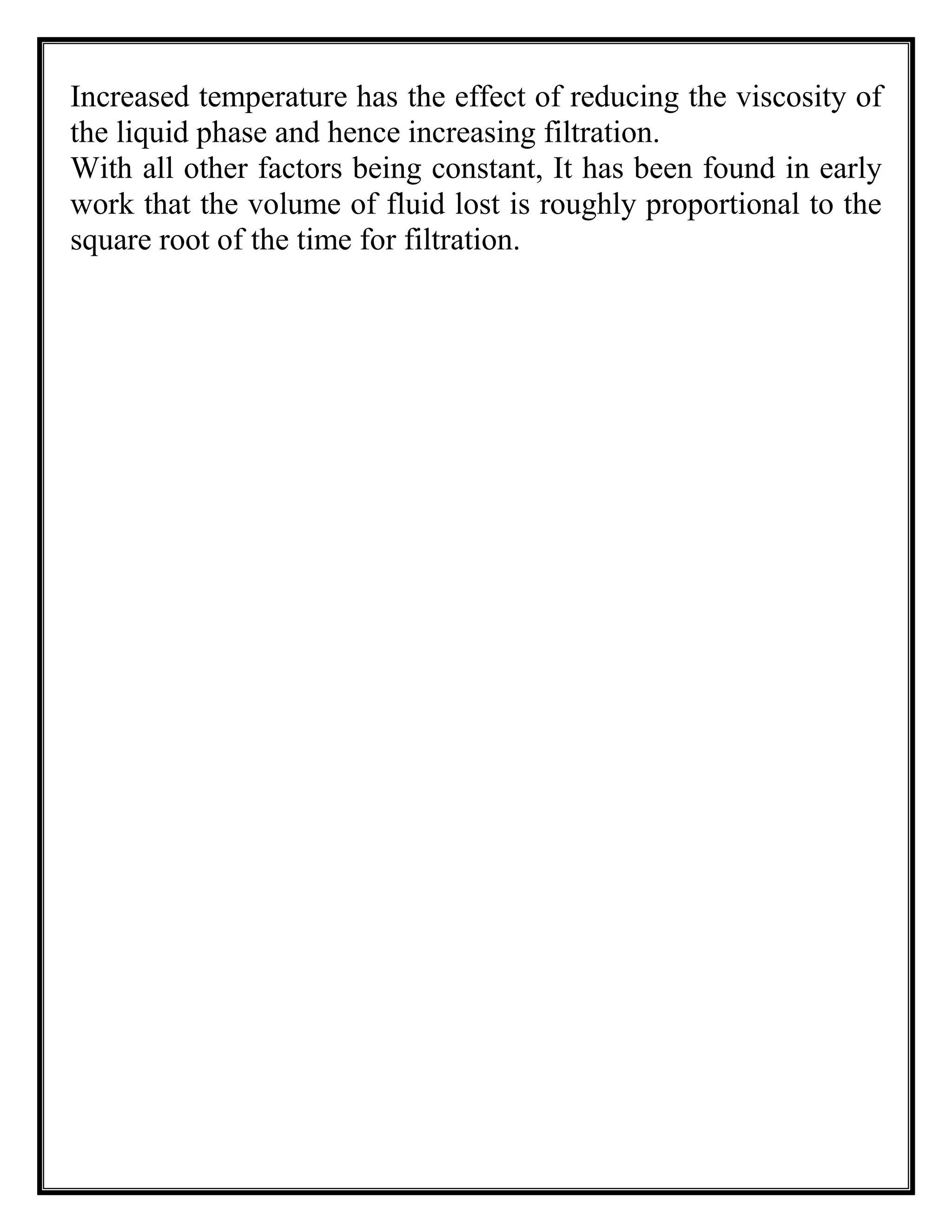
Our objective is determine the filtration rate of mud
and thickness of mud cake that formed under 100psi,
by using Standard API Filter Press.
Abstract
Filtration from drilling fluids arises from the pressure differential
between the hydrostatic pressure of the mud column and the
formation pressure. Since the hypostatic pressure in the borehole is
always greater than the formation pressure, water filters into the
porous medium, depositing a porous, permeable and compressible
cake of mud particles on the wall of the borehole. (Churchill, S.W.
(November 7, 1977)).
Three classes of filtration: static, dynamic and beneath the bit
filtration have been recognized and understanding the mechanism of
each type of filtration and its practical implications could lead to
significant reduction in mud filtration without compromising the
beneficial functions of drilling fluids. While drilling muds help to
hold formation pressure in place, the filtrates could cause shale
swelling and sloughing in wellbores and formation of viscous
emulsions with formation fluids leading to damage of reservoir
permeability and reduction
Theory
Loss of fluid (usually water and soluble chemicals) from the mud
to the formation occurs when the permeability is such that it
allows fluid to pass through the pore spaces. As fluid is lost, a
build up of mud solids occurs on the face of the wellbore. This is
the filter cake.
The loss of liquid from a mud due to filtration is controlled by the
filter cake formed of the solid constituents in the drilling fluid.
Two types of filtration occur; dynamic, while circulating and
static, while the mud is at rest.
Dynamic filtration reaches a constant rate when the rate of erosion
of the filter cake due to circulating matches the rate of deposition
of the filter cake.
Static filtration will cause the cake to grow thicker with time,
which results in a decrease in loss of fluids with time. The test
consists of monitoring the rate at which fluid is forced from a filter
press under specific conditions of time, temperature and pressure,
then measuring the thickness of the residue deposited upon the
filter paper. Excessive filtration and thick filter cake build up are
likely to cause the following problems:
1.Tight hole, causing excessive barrier.
2. Increased pressure, due to reduced hole diameter.
3. Differential sticking, due to an increased pipe contact in filter
cake.
4. Excessive formation damage and evaluation problems with
wireline logs.
Pressure also affects filtration by compressing the filter cake,
reducing its permeability and therefore reducing the filtrate.
Increased temperature has the effect of reducing the viscosity of
the liquid phase and hence increasing filtration.
With all other factors being constant, It has been found in early
work that the volume of fluid lost is roughly proportional to the
square root of the time for filtration.
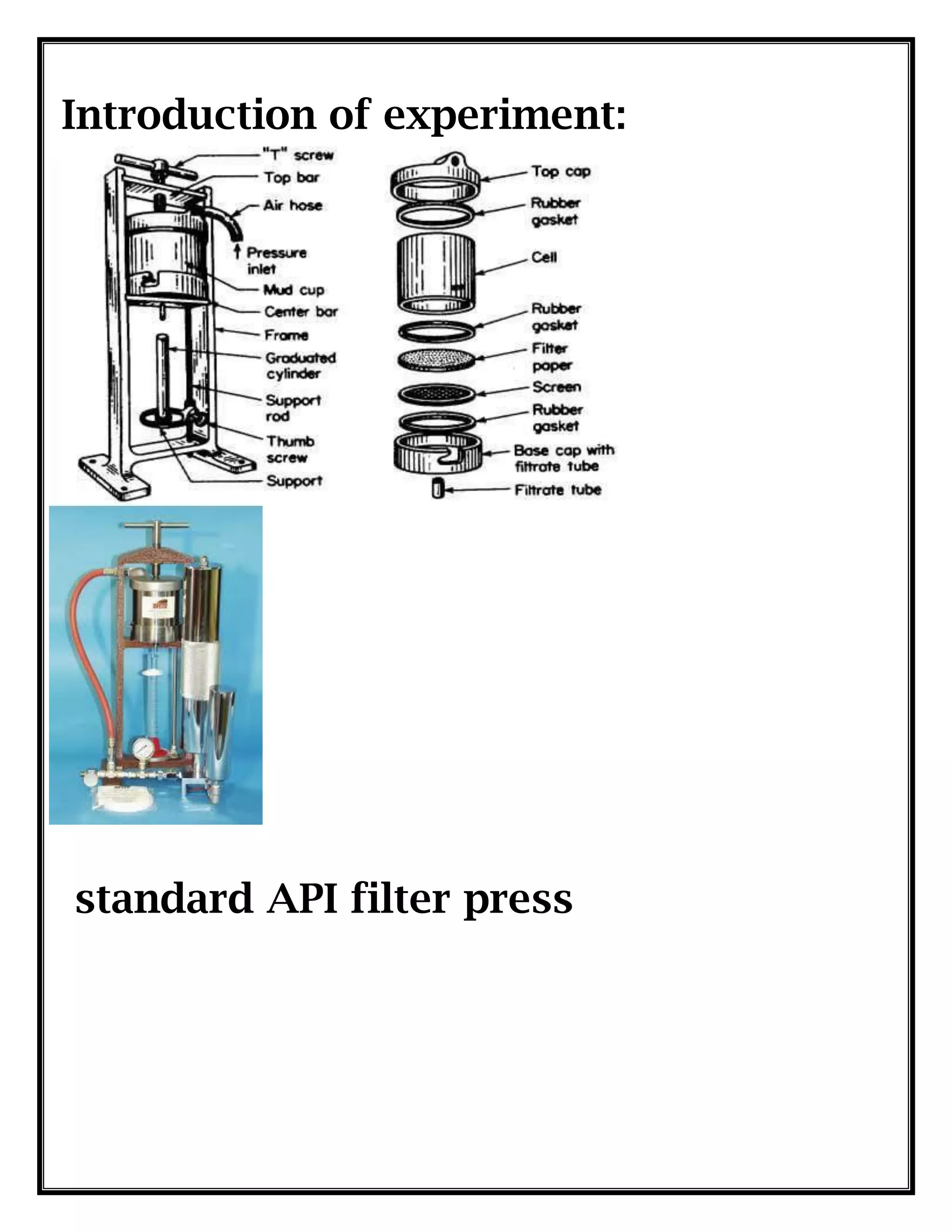
Introduction of experiment:
standard API filter press
Procedure
1.Loosen the T-screw until the filter cell can be removed from the frame.
2.Remove the filter cell and disassemble it.
3.Be certain that all parts of the filter cell are dry and clean.
4.Check to see that the rubber gasket in the base cap is evenly placed.
5.Check the filtrate tube in the base cap to be certain it is free of obstruction.
6.Place the screen in the base cap with the wide rim up.
7.Place filter paper on the top of the screen.
8.Place the second rubber gasket on top of the filter paper.
9.Replace the cell body.
10.Turn the cell body clockwise until it securely fastens into the J slots.
11.Check to see that the rubber gasket is evenly fitted into the top cap.
12.Fill the filter cell to within the drilling mud sample.
13.Check to see that the hole in the top cap is free of obstruction.
14.Place the top cap on the filter cell.
15.Place the cell body into the frame.
16.Tighten the T-screw securely
17.Place a graduated cylinder under the filtrate tube and adjust the support to keep
the cylinder under the filtrate tube.
18.Close the pressure-relief valve and until the pressure is 100 (± 5) psi. Start timing
immediately.
19.Allow the test to continue for 30 minutes.
20.Read and make note of the amount of filtrate in the graduated cylinder to the
nearest 0.1 cc.
21.Open the valve on the regulator by turning counterclockwise.
22. Wait until all pressure is released.
23. Remove the cell from the frame by loosening the T-screw.
24.Remove the top cap and pour the mud out.
25.Remove the bottom cap from the cell.
27.Turn the bottom cap upside down on a solid surface and remove the filter paper.
28.Measure the thickness of the filter cake to the nearest 1/32 in.
29.Wash and dry all parts of the filter press
DISCUSION
In this test we are used the Standard API Filter Press to determine the
mud filter rate & mud cake thickness.
by doing this test we got quit a few knowledge of Loss of fluid
(usually water and soluble chemicals) from the mud to the formation.
Some point in this experiment we noticed, we can discuss like that:
1-There are three specific conditions which have affected on the
rate of filtration &mud cake thickness; these are pressure,
temperature, and time. Excessive filtration and thick filter cake
build up are likely to cause the problems.
 Pressure affects filtration by compressing the filter cake,
reducing its permeability and therefore reducing the filtrate.
 Increased temperature has the effect of reducing the viscosity
of the liquid phase and hence increasing filtration.
 With all other factors being constant, It has been found in early
work that the volume of fluid lost is roughly proportional to the
square root of the time for filtration.
2- There was an error during the process which was opening the T-screw
before releasing the pressure so the top cap just dropped up from the cell
but fortunately we had stood far from it so we avoid the risk on our selves .
3- Finally we determined the thickness of the cake which is measured in
(mm) and the amount of water which was filtrated from the process and is
measured in (ml).
4- we know the loss of fluid occur more from the dynamic filtration
(during circulating) than static (while mud as it rest).
5-As mentioned above we can find the conditions of the mud and the
formation together to determine whether it will cause making the cake or in
other word there will be invasion around the well , because it is significant
factor in indicating lithology of the formation which we can take the
benefit of it to use in other next operation
References
1-Bingham, E.C. (1916). "An Investigation of the Laws of Plastic
Flow". US Bureau of Standards Bulletin 13: 309–353.
2. a b Steffe, J.F. (1996). Rheological Methods in filtration Process
Engineering (2nd ed.). ISBN 0-9632036-1-4.
3. Bingham, E.C. (1922). Fluidity and Plasticity. New York:
McGraw-Hill. p. 219.
4. Darby, Ron (1996). "Chapter 6". Chemical Engineering Fluid
Mechanics. Marcel Dekker. ISBN 0-8247-0444-4.
5. Buckingham, E. (1921). "On Plastic Flow Through Capillary
Tubes". ASTM Proceedings 21: 1154–1156.
6.a b Darby, R. and Melson J.(1981). "How to predict the friction
factor for flow of Bingham plastics". Chemical Engineering 28: 59–
61.
7. Darby, R.; et al. (September 1992). "Prediction friction loss in
slurry pipes". Chemical Engineering.
8. Swamee, P.K. and Aggarwal, N.(2011). "Explicit equations for
laminar flow of Bingham plastic fluids". Journal of Petroleum
Science and Engineering. doi:10.1016/j.petrol.2011.01.015.
9. Danish, M. et al. (1981). "Approximate explicit analytical
expressions of friction factor for flow of Bingham fluids in smooth
pipes using Adomian decomposition method". Communications in
Nonlinear Science and Numerical Simulation 16: 239–251.
10. Churchill, S.W. (November 7, 1977). "Filtration factor equation
spans all fluid-flow regimes". Chemical Engineering: 91–92.

(Mud Filtration)

  • 1.
    Koya University Faculty ofengineering Petroleum department Drilling engineering laboratory (Mud Filtration) Feb.25th .2015 Lab EXP.(5) Supervised By Prepared By Mr. Pishtiwan Bakhtiar star m. Eng.muhamad Submitted on: Feb. 3th 2015
  • 2.
    Table of Contents Objective…………………………………………………………………………………………………………3 Abstract……………………………………………………………………………..4 Theory……………………………………………………………………………….5 Introduction of experiment …………………………………………………………..6 Procedure ……………………………………………………………………………..7 Calculation ……………………………………………………………………………8 Discussion………………………………………………………………………….....9 &10 Reference ……………………………………………………………………………..11
  • 3.
    Objective Our objective isdetermine the filtration rate of mud and thickness of mud cake that formed under 100psi, by using Standard API Filter Press.
  • 4.
    Abstract Filtration from drillingfluids arises from the pressure differential between the hydrostatic pressure of the mud column and the formation pressure. Since the hypostatic pressure in the borehole is always greater than the formation pressure, water filters into the porous medium, depositing a porous, permeable and compressible cake of mud particles on the wall of the borehole. (Churchill, S.W. (November 7, 1977)). Three classes of filtration: static, dynamic and beneath the bit filtration have been recognized and understanding the mechanism of each type of filtration and its practical implications could lead to significant reduction in mud filtration without compromising the beneficial functions of drilling fluids. While drilling muds help to hold formation pressure in place, the filtrates could cause shale swelling and sloughing in wellbores and formation of viscous emulsions with formation fluids leading to damage of reservoir permeability and reduction
  • 5.
    Theory Loss of fluid(usually water and soluble chemicals) from the mud to the formation occurs when the permeability is such that it allows fluid to pass through the pore spaces. As fluid is lost, a build up of mud solids occurs on the face of the wellbore. This is the filter cake. The loss of liquid from a mud due to filtration is controlled by the filter cake formed of the solid constituents in the drilling fluid. Two types of filtration occur; dynamic, while circulating and static, while the mud is at rest. Dynamic filtration reaches a constant rate when the rate of erosion of the filter cake due to circulating matches the rate of deposition of the filter cake. Static filtration will cause the cake to grow thicker with time, which results in a decrease in loss of fluids with time. The test consists of monitoring the rate at which fluid is forced from a filter press under specific conditions of time, temperature and pressure, then measuring the thickness of the residue deposited upon the filter paper. Excessive filtration and thick filter cake build up are likely to cause the following problems: 1.Tight hole, causing excessive barrier. 2. Increased pressure, due to reduced hole diameter. 3. Differential sticking, due to an increased pipe contact in filter cake. 4. Excessive formation damage and evaluation problems with wireline logs. Pressure also affects filtration by compressing the filter cake, reducing its permeability and therefore reducing the filtrate.
  • 6.
    Increased temperature hasthe effect of reducing the viscosity of the liquid phase and hence increasing filtration. With all other factors being constant, It has been found in early work that the volume of fluid lost is roughly proportional to the square root of the time for filtration.
  • 7.
  • 9.
    Procedure 1.Loosen the T-screwuntil the filter cell can be removed from the frame. 2.Remove the filter cell and disassemble it. 3.Be certain that all parts of the filter cell are dry and clean. 4.Check to see that the rubber gasket in the base cap is evenly placed. 5.Check the filtrate tube in the base cap to be certain it is free of obstruction. 6.Place the screen in the base cap with the wide rim up. 7.Place filter paper on the top of the screen. 8.Place the second rubber gasket on top of the filter paper. 9.Replace the cell body. 10.Turn the cell body clockwise until it securely fastens into the J slots. 11.Check to see that the rubber gasket is evenly fitted into the top cap.
  • 10.
    12.Fill the filtercell to within the drilling mud sample. 13.Check to see that the hole in the top cap is free of obstruction. 14.Place the top cap on the filter cell. 15.Place the cell body into the frame. 16.Tighten the T-screw securely 17.Place a graduated cylinder under the filtrate tube and adjust the support to keep the cylinder under the filtrate tube. 18.Close the pressure-relief valve and until the pressure is 100 (± 5) psi. Start timing immediately. 19.Allow the test to continue for 30 minutes. 20.Read and make note of the amount of filtrate in the graduated cylinder to the nearest 0.1 cc. 21.Open the valve on the regulator by turning counterclockwise. 22. Wait until all pressure is released. 23. Remove the cell from the frame by loosening the T-screw. 24.Remove the top cap and pour the mud out. 25.Remove the bottom cap from the cell. 27.Turn the bottom cap upside down on a solid surface and remove the filter paper. 28.Measure the thickness of the filter cake to the nearest 1/32 in. 29.Wash and dry all parts of the filter press
  • 11.
    DISCUSION In this testwe are used the Standard API Filter Press to determine the mud filter rate & mud cake thickness. by doing this test we got quit a few knowledge of Loss of fluid (usually water and soluble chemicals) from the mud to the formation. Some point in this experiment we noticed, we can discuss like that: 1-There are three specific conditions which have affected on the rate of filtration &mud cake thickness; these are pressure, temperature, and time. Excessive filtration and thick filter cake build up are likely to cause the problems.  Pressure affects filtration by compressing the filter cake, reducing its permeability and therefore reducing the filtrate.  Increased temperature has the effect of reducing the viscosity of the liquid phase and hence increasing filtration.  With all other factors being constant, It has been found in early work that the volume of fluid lost is roughly proportional to the square root of the time for filtration. 2- There was an error during the process which was opening the T-screw before releasing the pressure so the top cap just dropped up from the cell but fortunately we had stood far from it so we avoid the risk on our selves . 3- Finally we determined the thickness of the cake which is measured in (mm) and the amount of water which was filtrated from the process and is measured in (ml).
  • 12.
    4- we knowthe loss of fluid occur more from the dynamic filtration (during circulating) than static (while mud as it rest). 5-As mentioned above we can find the conditions of the mud and the formation together to determine whether it will cause making the cake or in other word there will be invasion around the well , because it is significant factor in indicating lithology of the formation which we can take the benefit of it to use in other next operation
  • 13.
    References 1-Bingham, E.C. (1916)."An Investigation of the Laws of Plastic Flow". US Bureau of Standards Bulletin 13: 309–353. 2. a b Steffe, J.F. (1996). Rheological Methods in filtration Process Engineering (2nd ed.). ISBN 0-9632036-1-4. 3. Bingham, E.C. (1922). Fluidity and Plasticity. New York: McGraw-Hill. p. 219. 4. Darby, Ron (1996). "Chapter 6". Chemical Engineering Fluid Mechanics. Marcel Dekker. ISBN 0-8247-0444-4. 5. Buckingham, E. (1921). "On Plastic Flow Through Capillary Tubes". ASTM Proceedings 21: 1154–1156. 6.a b Darby, R. and Melson J.(1981). "How to predict the friction factor for flow of Bingham plastics". Chemical Engineering 28: 59– 61. 7. Darby, R.; et al. (September 1992). "Prediction friction loss in slurry pipes". Chemical Engineering. 8. Swamee, P.K. and Aggarwal, N.(2011). "Explicit equations for laminar flow of Bingham plastic fluids". Journal of Petroleum Science and Engineering. doi:10.1016/j.petrol.2011.01.015. 9. Danish, M. et al. (1981). "Approximate explicit analytical expressions of friction factor for flow of Bingham fluids in smooth pipes using Adomian decomposition method". Communications in Nonlinear Science and Numerical Simulation 16: 239–251. 10. Churchill, S.W. (November 7, 1977). "Filtration factor equation spans all fluid-flow regimes". Chemical Engineering: 91–92.