1
Drilling Engineering
TITLE: Drilling Mud Contamination
Author name: Mahmood Abdul-Jabbar hebah
2
Acknowledgement
“I would like to express my deepest appreciation to all those who provided me
the possibility to complete this experiment. I would also like to show my deepest
gratitude to my lecturer, Dr. Mahmood for giving me a good guideline for this
experiment throughout numerous consultations. Moreover, I would like to appreciate
the crucial role of the staff of APU University who gave the permission to use all
equipment and necessary materials to complete the laboratory, and also a special thanks
goes to my group who did well in the lab to success in this experiment. Last but not
least, many thanks go to the head of the APU University whose have invested his full
effort in guiding the students to achieving their goals.”
3
Abstract
“This experiment was about drilling fluid contamination test. In this test we
were studying the effect of contamination of monovalent chemicals (NaCl and KCl)
and divalent chemicals that cause contamination are calcium sulfate (CaSO), cement
(Ca (OH), and Gypsum (CaSO-2HO). In this experiment study the effect of
contamination of KCL to the density, Plastic Viscosity and Yield Point of water-based
mud was conducted. a range of instruments were used such Mud mixer, Mud balance,
Thermometer, Remoter, Filter press, Graduated cylinder, pH meter / pH paper, Aging
cell, Rotating oven and litter cup, Viscometer and Venire calliper. All these materials
were used in order to understand the reasons why the mud varies and to know with
precision the different properties that the fluids have. Intertek determines the true nature
of formation oil recovered and the degree of contamination by water-based drill mud.
Drilling clients need to understand if oil recovered during a series of Repeat Formation
Tests (RFT) was naturally occurring formation fluid or oil-based mud, and if both were
present, the degree of contamination from the drilling mud. Testing petroleum reservoir
fluids and drilling mud for accuracy brings benefits when determining possible drill
mud contamination.”
4
Table of Contents
Abstract.......................................................................................................................................3
1.0 Introduction ...................................................................................................................... 6
2.0 Objective .......................................................................................................................... 7
3.0 Theory and Literature Review ............................................................................................ 8
4.0 Apparatus & Materials:......................................................................................................9
4.1 Mud mixer ........................................................................................................................ 9
4.2 Weighing balance .............................................................................................................. 9
4.3 Mud Balance................................................................................................................... 10
4.4 Rheometer....................................................................................................................... 10
4.5 Thermometer................................................................................................................... 11
4.6 Filter Press...................................................................................................................... 11
4.7 Graduated Cylinder.......................................................................................................... 12
4.8 pH scale.......................................................................................................................... 12
4.9 Aging cell....................................................................................................................... 12
4.10 Vernier Caliper................................................................................................................ 13
4.11 Materials used. ................................................................................................................ 13
5.0 Procedure........................................................................................................................ 14
6.0 Results............................................................................................................................ 15
7.0 Discussion....................................................................................................................... 17
8.0 Conclusion...................................................................................................................... 20
9.0 References ...................................................................................................................... 22
5
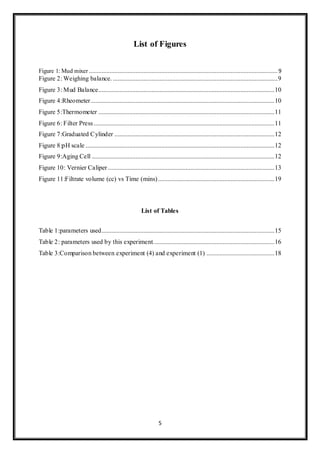
List of Figures
Figure 1: Mud mixer..................................................................................................................... 9
Figure 2: Weighing balance. ......................................................................................................9
Figure 3: Mud Balance.............................................................................................................10
Figure 4:Rheometer..................................................................................................................10
Figure 5:Thermometer .............................................................................................................11
Figure 6: Filter Press................................................................................................................11
Figure 7:Graduated Cylinder ...................................................................................................12
Figure 8:pH scale .....................................................................................................................12
Figure 9:Aging Cell .................................................................................................................12
Figure 10: Vernier Caliper .......................................................................................................13
Figure 11:Filtrate volume (cc) vs Time (mins)........................................................................19
List of Tables
Table 1:parameters used...........................................................................................................15
Table 2: parameters used by this experiment...........................................................................16
Table 3:Comparison between experiment (4) and experiment (1) ..........................................18
6
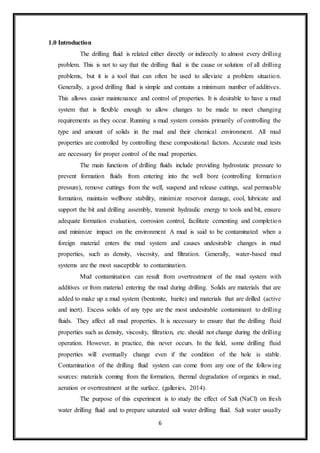
1.0 Introduction
“The drilling fluid is related either directly or indirectly to almost every drilling
problem. This is not to say that the drilling fluid is the cause or solution of all drilling
problems, but it is a tool that can often be used to alleviate a problem situation.
Generally, a good drilling fluid is simple and contains a minimum number of additives.
This allows easier maintenance and control of properties. It is desirable to have a mud
system that is flexible enough to allow changes to be made to meet changing
requirements as they occur. Running a mud system consists primarily of controlling the
type and amount of solids in the mud and their chemical environment. All mud
properties are controlled by controlling these compositional factors. Accurate mud tests
are necessary for proper control of the mud properties.”
“The main functions of drilling fluids include providing hydrostatic pressure to
prevent formation fluids from entering into the well bore (controlling formation
pressure), remove cuttings from the well, suspend and release cuttings, seal permeable
formation, maintain wellbore stability, minimize reservoir damage, cool, lubricate and
support the bit and drilling assembly, transmit hydraulic energy to tools and bit, ensure
adequate formation evaluation, corrosion control, facilitate cementing and completion
and minimize impact on the environment A mud is said to be contaminated when a
foreign material enters the mud system and causes undesirable changes in mud
properties, such as density, viscosity, and filtration. Generally, water-based mud
systems are the most susceptible to contamination.”
“Mud contamination can result from overtreatment of the mud system with
additives or from material entering the mud during drilling. Solids are materials that are
added to make up a mud system (bentonite, barite) and materials that are drilled (active
and inert). Excess solids of any type are the most undesirable contaminant to drilling
fluids. They affect all mud properties. It is necessary to ensure that the drilling fluid
properties such as density, viscosity, filtration, etc. should not change during the drilling
operation. However, in practice, this never occurs. In the field, some drilling fluid
properties will eventually change even if the condition of the hole is stable.
Contamination of the drilling fluid system can come from any one of the following
sources: materials coming from the formation, thermal degradation of organics in mud,
aeration or overtreatment at the surface. (galleries, 2014).”
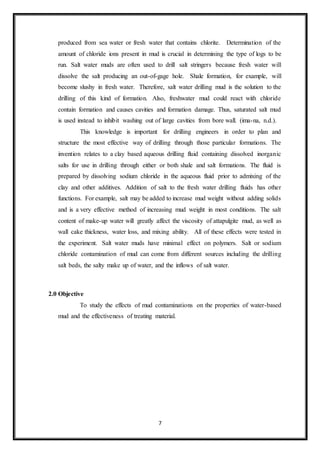
“The purpose of this experiment is to study the effect of Salt (NaCl) on fresh
water drilling fluid and to prepare saturated salt water drilling fluid. Salt water usually
7
produced from sea water or fresh water that contains chlorite. Determination of the
amount of chloride ions present in mud is crucial in determining the type of logs to be
run. Salt water muds are often used to drill salt stringers because fresh water will
dissolve the salt producing an out-of-gage hole. Shale formation, for example, will
become slushy in fresh water. Therefore, salt water drilling mud is the solution to the
drilling of this kind of formation. Also, freshwater mud could react with chloride
contain formation and causes cavities and formation damage. Thus, saturated salt mud
is used instead to inhibit washing out of large cavities from bore wall. (ima-na, n.d.).”
“This knowledge is important for drilling engineers in order to plan and
structure the most effective way of drilling through those particular formations. The
invention relates to a clay based aqueous drilling fluid containing dissolved inorganic
salts for use in drilling through either or both shale and salt formations. The fluid is
prepared by dissolving sodium chloride in the aqueous fluid prior to admixing of the
clay and other additives. Addition of salt to the fresh water drilling fluids has other
functions. For example, salt may be added to increase mud weight without adding solids
and is a very effective method of increasing mud weight in most conditions. The salt
content of make-up water will greatly affect the viscosity of attapulgite mud, as well as
wall cake thickness, water loss, and mixing ability. All of these effects were tested in
the experiment. Salt water muds have minimal effect on polymers. Salt or sodium
chloride contamination of mud can come from different sources including the drilling
salt beds, the salty make up of water, and the inflows of salt water.”
2.0 Objective
“To study the effects of mud contaminations on the properties of water-based
mud and the effectiveness of treating material.”
8
3.0 Theory and Literature Review
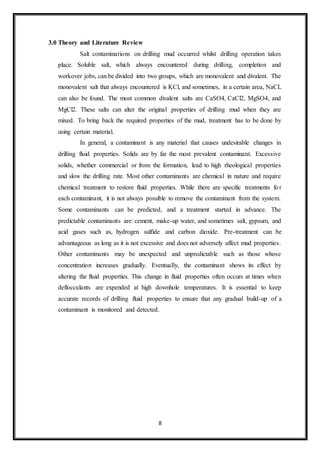
“Salt contaminations on drilling mud occurred whilst drilling operation takes
place. Soluble salt, which always encountered during drilling, completion and
workover jobs, can be divided into two groups, which are monovalent and divalent. The
monovalent salt that always encountered is KCl, and sometimes, in a certain area, NaCL
can also be found. The most common divalent salts are CaSO4, CaCl2, MgSO4, and
MgCl2. These salts can alter the original properties of drilling mud when they are
mixed. To bring back the required properties of the mud, treatment has to be done by
using certain material.”
“In general, a contaminant is any material that causes undesirable changes in
drilling fluid properties. Solids are by far the most prevalent contaminant. Excessive
solids, whether commercial or from the formation, lead to high rheological properties
and slow the drilling rate. Most other contaminants are chemical in nature and require
chemical treatment to restore fluid properties. While there are specific treatments for
each contaminant, it is not always possible to remove the contaminant from the system.
Some contaminants can be predicted, and a treatment started in advance. The
predictable contaminants are: cement, make-up water, and sometimes salt, gypsum, and
acid gases such as, hydrogen sulfide and carbon dioxide. Pre-treatment can be
advantageous as long as it is not excessive and does not adversely affect mud properties.
Other contaminants may be unexpected and unpredictable such as those whose
concentration increases gradually. Eventually, the contaminant shows its effect by
altering the fluid properties. This change in fluid properties often occurs at times when
deflocculants are expended at high downhole temperatures. It is essential to keep
accurate records of drilling fluid properties to ensure that any gradual build-up of a
contaminant is monitored and detected.”
9
4.0 Apparatus & Materials:
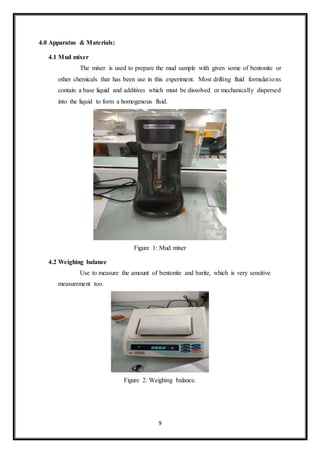
4.1 Mud mixer
“The mixer is used to prepare the mud sample with given some of bentonite or
other chemicals that has been use in this experiment. Most drilling fluid formulations
contain a base liquid and additives which must be dissolved or mechanically dispersed
into the liquid to form a homogenous fluid.”
Figure 1: Mud mixer
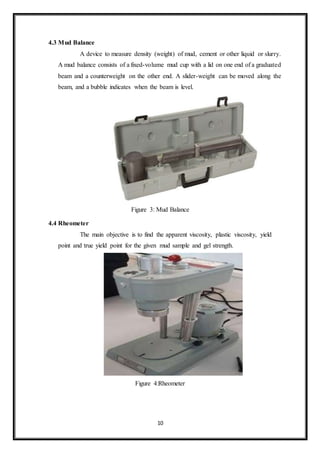
4.2 Weighing balance
“Use to measure the amount of bentonite and barite, which is very sensitive
measurement too.”
Figure 2: Weighing balance.
10
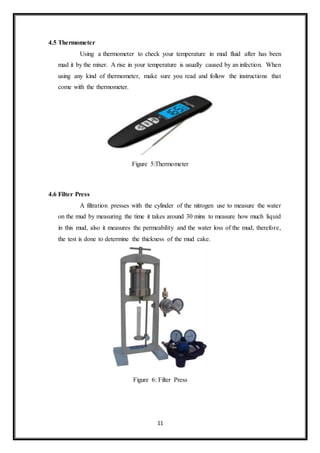
4.3 Mud Balance
“A device to measure density (weight) of mud, cement or other liquid or slurry.
A mud balance consists of a fixed-volume mud cup with a lid on one end of a graduated
beam and a counterweight on the other end. A slider-weight can be moved along the
beam, and a bubble indicates when the beam is level.”
Figure 3: Mud Balance
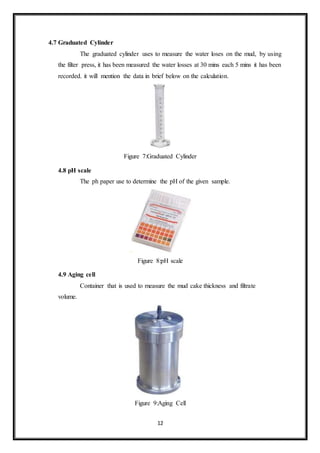
4.4 Rheometer
“The main objective is to find the apparent viscosity, plastic viscosity, yield
point and true yield point for the given mud sample and gel strength.”
Figure 4:Rheometer
11
4.5 Thermometer
“Using a thermometer to check your temperature in mud fluid after has been
mad it by the mixer. A rise in your temperature is usually caused by an infection. When
using any kind of thermometer, make sure you read and follow the instructions that
come with the thermometer.”
Figure 5:Thermometer
4.6 Filter Press
“A filtration presses with the cylinder of the nitrogen use to measure the water
on the mud by measuring the time it takes around 30 mins to measure how much liquid
in this mud, also it measures the permeability and the water loss of the mud, therefore,
the test is done to determine the thickness of the mud cake.”
Figure 6: Filter Press
12
4.7 Graduated Cylinder
“The graduated cylinder uses to measure the water loses on the mud, by using
the filter press, it has been measured the water losses at 30 mins each 5 mins it has been
recorded. it will mention the data in brief below on the calculation.”
Figure 7:Graduated Cylinder
4.8 pH scale
“The ph paper use to determine the pH of the given sample.”
Figure 8:pH scale
4.9 Aging cell
“Container that is used to measure the mud cake thickness and filtrate
volume.”
Figure 9:Aging Cell
13
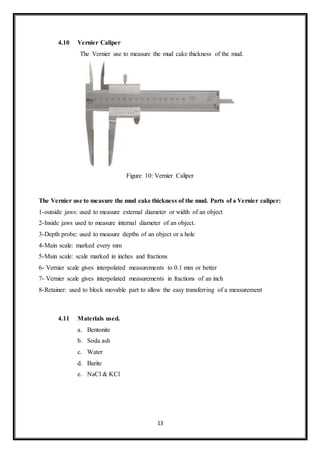
4.10 Vernier Caliper
“The Vernier use to measure the mud cake thickness of the mud.”
Figure 10: Vernier Caliper
The Vernier use to measure the mud cake thickness of the mud. Parts of a Vernier caliper:
1-outside jaws: used to measure external diameter or width of an object
2-Inside jaws used to measure internal diameter of an object.
3-Depth probe: used to measure depths of an object or a hole
4-Main scale: marked every mm
5-Main scale: scale marked in inches and fractions
6- Vernier scale gives interpolated measurements to 0.1 mm or better
7- Vernier scale gives interpolated measurements in fractions of an inch
8-Retainer: used to block movable part to allow the easy transferring of a measurement
4.11 Materials used.
a. Bentonite
b. Soda ash
c. Water
d. Barite
e. NaCl & KCl
14
5.0 Procedure
5.1 Prepare a mud as per experiment 2.
5.2 Add 0.10 % of contaminants to the mud formulation.
5.3 Stir thoroughly for 10 – 15 minutes for complete mixing.
5.4 Test the mud properties below and record the mud temperature during testing
a. Mud density (ppg)
b. Plastic viscosity (cp)
c. Apparent viscosity (cp)
d. Gel strength (10 sec and 10 minutes)
e. pH
f. Filtrate volume (cc) for 30 minutes
g. Mud cake thickness
h. Mud resistivity
15
6.0 Results
“This section will be all about the results determined within this experiment in
terms of density, pH, viscosity, filter volume and mud cake thickness for a mud made
of water, soda ash and bentonite. The mud was required to be increased by 0.1% of
contaminants to the mud formulation by adding Kcl. The amount of potassium chloride
added to this experiment mud, can be calculated using the given equation:”
mass = density * volume
Table 1:parameters used
The required amount of Kcl is equal to 0.385g
 “The equation needed to calculate the plastic viscosity,”
Plastic viscosity (cp)= [600 rpm reading] – [300 rpm reading]
 “The equation needed to calculate the Apparent viscosity,”
Apparent viscosity (cp) = [600 rpm reading] / 2
 “The equation needed to calculate the Yield Point,”
Yield Point (Ib/1002) = [300rpm reading] – Plastic viscosity
16
Table 2: parameters used by this experiment.
No. Apparatus Property Result
1 Thermometer Temperature (°C) 32 °C
2 Mud Balance Density (ppg) 9.08 ppg
3 pH Meter / pH Paper pH Value 8
4 Rotational Viscometer
Rheology (cP)
3 rpm 24.5 cP
6 rpm 24.5 cP
100 rpm 30 cP
200 rpm 32 cP
300 rpm 34 cP
600 rpm 40 cP
Plastic Viscosity (cP) Plastic viscosity (cp)= [600 rpm
reading] – [300 rpm reading]
40 – 34 = 6 cP
Apparent Viscosity (cP) Apparent viscosity (cp) = [600 rpm
reading] / 2
40 ÷ 2 = 20 cP
Yield Point (lb/100 ft2) Yield Point (Ib/1002) = [300rpm
reading] – Plastic viscosity
34 – 6 = 28 lb/100 ft2
Gel Strength (lb/100 ft2) 3(10 sec) 30 lb/100 ft2
3 (10 min) 31 lb/100 ft2
5
LPLT Filter Press
Filtrate Volume (cc)
5 min 9 (cc)
10 min 13 (cc)
15 min 10 (cc)
20 min 18 (cc)
25 min 20 (cc)
30 min 22 (cc)
6 Vernier Caliper Mud cake Thickness (mm) 3.42 mm
17
7.0 Discussion
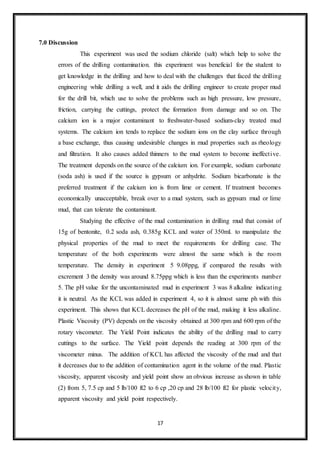
“This experiment was used the sodium chloride (salt) which help to solve the
errors of the drilling contamination. this experiment was beneficial for the student to
get knowledge in the drilling and how to deal with the challenges that faced the drilling
engineering while drilling a well, and it aids the drilling engineer to create proper mud
for the drill bit, which use to solve the problems such as high pressure, low pressure,
friction, carrying the cuttings, protect the formation from damage and so on. The
calcium ion is a major contaminant to freshwater-based sodium-clay treated mud
systems. The calcium ion tends to replace the sodium ions on the clay surface through
a base exchange, thus causing undesirable changes in mud properties such as rheology
and filtration. It also causes added thinners to the mud system to become ineffective.
The treatment depends on the source of the calcium ion. For example, sodium carbonate
(soda ash) is used if the source is gypsum or anhydrite. Sodium bicarbonate is the
preferred treatment if the calcium ion is from lime or cement. If treatment becomes
economically unacceptable, break over to a mud system, such as gypsum mud or lime
mud, that can tolerate the contaminant.”
“Studying the effective of the mud contamination in drilling mud that consist of
15g of bentonite, 0.2 soda ash, 0.385g KCL and water of 350ml. to manipulate the
physical properties of the mud to meet the requirements for drilling case. The
temperature of the both experiments were almost the same which is the room
temperature. The density in experiment 5 9.08ppg, if compared the results with
excrement 3 the density was around 8.75ppg which is less than the experiments number
5. The pH value for the uncontaminated mud in experiment 3 was 8 alkaline indicating
it is neutral. As the KCL was added in experiment 4, so it is almost same ph with this
experiment. This shows that KCL decreases the pH of the mud, making it less alkaline.
Plastic Viscosity (PV) depends on the viscosity obtained at 300 rpm and 600 rpm of the
rotary viscometer. The Yield Point indicates the ability of the drilling mud to carry
cuttings to the surface. The Yield point depends the reading at 300 rpm of the
viscometer minus. The addition of KCL has affected the viscosity of the mud and that
it decreases due to the addition of contamination agent in the volume of the mud. Plastic
viscosity, apparent viscosity and yield point show an obvious increase as shown in table
(2) from 5, 7.5 cp and 5 lb/100 ft2 to 6 cp ,20 cp and 28 lb/100 ft2 for plastic velocity,
apparent viscosity and yield point respectively.”
18
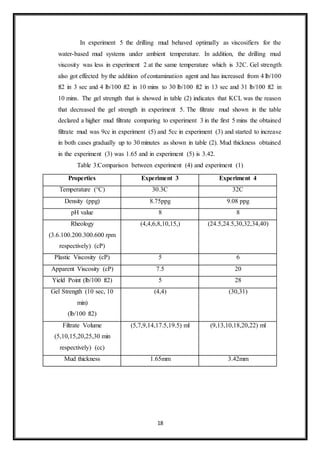
“In experiment 5 the drilling mud behaved optimally as viscosifiers for the
water-based mud systems under ambient temperature. In addition, the drilling mud
viscosity was less in experiment 2 at the same temperature which is 32C. Gel strength
also got effected by the addition of contamination agent and has increased from 4 lb/100
ft2 in 3 sec and 4 lb/100 ft2 in 10 mins to 30 lb/100 ft2 in 13 sec and 31 lb/100 ft2 in
10 mins. The gel strength that is showed in table (2) indicates that KCL was the reason
that decreased the gel strength in experiment 5. The filtrate mud shown in the table
declared a higher mud filtrate comparing to experiment 3 in the first 5 mins the obtained
filtrate mud was 9cc in experiment (5) and 5cc in experiment (3) and started to increase
in both cases gradually up to 30 minutes as shown in table (2). Mud thickness obtained
in the experiment (3) was 1.65 and in experiment (5) is 3.42.”
Table 3:Comparison between experiment (4) and experiment (1)
Properties Experiment 3 Experiment 4
Temperature (°C) 30.3C 32C
Density (ppg) 8.75ppg 9.08 ppg
pH value 8 8
Rheology
(3.6.100.200.300.600 rpm
respectively) (cP)
(4,4,6,8,10,15,) (24.5,24.5,30,32,34,40)
Plastic Viscosity (cP) 5 6
Apparent Viscosity (cP) 7.5 20
Yield Point (lb/100 ft2) 5 28
Gel Strength (10 sec, 10
min)
(lb/100 ft2)
(4,4) (30,31)
Filtrate Volume
(5,10,15,20,25,30 min
respectively) (cc)
(5,7,9,14,17.5,19.5) ml (9,13,10,18,20,22) ml
Mud thickness 1.65mm 3.42mm
19
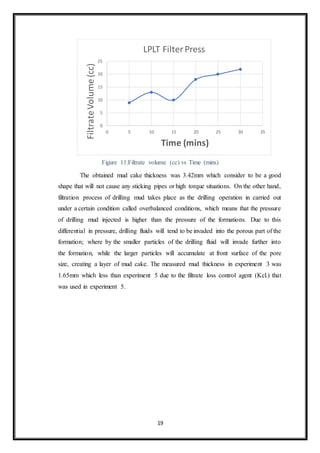
Figure 11:Filtrate volume (cc) vs Time (mins)
“The obtained mud cake thickness was 3.42mm which consider to be a good
shape that will not cause any sticking pipes or high torque situations. On the other hand,
filtration process of drilling mud takes place as the drilling operation in carried out
under a certain condition called overbalanced conditions, which means that the pressure
of drilling mud injected is higher than the pressure of the formations. Due to this
differential in pressure, drilling fluids will tend to be invaded into the porous part of the
formation; where by the smaller particles of the drilling fluid will invade further into
the formation, while the larger particles will accumulate at front surface of the pore
size, creating a layer of mud cake. The measured mud thickness in experiment 3 was
1.65mm which less than experiment 5 due to the filtrate loss control agent (Kcl.) that
was used in experiment 5.”
0
5
10
15
20
25
0 5 10 15 20 25 30 35
Filtrate
Volume
(cc)
Time (mins)
LPLT FilterPress
20
8.0 Conclusion
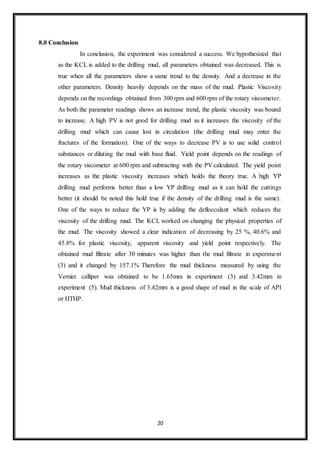
“In conclusion, the experiment was considered a success. We hypothesized that
as the KCL is added to the drilling mud, all parameters obtained was decreased. This is
true when all the parameters show a same trend to the density. And a decrease in the
other parameters. Density heavily depends on the mass of the mud. Plastic Viscosity
depends on the recordings obtained from 300 rpm and 600 rpm of the rotary viscometer.
As both the parameter readings shows an increase trend, the plastic viscosity was bound
to increase. A high PV is not good for drilling mud as it increases the viscosity of the
drilling mud which can cause lost in circulation (the drilling mud may enter the
fractures of the formation). One of the ways to decrease PV is to use solid control
substances or diluting the mud with base fluid. Yield point depends on the readings of
the rotary viscometer at 600 rpm and subtracting with the PV calculated. The yield point
increases as the plastic viscosity increases which holds the theory true. A high YP
drilling mud performs better than a low YP drilling mud as it can hold the cuttings
better (it should be noted this hold true if the density of the drilling mud is the same).
One of the ways to reduce the YP is by adding the deflocculant which reduces the
viscosity of the drilling mud. The KCL worked on changing the physical properties of
the mud. The viscosity showed a clear indication of decreasing by 25 %, 40.6% and
45.8% for plastic viscosity, apparent viscosity and yield point respectively. The
obtained mud filtrate after 30 minutes was higher than the mud filtrate in experiment
(3) and it changed by 157.1% Therefore the mud thickness measured by using the
Vernier calliper was obtained to be 1.65mm in experiment (3) and 3.42mm in
experiment (5). Mud thickness of 3.42mm is a good shape of mud in the scale of API
or HTHP.”
21
Errors
 “Human error occurred in the experiment that effected the main objective of
the series of experiment to compare experiment with the coming after
experiments that 40g of bentonite, 20 soda ash and 300 ml of water. On other
hand in this experiment 15g of bentonite, 0.2 soda ash and 350ml of water.
The change of amounts used affected the results of experiment.”
 “Human error occurred in the experiment that the barite was forgotten and
was not included in the mixer where this experiment was meant to be
compared with experiment (5).”
Suggestions
 “drilling fluid has good fluid loss property, it will show a thin and
impermeable mud cake. because at the surface condition the test
demonstrates very good fluid loss and a very thin filter cake. When the
drilling mud is in a downhole condition, wellbore temperature and pressure
can dramatically change drilling fluid properties. The best way to test the
fluid loss is to simulate wellbore condition at high pressure high temperature
in order to see what the fluid loss property will be.”
 “Since this experiment is based on the bentonite density in this experiment
which was 9.15 ppg at 30.9 degree Celsius, the change in temperature should
considered due to its ability to affect density.”
22
9.0 References
A. galleries, 2014. galleries. [Online] Available at: http://www.galleries.com/Barite
[Accessed 25 2 2021].
B. ima-na, n.d. ima-na. [Online] Available at: https://www.ima-
na.org/page/what_is_barite [Accessed 25 2 2021].
C. Oilfield Glossary, n.d. Oilfield Glossary. [Online] Available at:
https://www.glossary.oilfield.slb.com/en/Terms/a/apparent_viscosity.aspx [Accessed
25 2 2021].
D. Philips, A., 2016. drillingformulas. [Online] Available at:
http://www.drillingformulas.com/yield-point-yp-of-drilling-fluids/ [Accessed 25 2
2021].

Drilling mud contamination

  • 1.
    1 Drilling Engineering TITLE: DrillingMud Contamination Author name: Mahmood Abdul-Jabbar hebah
  • 2.
    2 Acknowledgement “I would liketo express my deepest appreciation to all those who provided me the possibility to complete this experiment. I would also like to show my deepest gratitude to my lecturer, Dr. Mahmood for giving me a good guideline for this experiment throughout numerous consultations. Moreover, I would like to appreciate the crucial role of the staff of APU University who gave the permission to use all equipment and necessary materials to complete the laboratory, and also a special thanks goes to my group who did well in the lab to success in this experiment. Last but not least, many thanks go to the head of the APU University whose have invested his full effort in guiding the students to achieving their goals.”
  • 3.
    3 Abstract “This experiment wasabout drilling fluid contamination test. In this test we were studying the effect of contamination of monovalent chemicals (NaCl and KCl) and divalent chemicals that cause contamination are calcium sulfate (CaSO), cement (Ca (OH), and Gypsum (CaSO-2HO). In this experiment study the effect of contamination of KCL to the density, Plastic Viscosity and Yield Point of water-based mud was conducted. a range of instruments were used such Mud mixer, Mud balance, Thermometer, Remoter, Filter press, Graduated cylinder, pH meter / pH paper, Aging cell, Rotating oven and litter cup, Viscometer and Venire calliper. All these materials were used in order to understand the reasons why the mud varies and to know with precision the different properties that the fluids have. Intertek determines the true nature of formation oil recovered and the degree of contamination by water-based drill mud. Drilling clients need to understand if oil recovered during a series of Repeat Formation Tests (RFT) was naturally occurring formation fluid or oil-based mud, and if both were present, the degree of contamination from the drilling mud. Testing petroleum reservoir fluids and drilling mud for accuracy brings benefits when determining possible drill mud contamination.”
  • 4.
    4 Table of Contents Abstract.......................................................................................................................................3 1.0Introduction ...................................................................................................................... 6 2.0 Objective .......................................................................................................................... 7 3.0 Theory and Literature Review ............................................................................................ 8 4.0 Apparatus & Materials:......................................................................................................9 4.1 Mud mixer ........................................................................................................................ 9 4.2 Weighing balance .............................................................................................................. 9 4.3 Mud Balance................................................................................................................... 10 4.4 Rheometer....................................................................................................................... 10 4.5 Thermometer................................................................................................................... 11 4.6 Filter Press...................................................................................................................... 11 4.7 Graduated Cylinder.......................................................................................................... 12 4.8 pH scale.......................................................................................................................... 12 4.9 Aging cell....................................................................................................................... 12 4.10 Vernier Caliper................................................................................................................ 13 4.11 Materials used. ................................................................................................................ 13 5.0 Procedure........................................................................................................................ 14 6.0 Results............................................................................................................................ 15 7.0 Discussion....................................................................................................................... 17 8.0 Conclusion...................................................................................................................... 20 9.0 References ...................................................................................................................... 22
  • 5.
    5 List of Figures Figure1: Mud mixer..................................................................................................................... 9 Figure 2: Weighing balance. ......................................................................................................9 Figure 3: Mud Balance.............................................................................................................10 Figure 4:Rheometer..................................................................................................................10 Figure 5:Thermometer .............................................................................................................11 Figure 6: Filter Press................................................................................................................11 Figure 7:Graduated Cylinder ...................................................................................................12 Figure 8:pH scale .....................................................................................................................12 Figure 9:Aging Cell .................................................................................................................12 Figure 10: Vernier Caliper .......................................................................................................13 Figure 11:Filtrate volume (cc) vs Time (mins)........................................................................19 List of Tables Table 1:parameters used...........................................................................................................15 Table 2: parameters used by this experiment...........................................................................16 Table 3:Comparison between experiment (4) and experiment (1) ..........................................18
  • 6.
    6 1.0 Introduction “The drillingfluid is related either directly or indirectly to almost every drilling problem. This is not to say that the drilling fluid is the cause or solution of all drilling problems, but it is a tool that can often be used to alleviate a problem situation. Generally, a good drilling fluid is simple and contains a minimum number of additives. This allows easier maintenance and control of properties. It is desirable to have a mud system that is flexible enough to allow changes to be made to meet changing requirements as they occur. Running a mud system consists primarily of controlling the type and amount of solids in the mud and their chemical environment. All mud properties are controlled by controlling these compositional factors. Accurate mud tests are necessary for proper control of the mud properties.” “The main functions of drilling fluids include providing hydrostatic pressure to prevent formation fluids from entering into the well bore (controlling formation pressure), remove cuttings from the well, suspend and release cuttings, seal permeable formation, maintain wellbore stability, minimize reservoir damage, cool, lubricate and support the bit and drilling assembly, transmit hydraulic energy to tools and bit, ensure adequate formation evaluation, corrosion control, facilitate cementing and completion and minimize impact on the environment A mud is said to be contaminated when a foreign material enters the mud system and causes undesirable changes in mud properties, such as density, viscosity, and filtration. Generally, water-based mud systems are the most susceptible to contamination.” “Mud contamination can result from overtreatment of the mud system with additives or from material entering the mud during drilling. Solids are materials that are added to make up a mud system (bentonite, barite) and materials that are drilled (active and inert). Excess solids of any type are the most undesirable contaminant to drilling fluids. They affect all mud properties. It is necessary to ensure that the drilling fluid properties such as density, viscosity, filtration, etc. should not change during the drilling operation. However, in practice, this never occurs. In the field, some drilling fluid properties will eventually change even if the condition of the hole is stable. Contamination of the drilling fluid system can come from any one of the following sources: materials coming from the formation, thermal degradation of organics in mud, aeration or overtreatment at the surface. (galleries, 2014).” “The purpose of this experiment is to study the effect of Salt (NaCl) on fresh water drilling fluid and to prepare saturated salt water drilling fluid. Salt water usually
  • 7.
    7 produced from seawater or fresh water that contains chlorite. Determination of the amount of chloride ions present in mud is crucial in determining the type of logs to be run. Salt water muds are often used to drill salt stringers because fresh water will dissolve the salt producing an out-of-gage hole. Shale formation, for example, will become slushy in fresh water. Therefore, salt water drilling mud is the solution to the drilling of this kind of formation. Also, freshwater mud could react with chloride contain formation and causes cavities and formation damage. Thus, saturated salt mud is used instead to inhibit washing out of large cavities from bore wall. (ima-na, n.d.).” “This knowledge is important for drilling engineers in order to plan and structure the most effective way of drilling through those particular formations. The invention relates to a clay based aqueous drilling fluid containing dissolved inorganic salts for use in drilling through either or both shale and salt formations. The fluid is prepared by dissolving sodium chloride in the aqueous fluid prior to admixing of the clay and other additives. Addition of salt to the fresh water drilling fluids has other functions. For example, salt may be added to increase mud weight without adding solids and is a very effective method of increasing mud weight in most conditions. The salt content of make-up water will greatly affect the viscosity of attapulgite mud, as well as wall cake thickness, water loss, and mixing ability. All of these effects were tested in the experiment. Salt water muds have minimal effect on polymers. Salt or sodium chloride contamination of mud can come from different sources including the drilling salt beds, the salty make up of water, and the inflows of salt water.” 2.0 Objective “To study the effects of mud contaminations on the properties of water-based mud and the effectiveness of treating material.”
  • 8.
    8 3.0 Theory andLiterature Review “Salt contaminations on drilling mud occurred whilst drilling operation takes place. Soluble salt, which always encountered during drilling, completion and workover jobs, can be divided into two groups, which are monovalent and divalent. The monovalent salt that always encountered is KCl, and sometimes, in a certain area, NaCL can also be found. The most common divalent salts are CaSO4, CaCl2, MgSO4, and MgCl2. These salts can alter the original properties of drilling mud when they are mixed. To bring back the required properties of the mud, treatment has to be done by using certain material.” “In general, a contaminant is any material that causes undesirable changes in drilling fluid properties. Solids are by far the most prevalent contaminant. Excessive solids, whether commercial or from the formation, lead to high rheological properties and slow the drilling rate. Most other contaminants are chemical in nature and require chemical treatment to restore fluid properties. While there are specific treatments for each contaminant, it is not always possible to remove the contaminant from the system. Some contaminants can be predicted, and a treatment started in advance. The predictable contaminants are: cement, make-up water, and sometimes salt, gypsum, and acid gases such as, hydrogen sulfide and carbon dioxide. Pre-treatment can be advantageous as long as it is not excessive and does not adversely affect mud properties. Other contaminants may be unexpected and unpredictable such as those whose concentration increases gradually. Eventually, the contaminant shows its effect by altering the fluid properties. This change in fluid properties often occurs at times when deflocculants are expended at high downhole temperatures. It is essential to keep accurate records of drilling fluid properties to ensure that any gradual build-up of a contaminant is monitored and detected.”
  • 9.
    9 4.0 Apparatus &Materials: 4.1 Mud mixer “The mixer is used to prepare the mud sample with given some of bentonite or other chemicals that has been use in this experiment. Most drilling fluid formulations contain a base liquid and additives which must be dissolved or mechanically dispersed into the liquid to form a homogenous fluid.” Figure 1: Mud mixer 4.2 Weighing balance “Use to measure the amount of bentonite and barite, which is very sensitive measurement too.” Figure 2: Weighing balance.
  • 10.
    10 4.3 Mud Balance “Adevice to measure density (weight) of mud, cement or other liquid or slurry. A mud balance consists of a fixed-volume mud cup with a lid on one end of a graduated beam and a counterweight on the other end. A slider-weight can be moved along the beam, and a bubble indicates when the beam is level.” Figure 3: Mud Balance 4.4 Rheometer “The main objective is to find the apparent viscosity, plastic viscosity, yield point and true yield point for the given mud sample and gel strength.” Figure 4:Rheometer
  • 11.
    11 4.5 Thermometer “Using athermometer to check your temperature in mud fluid after has been mad it by the mixer. A rise in your temperature is usually caused by an infection. When using any kind of thermometer, make sure you read and follow the instructions that come with the thermometer.” Figure 5:Thermometer 4.6 Filter Press “A filtration presses with the cylinder of the nitrogen use to measure the water on the mud by measuring the time it takes around 30 mins to measure how much liquid in this mud, also it measures the permeability and the water loss of the mud, therefore, the test is done to determine the thickness of the mud cake.” Figure 6: Filter Press
  • 12.
    12 4.7 Graduated Cylinder “Thegraduated cylinder uses to measure the water loses on the mud, by using the filter press, it has been measured the water losses at 30 mins each 5 mins it has been recorded. it will mention the data in brief below on the calculation.” Figure 7:Graduated Cylinder 4.8 pH scale “The ph paper use to determine the pH of the given sample.” Figure 8:pH scale 4.9 Aging cell “Container that is used to measure the mud cake thickness and filtrate volume.” Figure 9:Aging Cell
  • 13.
    13 4.10 Vernier Caliper “TheVernier use to measure the mud cake thickness of the mud.” Figure 10: Vernier Caliper The Vernier use to measure the mud cake thickness of the mud. Parts of a Vernier caliper: 1-outside jaws: used to measure external diameter or width of an object 2-Inside jaws used to measure internal diameter of an object. 3-Depth probe: used to measure depths of an object or a hole 4-Main scale: marked every mm 5-Main scale: scale marked in inches and fractions 6- Vernier scale gives interpolated measurements to 0.1 mm or better 7- Vernier scale gives interpolated measurements in fractions of an inch 8-Retainer: used to block movable part to allow the easy transferring of a measurement 4.11 Materials used. a. Bentonite b. Soda ash c. Water d. Barite e. NaCl & KCl
  • 14.
    14 5.0 Procedure 5.1 Preparea mud as per experiment 2. 5.2 Add 0.10 % of contaminants to the mud formulation. 5.3 Stir thoroughly for 10 – 15 minutes for complete mixing. 5.4 Test the mud properties below and record the mud temperature during testing a. Mud density (ppg) b. Plastic viscosity (cp) c. Apparent viscosity (cp) d. Gel strength (10 sec and 10 minutes) e. pH f. Filtrate volume (cc) for 30 minutes g. Mud cake thickness h. Mud resistivity
  • 15.
    15 6.0 Results “This sectionwill be all about the results determined within this experiment in terms of density, pH, viscosity, filter volume and mud cake thickness for a mud made of water, soda ash and bentonite. The mud was required to be increased by 0.1% of contaminants to the mud formulation by adding Kcl. The amount of potassium chloride added to this experiment mud, can be calculated using the given equation:” mass = density * volume Table 1:parameters used The required amount of Kcl is equal to 0.385g  “The equation needed to calculate the plastic viscosity,” Plastic viscosity (cp)= [600 rpm reading] – [300 rpm reading]  “The equation needed to calculate the Apparent viscosity,” Apparent viscosity (cp) = [600 rpm reading] / 2  “The equation needed to calculate the Yield Point,” Yield Point (Ib/1002) = [300rpm reading] – Plastic viscosity
  • 16.
    16 Table 2: parametersused by this experiment. No. Apparatus Property Result 1 Thermometer Temperature (°C) 32 °C 2 Mud Balance Density (ppg) 9.08 ppg 3 pH Meter / pH Paper pH Value 8 4 Rotational Viscometer Rheology (cP) 3 rpm 24.5 cP 6 rpm 24.5 cP 100 rpm 30 cP 200 rpm 32 cP 300 rpm 34 cP 600 rpm 40 cP Plastic Viscosity (cP) Plastic viscosity (cp)= [600 rpm reading] – [300 rpm reading] 40 – 34 = 6 cP Apparent Viscosity (cP) Apparent viscosity (cp) = [600 rpm reading] / 2 40 ÷ 2 = 20 cP Yield Point (lb/100 ft2) Yield Point (Ib/1002) = [300rpm reading] – Plastic viscosity 34 – 6 = 28 lb/100 ft2 Gel Strength (lb/100 ft2) 3(10 sec) 30 lb/100 ft2 3 (10 min) 31 lb/100 ft2 5 LPLT Filter Press Filtrate Volume (cc) 5 min 9 (cc) 10 min 13 (cc) 15 min 10 (cc) 20 min 18 (cc) 25 min 20 (cc) 30 min 22 (cc) 6 Vernier Caliper Mud cake Thickness (mm) 3.42 mm
  • 17.
    17 7.0 Discussion “This experimentwas used the sodium chloride (salt) which help to solve the errors of the drilling contamination. this experiment was beneficial for the student to get knowledge in the drilling and how to deal with the challenges that faced the drilling engineering while drilling a well, and it aids the drilling engineer to create proper mud for the drill bit, which use to solve the problems such as high pressure, low pressure, friction, carrying the cuttings, protect the formation from damage and so on. The calcium ion is a major contaminant to freshwater-based sodium-clay treated mud systems. The calcium ion tends to replace the sodium ions on the clay surface through a base exchange, thus causing undesirable changes in mud properties such as rheology and filtration. It also causes added thinners to the mud system to become ineffective. The treatment depends on the source of the calcium ion. For example, sodium carbonate (soda ash) is used if the source is gypsum or anhydrite. Sodium bicarbonate is the preferred treatment if the calcium ion is from lime or cement. If treatment becomes economically unacceptable, break over to a mud system, such as gypsum mud or lime mud, that can tolerate the contaminant.” “Studying the effective of the mud contamination in drilling mud that consist of 15g of bentonite, 0.2 soda ash, 0.385g KCL and water of 350ml. to manipulate the physical properties of the mud to meet the requirements for drilling case. The temperature of the both experiments were almost the same which is the room temperature. The density in experiment 5 9.08ppg, if compared the results with excrement 3 the density was around 8.75ppg which is less than the experiments number 5. The pH value for the uncontaminated mud in experiment 3 was 8 alkaline indicating it is neutral. As the KCL was added in experiment 4, so it is almost same ph with this experiment. This shows that KCL decreases the pH of the mud, making it less alkaline. Plastic Viscosity (PV) depends on the viscosity obtained at 300 rpm and 600 rpm of the rotary viscometer. The Yield Point indicates the ability of the drilling mud to carry cuttings to the surface. The Yield point depends the reading at 300 rpm of the viscometer minus. The addition of KCL has affected the viscosity of the mud and that it decreases due to the addition of contamination agent in the volume of the mud. Plastic viscosity, apparent viscosity and yield point show an obvious increase as shown in table (2) from 5, 7.5 cp and 5 lb/100 ft2 to 6 cp ,20 cp and 28 lb/100 ft2 for plastic velocity, apparent viscosity and yield point respectively.”
  • 18.
    18 “In experiment 5the drilling mud behaved optimally as viscosifiers for the water-based mud systems under ambient temperature. In addition, the drilling mud viscosity was less in experiment 2 at the same temperature which is 32C. Gel strength also got effected by the addition of contamination agent and has increased from 4 lb/100 ft2 in 3 sec and 4 lb/100 ft2 in 10 mins to 30 lb/100 ft2 in 13 sec and 31 lb/100 ft2 in 10 mins. The gel strength that is showed in table (2) indicates that KCL was the reason that decreased the gel strength in experiment 5. The filtrate mud shown in the table declared a higher mud filtrate comparing to experiment 3 in the first 5 mins the obtained filtrate mud was 9cc in experiment (5) and 5cc in experiment (3) and started to increase in both cases gradually up to 30 minutes as shown in table (2). Mud thickness obtained in the experiment (3) was 1.65 and in experiment (5) is 3.42.” Table 3:Comparison between experiment (4) and experiment (1) Properties Experiment 3 Experiment 4 Temperature (°C) 30.3C 32C Density (ppg) 8.75ppg 9.08 ppg pH value 8 8 Rheology (3.6.100.200.300.600 rpm respectively) (cP) (4,4,6,8,10,15,) (24.5,24.5,30,32,34,40) Plastic Viscosity (cP) 5 6 Apparent Viscosity (cP) 7.5 20 Yield Point (lb/100 ft2) 5 28 Gel Strength (10 sec, 10 min) (lb/100 ft2) (4,4) (30,31) Filtrate Volume (5,10,15,20,25,30 min respectively) (cc) (5,7,9,14,17.5,19.5) ml (9,13,10,18,20,22) ml Mud thickness 1.65mm 3.42mm
  • 19.
    19 Figure 11:Filtrate volume(cc) vs Time (mins) “The obtained mud cake thickness was 3.42mm which consider to be a good shape that will not cause any sticking pipes or high torque situations. On the other hand, filtration process of drilling mud takes place as the drilling operation in carried out under a certain condition called overbalanced conditions, which means that the pressure of drilling mud injected is higher than the pressure of the formations. Due to this differential in pressure, drilling fluids will tend to be invaded into the porous part of the formation; where by the smaller particles of the drilling fluid will invade further into the formation, while the larger particles will accumulate at front surface of the pore size, creating a layer of mud cake. The measured mud thickness in experiment 3 was 1.65mm which less than experiment 5 due to the filtrate loss control agent (Kcl.) that was used in experiment 5.” 0 5 10 15 20 25 0 5 10 15 20 25 30 35 Filtrate Volume (cc) Time (mins) LPLT FilterPress
  • 20.
    20 8.0 Conclusion “In conclusion,the experiment was considered a success. We hypothesized that as the KCL is added to the drilling mud, all parameters obtained was decreased. This is true when all the parameters show a same trend to the density. And a decrease in the other parameters. Density heavily depends on the mass of the mud. Plastic Viscosity depends on the recordings obtained from 300 rpm and 600 rpm of the rotary viscometer. As both the parameter readings shows an increase trend, the plastic viscosity was bound to increase. A high PV is not good for drilling mud as it increases the viscosity of the drilling mud which can cause lost in circulation (the drilling mud may enter the fractures of the formation). One of the ways to decrease PV is to use solid control substances or diluting the mud with base fluid. Yield point depends on the readings of the rotary viscometer at 600 rpm and subtracting with the PV calculated. The yield point increases as the plastic viscosity increases which holds the theory true. A high YP drilling mud performs better than a low YP drilling mud as it can hold the cuttings better (it should be noted this hold true if the density of the drilling mud is the same). One of the ways to reduce the YP is by adding the deflocculant which reduces the viscosity of the drilling mud. The KCL worked on changing the physical properties of the mud. The viscosity showed a clear indication of decreasing by 25 %, 40.6% and 45.8% for plastic viscosity, apparent viscosity and yield point respectively. The obtained mud filtrate after 30 minutes was higher than the mud filtrate in experiment (3) and it changed by 157.1% Therefore the mud thickness measured by using the Vernier calliper was obtained to be 1.65mm in experiment (3) and 3.42mm in experiment (5). Mud thickness of 3.42mm is a good shape of mud in the scale of API or HTHP.”
  • 21.
    21 Errors  “Human erroroccurred in the experiment that effected the main objective of the series of experiment to compare experiment with the coming after experiments that 40g of bentonite, 20 soda ash and 300 ml of water. On other hand in this experiment 15g of bentonite, 0.2 soda ash and 350ml of water. The change of amounts used affected the results of experiment.”  “Human error occurred in the experiment that the barite was forgotten and was not included in the mixer where this experiment was meant to be compared with experiment (5).” Suggestions  “drilling fluid has good fluid loss property, it will show a thin and impermeable mud cake. because at the surface condition the test demonstrates very good fluid loss and a very thin filter cake. When the drilling mud is in a downhole condition, wellbore temperature and pressure can dramatically change drilling fluid properties. The best way to test the fluid loss is to simulate wellbore condition at high pressure high temperature in order to see what the fluid loss property will be.”  “Since this experiment is based on the bentonite density in this experiment which was 9.15 ppg at 30.9 degree Celsius, the change in temperature should considered due to its ability to affect density.”
  • 22.
    22 9.0 References A. galleries,2014. galleries. [Online] Available at: http://www.galleries.com/Barite [Accessed 25 2 2021]. B. ima-na, n.d. ima-na. [Online] Available at: https://www.ima- na.org/page/what_is_barite [Accessed 25 2 2021]. C. Oilfield Glossary, n.d. Oilfield Glossary. [Online] Available at: https://www.glossary.oilfield.slb.com/en/Terms/a/apparent_viscosity.aspx [Accessed 25 2 2021]. D. Philips, A., 2016. drillingformulas. [Online] Available at: http://www.drillingformulas.com/yield-point-yp-of-drilling-fluids/ [Accessed 25 2 2021].