INSTITUTE OF MANAGEMENT SCIENCES
UNIVERSITY OF LUCKNOW
Presented by…….
Juhi Siddiqui
MBA Sem. III
CONTENTS
1. Petrophysics
2. Porosity
3. Permeability
4. Capillarity
5. Saturation
6. Conclusions
PETROPHYSICS
 Petrophysics (petro is Latin for "rock" and physics is the study
of nature) is the study of the physical and chemical properties
that describe the occurrence and behavior of rocks, soils and
fluids.
 Petrophysics mainly studies reservoirs of resources, including
ore deposits and oil or natural gas reservoirs.
 The productivity of wells in a hydrocarbon-bearing (oil/gas)
reservoir depends on petrophysical properties.
Hydrocarbon bearing reservoir rock consists of two
components:
a. Rock matrix
b. Interconnected pore network
The main petrophysical properties of reservoir rocks
are:
 Porosity
 Permeability
 Saturation
 Capillarity
POROSITY
 The porosity determines the storage capacity for
hydrocarbons.
It can be defined in various ways:-
 The porosity of rock is the ratio of its total pore spaces
to its total volumes i.e., for given sample.
Porosity = Total volumes –Bulk volume.
 Porosity of a material is defined as that fraction of the
bulk volume of the material that is not occupied by the
solid framework of the material.
 In oil reservoirs, the porosity represents the percentage of the
total space that is available for occupancy by either liquids or
gases.
 Porosity determines the storage capacity of the sand and is
generally expressed on a percentage basis or as a fraction or as
a decimal.
Porosity = Volume of total pore space× 100
Volume of rock sample
TYPE OF
POROSITY
ON THE BASIS
OF ORIGIN
PRIMARY
POROSITY
SECONDARY
POROSITY
ON THE BASIS
OF PORE
PATTERN
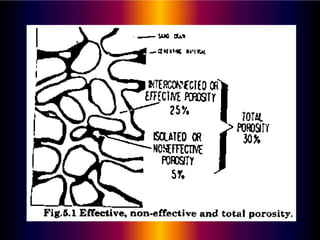
ABSOLUTE
POROSITY
EFFECTIVE
POROSITY
Figure showing
Different
types of porosity
63
PERMEABILITY
It is mainly known as the efficiency of the porous medium
and is defined as the property that permits the passage of
a fluid through the interconnected pores of a rock without
damage or displacement of the rock particles.
 It is measured in darcies.
Darcy's law.
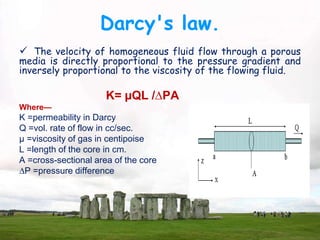
 The velocity of homogeneous fluid flow through a porous
media is directly proportional to the pressure gradient and
inversely proportional to the viscosity of the flowing fluid.
K= µQL /∆PA
Where—
K =permeability in Darcy
Q =vol. rate of flow in cc/sec.
µ =viscosity of gas in centipoise
L =length of the core in cm.
A =cross-sectional area of the core
∆P =pressure difference
Types of Permeability
Effective Permeability
The ability of the rock to
conduct a fluid in the
presence of another fluid,
immiscible with the first, is
called its effective
permeability to that fluid.
Relative Permeability
Relative permeability is the
ratio of effective
permeability of a particular
fluid at a particular
saturation to absolute
permeability of that fluid
at total saturation.
CAPILLARY PRESSURE
 When two fluids occupy the pore space in a porous medium the
interfacial boundary between the two fluids is curved.
 The degree of the curvature is dependent on the size of the
rock pores and the proportion of the fluids present.
 There is difference in pressure between the fluids across this
interface; it is usually termed the capillary pressure.
 Capillarity determines how much of the available hydrocarbons
can be produced.
The capillary properties of a porous medium are
determined by:
(a) The geometrical configuration of the interstitial space in
the matrix.
(b) The physical and chemical nature of the interstitial
surfaces.
(c) The physical and chemical properties of the fluid phases
in contact with the interstitial surfaces.
FLUID SATURATION
 Fluid saturation is the measure of the gross void space in a
reservoir rock that is occupied by a fluid.
 In place determination of reservoir fluid saturation
consist in analyzing reservoir core samples for water and
oil, the saturation in gas being obtained by differences
since the sum of the saturations in the three fluids is
equal to unity.
CONCLUSIONS
 Accuracy of petroleum reserve estimation lies mainly in
proper analysis of petrophysical behavior of reservoir.
 Extensive work on petrophysical modeling of reservoir
results in exponentially increased recovery factor.
 The ratio of the permeability of the rock to the oil to its
permeability to gas or water determines the efficiency of
the recovery mechanism, and this ratio continually
changes.
vdocument.in_petrophysical-properties-of-reservoir-rocks.pptx

vdocument.in_petrophysical-properties-of-reservoir-rocks.pptx

  • 1.
    INSTITUTE OF MANAGEMENTSCIENCES UNIVERSITY OF LUCKNOW Presented by……. Juhi Siddiqui MBA Sem. III
  • 2.
    CONTENTS 1. Petrophysics 2. Porosity 3.Permeability 4. Capillarity 5. Saturation 6. Conclusions
  • 3.
    PETROPHYSICS  Petrophysics (petrois Latin for "rock" and physics is the study of nature) is the study of the physical and chemical properties that describe the occurrence and behavior of rocks, soils and fluids.  Petrophysics mainly studies reservoirs of resources, including ore deposits and oil or natural gas reservoirs.  The productivity of wells in a hydrocarbon-bearing (oil/gas) reservoir depends on petrophysical properties.
  • 4.
    Hydrocarbon bearing reservoirrock consists of two components: a. Rock matrix b. Interconnected pore network The main petrophysical properties of reservoir rocks are:  Porosity  Permeability  Saturation  Capillarity
  • 5.
    POROSITY  The porositydetermines the storage capacity for hydrocarbons. It can be defined in various ways:-  The porosity of rock is the ratio of its total pore spaces to its total volumes i.e., for given sample. Porosity = Total volumes –Bulk volume.  Porosity of a material is defined as that fraction of the bulk volume of the material that is not occupied by the solid framework of the material.
  • 6.
     In oilreservoirs, the porosity represents the percentage of the total space that is available for occupancy by either liquids or gases.  Porosity determines the storage capacity of the sand and is generally expressed on a percentage basis or as a fraction or as a decimal. Porosity = Volume of total pore space× 100 Volume of rock sample
  • 7.
    TYPE OF POROSITY ON THEBASIS OF ORIGIN PRIMARY POROSITY SECONDARY POROSITY ON THE BASIS OF PORE PATTERN ABSOLUTE POROSITY EFFECTIVE POROSITY
  • 8.
  • 9.
  • 10.
    PERMEABILITY It is mainlyknown as the efficiency of the porous medium and is defined as the property that permits the passage of a fluid through the interconnected pores of a rock without damage or displacement of the rock particles.  It is measured in darcies.
  • 11.
    Darcy's law.  Thevelocity of homogeneous fluid flow through a porous media is directly proportional to the pressure gradient and inversely proportional to the viscosity of the flowing fluid. K= µQL /∆PA Where— K =permeability in Darcy Q =vol. rate of flow in cc/sec. µ =viscosity of gas in centipoise L =length of the core in cm. A =cross-sectional area of the core ∆P =pressure difference
  • 12.
    Types of Permeability EffectivePermeability The ability of the rock to conduct a fluid in the presence of another fluid, immiscible with the first, is called its effective permeability to that fluid. Relative Permeability Relative permeability is the ratio of effective permeability of a particular fluid at a particular saturation to absolute permeability of that fluid at total saturation.
  • 13.
    CAPILLARY PRESSURE  Whentwo fluids occupy the pore space in a porous medium the interfacial boundary between the two fluids is curved.  The degree of the curvature is dependent on the size of the rock pores and the proportion of the fluids present.  There is difference in pressure between the fluids across this interface; it is usually termed the capillary pressure.  Capillarity determines how much of the available hydrocarbons can be produced.
  • 14.
    The capillary propertiesof a porous medium are determined by: (a) The geometrical configuration of the interstitial space in the matrix. (b) The physical and chemical nature of the interstitial surfaces. (c) The physical and chemical properties of the fluid phases in contact with the interstitial surfaces.
  • 15.
    FLUID SATURATION  Fluidsaturation is the measure of the gross void space in a reservoir rock that is occupied by a fluid.  In place determination of reservoir fluid saturation consist in analyzing reservoir core samples for water and oil, the saturation in gas being obtained by differences since the sum of the saturations in the three fluids is equal to unity.
  • 16.
    CONCLUSIONS  Accuracy ofpetroleum reserve estimation lies mainly in proper analysis of petrophysical behavior of reservoir.  Extensive work on petrophysical modeling of reservoir results in exponentially increased recovery factor.  The ratio of the permeability of the rock to the oil to its permeability to gas or water determines the efficiency of the recovery mechanism, and this ratio continually changes.