( Drilling Hydraulics)
Ararat Private Technical Institute
Drilling Oil Wells Department
(Mud Weight Density)
Date of Experiment:22/10/2018
Lab No.: (1)
Prepared by:
Hazhar Kamal Twfiq
Supervised by:
Submitted on: 4/11/2018
( Drilling Hydraulics)
Aim
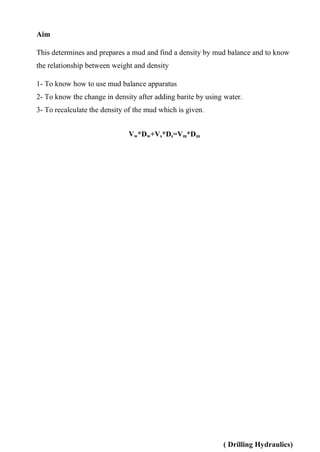
This determines and prepares a mud and find a density by mud balance and to know
the relationship between weight and density
1- To know how to use mud balance apparatus
2- To know the change in density after adding barite by using water.
3- To recalculate the density of the mud which is given.
Vw*Dw+Vs*Ds=Vm*Dm
( Drilling Hydraulics)
Introduction
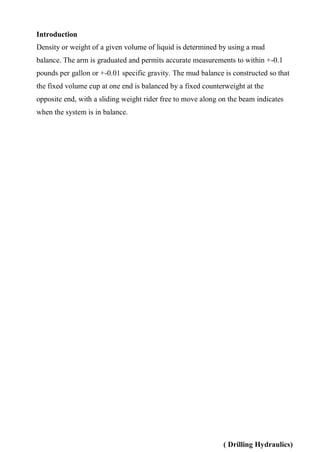
Density or weight of a given volume of liquid is determined by using a mud
balance. The arm is graduated and permits accurate measurements to within +-0.1
pounds per gallon or +-0.01 specific gravity. The mud balance is constructed so that
the fixed volume cup at one end is balanced by a fixed counterweight at the
opposite end, with a sliding weight rider free to move along on the beam indicates
when the system is in balance.
( Drilling Hydraulics)
Theory
The density of the drilling fluid must be controlled to provide adequate hydrostatic
head to prevent influx of formation fluid, but not so high as to cause loss of
circulation or adversely affect the drilling rate and damaging the formation.
Normal pressure gradient by water is equal to (0.433 psi / ft) and equal to 433 psi /
1000 ft.
A mud balance, also known as a mud scale is a device used to measure the density
(weight) of drilling fluid, cement or any type of liquid or slurry. There is no reliable
visual method of determining the density of drilling mud, the mud balance is the
most reliable and simple way of making the determination.
Density and Specific gravity
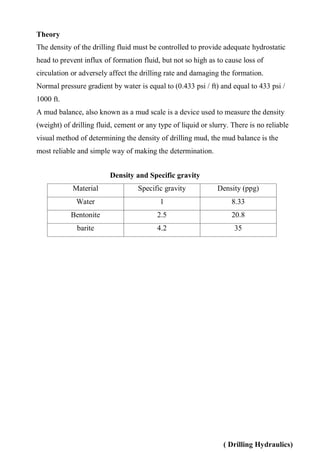
Density (ppg)Specific gravityMaterial
8.331Water
20.82.5Bentonite
354.2barite
( Drilling Hydraulics)
Procedure
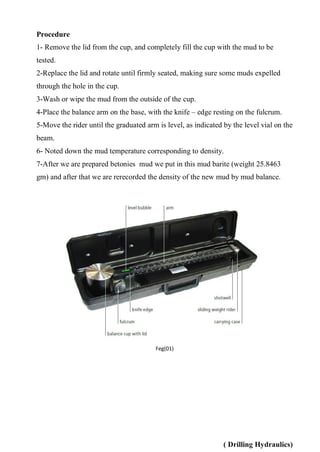
1- Remove the lid from the cup, and completely fill the cup with the mud to be
tested.
2-Replace the lid and rotate until firmly seated, making sure some muds expelled
through the hole in the cup.
3-Wash or wipe the mud from the outside of the cup.
4-Place the balance arm on the base, with the knife – edge resting on the fulcrum.
5-Move the rider until the graduated arm is level, as indicated by the level vial on the
beam.
6- Noted down the mud temperature corresponding to density.
7-After we are prepared betonies mud we put in this mud barite (weight 25.8463
gm) and after that we are rerecorded the density of the new mud by mud balance.
Feg(01)
( Drilling Hydraulics)
Calibration
1- Remove the lid from the cup, and completely fill the cup with water.
2- Replace the lid and wipe dry.
3- Replace the balance arm on the base with knife – edge resting on the fulcrum.
4- The level via I should be centered when the rider set on 8.33ppg.if not, add to or
remove shot from the well in the end of the beam.
( Drilling Hydraulics)
Discussion
Q/ What will effect of temperature on ideal test?
The temperature effected on density of liquid, so we should be do this experiment in
room temperature to get an accuracy result
Q/ what are factors get you error?
 If you don’t use pure water content a many impurity that effected on density.
 Quality of Bentonite.
 Accuracy of the mud balance and weighting balance.
Q/ why the mud density is so important?
Mud has many functions < including:
 Transporting cutting
 Serves as a medium for formation logging
 Transmitting power to bit nozzles or turbines
 Cooling and lubrication of bit and drill string.
 Reducing formation damages.
 Protecting cutting.
 Supports the weight of pipe and casing.
 One of its most important functions is to provide the hydrostatic pressure to
balance formation pressure.
This is why the mud density is so important
Q/ Mud balance must be clean and dry before using it. Why?
 For accurate of test, we should be carefully doing this test because the density
will change could be hand out a lot money and time.
Q/ How much unite the mud balance had?
 Mud weight is the density of the drilling fluid and is normally measured in
pounds per gallon (Ibm/gal) (ppg) or pound cubic feet (pcf). In the field it is
measured using a mud scale or mud balance.
 Pounds per gallon
 Specific gravity
 Pounds per cubic foot
 Pounds per square inch per 1,000 feet of depth
( Drilling Hydraulics)
REFRENCES

Mud weight density1

  • 1.
    ( Drilling Hydraulics) AraratPrivate Technical Institute Drilling Oil Wells Department (Mud Weight Density) Date of Experiment:22/10/2018 Lab No.: (1) Prepared by: Hazhar Kamal Twfiq Supervised by: Submitted on: 4/11/2018
  • 2.
    ( Drilling Hydraulics) Aim Thisdetermines and prepares a mud and find a density by mud balance and to know the relationship between weight and density 1- To know how to use mud balance apparatus 2- To know the change in density after adding barite by using water. 3- To recalculate the density of the mud which is given. Vw*Dw+Vs*Ds=Vm*Dm
  • 3.
    ( Drilling Hydraulics) Introduction Densityor weight of a given volume of liquid is determined by using a mud balance. The arm is graduated and permits accurate measurements to within +-0.1 pounds per gallon or +-0.01 specific gravity. The mud balance is constructed so that the fixed volume cup at one end is balanced by a fixed counterweight at the opposite end, with a sliding weight rider free to move along on the beam indicates when the system is in balance.
  • 4.
    ( Drilling Hydraulics) Theory Thedensity of the drilling fluid must be controlled to provide adequate hydrostatic head to prevent influx of formation fluid, but not so high as to cause loss of circulation or adversely affect the drilling rate and damaging the formation. Normal pressure gradient by water is equal to (0.433 psi / ft) and equal to 433 psi / 1000 ft. A mud balance, also known as a mud scale is a device used to measure the density (weight) of drilling fluid, cement or any type of liquid or slurry. There is no reliable visual method of determining the density of drilling mud, the mud balance is the most reliable and simple way of making the determination. Density and Specific gravity Density (ppg)Specific gravityMaterial 8.331Water 20.82.5Bentonite 354.2barite
  • 5.
    ( Drilling Hydraulics) Procedure 1-Remove the lid from the cup, and completely fill the cup with the mud to be tested. 2-Replace the lid and rotate until firmly seated, making sure some muds expelled through the hole in the cup. 3-Wash or wipe the mud from the outside of the cup. 4-Place the balance arm on the base, with the knife – edge resting on the fulcrum. 5-Move the rider until the graduated arm is level, as indicated by the level vial on the beam. 6- Noted down the mud temperature corresponding to density. 7-After we are prepared betonies mud we put in this mud barite (weight 25.8463 gm) and after that we are rerecorded the density of the new mud by mud balance. Feg(01)
  • 6.
    ( Drilling Hydraulics) Calibration 1-Remove the lid from the cup, and completely fill the cup with water. 2- Replace the lid and wipe dry. 3- Replace the balance arm on the base with knife – edge resting on the fulcrum. 4- The level via I should be centered when the rider set on 8.33ppg.if not, add to or remove shot from the well in the end of the beam.
  • 7.
    ( Drilling Hydraulics) Discussion Q/What will effect of temperature on ideal test? The temperature effected on density of liquid, so we should be do this experiment in room temperature to get an accuracy result Q/ what are factors get you error?  If you don’t use pure water content a many impurity that effected on density.  Quality of Bentonite.  Accuracy of the mud balance and weighting balance. Q/ why the mud density is so important? Mud has many functions < including:  Transporting cutting  Serves as a medium for formation logging  Transmitting power to bit nozzles or turbines  Cooling and lubrication of bit and drill string.  Reducing formation damages.  Protecting cutting.  Supports the weight of pipe and casing.  One of its most important functions is to provide the hydrostatic pressure to balance formation pressure. This is why the mud density is so important Q/ Mud balance must be clean and dry before using it. Why?  For accurate of test, we should be carefully doing this test because the density will change could be hand out a lot money and time. Q/ How much unite the mud balance had?  Mud weight is the density of the drilling fluid and is normally measured in pounds per gallon (Ibm/gal) (ppg) or pound cubic feet (pcf). In the field it is measured using a mud scale or mud balance.  Pounds per gallon  Specific gravity  Pounds per cubic foot  Pounds per square inch per 1,000 feet of depth
  • 8.