Koya university
Faculty of engineering
Petroleum department
Drilling engineering laboratory
(Viscosity & Yield Point)
Dec.17th
.2015
Lab EXP.(5)
Supervised By Prepared By
Mr. Pishtiwan Bakhtiar star m.
Eng.muhamad
Submitted on: Jan. 28th
2015
Table of Contents
Objective…………………………………………………………………………………………………………3
Abstract……………………………………………………………………………..4
Theory ……………………………………………………………………………….5
Introduction of experiment …………………………………………………………..6
Procedure ……………………………………………………………………………..7
Calculation ……………………………………………………………………………8
Discussion………………………………………………………………………….....9 &10
Reference ……………………………………………………………………………..11
Objective
1-To calculate plastic viscosity of the mud .
2-To calculate yield point.
Abstract
Viscosity is a measurement of a fluids resistance to flow:the
greater the resistance, the higher the viscosity. (Musaed, 2005).
Rheology refers to the deformation and flow behaviour of all forms
of matter. Certain rheological measurements made on fluids, such
as viscosity, gel strength, etc. help determine how this fluid will flow
under a variety of different conditions. This information is important
in the design of circulating systems required to accomplish certain
desired objectives in drilling operations
The ability of drilling mud to suspend drill cuttings and weighting
materials depends entire Lyon its viscosity. Without viscosity, all the
weighting material and drill cuttings would settle to the bottom of the
hole as soon as circulation is stopped. (Bingham, E.C. (1916).
Theory
The effects of increased viscosity can be felt by the increased
resistance to fluid flow; in drilling this would man ifest itself by
increased pressure losses in the circulating system.
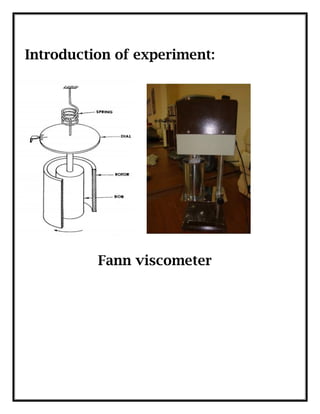
Viscometer or rheometer is a device used to measure the viscosity
and yield point of mud, A sample of mud is placed in a slurry cup
and rotation of a sleeve in the mud.
Readings which can be mathematically converted into plastic
viscosity(PV) and yield point (YP)6. Multi-speed rheometer are
recommended whenever possible since readings can be obtained at
600,300,200,100,6 and 3 rpm. PV (in cP) is measured by taking the
difference between the dial readings taken at the two highest speeds
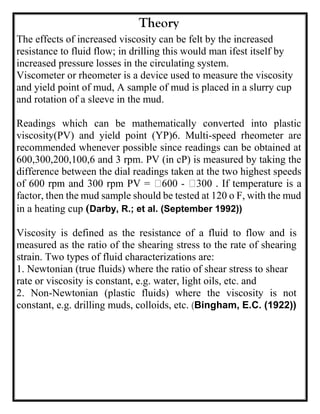
-
factor, then the mud sample should be tested at 120 o F, with the mud
in a heating cup (Darby, R.; et al. (September 1992))
Viscosity is defined as the resistance of a fluid to flow and is
measured as the ratio of the shearing stress to the rate of shearing
strain. Two types of fluid characterizations are:
1. Newtonian (true fluids) where the ratio of shear stress to shear
rate or viscosity is constant, e.g. water, light oils, etc. and
2. Non-Newtonian (plastic fluids) where the viscosity is not
constant, e.g. drilling muds, colloids, etc. (Bingham, E.C. (1922))
Introduction of experiment:
Fann viscometer
Procedure
1-prapared mud the density is 8.6 ppg
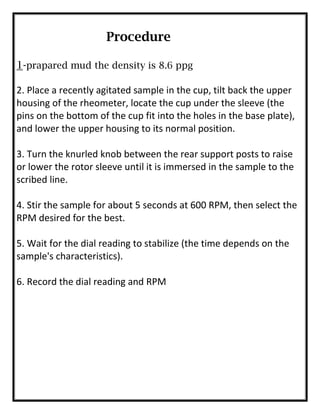
2. Place a recently agitated sample in the cup, tilt back the upper
housing of the rheometer, locate the cup under the sleeve (the
pins on the bottom of the cup fit into the holes in the base plate),
and lower the upper housing to its normal position.
3. Turn the knurled knob between the rear support posts to raise
or lower the rotor sleeve until it is immersed in the sample to the
scribed line.
4. Stir the sample for about 5 seconds at 600 RPM, then select the
RPM desired for the best.
5. Wait for the dial reading to stabilize (the time depends on the
sample's characteristics).
6. Record the dial reading and RPM
DISCUSION
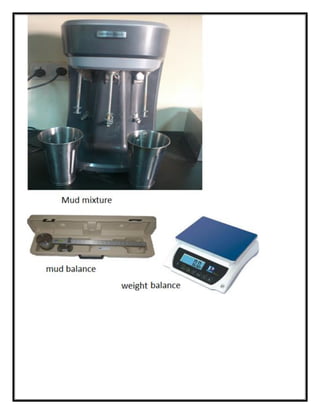
After we did this experiment in order to test the accuracy of reading
of mud balance and compare it with hand calculation of mud
density, after adding barite to the prepared mud. And finding plastic
viscosity of mud
Some point in this experiment we noticed, we can discuss like that:
1-And plastic viscosity and yield point were calculated that
effect on caring cutting to the surface the main cause of error
was reading of the gauge by the audience, quality of the
equipment , temperature of the laboratory since viscosity is
inversely proportional with temperature. The mud is sheared
between an inner bob and outer rotating sleeve
2- Six standard plus avariable speeds setting are available but
only two standard speed used in the most modeles
What is the plastic viscosity?
Plastic viscosity is the viscosity that is not constant and it is in non-
Newtonian fluid, like viscosity of the drilling mud.
What is the effect of the time in prepare a mud?
The bentonite and the water must be mix very good and in the
possible time, so we must not to hurry up in the lab.
Why we will find a yield point?
Because yield point is reflected of the fluid ability to transfer
cuttings to the surface in drilling process so we must find it.
WARNING: Do not use for tests above 200F when a closed –end
hollow
We use water before using our mud to calibrate the rheology
device and the difference between readings of the 600rmp and
300rmp must be equal to 1,
If it is not 1 the device may be bad and our result of the plastic
viscosity of the mud may be error.
The temperature not at a standard condition therefore occur error in
the test.
References
1-Bingham, E.C. (1916). "An Investigation of the Laws of Plastic
Flow". US Bureau of Standards Bulletin 13: 309–353.
2. a b Steffe, J.F. (1996). Rheological Methods in Food Process
Engineering (2nd ed.). ISBN 0-9632036-1-4.
3. Bingham, E.C. (1922). Fluidity and Plasticity. New York:
McGraw-Hill. p. 219.
4. Darby, Ron (1996). "Chapter 6". Chemical Engineering Fluid
Mechanics. Marcel Dekker. ISBN 0-8247-0444-4.
5. Buckingham, E. (1921). "On Plastic Flow Through Capillary
Tubes". ASTM Proceedings 21: 1154–1156.
6.a b Darby, R. and Melson J.(1981). "How to predict the friction
factor for flow of Bingham plastics". Chemical Engineering 28: 59–
61.
7. Darby, R.; et al. (September 1992). "Prediction friction loss in
slurry pipes". Chemical Engineering.
8. Swamee, P.K. and Aggarwal, N.(2011). "Explicit equations for
laminar flow of Bingham plastic fluids". Journal of Petroleum
Science and Engineering. doi:10.1016/j.petrol.2011.01.015.
9. Danish, M. et al. (1981). "Approximate explicit analytical
expressions of friction factor for flow of Bingham fluids in smooth
pipes using Adomian decomposition method". Communications in
Nonlinear Science and Numerical Simulation 16: 239–251.
10. Churchill, S.W. (November 7, 1977). "Friction factor equation
spans all fluid-flow regimes". Chemical Engineering: 91–92.

Plastic viscosity(mud properties test)

  • 1.
    Koya university Faculty ofengineering Petroleum department Drilling engineering laboratory (Viscosity & Yield Point) Dec.17th .2015 Lab EXP.(5) Supervised By Prepared By Mr. Pishtiwan Bakhtiar star m. Eng.muhamad Submitted on: Jan. 28th 2015
  • 2.
    Table of Contents Objective…………………………………………………………………………………………………………3 Abstract……………………………………………………………………………..4 Theory……………………………………………………………………………….5 Introduction of experiment …………………………………………………………..6 Procedure ……………………………………………………………………………..7 Calculation ……………………………………………………………………………8 Discussion………………………………………………………………………….....9 &10 Reference ……………………………………………………………………………..11
  • 3.
    Objective 1-To calculate plasticviscosity of the mud . 2-To calculate yield point.
  • 4.
    Abstract Viscosity is ameasurement of a fluids resistance to flow:the greater the resistance, the higher the viscosity. (Musaed, 2005). Rheology refers to the deformation and flow behaviour of all forms of matter. Certain rheological measurements made on fluids, such as viscosity, gel strength, etc. help determine how this fluid will flow under a variety of different conditions. This information is important in the design of circulating systems required to accomplish certain desired objectives in drilling operations The ability of drilling mud to suspend drill cuttings and weighting materials depends entire Lyon its viscosity. Without viscosity, all the weighting material and drill cuttings would settle to the bottom of the hole as soon as circulation is stopped. (Bingham, E.C. (1916).
  • 5.
    Theory The effects ofincreased viscosity can be felt by the increased resistance to fluid flow; in drilling this would man ifest itself by increased pressure losses in the circulating system. Viscometer or rheometer is a device used to measure the viscosity and yield point of mud, A sample of mud is placed in a slurry cup and rotation of a sleeve in the mud. Readings which can be mathematically converted into plastic viscosity(PV) and yield point (YP)6. Multi-speed rheometer are recommended whenever possible since readings can be obtained at 600,300,200,100,6 and 3 rpm. PV (in cP) is measured by taking the difference between the dial readings taken at the two highest speeds - factor, then the mud sample should be tested at 120 o F, with the mud in a heating cup (Darby, R.; et al. (September 1992)) Viscosity is defined as the resistance of a fluid to flow and is measured as the ratio of the shearing stress to the rate of shearing strain. Two types of fluid characterizations are: 1. Newtonian (true fluids) where the ratio of shear stress to shear rate or viscosity is constant, e.g. water, light oils, etc. and 2. Non-Newtonian (plastic fluids) where the viscosity is not constant, e.g. drilling muds, colloids, etc. (Bingham, E.C. (1922))
  • 6.
  • 8.
    Procedure 1-prapared mud thedensity is 8.6 ppg 2. Place a recently agitated sample in the cup, tilt back the upper housing of the rheometer, locate the cup under the sleeve (the pins on the bottom of the cup fit into the holes in the base plate), and lower the upper housing to its normal position. 3. Turn the knurled knob between the rear support posts to raise or lower the rotor sleeve until it is immersed in the sample to the scribed line. 4. Stir the sample for about 5 seconds at 600 RPM, then select the RPM desired for the best. 5. Wait for the dial reading to stabilize (the time depends on the sample's characteristics). 6. Record the dial reading and RPM
  • 9.
    DISCUSION After we didthis experiment in order to test the accuracy of reading of mud balance and compare it with hand calculation of mud density, after adding barite to the prepared mud. And finding plastic viscosity of mud Some point in this experiment we noticed, we can discuss like that: 1-And plastic viscosity and yield point were calculated that effect on caring cutting to the surface the main cause of error was reading of the gauge by the audience, quality of the equipment , temperature of the laboratory since viscosity is inversely proportional with temperature. The mud is sheared between an inner bob and outer rotating sleeve 2- Six standard plus avariable speeds setting are available but only two standard speed used in the most modeles What is the plastic viscosity? Plastic viscosity is the viscosity that is not constant and it is in non- Newtonian fluid, like viscosity of the drilling mud. What is the effect of the time in prepare a mud? The bentonite and the water must be mix very good and in the possible time, so we must not to hurry up in the lab.
  • 10.
    Why we willfind a yield point? Because yield point is reflected of the fluid ability to transfer cuttings to the surface in drilling process so we must find it. WARNING: Do not use for tests above 200F when a closed –end hollow We use water before using our mud to calibrate the rheology device and the difference between readings of the 600rmp and 300rmp must be equal to 1, If it is not 1 the device may be bad and our result of the plastic viscosity of the mud may be error. The temperature not at a standard condition therefore occur error in the test.
  • 11.
    References 1-Bingham, E.C. (1916)."An Investigation of the Laws of Plastic Flow". US Bureau of Standards Bulletin 13: 309–353. 2. a b Steffe, J.F. (1996). Rheological Methods in Food Process Engineering (2nd ed.). ISBN 0-9632036-1-4. 3. Bingham, E.C. (1922). Fluidity and Plasticity. New York: McGraw-Hill. p. 219. 4. Darby, Ron (1996). "Chapter 6". Chemical Engineering Fluid Mechanics. Marcel Dekker. ISBN 0-8247-0444-4. 5. Buckingham, E. (1921). "On Plastic Flow Through Capillary Tubes". ASTM Proceedings 21: 1154–1156. 6.a b Darby, R. and Melson J.(1981). "How to predict the friction factor for flow of Bingham plastics". Chemical Engineering 28: 59– 61. 7. Darby, R.; et al. (September 1992). "Prediction friction loss in slurry pipes". Chemical Engineering. 8. Swamee, P.K. and Aggarwal, N.(2011). "Explicit equations for laminar flow of Bingham plastic fluids". Journal of Petroleum Science and Engineering. doi:10.1016/j.petrol.2011.01.015. 9. Danish, M. et al. (1981). "Approximate explicit analytical expressions of friction factor for flow of Bingham fluids in smooth pipes using Adomian decomposition method". Communications in Nonlinear Science and Numerical Simulation 16: 239–251. 10. Churchill, S.W. (November 7, 1977). "Friction factor equation spans all fluid-flow regimes". Chemical Engineering: 91–92.