Peripheral Nerve Injuries
Chye Yew Ng
MBChB(Hons) FRCS(Tr&Orth) British Diploma in Hand Surgery
European Board of Hand Surgery Diploma
Consultant Hand & Peripheral Nerve Surgeon
Fellowship Director, Upper Limb Fellowship
Wrightington Hospital
www.wrightington.com
Overview
Basic science
Classification of nerve injuries
Principles of nerve surgery
What (I think) you may be asked
www.wrightington.com
Key Message
Not all nerve injuries are neurapraxia
Delay in treatment may lead to poorer outcome
Recognise nerve in danger:
Pain
Autonomic dysfunction
Tinel sign
www.wrightington.com
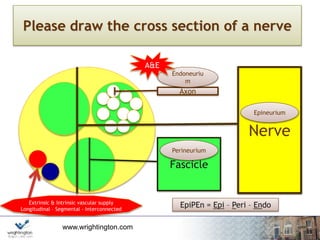
Please draw the cross section of a nerve
Axon
Fascicle
Nerve
Endoneuriu
m
Epineurium
Perineurium
EpiPEn = Epi – Peri – Endo
A&E
Extrinsic & Intrinsic vascular supply
Longitudinal – Segmental - Interconnected
www.wrightington.com
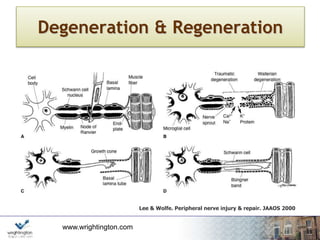
Degeneration & Regeneration
Lee & Wolfe. Peripheral nerve injury & repair. JAAOS 2000
www.wrightington.com
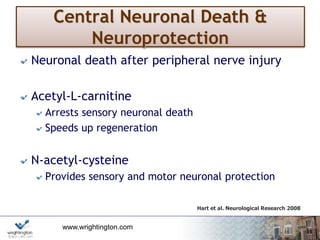
Central Neuronal Death &
Neuroprotection
Neuronal death after peripheral nerve injury
Acetyl-L-carnitine
Arrests sensory neuronal death
Speeds up regeneration
N-acetyl-cysteine
Provides sensory and motor neuronal protection
Hart et al. Neurological Research 2008
www.wrightington.com
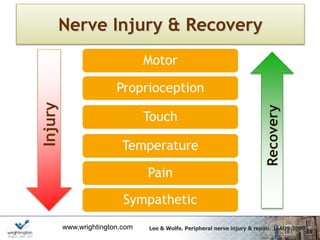
Nerve Injury & Recovery
Motor
Proprioception
Touch
Temperature
Pain
Sympathetic
Recovery
Injury
Lee & Wolfe. Peripheral nerve injury & repair. JAAOS 2000
www.wrightington.com
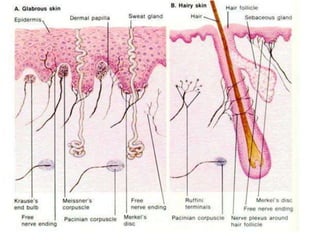
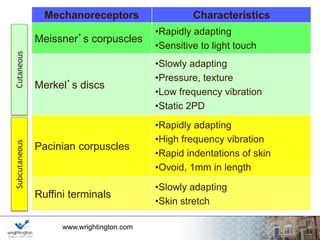
Mechanoreceptors Characteristics
Meissner’s corpuscles
•Rapidly adapting
•Sensitive to light touch
Merkel’s discs
•Slowly adapting
•Pressure, texture
•Low frequency vibration
•Static 2PD
Pacinian corpuscles
•Rapidly adapting
•High frequency vibration
•Rapid indentations of skin
•Ovoid, 1mm in length
Ruffini terminals
•Slowly adapting
•Skin stretch
SubcutaneousCutaneous
www.wrightington.com
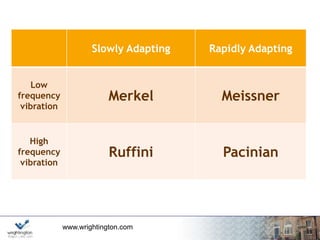
Slowly Adapting Rapidly Adapting
Low
frequency
vibration
Merkel Meissner
High
frequency
vibration
Ruffini Pacinian
www.wrightington.com
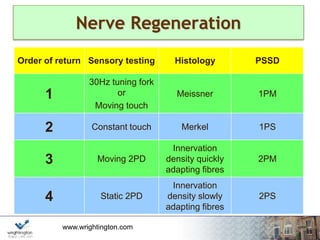
Nerve Regeneration
Order of return Sensory testing Histology PSSD
1
30Hz tuning fork
or
Moving touch
Meissner 1PM
2 Constant touch Merkel 1PS
3 Moving 2PD
Innervation
density quickly
adapting fibres
2PM
4 Static 2PD
Innervation
density slowly
adapting fibres
2PS
www.wrightington.com
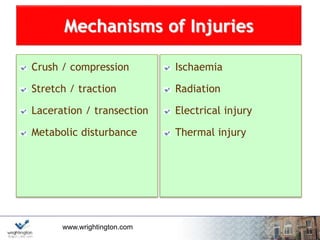
Mechanisms of Injuries
Crush / compression
Stretch / traction
Laceration / transection
Metabolic disturbance
Ischaemia
Radiation
Electrical injury
Thermal injury
www.wrightington.com
Classification of Nerve Injuries
Seddon
BMJ
1942
Neurapraxia
(Transient Block)
Axonotmesis
(Lesion in Continuity)
Neurotmesis
(Division of a nerve)
Brain
1943
• Localised
degeneration of
the myelin
sheaths
• Complete
interruption of
axons
• Preservation of
supporting
structures
(Schwann tubes,
endoneurium,
perineurium)
• All essential parts
destroyed
• Interruption can
occur without
apparent loss of
continuity
www.wrightington.com
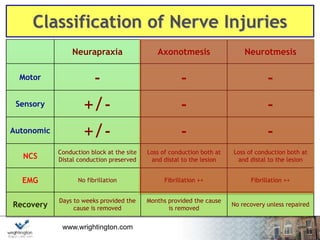
Classification of Nerve Injuries
Neurapraxia Axonotmesis Neurotmesis
Motor
- - -
Sensory
+/- - -
Autonomic
+/- - -
NCS
Conduction block at the site
Distal conduction preserved
Loss of conduction both at
and distal to the lesion
Loss of conduction both at
and distal to the lesion
EMG No fibrillation Fibrillation ++ Fibrillation ++
Recovery
Days to weeks provided the
cause is removed
Months provided the cause
is removed
No recovery unless repaired
www.wrightington.com
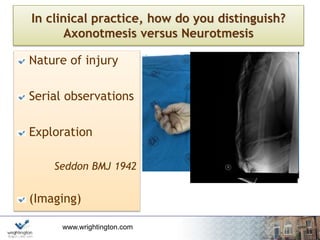
In clinical practice, how do you distinguish?
Axonotmesis versus Neurotmesis
Nature of injury
Serial observations
Exploration
Seddon BMJ 1942
(Imaging)
www.wrightington.com
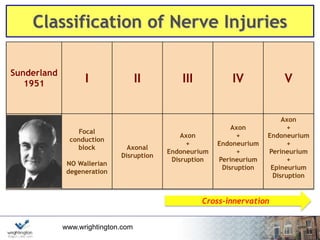
Classification of Nerve Injuries
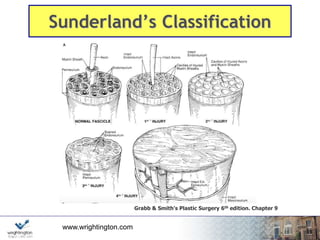
Sunderland
1951 I II III IV V
Focal
conduction
block
NO Wallerian
degeneration
Axonal
Disruption
Axon
+
Endoneurium
Disruption
Axon
+
Endoneurium
+
Perineurium
Disruption
Axon
+
Endoneurium
+
Perineurium
+
Epineurium
Disruption
Cross-innervation
www.wrightington.com
Sunderland’s Classification
Grabb & Smith’s Plastic Surgery 6th edition. Chapter 9
www.wrightington.com
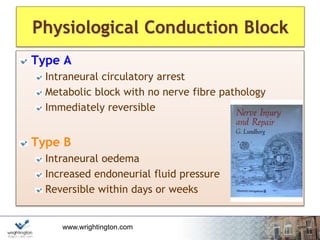
Physiological Conduction Block
Type A
Intraneural circulatory arrest
Metabolic block with no nerve fibre pathology
Immediately reversible
Type B
Intraneural oedema
Increased endoneurial fluid pressure
Reversible within days or weeks
www.wrightington.com
Classification of Nerve Injuries
Lundborg
1988
Physiological
conduction
block
Myelin
damage
Axonal
damage
Axon
+
Endo
damage
Axon
+
Endo
+
Peri
damage
Axon
+
Endoneuriu
m
+
Perineurium
+
Epineurium
damage
Type
A
Type
B
Sunder
land
1951
I II III IV V
Seddon
1942
Neurapraxia
(Transient Block)
Axonotmesis
(Lesion in
Continuity)
Neurotmesis
(Division of a nerve)
www.wrightington.com
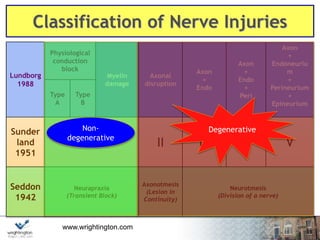
Classification of Nerve Injuries
Lundborg
1988
Physiological
conduction
block
Myelin
damage
Axonal
disruption
Axon
+
Endo
Axon
+
Endo
+
Peri
Axon
+
Endoneuriu
m
+
Perineurium
+
Epineurium
Type
A
Type
B
Sunder
land
1951
I II III IV V
Seddon
1942
Neurapraxia
(Transient Block)
Axonotmesis
(Lesion in
Continuity)
Neurotmesis
(Division of a nerve)
Non-
degenerative
Degenerative
www.wrightington.com
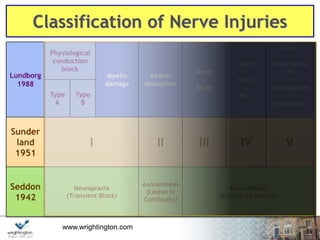
Classification of Nerve Injuries
Lundborg
1988
Physiological
conduction
block
Myelin
damage
Axonal
disruption
Axon
+
Endo
Axon
+
Endo
+
Peri
Axon
+
Endoneuriu
m
+
Perineurium
+
Epineurium
Type
A
Type
B
Sunder
land
1951
I II III IV V
Seddon
1942
Neurapraxia
(Transient Block)
Axonotmesis
(Lesion in
Continuity)
Neurotmesis
(Division of a nerve)
www.wrightington.com
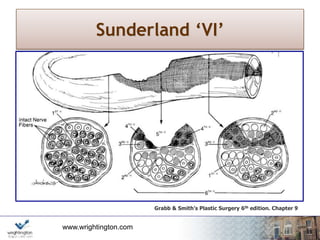
Sunderland ‘VI’
Grabb & Smith’s Plastic Surgery 6th edition. Chapter 9
www.wrightington.com
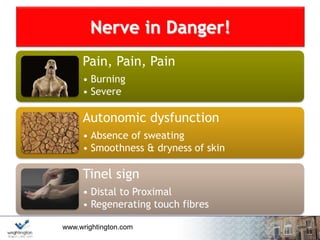
Nerve in Danger!
Pain, Pain, Pain
• Burning
• Severe
Autonomic dysfunction
• Absence of sweating
• Smoothness & dryness of skin
Tinel sign
• Distal to Proximal
• Regenerating touch fibres
www.wrightington.com
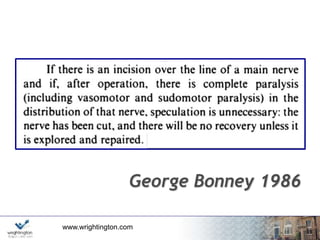
George Bonney 1986
www.wrightington.com
Nerve Surgery
Neurolysis
Nerve repair
Nerve grafting
Nerve transfer
www.wrightington.com
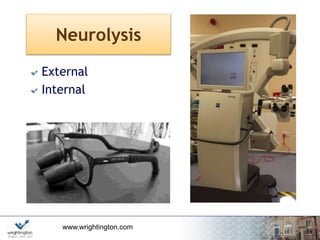
Neurolysis
External
Internal
www.wrightington.com
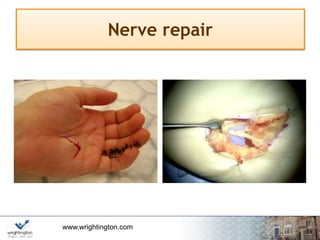
Nerve repair
www.wrightington.com
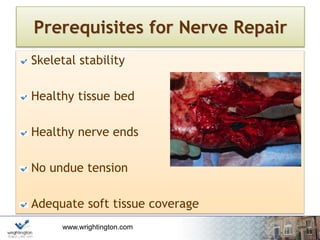
Prerequisites for Nerve Repair
Skeletal stability
Healthy tissue bed
Healthy nerve ends
No undue tension
Adequate soft tissue coverage
www.wrightington.com
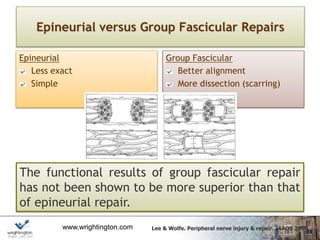
Epineurial versus Group Fascicular Repairs
Epineurial
Less exact
Simple
Group Fascicular
Better alignment
More dissection (scarring)
The functional results of group fascicular repair
has not been shown to be more superior than that
of epineurial repair.
Lee & Wolfe. Peripheral nerve injury & repair. JAAOS 2000
www.wrightington.com
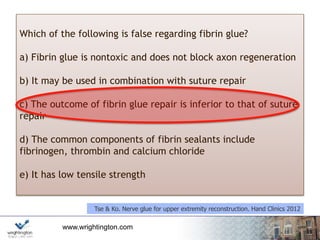
Which of the following is false regarding fibrin glue?
a) Fibrin glue is nontoxic and does not block axon regeneration
b) It may be used in combination with suture repair
c) The outcome of fibrin glue repair is inferior to that of suture
repair
d) The common components of fibrin sealants include
fibrinogen, thrombin and calcium chloride
e) It has low tensile strength
Tse & Ko. Nerve glue for upper extremity reconstruction. Hand Clinics 2012
www.wrightington.com
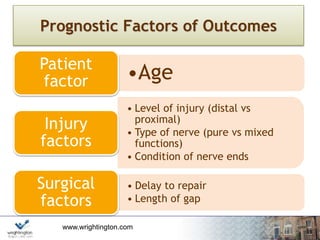
Prognostic Factors of Outcomes
•AgePatient
factor
• Level of injury (distal vs
proximal)
• Type of nerve (pure vs mixed
functions)
• Condition of nerve ends
Injury
factors
• Delay to repair
• Length of gap
Surgical
factors
www.wrightington.com
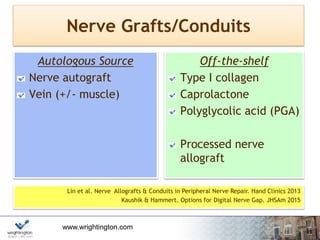
Nerve Grafts/Conduits
Autologous Source
Nerve autograft
Vein (+/- muscle)
Off-the-shelf
Type I collagen
Caprolactone
Polyglycolic acid (PGA)
Processed nerve
allograft
Lin et al. Nerve Allografts & Conduits in Peripheral Nerve Repair. Hand Clinics 2013
Kaushik & Hammert. Options for Digital Nerve Gap. JHSAm 2015
www.wrightington.com
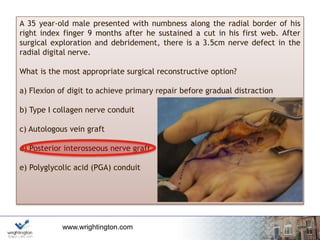
A 35 year-old male presented with numbness along the radial border of his
right index finger 9 months after he sustained a cut in his first web. After
surgical exploration and debridement, there is a 3.5cm nerve defect in the
radial digital nerve.
What is the most appropriate surgical reconstructive option?
a) Flexion of digit to achieve primary repair before gradual distraction
b) Type I collagen nerve conduit
c) Autologous vein graft
d) Posterior interosseous nerve graft
e) Polyglycolic acid (PGA) conduit
www.wrightington.com
Principles of Motor Nerve Transfers
Donor nerve near target motor end plates
Expendable donor nerve
Pure motor donor nerve
Donor-recipient size match
Donor function synergy with recipient function
Motor re-education improves function
Mackinnon SE, Novak CB. Hand Clin 1999
www.wrightington.com
Key Message
Not all nerve injuries are neurapraxia
Delay in treatment may lead to poorer outcome
Recognise nerve in danger:
Pain
Autonomic dysfunction
Tinel sign
www.wrightington.com
Peripheral Nerve Injury Service
Tel: 01257 488285
Fax: 01257 256476
Email: nerve@wwl.nhs.uk
We treat
Adult traumatic brachial plexus injuries
Nerve injuries following trauma/surgery
Recurrent/persistent entrapment neuropathies
Painful scarred nerve or neuroma
Brachial neuritis / Parsonage Turner syndrome
Benign nerve sheath tumour

Peripheral nerve injuries

  • 1.
    Peripheral Nerve Injuries ChyeYew Ng MBChB(Hons) FRCS(Tr&Orth) British Diploma in Hand Surgery European Board of Hand Surgery Diploma Consultant Hand & Peripheral Nerve Surgeon Fellowship Director, Upper Limb Fellowship Wrightington Hospital
  • 2.
    www.wrightington.com Overview Basic science Classification ofnerve injuries Principles of nerve surgery What (I think) you may be asked
  • 3.
    www.wrightington.com Key Message Not allnerve injuries are neurapraxia Delay in treatment may lead to poorer outcome Recognise nerve in danger: Pain Autonomic dysfunction Tinel sign
  • 4.
    www.wrightington.com Please draw thecross section of a nerve Axon Fascicle Nerve Endoneuriu m Epineurium Perineurium EpiPEn = Epi – Peri – Endo A&E Extrinsic & Intrinsic vascular supply Longitudinal – Segmental - Interconnected
  • 5.
    www.wrightington.com Degeneration & Regeneration Lee& Wolfe. Peripheral nerve injury & repair. JAAOS 2000
  • 6.
    www.wrightington.com Central Neuronal Death& Neuroprotection Neuronal death after peripheral nerve injury Acetyl-L-carnitine Arrests sensory neuronal death Speeds up regeneration N-acetyl-cysteine Provides sensory and motor neuronal protection Hart et al. Neurological Research 2008
  • 7.
    www.wrightington.com Nerve Injury &Recovery Motor Proprioception Touch Temperature Pain Sympathetic Recovery Injury Lee & Wolfe. Peripheral nerve injury & repair. JAAOS 2000
  • 9.
    www.wrightington.com Mechanoreceptors Characteristics Meissner’s corpuscles •Rapidlyadapting •Sensitive to light touch Merkel’s discs •Slowly adapting •Pressure, texture •Low frequency vibration •Static 2PD Pacinian corpuscles •Rapidly adapting •High frequency vibration •Rapid indentations of skin •Ovoid, 1mm in length Ruffini terminals •Slowly adapting •Skin stretch SubcutaneousCutaneous
  • 10.
    www.wrightington.com Slowly Adapting RapidlyAdapting Low frequency vibration Merkel Meissner High frequency vibration Ruffini Pacinian
  • 11.
    www.wrightington.com Nerve Regeneration Order ofreturn Sensory testing Histology PSSD 1 30Hz tuning fork or Moving touch Meissner 1PM 2 Constant touch Merkel 1PS 3 Moving 2PD Innervation density quickly adapting fibres 2PM 4 Static 2PD Innervation density slowly adapting fibres 2PS
  • 12.
    www.wrightington.com Mechanisms of Injuries Crush/ compression Stretch / traction Laceration / transection Metabolic disturbance Ischaemia Radiation Electrical injury Thermal injury
  • 13.
    www.wrightington.com Classification of NerveInjuries Seddon BMJ 1942 Neurapraxia (Transient Block) Axonotmesis (Lesion in Continuity) Neurotmesis (Division of a nerve) Brain 1943 • Localised degeneration of the myelin sheaths • Complete interruption of axons • Preservation of supporting structures (Schwann tubes, endoneurium, perineurium) • All essential parts destroyed • Interruption can occur without apparent loss of continuity
  • 14.
    www.wrightington.com Classification of NerveInjuries Neurapraxia Axonotmesis Neurotmesis Motor - - - Sensory +/- - - Autonomic +/- - - NCS Conduction block at the site Distal conduction preserved Loss of conduction both at and distal to the lesion Loss of conduction both at and distal to the lesion EMG No fibrillation Fibrillation ++ Fibrillation ++ Recovery Days to weeks provided the cause is removed Months provided the cause is removed No recovery unless repaired
  • 15.
    www.wrightington.com In clinical practice,how do you distinguish? Axonotmesis versus Neurotmesis Nature of injury Serial observations Exploration Seddon BMJ 1942 (Imaging)
  • 16.
    www.wrightington.com Classification of NerveInjuries Sunderland 1951 I II III IV V Focal conduction block NO Wallerian degeneration Axonal Disruption Axon + Endoneurium Disruption Axon + Endoneurium + Perineurium Disruption Axon + Endoneurium + Perineurium + Epineurium Disruption Cross-innervation
  • 17.
    www.wrightington.com Sunderland’s Classification Grabb &Smith’s Plastic Surgery 6th edition. Chapter 9
  • 18.
    www.wrightington.com Physiological Conduction Block TypeA Intraneural circulatory arrest Metabolic block with no nerve fibre pathology Immediately reversible Type B Intraneural oedema Increased endoneurial fluid pressure Reversible within days or weeks
  • 19.
    www.wrightington.com Classification of NerveInjuries Lundborg 1988 Physiological conduction block Myelin damage Axonal damage Axon + Endo damage Axon + Endo + Peri damage Axon + Endoneuriu m + Perineurium + Epineurium damage Type A Type B Sunder land 1951 I II III IV V Seddon 1942 Neurapraxia (Transient Block) Axonotmesis (Lesion in Continuity) Neurotmesis (Division of a nerve)
  • 20.
    www.wrightington.com Classification of NerveInjuries Lundborg 1988 Physiological conduction block Myelin damage Axonal disruption Axon + Endo Axon + Endo + Peri Axon + Endoneuriu m + Perineurium + Epineurium Type A Type B Sunder land 1951 I II III IV V Seddon 1942 Neurapraxia (Transient Block) Axonotmesis (Lesion in Continuity) Neurotmesis (Division of a nerve) Non- degenerative Degenerative
  • 21.
    www.wrightington.com Classification of NerveInjuries Lundborg 1988 Physiological conduction block Myelin damage Axonal disruption Axon + Endo Axon + Endo + Peri Axon + Endoneuriu m + Perineurium + Epineurium Type A Type B Sunder land 1951 I II III IV V Seddon 1942 Neurapraxia (Transient Block) Axonotmesis (Lesion in Continuity) Neurotmesis (Division of a nerve)
  • 22.
    www.wrightington.com Sunderland ‘VI’ Grabb &Smith’s Plastic Surgery 6th edition. Chapter 9
  • 23.
    www.wrightington.com Nerve in Danger! Pain,Pain, Pain • Burning • Severe Autonomic dysfunction • Absence of sweating • Smoothness & dryness of skin Tinel sign • Distal to Proximal • Regenerating touch fibres
  • 24.
  • 25.
  • 26.
  • 27.
  • 28.
    www.wrightington.com Prerequisites for NerveRepair Skeletal stability Healthy tissue bed Healthy nerve ends No undue tension Adequate soft tissue coverage
  • 29.
    www.wrightington.com Epineurial versus GroupFascicular Repairs Epineurial Less exact Simple Group Fascicular Better alignment More dissection (scarring) The functional results of group fascicular repair has not been shown to be more superior than that of epineurial repair. Lee & Wolfe. Peripheral nerve injury & repair. JAAOS 2000
  • 30.
    www.wrightington.com Which of thefollowing is false regarding fibrin glue? a) Fibrin glue is nontoxic and does not block axon regeneration b) It may be used in combination with suture repair c) The outcome of fibrin glue repair is inferior to that of suture repair d) The common components of fibrin sealants include fibrinogen, thrombin and calcium chloride e) It has low tensile strength Tse & Ko. Nerve glue for upper extremity reconstruction. Hand Clinics 2012
  • 31.
    www.wrightington.com Prognostic Factors ofOutcomes •AgePatient factor • Level of injury (distal vs proximal) • Type of nerve (pure vs mixed functions) • Condition of nerve ends Injury factors • Delay to repair • Length of gap Surgical factors
  • 32.
    www.wrightington.com Nerve Grafts/Conduits Autologous Source Nerveautograft Vein (+/- muscle) Off-the-shelf Type I collagen Caprolactone Polyglycolic acid (PGA) Processed nerve allograft Lin et al. Nerve Allografts & Conduits in Peripheral Nerve Repair. Hand Clinics 2013 Kaushik & Hammert. Options for Digital Nerve Gap. JHSAm 2015
  • 33.
    www.wrightington.com A 35 year-oldmale presented with numbness along the radial border of his right index finger 9 months after he sustained a cut in his first web. After surgical exploration and debridement, there is a 3.5cm nerve defect in the radial digital nerve. What is the most appropriate surgical reconstructive option? a) Flexion of digit to achieve primary repair before gradual distraction b) Type I collagen nerve conduit c) Autologous vein graft d) Posterior interosseous nerve graft e) Polyglycolic acid (PGA) conduit
  • 34.
    www.wrightington.com Principles of MotorNerve Transfers Donor nerve near target motor end plates Expendable donor nerve Pure motor donor nerve Donor-recipient size match Donor function synergy with recipient function Motor re-education improves function Mackinnon SE, Novak CB. Hand Clin 1999
  • 35.
    www.wrightington.com Key Message Not allnerve injuries are neurapraxia Delay in treatment may lead to poorer outcome Recognise nerve in danger: Pain Autonomic dysfunction Tinel sign
  • 36.
    www.wrightington.com Peripheral Nerve InjuryService Tel: 01257 488285 Fax: 01257 256476 Email: nerve@wwl.nhs.uk We treat Adult traumatic brachial plexus injuries Nerve injuries following trauma/surgery Recurrent/persistent entrapment neuropathies Painful scarred nerve or neuroma Brachial neuritis / Parsonage Turner syndrome Benign nerve sheath tumour