Retinal Detachment
(RD)
Dr. Pradeep Bastola, MBBS, MD, MPH
Vitreo-retinal Surgeon,
Professor, Department of Ophthalmology,
Chitwan Medical College Teaching Hospital,
Nepal
References
• American Academy of Ophthalmology
• Wolff’s Ocular Anatomy
• Myrin Yanoff
• Ryan’s Retina 5th Edition
• Clinical Ophthalmology by Jack J. Kanski
• The Massachusetts Eye and Ear
Infirmary Illustrated Manual of
Ophthalmology
• AIOS Ready Reckoner in Ophthalmology
• Duke Elder Book of Ophthalmology
• Various articles from Internet
• Presentations of Dr. Pradeep Bastola
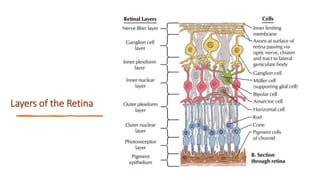
Layers of the Retina
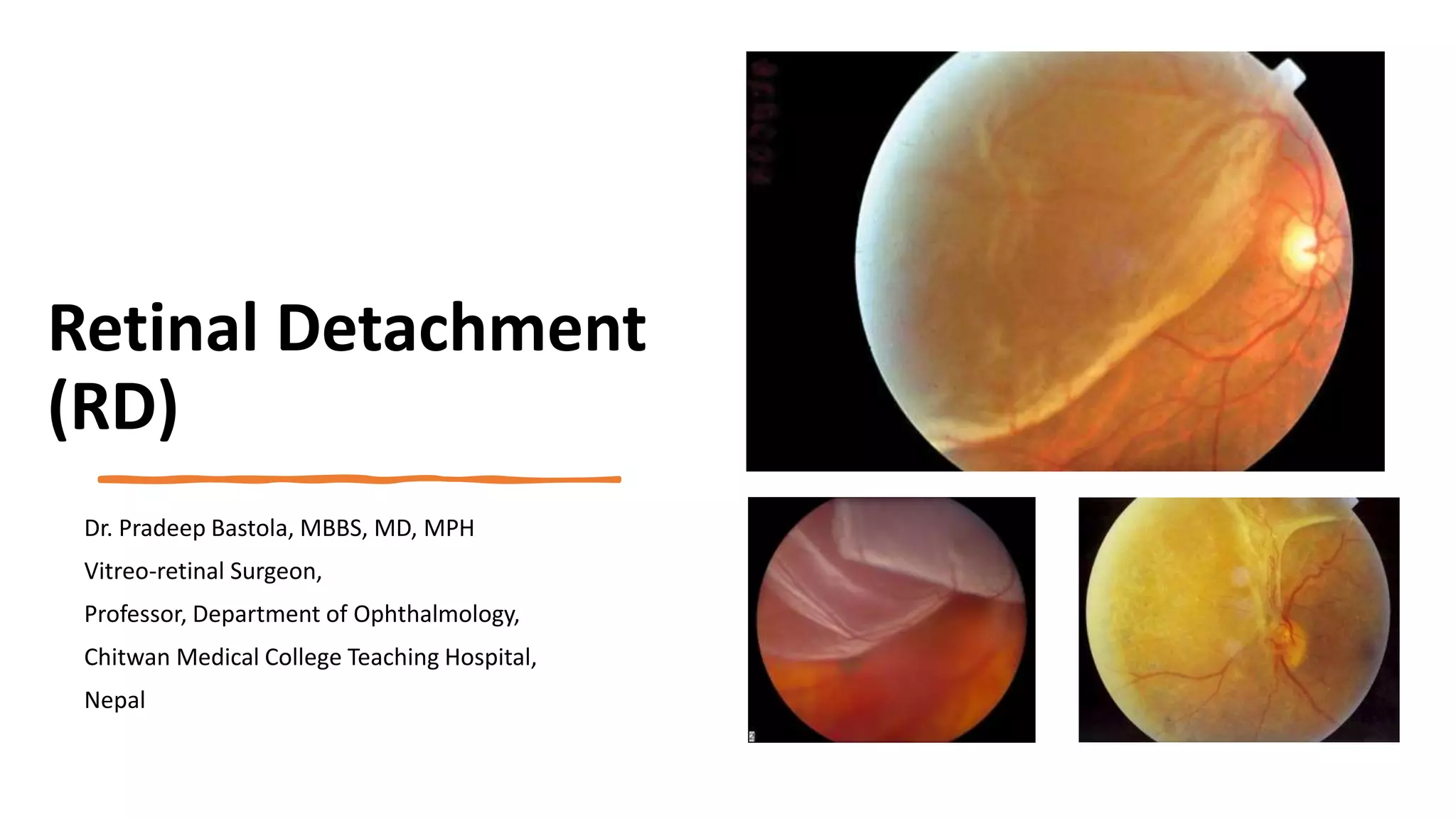
What is Retinal Detachment?
Separation of the Neuro-sensory retina (NSR) from the Retinal Pigment Epithelium
(RPE) is known as Retinal Detachment.
Types
Rhegmatogenous RD – Retinal Detachment in presence of a retinal tear,
break or hole (Rhegma = Break)
Non-Rhegmatogenous RD (No break/Rhegma)
• Tractional RD (Due to tractional force eg. Proliferative Diabetic Retinopathy,
Post traumatic RD)
• Serous/Exudative RD – Posterior uveitis, Retinal Tumors
• Combined (Rhegmatogenous + Tractional)
Rhegmatogenous (Rhegma- break), occurs secondarily to a full-thickness
defect in the Neurosensory retina (NSR), which permits fluid derived
from synchytic (liquefied) vitreous to gain access to the sub retinal space.
Tractional in which the NSR is pulled away from the RPE by contracting
Vitreoretinal membranes in the absence of a retinal break.
Exudative (Serous, Secondary) is caused neither by a break nor traction; the
SRF is derived from fluid in the vessels of the NSR or choroid, or both.
Combined tractional - Rhegmatogenous, as the name implies, is the result of
a combination of a retinal break and retinal traction. The retinal break is
caused by traction from an adjacent area of fibrovascular proliferation and is
most commonly seen in advanced proliferative diabetic retinopathy
Vitreous adhesions
Normal
The peripheral cortical vitreous is loosely attached to the internal limiting membrane (ILM)
of the sensory retina.
• Stronger adhesions occur at the following sites:
• Vitreous base, where they are very strong.
• Around the optic nerve head, where they are strong
• Around the fovea, where they are weak, except in eyes with vitreo-macular traction and
macular hole formation
• Along peripheral blood vessels, where they are usually weak
Abnormal adhesions
These may be associated with retinal tear formation as a result of dynamic Vitreoretinal
traction associated with acute posterior vitreous detachment (PVD)
• Posterior border of islands of lattice degeneration
• Retinal pigment clumps peripheral paravascular condensations
• Vitreous base anomalies such a tongue like extensions and posterior islands
• ‘White with pressure’ and ‘white without pressure’
Predisposing risk factors
• Extreme near sightedness (Moderate – High Myopia)
• Eye injury/trauma
• Cataract surgery
• Family history
• Advanced Diabetes
• Aging
• Eye disease or disorders like retinoschisis, uveitis, degenerative myopia, or lattice degeneration
• History of Retinal Detachment in the fellow eye
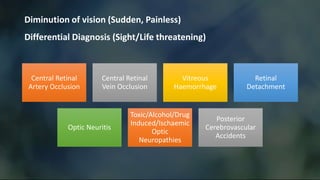
Diminution of vision (Sudden, Painless)
Differential Diagnosis (Sight/Life threatening)
Central Retinal
Artery Occlusion
Central Retinal
Vein Occlusion
Vitreous
Haemorrhage
Retinal
Detachment
Optic Neuritis
Toxic/Alcohol/Drug
Induced/Ischaemic
Optic
Neuropathies
Posterior
Cerebrovascular
Accidents
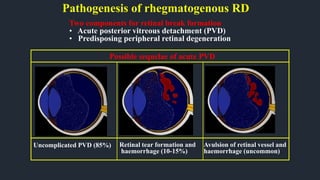
Pathogenesis of rhegmatogenous RD
Possible sequelae of acute PVD
Two components for retinal break formation
• Acute posterior vitreous detachment (PVD)
• Predisposing peripheral retinal degeneration
Uncomplicated PVD (85%) Retinal tear formation and
haemorrhage (10-15%)
Avulsion of retinal vessel and
haemorrhage (uncommon)
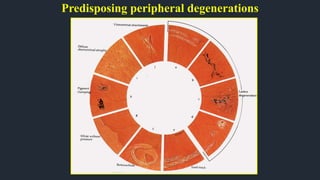
Predisposing peripheral degenerations
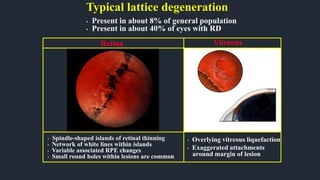
Typical lattice degeneration
• Present in about 8% of general population
• Present in about 40% of eyes with RD
• Spindle-shaped islands of retinal thinning
• Network of white lines within islands
• Variable associated RPE changes
• Small round holes within lesions are common
• Overlying vitreous liquefaction
• Exaggerated attachments
around margin of lesion
Retina Vitreous
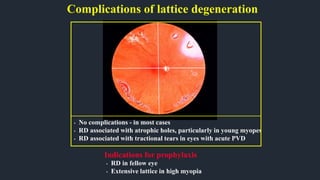
Complications of lattice degeneration
Indications for prophylaxis
• No complications - in most cases
• RD associated with atrophic holes, particularly in young myopes
• RD associated with tractional tears in eyes with acute PVD
• RD in fellow eye
• Extensive lattice in high myopia
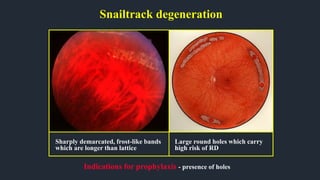
Snailtrack degeneration
Indications for prophylaxis - presence of holes
Sharply demarcated, frost-like bands
which are longer than lattice
Large round holes which carry
high risk of RD
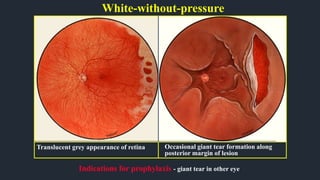
White-without-pressure
Indications for prophylaxis - giant tear in other eye
Translucent grey appearance of retina Occasional giant tear formation along
posterior margin of lesion
Pathogenesis
Rhegmatogenous RD affects about 1 in
10000 of the population each year and
both eyes may eventually be involved in
about 10% of patients.
It is characterized by the presence of a
retinal break held open by Vitreoretinal
traction that allows accumulation of
liquefied vitreous under the NSR,
separating it from the RPE.
• The retinal breaks responsible for RD are caused by interplay between
dynamic Vitreoretinal traction, and an underlying weakness in the
peripheral retina referred to as predisposing degeneration.
• Even though a retinal break is present, a RD will not occur if the vitreous is
not partially liquefied, and if the necessary traction is not present.
Dynamic Vitreo-retinal traction
Pathogenesis (Predisposed eyes with risk factors)
• Syneresis defines liquefaction of the vitreous gel.
• Some eyes with syneresis develop a hole in the posterior hyaloid membrane and fluid
from within the vitreous cavity passes through this defect into the newly formed
retrohyaloid space
• This process forcibly detaches the posterior vitreous, and the posterior hyaloid
membrane from the internal limiting membrane (ILM) of the sensory retina as far as the
posterior border of the vitreous base
• The remaining solid vitreous gel collapses inferiorly and the retrohyaloid space is
occupied entirely by synchytic fluid,
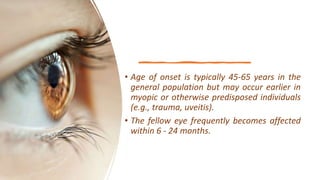
• Age of onset is typically 45-65 years in the
general population but may occur earlier in
myopic or otherwise predisposed individuals
(e.g., trauma, uveitis).
• The fellow eye frequently becomes affected
within 6 - 24 months.
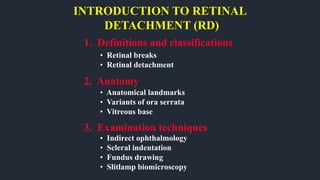
INTRODUCTION TO RETINAL
DETACHMENT (RD)
1. Definitions and classifications
3. Examination techniques
2. Anatomy
• Retinal breaks
• Retinal detachment
• Anatomical landmarks
• Variants of ora serrata
• Vitreous base
• Indirect ophthalmology
• Scleral indentation
• Fundus drawing
• Slitlamp biomicroscopy
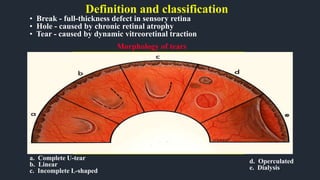
• Break - full-thickness defect in sensory retina
• Hole - caused by chronic retinal atrophy
• Tear - caused by dynamic vitreoretinal traction
d. Operculated
e. Dialysis
Morphology of tears
a. Complete U-tear
b. Linear
c. Incomplete L-shaped
Definition and classification
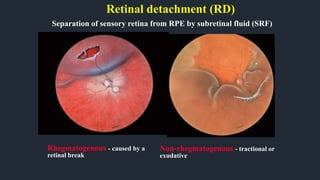
Retinal detachment (RD)
Separation of sensory retina from RPE by subretinal fluid (SRF)
Rhegmatogenous - caused by a
retinal break
Non-rhegmatogenous - tractional or
exudative
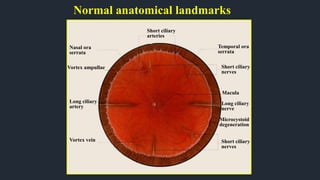
Normal anatomical landmarks
Short ciliary
arteries
Temporal ora
serrata
Short ciliary
nerves
Macula
Long ciliary
nerve
Short ciliary
nerves
Microcystoid
degeneration
Nasal ora
serrata
Vortex ampullae
Long ciliary
artery
Vortex vein
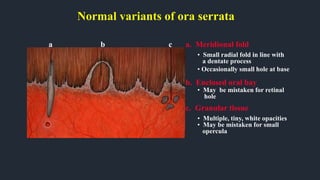
Normal variants of ora serrata
a. Meridional fold
• Small radial fold in line with
a dentate process
• Occasionally small hole at base
b. Enclosed oral bay
• May be mistaken for retinal
hole
c. Granular tissue
• Multiple, tiny, white opacities
• May be mistaken for small
opercula
a c
b
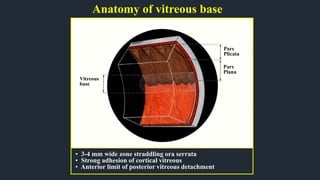
Anatomy of vitreous base
• 3-4 mm wide zone straddling ora serrata
• Strong adhesion of cortical vitreous
• Anterior limit of posterior vitreous detachment
Vitreous
base
Pars
Plicata
Pars
Plana
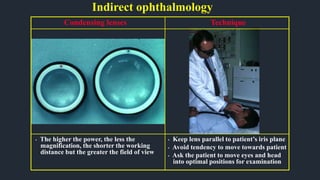
Indirect ophthalmology
• Keep lens parallel to patient’s iris plane
• Avoid tendency to move towards patient
• Ask the patient to move eyes and head
into optimal positions for examination
Technique
• The higher the power, the less the
magnification, the shorter the working
distance but the greater the field of view
Condensing lenses
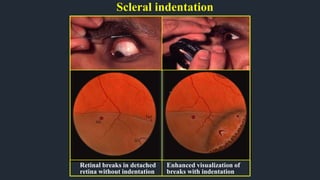
Scleral indentation
Retinal breaks in detached
retina without indentation
Enhanced visualization of
breaks with indentation
Fundus drawing
• Place chart upside down
• Draw what you see
Technique Colour code
Slitlamp biomicroscopy
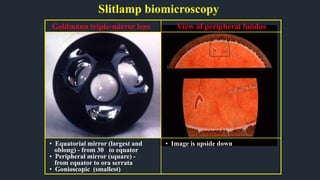
Goldmann triple-mirror lens
• Equatorial mirror (largest and
oblong) - from 30 to equator
• Peripheral mirror (square) -
from equator to ora serrata
• Gonioscopic (smallest)
• Image is upside down
View of peripheral fundus
Primary retinal break
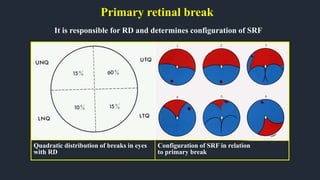
It is responsible for RD and determines configuration of SRF
Quadratic distribution of breaks in eyes
with RD
Configuration of SRF in relation
to primary break
PATHOGENESIS AND SIGNS OF
RETINAL DETACHMENT (RD)
1. Rhegmatogenous RD
3. Exudative RD
2. Diabetic tractional RD
4. Differential diagnosis RD
• Fresh
• Longstanding
• Proliferative vitreoretinopathy (PVR)
Symptoms
• Flashes of light/Photopsia, is the subjective sensation of a flash of light. In eyes
with acute PVD it is probably caused by traction at sited of Vitreoretinal adhesion
• The cessation of photopsia is the result of either separation of the adhesion or
complete tearing away of a piece of retina (operculum).
• In PVD the photopsia is often described as an arc of golden or white light induced
by eye movements and is more noticeable in dim illumination.
• It tends to be projected into the patient’s temporal peripheral visual field.
• Photopsia may precedes PVD by 24-48 hours.
• Floaters are moving vitreous opacities which are perceived when they cast shadows on
the retina.
Vitreous opacities in eyes with acute PVD are of the following three types;
A) Weiss ring is a solitary floater consisting of the detached annular attachment of vitreous
to the margin of the optic disc
B) Cobwebs are caused by condensation of collagen fibres within the collapsed vitreous
cortex
C) A sudden shower of onset red - colored or dark spots usually indicated vitreous
Haemorrhage secondary to tearing of a peripheral retina blood vessels. Vitreous
Haemorrhage associated with acute PVD is usually sparse due to the small caliber of
peripheral retinal vessels.
A visual field defect Is perceived as a ‘black curtain’.
• In some patients it may not bee present on waking up in the morning, due to
spontaneous absorption of SRF while lying inactive overnight, only to reappear later in
the day.
• A lower field defect is usually appreciated more quickly by the patient than an upper
field defect
• The quadrant of the visual field in which the field defect first appears is useful in
predicting the location of the primary retinal break, which will be in the opposite
quadrant.
• Loss of central vision may be due either to involvement of the fovea by SRF or, less
frequently, obstruction of the visual axis by a large upper bullous RD.
Sudden onset painless, diminution of vision in the presence of above-
mentioned symptoms is the most important symptom in cases of RDs.
D/D: Very Important
Signs
• Diminished Visual Acuity (Severe) when the macula is involved
• Chronic Retinal Detachment may have Relative Afferent Pupillary Defect (Marcus
Gunn Pupil)
• Iritis (May be present)
• Retinal Pigments in the Vitreous cavity (Tobacco Dust Sign)
• Intra ocular pressure (Lower by about 5 mm in the affected eye when compared
with the normal eye) – Suspect Choroidal Detachment too
Fresh rhegmatogenous RD - signs
• Annual incidence - 1:10,000 of population
• Eventually bilateral in 10%
• Convex, deep mobile elevation
extending to ora serrata
• Slightly opaque with dark blood vessels
• Loss of choroidal pattern
• Retinal breaks
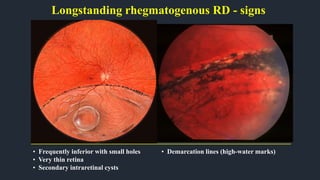
Longstanding rhegmatogenous RD - signs
• Frequently inferior with small holes
• Very thin retina
• Secondary intraretinal cysts
• Demarcation lines (high-water marks)
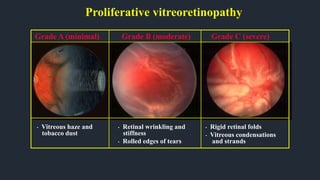
Proliferative vitreoretinopathy
• Vitreous haze and
tobacco dust
Grade A (minimal)
• Rigid retinal folds
• Vitreous condensations
and strands
Grade C (severe)
• Retinal wrinkling and
stiffness
• Rolled edges of tears
Grade B (moderate)
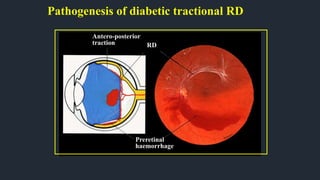
Pathogenesis of diabetic tractional RD
Antero-posterior
traction RD
Preretinal
haemorrhage
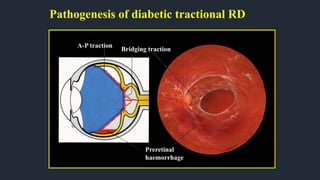
Pathogenesis of diabetic tractional RD
Bridging traction
A-P traction
Preretinal
haemorrhage
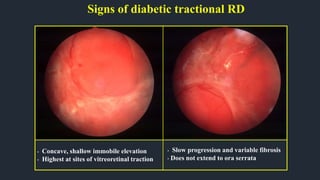
Signs of diabetic tractional RD
• Slow progression and variable fibrosis
• Does not extend to ora serrata
• Concave, shallow immobile elevation
• Highest at sites of vitreoretinal traction
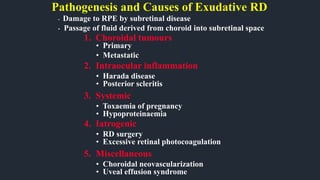
Pathogenesis and Causes of Exudative RD
• Damage to RPE by subretinal disease
• Passage of fluid derived from choroid into subretinal space
1. Choroidal tumours
• Primary
• Metastatic
2. Intraocular inflammation
• Harada disease
• Posterior scleritis
3. Systemic
• Toxaemia of pregnancy
• Hypoproteinaemia
4. Iatrogenic
• RD surgery
• Excessive retinal photocoagulation
5. Miscellaneous
• Choroidal neovascularization
• Uveal effusion syndrome
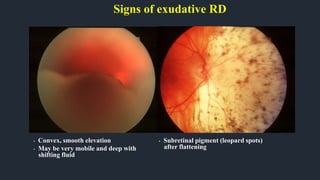
Signs of exudative RD
• Convex, smooth elevation
• May be very mobile and deep with
shifting fluid
• Subretinal pigment (leopard spots)
after flattening
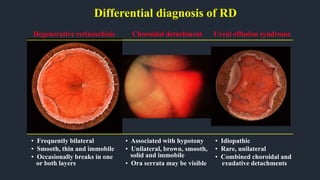
Differential diagnosis of RD
Degenerative retinoschisis
• Frequently bilateral
• Smooth, thin and immobile
• Occasionally breaks in one
or both layers
Choroidal detachment
• Associated with hypotony
• Unilateral, brown, smooth,
solid and immobile
• Ora serrata may be visible
Uveal effusion syndrome
• Idiopathic
• Rare, unilateral
• Combined choroidal and
exudative detachments
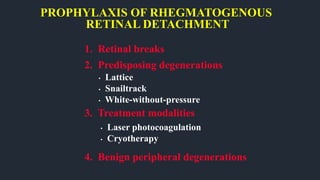
PROPHYLAXIS OF RHEGMATOGENOUS
RETINAL DETACHMENT
• Lattice
• Snailtrack
• White-without-pressure
1. Retinal breaks
• Laser photocoagulation
• Cryotherapy
3. Treatment modalities
2. Predisposing degenerations
4. Benign peripheral degenerations
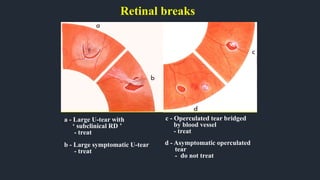
Retinal breaks
a - Large U-tear with
‘ subclinical RD ’
- treat
b - Large symptomatic U-tear
- treat
c - Operculated tear bridged
by blood vessel
- treat
d - Asymptomatic operculated
tear
- do not treat
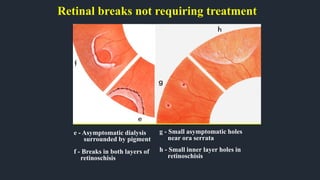
Retinal breaks not requiring treatment
e - Asymptomatic dialysis
surrounded by pigment
f - Breaks in both layers of
retinoschisis
g - Small asymptomatic holes
near ora serrata
h - Small inner layer holes in
retinoschisis
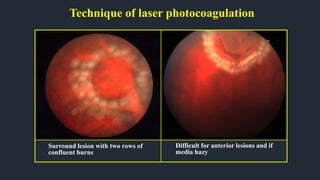
Technique of laser photocoagulation
Surround lesion with two rows of
confluent burns
Difficult for anterior lesions and if
media hazy
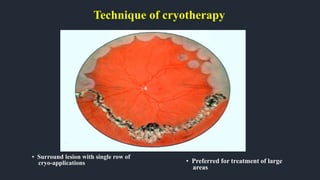
Technique of cryotherapy
• Surround lesion with single row of
cryo-applications • Preferred for treatment of large
areas
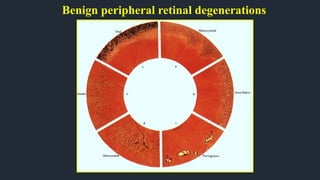
Benign peripheral retinal degenerations
PRINCIPLES OF RETINAL
DETACHMENT SURGERY
1. Scleral buckling
2. Pneumatic retinopexy
• Configuration of buckles
• Preliminary steps
• Localization of breaks
• Cryotherapy
• Insertion of local explant
• Encircling procedure
• Drainage of subretinal fluid
• Causes of early failure
3. Vitrectomy
• Giant tears
• Proliferative vitreoretinopathy (PVR)
• Diabetic tractional RD
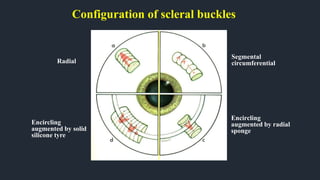
Configuration of scleral buckles
Radial
Segmental
circumferential
Encircling
augmented by radial
sponge
Encircling
augmented by solid
silicone tyre
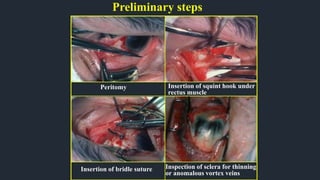
Preliminary steps
Peritomy Insertion of squint hook under
rectus muscle
Insertion of bridle suture Inspection of sclera for thinning
or anomalous vortex veins
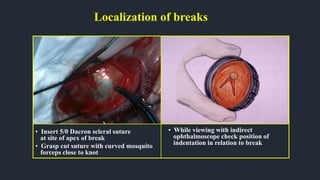
Localization of breaks
• Insert 5/0 Dacron scleral suture
at site of apex of break
• Grasp cut suture with curved mosquito
forceps close to knot
• While viewing with indirect
ophthalmoscope check position of
indentation in relation to break
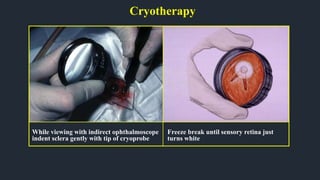
While viewing with indirect ophthalmoscope
indent sclera gently with tip of cryoprobe
Freeze break until sensory retina just
turns white
Cryotherapy
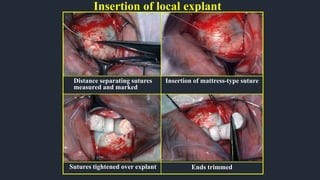
Insertion of local explant
Distance separating sutures
measured and marked
Ends trimmed
Sutures tightened over explant
Insertion of mattress-type suture
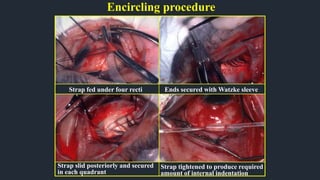
Encircling procedure
Strap fed under four recti Ends secured with Watzke sleeve
Strap slid posteriorly and secured
in each quadrant
Strap tightened to produce required
amount of internal indentation
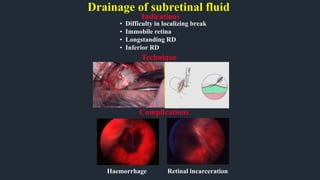
Drainage of subretinal fluid
Indications
Haemorrhage
• Difficulty in localizing break
• Immobile retina
• Longstanding RD
• Inferior RD
Retinal incarceration
Complications
Technique
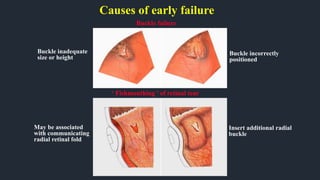
Causes of early failure
May be associated
with communicating
radial retinal fold
Insert additional radial
buckle
Buckle failure
‘ Fishmouthing ’ of retinal tear
Buckle inadequate
size or height
Buckle incorrectly
positioned
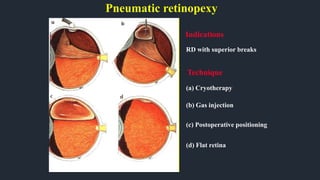
Technique
(a) Cryotherapy
Pneumatic retinopexy
Indications
RD with superior breaks
(b) Gas injection
(c) Postoperative positioning
(d) Flat retina
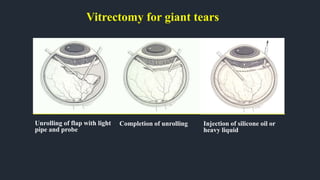
Vitrectomy for giant tears
Unrolling of flap with light
pipe and probe
Completion of unrolling Injection of silicone oil or
heavy liquid
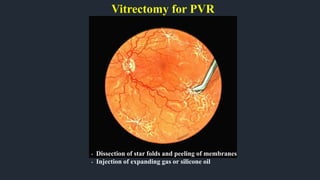
Vitrectomy for PVR
• Dissection of star folds and peeling of membranes
• Injection of expanding gas or silicone oil
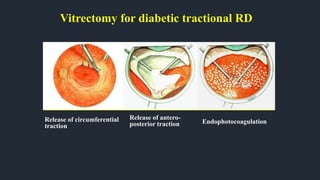
Vitrectomy for diabetic tractional RD
Release of circumferential
traction
Release of antero-
posterior traction Endophotocoagulation
Retinal Detachment_Pradeep Bastola.pptx

Retinal Detachment_Pradeep Bastola.pptx

  • 1.
    Retinal Detachment (RD) Dr. PradeepBastola, MBBS, MD, MPH Vitreo-retinal Surgeon, Professor, Department of Ophthalmology, Chitwan Medical College Teaching Hospital, Nepal
  • 2.
    References • American Academyof Ophthalmology • Wolff’s Ocular Anatomy • Myrin Yanoff • Ryan’s Retina 5th Edition • Clinical Ophthalmology by Jack J. Kanski • The Massachusetts Eye and Ear Infirmary Illustrated Manual of Ophthalmology • AIOS Ready Reckoner in Ophthalmology • Duke Elder Book of Ophthalmology • Various articles from Internet • Presentations of Dr. Pradeep Bastola
  • 3.
  • 4.
    What is RetinalDetachment? Separation of the Neuro-sensory retina (NSR) from the Retinal Pigment Epithelium (RPE) is known as Retinal Detachment.
  • 5.
    Types Rhegmatogenous RD –Retinal Detachment in presence of a retinal tear, break or hole (Rhegma = Break) Non-Rhegmatogenous RD (No break/Rhegma) • Tractional RD (Due to tractional force eg. Proliferative Diabetic Retinopathy, Post traumatic RD) • Serous/Exudative RD – Posterior uveitis, Retinal Tumors • Combined (Rhegmatogenous + Tractional)
  • 6.
    Rhegmatogenous (Rhegma- break),occurs secondarily to a full-thickness defect in the Neurosensory retina (NSR), which permits fluid derived from synchytic (liquefied) vitreous to gain access to the sub retinal space. Tractional in which the NSR is pulled away from the RPE by contracting Vitreoretinal membranes in the absence of a retinal break.
  • 7.
    Exudative (Serous, Secondary)is caused neither by a break nor traction; the SRF is derived from fluid in the vessels of the NSR or choroid, or both. Combined tractional - Rhegmatogenous, as the name implies, is the result of a combination of a retinal break and retinal traction. The retinal break is caused by traction from an adjacent area of fibrovascular proliferation and is most commonly seen in advanced proliferative diabetic retinopathy
  • 8.
    Vitreous adhesions Normal The peripheralcortical vitreous is loosely attached to the internal limiting membrane (ILM) of the sensory retina. • Stronger adhesions occur at the following sites: • Vitreous base, where they are very strong. • Around the optic nerve head, where they are strong • Around the fovea, where they are weak, except in eyes with vitreo-macular traction and macular hole formation • Along peripheral blood vessels, where they are usually weak
  • 9.
    Abnormal adhesions These maybe associated with retinal tear formation as a result of dynamic Vitreoretinal traction associated with acute posterior vitreous detachment (PVD) • Posterior border of islands of lattice degeneration • Retinal pigment clumps peripheral paravascular condensations • Vitreous base anomalies such a tongue like extensions and posterior islands • ‘White with pressure’ and ‘white without pressure’
  • 10.
    Predisposing risk factors •Extreme near sightedness (Moderate – High Myopia) • Eye injury/trauma • Cataract surgery • Family history • Advanced Diabetes • Aging • Eye disease or disorders like retinoschisis, uveitis, degenerative myopia, or lattice degeneration • History of Retinal Detachment in the fellow eye
  • 11.
    Diminution of vision(Sudden, Painless) Differential Diagnosis (Sight/Life threatening) Central Retinal Artery Occlusion Central Retinal Vein Occlusion Vitreous Haemorrhage Retinal Detachment Optic Neuritis Toxic/Alcohol/Drug Induced/Ischaemic Optic Neuropathies Posterior Cerebrovascular Accidents
  • 12.
    Pathogenesis of rhegmatogenousRD Possible sequelae of acute PVD Two components for retinal break formation • Acute posterior vitreous detachment (PVD) • Predisposing peripheral retinal degeneration Uncomplicated PVD (85%) Retinal tear formation and haemorrhage (10-15%) Avulsion of retinal vessel and haemorrhage (uncommon)
  • 13.
  • 14.
    Typical lattice degeneration •Present in about 8% of general population • Present in about 40% of eyes with RD • Spindle-shaped islands of retinal thinning • Network of white lines within islands • Variable associated RPE changes • Small round holes within lesions are common • Overlying vitreous liquefaction • Exaggerated attachments around margin of lesion Retina Vitreous
  • 15.
    Complications of latticedegeneration Indications for prophylaxis • No complications - in most cases • RD associated with atrophic holes, particularly in young myopes • RD associated with tractional tears in eyes with acute PVD • RD in fellow eye • Extensive lattice in high myopia
  • 16.
    Snailtrack degeneration Indications forprophylaxis - presence of holes Sharply demarcated, frost-like bands which are longer than lattice Large round holes which carry high risk of RD
  • 17.
    White-without-pressure Indications for prophylaxis- giant tear in other eye Translucent grey appearance of retina Occasional giant tear formation along posterior margin of lesion
  • 18.
    Pathogenesis Rhegmatogenous RD affectsabout 1 in 10000 of the population each year and both eyes may eventually be involved in about 10% of patients. It is characterized by the presence of a retinal break held open by Vitreoretinal traction that allows accumulation of liquefied vitreous under the NSR, separating it from the RPE.
  • 19.
    • The retinalbreaks responsible for RD are caused by interplay between dynamic Vitreoretinal traction, and an underlying weakness in the peripheral retina referred to as predisposing degeneration. • Even though a retinal break is present, a RD will not occur if the vitreous is not partially liquefied, and if the necessary traction is not present.
  • 20.
    Dynamic Vitreo-retinal traction Pathogenesis(Predisposed eyes with risk factors) • Syneresis defines liquefaction of the vitreous gel. • Some eyes with syneresis develop a hole in the posterior hyaloid membrane and fluid from within the vitreous cavity passes through this defect into the newly formed retrohyaloid space • This process forcibly detaches the posterior vitreous, and the posterior hyaloid membrane from the internal limiting membrane (ILM) of the sensory retina as far as the posterior border of the vitreous base • The remaining solid vitreous gel collapses inferiorly and the retrohyaloid space is occupied entirely by synchytic fluid,
  • 21.
    • Age ofonset is typically 45-65 years in the general population but may occur earlier in myopic or otherwise predisposed individuals (e.g., trauma, uveitis). • The fellow eye frequently becomes affected within 6 - 24 months.
  • 22.
    INTRODUCTION TO RETINAL DETACHMENT(RD) 1. Definitions and classifications 3. Examination techniques 2. Anatomy • Retinal breaks • Retinal detachment • Anatomical landmarks • Variants of ora serrata • Vitreous base • Indirect ophthalmology • Scleral indentation • Fundus drawing • Slitlamp biomicroscopy
  • 23.
    • Break -full-thickness defect in sensory retina • Hole - caused by chronic retinal atrophy • Tear - caused by dynamic vitreoretinal traction d. Operculated e. Dialysis Morphology of tears a. Complete U-tear b. Linear c. Incomplete L-shaped Definition and classification
  • 24.
    Retinal detachment (RD) Separationof sensory retina from RPE by subretinal fluid (SRF) Rhegmatogenous - caused by a retinal break Non-rhegmatogenous - tractional or exudative
  • 25.
    Normal anatomical landmarks Shortciliary arteries Temporal ora serrata Short ciliary nerves Macula Long ciliary nerve Short ciliary nerves Microcystoid degeneration Nasal ora serrata Vortex ampullae Long ciliary artery Vortex vein
  • 26.
    Normal variants ofora serrata a. Meridional fold • Small radial fold in line with a dentate process • Occasionally small hole at base b. Enclosed oral bay • May be mistaken for retinal hole c. Granular tissue • Multiple, tiny, white opacities • May be mistaken for small opercula a c b
  • 27.
    Anatomy of vitreousbase • 3-4 mm wide zone straddling ora serrata • Strong adhesion of cortical vitreous • Anterior limit of posterior vitreous detachment Vitreous base Pars Plicata Pars Plana
  • 28.
    Indirect ophthalmology • Keeplens parallel to patient’s iris plane • Avoid tendency to move towards patient • Ask the patient to move eyes and head into optimal positions for examination Technique • The higher the power, the less the magnification, the shorter the working distance but the greater the field of view Condensing lenses
  • 29.
    Scleral indentation Retinal breaksin detached retina without indentation Enhanced visualization of breaks with indentation
  • 30.
    Fundus drawing • Placechart upside down • Draw what you see Technique Colour code
  • 31.
    Slitlamp biomicroscopy Goldmann triple-mirrorlens • Equatorial mirror (largest and oblong) - from 30 to equator • Peripheral mirror (square) - from equator to ora serrata • Gonioscopic (smallest) • Image is upside down View of peripheral fundus
  • 32.
    Primary retinal break Itis responsible for RD and determines configuration of SRF Quadratic distribution of breaks in eyes with RD Configuration of SRF in relation to primary break
  • 33.
    PATHOGENESIS AND SIGNSOF RETINAL DETACHMENT (RD) 1. Rhegmatogenous RD 3. Exudative RD 2. Diabetic tractional RD 4. Differential diagnosis RD • Fresh • Longstanding • Proliferative vitreoretinopathy (PVR)
  • 34.
    Symptoms • Flashes oflight/Photopsia, is the subjective sensation of a flash of light. In eyes with acute PVD it is probably caused by traction at sited of Vitreoretinal adhesion • The cessation of photopsia is the result of either separation of the adhesion or complete tearing away of a piece of retina (operculum). • In PVD the photopsia is often described as an arc of golden or white light induced by eye movements and is more noticeable in dim illumination. • It tends to be projected into the patient’s temporal peripheral visual field. • Photopsia may precedes PVD by 24-48 hours.
  • 35.
    • Floaters aremoving vitreous opacities which are perceived when they cast shadows on the retina. Vitreous opacities in eyes with acute PVD are of the following three types; A) Weiss ring is a solitary floater consisting of the detached annular attachment of vitreous to the margin of the optic disc B) Cobwebs are caused by condensation of collagen fibres within the collapsed vitreous cortex C) A sudden shower of onset red - colored or dark spots usually indicated vitreous Haemorrhage secondary to tearing of a peripheral retina blood vessels. Vitreous Haemorrhage associated with acute PVD is usually sparse due to the small caliber of peripheral retinal vessels.
  • 36.
    A visual fielddefect Is perceived as a ‘black curtain’. • In some patients it may not bee present on waking up in the morning, due to spontaneous absorption of SRF while lying inactive overnight, only to reappear later in the day. • A lower field defect is usually appreciated more quickly by the patient than an upper field defect • The quadrant of the visual field in which the field defect first appears is useful in predicting the location of the primary retinal break, which will be in the opposite quadrant. • Loss of central vision may be due either to involvement of the fovea by SRF or, less frequently, obstruction of the visual axis by a large upper bullous RD.
  • 37.
    Sudden onset painless,diminution of vision in the presence of above- mentioned symptoms is the most important symptom in cases of RDs. D/D: Very Important
  • 38.
    Signs • Diminished VisualAcuity (Severe) when the macula is involved • Chronic Retinal Detachment may have Relative Afferent Pupillary Defect (Marcus Gunn Pupil) • Iritis (May be present) • Retinal Pigments in the Vitreous cavity (Tobacco Dust Sign) • Intra ocular pressure (Lower by about 5 mm in the affected eye when compared with the normal eye) – Suspect Choroidal Detachment too
  • 39.
    Fresh rhegmatogenous RD- signs • Annual incidence - 1:10,000 of population • Eventually bilateral in 10% • Convex, deep mobile elevation extending to ora serrata • Slightly opaque with dark blood vessels • Loss of choroidal pattern • Retinal breaks
  • 40.
    Longstanding rhegmatogenous RD- signs • Frequently inferior with small holes • Very thin retina • Secondary intraretinal cysts • Demarcation lines (high-water marks)
  • 41.
    Proliferative vitreoretinopathy • Vitreoushaze and tobacco dust Grade A (minimal) • Rigid retinal folds • Vitreous condensations and strands Grade C (severe) • Retinal wrinkling and stiffness • Rolled edges of tears Grade B (moderate)
  • 42.
    Pathogenesis of diabetictractional RD Antero-posterior traction RD Preretinal haemorrhage
  • 43.
    Pathogenesis of diabetictractional RD Bridging traction A-P traction Preretinal haemorrhage
  • 44.
    Signs of diabetictractional RD • Slow progression and variable fibrosis • Does not extend to ora serrata • Concave, shallow immobile elevation • Highest at sites of vitreoretinal traction
  • 45.
    Pathogenesis and Causesof Exudative RD • Damage to RPE by subretinal disease • Passage of fluid derived from choroid into subretinal space 1. Choroidal tumours • Primary • Metastatic 2. Intraocular inflammation • Harada disease • Posterior scleritis 3. Systemic • Toxaemia of pregnancy • Hypoproteinaemia 4. Iatrogenic • RD surgery • Excessive retinal photocoagulation 5. Miscellaneous • Choroidal neovascularization • Uveal effusion syndrome
  • 46.
    Signs of exudativeRD • Convex, smooth elevation • May be very mobile and deep with shifting fluid • Subretinal pigment (leopard spots) after flattening
  • 47.
    Differential diagnosis ofRD Degenerative retinoschisis • Frequently bilateral • Smooth, thin and immobile • Occasionally breaks in one or both layers Choroidal detachment • Associated with hypotony • Unilateral, brown, smooth, solid and immobile • Ora serrata may be visible Uveal effusion syndrome • Idiopathic • Rare, unilateral • Combined choroidal and exudative detachments
  • 48.
    PROPHYLAXIS OF RHEGMATOGENOUS RETINALDETACHMENT • Lattice • Snailtrack • White-without-pressure 1. Retinal breaks • Laser photocoagulation • Cryotherapy 3. Treatment modalities 2. Predisposing degenerations 4. Benign peripheral degenerations
  • 49.
    Retinal breaks a -Large U-tear with ‘ subclinical RD ’ - treat b - Large symptomatic U-tear - treat c - Operculated tear bridged by blood vessel - treat d - Asymptomatic operculated tear - do not treat
  • 50.
    Retinal breaks notrequiring treatment e - Asymptomatic dialysis surrounded by pigment f - Breaks in both layers of retinoschisis g - Small asymptomatic holes near ora serrata h - Small inner layer holes in retinoschisis
  • 51.
    Technique of laserphotocoagulation Surround lesion with two rows of confluent burns Difficult for anterior lesions and if media hazy
  • 52.
    Technique of cryotherapy •Surround lesion with single row of cryo-applications • Preferred for treatment of large areas
  • 53.
  • 54.
    PRINCIPLES OF RETINAL DETACHMENTSURGERY 1. Scleral buckling 2. Pneumatic retinopexy • Configuration of buckles • Preliminary steps • Localization of breaks • Cryotherapy • Insertion of local explant • Encircling procedure • Drainage of subretinal fluid • Causes of early failure 3. Vitrectomy • Giant tears • Proliferative vitreoretinopathy (PVR) • Diabetic tractional RD
  • 55.
    Configuration of scleralbuckles Radial Segmental circumferential Encircling augmented by radial sponge Encircling augmented by solid silicone tyre
  • 56.
    Preliminary steps Peritomy Insertionof squint hook under rectus muscle Insertion of bridle suture Inspection of sclera for thinning or anomalous vortex veins
  • 57.
    Localization of breaks •Insert 5/0 Dacron scleral suture at site of apex of break • Grasp cut suture with curved mosquito forceps close to knot • While viewing with indirect ophthalmoscope check position of indentation in relation to break
  • 58.
    While viewing withindirect ophthalmoscope indent sclera gently with tip of cryoprobe Freeze break until sensory retina just turns white Cryotherapy
  • 59.
    Insertion of localexplant Distance separating sutures measured and marked Ends trimmed Sutures tightened over explant Insertion of mattress-type suture
  • 60.
    Encircling procedure Strap fedunder four recti Ends secured with Watzke sleeve Strap slid posteriorly and secured in each quadrant Strap tightened to produce required amount of internal indentation
  • 61.
    Drainage of subretinalfluid Indications Haemorrhage • Difficulty in localizing break • Immobile retina • Longstanding RD • Inferior RD Retinal incarceration Complications Technique
  • 62.
    Causes of earlyfailure May be associated with communicating radial retinal fold Insert additional radial buckle Buckle failure ‘ Fishmouthing ’ of retinal tear Buckle inadequate size or height Buckle incorrectly positioned
  • 63.
    Technique (a) Cryotherapy Pneumatic retinopexy Indications RDwith superior breaks (b) Gas injection (c) Postoperative positioning (d) Flat retina
  • 64.
    Vitrectomy for gianttears Unrolling of flap with light pipe and probe Completion of unrolling Injection of silicone oil or heavy liquid
  • 65.
    Vitrectomy for PVR •Dissection of star folds and peeling of membranes • Injection of expanding gas or silicone oil
  • 66.
    Vitrectomy for diabetictractional RD Release of circumferential traction Release of antero- posterior traction Endophotocoagulation