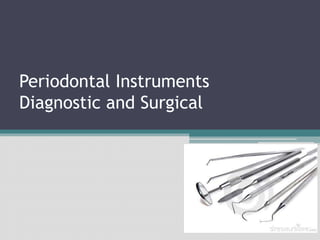
Periodontal Instruments
Diagnostic and Surgical
Contents
• Introduction & History
• Classifications
• Parts of instruments
• Diagnostic instruments
▫ Explorers
▫ Probes
 Probe designs
 Uses
 Angulation
 Adaptation
 Readings
 Limitations
 Factors affecting penetration
 Classification
 First generation
▫ Williams probe
▫ CPITN
▫ University of Michigan
– O
▫ University of North
Carolina – 15 (UNC-15)
▫ Nabers Probe
▫ Goldman fox
▫ Advantages /
disadvantages
 Second generation
 Third generation
▫ Foster miller probe
▫ Florida probe
▫ Toronto automated
probe
▫ Interprobe
 Fourth generation
probes
 Fifth generation probes
• Non-periodontal probes
▫ Calculus detection probe
▫ Periodontal disease
evaluation system
▫ The periotemp probe
• Peri-implant probing
• Mouth mirrors
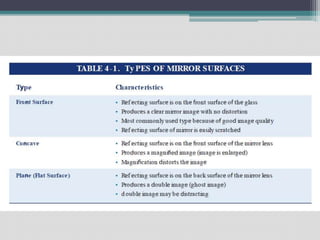
▫ Types of mirror surfaces
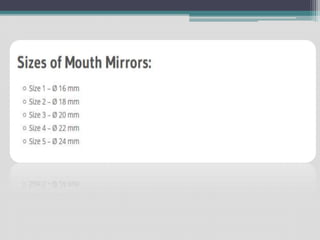
▫ Sizes of mouth mirrors
▫ Functions
• SURGICAL INSTRUMENTS
▫ Surgical scalpel
▫ Periodontal knives
▫ Interdental knives
▫ Periosteal elevators
▫ Tissue holding forceps
▫ Surgical curettes
▫ Chisels
▫ Surgical files
▫ Scissors & nippers
▫ Needle
▫ Needle holder
▫ Miscellaneous instruments
▫ Conclusion
▫ References
INTRODUCTION & HISTORY
• Almost from the time that calculus was discovered to be
a foreign substance deposited on the tooth surface, its
obvious relationship to disease of the gingivae has been
recognized.
• By the same token it is clear that its removal was
recognized as an adjunct in the treatment of disorders of
these tissues.
• It seems probable that the scaler, or some progenitor of
the scaler was one of the earliest instruments designed
for use in dental treatment.
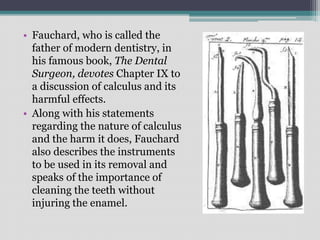
• Fauchard, who is called the
father of modern dentistry, in
his famous book, The Dental
Surgeon, devotes Chapter IX to
a discussion of calculus and its
harmful effects.
• Along with his statements
regarding the nature of calculus
and the harm it does, Fauchard
also describes the instruments
to be used in its removal and
speaks of the importance of
cleaning the teeth without
injuring the enamel.
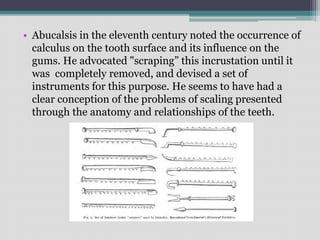
• Abucalsis in the eleventh century noted the occurrence of
calculus on the tooth surface and its influence on the
gums. He advocated "scraping” this incrustation until it
was completely removed, and devised a set of
instruments for this purpose. He seems to have had a
clear conception of the problems of scaling presented
through the anatomy and relationships of the teeth.
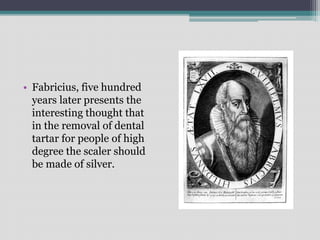
• Fabricius, five hundred
years later presents the
interesting thought that
in the removal of dental
tartar for people of high
degree the scaler should
be made of silver.
• As was to be expected, the early dentists developed very
crude instruments for the removal of calculus. There was
no philosophy as to the most efficient method of
instrumentation and usually little regard for the possible
harm that the scaling instrument might do to either
tooth surface or gum. And there was, in consequence, no
systematizing of design. It seems obvious that a pointed
instrument either straight or curved into a hook,
predominates in early design.
• The straight pointed instrument has passed out of the
picture; since it must necessarily have been used with a
push motion, with probable painful and injurious
sequelae.
• The hook-shaped instrument has, somewhere through
the years, acquired cutting edges leading out to the point
and now is known as a sickle scaler. A modification is
the hooked instrument with a rounded end instead of a
point, but with the cutting edges of the sickle. This is
now known as a curet.
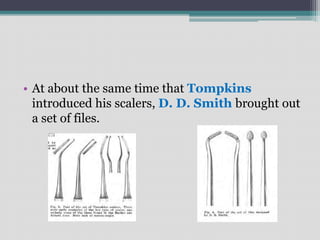
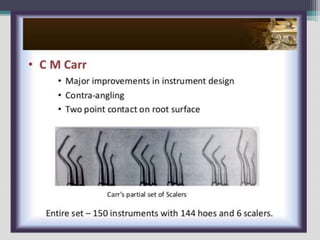
• At about the same time that Tompkins
introduced his scalers, D. D. Smith brought out
a set of files.
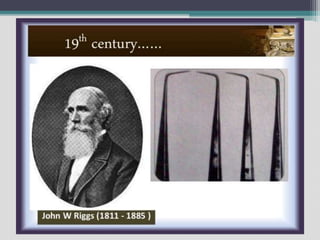
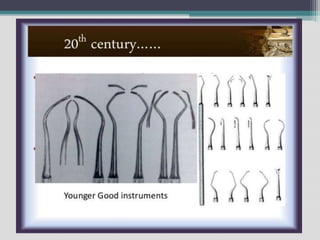
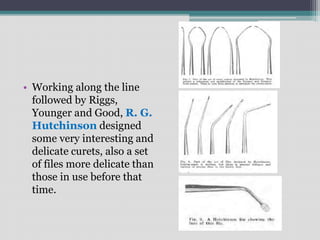
• Working along the line
followed by Riggs,
Younger and Good, R. G.
Hutchinson designed
some very interesting and
delicate curets, also a set
of files more delicate than
those in use before that
time.
• An ancient Indian book written by SUSRUTA (6th
century BC), entitled Susruta Samhita, contains four
descriptions of periodontal disease, such as “the gums of
the teeth suddenly bleed and become putrefied, black
and slimy and emit fetid smell”.
• It is believed that this is the most probably the first
classification of periodontal diseases (Dentino A et al
2013)
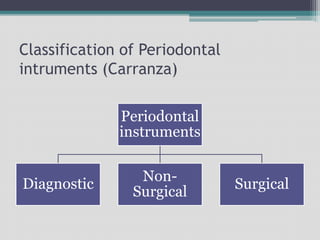
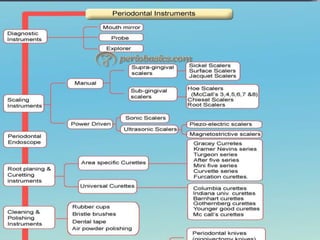
Classification of Periodontal
intruments (Carranza)
Periodontal
instruments
Diagnostic
Non-
Surgical
Surgical
Dignostic Instruments
• Periodontal probes
• Periodontal explorers
• Periodontal endoscope
Non-Surgical Instruments
• Scaling, root planing & curettage instruments
▫ Sickle scalers
▫ Curettes
▫ Hoe, chisel & file scalers
▫ Ultrasonic & sonic instruments
• Cleaning & polishing instruments
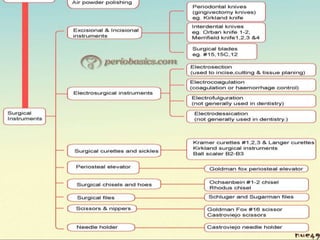
Surgical instruments
• Excisional & incisional instruments
• Surgical curettes & sickles
• Periosteal elevators
• Surgical chisels
• Surgical files
• Scissors
• Hemostat & tissue forceps
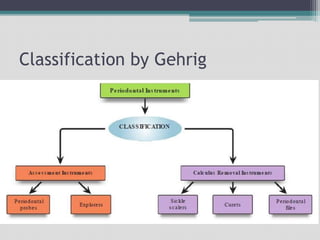
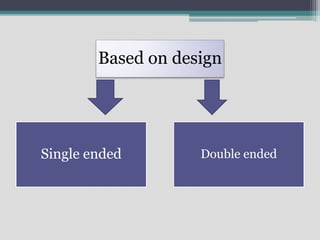
Classification by Gehrig
Based on design
Single ended Double ended
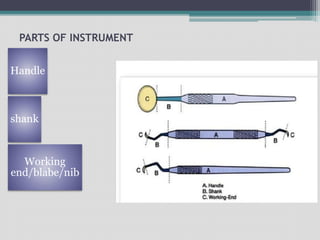
PARTS OF INSTRUMENT
Handle
shank
Working
end/blabe/nib
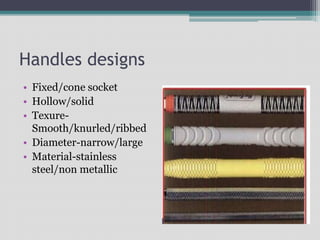
Handles designs
• Fixed/cone socket
• Hollow/solid
• Texure-
Smooth/knurled/ribbed
• Diameter-narrow/large
• Material-stainless
steel/non metallic
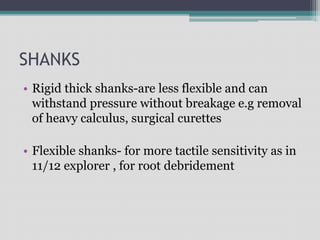
SHANKS
• Rigid thick shanks-are less flexible and can
withstand pressure without breakage e.g removal
of heavy calculus, surgical curettes
• Flexible shanks- for more tactile sensitivity as in
11/12 explorer , for root debridement
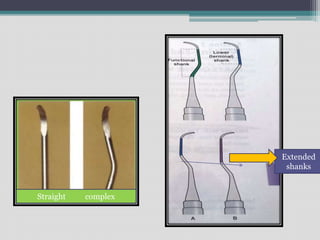
Extended
shanks
Straight complex
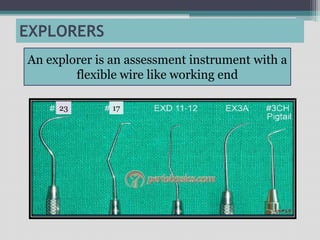
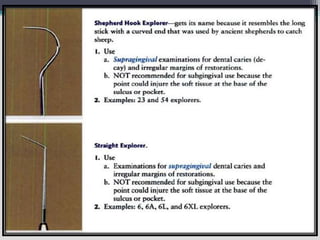
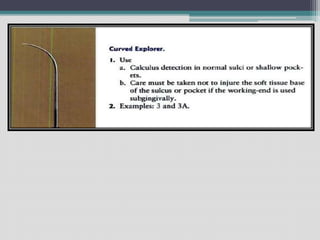
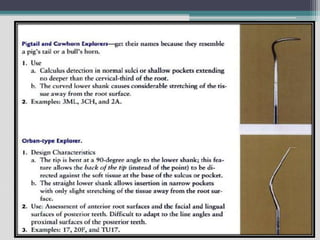
EXPLORERS
An explorer is an assessment instrument with a
flexible wire like working end
17
23
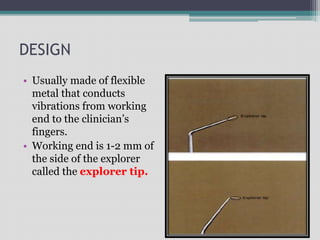
DESIGN
• Usually made of flexible
metal that conducts
vibrations from working
end to the clinician’s
fingers.
• Working end is 1-2 mm of
the side of the explorer
called the explorer tip.
FUNCTIONS
• Used to detect by tactile means , the texture and
character of tooth surfaces before , during and
after debridement to assess progress and
completion of instrumentation.
• Also used to assess
▫ Calculus
▫ Carious lesions
▫ Dental anomalies
▫ Anatomic features like grooves, curvatures, root
furcations
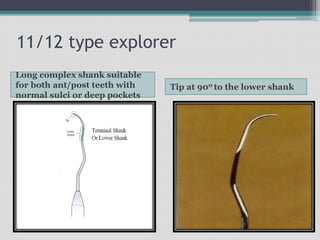
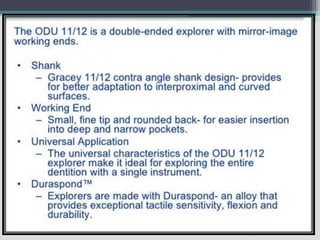
11/12 type explorer
Long complex shank suitable
for both ant/post teeth with
normal sulci or deep pockets
Tip at 900 to the lower shank
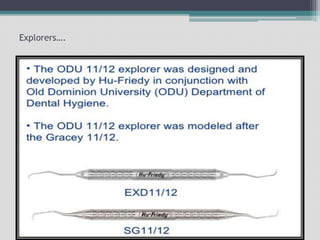
Explorers….
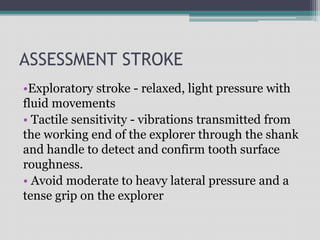
ASSESSMENT STROKE
•Exploratory stroke - relaxed, light pressure with
fluid movements
• Tactile sensitivity - vibrations transmitted from
the working end of the explorer through the shank
and handle to detect and confirm tooth surface
roughness.
• Avoid moderate to heavy lateral pressure and a
tense grip on the explorer
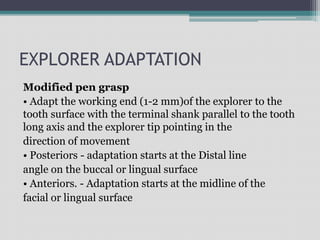
EXPLORER ADAPTATION
Modified pen grasp
• Adapt the working end (1-2 mm)of the explorer to the
tooth surface with the terminal shank parallel to the tooth
long axis and the explorer tip pointing in the
direction of movement
• Posteriors - adaptation starts at the Distal line
angle on the buccal or lingual surface
• Anteriors. - Adaptation starts at the midline of the
facial or lingual surface
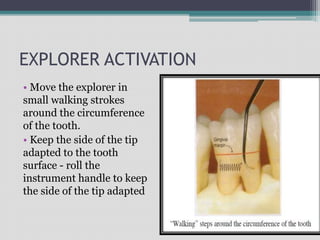
EXPLORER ACTIVATION
• Move the explorer in
small walking strokes
around the circumference
of the tooth.
• Keep the side of the tip
adapted to the tooth
surface - roll the
instrument handle to keep
the side of the tip adapted
• Use overlapping strokes to assure accuracy/completeness
• Walking strokes should be 1-2 mm in width and long
enough to contact the depth of the sulcus to the contact
area
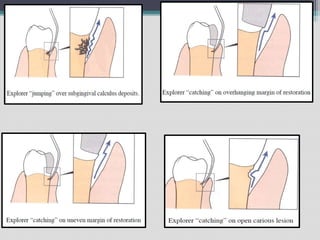
• These strokes can be used additionally for calculus
detection during and after periodontal instrumentation
PERIODONTAL PROBES
• Periodontal probes are used to locate, measure, and
mark pockets, as well as determine their course on
individual tooth surfaces.
• Primary instrument in the periodontal exam
• Latin word : probos “to test”
• The third edition of G.V.Black’s Special Dental Pathology
published in 1924 after his death mentions “the use of
very thin flat explorers to determine the depth of
pockets”
• First used by F.V Simonton of the University Of
California, San Francisco in 1925.
• Simoton refers the periodontal probe as a
“Periodontiometer ” and credits W.H.Hamford and
C.O.Patten for its invention.
Probe Design
• Vary in cross-sectional design
▫ Rectangular in shape (flat)
▫ Oval
▫ Round
• Millimeter markings
• Calibrated at varying intervals
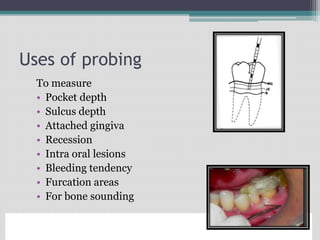
Uses of probing
To measure
• Pocket depth
• Sulcus depth
• Attached gingiva
• Recession
• Intra oral lesions
• Bleeding tendency
• Furcation areas
• For bone sounding
Esther M Wilkins. Examination procedures. In: Wilkins EM. Clinical Practice of the
Dental Hygienist. 9th ed. Philadelphia, PA: Lippincott Williams and Wilkins;
2005:222-245.
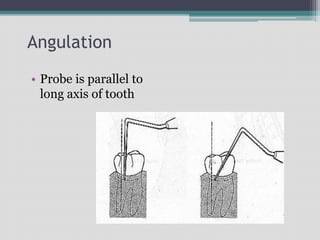
Angulation
• Probe is parallel to
long axis of tooth
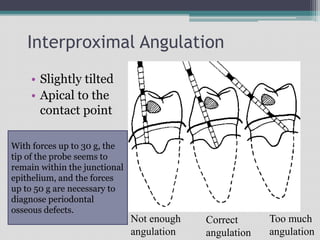
Interproximal Angulation
• Slightly tilted
• Apical to the
contact point
Not enough
angulation
Correct
angulation
Too much
angulation
With forces up to 30 g, the
tip of the probe seems to
remain within the junctional
epithelium, and the forces
up to 50 g are necessary to
diagnose periodontal
osseous defects.
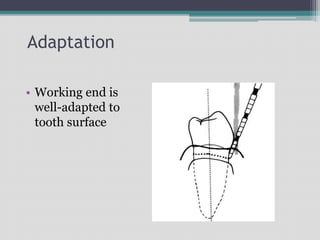
Adaptation
• Working end is
well-adapted to
tooth surface
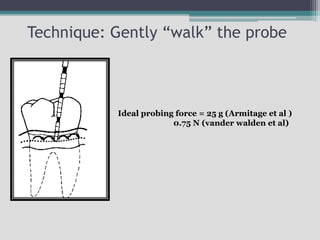
Technique: Gently “walk” the probe
Ideal probing force = 25 g (Armitage et al )
0.75 N (vander walden et al)
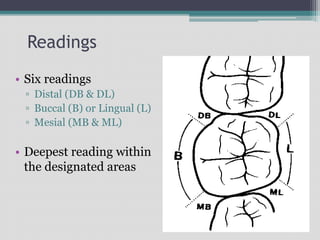
Readings
• Six readings
▫ Distal (DB & DL)
▫ Buccal (B) or Lingual (L)
▫ Mesial (MB & ML)
• Deepest reading within
the designated areas
Limitations of probes
• Errors may result from naturally occurring states, such
as interference from the calculus on the tooth or root
surface, the presence of an overhanging restoration, or
the crown’s contour.
• Another factor is operator error, such as incorrect
angulation of the probe, the amount of pressure applied
to the probe, misreading the probe, recording the data
imprecisely, and miscalculating the attachment loss
(Badersten A et al 1984)
FACTORS AFFECTING PENETRATION
• Probe-tip size
• Angle of insertion of the probe
• Probing pressure, &
• Degree of inflammation in the underlying periodontal
tissues (Listgarten MA et al 1974)
Classification of probes
• For consistency of use and academic purposes, in 1992,
Pihlstrom et al classified probes into three generations;
first, second and third generation.
• In 2000, Watts extended this classification by adding
fourth- and fifth-generation probes.
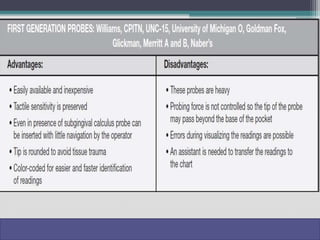
First Generation Probes
• Conventional or manual probes do not control for
probing pressure and are not suited for automatic data
collection. These probes most commonly are used by
general dental practitioners as well as periodontists.
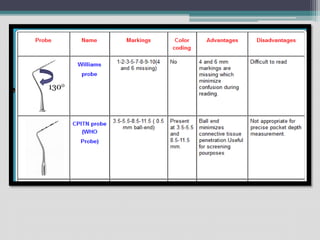
• Invented in 1936 by periodontist Charles H.M.
Williams, the Williams' periodontal probe is the
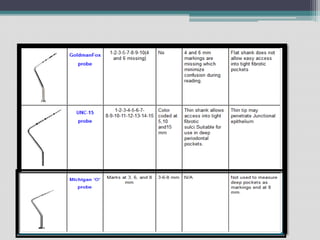
prototype or benchmark for all first-generation probes.
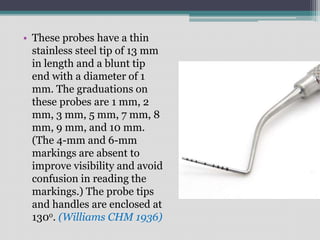
• These probes have a thin
stainless steel tip of 13 mm
in length and a blunt tip
end with a diameter of 1
mm. The graduations on
these probes are 1 mm, 2
mm, 3 mm, 5 mm, 7 mm, 8
mm, 9 mm, and 10 mm.
(The 4-mm and 6-mm
markings are absent to
improve visibility and avoid
confusion in reading the
markings.) The probe tips
and handles are enclosed at
130o. (Williams CHM 1936)
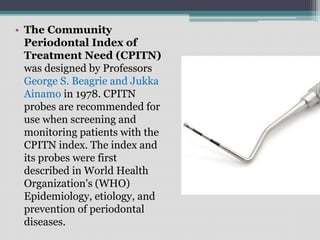
• The Community
Periodontal Index of
Treatment Need (CPITN)
was designed by Professors
George S. Beagrie and Jukka
Ainamo in 1978. CPITN
probes are recommended for
use when screening and
monitoring patients with the
CPITN index. The index and
its probes were first
described in World Health
Organization's (WHO)
Epidemiology, etiology, and
prevention of periodontal
diseases.
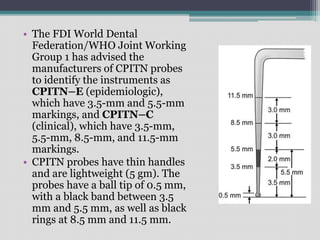
• The FDI World Dental
Federation/WHO Joint Working
Group 1 has advised the
manufacturers of CPITN probes
to identify the instruments as
CPITN–E (epidemiologic),
which have 3.5-mm and 5.5-mm
markings, and CPITN–C
(clinical), which have 3.5-mm,
5.5-mm, 8.5-mm, and 11.5-mm
markings.
• CPITN probes have thin handles
and are lightweight (5 gm). The
probes have a ball tip of 0.5 mm,
with a black band between 3.5
mm and 5.5 mm, as well as black
rings at 8.5 mm and 11.5 mm.
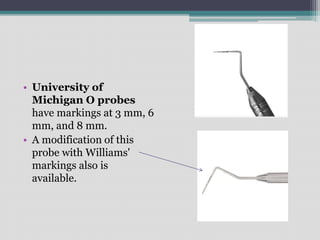
• University of
Michigan O probes
have markings at 3 mm, 6
mm, and 8 mm.
• A modification of this
probe with Williams'
markings also is
available.
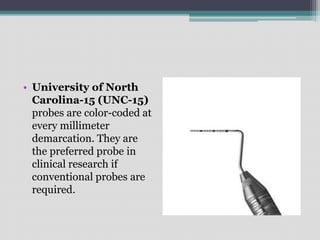
• University of North
Carolina-15 (UNC-15)
probes are color-coded at
every millimeter
demarcation. They are
the preferred probe in
clinical research if
conventional probes are
required.
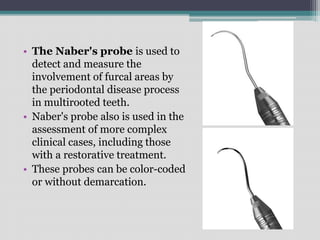
• The Naber's probe is used to
detect and measure the
involvement of furcal areas by
the periodontal disease process
in multirooted teeth.
• Naber's probe also is used in the
assessment of more complex
clinical cases, including those
with a restorative treatment.
• These probes can be color-coded
or without demarcation.
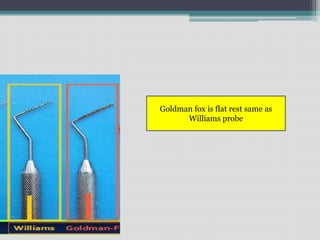
Goldman fox is flat rest same as
Williams probe
1300
Second Generation (Constant-Pressure)
Probes
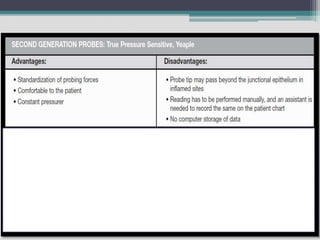
• The second-generation instruments are pressure
sensitive, allowing for improved standardization of
probing pressure. Scientific literature that demonstrated
probing pressure should be standardized and not exceed
0.2 N/mm2 led to the development of their probes.
(Hefti AF 1997)
• Second-generation probes can be used in general dental
practices, as well as periodontal practices, and do not
require computerization in the operatory. The True
Pressure Sensitive (TPS) probe is the prototype for
second-generation probes.
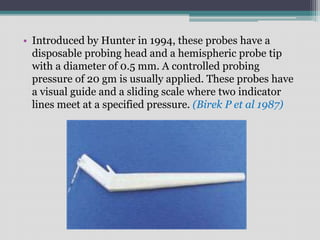
• Introduced by Hunter in 1994, these probes have a
disposable probing head and a hemispheric probe tip
with a diameter of 0.5 mm. A controlled probing
pressure of 20 gm is usually applied. These probes have
a visual guide and a sliding scale where two indicator
lines meet at a specified pressure. (Birek P et al 1987)
• In 1977, Armitage designed a pressure-sensitive
probe holder to standardize the insertion pressure
and determine how accurate probing pressure of 25
pounds affected the connective-tissue attachment.
(Armitage GC et al 1977)
• In 1978, van der Velden devised a pressure-sensitive
probe with a cylinder and piston connected to an
air-pressure system. Subsequently, it was modified
with a displacement transducer for electronic
pocket-depth reading. (Van der Velden U et al 1978)
• The electronic pressure-sensitive probe, allowing for
control of insertion pressure, was introduced by
Polson in 1980. This probe has a handpiece and a
control base that allows the examiner to control the
probing pressure. The pressure is increased until an
audio signal indicates that the preset pressure has
been reached. (Polson AM et al 1980)
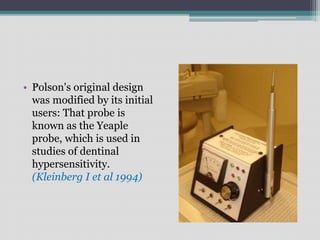
• Polson's original design
was modified by its initial
users: That probe is
known as the Yeaple
probe, which is used in
studies of dentinal
hypersensitivity.
(Kleinberg I et al 1994)
THIRD GENERATION (AUTOMATED) PROBES
• In spite of the advances in second-generation probes,
other sources of errors, such as in reading the probe,
recording data, and calculating attachment level, still
needed to be addressed.
• Third-generation probes were developed to help
minimize these mistakes by using not only standardized
pressure, but also digital readouts of the probes'
readings and computer storage of data.
• This generation includes computer-assisted direct data
capture to reduce examiner bias and allows for greater
probe precision. These probes require computerization
of the dental operatory and can be used by periodontists
and academic institutions for research.
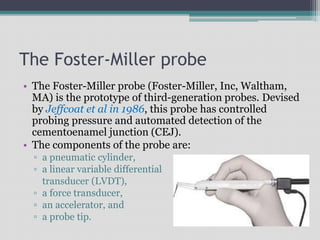
The Foster-Miller probe
• The Foster-Miller probe (Foster-Miller, Inc, Waltham,
MA) is the prototype of third-generation probes. Devised
by Jeffcoat et al in 1986, this probe has controlled
probing pressure and automated detection of the
cementoenamel junction (CEJ).
• The components of the probe are:
▫ a pneumatic cylinder,
▫ a linear variable differential
transducer (LVDT),
▫ a force transducer,
▫ an accelerator, and
▫ a probe tip.
• The main mechanism of action of the Foster-Miller
probe is by detection of the CEJ. The ball tip moves or
glides over the root surface at a controlled speed and
preset pressure. Abrupt changes in the acceleration of
the probe movement (recorded on a graph) indicate
when it meets the CEJ and when it is stopped at the base
of the pocket.
• Under controlled pressure, the probe tip is extended into
the pocket and refracted automatically when the base of
the pocket is reached. Position and acceleration-time
histories are analyzed to determine attachment level and
pocket depth.
• The main ADVANTAGE is the automatic detection of
the CEJ, which is a better landmark than gingival
margin, because the position of the gingival margin may
change depending on inflammation or recession.
(Jeffcoat MK 1991)
• The main DISADVANTAGE is that it can deem root
roughness or root surface irregularities as the CEJ.
(Jeffcoat MK et al 1986)
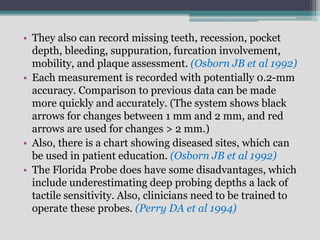
THE FLORIDA PROBE®
• It was devised by Gibbs et al in 1988.
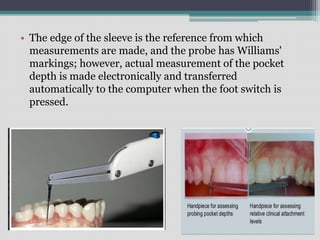
• This probe consists of a probe handpiece and
sleeve; a displacement transducer; a foot switch;
and a computer interface/personal computer.
The hemispheric probe tip has a diameter of
0.45 mm, and the sleeve has a diameter of 0.97
mm. Constant probing pressure of 15 gm is
provided by coil springs inside the handpiece.
• The edge of the sleeve is the reference from which
measurements are made, and the probe has Williams'
markings; however, actual measurement of the pocket
depth is made electronically and transferred
automatically to the computer when the foot switch is
pressed.
• They also can record missing teeth, recession, pocket
depth, bleeding, suppuration, furcation involvement,
mobility, and plaque assessment. (Osborn JB et al 1992)
• Each measurement is recorded with potentially 0.2-mm
accuracy. Comparison to previous data can be made
more quickly and accurately. (The system shows black
arrows for changes between 1 mm and 2 mm, and red
arrows are used for changes > 2 mm.)
• Also, there is a chart showing diseased sites, which can
be used in patient education. (Osborn JB et al 1992)
• The Florida Probe does have some disadvantages, which
include underestimating deep probing depths a lack of
tactile sensitivity. Also, clinicians need to be trained to
operate these probes. (Perry DA et al 1994)
The Toronto Automated probe
• It was devised by McCulloch and Birek in 1991 at
University of Toronto, used the occlusoincisal surface to
measure relative clinical attachment levels. (McCulloch
CA, Birek P 1991)
• The sulcus is probed with a 0.5-mm nickel-titanium wire
that is extended under air pressure. It controls angular
discrepancies by means of a mercury tilt sensor that
limits angulation within ± 30º.
• This probe has the advantage of an incorporated
electronic guidance system to improve precision in probe
angulation.
• It also estimates the biophysical integrity of the
dentogingival junction by measuring intrapocket probing
velocity. (Tessier JF et al 1994)
• The disadvantages are associated with positioning: It is
difficult to measure second and third molars, and
patients have to position their heads in the same place to
reproduce readings. (Mariano S. 2006)
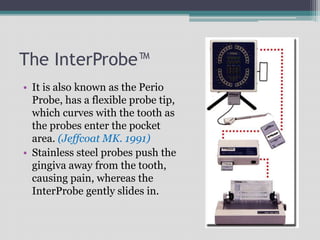
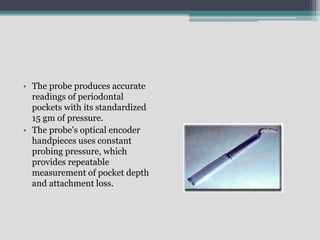
The InterProbe™
• It is also known as the Perio
Probe, has a flexible probe tip,
which curves with the tooth as
the probes enter the pocket
area. (Jeffcoat MK. 1991)
• Stainless steel probes push the
gingiva away from the tooth,
causing pain, whereas the
InterProbe gently slides in.
• The probe produces accurate
readings of periodontal
pockets with its standardized
15 gm of pressure.
• The probe's optical encoder
handpieces uses constant
probing pressure, which
provides repeatable
measurement of pocket depth
and attachment loss.
FOURTH GENERATION PROBES
• Fourth-generation refers to three-dimensional (3D)
probes.
• Currently under development.
• These probes are aimed at recording sequential probe
positions along the gingival sulcus. They are an attempt
to extend linear probing in a serial manner to take into
account the continuous and 3D pocket being examined.
FIFTH GENERATION PROBES
• Despite all the advances in earlier generation
probes, they remain invasive and, at times, their use
can be painful to patients.
• Plus, with these earlier generation probes, the probe
tip usually crosses the junctional epithelium.
• Fifth-generation probes are being devised to
eliminate these disadvantages.
• Probes are being designed to be 3D and
noninvasive: an ultrasound or other device is added
to a fourth-generation probe.
• Fifth-generation probes aim to identify the
attachment level without penetrating it.
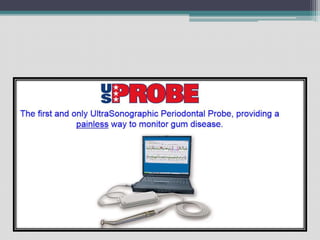
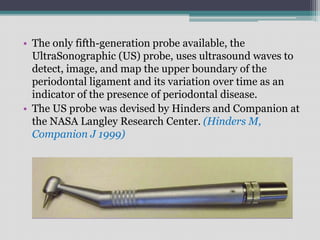
• The only fifth-generation probe available, the
UltraSonographic (US) probe, uses ultrasound waves to
detect, image, and map the upper boundary of the
periodontal ligament and its variation over time as an
indicator of the presence of periodontal disease.
• The US probe was devised by Hinders and Companion at
the NASA Langley Research Center. (Hinders M,
Companion J 1999)
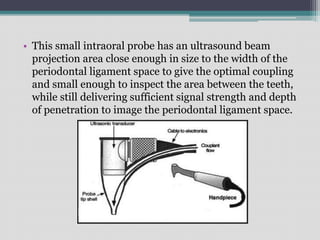
• This small intraoral probe has an ultrasound beam
projection area close enough in size to the width of the
periodontal ligament space to give the optimal coupling
and small enough to inspect the area between the teeth,
while still delivering sufficient signal strength and depth
of penetration to image the periodontal ligament space.
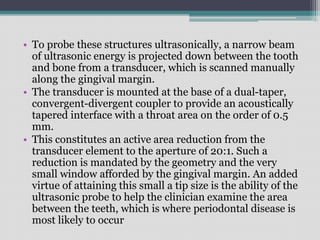
• To probe these structures ultrasonically, a narrow beam
of ultrasonic energy is projected down between the tooth
and bone from a transducer, which is scanned manually
along the gingival margin.
• The transducer is mounted at the base of a dual-taper,
convergent-divergent coupler to provide an acoustically
tapered interface with a throat area on the order of 0.5
mm.
• This constitutes an active area reduction from the
transducer element to the aperture of 20:1. Such a
reduction is mandated by the geometry and the very
small window afforded by the gingival margin. An added
virtue of attaining this small a tip size is the ability of the
ultrasonic probe to help the clinician examine the area
between the teeth, which is where periodontal disease is
most likely to occur
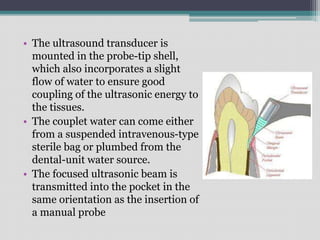
• The ultrasound transducer is
mounted in the probe-tip shell,
which also incorporates a slight
flow of water to ensure good
coupling of the ultrasonic energy to
the tissues.
• The couplet water can come either
from a suspended intravenous-type
sterile bag or plumbed from the
dental-unit water source.
• The focused ultrasonic beam is
transmitted into the pocket in the
same orientation as the insertion of
a manual probe
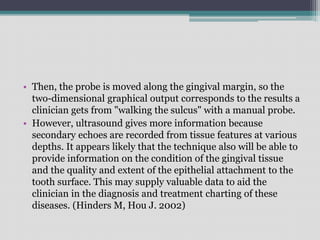
• Then, the probe is moved along the gingival margin, so the
two-dimensional graphical output corresponds to the results a
clinician gets from "walking the sulcus" with a manual probe.
• However, ultrasound gives more information because
secondary echoes are recorded from tissue features at various
depths. It appears likely that the technique also will be able to
provide information on the condition of the gingival tissue
and the quality and extent of the epithelial attachment to the
tooth surface. This may supply valuable data to aid the
clinician in the diagnosis and treatment charting of these
diseases. (Hinders M, Hou J. 2002)
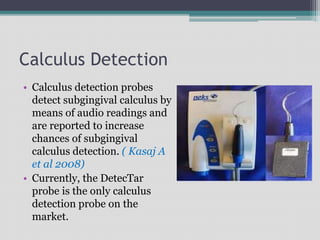
Calculus Detection
• Calculus detection probes
detect subgingival calculus by
means of audio readings and
are reported to increase
chances of subgingival
calculus detection. ( Kasaj A
et al 2008)
• Currently, the DetecTar
probe is the only calculus
detection probe on the
market.
• This device has a lightweight, well-balanced handpiece,
which can be autoclaved, and it produces an audible
beep to signify calculus detection (beep function can be
disengaged).
• This probe may augment standard methods of calculus
detection; however, it is expensive and the handpiece is
bulkier than a standard periodontal probe.
• The probe has a short waterline hookup, which may
prevent ergonomic placement of the unit, and it does not
have a published waterline treatment protocol. As with
many automated probes, there is potential for false
positives and false negatives; therefore, further research
is required.
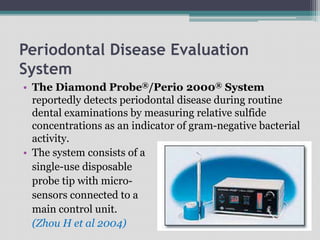
Periodontal Disease Evaluation
System
• The Diamond Probe®/Perio 2000® System
reportedly detects periodontal disease during routine
dental examinations by measuring relative sulfide
concentrations as an indicator of gram-negative bacterial
activity.
• The system consists of a
single-use disposable
probe tip with micro-
sensors connected to a
main control unit.
(Zhou H et al 2004)
• The probe might detect periodontal disease at an early
stage and might find an active site that requires
treatment. However, the probing pressure is not
controlled. Also, periodontal disease can be caused by
bacteria that do not produce volatile sulfur compounds,
creating the potential for some disease activity to be
missed. (McNamara TF et al 1972)
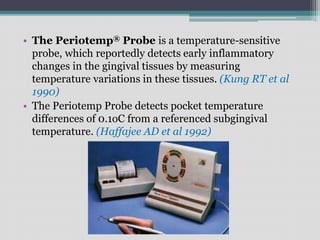
• The Periotemp® Probe is a temperature-sensitive
probe, which reportedly detects early inflammatory
changes in the gingival tissues by measuring
temperature variations in these tissues. (Kung RT et al
1990)
• The Periotemp Probe detects pocket temperature
differences of 0.1oC from a referenced subgingival
temperature. (Haffajee AD et al 1992)
• This probe has two light indicating diodes: red-emitting
diode, which indicates higher temperature, denoting risk
is twice as likely for future attachment loss; and green-
emitting diode, which indicates a lower temperature,
indicating lower risk. This probe can detect initial
inflammatory changes; therefore, treatment can be
initiated at an early stage. (Haffajee AD et al 1992)
• However, the presence of surface cooling caused by
breath airflow may further complicate the determination
of even a normal temperature distribution. (Kung RTV,
Goodson JM. 2008)
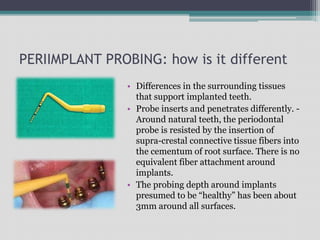
PERIIMPLANT PROBING: how is it different
• Differences in the surrounding tissues
that support implanted teeth.
• Probe inserts and penetrates differently. -
Around natural teeth, the periodontal
probe is resisted by the insertion of
supra-crestal connective tissue fibers into
the cementum of root surface. There is no
equivalent fiber attachment around
implants.
• The probing depth around implants
presumed to be “healthy” has been about
3mm around all surfaces.
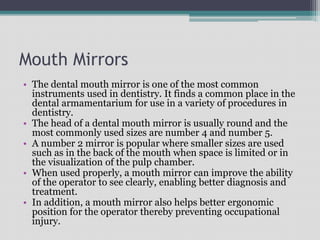
Mouth Mirrors
• The dental mouth mirror is one of the most common
instruments used in dentistry. It finds a common place in the
dental armamentarium for use in a variety of procedures in
dentistry.
• The head of a dental mouth mirror is usually round and the
most commonly used sizes are number 4 and number 5.
• A number 2 mirror is popular where smaller sizes are used
such as in the back of the mouth when space is limited or in
the visualization of the pulp chamber.
• When used properly, a mouth mirror can improve the ability
of the operator to see clearly, enabling better diagnosis and
treatment.
• In addition, a mouth mirror also helps better ergonomic
position for the operator thereby preventing occupational
injury.
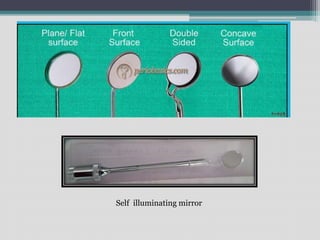
Self illuminating mirror
Functions Of The Mouth Mirror
• The dental mirror is used in four ways during
periodontal instrumentation:
(1) Indirect vision,
(2)Retraction
(3)Indirect illumination, and
(4)Transillumination.
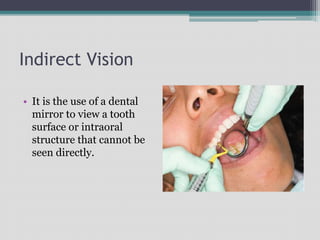
Indirect Vision
• It is the use of a dental
mirror to view a tooth
surface or intraoral
structure that cannot be
seen directly.
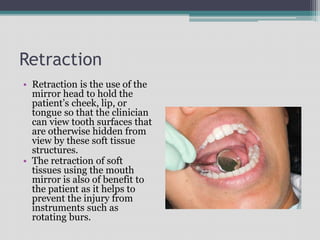
Retraction
• Retraction is the use of the
mirror head to hold the
patient’s cheek, lip, or
tongue so that the clinician
can view tooth surfaces that
are otherwise hidden from
view by these soft tissue
structures.
• The retraction of soft
tissues using the mouth
mirror is also of benefit to
the patient as it helps to
prevent the injury from
instruments such as
rotating burs.
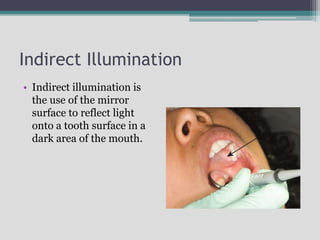
Indirect Illumination
• Indirect illumination is
the use of the mirror
surface to reflect light
onto a tooth surface in a
dark area of the mouth.
Transillumination
• Transillumination is the
technique of directing
light off of the mirror
surface and through the
anterior teeth. [Trans =
through + Illumination =
lighting up].
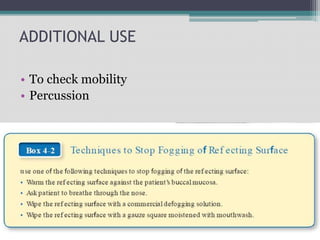
ADDITIONAL USE
• To check mobility
• Percussion
Surgical instruments
• Excisional & incisional instruments
• Surgical curettes & sickles
• Periosteal elevators
• Surgical chisels
• Surgical files
• Scissors
• Hemostat & tissue forceps
Surgical scalpels
• Surgical scalpels consist of two parts, a blade
and a handle. The handles are reusable, with the
blades being replaceable.
• The handle is also known as a "B.P. handle",
named after Charles Russell Bard and Morgan
Parker, founders of the Bard-Parker Company.
• Morgan Parker patented the revolutionary 2-
piece scalpel design in 1915
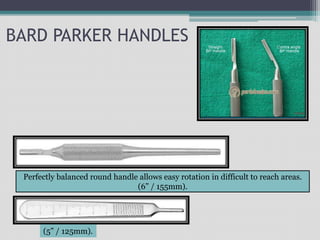
BARD PARKER HANDLES
(5” / 125mm).
Perfectly balanced round handle allows easy rotation in difficult to reach areas.
(6” / 155mm).
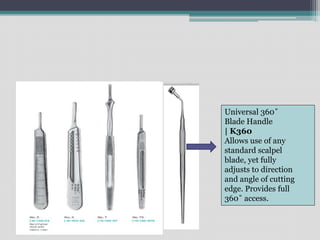
Universal 360˚
Blade Handle
| K360
Allows use of any
standard scalpel
blade, yet fully
adjusts to direction
and angle of cutting
edge. Provides full
360˚ access.
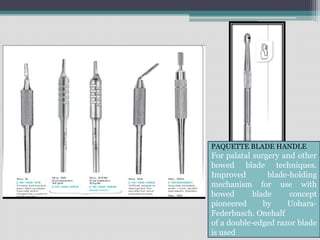
PAQUETTE BLADE HANDLE
For palatal surgery and other
bowed blade techniques.
Improved blade-holding
mechanism for use with
bowed blade concept
pioneered by Uohara-
Federbusch. Onehalf
of a double-edged razor blade
is used
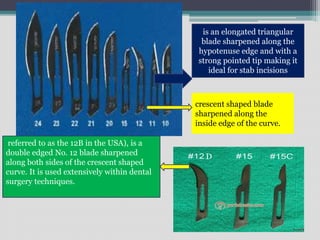
is an elongated triangular
blade sharpened along the
hypotenuse edge and with a
strong pointed tip making it
ideal for stab incisions
crescent shaped blade
sharpened along the
inside edge of the curve.
referred to as the 12B in the USA), is a
double edged No. 12 blade sharpened
along both sides of the crescent shaped
curve. It is used extensively within dental
surgery techniques.
D
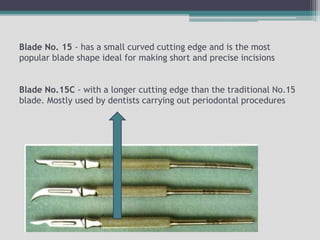
Blade No. 15 - has a small curved cutting edge and is the most
popular blade shape ideal for making short and precise incisions
Blade No.15C - with a longer cutting edge than the traditional No.15
blade. Mostly used by dentists carrying out periodontal procedures
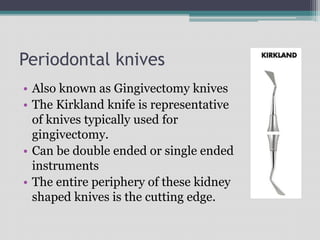
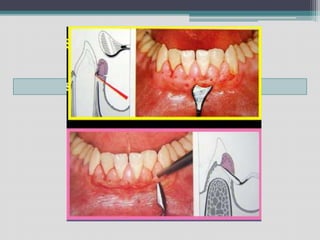
Periodontal knives
• Also known as Gingivectomy knives
• The Kirkland knife is representative
of knives typically used for
gingivectomy.
• Can be double ended or single ended
instruments
• The entire periphery of these kidney
shaped knives is the cutting edge.
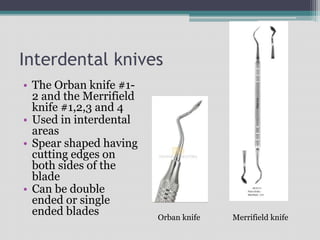
Interdental knives
• The Orban knife #1-
2 and the Merrifield
knife #1,2,3 and 4
• Used in interdental
areas
• Spear shaped having
cutting edges on
both sides of the
blade
• Can be double
ended or single
ended blades Orban knife Merrifield knife
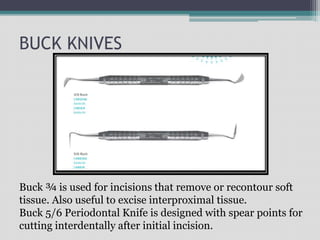
BUCK KNIVES
Buck ¾ is used for incisions that remove or recontour soft
tissue. Also useful to excise interproximal tissue.
Buck 5/6 Periodontal Knife is designed with spear points for
cutting interdentally after initial incision.
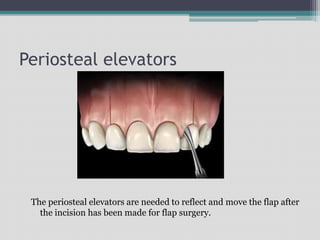
Periosteal elevators
The periosteal elevators are needed to reflect and move the flap after
the incision has been made for flap surgery.
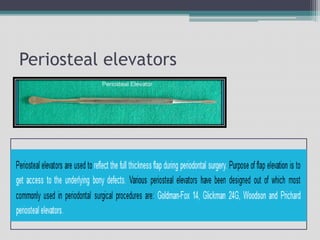
Periosteal elevators
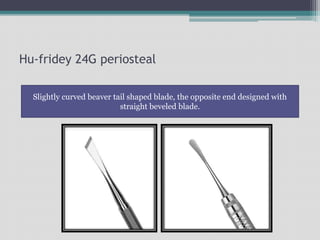
Hu-fridey 24G periosteal
Slightly curved beaver tail shaped blade, the opposite end designed with
straight beveled blade.
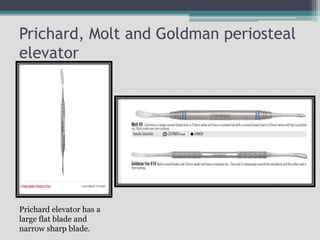
Prichard, Molt and Goldman periosteal
elevator
Prichard elevator has a
large flat blade and
narrow sharp blade.
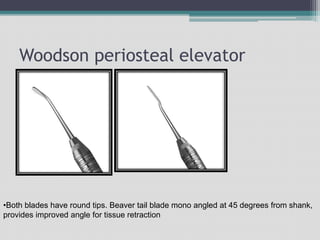
Woodson periosteal elevator
•Both blades have round tips. Beaver tail blade mono angled at 45 degrees from shank,
provides improved angle for tissue retraction
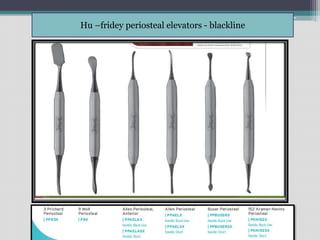
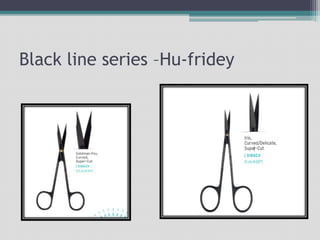
The black line series by Hu-Fridey
• The Black Line range of instruments are
introduced by Hu-fridey. They include scissors,
periosteals ,periodontal knives, surgical curettes
and variety of other speciality instruments.
• The Black Line features a performance
engineered coating for optimal edge retention,
reduced light reflection afforded by the black
matte finish and enhanced contrast and visual
acuity at the surgical site and underlying tissue.
Hu –fridey periosteal elevators - blackline
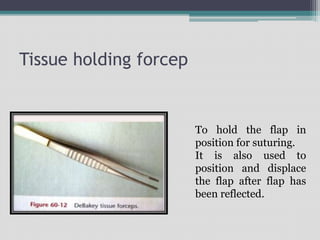
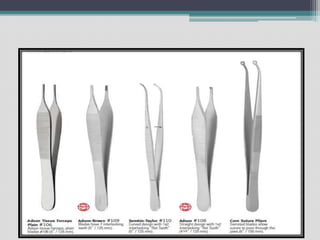
Tissue holding forcep
To hold the flap in
position for suturing.
It is also used to
position and displace
the flap after flap has
been reflected.
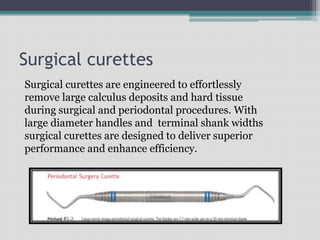
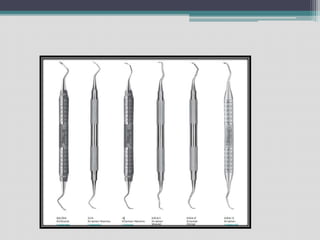
Surgical curettes
Surgical curettes are engineered to effortlessly
remove large calculus deposits and hard tissue
during surgical and periodontal procedures. With
large diameter handles and terminal shank widths
surgical curettes are designed to deliver superior
performance and enhance efficiency.
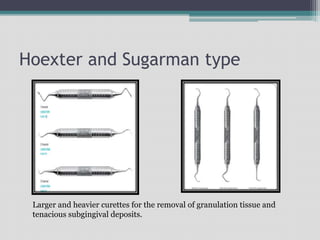
Hoexter and Sugarman type
Larger and heavier curettes for the removal of granulation tissue and
tenacious subgingival deposits.
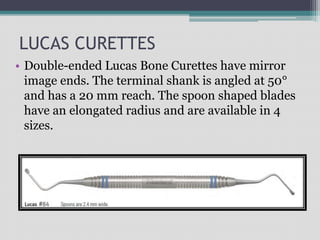
LUCAS CURETTES
• Double-ended Lucas Bone Curettes have mirror
image ends. The terminal shank is angled at 50°
and has a 20 mm reach. The spoon shaped blades
have an elongated radius and are available in 4
sizes.
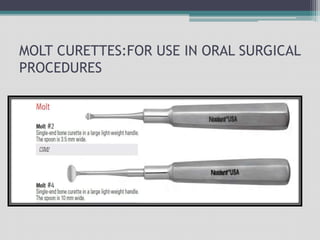
MOLT CURETTES:FOR USE IN ORAL SURGICAL
PROCEDURES
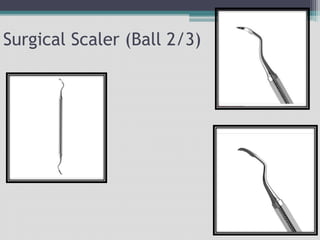
Surgical Scaler (Ball 2/3)
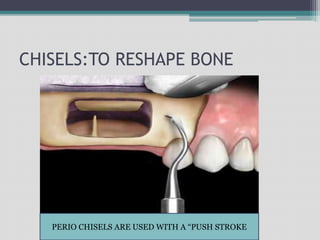
CHISELS:TO RESHAPE BONE
PERIO CHISELS ARE USED WITH A “PUSH STROKE
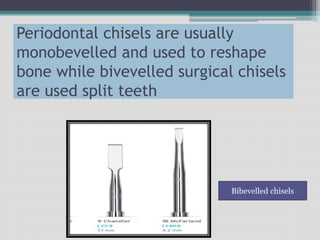
Periodontal chisels are usually
monobevelled and used to reshape
bone while bivevelled surgical chisels
are used split teeth
Bibevelled chisels
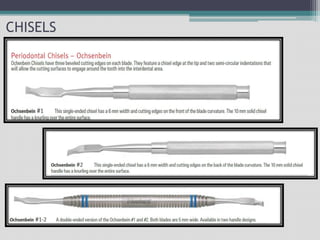
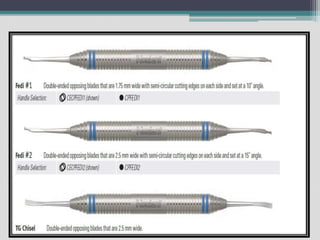
CHISELS
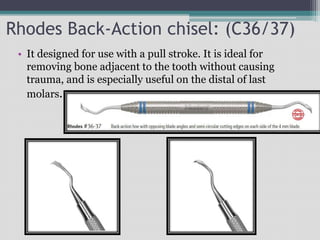
Rhodes Back-Action chisel: (C36/37)
• It designed for use with a pull stroke. It is ideal for
removing bone adjacent to the tooth without causing
trauma, and is especially useful on the distal of last
molars.
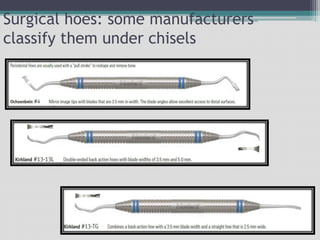
Surgical hoes: some manufacturers
classify them under chisels
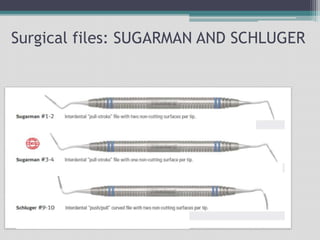
Surgical files: SUGARMAN AND SCHLUGER
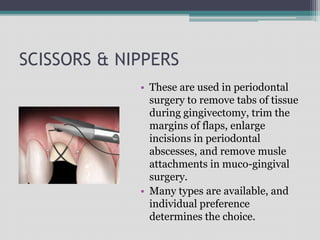
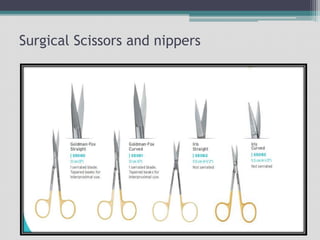
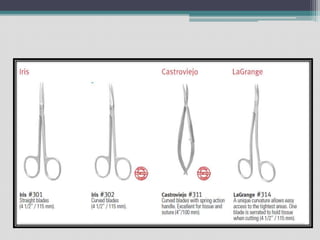
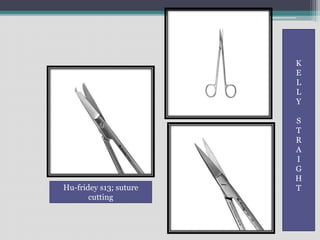
SCISSORS & NIPPERS
• These are used in periodontal
surgery to remove tabs of tissue
during gingivectomy, trim the
margins of flaps, enlarge
incisions in periodontal
abscesses, and remove musle
attachments in muco-gingival
surgery.
• Many types are available, and
individual preference
determines the choice.
Surgical Scissors and nippers
Black line series –Hu-fridey
Hu-fridey s13; suture
cutting
K
E
L
L
Y
S
T
R
A
I
G
H
T
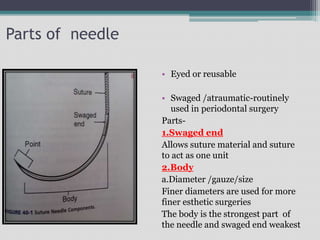
Parts of needle
• Eyed or reusable
• Swaged /atraumatic-routinely
used in periodontal surgery
Parts-
1.Swaged end
Allows suture material and suture
to act as one unit
2.Body
a.Diameter /gauze/size
Finer diameters are used for more
finer esthetic surgeries
The body is the strongest part of
the needle and swaged end weakest
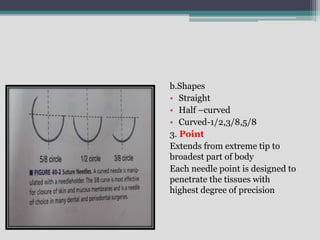
b.Shapes
• Straight
• Half –curved
• Curved-1/2,3/8,5/8
3. Point
Extends from extreme tip to
broadest part of body
Each needle point is designed to
penetrate the tissues with
highest degree of precision
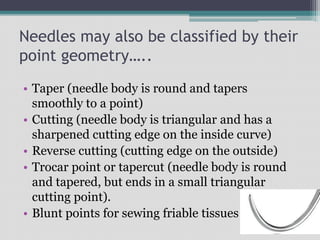
Needles may also be classified by their
point geometry…..
• Taper (needle body is round and tapers
smoothly to a point)
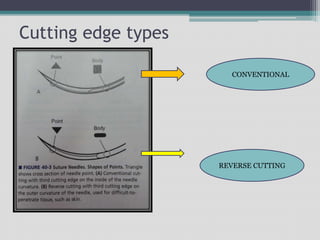
• Cutting (needle body is triangular and has a
sharpened cutting edge on the inside curve)
• Reverse cutting (cutting edge on the outside)
• Trocar point or tapercut (needle body is round
and tapered, but ends in a small triangular
cutting point).
• Blunt points for sewing friable tissues
Cutting edge types
CONVENTIONAL
REVERSE CUTTING
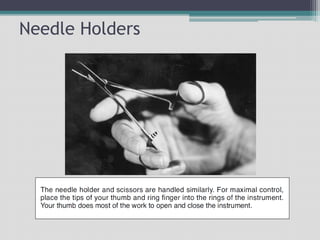
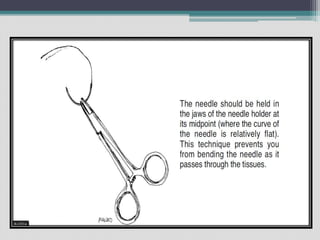
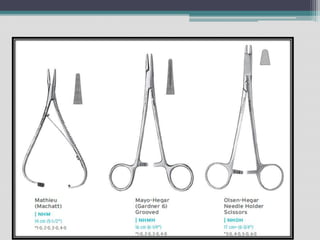
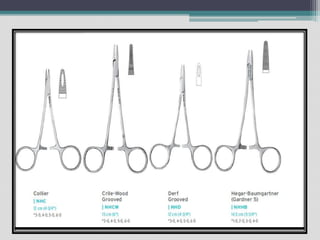
Needle Holders
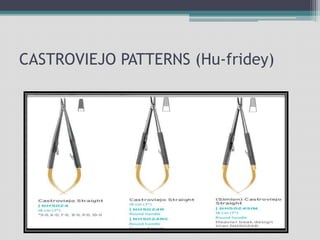
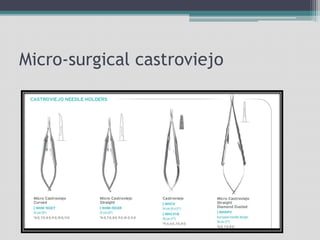
CASTROVIEJO PATTERNS (Hu-fridey)
Micro-surgical castroviejo
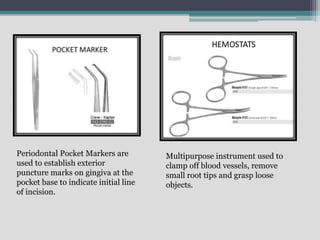
Periodontal Pocket Markers are
used to establish exterior
puncture marks on gingiva at the
pocket base to indicate initial line
of incision.
Multipurpose instrument used to
clamp off blood vessels, remove
small root tips and grasp loose
objects.
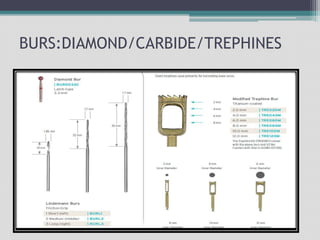
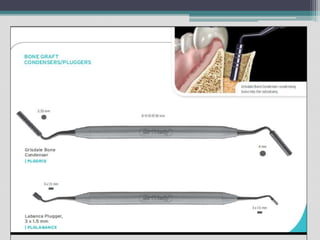
BURS:DIAMOND/CARBIDE/TREPHINES
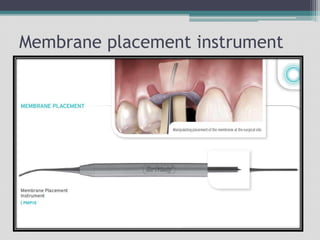
Membrane placement instrument
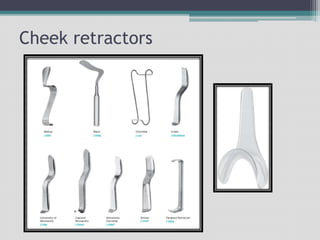
Cheek retractors
Conclusion
• The advancing abilities of instrument makers,
coupled with the ingenuity of dental practitioners,
have provided the present practitioner with a
multitude of instrument designs capable of reaching
nearly every portion of the dentition.
• But it is equally important to understand their usage
and indications at the same time.
• Some of the more efficient instruments from these
sets have withstood the test of long-term use and
now appear and reappear in newly created
instrument sets.
References
• Fundamentals of periodontal instrumentation and advanced root
instrumentation. Jill S. Neild –Gehrig
• Textbook of dental hygienist- 3rd edition- Wilkins
• Carranza’s Clinical Periodontology 10th ,11th edition
• Ram TE, slots J. Comparison of two pressure sensitive periodontal
probes and a manual periodontal probe in shallow and deep
pocket.Int J Periodontics Restorative Dent. 1993 DEC;13(6):520-
5299
• L. Mayfield, G. Bratthall, R. Attstrom : Periodontal probe precision
using 4 different periodontal probes. Journal of Clinical
Periodontology 23;(20)76-82 February 1996
• Garnick JJ, Silverstein L; Periodontal probing: probe tip diameter.
J Periodontology.2000 Jan;71(1):96-103
• Crit Rev Oral Biol Med: Periodontal probing 1997;8(3):336-56.
Hefti AF.
• www.hufridey.com
• www.periobasics.com
• www.usprobe.com
• Orban B, Wentz FM, Everett FG, et al. Periodontics—A Concept: Theory
and Practice. St Louis, MO: C.V. Mosby Co; 1958:103.
• Wilkins EM. Examination procedures. In: Wilkins EM. Clinical Practice
of the Dental Hygienist. 9th ed. Philadelphia, PA: Lippincott Williams
and Wilkins; 2005:222-245.
• Badersten A, Nilvéus R, Egelberg J. Reproducibility of probing
attachment level measurements. J Clin Periodontol. 1984;11(7):475-485.
• Listgarten MA, Mao R, Robinson PJ. Periodontal probing and the
relationship of the probe tip to periodontal tissues. J Periodontol.
1976;47(9):511-513.
• Parakkal PF. Proceedings of the workshop on quantitative evaluation of
periodontal diseases by physical measurement techniques. J Dent Res.
1979;58(2):547-553.
• Pihlstrom BL. Measurement of attachment level in clinical trials: Probing
methods. J Periodontol. 1992;63(12 Suppl):1072-1077.
• Watts TLP. Assessing periodontal health and disease. In: Periodontics in
Practice: Science with Humanity. New York, NY: Informa Healthcare;
2000:33-40.
• Williams CHM. Some newer periodontal findings of practical importance
to the general practitioner. J Can Dent Assoc. 1936;2:333-340.
• World Health Organization. Epidemiology, Etiology and Prevention of
Periodontal Diseases. Report of a WHO Scientific Group. Geneva,
Switzerland: World Health Organization; 1978. Technical Report Series
No. 621.
• Hefti AF. Periodontal probing. Crit Rev Oral Biol Med. 1997;8(3):336-
356.
• Birek P, McCulloch CAG, Hardy V. Gingival attachment level
measurements with an automated periodontal probe. J Clin Periodontol.
1987;14(8):472-477.
• Armitage GC, Svanberg GK, Löe H. Microscopic evaluation of clinical
measurements of connective tissue attachment levels. J Clin Periodontol.
1977;4(3):173-190.
• Van der Velden U, de Vries IH. Introduction of a new periodontal probe:
the pressure probe. J Clin Periodontol. 1978;5(3):188-197.
• Polson AM, Caton IB, Yeaple RN, et al. Histological determination of probe
tip penetration into gingival sulcus of humans using an electronic pressure
sensitive probe. J Clin Periodontol. 1980;7(6):479-488.
• Kleinberg I, Kaufman HW, Wolff M. Measurement of tooth
hypersensitivity and oral factors involved in its development. Arch Oral
Biol. 1994;39(Suppl):63S-71S.
• Jeffcoat MK, Jeffcoat RL, Jens SC, et al. A new periodontal probe with
automated cemento-enamel junction detection. J Clin Periodontol.
1986;13(4):276-280.
• Jeffcoat MK. Diagnosing periodontal disease: new tools to solve an old
problem. J Am Dent Assoc. 1991;122(1):54-59.
• Gibbs CH, Hirschfeld IW, Lee JG, et al. Description and clinical evaluation
of a new computerized periodontal probe-the Florida Probe. J Clin
Periodontol. 1988;15(2):137-144.
• Perry DA, Taggart EJ, Leung A, et al. Comparison of a conventional
probe with electronic and manual pressure-regulated probes. J
Periodontol. 1994;65(10):908-913.
• McCulloch CA, Birek P. Automated probe: futuristic technology for
diagnosis of periodontal disease. Univ Toronto Dent J. 1991;4(2):6-8.
• Tessier JF, Kulkarni GV, Ellen RP, et al. Probing velocity: novel approach
for assessment of inflamed periodontal attachment. J Periodontol.
1994;65(2):103-108.
• Mariano S. Advanced diagnostic techniques. In: Newman MG, Takei H,
Carranza FA, et al. Carranza‘s Clinical Periodontology.10th ed.
Philadelphia, PA: Saunders; 2006:579-598.
• Hinders M, Companion J. Ultrasonic probe for periodontal Disease. In:
Thompson DO, Chimenti DE. Reviews of Progress in Quantitative
Nondestructive Evaluation. Volume 18. New York, NY: Plenum
Publishing; 1999:1609.
• Hinders M, Hou J. Dynamic Wavelet fingerprint identification of
ultrasound signals. Materials Evaluation. 2002;60(9):1089-1093.
• Kasaj A, Moschos I, Röhrig B, et al. The effectiveness of a novel optical
probe in subgingival calculus detection. Int J Dent Hyg. 2008;6(2):143-
147.
• Zhou H, McCombs GB, Darby ML, et al. Sulphur by-product: the
relationship between volatile sulphur compounds and dental plaque-
induced gingivitis. J Contemp Dent Pract. 2004;5(2):27-39.
• McNamara TF, Alexander JF, Lee M. The role of microorganisms in the
production of oral malodor. Oral Surg Oral Med Oral Pathol.
1972;34(1):41-48.
• Kung RT, Ochs B, Goodson JM. Temperature as a periodontal diagnostic.
J Clin Periodontol. 1990;17(8):557-563.
• Haffajee AD, Socransky SS, Goodson JM. Subgingival temperature (I).
relation to baseline clinical parameters. J Clin Periodontol.
1992;19(6):401-408.
• Kung RTV, Goodson JM. Diagnostic temperature probe. Available at:
http://www.freepatentsonline.com/result.html?query_txt=PN/EP03495
81%20OR%20EP0349581AO.
Periodontal instruments

Periodontal instruments

  • 1.
  • 2.
    Contents • Introduction &History • Classifications • Parts of instruments • Diagnostic instruments ▫ Explorers ▫ Probes  Probe designs  Uses  Angulation  Adaptation  Readings  Limitations  Factors affecting penetration  Classification
  • 3.
     First generation ▫Williams probe ▫ CPITN ▫ University of Michigan – O ▫ University of North Carolina – 15 (UNC-15) ▫ Nabers Probe ▫ Goldman fox ▫ Advantages / disadvantages  Second generation  Third generation ▫ Foster miller probe ▫ Florida probe ▫ Toronto automated probe ▫ Interprobe  Fourth generation probes  Fifth generation probes • Non-periodontal probes ▫ Calculus detection probe ▫ Periodontal disease evaluation system ▫ The periotemp probe • Peri-implant probing • Mouth mirrors ▫ Types of mirror surfaces ▫ Sizes of mouth mirrors ▫ Functions
  • 4.
    • SURGICAL INSTRUMENTS ▫Surgical scalpel ▫ Periodontal knives ▫ Interdental knives ▫ Periosteal elevators ▫ Tissue holding forceps ▫ Surgical curettes ▫ Chisels ▫ Surgical files ▫ Scissors & nippers ▫ Needle ▫ Needle holder ▫ Miscellaneous instruments ▫ Conclusion ▫ References
  • 5.
    INTRODUCTION & HISTORY •Almost from the time that calculus was discovered to be a foreign substance deposited on the tooth surface, its obvious relationship to disease of the gingivae has been recognized. • By the same token it is clear that its removal was recognized as an adjunct in the treatment of disorders of these tissues. • It seems probable that the scaler, or some progenitor of the scaler was one of the earliest instruments designed for use in dental treatment.
  • 6.
    • Fauchard, whois called the father of modern dentistry, in his famous book, The Dental Surgeon, devotes Chapter IX to a discussion of calculus and its harmful effects. • Along with his statements regarding the nature of calculus and the harm it does, Fauchard also describes the instruments to be used in its removal and speaks of the importance of cleaning the teeth without injuring the enamel.
  • 7.
    • Abucalsis inthe eleventh century noted the occurrence of calculus on the tooth surface and its influence on the gums. He advocated "scraping” this incrustation until it was completely removed, and devised a set of instruments for this purpose. He seems to have had a clear conception of the problems of scaling presented through the anatomy and relationships of the teeth.
  • 8.
    • Fabricius, fivehundred years later presents the interesting thought that in the removal of dental tartar for people of high degree the scaler should be made of silver.
  • 9.
    • As wasto be expected, the early dentists developed very crude instruments for the removal of calculus. There was no philosophy as to the most efficient method of instrumentation and usually little regard for the possible harm that the scaling instrument might do to either tooth surface or gum. And there was, in consequence, no systematizing of design. It seems obvious that a pointed instrument either straight or curved into a hook, predominates in early design. • The straight pointed instrument has passed out of the picture; since it must necessarily have been used with a push motion, with probable painful and injurious sequelae. • The hook-shaped instrument has, somewhere through the years, acquired cutting edges leading out to the point and now is known as a sickle scaler. A modification is the hooked instrument with a rounded end instead of a point, but with the cutting edges of the sickle. This is now known as a curet.
  • 12.
    • At aboutthe same time that Tompkins introduced his scalers, D. D. Smith brought out a set of files.
  • 13.
    • Working alongthe line followed by Riggs, Younger and Good, R. G. Hutchinson designed some very interesting and delicate curets, also a set of files more delicate than those in use before that time.
  • 16.
    • An ancientIndian book written by SUSRUTA (6th century BC), entitled Susruta Samhita, contains four descriptions of periodontal disease, such as “the gums of the teeth suddenly bleed and become putrefied, black and slimy and emit fetid smell”. • It is believed that this is the most probably the first classification of periodontal diseases (Dentino A et al 2013)
  • 17.
    Classification of Periodontal intruments(Carranza) Periodontal instruments Diagnostic Non- Surgical Surgical
  • 18.
    Dignostic Instruments • Periodontalprobes • Periodontal explorers • Periodontal endoscope
  • 19.
    Non-Surgical Instruments • Scaling,root planing & curettage instruments ▫ Sickle scalers ▫ Curettes ▫ Hoe, chisel & file scalers ▫ Ultrasonic & sonic instruments • Cleaning & polishing instruments
  • 20.
    Surgical instruments • Excisional& incisional instruments • Surgical curettes & sickles • Periosteal elevators • Surgical chisels • Surgical files • Scissors • Hemostat & tissue forceps
  • 21.
  • 24.
    Based on design Singleended Double ended
  • 25.
  • 26.
    Handles designs • Fixed/conesocket • Hollow/solid • Texure- Smooth/knurled/ribbed • Diameter-narrow/large • Material-stainless steel/non metallic
  • 27.
    SHANKS • Rigid thickshanks-are less flexible and can withstand pressure without breakage e.g removal of heavy calculus, surgical curettes • Flexible shanks- for more tactile sensitivity as in 11/12 explorer , for root debridement
  • 28.
  • 30.
    EXPLORERS An explorer isan assessment instrument with a flexible wire like working end 17 23
  • 31.
    DESIGN • Usually madeof flexible metal that conducts vibrations from working end to the clinician’s fingers. • Working end is 1-2 mm of the side of the explorer called the explorer tip.
  • 32.
    FUNCTIONS • Used todetect by tactile means , the texture and character of tooth surfaces before , during and after debridement to assess progress and completion of instrumentation. • Also used to assess ▫ Calculus ▫ Carious lesions ▫ Dental anomalies ▫ Anatomic features like grooves, curvatures, root furcations
  • 37.
    11/12 type explorer Longcomplex shank suitable for both ant/post teeth with normal sulci or deep pockets Tip at 900 to the lower shank
  • 38.
  • 40.
    ASSESSMENT STROKE •Exploratory stroke- relaxed, light pressure with fluid movements • Tactile sensitivity - vibrations transmitted from the working end of the explorer through the shank and handle to detect and confirm tooth surface roughness. • Avoid moderate to heavy lateral pressure and a tense grip on the explorer
  • 41.
    EXPLORER ADAPTATION Modified pengrasp • Adapt the working end (1-2 mm)of the explorer to the tooth surface with the terminal shank parallel to the tooth long axis and the explorer tip pointing in the direction of movement • Posteriors - adaptation starts at the Distal line angle on the buccal or lingual surface • Anteriors. - Adaptation starts at the midline of the facial or lingual surface
  • 42.
    EXPLORER ACTIVATION • Movethe explorer in small walking strokes around the circumference of the tooth. • Keep the side of the tip adapted to the tooth surface - roll the instrument handle to keep the side of the tip adapted
  • 43.
    • Use overlappingstrokes to assure accuracy/completeness • Walking strokes should be 1-2 mm in width and long enough to contact the depth of the sulcus to the contact area • These strokes can be used additionally for calculus detection during and after periodontal instrumentation
  • 44.
    PERIODONTAL PROBES • Periodontalprobes are used to locate, measure, and mark pockets, as well as determine their course on individual tooth surfaces. • Primary instrument in the periodontal exam • Latin word : probos “to test” • The third edition of G.V.Black’s Special Dental Pathology published in 1924 after his death mentions “the use of very thin flat explorers to determine the depth of pockets”
  • 45.
    • First usedby F.V Simonton of the University Of California, San Francisco in 1925. • Simoton refers the periodontal probe as a “Periodontiometer ” and credits W.H.Hamford and C.O.Patten for its invention.
  • 46.
    Probe Design • Varyin cross-sectional design ▫ Rectangular in shape (flat) ▫ Oval ▫ Round • Millimeter markings • Calibrated at varying intervals
  • 47.
    Uses of probing Tomeasure • Pocket depth • Sulcus depth • Attached gingiva • Recession • Intra oral lesions • Bleeding tendency • Furcation areas • For bone sounding Esther M Wilkins. Examination procedures. In: Wilkins EM. Clinical Practice of the Dental Hygienist. 9th ed. Philadelphia, PA: Lippincott Williams and Wilkins; 2005:222-245.
  • 48.
    Angulation • Probe isparallel to long axis of tooth
  • 49.
    Interproximal Angulation • Slightlytilted • Apical to the contact point Not enough angulation Correct angulation Too much angulation With forces up to 30 g, the tip of the probe seems to remain within the junctional epithelium, and the forces up to 50 g are necessary to diagnose periodontal osseous defects.
  • 50.
    Adaptation • Working endis well-adapted to tooth surface
  • 51.
    Technique: Gently “walk”the probe Ideal probing force = 25 g (Armitage et al ) 0.75 N (vander walden et al)
  • 52.
    Readings • Six readings ▫Distal (DB & DL) ▫ Buccal (B) or Lingual (L) ▫ Mesial (MB & ML) • Deepest reading within the designated areas
  • 53.
    Limitations of probes •Errors may result from naturally occurring states, such as interference from the calculus on the tooth or root surface, the presence of an overhanging restoration, or the crown’s contour. • Another factor is operator error, such as incorrect angulation of the probe, the amount of pressure applied to the probe, misreading the probe, recording the data imprecisely, and miscalculating the attachment loss (Badersten A et al 1984)
  • 54.
    FACTORS AFFECTING PENETRATION •Probe-tip size • Angle of insertion of the probe • Probing pressure, & • Degree of inflammation in the underlying periodontal tissues (Listgarten MA et al 1974)
  • 55.
    Classification of probes •For consistency of use and academic purposes, in 1992, Pihlstrom et al classified probes into three generations; first, second and third generation. • In 2000, Watts extended this classification by adding fourth- and fifth-generation probes.
  • 56.
    First Generation Probes •Conventional or manual probes do not control for probing pressure and are not suited for automatic data collection. These probes most commonly are used by general dental practitioners as well as periodontists. • Invented in 1936 by periodontist Charles H.M. Williams, the Williams' periodontal probe is the prototype or benchmark for all first-generation probes.
  • 57.
    • These probeshave a thin stainless steel tip of 13 mm in length and a blunt tip end with a diameter of 1 mm. The graduations on these probes are 1 mm, 2 mm, 3 mm, 5 mm, 7 mm, 8 mm, 9 mm, and 10 mm. (The 4-mm and 6-mm markings are absent to improve visibility and avoid confusion in reading the markings.) The probe tips and handles are enclosed at 130o. (Williams CHM 1936)
  • 58.
    • The Community PeriodontalIndex of Treatment Need (CPITN) was designed by Professors George S. Beagrie and Jukka Ainamo in 1978. CPITN probes are recommended for use when screening and monitoring patients with the CPITN index. The index and its probes were first described in World Health Organization's (WHO) Epidemiology, etiology, and prevention of periodontal diseases.
  • 59.
    • The FDIWorld Dental Federation/WHO Joint Working Group 1 has advised the manufacturers of CPITN probes to identify the instruments as CPITN–E (epidemiologic), which have 3.5-mm and 5.5-mm markings, and CPITN–C (clinical), which have 3.5-mm, 5.5-mm, 8.5-mm, and 11.5-mm markings. • CPITN probes have thin handles and are lightweight (5 gm). The probes have a ball tip of 0.5 mm, with a black band between 3.5 mm and 5.5 mm, as well as black rings at 8.5 mm and 11.5 mm.
  • 60.
    • University of MichiganO probes have markings at 3 mm, 6 mm, and 8 mm. • A modification of this probe with Williams' markings also is available.
  • 61.
    • University ofNorth Carolina-15 (UNC-15) probes are color-coded at every millimeter demarcation. They are the preferred probe in clinical research if conventional probes are required.
  • 62.
    • The Naber'sprobe is used to detect and measure the involvement of furcal areas by the periodontal disease process in multirooted teeth. • Naber's probe also is used in the assessment of more complex clinical cases, including those with a restorative treatment. • These probes can be color-coded or without demarcation.
  • 63.
    Goldman fox isflat rest same as Williams probe
  • 65.
  • 67.
    Second Generation (Constant-Pressure) Probes •The second-generation instruments are pressure sensitive, allowing for improved standardization of probing pressure. Scientific literature that demonstrated probing pressure should be standardized and not exceed 0.2 N/mm2 led to the development of their probes. (Hefti AF 1997) • Second-generation probes can be used in general dental practices, as well as periodontal practices, and do not require computerization in the operatory. The True Pressure Sensitive (TPS) probe is the prototype for second-generation probes.
  • 68.
    • Introduced byHunter in 1994, these probes have a disposable probing head and a hemispheric probe tip with a diameter of 0.5 mm. A controlled probing pressure of 20 gm is usually applied. These probes have a visual guide and a sliding scale where two indicator lines meet at a specified pressure. (Birek P et al 1987)
  • 69.
    • In 1977,Armitage designed a pressure-sensitive probe holder to standardize the insertion pressure and determine how accurate probing pressure of 25 pounds affected the connective-tissue attachment. (Armitage GC et al 1977) • In 1978, van der Velden devised a pressure-sensitive probe with a cylinder and piston connected to an air-pressure system. Subsequently, it was modified with a displacement transducer for electronic pocket-depth reading. (Van der Velden U et al 1978) • The electronic pressure-sensitive probe, allowing for control of insertion pressure, was introduced by Polson in 1980. This probe has a handpiece and a control base that allows the examiner to control the probing pressure. The pressure is increased until an audio signal indicates that the preset pressure has been reached. (Polson AM et al 1980)
  • 70.
    • Polson's originaldesign was modified by its initial users: That probe is known as the Yeaple probe, which is used in studies of dentinal hypersensitivity. (Kleinberg I et al 1994)
  • 72.
    THIRD GENERATION (AUTOMATED)PROBES • In spite of the advances in second-generation probes, other sources of errors, such as in reading the probe, recording data, and calculating attachment level, still needed to be addressed. • Third-generation probes were developed to help minimize these mistakes by using not only standardized pressure, but also digital readouts of the probes' readings and computer storage of data. • This generation includes computer-assisted direct data capture to reduce examiner bias and allows for greater probe precision. These probes require computerization of the dental operatory and can be used by periodontists and academic institutions for research.
  • 73.
    The Foster-Miller probe •The Foster-Miller probe (Foster-Miller, Inc, Waltham, MA) is the prototype of third-generation probes. Devised by Jeffcoat et al in 1986, this probe has controlled probing pressure and automated detection of the cementoenamel junction (CEJ). • The components of the probe are: ▫ a pneumatic cylinder, ▫ a linear variable differential transducer (LVDT), ▫ a force transducer, ▫ an accelerator, and ▫ a probe tip.
  • 74.
    • The mainmechanism of action of the Foster-Miller probe is by detection of the CEJ. The ball tip moves or glides over the root surface at a controlled speed and preset pressure. Abrupt changes in the acceleration of the probe movement (recorded on a graph) indicate when it meets the CEJ and when it is stopped at the base of the pocket. • Under controlled pressure, the probe tip is extended into the pocket and refracted automatically when the base of the pocket is reached. Position and acceleration-time histories are analyzed to determine attachment level and pocket depth.
  • 75.
    • The mainADVANTAGE is the automatic detection of the CEJ, which is a better landmark than gingival margin, because the position of the gingival margin may change depending on inflammation or recession. (Jeffcoat MK 1991) • The main DISADVANTAGE is that it can deem root roughness or root surface irregularities as the CEJ. (Jeffcoat MK et al 1986)
  • 76.
    THE FLORIDA PROBE® •It was devised by Gibbs et al in 1988. • This probe consists of a probe handpiece and sleeve; a displacement transducer; a foot switch; and a computer interface/personal computer. The hemispheric probe tip has a diameter of 0.45 mm, and the sleeve has a diameter of 0.97 mm. Constant probing pressure of 15 gm is provided by coil springs inside the handpiece.
  • 77.
    • The edgeof the sleeve is the reference from which measurements are made, and the probe has Williams' markings; however, actual measurement of the pocket depth is made electronically and transferred automatically to the computer when the foot switch is pressed.
  • 78.
    • They alsocan record missing teeth, recession, pocket depth, bleeding, suppuration, furcation involvement, mobility, and plaque assessment. (Osborn JB et al 1992) • Each measurement is recorded with potentially 0.2-mm accuracy. Comparison to previous data can be made more quickly and accurately. (The system shows black arrows for changes between 1 mm and 2 mm, and red arrows are used for changes > 2 mm.) • Also, there is a chart showing diseased sites, which can be used in patient education. (Osborn JB et al 1992) • The Florida Probe does have some disadvantages, which include underestimating deep probing depths a lack of tactile sensitivity. Also, clinicians need to be trained to operate these probes. (Perry DA et al 1994)
  • 79.
    The Toronto Automatedprobe • It was devised by McCulloch and Birek in 1991 at University of Toronto, used the occlusoincisal surface to measure relative clinical attachment levels. (McCulloch CA, Birek P 1991) • The sulcus is probed with a 0.5-mm nickel-titanium wire that is extended under air pressure. It controls angular discrepancies by means of a mercury tilt sensor that limits angulation within ± 30º.
  • 80.
    • This probehas the advantage of an incorporated electronic guidance system to improve precision in probe angulation. • It also estimates the biophysical integrity of the dentogingival junction by measuring intrapocket probing velocity. (Tessier JF et al 1994) • The disadvantages are associated with positioning: It is difficult to measure second and third molars, and patients have to position their heads in the same place to reproduce readings. (Mariano S. 2006)
  • 81.
    The InterProbe™ • Itis also known as the Perio Probe, has a flexible probe tip, which curves with the tooth as the probes enter the pocket area. (Jeffcoat MK. 1991) • Stainless steel probes push the gingiva away from the tooth, causing pain, whereas the InterProbe gently slides in.
  • 82.
    • The probeproduces accurate readings of periodontal pockets with its standardized 15 gm of pressure. • The probe's optical encoder handpieces uses constant probing pressure, which provides repeatable measurement of pocket depth and attachment loss.
  • 83.
    FOURTH GENERATION PROBES •Fourth-generation refers to three-dimensional (3D) probes. • Currently under development. • These probes are aimed at recording sequential probe positions along the gingival sulcus. They are an attempt to extend linear probing in a serial manner to take into account the continuous and 3D pocket being examined.
  • 84.
    FIFTH GENERATION PROBES •Despite all the advances in earlier generation probes, they remain invasive and, at times, their use can be painful to patients. • Plus, with these earlier generation probes, the probe tip usually crosses the junctional epithelium. • Fifth-generation probes are being devised to eliminate these disadvantages. • Probes are being designed to be 3D and noninvasive: an ultrasound or other device is added to a fourth-generation probe. • Fifth-generation probes aim to identify the attachment level without penetrating it.
  • 86.
    • The onlyfifth-generation probe available, the UltraSonographic (US) probe, uses ultrasound waves to detect, image, and map the upper boundary of the periodontal ligament and its variation over time as an indicator of the presence of periodontal disease. • The US probe was devised by Hinders and Companion at the NASA Langley Research Center. (Hinders M, Companion J 1999)
  • 87.
    • This smallintraoral probe has an ultrasound beam projection area close enough in size to the width of the periodontal ligament space to give the optimal coupling and small enough to inspect the area between the teeth, while still delivering sufficient signal strength and depth of penetration to image the periodontal ligament space.
  • 88.
    • To probethese structures ultrasonically, a narrow beam of ultrasonic energy is projected down between the tooth and bone from a transducer, which is scanned manually along the gingival margin. • The transducer is mounted at the base of a dual-taper, convergent-divergent coupler to provide an acoustically tapered interface with a throat area on the order of 0.5 mm. • This constitutes an active area reduction from the transducer element to the aperture of 20:1. Such a reduction is mandated by the geometry and the very small window afforded by the gingival margin. An added virtue of attaining this small a tip size is the ability of the ultrasonic probe to help the clinician examine the area between the teeth, which is where periodontal disease is most likely to occur
  • 89.
    • The ultrasoundtransducer is mounted in the probe-tip shell, which also incorporates a slight flow of water to ensure good coupling of the ultrasonic energy to the tissues. • The couplet water can come either from a suspended intravenous-type sterile bag or plumbed from the dental-unit water source. • The focused ultrasonic beam is transmitted into the pocket in the same orientation as the insertion of a manual probe
  • 90.
    • Then, theprobe is moved along the gingival margin, so the two-dimensional graphical output corresponds to the results a clinician gets from "walking the sulcus" with a manual probe. • However, ultrasound gives more information because secondary echoes are recorded from tissue features at various depths. It appears likely that the technique also will be able to provide information on the condition of the gingival tissue and the quality and extent of the epithelial attachment to the tooth surface. This may supply valuable data to aid the clinician in the diagnosis and treatment charting of these diseases. (Hinders M, Hou J. 2002)
  • 92.
    Calculus Detection • Calculusdetection probes detect subgingival calculus by means of audio readings and are reported to increase chances of subgingival calculus detection. ( Kasaj A et al 2008) • Currently, the DetecTar probe is the only calculus detection probe on the market.
  • 93.
    • This devicehas a lightweight, well-balanced handpiece, which can be autoclaved, and it produces an audible beep to signify calculus detection (beep function can be disengaged). • This probe may augment standard methods of calculus detection; however, it is expensive and the handpiece is bulkier than a standard periodontal probe. • The probe has a short waterline hookup, which may prevent ergonomic placement of the unit, and it does not have a published waterline treatment protocol. As with many automated probes, there is potential for false positives and false negatives; therefore, further research is required.
  • 94.
    Periodontal Disease Evaluation System •The Diamond Probe®/Perio 2000® System reportedly detects periodontal disease during routine dental examinations by measuring relative sulfide concentrations as an indicator of gram-negative bacterial activity. • The system consists of a single-use disposable probe tip with micro- sensors connected to a main control unit. (Zhou H et al 2004)
  • 95.
    • The probemight detect periodontal disease at an early stage and might find an active site that requires treatment. However, the probing pressure is not controlled. Also, periodontal disease can be caused by bacteria that do not produce volatile sulfur compounds, creating the potential for some disease activity to be missed. (McNamara TF et al 1972)
  • 96.
    • The Periotemp®Probe is a temperature-sensitive probe, which reportedly detects early inflammatory changes in the gingival tissues by measuring temperature variations in these tissues. (Kung RT et al 1990) • The Periotemp Probe detects pocket temperature differences of 0.1oC from a referenced subgingival temperature. (Haffajee AD et al 1992)
  • 97.
    • This probehas two light indicating diodes: red-emitting diode, which indicates higher temperature, denoting risk is twice as likely for future attachment loss; and green- emitting diode, which indicates a lower temperature, indicating lower risk. This probe can detect initial inflammatory changes; therefore, treatment can be initiated at an early stage. (Haffajee AD et al 1992) • However, the presence of surface cooling caused by breath airflow may further complicate the determination of even a normal temperature distribution. (Kung RTV, Goodson JM. 2008)
  • 98.
    PERIIMPLANT PROBING: howis it different • Differences in the surrounding tissues that support implanted teeth. • Probe inserts and penetrates differently. - Around natural teeth, the periodontal probe is resisted by the insertion of supra-crestal connective tissue fibers into the cementum of root surface. There is no equivalent fiber attachment around implants. • The probing depth around implants presumed to be “healthy” has been about 3mm around all surfaces.
  • 99.
    Mouth Mirrors • Thedental mouth mirror is one of the most common instruments used in dentistry. It finds a common place in the dental armamentarium for use in a variety of procedures in dentistry. • The head of a dental mouth mirror is usually round and the most commonly used sizes are number 4 and number 5. • A number 2 mirror is popular where smaller sizes are used such as in the back of the mouth when space is limited or in the visualization of the pulp chamber. • When used properly, a mouth mirror can improve the ability of the operator to see clearly, enabling better diagnosis and treatment. • In addition, a mouth mirror also helps better ergonomic position for the operator thereby preventing occupational injury.
  • 101.
  • 103.
    Functions Of TheMouth Mirror • The dental mirror is used in four ways during periodontal instrumentation: (1) Indirect vision, (2)Retraction (3)Indirect illumination, and (4)Transillumination.
  • 104.
    Indirect Vision • Itis the use of a dental mirror to view a tooth surface or intraoral structure that cannot be seen directly.
  • 105.
    Retraction • Retraction isthe use of the mirror head to hold the patient’s cheek, lip, or tongue so that the clinician can view tooth surfaces that are otherwise hidden from view by these soft tissue structures. • The retraction of soft tissues using the mouth mirror is also of benefit to the patient as it helps to prevent the injury from instruments such as rotating burs.
  • 106.
    Indirect Illumination • Indirectillumination is the use of the mirror surface to reflect light onto a tooth surface in a dark area of the mouth.
  • 107.
    Transillumination • Transillumination isthe technique of directing light off of the mirror surface and through the anterior teeth. [Trans = through + Illumination = lighting up].
  • 108.
    ADDITIONAL USE • Tocheck mobility • Percussion
  • 109.
  • 110.
    Surgical instruments • Excisional& incisional instruments • Surgical curettes & sickles • Periosteal elevators • Surgical chisels • Surgical files • Scissors • Hemostat & tissue forceps
  • 111.
    Surgical scalpels • Surgicalscalpels consist of two parts, a blade and a handle. The handles are reusable, with the blades being replaceable. • The handle is also known as a "B.P. handle", named after Charles Russell Bard and Morgan Parker, founders of the Bard-Parker Company. • Morgan Parker patented the revolutionary 2- piece scalpel design in 1915
  • 112.
    BARD PARKER HANDLES (5”/ 125mm). Perfectly balanced round handle allows easy rotation in difficult to reach areas. (6” / 155mm).
  • 113.
    Universal 360˚ Blade Handle |K360 Allows use of any standard scalpel blade, yet fully adjusts to direction and angle of cutting edge. Provides full 360˚ access.
  • 114.
    PAQUETTE BLADE HANDLE Forpalatal surgery and other bowed blade techniques. Improved blade-holding mechanism for use with bowed blade concept pioneered by Uohara- Federbusch. Onehalf of a double-edged razor blade is used
  • 115.
    is an elongatedtriangular blade sharpened along the hypotenuse edge and with a strong pointed tip making it ideal for stab incisions crescent shaped blade sharpened along the inside edge of the curve. referred to as the 12B in the USA), is a double edged No. 12 blade sharpened along both sides of the crescent shaped curve. It is used extensively within dental surgery techniques. D
  • 116.
    Blade No. 15- has a small curved cutting edge and is the most popular blade shape ideal for making short and precise incisions Blade No.15C - with a longer cutting edge than the traditional No.15 blade. Mostly used by dentists carrying out periodontal procedures
  • 117.
    Periodontal knives • Alsoknown as Gingivectomy knives • The Kirkland knife is representative of knives typically used for gingivectomy. • Can be double ended or single ended instruments • The entire periphery of these kidney shaped knives is the cutting edge.
  • 118.
    Interdental knives • TheOrban knife #1- 2 and the Merrifield knife #1,2,3 and 4 • Used in interdental areas • Spear shaped having cutting edges on both sides of the blade • Can be double ended or single ended blades Orban knife Merrifield knife
  • 120.
    BUCK KNIVES Buck ¾is used for incisions that remove or recontour soft tissue. Also useful to excise interproximal tissue. Buck 5/6 Periodontal Knife is designed with spear points for cutting interdentally after initial incision.
  • 121.
    Periosteal elevators The periostealelevators are needed to reflect and move the flap after the incision has been made for flap surgery.
  • 122.
  • 123.
    Hu-fridey 24G periosteal Slightlycurved beaver tail shaped blade, the opposite end designed with straight beveled blade.
  • 124.
    Prichard, Molt andGoldman periosteal elevator Prichard elevator has a large flat blade and narrow sharp blade.
  • 125.
    Woodson periosteal elevator •Bothblades have round tips. Beaver tail blade mono angled at 45 degrees from shank, provides improved angle for tissue retraction
  • 126.
    The black lineseries by Hu-Fridey • The Black Line range of instruments are introduced by Hu-fridey. They include scissors, periosteals ,periodontal knives, surgical curettes and variety of other speciality instruments. • The Black Line features a performance engineered coating for optimal edge retention, reduced light reflection afforded by the black matte finish and enhanced contrast and visual acuity at the surgical site and underlying tissue.
  • 127.
    Hu –fridey periostealelevators - blackline
  • 128.
    Tissue holding forcep Tohold the flap in position for suturing. It is also used to position and displace the flap after flap has been reflected.
  • 130.
    Surgical curettes Surgical curettesare engineered to effortlessly remove large calculus deposits and hard tissue during surgical and periodontal procedures. With large diameter handles and terminal shank widths surgical curettes are designed to deliver superior performance and enhance efficiency.
  • 132.
    Hoexter and Sugarmantype Larger and heavier curettes for the removal of granulation tissue and tenacious subgingival deposits.
  • 133.
    LUCAS CURETTES • Double-endedLucas Bone Curettes have mirror image ends. The terminal shank is angled at 50° and has a 20 mm reach. The spoon shaped blades have an elongated radius and are available in 4 sizes.
  • 134.
    MOLT CURETTES:FOR USEIN ORAL SURGICAL PROCEDURES
  • 135.
  • 136.
    CHISELS:TO RESHAPE BONE PERIOCHISELS ARE USED WITH A “PUSH STROKE
  • 137.
    Periodontal chisels areusually monobevelled and used to reshape bone while bivevelled surgical chisels are used split teeth Bibevelled chisels
  • 138.
  • 140.
    Rhodes Back-Action chisel:(C36/37) • It designed for use with a pull stroke. It is ideal for removing bone adjacent to the tooth without causing trauma, and is especially useful on the distal of last molars.
  • 141.
    Surgical hoes: somemanufacturers classify them under chisels
  • 142.
  • 143.
    SCISSORS & NIPPERS •These are used in periodontal surgery to remove tabs of tissue during gingivectomy, trim the margins of flaps, enlarge incisions in periodontal abscesses, and remove musle attachments in muco-gingival surgery. • Many types are available, and individual preference determines the choice.
  • 144.
  • 146.
    Black line series–Hu-fridey
  • 147.
  • 148.
    Parts of needle •Eyed or reusable • Swaged /atraumatic-routinely used in periodontal surgery Parts- 1.Swaged end Allows suture material and suture to act as one unit 2.Body a.Diameter /gauze/size Finer diameters are used for more finer esthetic surgeries The body is the strongest part of the needle and swaged end weakest
  • 149.
    b.Shapes • Straight • Half–curved • Curved-1/2,3/8,5/8 3. Point Extends from extreme tip to broadest part of body Each needle point is designed to penetrate the tissues with highest degree of precision
  • 150.
    Needles may alsobe classified by their point geometry….. • Taper (needle body is round and tapers smoothly to a point) • Cutting (needle body is triangular and has a sharpened cutting edge on the inside curve) • Reverse cutting (cutting edge on the outside) • Trocar point or tapercut (needle body is round and tapered, but ends in a small triangular cutting point). • Blunt points for sewing friable tissues
  • 151.
  • 152.
  • 156.
  • 157.
  • 159.
    Periodontal Pocket Markersare used to establish exterior puncture marks on gingiva at the pocket base to indicate initial line of incision. Multipurpose instrument used to clamp off blood vessels, remove small root tips and grasp loose objects.
  • 160.
  • 162.
  • 163.
  • 164.
    Conclusion • The advancingabilities of instrument makers, coupled with the ingenuity of dental practitioners, have provided the present practitioner with a multitude of instrument designs capable of reaching nearly every portion of the dentition. • But it is equally important to understand their usage and indications at the same time. • Some of the more efficient instruments from these sets have withstood the test of long-term use and now appear and reappear in newly created instrument sets.
  • 165.
    References • Fundamentals ofperiodontal instrumentation and advanced root instrumentation. Jill S. Neild –Gehrig • Textbook of dental hygienist- 3rd edition- Wilkins • Carranza’s Clinical Periodontology 10th ,11th edition • Ram TE, slots J. Comparison of two pressure sensitive periodontal probes and a manual periodontal probe in shallow and deep pocket.Int J Periodontics Restorative Dent. 1993 DEC;13(6):520- 5299 • L. Mayfield, G. Bratthall, R. Attstrom : Periodontal probe precision using 4 different periodontal probes. Journal of Clinical Periodontology 23;(20)76-82 February 1996 • Garnick JJ, Silverstein L; Periodontal probing: probe tip diameter. J Periodontology.2000 Jan;71(1):96-103 • Crit Rev Oral Biol Med: Periodontal probing 1997;8(3):336-56. Hefti AF. • www.hufridey.com • www.periobasics.com • www.usprobe.com
  • 166.
    • Orban B,Wentz FM, Everett FG, et al. Periodontics—A Concept: Theory and Practice. St Louis, MO: C.V. Mosby Co; 1958:103. • Wilkins EM. Examination procedures. In: Wilkins EM. Clinical Practice of the Dental Hygienist. 9th ed. Philadelphia, PA: Lippincott Williams and Wilkins; 2005:222-245. • Badersten A, Nilvéus R, Egelberg J. Reproducibility of probing attachment level measurements. J Clin Periodontol. 1984;11(7):475-485. • Listgarten MA, Mao R, Robinson PJ. Periodontal probing and the relationship of the probe tip to periodontal tissues. J Periodontol. 1976;47(9):511-513. • Parakkal PF. Proceedings of the workshop on quantitative evaluation of periodontal diseases by physical measurement techniques. J Dent Res. 1979;58(2):547-553.
  • 167.
    • Pihlstrom BL.Measurement of attachment level in clinical trials: Probing methods. J Periodontol. 1992;63(12 Suppl):1072-1077. • Watts TLP. Assessing periodontal health and disease. In: Periodontics in Practice: Science with Humanity. New York, NY: Informa Healthcare; 2000:33-40. • Williams CHM. Some newer periodontal findings of practical importance to the general practitioner. J Can Dent Assoc. 1936;2:333-340. • World Health Organization. Epidemiology, Etiology and Prevention of Periodontal Diseases. Report of a WHO Scientific Group. Geneva, Switzerland: World Health Organization; 1978. Technical Report Series No. 621. • Hefti AF. Periodontal probing. Crit Rev Oral Biol Med. 1997;8(3):336- 356. • Birek P, McCulloch CAG, Hardy V. Gingival attachment level measurements with an automated periodontal probe. J Clin Periodontol. 1987;14(8):472-477. • Armitage GC, Svanberg GK, Löe H. Microscopic evaluation of clinical measurements of connective tissue attachment levels. J Clin Periodontol. 1977;4(3):173-190.
  • 168.
    • Van derVelden U, de Vries IH. Introduction of a new periodontal probe: the pressure probe. J Clin Periodontol. 1978;5(3):188-197. • Polson AM, Caton IB, Yeaple RN, et al. Histological determination of probe tip penetration into gingival sulcus of humans using an electronic pressure sensitive probe. J Clin Periodontol. 1980;7(6):479-488. • Kleinberg I, Kaufman HW, Wolff M. Measurement of tooth hypersensitivity and oral factors involved in its development. Arch Oral Biol. 1994;39(Suppl):63S-71S. • Jeffcoat MK, Jeffcoat RL, Jens SC, et al. A new periodontal probe with automated cemento-enamel junction detection. J Clin Periodontol. 1986;13(4):276-280. • Jeffcoat MK. Diagnosing periodontal disease: new tools to solve an old problem. J Am Dent Assoc. 1991;122(1):54-59. • Gibbs CH, Hirschfeld IW, Lee JG, et al. Description and clinical evaluation of a new computerized periodontal probe-the Florida Probe. J Clin Periodontol. 1988;15(2):137-144.
  • 169.
    • Perry DA,Taggart EJ, Leung A, et al. Comparison of a conventional probe with electronic and manual pressure-regulated probes. J Periodontol. 1994;65(10):908-913. • McCulloch CA, Birek P. Automated probe: futuristic technology for diagnosis of periodontal disease. Univ Toronto Dent J. 1991;4(2):6-8. • Tessier JF, Kulkarni GV, Ellen RP, et al. Probing velocity: novel approach for assessment of inflamed periodontal attachment. J Periodontol. 1994;65(2):103-108. • Mariano S. Advanced diagnostic techniques. In: Newman MG, Takei H, Carranza FA, et al. Carranza‘s Clinical Periodontology.10th ed. Philadelphia, PA: Saunders; 2006:579-598. • Hinders M, Companion J. Ultrasonic probe for periodontal Disease. In: Thompson DO, Chimenti DE. Reviews of Progress in Quantitative Nondestructive Evaluation. Volume 18. New York, NY: Plenum Publishing; 1999:1609. • Hinders M, Hou J. Dynamic Wavelet fingerprint identification of ultrasound signals. Materials Evaluation. 2002;60(9):1089-1093.
  • 170.
    • Kasaj A,Moschos I, Röhrig B, et al. The effectiveness of a novel optical probe in subgingival calculus detection. Int J Dent Hyg. 2008;6(2):143- 147. • Zhou H, McCombs GB, Darby ML, et al. Sulphur by-product: the relationship between volatile sulphur compounds and dental plaque- induced gingivitis. J Contemp Dent Pract. 2004;5(2):27-39. • McNamara TF, Alexander JF, Lee M. The role of microorganisms in the production of oral malodor. Oral Surg Oral Med Oral Pathol. 1972;34(1):41-48. • Kung RT, Ochs B, Goodson JM. Temperature as a periodontal diagnostic. J Clin Periodontol. 1990;17(8):557-563. • Haffajee AD, Socransky SS, Goodson JM. Subgingival temperature (I). relation to baseline clinical parameters. J Clin Periodontol. 1992;19(6):401-408. • Kung RTV, Goodson JM. Diagnostic temperature probe. Available at: http://www.freepatentsonline.com/result.html?query_txt=PN/EP03495 81%20OR%20EP0349581AO.

Editor's Notes

  • #12 Robert M. Good modified the Younger instruments and we know them now chiefly as the Younger- Good scalers