Early Atomic Theory 
If, in some cataclysm, all of scientific knowledge were to be de­stroyed, 
and only one sentence passed on to the next 
generations of creatures, what statement would contain the 
most information in the fewest words? I believe it is the atomic 
hypothesis (or the atomic fact, or whatever you wish to call it) 
that all things are made of atoms-little particles that move 
around in perpetual motion, attracting each other when they are 
a little distance apart, but repelling upon being squeezed into 
one another. In that one sentence, you will see, there is an 
enormous amount of information about the world, if just a little 
imagination and thinking are applied 
September 19, 2014 Bill Bryson’s Brief History of Nearly Everything,
Imaging the Atom 
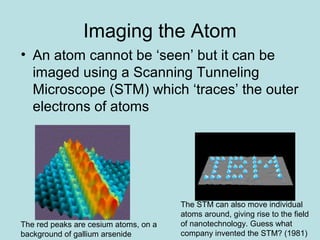
• An atom cannot be ‘seen’ but it can be 
imaged using a Scanning Tunneling 
Microscope (STM) which ‘traces’ the outer 
electrons of atoms 
The red peaks are cesium atoms, on a 
background of gallium arsenide 
The STM can also move individual 
atoms around, giving rise to the field 
of nanotechnology. Guess what 
company invented the STM? (1981)
• STM works by scanning an ultra­sharp 
metal tip across a surface. When a voltage 
is applied between the tip and the surface, 
electrons tunnel between the two, the 
tunneling current being proportional to the 
distance between the tip and surface 
features. In this way molecular features on 
the surface can be mapped 
–Royal Society of Chemistry
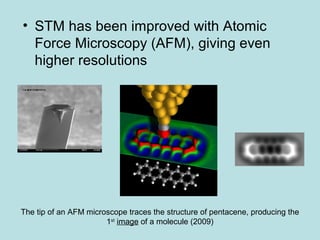
• STM has been improved with Atomic 
Force Microscopy (AFM), giving even 
higher resolutions 
The tip of an AFM microscope traces the structure of pentacene, producing the 
1st image of a molecule (2009)
The Scientific Method 
• Science is a process which we use to gain 
a better understanding of reality 
• We have improved upon our model of the 
atom over time 
• These changes continue to happen 
because of the scientific method
How the Scientific Method Works
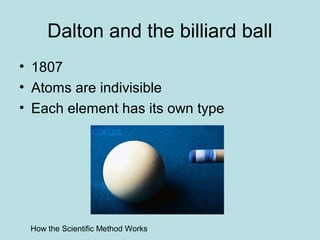
Dalton and the billiard ball 
• 1807 
• Atoms are indivisible 
• Each element has its own type 
How the Scientific Method Works
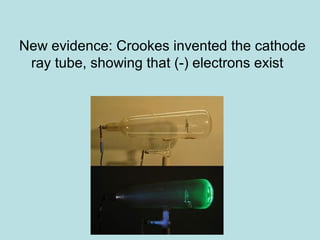
New evidence: Crookes invented the cathode 
ray tube, showing that (-) electrons exist
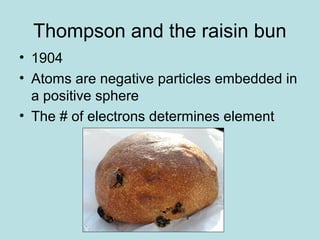
Thompson and the raisin bun 
• 1904 
• Atoms are negative particles embedded in 
a positive sphere 
• The # of electrons determines element
New evidence: Rutherford’s gold foil experiment 
showed that atoms ‘scatter’ alpha particles 
http://www.kcvs.ca/site/projects/physics_files/rutherford/historical_scattering.html
Rutherford and the nucleus 
• 1911 
• Geiger and Marsden shot alpha (+) 
particles at a piece of gold foil expecting 
them to go through 
• Some were deflected by something in the 
atom
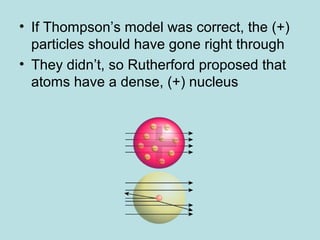
• If Thompson’s model was correct, the (+) 
particles should have gone right through 
• They didn’t, so Rutherford proposed that 
atoms have a dense, (+) nucleus
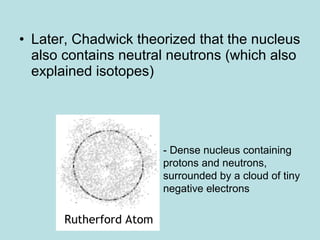
• Later, Chadwick theorized that the nucleus 
also contains neutral neutrons (which also 
explained isotopes) 
- Dense nucleus containing 
protons and neutrons, 
surrounded by a cloud of tiny 
negative electrons
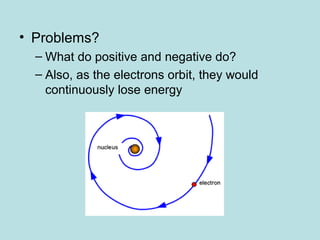
• Problems? 
– What do positive and negative do? 
– Also, as the electrons orbit, they would 
continuously lose energy
• If Rutherford’s model was correct, the 
electrons would spiral into the nucleus and 
matter could not exist 
• Clearly, it does. How?
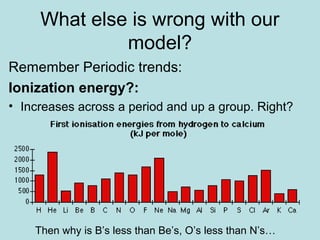
What else is wrong with our 
model? 
Remember Periodic trends: 
Ionization energy?: 
• Increases across a period and up a group. Right? 
Then why is B’s less than Be’s, O’s less than N’s…
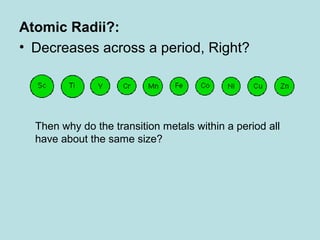
Atomic Radii?: 
• Decreases across a period, Right? 
Then why do the transition metals within a period all 
have about the same size?
• Pg. 166 
• Q. 3-8

Early Atomic Theory

  • 1.
    Early Atomic Theory If, in some cataclysm, all of scientific knowledge were to be de­stroyed, and only one sentence passed on to the next generations of creatures, what statement would contain the most information in the fewest words? I believe it is the atomic hypothesis (or the atomic fact, or whatever you wish to call it) that all things are made of atoms-little particles that move around in perpetual motion, attracting each other when they are a little distance apart, but repelling upon being squeezed into one another. In that one sentence, you will see, there is an enormous amount of information about the world, if just a little imagination and thinking are applied September 19, 2014 Bill Bryson’s Brief History of Nearly Everything,
  • 2.
    Imaging the Atom • An atom cannot be ‘seen’ but it can be imaged using a Scanning Tunneling Microscope (STM) which ‘traces’ the outer electrons of atoms The red peaks are cesium atoms, on a background of gallium arsenide The STM can also move individual atoms around, giving rise to the field of nanotechnology. Guess what company invented the STM? (1981)
  • 3.
    • STM worksby scanning an ultra­sharp metal tip across a surface. When a voltage is applied between the tip and the surface, electrons tunnel between the two, the tunneling current being proportional to the distance between the tip and surface features. In this way molecular features on the surface can be mapped –Royal Society of Chemistry
  • 4.
    • STM hasbeen improved with Atomic Force Microscopy (AFM), giving even higher resolutions The tip of an AFM microscope traces the structure of pentacene, producing the 1st image of a molecule (2009)
  • 5.
    The Scientific Method • Science is a process which we use to gain a better understanding of reality • We have improved upon our model of the atom over time • These changes continue to happen because of the scientific method
  • 6.
    How the ScientificMethod Works
  • 7.
    Dalton and thebilliard ball • 1807 • Atoms are indivisible • Each element has its own type How the Scientific Method Works
  • 8.
    New evidence: Crookesinvented the cathode ray tube, showing that (-) electrons exist
  • 9.
    Thompson and theraisin bun • 1904 • Atoms are negative particles embedded in a positive sphere • The # of electrons determines element
  • 10.
    New evidence: Rutherford’sgold foil experiment showed that atoms ‘scatter’ alpha particles http://www.kcvs.ca/site/projects/physics_files/rutherford/historical_scattering.html
  • 11.
    Rutherford and thenucleus • 1911 • Geiger and Marsden shot alpha (+) particles at a piece of gold foil expecting them to go through • Some were deflected by something in the atom
  • 12.
    • If Thompson’smodel was correct, the (+) particles should have gone right through • They didn’t, so Rutherford proposed that atoms have a dense, (+) nucleus
  • 13.
    • Later, Chadwicktheorized that the nucleus also contains neutral neutrons (which also explained isotopes) - Dense nucleus containing protons and neutrons, surrounded by a cloud of tiny negative electrons
  • 14.
    • Problems? –What do positive and negative do? – Also, as the electrons orbit, they would continuously lose energy
  • 15.
    • If Rutherford’smodel was correct, the electrons would spiral into the nucleus and matter could not exist • Clearly, it does. How?
  • 16.
    What else iswrong with our model? Remember Periodic trends: Ionization energy?: • Increases across a period and up a group. Right? Then why is B’s less than Be’s, O’s less than N’s…
  • 17.
    Atomic Radii?: •Decreases across a period, Right? Then why do the transition metals within a period all have about the same size?
  • 18.
    • Pg. 166 • Q. 3-8