Periodic Table of Elements
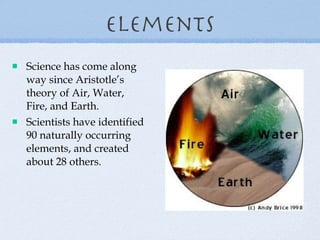
Elements Science has come along way since Aristotle’s theory of Air, Water, Fire, and Earth. Scientists have identified 90 naturally occurring elements, and created about 28 others.
 
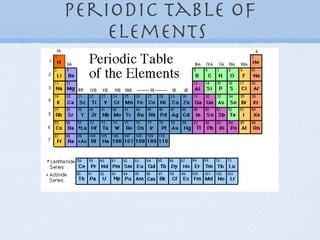
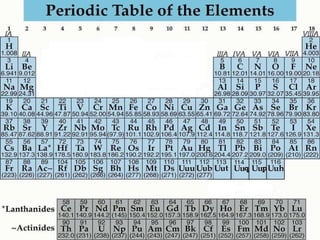
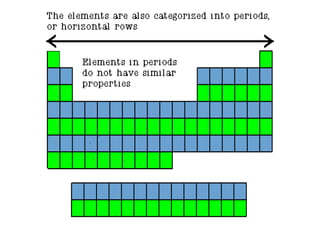
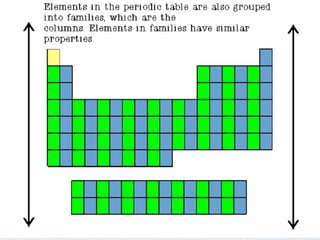
Groups  Periods Columns of elements are called groups or families.  Elements in each family have similar but not identical properties. All elements in a family have the same number of valence electrons. Each horizontal row of elements is called a period. The elements in a period are not alike in properties. The first element in a period is always an extremely active solid. The last element in a period, is always an inactive gas. Have the same number of energy levels.


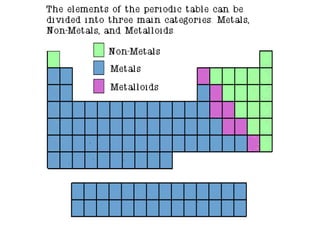
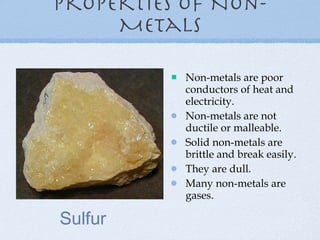
Properties of Non-Metals Non-metals are poor conductors of heat and electricity. Non-metals are not ductile or malleable. Solid non-metals are brittle and break easily. They are dull. Many non-metals are gases. Sulfur
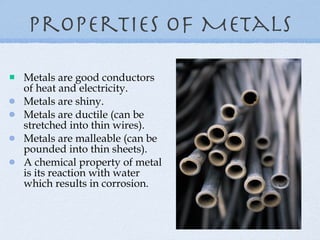
Properties of Metals Metals are good conductors of heat and electricity. Metals are shiny. Metals are ductile (can be stretched into thin wires). Metals are malleable (can be pounded into thin sheets). A chemical property of metal is its reaction with water which results in corrosion.
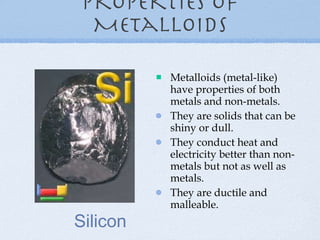
Properties of Metalloids Metalloids (metal-like) have properties of both metals and non-metals. They are solids that can be shiny or dull. They conduct heat and electricity better than non-metals but not as well as metals. They are ductile and malleable. Silicon
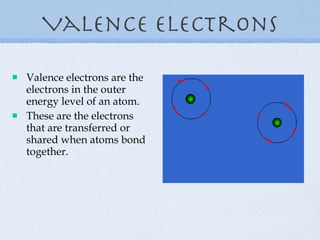
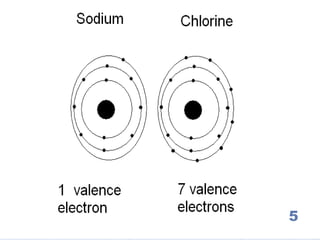
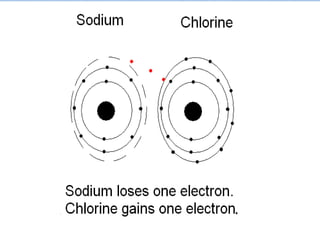
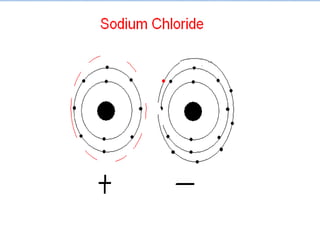
Valence Electrons Valence electrons are the electrons in the outer energy level of an atom. These are the electrons that are transferred or shared when atoms bond together.
5
 
 
What does it mean to be reactive? Elements that are reactive bond easily with other elements to make compounds. What makes an element reactive? An incomplete valence electron level. All atoms (except hydrogen) want to have 8 electrons in their very outermost energy level (This is called the rule of octet.) Atoms bond until this level is complete. Atoms with few valence electrons lose them during bonding. Atoms with 6, 7, or 8 valence electrons gain electrons during bonding.

Periodic table

  • 1.
  • 2.
    Elements Science hascome along way since Aristotle’s theory of Air, Water, Fire, and Earth. Scientists have identified 90 naturally occurring elements, and created about 28 others.
  • 3.
  • 4.
    Groups PeriodsColumns of elements are called groups or families. Elements in each family have similar but not identical properties. All elements in a family have the same number of valence electrons. Each horizontal row of elements is called a period. The elements in a period are not alike in properties. The first element in a period is always an extremely active solid. The last element in a period, is always an inactive gas. Have the same number of energy levels.
  • 5.
  • 6.
  • 7.
  • 8.
    Properties of Non-MetalsNon-metals are poor conductors of heat and electricity. Non-metals are not ductile or malleable. Solid non-metals are brittle and break easily. They are dull. Many non-metals are gases. Sulfur
  • 9.
    Properties of MetalsMetals are good conductors of heat and electricity. Metals are shiny. Metals are ductile (can be stretched into thin wires). Metals are malleable (can be pounded into thin sheets). A chemical property of metal is its reaction with water which results in corrosion.
  • 10.
    Properties of MetalloidsMetalloids (metal-like) have properties of both metals and non-metals. They are solids that can be shiny or dull. They conduct heat and electricity better than non-metals but not as well as metals. They are ductile and malleable. Silicon
  • 11.
    Valence Electrons Valenceelectrons are the electrons in the outer energy level of an atom. These are the electrons that are transferred or shared when atoms bond together.
  • 12.
  • 13.
  • 14.
  • 15.
    What does itmean to be reactive? Elements that are reactive bond easily with other elements to make compounds. What makes an element reactive? An incomplete valence electron level. All atoms (except hydrogen) want to have 8 electrons in their very outermost energy level (This is called the rule of octet.) Atoms bond until this level is complete. Atoms with few valence electrons lose them during bonding. Atoms with 6, 7, or 8 valence electrons gain electrons during bonding.