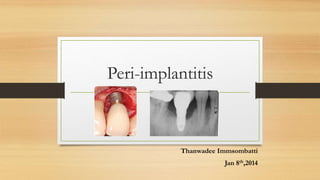
Peri-implantitis
Thanwadee Immsombatti
Jan 8th,2014
Background
• Peri-implant disease : An inflammatory reaction around the tissue
surrounding an implant consist of two forms
• Peri-implant mucositis
• Peri-implantitis
Mombelli A. et al. Periodontol 2000 1998;17:63-76.
The Sixth European Workshop on Periodontoloy 2008
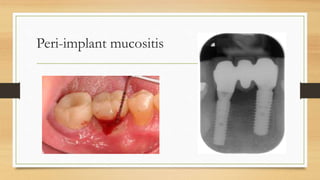
Peri-implant mucositis
• The presence of inflammation
• Confine to the soft tissue
• No signs of loss of supporting bone following initial bone remodeling
• Reversible condition : early intervention and remove etiology
San M. et al. J Clin Periodontol 2012;39(Suppl.12):202-206.
Peri-implant mucositis
• Clinical findings
• Bleeding on probing / gingival redness
• Probing depth ≥ 4 mm
• No radiographic bone loss
• Prevalence : 48% of implants
San M. et al. J Clin Periodontol 2012;39(Suppl.12):202-206.
Roos-Jansaker AM. J Clin Periodontol 2006;33:290-295.
Peri-implant mucositis
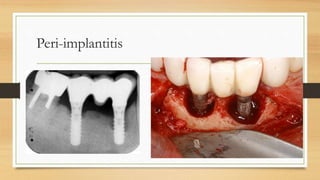
Peri-implantitis
• An inflammatory process
• Soft tissue inflammation, Bleeding on probing
• Probing depth ≥ 5 mm
• Suppuration
• Progressive loss of supporting bone beyond biological bone remodeling
• Mean crestal bone loss of 0.9-1.6 mm in first post-surgical year
• Then annual bone loss of 0.02-0.15 mm
• In case of no baseline radiograph, 2 mm vertical distance from expected marginal bone level
• Prevalence : varied from 11%-47% depending on the threshold used
Peri-implantitis
Koldlands OC. et al. J Periodontol 2010;81:231-238.
San M. et al. J Clin Periodontol 2012;39(Suppl.12):202-206.
Peri-implantitis
Etiologies
• Formation of biofilm
• Gram-negative anaerobic bacteria : similar to natural teeth in periodontal
disease
• Peri-implant mucositis – Gingivitis
• Peri-implantitis – Periodontitis : S.aureus could be found as the initiation of peri-
implantitis
Heit-Mayfield LJ. et al. Periodontol 2000 2010;53:167-181.
Leohardt A. et al. Clin Oral Implants Res 1999;10:399-345.
Factors associated Peri-implantitis
• History of periodontitis : two times
• Smoking : 3-4 times increased risk for peri-implantitis
• Residual cement : Rough area beneath gingival margin  Bacterial
attachment
• Implant position and design : inability to clean
Mombelli A. et al. Clin Oral Implants Res 2012;23(Suppl.6):67-76.
Linkevicius T. et al. Clin Oral Implants Res 2012 published online
Treatment
• Primary goals
• Resolve inflammation
• Arrest the progression of disease
Treatment
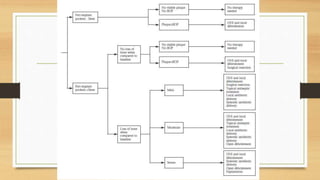
Non-Surgical treatment
• Mechanical debridement
• Ultrasonic scaler
• Hand instruments : Plastic curette
• Rubber cup & pumice
• Plaque control
• Effective in Peri-implant mucositis
• carbon fibers curette, rubber cup, pumice
• In peri-implantitis, mechanical debridement alone was found not to be
effective
Non-Surgical treatment
• Use in conjunction with mechanical debridement and chemical disinfection
• Local : high concentration, reduce side & adverse effect
• Tetracyclin HCL (Actisite® )
• Minocyclin
• Systemic : ornidazole 1000 mg daily, metronidazole, amoxicillin
Antibiotic
Antibiotic
Surgical approach
• Surgical approach
• Access surgery : apically positioned flap, surface modification
• Resective
• Regenerative : guided tissue regeneration, bone grafting
• Surface decontamination
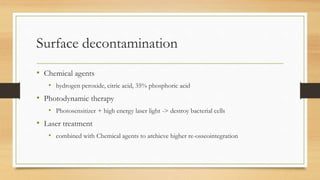
Surface decontamination
• Chemical agents
• hydrogen peroxide, citric acid, 35% phosphoric acid
• Photodynamic therapy
• Photosensitizer + high energy laser light -> destroy bacterial cells
• Laser treatment
• combined with Chemical agents to archieve higher re-osseointegration
Anti-infective protocol
• Peri-implantitis VS Periodontitis
• Eiology
• Treatment
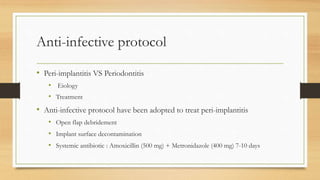
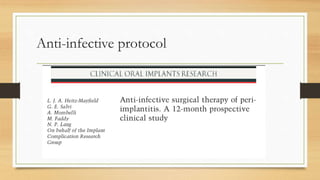
• Anti-infective protocol have been adopted to treat peri-implantitis
• Open flap debridement
• Implant surface decontamination
• Systemic antibiotic : Amoxicillin (500 mg) + Metronidazole (400 mg) 7-10 days
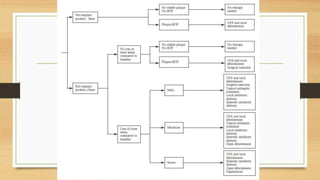
Anti-infective protocol
Conclusions
• Non-surgical treatment alone was found to be effective in peri-implant
mucositis : carbon fibers curette, rubber cup, pumice
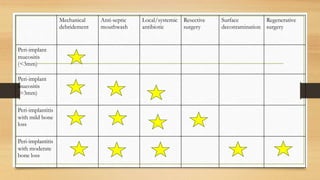
• Peri-implantitis with mild bone loss : Mechanical debridement,
Antiseptic(CHX mouthwash), Systemic/Local Antibiotic, Resective surgery
• Peri-implantitis with moderate bone loss : Mechanical debridement,
Antiseptic(CHX mouthwash), Systemic/Local Antibiotic, Open flap
debridement, Surface decontamination, Regenerative surgery
Mechanical
debridement
Anti-septic
mouthwash
Local/systemic
antibiotic
Resective
surgery
Surface
decontamination
Regenerative
surgery
Peri-implant
mucositis
(<3mm)
Peri-implant
mucositis
(>3mm)
Peri-implantitis
with mild bone
loss
Peri-implantitis
with moderate
bone loss
Conclusions
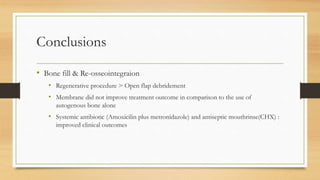
• Bone fill & Re-osseointegraion
• Regenerative procedure > Open flap debridement
• Membrane did not improve treatment outcome in comparison to the use of
autogenous bone alone
• Systemic antibiotic (Amoxicilin plus metronidazole) and antiseptic mouthrinse(CHX) :
improved clinical outcomes
Conclusions
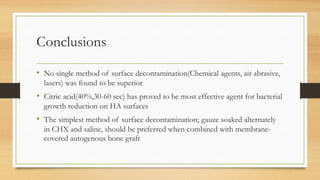
• No single method of surface decontamination(Chemical agents, air abrasive,
lasers) was found to be superior
• Citric acid(40%,30-60 sec) has proved to be most effective agent for bacterial
growth reduction on HA surfaces
• The simplest method of surface decontamination; gauze soaked alternately
in CHX and saline, should be preferred when combined with membrane-
covered autogenous bone graft

Peri implantitis

  • 1.
  • 2.
    Background • Peri-implant disease: An inflammatory reaction around the tissue surrounding an implant consist of two forms • Peri-implant mucositis • Peri-implantitis Mombelli A. et al. Periodontol 2000 1998;17:63-76. The Sixth European Workshop on Periodontoloy 2008
  • 3.
    Peri-implant mucositis • Thepresence of inflammation • Confine to the soft tissue • No signs of loss of supporting bone following initial bone remodeling • Reversible condition : early intervention and remove etiology San M. et al. J Clin Periodontol 2012;39(Suppl.12):202-206.
  • 4.
    Peri-implant mucositis • Clinicalfindings • Bleeding on probing / gingival redness • Probing depth ≥ 4 mm • No radiographic bone loss • Prevalence : 48% of implants San M. et al. J Clin Periodontol 2012;39(Suppl.12):202-206. Roos-Jansaker AM. J Clin Periodontol 2006;33:290-295.
  • 5.
  • 6.
    Peri-implantitis • An inflammatoryprocess • Soft tissue inflammation, Bleeding on probing • Probing depth ≥ 5 mm • Suppuration
  • 7.
    • Progressive lossof supporting bone beyond biological bone remodeling • Mean crestal bone loss of 0.9-1.6 mm in first post-surgical year • Then annual bone loss of 0.02-0.15 mm • In case of no baseline radiograph, 2 mm vertical distance from expected marginal bone level • Prevalence : varied from 11%-47% depending on the threshold used Peri-implantitis Koldlands OC. et al. J Periodontol 2010;81:231-238. San M. et al. J Clin Periodontol 2012;39(Suppl.12):202-206.
  • 8.
  • 9.
    Etiologies • Formation ofbiofilm • Gram-negative anaerobic bacteria : similar to natural teeth in periodontal disease • Peri-implant mucositis – Gingivitis • Peri-implantitis – Periodontitis : S.aureus could be found as the initiation of peri- implantitis Heit-Mayfield LJ. et al. Periodontol 2000 2010;53:167-181. Leohardt A. et al. Clin Oral Implants Res 1999;10:399-345.
  • 10.
    Factors associated Peri-implantitis •History of periodontitis : two times • Smoking : 3-4 times increased risk for peri-implantitis • Residual cement : Rough area beneath gingival margin  Bacterial attachment • Implant position and design : inability to clean Mombelli A. et al. Clin Oral Implants Res 2012;23(Suppl.6):67-76. Linkevicius T. et al. Clin Oral Implants Res 2012 published online
  • 11.
    Treatment • Primary goals •Resolve inflammation • Arrest the progression of disease
  • 12.
  • 14.
    Non-Surgical treatment • Mechanicaldebridement • Ultrasonic scaler • Hand instruments : Plastic curette • Rubber cup & pumice • Plaque control
  • 16.
    • Effective inPeri-implant mucositis • carbon fibers curette, rubber cup, pumice • In peri-implantitis, mechanical debridement alone was found not to be effective Non-Surgical treatment
  • 17.
    • Use inconjunction with mechanical debridement and chemical disinfection • Local : high concentration, reduce side & adverse effect • Tetracyclin HCL (Actisite® ) • Minocyclin • Systemic : ornidazole 1000 mg daily, metronidazole, amoxicillin Antibiotic
  • 18.
  • 19.
    Surgical approach • Surgicalapproach • Access surgery : apically positioned flap, surface modification • Resective • Regenerative : guided tissue regeneration, bone grafting • Surface decontamination
  • 22.
    Surface decontamination • Chemicalagents • hydrogen peroxide, citric acid, 35% phosphoric acid • Photodynamic therapy • Photosensitizer + high energy laser light -> destroy bacterial cells • Laser treatment • combined with Chemical agents to archieve higher re-osseointegration
  • 25.
    Anti-infective protocol • Peri-implantitisVS Periodontitis • Eiology • Treatment • Anti-infective protocol have been adopted to treat peri-implantitis • Open flap debridement • Implant surface decontamination • Systemic antibiotic : Amoxicillin (500 mg) + Metronidazole (400 mg) 7-10 days
  • 26.
  • 28.
    Conclusions • Non-surgical treatmentalone was found to be effective in peri-implant mucositis : carbon fibers curette, rubber cup, pumice • Peri-implantitis with mild bone loss : Mechanical debridement, Antiseptic(CHX mouthwash), Systemic/Local Antibiotic, Resective surgery • Peri-implantitis with moderate bone loss : Mechanical debridement, Antiseptic(CHX mouthwash), Systemic/Local Antibiotic, Open flap debridement, Surface decontamination, Regenerative surgery
  • 29.
  • 30.
    Conclusions • Bone fill& Re-osseointegraion • Regenerative procedure > Open flap debridement • Membrane did not improve treatment outcome in comparison to the use of autogenous bone alone • Systemic antibiotic (Amoxicilin plus metronidazole) and antiseptic mouthrinse(CHX) : improved clinical outcomes
  • 31.
    Conclusions • No singlemethod of surface decontamination(Chemical agents, air abrasive, lasers) was found to be superior • Citric acid(40%,30-60 sec) has proved to be most effective agent for bacterial growth reduction on HA surfaces • The simplest method of surface decontamination; gauze soaked alternately in CHX and saline, should be preferred when combined with membrane- covered autogenous bone graft