


A Frustrating Disease in
        Cardiology

Cases and Treatment Options
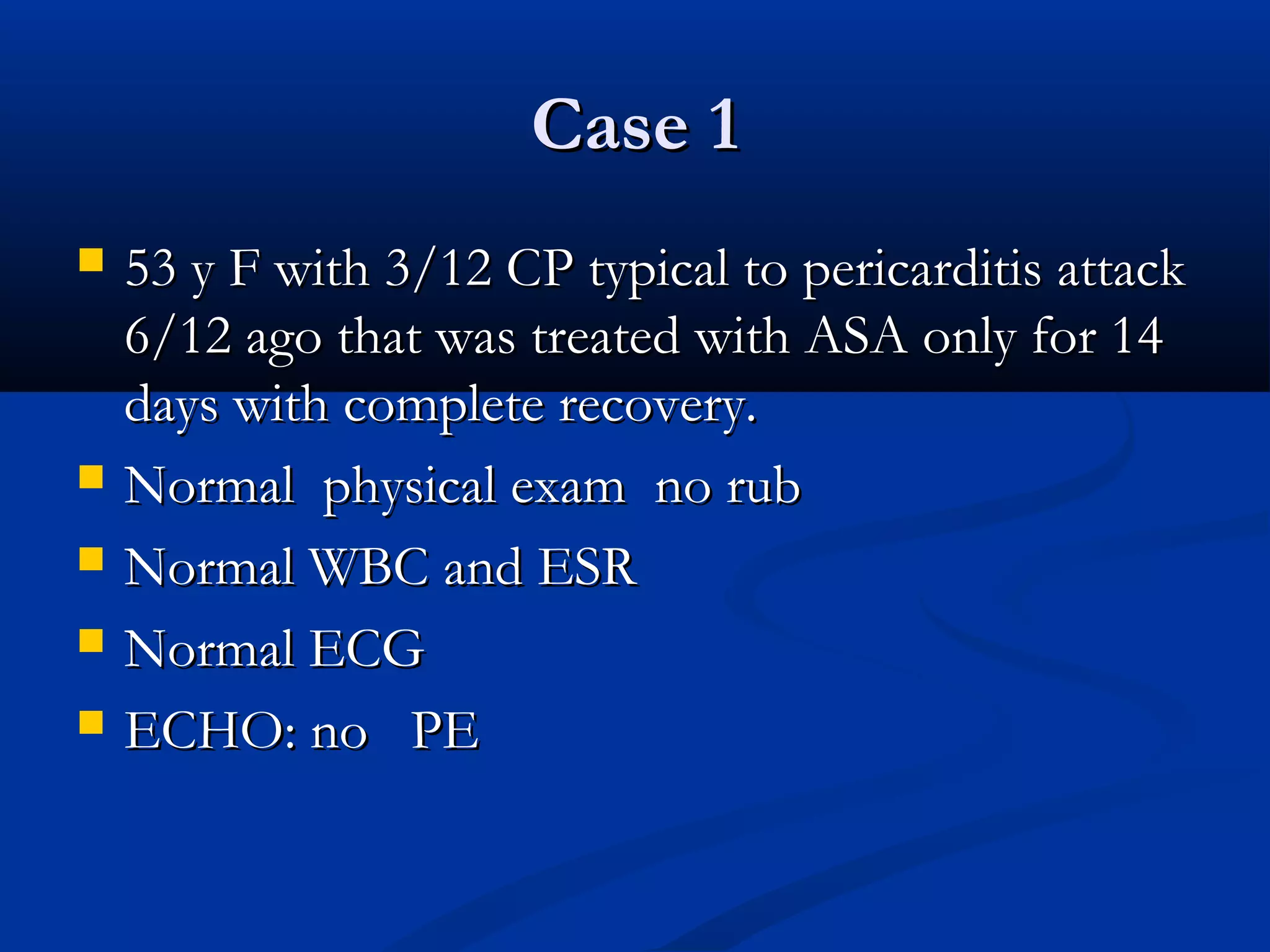
Case 1
   53 y F with 3/12 CP typical to pericarditis attack
    6/12 ago that was treated with ASA only for 14
    days with complete recovery.
   Normal physical exam no rub
   Normal WBC and ESR
   Normal ECG
   ECHO: no PE
Does she have recurrent
     pericarditis?
   How would you treat her?
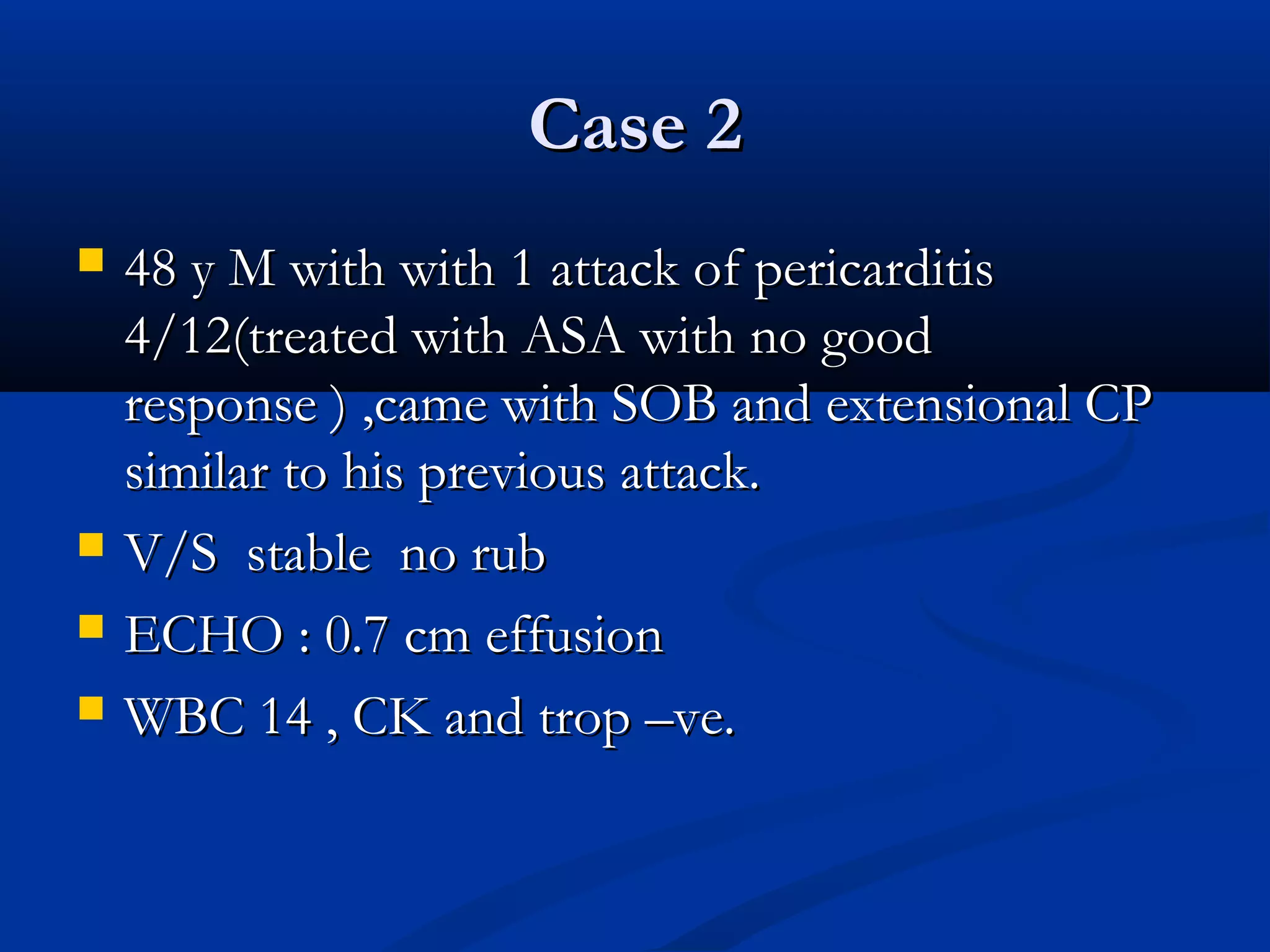
Case 2
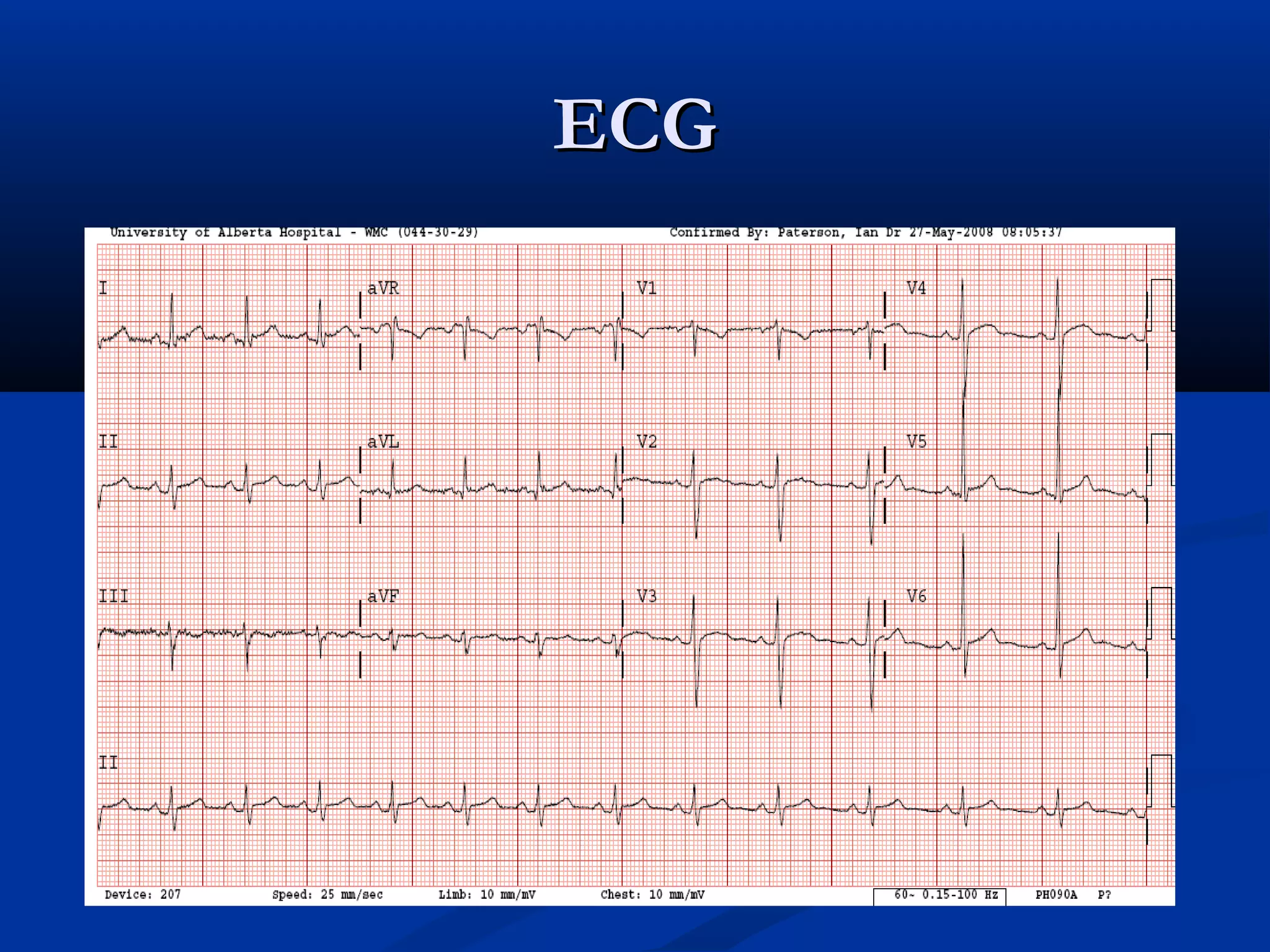
   48 y M with with 1 attack of pericarditis
    4/12(treated with ASA with no good
    response ) ,came with SOB and extensional CP
    similar to his previous attack.
   V/S stable no rub
   ECHO : 0.7 cm effusion
   WBC 14 , CK and trop –ve.
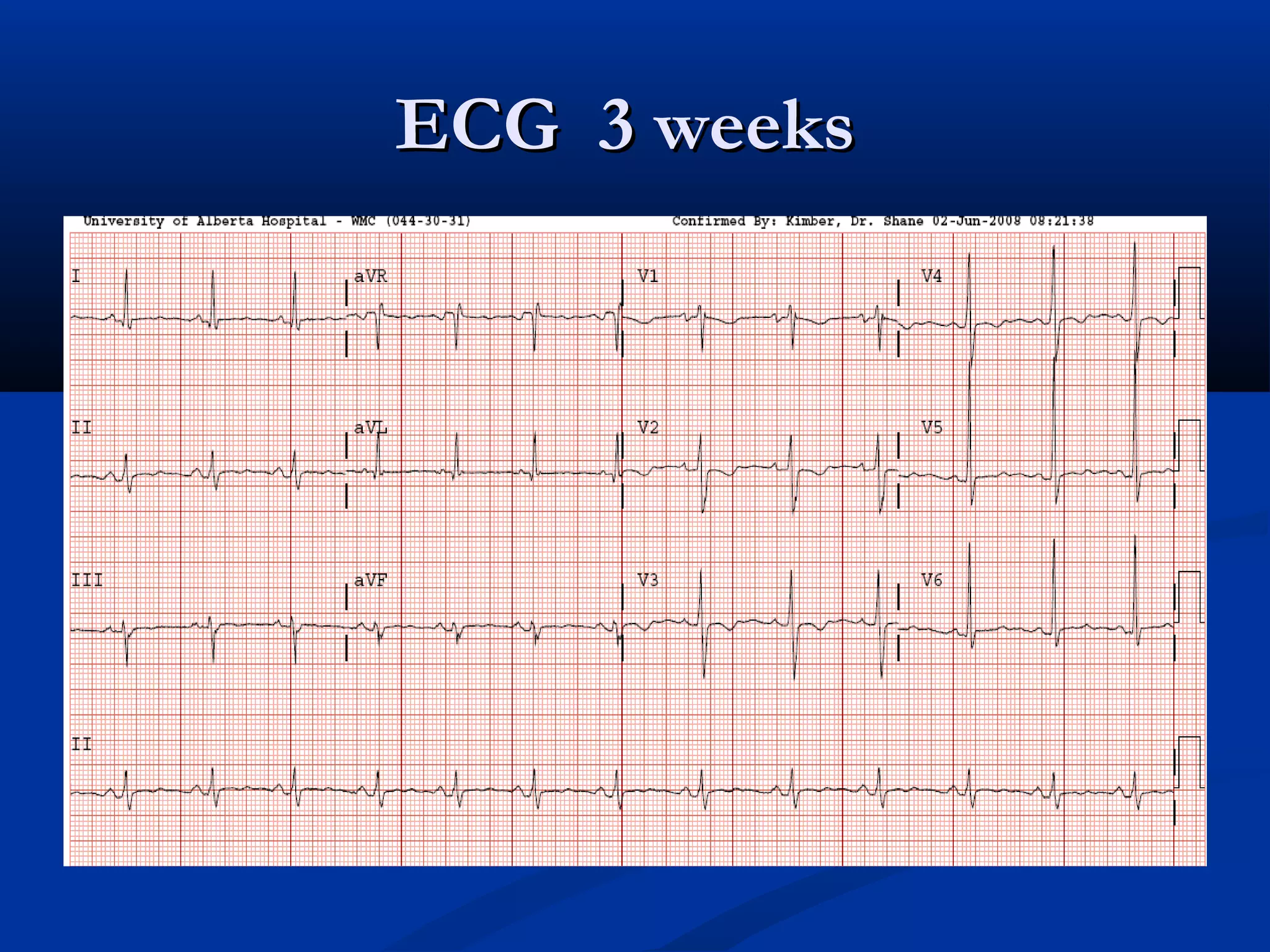
ECG
How would you treat him ?
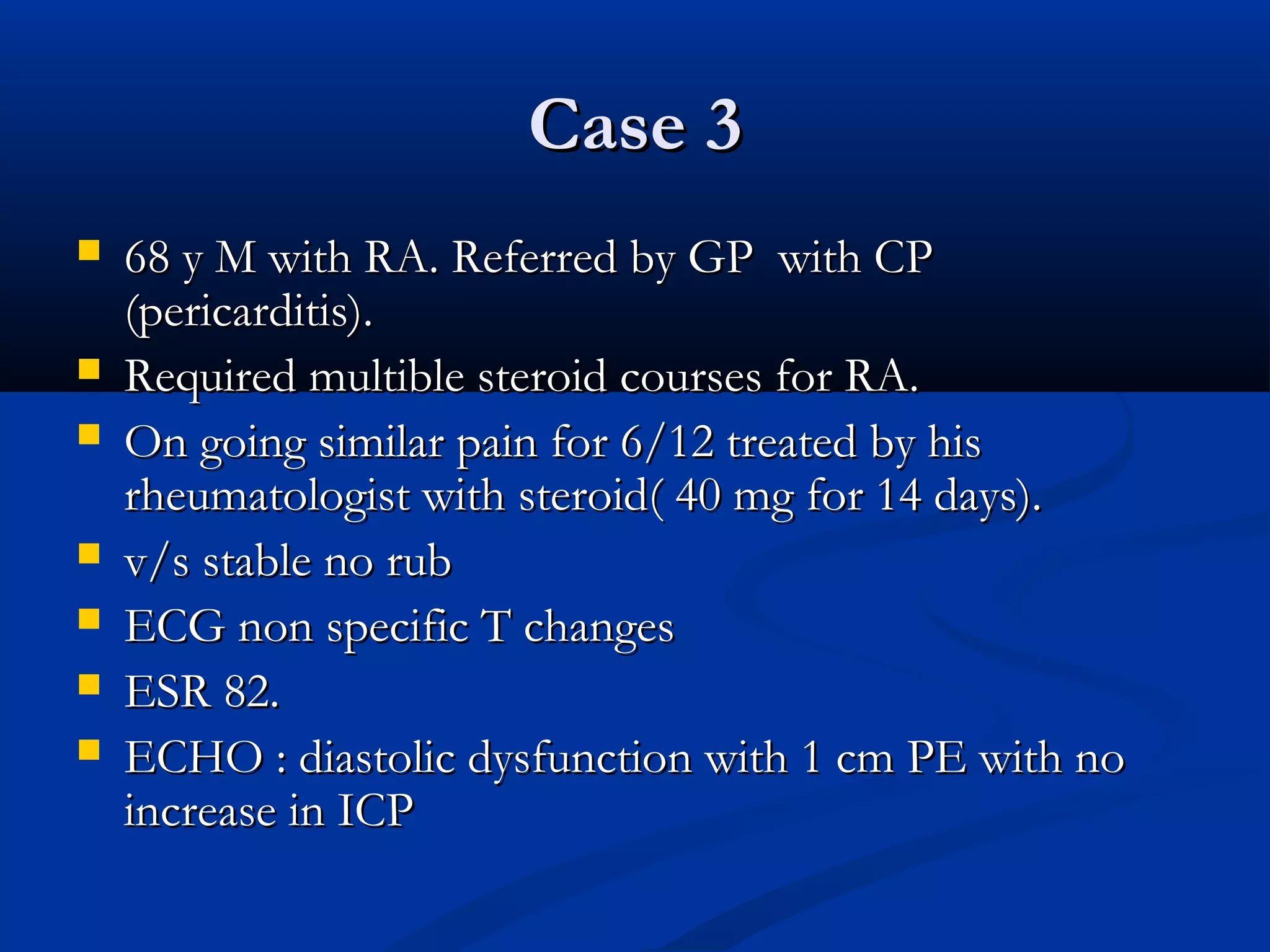
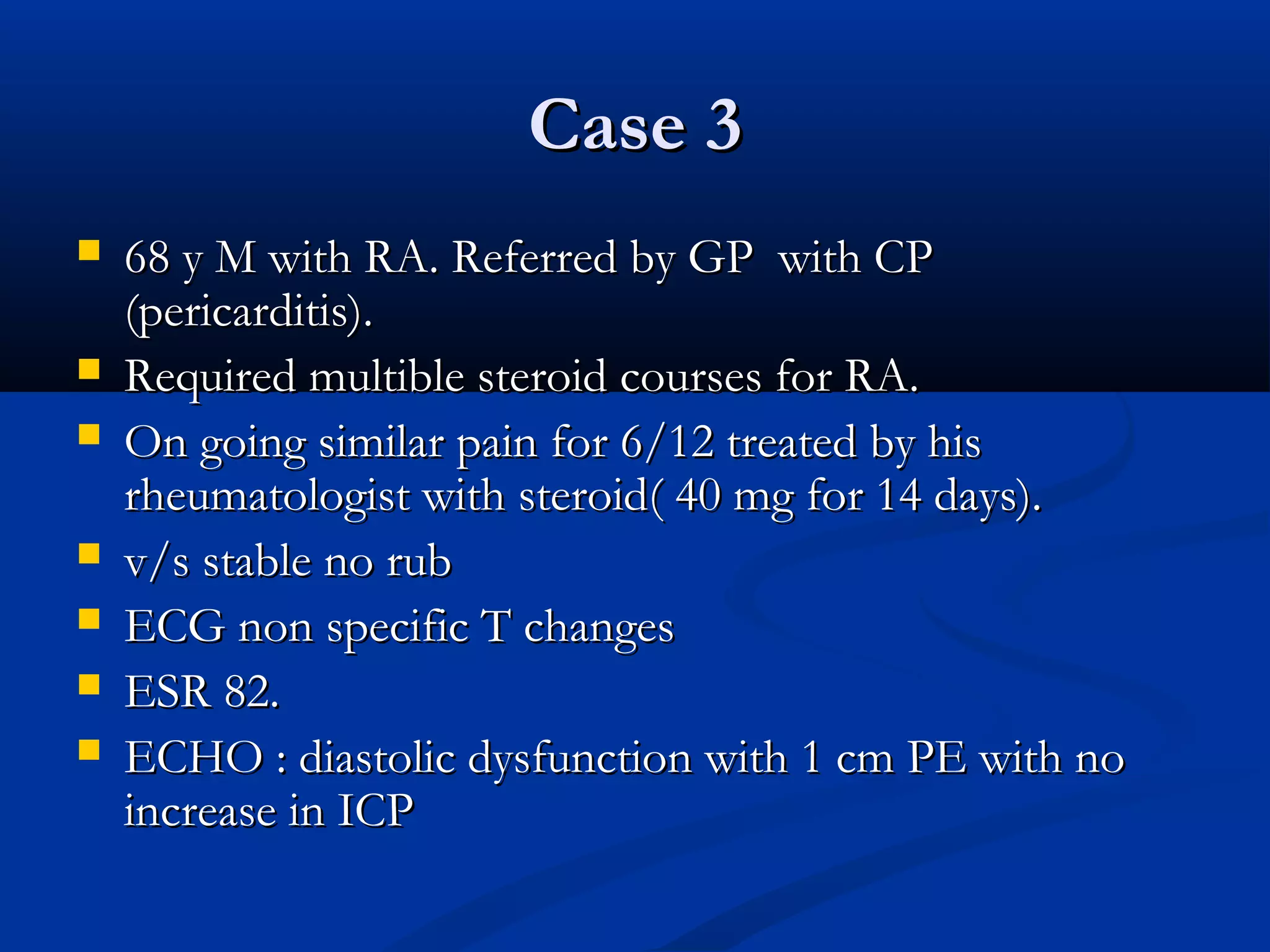
Case 3
   68 y M with RA. Referred by GP with CP
    (pericarditis).
   Required multible steroid courses for RA.
   On going similar pain for 6/12 treated by his
    rheumatologist with steroid( 40 mg for 14 days).
   v/s stable no rub
   ECG non specific T changes
   ESR 82.
   ECHO : diastolic dysfunction with 1 cm PE with no
    increase in ICP
How would you treat him ?
Recurrent Pericarditis
                    Objectives

   How to make the diagnosis?
   How is at risk?
   Prognosis
   Treatment options
   Guideline
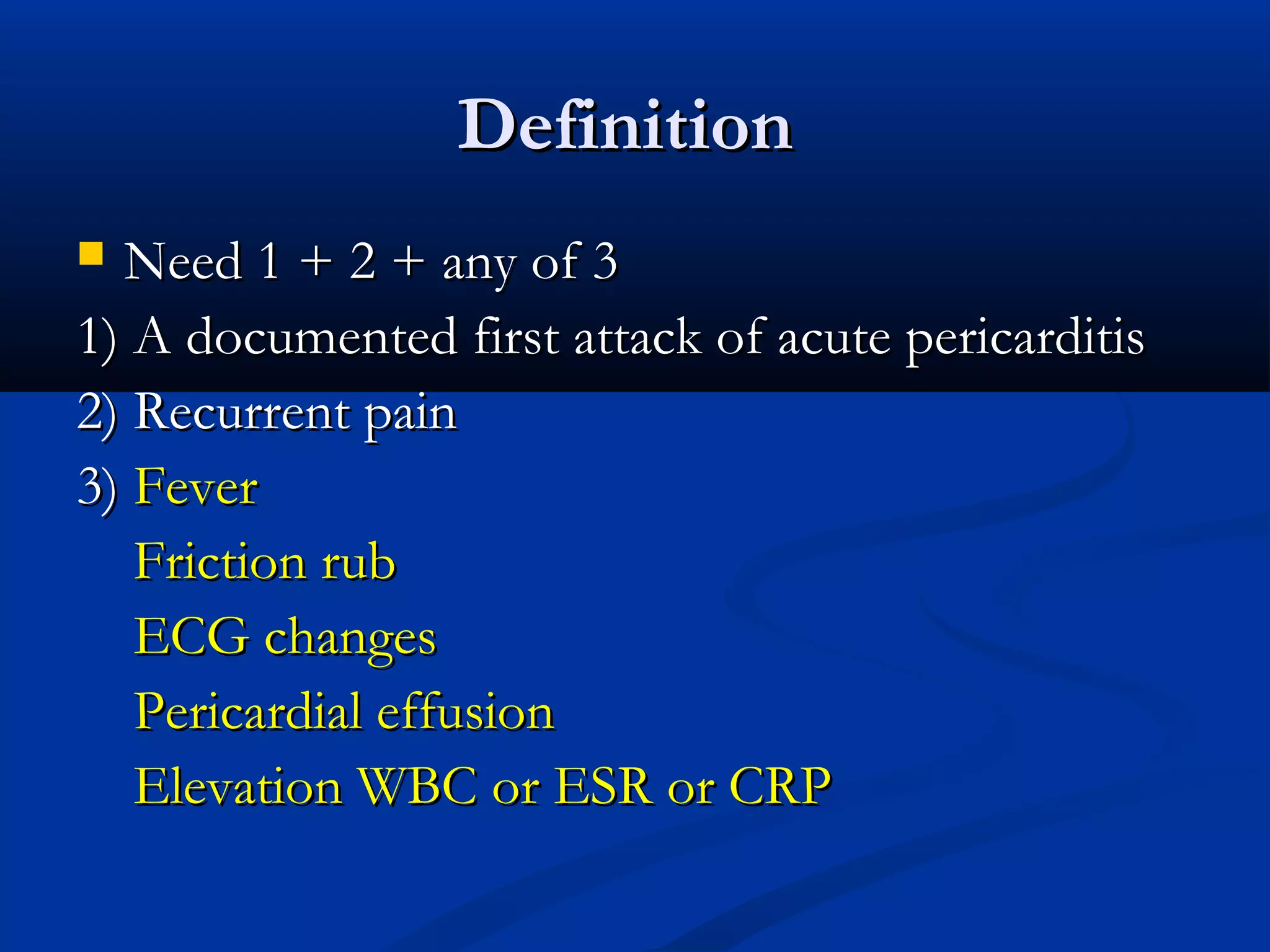
Definition
 Need 1 + 2 + any of 3
1) A documented first attack of acute pericarditis
2) Recurrent pain
3) Fever
   Friction rub
   ECG changes
   Pericardial effusion
   Elevation WBC or ESR or CRP
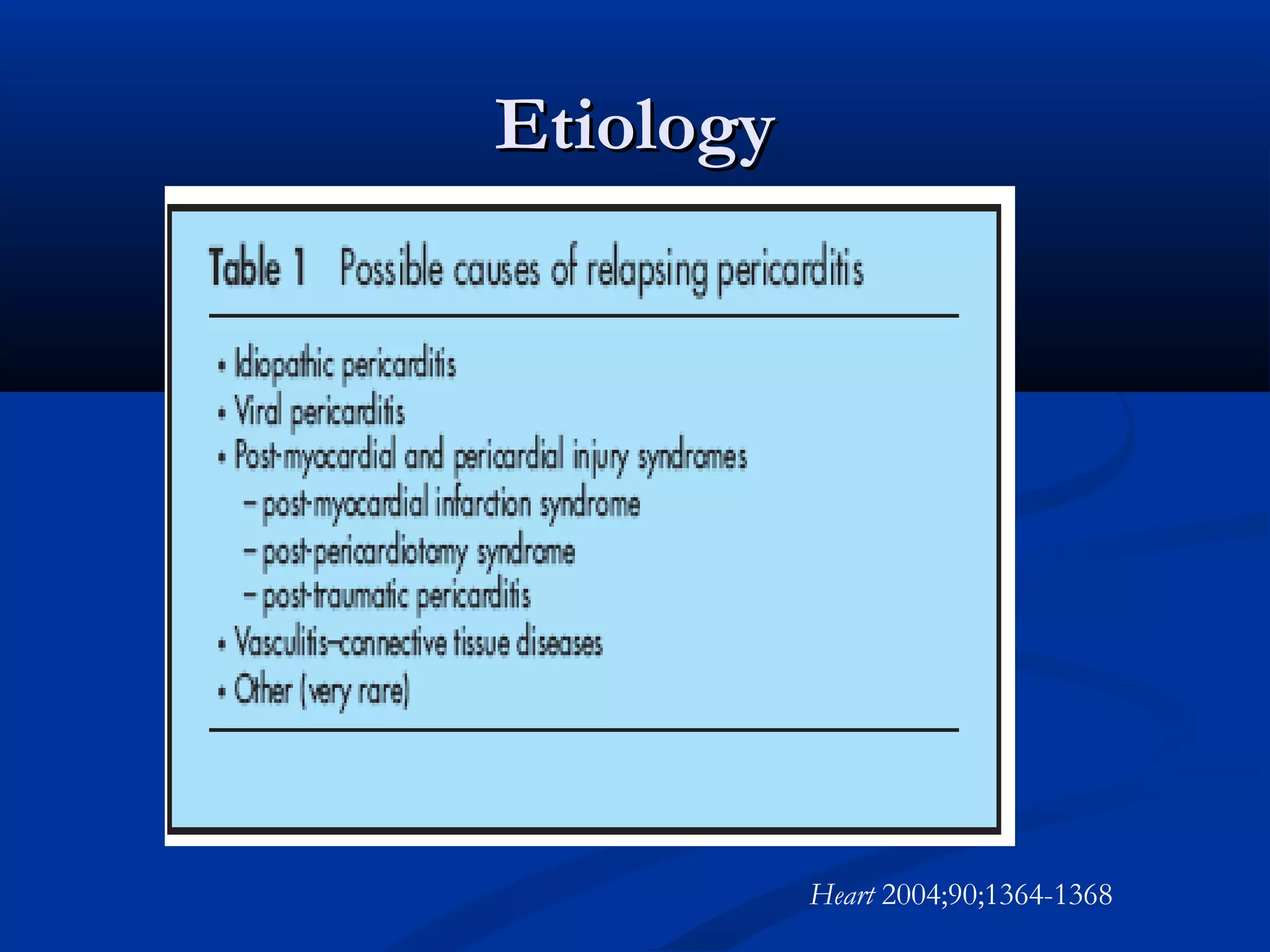
Etiology


           Heart 2004;90;1364-1368
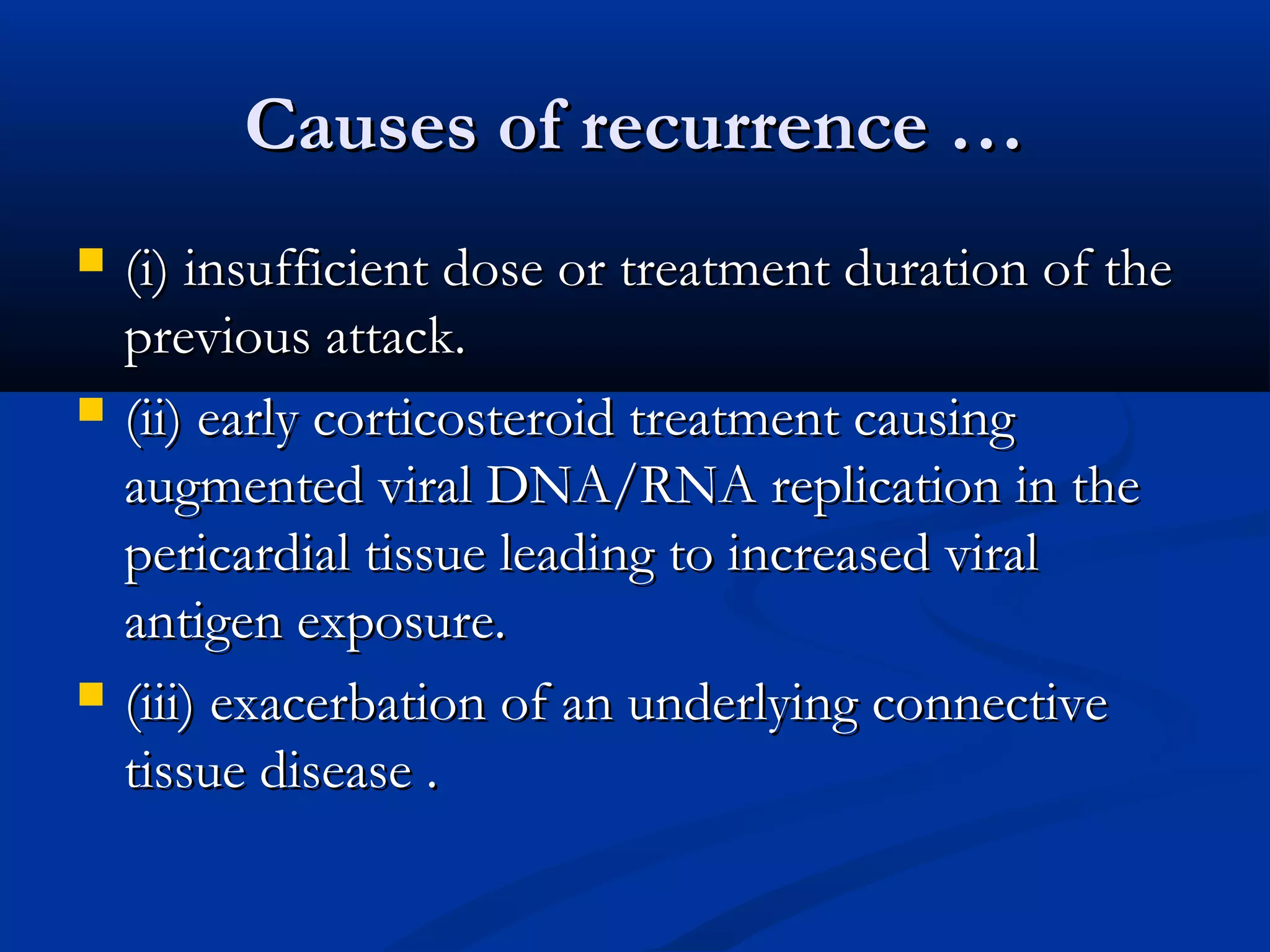
Causes of recurrence …
   (i) insufficient dose or treatment duration of the
    previous attack.
   (ii) early corticosteroid treatment causing
    augmented viral DNA/RNA replication in the
    pericardial tissue leading to increased viral
    antigen exposure.
   (iii) exacerbation of an underlying connective
    tissue disease .
Work up …
   Often negative
   Not recommended to consider routine
    pericardial tap for diagnostic purpose
   Work up for infectious and or CT causes are
    guided by clinical picture


                        Mayo Clin Proc 2002 Jan;77(1):39-43
                        Am J Cardiol. 2006 Jul 15;98(2):267-71
                        Am J Cardiol 2005 Sep 1;96(5):736-9
Course and types
   The first symptoms of recurrent pericarditis occur at a
    variable time after the initial attack, but usually within
    18 to 20 months.

1)The intermittent form, symptoms start after a symptom-
  free interval longer than six weeks after drug
  withdrawal .
2)The incessant form, symptoms appear within six weeks
  after drug discontinuation or during attempted
  weaning.
Symptoms

   The most frequent symptom of recurrent
    pericarditis is chest pain.
   Typically sharp improve with sitting
   Mimic angina (exertional) once chronic .
Answer this ..
   ………. is the most common cause of SOB in patients
    with recurrent pericarditis .

   A) Tamponade
   B) Constrictive pericarditis
   C) All of above
   D) Non of the above


                    Answer is D
Complications
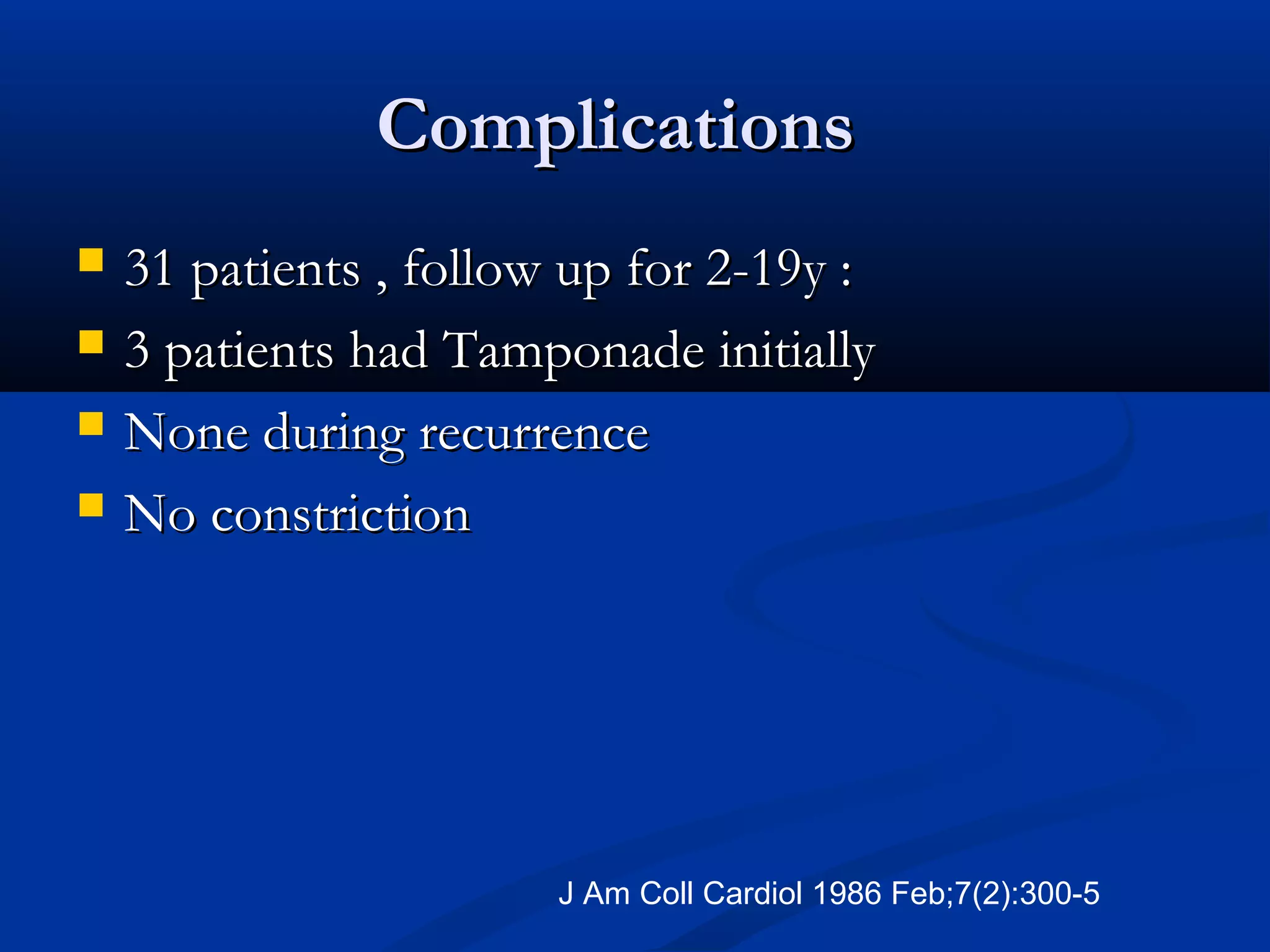
   31 patients , follow up for 2-19y :
   3 patients had Tamponade initially
   None during recurrence
   No constriction


                        J Am Coll Cardiol 1986 Feb;7(2):300-5
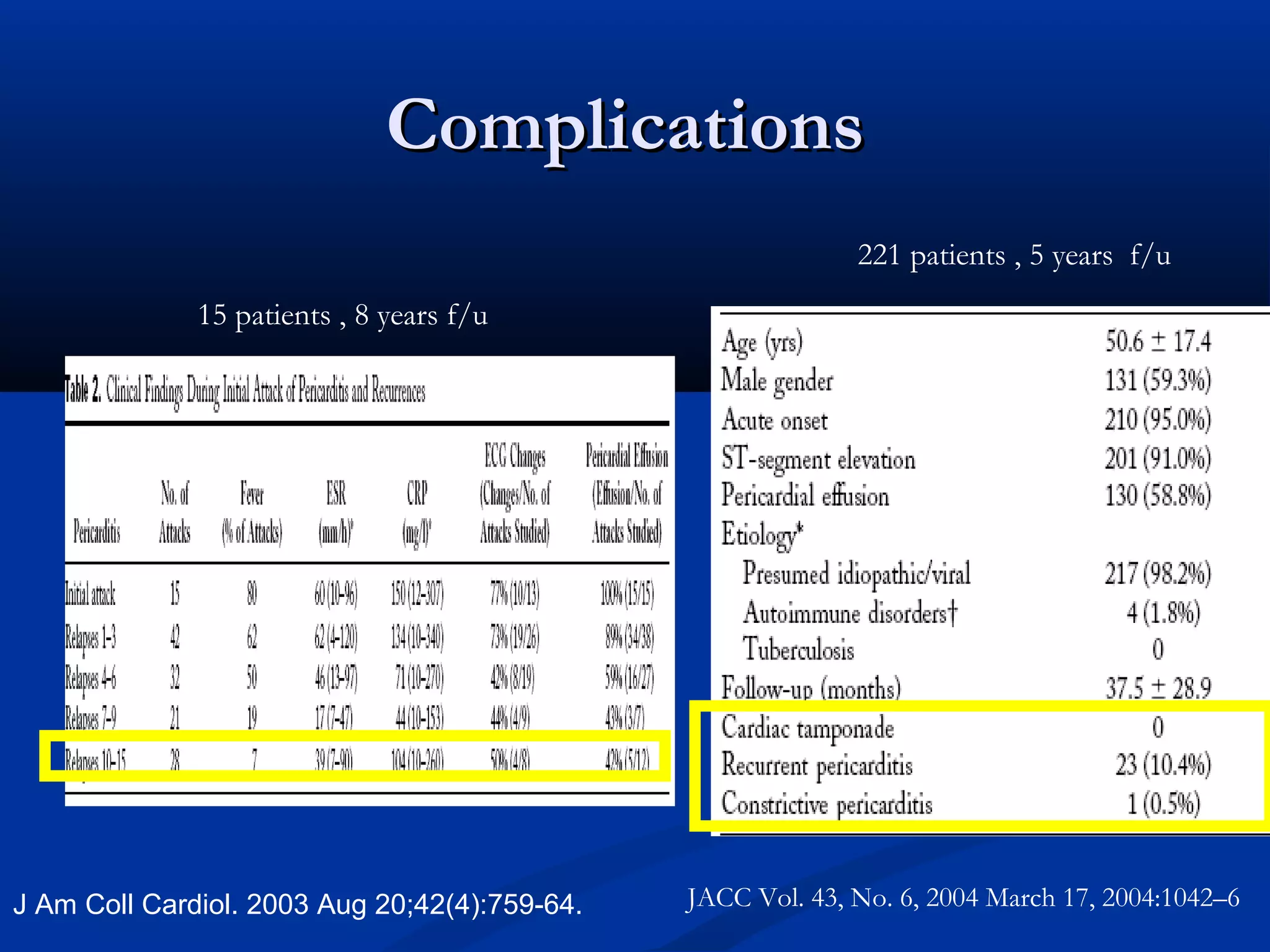
Complications
                                                             221 patients , 5 years f/u
              15 patients , 8 years f/u


J Am Coll Cardiol. 2003 Aug 20;42(4):759-64.   JACC Vol. 43, No. 6, 2004 March 17, 2004:1042–6
Prognosis
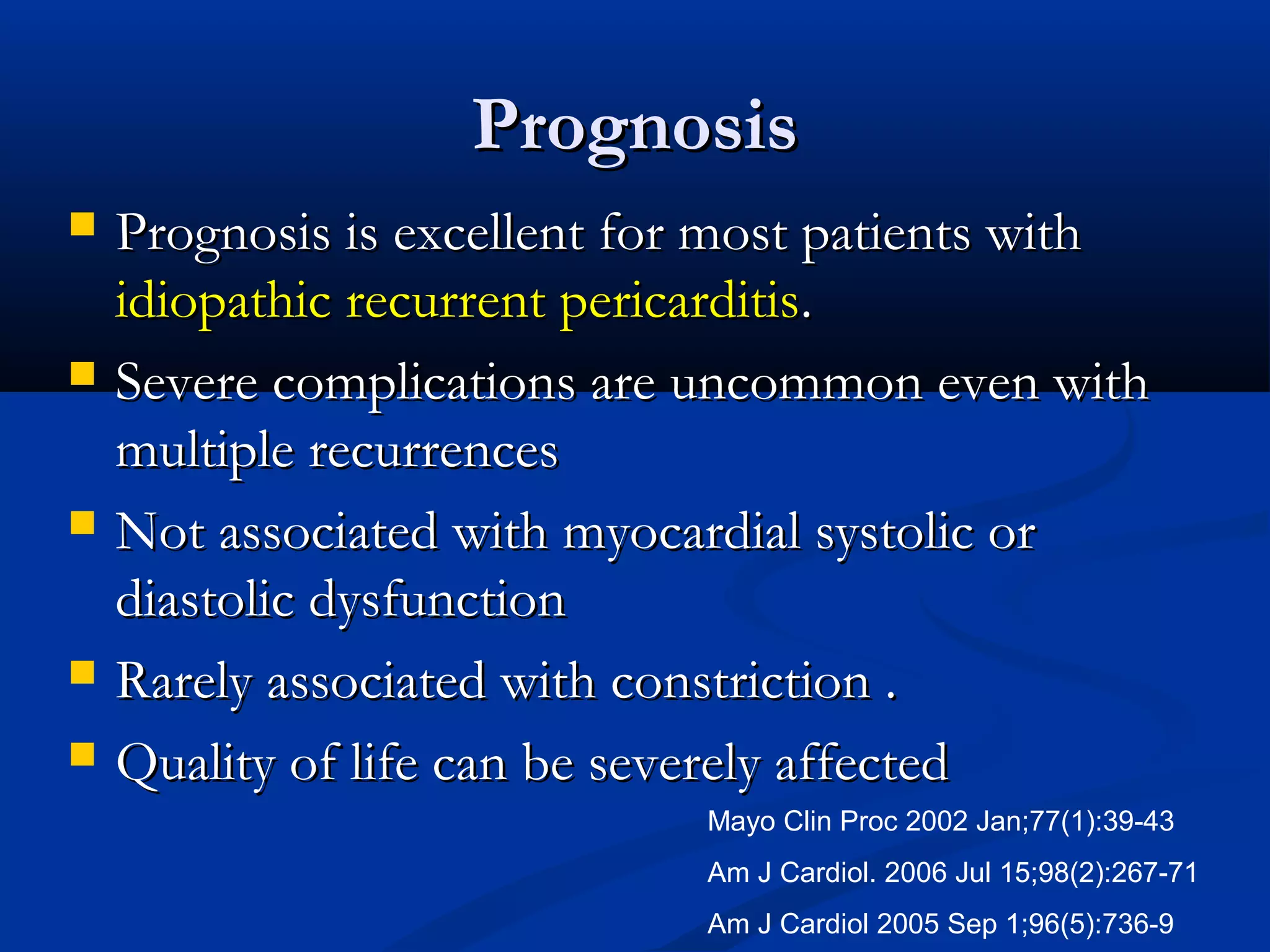
   Prognosis is excellent for most patients with
    idiopathic recurrent pericarditis.
   Severe complications are uncommon even with
    multiple recurrences
   Not associated with myocardial systolic or
    diastolic dysfunction
   Rarely associated with constriction .
   Quality of life can be severely affected
                             Mayo Clin Proc 2002 Jan;77(1):39-43
                             Am J Cardiol. 2006 Jul 15;98(2):267-71
                             Am J Cardiol 2005 Sep 1;96(5):736-9
What predicts recurrence ?
Predictors of recurrence
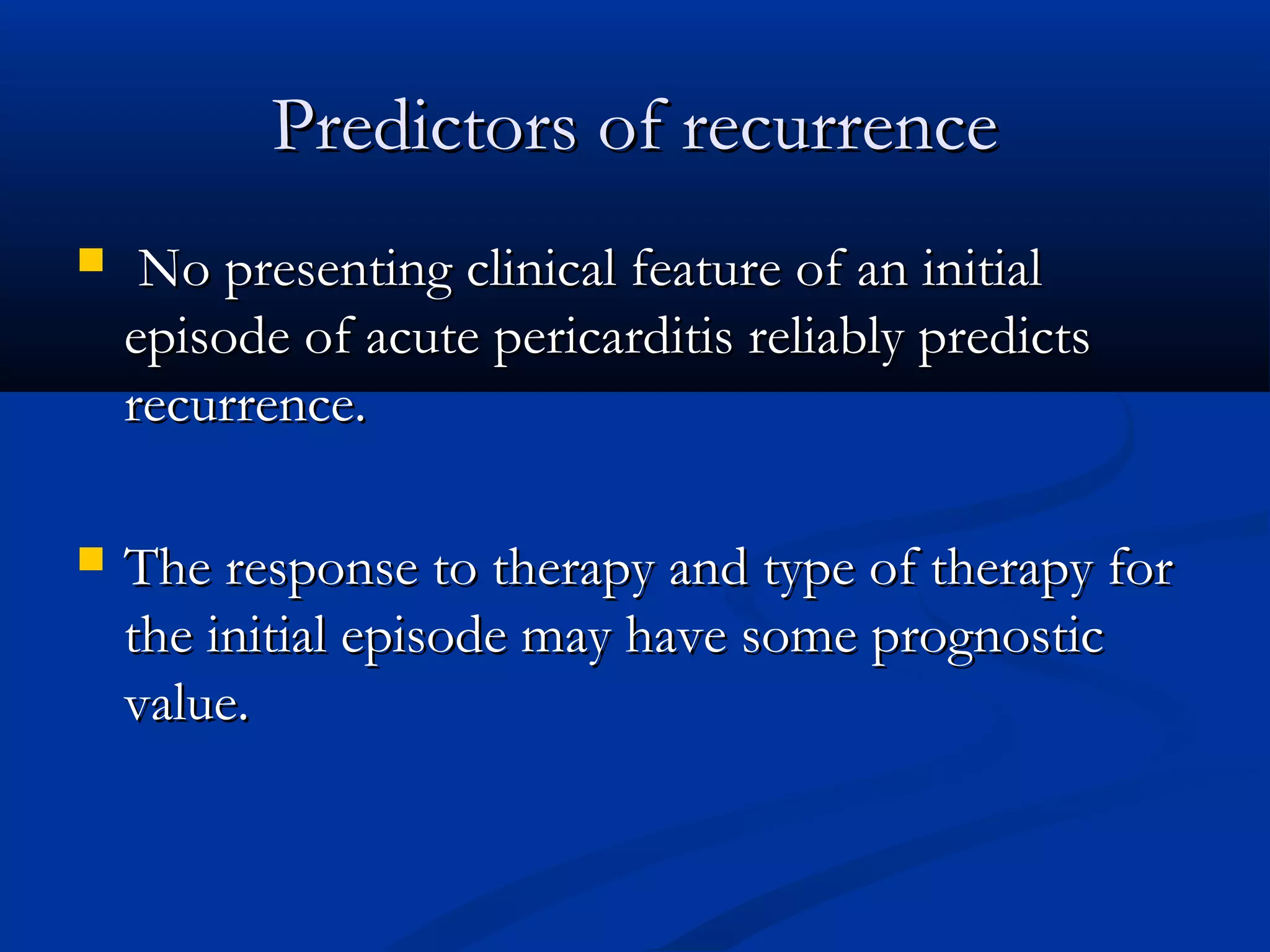
    No presenting clinical feature of an initial
    episode of acute pericarditis reliably predicts
    recurrence.

   The response to therapy and type of therapy for
    the initial episode may have some prognostic
    value.
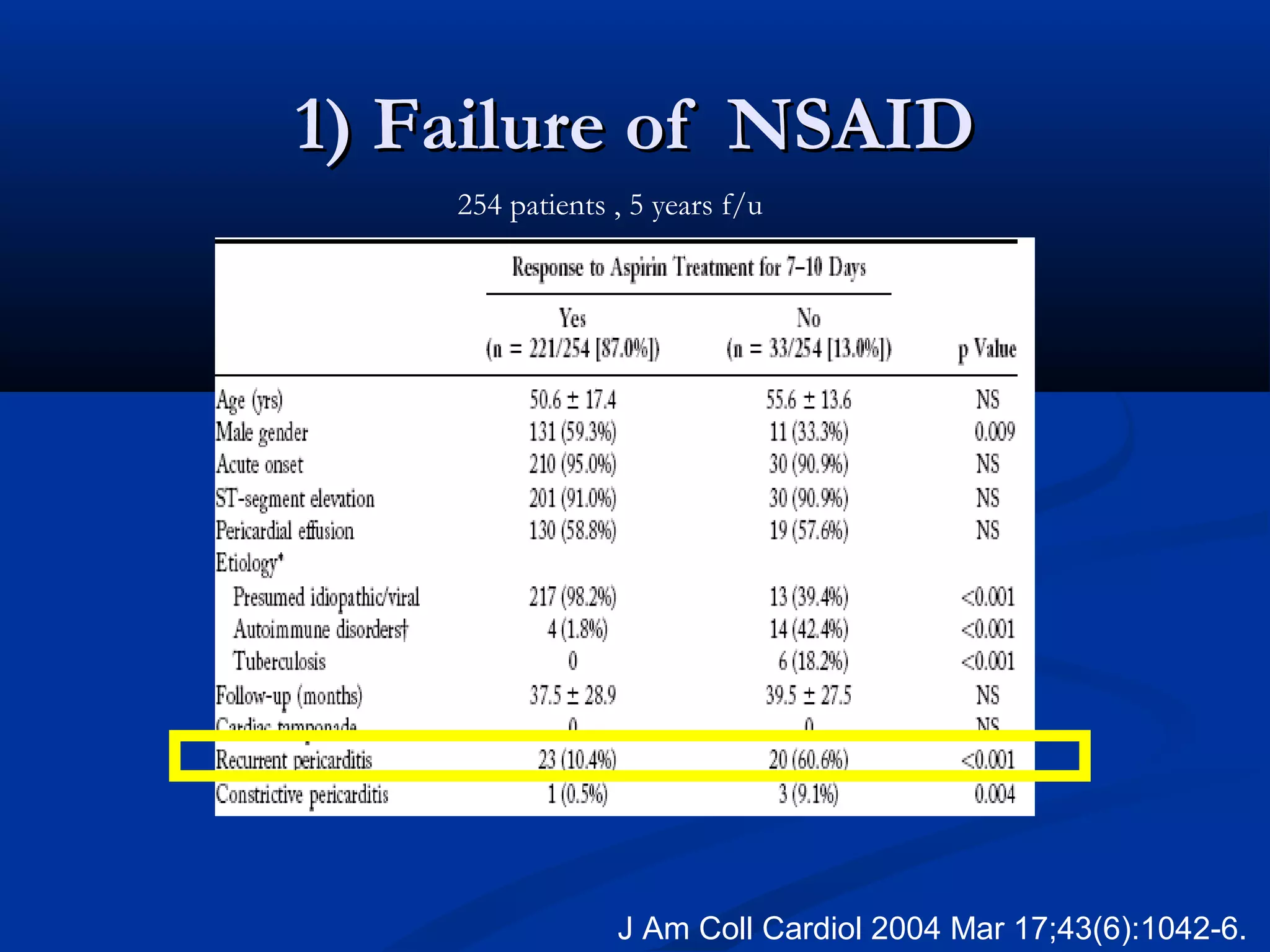
1) Failure of NSAID
    254 patients , 5 years f/u


                 J Am Coll Cardiol 2004 Mar 17;43(6):1042-6.
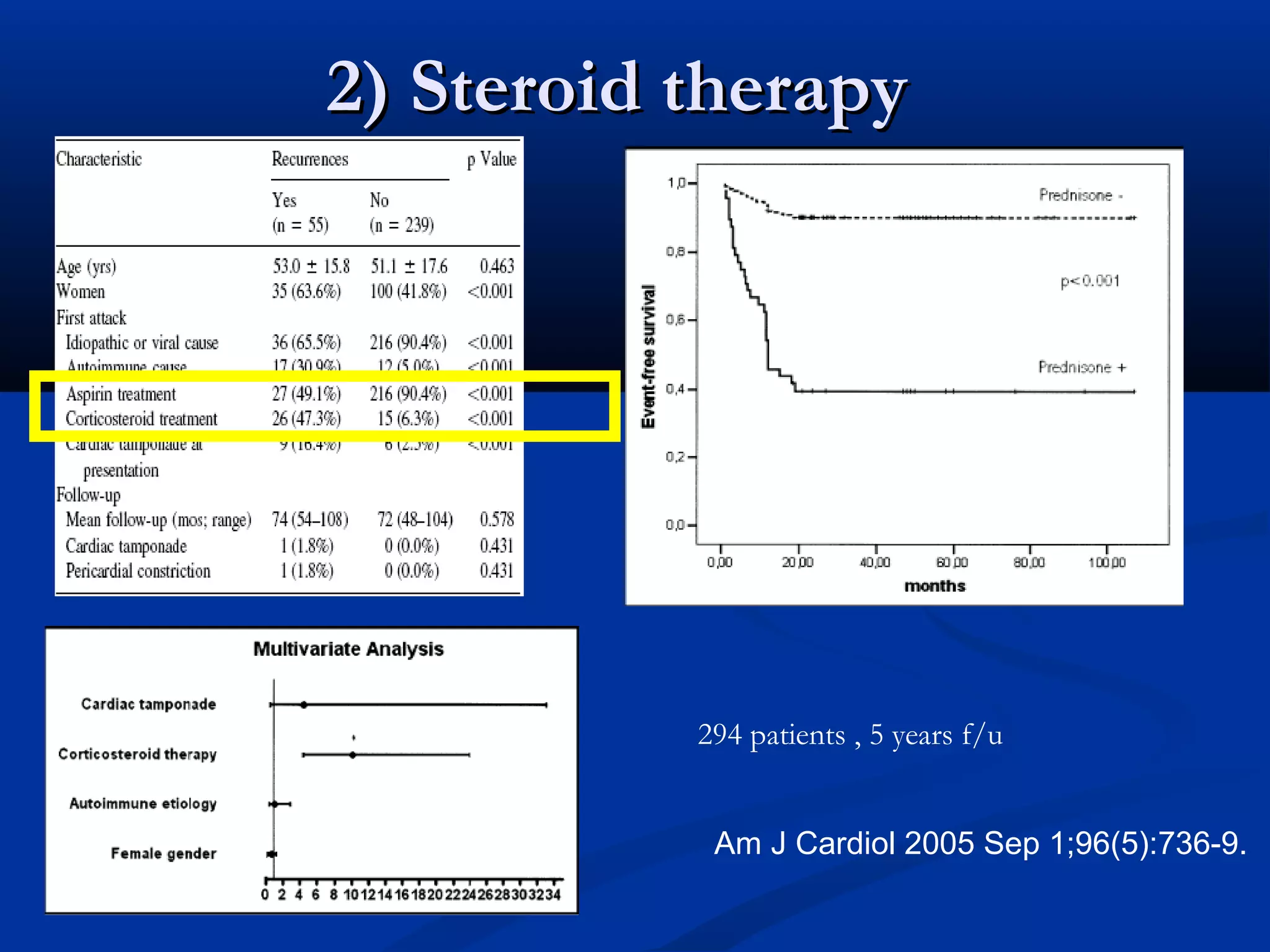
2) Steroid therapy


           294 patients , 5 years f/u


            Am J Cardiol 2005 Sep 1;96(5):736-9.
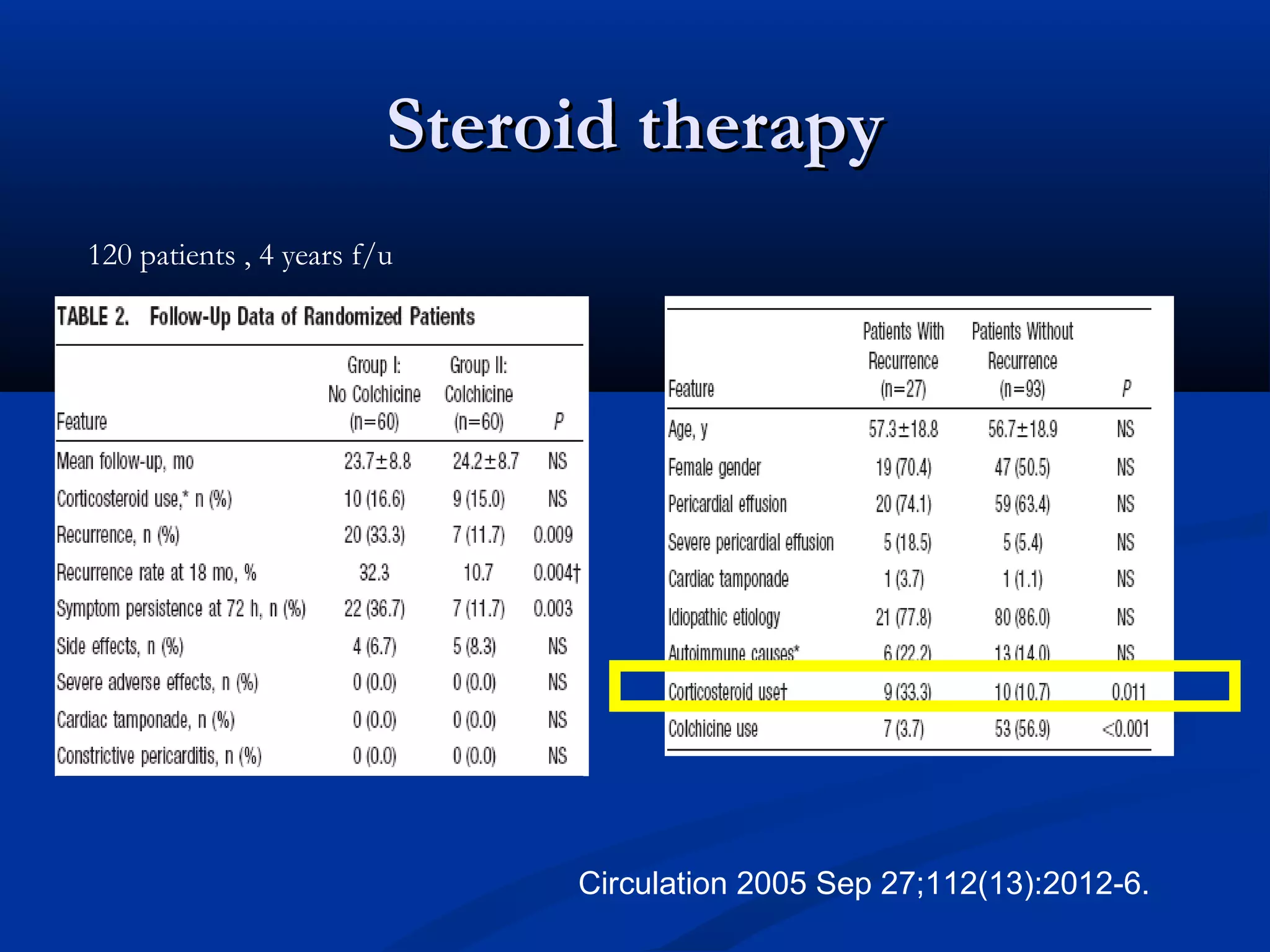
Steroid therapy
120 patients , 4 years f/u


                              Circulation 2005 Sep 27;112(13):2012-6.
Therapy
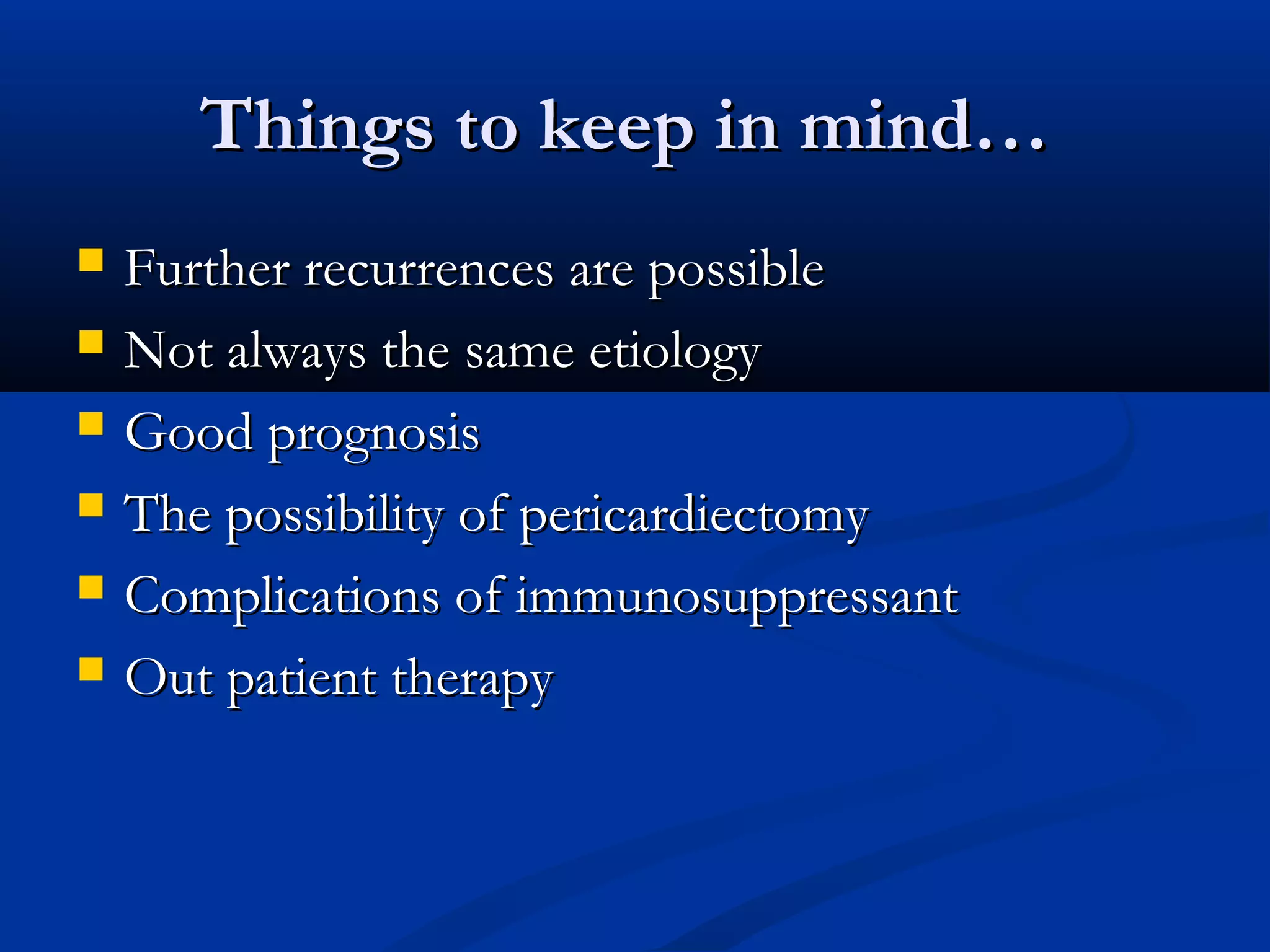
Before that…
   Recurrent pericarditis can be a prolonged and
    frustrating disease to patients and doctors.

   Because of this and the need to maintain
    compliance, effective communication with the
    patient is important.
Things to keep in mind…
   Further recurrences are possible
   Not always the same etiology
   Good prognosis
   The possibility of pericardiectomy
   Complications of immunosuppressant
   Out patient therapy
What is recommended…
Colchicine plus NSAID
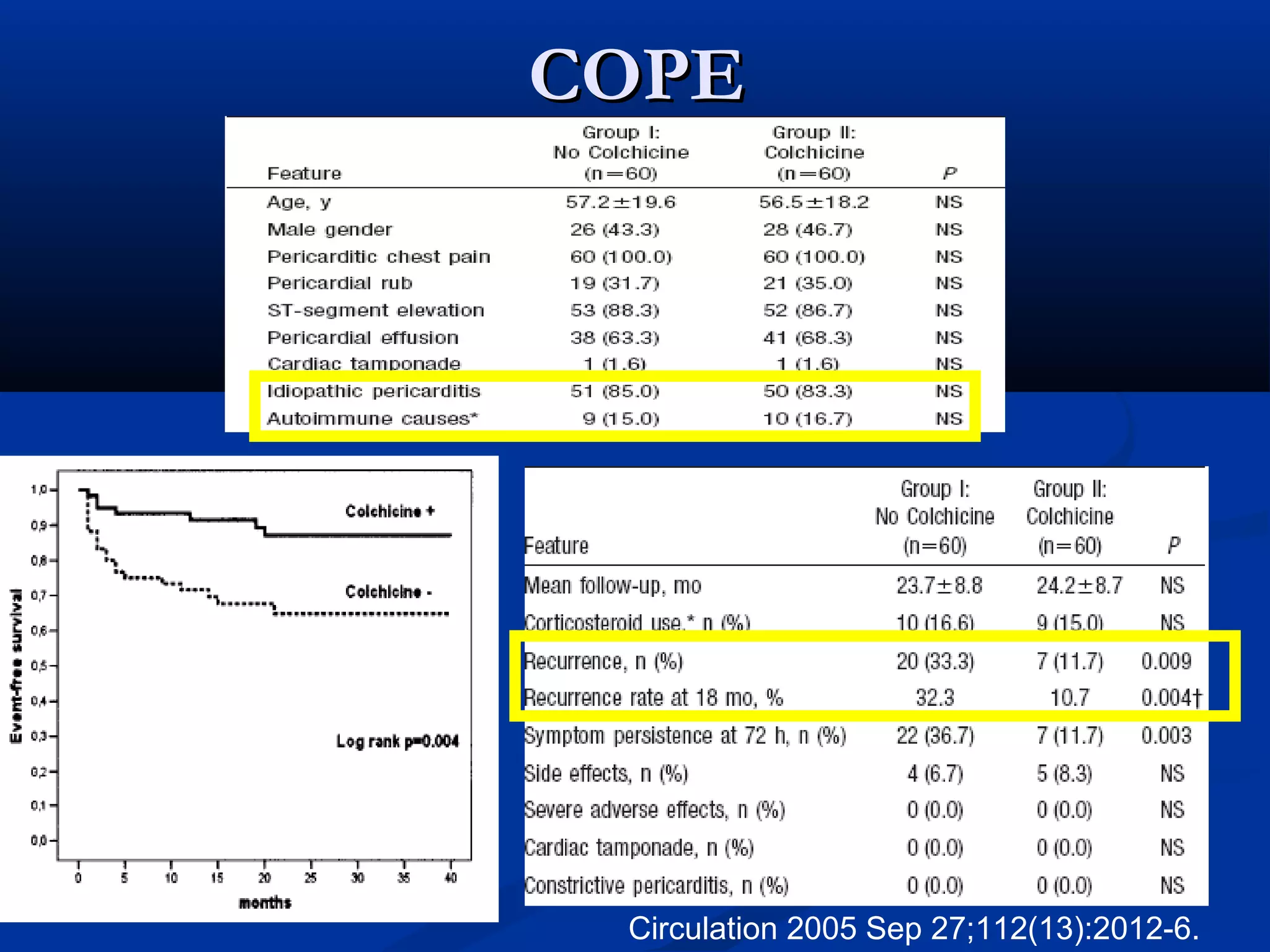
COPE


 Circulation 2005 Sep 27;112(13):2012-6.
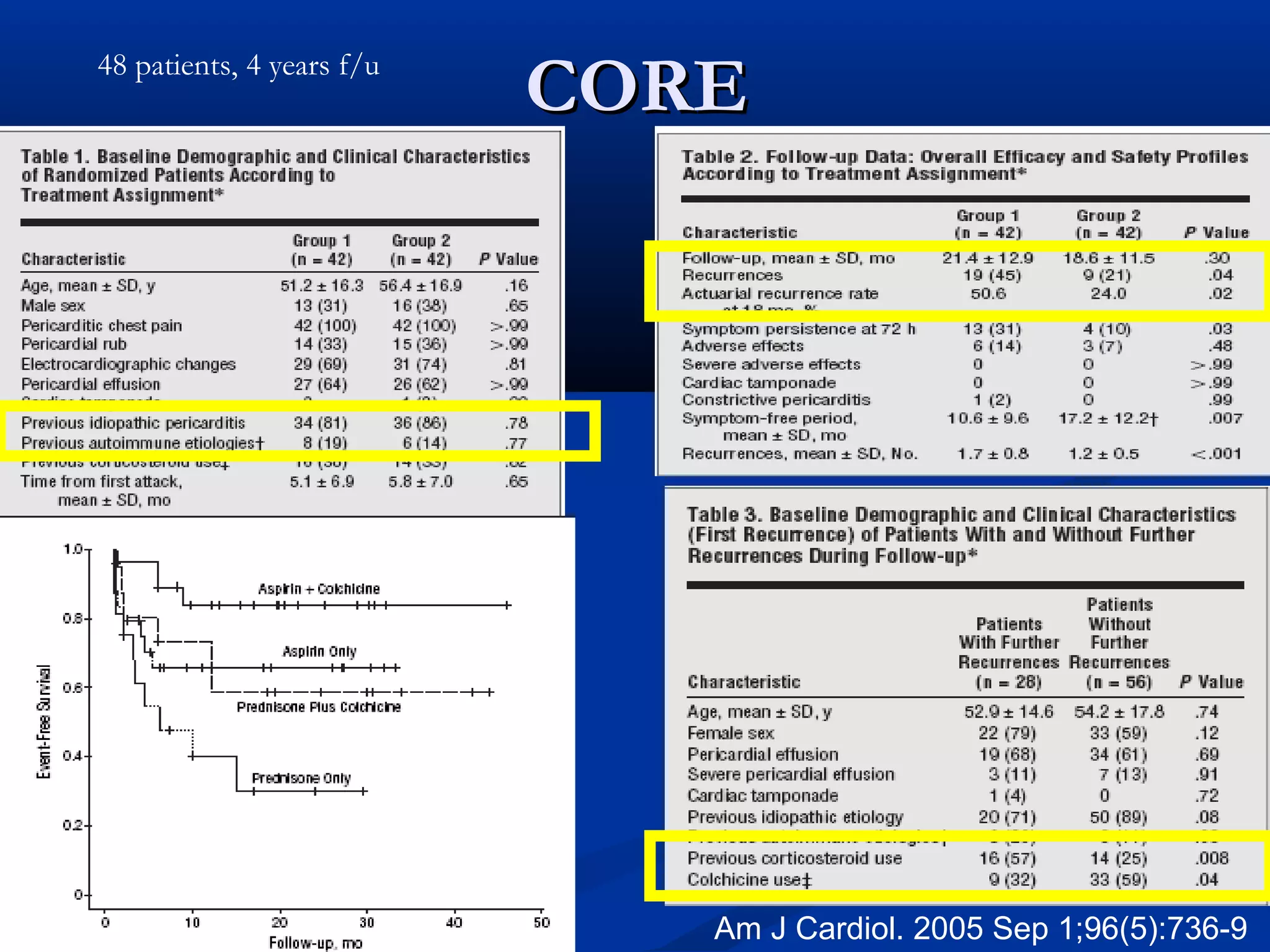
48 patients, 4 years f/u
                           CORE


                              Am J Cardiol. 2005 Sep 1;96(5):736-9
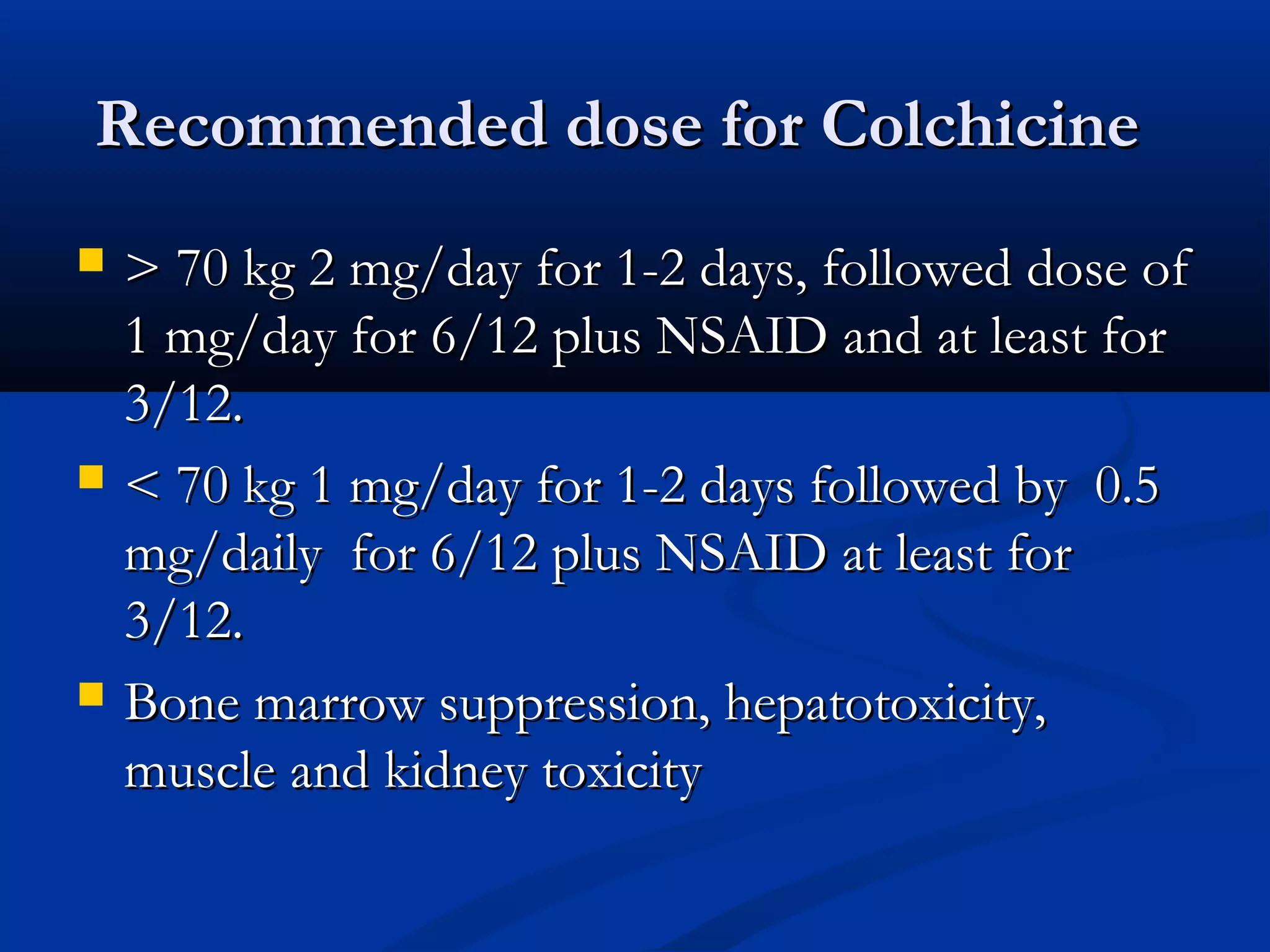
Recommended dose for Colchicine
   > 70 kg 2 mg/day for 1-2 days, followed dose of
    1 mg/day for 6/12 plus NSAID and at least for
    3/12.
   < 70 kg 1 mg/day for 1-2 days followed by 0.5
    mg/daily for 6/12 plus NSAID at least for
    3/12.
   Bone marrow suppression, hepatotoxicity,
    muscle and kidney toxicity
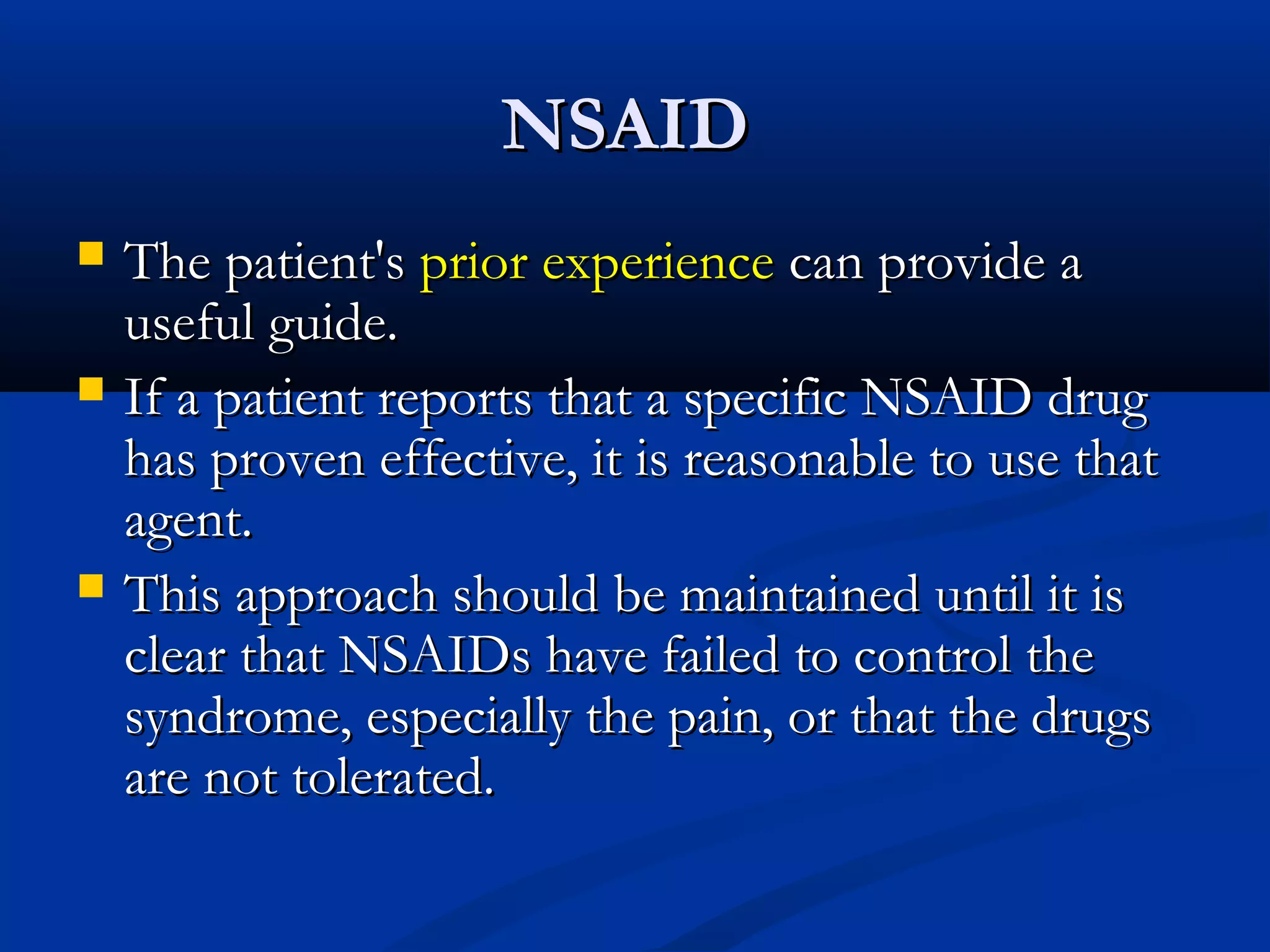
NSAID
   The patient's prior experience can provide a
    useful guide.
   If a patient reports that a specific NSAID drug
    has proven effective, it is reasonable to use that
    agent.
   This approach should be maintained until it is
    clear that NSAIDs have failed to control the
    syndrome, especially the pain, or that the drugs
    are not tolerated.
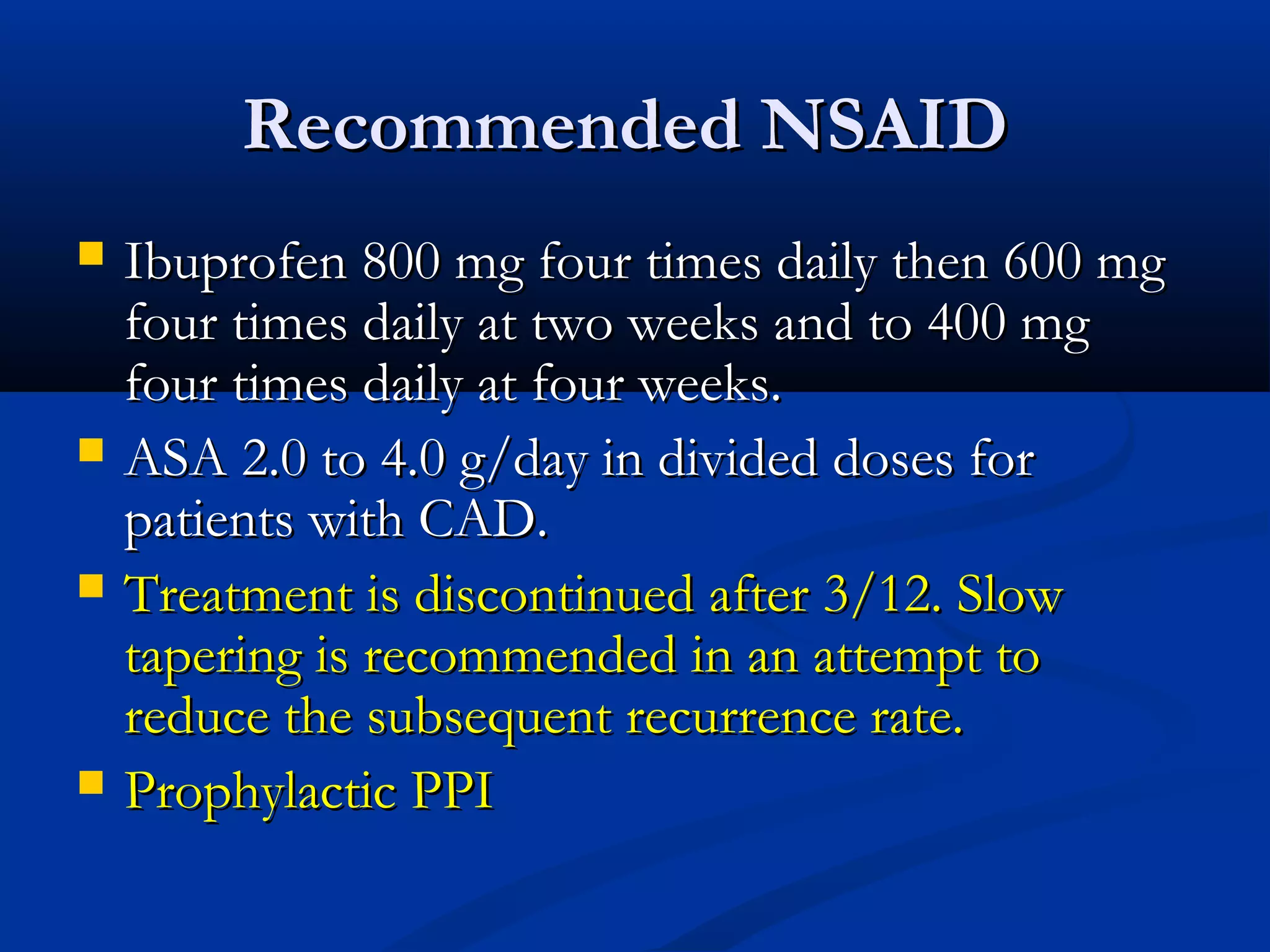
Recommended NSAID
   Ibuprofen 800 mg four times daily then 600 mg
    four times daily at two weeks and to 400 mg
    four times daily at four weeks.
   ASA 2.0 to 4.0 g/day in divided doses for
    patients with CAD.
   Treatment is discontinued after 3/12. Slow
    tapering is recommended in an attempt to
    reduce the subsequent recurrence rate.
   Prophylactic PPI
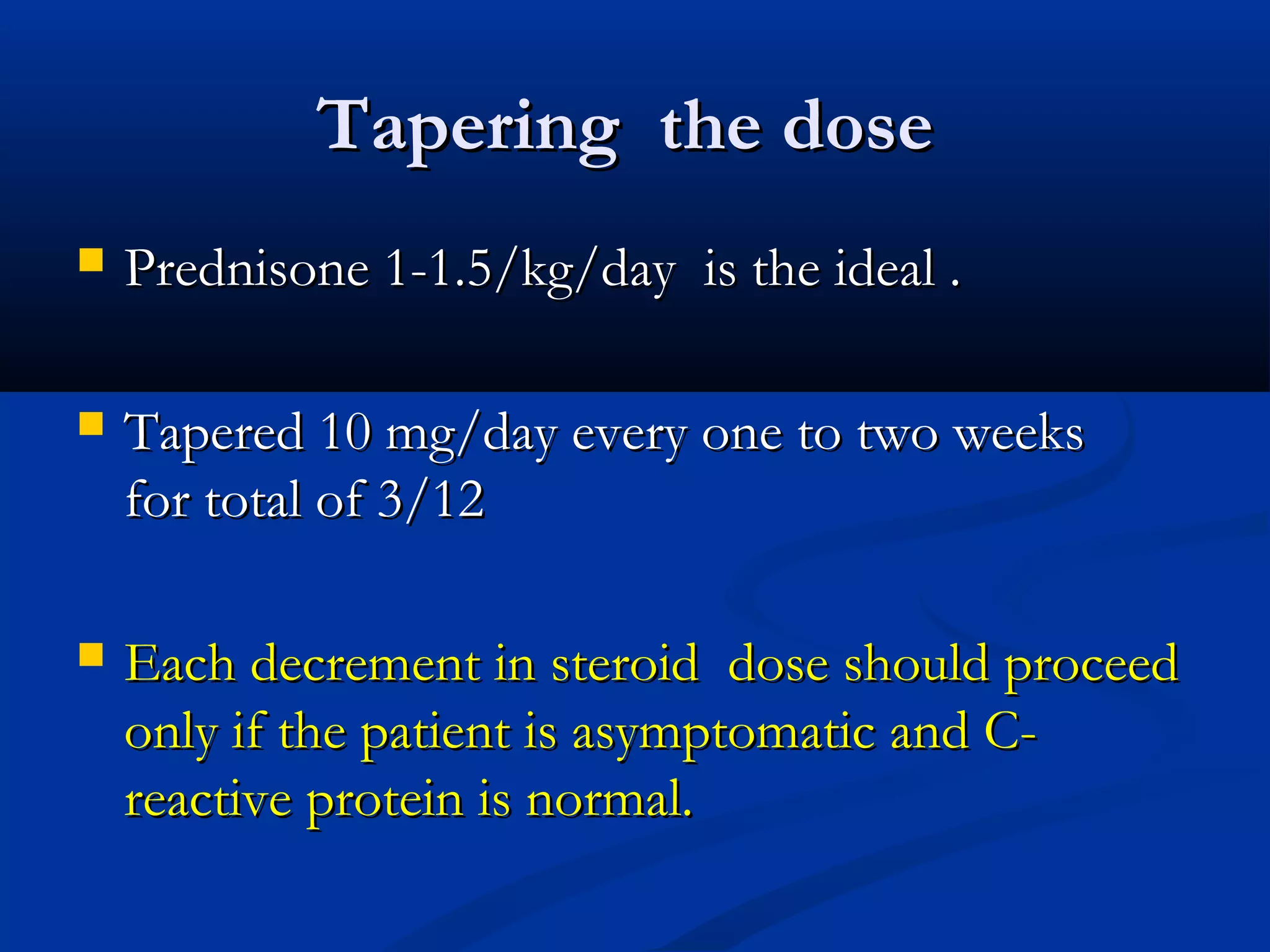
Steroids are not bad…but
   Glucocorticoid therapy should generally be
    avoided in patients with recurrent pericarditis

   May be required to treat patients who fail
    NSAID and/or colchicine therapy.

   Common mistakes are to use too low dose and,
    more often, to taper the dose too rapidly
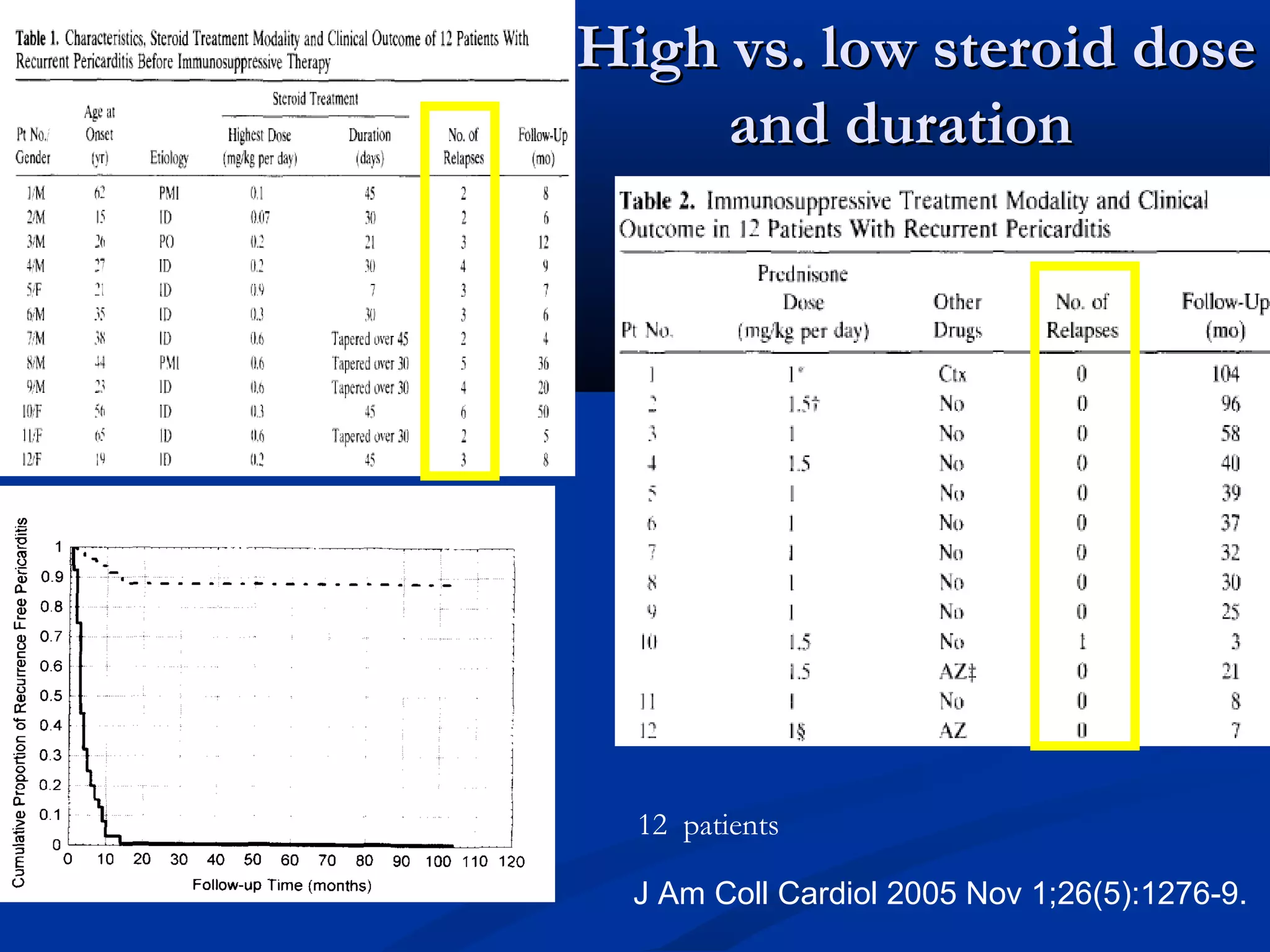
High vs. low steroid dose
     and duration


  12 patients

  J Am Coll Cardiol 2005 Nov 1;26(5):1276-9.
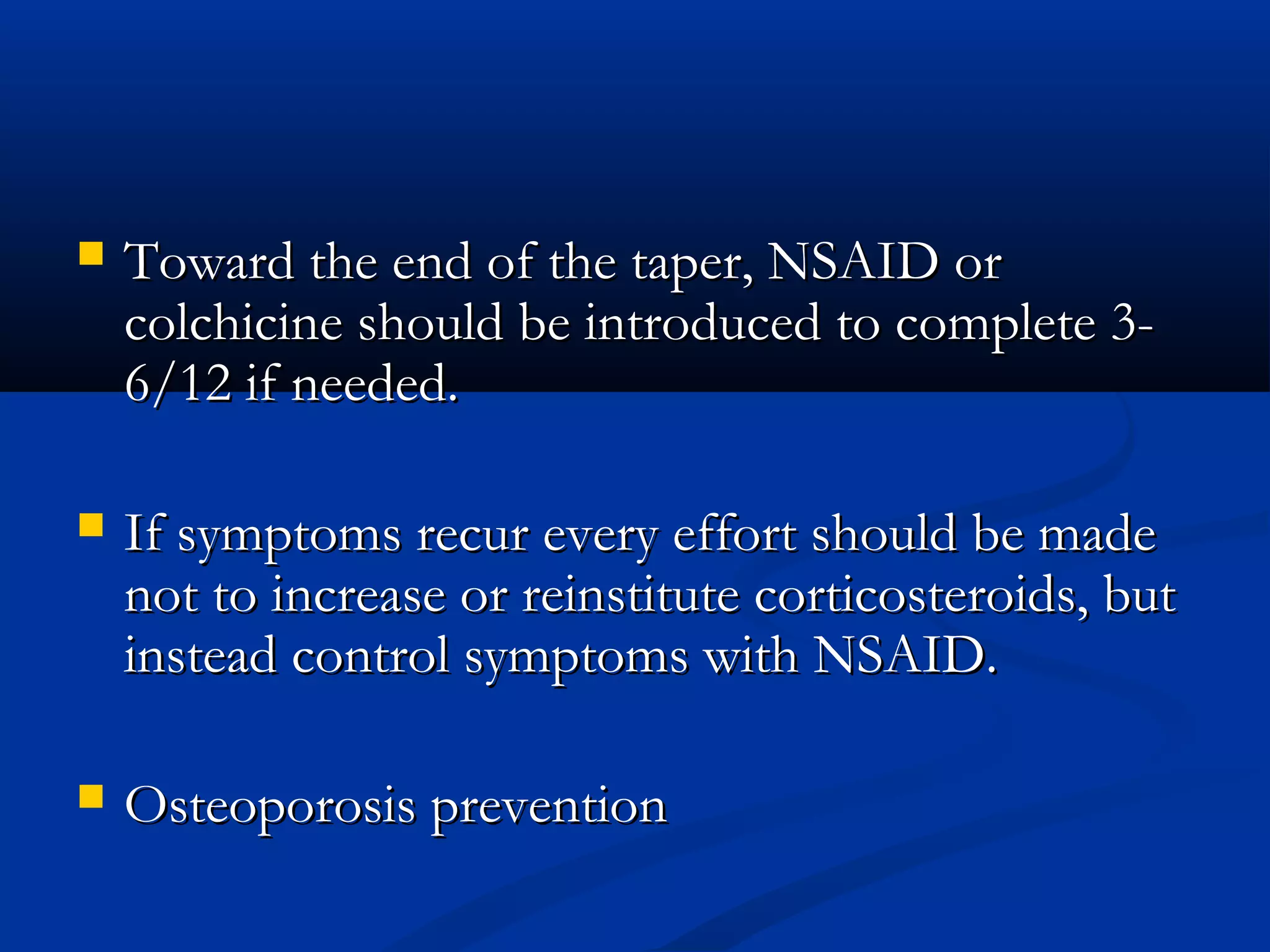
Tapering the dose
   Prednisone 1-1.5/kg/day is the ideal .

   Tapered 10 mg/day every one to two weeks
    for total of 3/12

   Each decrement in steroid dose should proceed
    only if the patient is asymptomatic and C-
    reactive protein is normal.
   Toward the end of the taper, NSAID or
    colchicine should be introduced to complete 3-
    6/12 if needed.

   If symptoms recur every effort should be made
    not to increase or reinstitute corticosteroids, but
    instead control symptoms with NSAID.

   Osteoporosis prevention
Immunosuppressant
   The ESC guidelines recommend azathioprine
    (75 to 100 mg/day).
   Methotrexate
   Cyclophosphamide
   IG
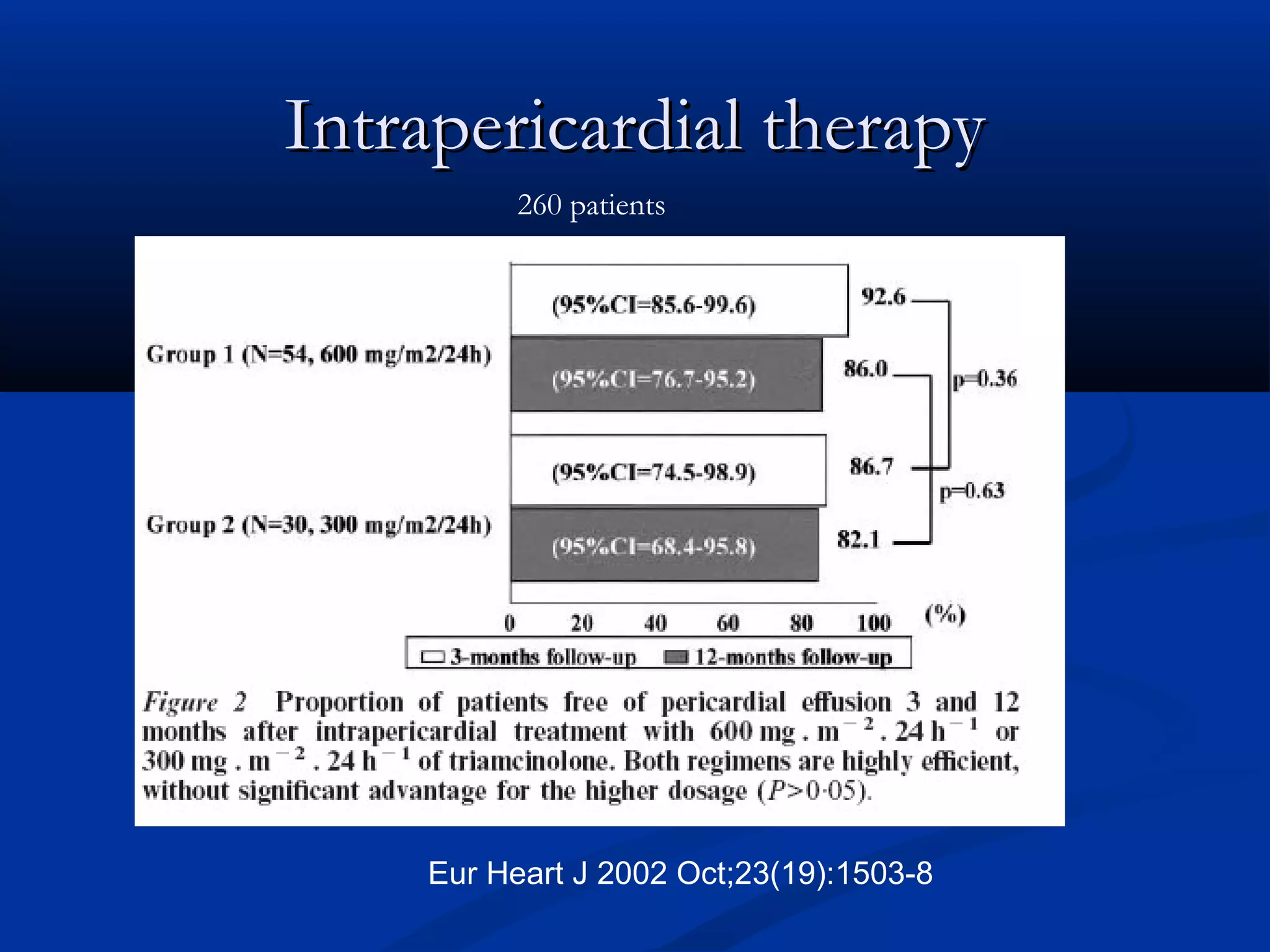
Intrapericardial therapy
                    260 patients
15 patients


              Eur Heart J 2002 Oct;23(19):1503-8
Pericardiectomy
 Still a treatment option for refractory cases
or its complication Constriction
 Operators dependent with high mortality rate .
Recurrent pain without objective
      evidence of disease 
   A difficult management .
   This problem is most likely to occur in more
    chronic cases in which numerous recurrences
    have been suppressed by steroid.
   Pain management should be initiated
   Pain management begins with Tylenol
   Pain service
   Watch for recurrence.
Case 1
   53 y F with 3/12 CP typical to pericarditis attack
    6/12 ago that was treated with ASA only for 14
    days with complete recovery.
   Normal physical exam no rub
   Normal WBC and ESR
   Normal ECG
   ECHO: no PE
Does she have recurrent
     pericarditis?
   How would you treat her?
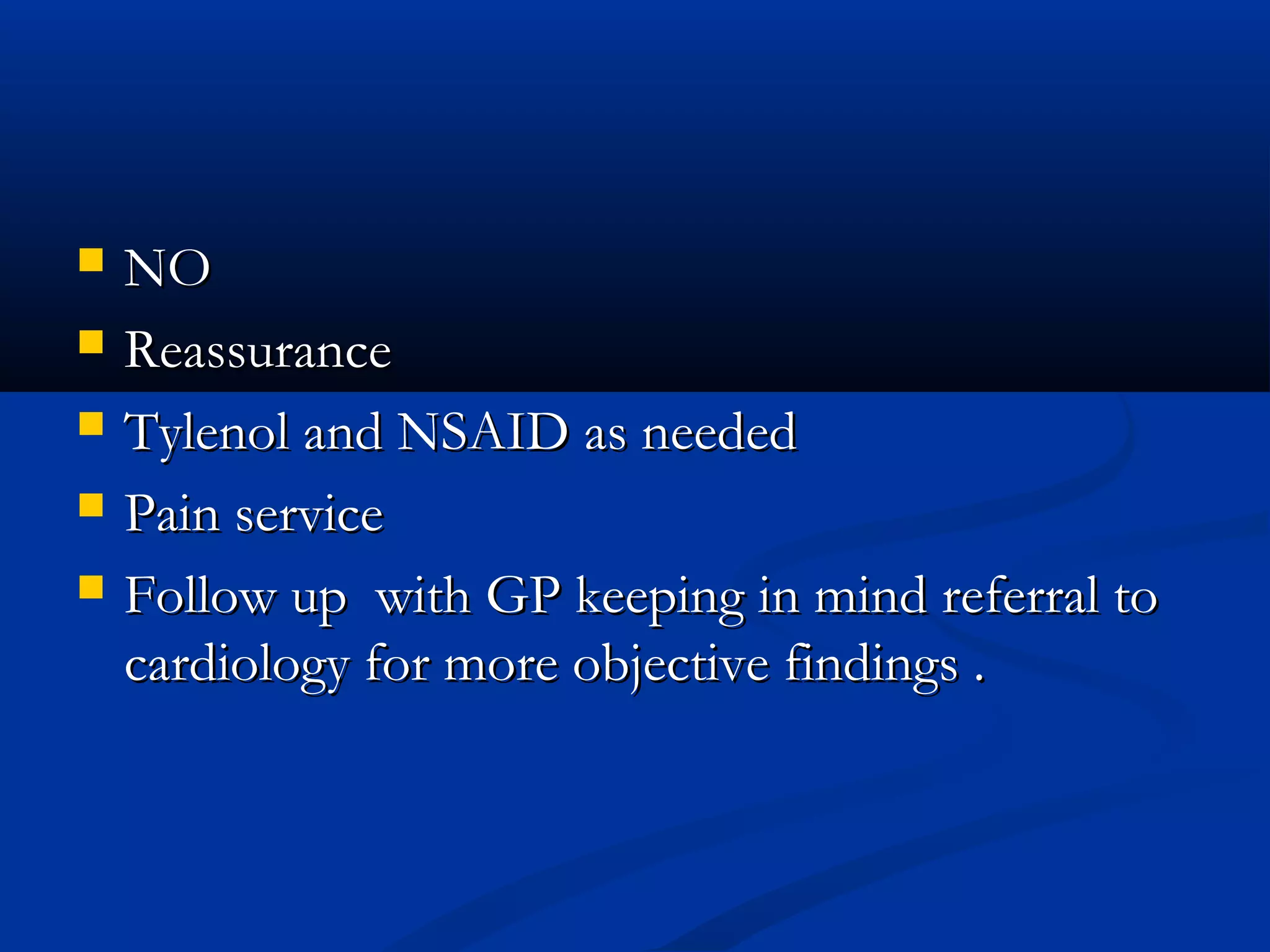
   NO
   Reassurance
   Tylenol and NSAID as needed
   Pain service
   Follow up with GP keeping in mind referral to
    cardiology for more objective findings .
Case 2
   48 y M with with 1 attack of pericarditis
    4/12(treated with ASA with no good
    response ) ,came with SOB and extensional CP
    similar to his previous attack.
   V/S stable no rub
   ECHO : 0.7 cm effusion
   WBC 14 , CK and trop –ve.
How would you treat him ?
   Ibuprfen despite ASA failure and colchicine
    course for 3-6/12.
   Follow up
ECG 3 weeks
Case 3
   68 y M with RA. Referred by GP with CP
    (pericarditis).
   Required multible steroid courses for RA.
   On going similar pain for 6/12 treated by his
    rheumatologist with steroid( 40 mg for 14 days).
   v/s stable no rub
   ECG non specific T changes
   ESR 82.
   ECHO : diastolic dysfunction with 1 cm PE with no
    increase in ICP
How would you treat him ?

    What predicts recurrence ?
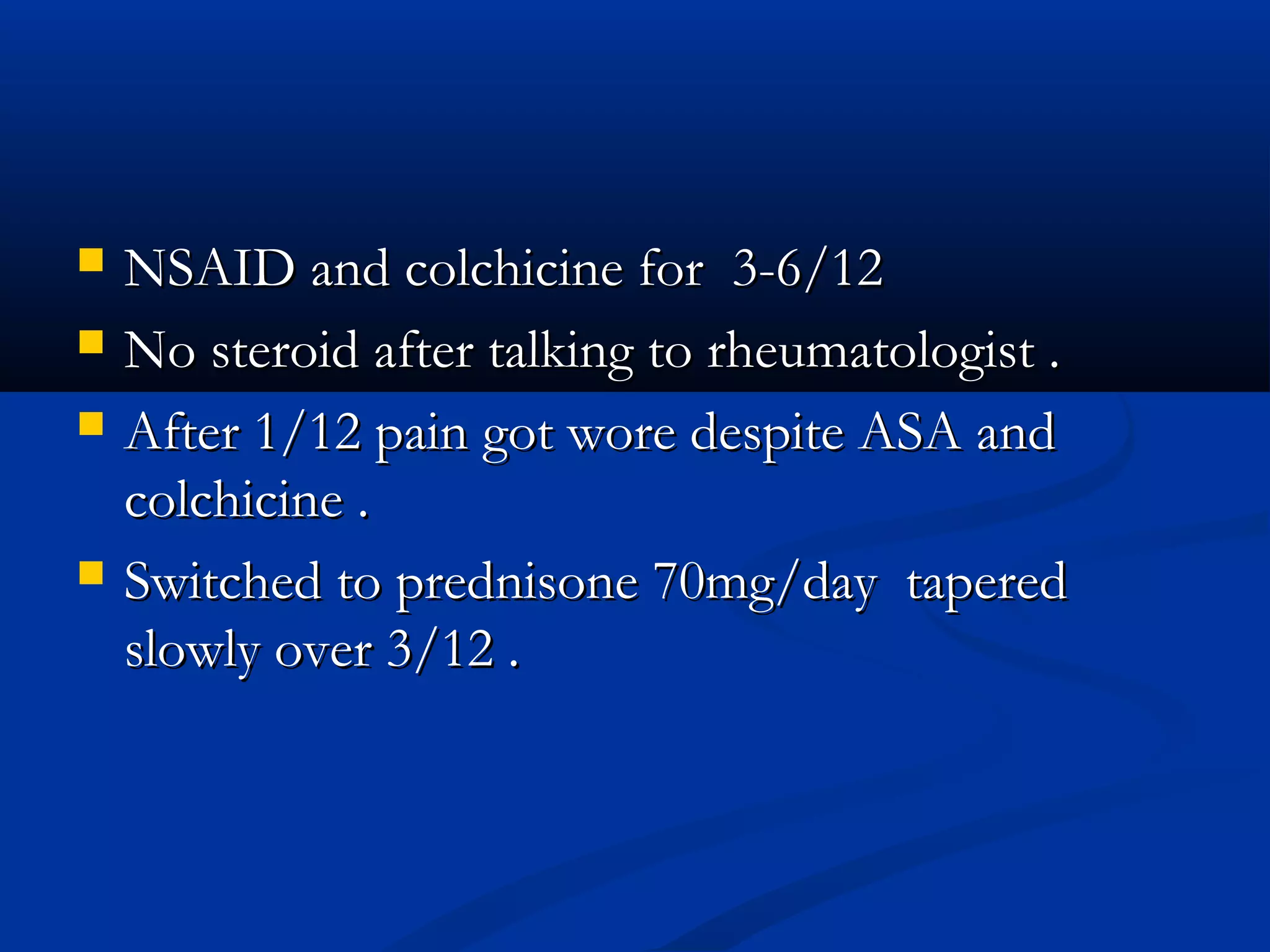
   NSAID and colchicine for 3-6/12
   No steroid after talking to rheumatologist .
   After 1/12 pain got wore despite ASA and
    colchicine .
   Switched to prednisone 70mg/day tapered
    slowly over 3/12 .
Thanks

Pericarditis

  • 1.
    A Frustrating Diseasein Cardiology Cases and Treatment Options
  • 2.
    Case 1  53 y F with 3/12 CP typical to pericarditis attack 6/12 ago that was treated with ASA only for 14 days with complete recovery.  Normal physical exam no rub  Normal WBC and ESR  Normal ECG  ECHO: no PE
  • 3.
    Does she haverecurrent pericarditis? How would you treat her?
  • 4.
    Case 2  48 y M with with 1 attack of pericarditis 4/12(treated with ASA with no good response ) ,came with SOB and extensional CP similar to his previous attack.  V/S stable no rub  ECHO : 0.7 cm effusion  WBC 14 , CK and trop –ve.
  • 5.
  • 6.
    How would youtreat him ?
  • 7.
    Case 3  68 y M with RA. Referred by GP with CP (pericarditis).  Required multible steroid courses for RA.  On going similar pain for 6/12 treated by his rheumatologist with steroid( 40 mg for 14 days).  v/s stable no rub  ECG non specific T changes  ESR 82.  ECHO : diastolic dysfunction with 1 cm PE with no increase in ICP
  • 8.
    How would youtreat him ?
  • 9.
    Recurrent Pericarditis Objectives  How to make the diagnosis?  How is at risk?  Prognosis  Treatment options  Guideline
  • 10.
    Definition  Need 1+ 2 + any of 3 1) A documented first attack of acute pericarditis 2) Recurrent pain 3) Fever Friction rub ECG changes Pericardial effusion Elevation WBC or ESR or CRP
  • 11.
    Etiology Heart 2004;90;1364-1368
  • 12.
    Causes of recurrence…  (i) insufficient dose or treatment duration of the previous attack.  (ii) early corticosteroid treatment causing augmented viral DNA/RNA replication in the pericardial tissue leading to increased viral antigen exposure.  (iii) exacerbation of an underlying connective tissue disease .
  • 13.
    Work up …  Often negative  Not recommended to consider routine pericardial tap for diagnostic purpose  Work up for infectious and or CT causes are guided by clinical picture Mayo Clin Proc 2002 Jan;77(1):39-43 Am J Cardiol. 2006 Jul 15;98(2):267-71 Am J Cardiol 2005 Sep 1;96(5):736-9
  • 14.
    Course and types  The first symptoms of recurrent pericarditis occur at a variable time after the initial attack, but usually within 18 to 20 months. 1)The intermittent form, symptoms start after a symptom- free interval longer than six weeks after drug withdrawal . 2)The incessant form, symptoms appear within six weeks after drug discontinuation or during attempted weaning.
  • 15.
    Symptoms  The most frequent symptom of recurrent pericarditis is chest pain.  Typically sharp improve with sitting  Mimic angina (exertional) once chronic .
  • 16.
    Answer this ..  ………. is the most common cause of SOB in patients with recurrent pericarditis .  A) Tamponade  B) Constrictive pericarditis  C) All of above  D) Non of the above Answer is D
  • 17.
    Complications  31 patients , follow up for 2-19y :  3 patients had Tamponade initially  None during recurrence  No constriction J Am Coll Cardiol 1986 Feb;7(2):300-5
  • 18.
    Complications 221 patients , 5 years f/u 15 patients , 8 years f/u J Am Coll Cardiol. 2003 Aug 20;42(4):759-64. JACC Vol. 43, No. 6, 2004 March 17, 2004:1042–6
  • 19.
    Prognosis  Prognosis is excellent for most patients with idiopathic recurrent pericarditis.  Severe complications are uncommon even with multiple recurrences  Not associated with myocardial systolic or diastolic dysfunction  Rarely associated with constriction .  Quality of life can be severely affected Mayo Clin Proc 2002 Jan;77(1):39-43 Am J Cardiol. 2006 Jul 15;98(2):267-71 Am J Cardiol 2005 Sep 1;96(5):736-9
  • 20.
  • 21.
    Predictors of recurrence   No presenting clinical feature of an initial episode of acute pericarditis reliably predicts recurrence.  The response to therapy and type of therapy for the initial episode may have some prognostic value.
  • 22.
    1) Failure ofNSAID 254 patients , 5 years f/u J Am Coll Cardiol 2004 Mar 17;43(6):1042-6.
  • 23.
    2) Steroid therapy 294 patients , 5 years f/u Am J Cardiol 2005 Sep 1;96(5):736-9.
  • 24.
    Steroid therapy 120 patients, 4 years f/u Circulation 2005 Sep 27;112(13):2012-6.
  • 25.
  • 26.
    Before that…  Recurrent pericarditis can be a prolonged and frustrating disease to patients and doctors.  Because of this and the need to maintain compliance, effective communication with the patient is important.
  • 27.
    Things to keepin mind…  Further recurrences are possible  Not always the same etiology  Good prognosis  The possibility of pericardiectomy  Complications of immunosuppressant  Out patient therapy
  • 28.
  • 29.
  • 30.
    COPE Circulation 2005Sep 27;112(13):2012-6.
  • 31.
    48 patients, 4years f/u CORE Am J Cardiol. 2005 Sep 1;96(5):736-9
  • 32.
    Recommended dose forColchicine  > 70 kg 2 mg/day for 1-2 days, followed dose of 1 mg/day for 6/12 plus NSAID and at least for 3/12.  < 70 kg 1 mg/day for 1-2 days followed by 0.5 mg/daily for 6/12 plus NSAID at least for 3/12.  Bone marrow suppression, hepatotoxicity, muscle and kidney toxicity
  • 33.
    NSAID  The patient's prior experience can provide a useful guide.  If a patient reports that a specific NSAID drug has proven effective, it is reasonable to use that agent.  This approach should be maintained until it is clear that NSAIDs have failed to control the syndrome, especially the pain, or that the drugs are not tolerated.
  • 34.
    Recommended NSAID  Ibuprofen 800 mg four times daily then 600 mg four times daily at two weeks and to 400 mg four times daily at four weeks.  ASA 2.0 to 4.0 g/day in divided doses for patients with CAD.  Treatment is discontinued after 3/12. Slow tapering is recommended in an attempt to reduce the subsequent recurrence rate.  Prophylactic PPI
  • 35.
    Steroids are notbad…but  Glucocorticoid therapy should generally be avoided in patients with recurrent pericarditis  May be required to treat patients who fail NSAID and/or colchicine therapy.  Common mistakes are to use too low dose and, more often, to taper the dose too rapidly
  • 36.
    High vs. lowsteroid dose and duration 12 patients J Am Coll Cardiol 2005 Nov 1;26(5):1276-9.
  • 37.
    Tapering the dose  Prednisone 1-1.5/kg/day is the ideal .  Tapered 10 mg/day every one to two weeks for total of 3/12  Each decrement in steroid dose should proceed only if the patient is asymptomatic and C- reactive protein is normal.
  • 38.
    Toward the end of the taper, NSAID or colchicine should be introduced to complete 3- 6/12 if needed.  If symptoms recur every effort should be made not to increase or reinstitute corticosteroids, but instead control symptoms with NSAID.  Osteoporosis prevention
  • 39.
    Immunosuppressant  The ESC guidelines recommend azathioprine (75 to 100 mg/day).  Methotrexate  Cyclophosphamide  IG
  • 40.
    Intrapericardial therapy 260 patients 15 patients Eur Heart J 2002 Oct;23(19):1503-8
  • 41.
    Pericardiectomy  Still atreatment option for refractory cases or its complication Constriction  Operators dependent with high mortality rate .
  • 42.
    Recurrent pain withoutobjective evidence of disease 
  • 43.
    A difficult management .  This problem is most likely to occur in more chronic cases in which numerous recurrences have been suppressed by steroid.  Pain management should be initiated  Pain management begins with Tylenol  Pain service  Watch for recurrence.
  • 44.
    Case 1  53 y F with 3/12 CP typical to pericarditis attack 6/12 ago that was treated with ASA only for 14 days with complete recovery.  Normal physical exam no rub  Normal WBC and ESR  Normal ECG  ECHO: no PE
  • 45.
    Does she haverecurrent pericarditis? How would you treat her?
  • 46.
    NO  Reassurance  Tylenol and NSAID as needed  Pain service  Follow up with GP keeping in mind referral to cardiology for more objective findings .
  • 47.
    Case 2  48 y M with with 1 attack of pericarditis 4/12(treated with ASA with no good response ) ,came with SOB and extensional CP similar to his previous attack.  V/S stable no rub  ECHO : 0.7 cm effusion  WBC 14 , CK and trop –ve.
  • 48.
    How would youtreat him ?
  • 49.
    Ibuprfen despite ASA failure and colchicine course for 3-6/12.  Follow up
  • 50.
  • 51.
    Case 3  68 y M with RA. Referred by GP with CP (pericarditis).  Required multible steroid courses for RA.  On going similar pain for 6/12 treated by his rheumatologist with steroid( 40 mg for 14 days).  v/s stable no rub  ECG non specific T changes  ESR 82.  ECHO : diastolic dysfunction with 1 cm PE with no increase in ICP
  • 52.
    How would youtreat him ? What predicts recurrence ?
  • 53.
    NSAID and colchicine for 3-6/12  No steroid after talking to rheumatologist .  After 1/12 pain got wore despite ASA and colchicine .  Switched to prednisone 70mg/day tapered slowly over 3/12 .
  • 54.