
PERFORMANCE INDICES
KPAs for various job holders
KRAs for various job holders
KPAS / KPI/ KPFS/ KSI
Key Performance Areas /
Key Performance Indicator/
Key Performance Factor/
Key Success Indicators
KRAS
Key Result Areas
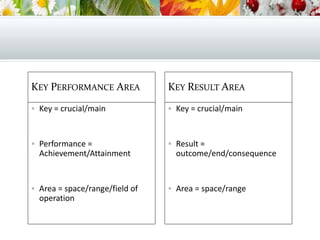
KEY PERFORMANCE AREA
 Key = crucial/main
 Performance =
Achievement/Attainment
 Area = space/range/field of
operation
KEY RESULT AREA
 Key = crucial/main
 Result =
outcome/end/consequence
 Area = space/range
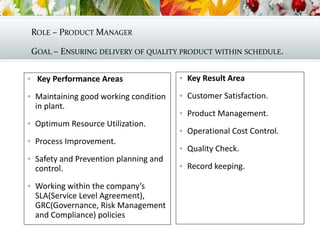
ROLE – PRODUCT MANAGER
GOAL – ENSURING DELIVERY OF QUALITY PRODUCT WITHIN SCHEDULE.
 Key Result Area
 Customer Satisfaction.
 Product Management.
 Operational Cost Control.
 Quality Check.
 Record keeping.
 Key Performance Areas
 Maintaining good working condition
in plant.
 Optimum Resource Utilization.
 Process Improvement.
 Safety and Prevention planning and
control.
 Working within the company’s
SLA(Service Level Agreement),
GRC(Governance, Risk Management
and Compliance) policies
KEY PERFORMANCE INDICATORS (KPI)
 Key Performance Indicators, also known as KPI or Key
Success Indicators (KSI), help an organization define and
measure progress toward organizational goals.
 Once an organization has analyzed its mission, identified
all its stakeholders, and defined its goals, it needs a way
to measure progress toward those goals.
 Key Performance Indicators are those measurements.
 Key Performance Indicators are quantifiable
measurements, agreed to beforehand, that reflect the
critical success factors of an organization. They will differ
depending on the organization.
 Key Performance Indicators are quantifiable measurements,
agreed to beforehand, that reflect the critical success factors of an
organization. They will differ depending on the organization.
 A business may have as one of its Key Performance Indicators the
percentage of its income that comes from return customers.
 A school may focus its Key Performance Indicators on graduation
rates of its students.
 A Customer Service Department may have as one of its Key
Performance Indicators, in line with overall company KPIs,
percentage of customer calls answered in the first minute
 A Key Performance Indicator for a social service organization might
be number of clients assisted during the year.
 Key Performance Factors or KPA are the factors that make up an
employees’ job. KPAs are fixed and are those where the
incumbent is doing the maximum value creation for organization.
 These 5 Key Performance Factors (In General) are –
Job knowledge
Quality of output
Quantity of output
Cost/time consciousness
Team Work
 2 methods adopted to carry on KPF
analysis are dependent on size of the team
and are-
TEAM SIZE MORE OR EQUAL TO 5
 PCR – Paired Comparison & Review - Each employee is
compared with all his team members individually on
basis of KPFs. He/ she is given 1 ( if better than other with
whom he / she is compared) or 0 ( vice-versa). His total
individual score is obtained by adding all 1’s obtained by
him in the sheet.

Individual Weightage score = Total Individual score *
Weightage given to each attribute
Individual Attribute Score = Weightage score / No. of
employees in the department
Common Organizational Score/PC Score/ KPF Score =
Sum of Individual Attribute Scores in all 5 attributes
TEAM SIZE LESS THAN 5
 SWR – Strength Weakness & Review -
Individual Attribute Score = Total Score attained in each
point of that attribute/ 4
Individual Weightage Score = Individual Attribute score *
Weightage given to each attribute
Common Organizational Score/SW Score/ KPF Score =
Sum of Individual Weightage Scores in all 5 attributes/5
There can be other factors based on relevant factors.
KRAS
Key Result Areas
 The KRAs are considered to be a parameter for
performance is mutually agreed upon by both appraisee
and appraiser
 The KRAs are the activities/project/s which are assigned
to an employee time to time and are essentially SMART.
 It should be:
Specific
Relevant
Measurable
Time-based
Achievable
KRA BASED
PERFORMANCE
APPRAISAL
SYSTEM
Performance Appraisal
 Annual Activity with mid-year reviews
 Two way evaluation process of employee
performance.
 Measures performance during the year,
setting up future goals.
 Basis for decision –growth in terms of
Remuneration, Promotion, training.
 Identify potential for additional and higher
roles and responsibilities
WHY KRA BASED PERFORMANCE
APPRAISAL?
Don't measure yourself by what you have accomplished,
but by what you could have accomplished with your
ability.
 Focused growth path
 Better monitoring with growing times
 Bench mark against global standards
 Scientific methodology of evaluation towards
standardization and fairness of the
Appraisal Instrument
Meaning: KRA
• Key Result Area
• Identified out of the day to day routine activities
• Primary Job objectives or Major Goals
• Outcomes or Expectations of a Job Position
• Groups relevant activities under one cluster
forming a KRA
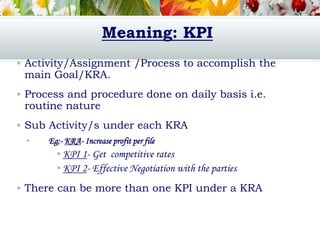
Meaning: KPI
 Activity/Assignment /Process to accomplish the
main Goal/KRA.
 Process and procedure done on daily basis i.e.
routine nature
 Sub Activity/s under each KRA
 Eg;- KRA- Increase profit per file
 KPI 1- Get competitive rates
 KPI 2- Effective Negotiation with the parties
 There can be more than one KPI under a KRA
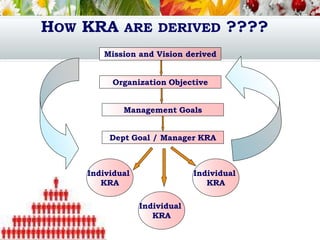
HOW KRA ARE DERIVED ????
Mission and Vision derived
Individual
KRA
Individual
KRA
Individual
KRA
Organization Objective
Management Goals
Dept Goal / Manager KRA
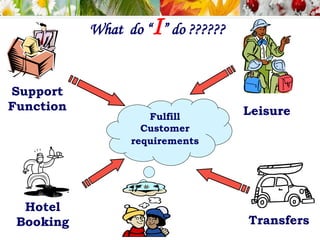
What do “I” do ??????
Fulfill
Customer
requirements
Support
Function
Hotel
Booking
Leisure
Transfers
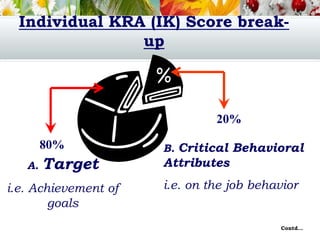
Individual KRA (IK) Score break-
up
80%
20%
A. Target
i.e. Achievement of
goals
B. Critical Behavioral
Attributes
i.e. on the job behavior
Contd…
Service oriented Industry
One organization- One Set of values
Differentiation factors - Personal Touch
Higher the responsibility, more
emphasis on behavioral skills
Better the interpersonal skills, better the
growth prospects
Long Term success Mantra
SIGNIFICANCE OF BEHAVIORAL ATTRIBUTES
WHY MEASURE BEHAVIOUR
 Communication on phone, email, chat is the mainstay of
our business
 Say the right thing the right way – negotiate, convince
and convert.
 Relationships determine your business
 We cannot work in isolation - team work is important
 Display of responsibility and leadership determines the
leaders for the future
 Keeping abreast of the market environment is essential to
distinguish leaders from followers
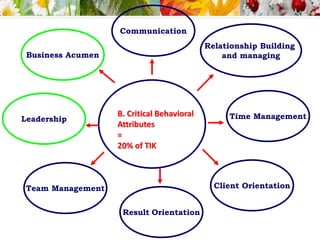
B. Critical Behavioral
Attributes
=
20% of TIK
Relationship Building
and managing
Time Management
Result Orientation
Communication
Leadership
Team Management Client Orientation
Business Acumen
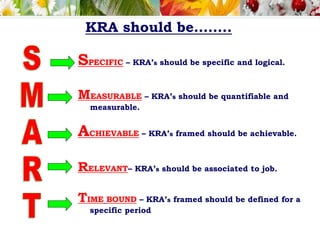
KRA should be……..
SPECIFIC – KRA’s should be specific and logical.
MEASURABLE – KRA’s should be quantifiable and
measurable.
ACHIEVABLE – KRA’s framed should be achievable.
RELEVANT– KRA’s should be associated to job.
TIME BOUND – KRA’s framed should be defined for a
specific period
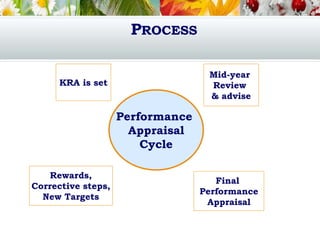
PROCESS
Rewards,
Corrective steps,
New Targets
Final
Performance
Appraisal
Mid-year
Review
& advise
Performance
Appraisal
Cycle
KRA is set
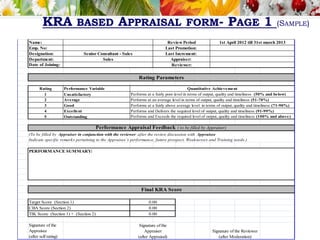
KRA BASED APPRAISAL FORM- PAGE 1 (SAMPLE)
Name:
Emp. No:
Designation:
Department:
Date of Joining:
Rating Performance Variable
1 Unsatisfactory
2 Average
3 Good
4 Excellent
5 Outstanding
Signature of the
Appraisee
(after self rating)
CBA Score (Section 2) 0.00
TIK Score (Section 1) + (Section 2) 0.00
Signature of the
Appraiser
(after Appraisal)
Signature of the Reviewer
(after Moderation)
(To be filled by Appraiser in conjunction with the reviewer after the review discussion with Appraisee
Indicate specific remarks pertaining to the Appraisee’s performance, future prospect, Weaknesses and Training needs.)
PERFORMANCE SUMMARY:
Final KRA Score
Target Score (Section 1) 0.00
Performs at a fairly poor level in terms of output, quality and timeliness (50% and below)
Performs at an average level in terms of output, quality and timeliness (51-70%)
Performs at a fairly above average level in terms of output, quality and timeliness (71-90%)
Performs and Delivers the required level of output, quality and timeliness (91-99%)
Performs and Exceeds the required level of output, quality and timeliness (100% and above)
Performance Appraisal Feedback ( to be filled by Appraiser)
Reviewer:
Rating Parameters
Quantitative Achievement
Senior Consultant - Sales Last Increment:
Sales Appraiser:
Review Period 1st April 2012 till 31st march 2013
Last Promotion:
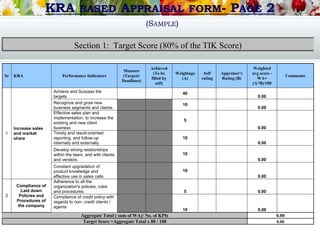
KRA BASED APPRAISAL FORM- PAGE 2
(SAMPLE)
Section 1: Target Score (80% of the TIK Score)
Sr KRA Performance Indicators
Measure
(Targets/
Deadlines)
Achieved
(To be
filled by
self)
Weightage
(A)
Self
rating
Appraiser's
Rating (B)
Weighted
avg score -
WA=
(A*B)/100
Comments
1
Increase sales
and market
share
Achieve and Surpass the
targets
40
0.00
Recognize and grow new
business segments and clients.
10
0.00
Effective sales plan and
implementation, to increase the
existing and new client
business
5
0.00
Timely and result-oriented
reporting, and follow-up
internally and externally
10
0.00
Develop strong relationships
within the team, and with clients
and vendors
10
0.00
Constant upgradation of
product knowledge and
effective use in sales calls
10
0.00
2
Compliance of
Laid down
Policies and
Procedures of
the company
Adherence to all the
organization's policies, rules
and procedures. 5 0.00
Compliance of credit policy with
regards to non- credit clients /
agents
10 0.00
Aggregate Total ( sum of WA)/ No. of KPIs 0.00
Target Score =Aggregate Total x 80 / 100 0.00
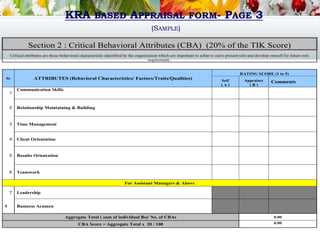
KRA BASED APPRAISAL FORM- PAGE 3
(SAMPLE)
Section 2 : Critical Behavioral Attributes (CBA) (20% of the TIK Score)
Critical attributes are those behavioral characteristic identified by the organization which are important to achieve one's present role and develop oneself for future role
requirement..
Sr ATTRIBUTES (Behavioral Characteristics/ Factors/Traits/Qualities)
RATING SCORE (1 to 5)
Self
( A )
Appraiser
( B )
Comments
1
Communication Skills
2 Relationship Maintaining & Building
3 Time Management
4 Client Orientation
5 Results Orientation
6 Teamwork
For Assistant Managers & Above
7 Leadership
8 Business Acumen
Aggregate Total ( sum of individual Bs)/ No. of CBAs 0.00
CBA Score = Aggregate Total x 20 / 100 0.00
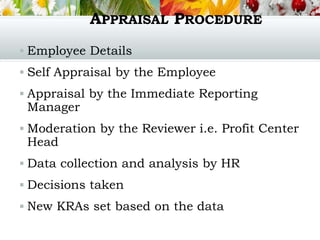
APPRAISAL PROCEDURE
 Employee Details
 Self Appraisal by the Employee
 Appraisal by the Immediate Reporting
Manager
 Moderation by the Reviewer i.e. Profit Center
Head
 Data collection and analysis by HR
 Decisions taken
 New KRAs set based on the data
THANK YOU…..

Performance indices

  • 1.
    PERFORMANCE INDICES KPAs forvarious job holders KRAs for various job holders
  • 2.
    KPAS / KPI/KPFS/ KSI Key Performance Areas / Key Performance Indicator/ Key Performance Factor/ Key Success Indicators
  • 3.
  • 4.
    KEY PERFORMANCE AREA Key = crucial/main  Performance = Achievement/Attainment  Area = space/range/field of operation KEY RESULT AREA  Key = crucial/main  Result = outcome/end/consequence  Area = space/range
  • 5.
    ROLE – PRODUCTMANAGER GOAL – ENSURING DELIVERY OF QUALITY PRODUCT WITHIN SCHEDULE.  Key Result Area  Customer Satisfaction.  Product Management.  Operational Cost Control.  Quality Check.  Record keeping.  Key Performance Areas  Maintaining good working condition in plant.  Optimum Resource Utilization.  Process Improvement.  Safety and Prevention planning and control.  Working within the company’s SLA(Service Level Agreement), GRC(Governance, Risk Management and Compliance) policies
  • 6.
    KEY PERFORMANCE INDICATORS(KPI)  Key Performance Indicators, also known as KPI or Key Success Indicators (KSI), help an organization define and measure progress toward organizational goals.  Once an organization has analyzed its mission, identified all its stakeholders, and defined its goals, it needs a way to measure progress toward those goals.  Key Performance Indicators are those measurements.
  • 7.
     Key PerformanceIndicators are quantifiable measurements, agreed to beforehand, that reflect the critical success factors of an organization. They will differ depending on the organization.
  • 8.
     Key PerformanceIndicators are quantifiable measurements, agreed to beforehand, that reflect the critical success factors of an organization. They will differ depending on the organization.  A business may have as one of its Key Performance Indicators the percentage of its income that comes from return customers.  A school may focus its Key Performance Indicators on graduation rates of its students.  A Customer Service Department may have as one of its Key Performance Indicators, in line with overall company KPIs, percentage of customer calls answered in the first minute  A Key Performance Indicator for a social service organization might be number of clients assisted during the year.
  • 9.
     Key PerformanceFactors or KPA are the factors that make up an employees’ job. KPAs are fixed and are those where the incumbent is doing the maximum value creation for organization.  These 5 Key Performance Factors (In General) are – Job knowledge Quality of output Quantity of output Cost/time consciousness Team Work
  • 10.
     2 methodsadopted to carry on KPF analysis are dependent on size of the team and are-
  • 11.
    TEAM SIZE MOREOR EQUAL TO 5  PCR – Paired Comparison & Review - Each employee is compared with all his team members individually on basis of KPFs. He/ she is given 1 ( if better than other with whom he / she is compared) or 0 ( vice-versa). His total individual score is obtained by adding all 1’s obtained by him in the sheet.  Individual Weightage score = Total Individual score * Weightage given to each attribute Individual Attribute Score = Weightage score / No. of employees in the department Common Organizational Score/PC Score/ KPF Score = Sum of Individual Attribute Scores in all 5 attributes
  • 12.
    TEAM SIZE LESSTHAN 5  SWR – Strength Weakness & Review - Individual Attribute Score = Total Score attained in each point of that attribute/ 4 Individual Weightage Score = Individual Attribute score * Weightage given to each attribute Common Organizational Score/SW Score/ KPF Score = Sum of Individual Weightage Scores in all 5 attributes/5 There can be other factors based on relevant factors.
  • 13.
  • 14.
     The KRAsare considered to be a parameter for performance is mutually agreed upon by both appraisee and appraiser  The KRAs are the activities/project/s which are assigned to an employee time to time and are essentially SMART.  It should be: Specific Relevant Measurable Time-based Achievable
  • 15.
  • 16.
    Performance Appraisal  AnnualActivity with mid-year reviews  Two way evaluation process of employee performance.  Measures performance during the year, setting up future goals.  Basis for decision –growth in terms of Remuneration, Promotion, training.  Identify potential for additional and higher roles and responsibilities
  • 17.
    WHY KRA BASEDPERFORMANCE APPRAISAL? Don't measure yourself by what you have accomplished, but by what you could have accomplished with your ability.  Focused growth path  Better monitoring with growing times  Bench mark against global standards  Scientific methodology of evaluation towards standardization and fairness of the Appraisal Instrument
  • 18.
    Meaning: KRA • KeyResult Area • Identified out of the day to day routine activities • Primary Job objectives or Major Goals • Outcomes or Expectations of a Job Position • Groups relevant activities under one cluster forming a KRA
  • 19.
    Meaning: KPI  Activity/Assignment/Process to accomplish the main Goal/KRA.  Process and procedure done on daily basis i.e. routine nature  Sub Activity/s under each KRA  Eg;- KRA- Increase profit per file  KPI 1- Get competitive rates  KPI 2- Effective Negotiation with the parties  There can be more than one KPI under a KRA
  • 20.
    HOW KRA AREDERIVED ???? Mission and Vision derived Individual KRA Individual KRA Individual KRA Organization Objective Management Goals Dept Goal / Manager KRA
  • 21.
    What do “I”do ?????? Fulfill Customer requirements Support Function Hotel Booking Leisure Transfers
  • 22.
    Individual KRA (IK)Score break- up 80% 20% A. Target i.e. Achievement of goals B. Critical Behavioral Attributes i.e. on the job behavior Contd…
  • 23.
    Service oriented Industry Oneorganization- One Set of values Differentiation factors - Personal Touch Higher the responsibility, more emphasis on behavioral skills Better the interpersonal skills, better the growth prospects Long Term success Mantra SIGNIFICANCE OF BEHAVIORAL ATTRIBUTES
  • 24.
    WHY MEASURE BEHAVIOUR Communication on phone, email, chat is the mainstay of our business  Say the right thing the right way – negotiate, convince and convert.  Relationships determine your business  We cannot work in isolation - team work is important  Display of responsibility and leadership determines the leaders for the future  Keeping abreast of the market environment is essential to distinguish leaders from followers
  • 25.
    B. Critical Behavioral Attributes = 20%of TIK Relationship Building and managing Time Management Result Orientation Communication Leadership Team Management Client Orientation Business Acumen
  • 26.
    KRA should be…….. SPECIFIC– KRA’s should be specific and logical. MEASURABLE – KRA’s should be quantifiable and measurable. ACHIEVABLE – KRA’s framed should be achievable. RELEVANT– KRA’s should be associated to job. TIME BOUND – KRA’s framed should be defined for a specific period
  • 27.
  • 28.
    KRA BASED APPRAISALFORM- PAGE 1 (SAMPLE) Name: Emp. No: Designation: Department: Date of Joining: Rating Performance Variable 1 Unsatisfactory 2 Average 3 Good 4 Excellent 5 Outstanding Signature of the Appraisee (after self rating) CBA Score (Section 2) 0.00 TIK Score (Section 1) + (Section 2) 0.00 Signature of the Appraiser (after Appraisal) Signature of the Reviewer (after Moderation) (To be filled by Appraiser in conjunction with the reviewer after the review discussion with Appraisee Indicate specific remarks pertaining to the Appraisee’s performance, future prospect, Weaknesses and Training needs.) PERFORMANCE SUMMARY: Final KRA Score Target Score (Section 1) 0.00 Performs at a fairly poor level in terms of output, quality and timeliness (50% and below) Performs at an average level in terms of output, quality and timeliness (51-70%) Performs at a fairly above average level in terms of output, quality and timeliness (71-90%) Performs and Delivers the required level of output, quality and timeliness (91-99%) Performs and Exceeds the required level of output, quality and timeliness (100% and above) Performance Appraisal Feedback ( to be filled by Appraiser) Reviewer: Rating Parameters Quantitative Achievement Senior Consultant - Sales Last Increment: Sales Appraiser: Review Period 1st April 2012 till 31st march 2013 Last Promotion:
  • 29.
    KRA BASED APPRAISALFORM- PAGE 2 (SAMPLE) Section 1: Target Score (80% of the TIK Score) Sr KRA Performance Indicators Measure (Targets/ Deadlines) Achieved (To be filled by self) Weightage (A) Self rating Appraiser's Rating (B) Weighted avg score - WA= (A*B)/100 Comments 1 Increase sales and market share Achieve and Surpass the targets 40 0.00 Recognize and grow new business segments and clients. 10 0.00 Effective sales plan and implementation, to increase the existing and new client business 5 0.00 Timely and result-oriented reporting, and follow-up internally and externally 10 0.00 Develop strong relationships within the team, and with clients and vendors 10 0.00 Constant upgradation of product knowledge and effective use in sales calls 10 0.00 2 Compliance of Laid down Policies and Procedures of the company Adherence to all the organization's policies, rules and procedures. 5 0.00 Compliance of credit policy with regards to non- credit clients / agents 10 0.00 Aggregate Total ( sum of WA)/ No. of KPIs 0.00 Target Score =Aggregate Total x 80 / 100 0.00
  • 30.
    KRA BASED APPRAISALFORM- PAGE 3 (SAMPLE) Section 2 : Critical Behavioral Attributes (CBA) (20% of the TIK Score) Critical attributes are those behavioral characteristic identified by the organization which are important to achieve one's present role and develop oneself for future role requirement.. Sr ATTRIBUTES (Behavioral Characteristics/ Factors/Traits/Qualities) RATING SCORE (1 to 5) Self ( A ) Appraiser ( B ) Comments 1 Communication Skills 2 Relationship Maintaining & Building 3 Time Management 4 Client Orientation 5 Results Orientation 6 Teamwork For Assistant Managers & Above 7 Leadership 8 Business Acumen Aggregate Total ( sum of individual Bs)/ No. of CBAs 0.00 CBA Score = Aggregate Total x 20 / 100 0.00
  • 31.
    APPRAISAL PROCEDURE  EmployeeDetails  Self Appraisal by the Employee  Appraisal by the Immediate Reporting Manager  Moderation by the Reviewer i.e. Profit Center Head  Data collection and analysis by HR  Decisions taken  New KRAs set based on the data
  • 32.

Editor's Notes

  • #18 20 20 match example- more out of less, focus, strategy, speed and excitement