Organaizational
Management
Training
AN INTRODUCTION TO
KEY PERFORMANCE AREAS
AND KEY PERFORMANCE
INDICATORS
PRESENTER – SHARIF
CONTENTS
VISION of the organization
MISSION
GOALS
OBJECTIVES
KEY PERFORMANCE AREA – KPI
KEY PERFORMANCE INDICATORS – KPI
DIFFERNCES BETWEEN KRA AND KPI
Is Margadarshi a
charity or non profit
organization ?...
01
MISSION
A mission is a
“general statement
of how [the
organization] will
achieve the vision.”
GOAL AND
OBJECTIVE
A goal describes what
you want to achieve.
they are the desired
outcome or the final
result Objectives can
also be described as a
series of steps or tasks
that need to be
completed in order to
achieve the final goal.
VISION
vision of an
organization is the
“big picture of what
you want to
achieve,
02
03
SMART
GOALS
SPECIFIC,
MEASURABLE ,
ATTAINABLE,
REALISTIC ,
TIME BOUND
GOAL AND OBJECTIVE
A goal describes what you want to achieve. they are the desired
outcome or the final result of an endeavor. Goals are broad since they
reflect the general intention.
OBJECTIVE
specific and concrete plans. Goals can be broken down into several
objectives. They define how the goal is going to be achieved. Objectives
can also be described as a series of steps or tasks that need to be
completed in order to achieve the final goal.
WRITE ANY TWO GOALS OF
THE ORGANISATION
01 UR TIME STARTS
NOW …1,2,3….
LETS KNOW ABOUT - KRA
KEY RESPONSIBILITY AREA…..
WHATS THAT ?
1. A Key Responsibility Area or KRA is the detailed
summary of what the employee is supposed to
work on
2. It gives clear description of what employees should
do, how they should do it,
3.,It gives employees a clearer picture of their roles and
responsibilities and gives them a sense of direction
while working.
WHY KRA IS IMPORTANT
FOR ANY ORGANISATION ?
1. TEAM ALIGNMENT
2. MAKE SPECIFIC ADJUSTMENTS
3. HOLD YOURT TEAM ACCOUNTABLE
4. MONITOR FINANCIAL HEALTH
5. PROGRESS -OVERALL
3 MAJOR ZONES WHERE NEED
MORE ATTENTION
STAFF
ACCOUNTABILITY
Use KPIs as a
performance metric to
ensure all employees
perform at a certain
standard
FINANCIAL
EVALUATION
Gives you an
accurate estimation
of your company's
financial health
TEAM
ALIGNMENT
Selecting and tracking
KPIs helps your team
make data-driven
decisions and keep your
organizational goals
aligned
FAR IS ALWAYS
NOT FAR WHEN
EACH STEP
CONTRIBUTES
WELL…
KEY
PERFORMANCE
INDICATOR
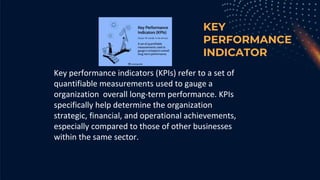
Key performance indicators (KPIs) refer to a set of
quantifiable measurements used to gauge a
organization overall long-term performance. KPIs
specifically help determine the organization
strategic, financial, and operational achievements,
especially compared to those of other businesses
within the same sector.
Understanding
KPI
● STRATEGIC
● OPERATIONAL
● FUNCTIONAL
● LEAD/ LAGGING
KPI Examples To Define and
Measure Nonprofit
organization Performance
Absentee rate of the employees ,
Amplification ,
Annual funds raised, Donation
growth rate
New donor acquisition rate etc.
ADVANTAGES
OF KPI
● KPIs help inform management of specific problems; the data-driven
approach provides quantifiable information useful in strategic planning
and ensuring operational excellence.
● KPIs help hold employees accountable. Instead of relying on feelings or
emotions, KPIs are statistically supported and cannot discriminate across
employees. When used appropriately, KPIs may help encourage
employees as they realize their numbers are being closely monitored.
WHAT IS A PROPER
KRA
CAN I DO MY OWN
KRA?...
LETS START WITH EACH
STEP
The first step is identifying the organization’s KPI (Key Performance Indicator), an
important area for employee contribution. However, all KPIs do not apply to every
employee.
Description of relevant responsibilities of employees according to
their job role is another important aspect.
The same job role may have different work responsibilities. Therefore, it is essential to document all of
them.
Categorization of achievement expectation from an employee is divided into two parts:
KRA…
Measurable – Achievements measured in numbers like the number of hires, number of training
conducted, increase in revenue, etc.
Immeasurable- Achievements that cannot be measured like brand value, productivity, etc.
The organization’s goal should be stated articulately. It should
have a measurable target and a realistic time frame.
Discussion of goals with the employees and their acceptance of
the same is also necessary.
The achievements and goals should be reviewed quarterly, and
when the organizational goals change, the employee goals
should also be changed.
A TIMELINE ALWAYS
WORKS WELL
Human Resource
Manager
KRA VS KPI
Gaant
chart
A Gantt chart is a bar chart
that visually represents a
project schedule. It's a
project management tool
that can be used to plan,
coordinate, and track tasks.
History and components
● Henry L. Gantt, an American
engineer and social scientist,
developed the Gantt chart in
1917 as a production control
tool.
● Tasks:
● Time:
● Duration:
● Timeline:
● Status:
● Responsibility:
A Gantt chart can:
• Provide a project roadmap
• Make it easier to manage, monitor, and organize project components
• Provide visibility into who, what, when, and where of a project
• Show the timelines of project steps, including dependencies and resources needed
A Gantt chart typically includes:
Horizontal axis: Time intervals
Vertical axis: Tasks to be performed
Horizontal bars: Duration of each activity
Color coding: Task responsibility
THANK YOU

organisation management.pptx

  • 1.
    Organaizational Management Training AN INTRODUCTION TO KEYPERFORMANCE AREAS AND KEY PERFORMANCE INDICATORS PRESENTER – SHARIF
  • 2.
    CONTENTS VISION of theorganization MISSION GOALS OBJECTIVES KEY PERFORMANCE AREA – KPI KEY PERFORMANCE INDICATORS – KPI DIFFERNCES BETWEEN KRA AND KPI
  • 3.
    Is Margadarshi a charityor non profit organization ?...
  • 4.
    01 MISSION A mission isa “general statement of how [the organization] will achieve the vision.” GOAL AND OBJECTIVE A goal describes what you want to achieve. they are the desired outcome or the final result Objectives can also be described as a series of steps or tasks that need to be completed in order to achieve the final goal. VISION vision of an organization is the “big picture of what you want to achieve, 02 03
  • 5.
  • 6.
    GOAL AND OBJECTIVE Agoal describes what you want to achieve. they are the desired outcome or the final result of an endeavor. Goals are broad since they reflect the general intention. OBJECTIVE specific and concrete plans. Goals can be broken down into several objectives. They define how the goal is going to be achieved. Objectives can also be described as a series of steps or tasks that need to be completed in order to achieve the final goal.
  • 7.
    WRITE ANY TWOGOALS OF THE ORGANISATION 01 UR TIME STARTS NOW …1,2,3….
  • 8.
    LETS KNOW ABOUT- KRA KEY RESPONSIBILITY AREA….. WHATS THAT ? 1. A Key Responsibility Area or KRA is the detailed summary of what the employee is supposed to work on 2. It gives clear description of what employees should do, how they should do it, 3.,It gives employees a clearer picture of their roles and responsibilities and gives them a sense of direction while working.
  • 9.
    WHY KRA ISIMPORTANT FOR ANY ORGANISATION ? 1. TEAM ALIGNMENT 2. MAKE SPECIFIC ADJUSTMENTS 3. HOLD YOURT TEAM ACCOUNTABLE 4. MONITOR FINANCIAL HEALTH 5. PROGRESS -OVERALL
  • 10.
    3 MAJOR ZONESWHERE NEED MORE ATTENTION STAFF ACCOUNTABILITY Use KPIs as a performance metric to ensure all employees perform at a certain standard FINANCIAL EVALUATION Gives you an accurate estimation of your company's financial health TEAM ALIGNMENT Selecting and tracking KPIs helps your team make data-driven decisions and keep your organizational goals aligned
  • 11.
    FAR IS ALWAYS NOTFAR WHEN EACH STEP CONTRIBUTES WELL…
  • 12.
    KEY PERFORMANCE INDICATOR Key performance indicators(KPIs) refer to a set of quantifiable measurements used to gauge a organization overall long-term performance. KPIs specifically help determine the organization strategic, financial, and operational achievements, especially compared to those of other businesses within the same sector.
  • 13.
  • 14.
    KPI Examples ToDefine and Measure Nonprofit organization Performance Absentee rate of the employees , Amplification , Annual funds raised, Donation growth rate New donor acquisition rate etc.
  • 15.
    ADVANTAGES OF KPI ● KPIshelp inform management of specific problems; the data-driven approach provides quantifiable information useful in strategic planning and ensuring operational excellence. ● KPIs help hold employees accountable. Instead of relying on feelings or emotions, KPIs are statistically supported and cannot discriminate across employees. When used appropriately, KPIs may help encourage employees as they realize their numbers are being closely monitored.
  • 16.
    WHAT IS APROPER KRA CAN I DO MY OWN KRA?...
  • 17.
    LETS START WITHEACH STEP The first step is identifying the organization’s KPI (Key Performance Indicator), an important area for employee contribution. However, all KPIs do not apply to every employee. Description of relevant responsibilities of employees according to their job role is another important aspect. The same job role may have different work responsibilities. Therefore, it is essential to document all of them. Categorization of achievement expectation from an employee is divided into two parts:
  • 18.
    KRA… Measurable – Achievementsmeasured in numbers like the number of hires, number of training conducted, increase in revenue, etc. Immeasurable- Achievements that cannot be measured like brand value, productivity, etc.
  • 19.
    The organization’s goalshould be stated articulately. It should have a measurable target and a realistic time frame. Discussion of goals with the employees and their acceptance of the same is also necessary. The achievements and goals should be reviewed quarterly, and when the organizational goals change, the employee goals should also be changed.
  • 20.
    A TIMELINE ALWAYS WORKSWELL Human Resource Manager
  • 21.
  • 22.
    Gaant chart A Gantt chartis a bar chart that visually represents a project schedule. It's a project management tool that can be used to plan, coordinate, and track tasks.
  • 23.
    History and components ●Henry L. Gantt, an American engineer and social scientist, developed the Gantt chart in 1917 as a production control tool. ● Tasks: ● Time: ● Duration: ● Timeline: ● Status: ● Responsibility:
  • 24.
    A Gantt chartcan: • Provide a project roadmap • Make it easier to manage, monitor, and organize project components • Provide visibility into who, what, when, and where of a project • Show the timelines of project steps, including dependencies and resources needed A Gantt chart typically includes: Horizontal axis: Time intervals Vertical axis: Tasks to be performed Horizontal bars: Duration of each activity Color coding: Task responsibility
  • 25.