Peter & Amy Vingerhoeds
RR 1 Hensall, ON
NOM 1X0
519-229-8810
avingerhoeds@quadro.net
Keeping Better Records
Humble beginnings
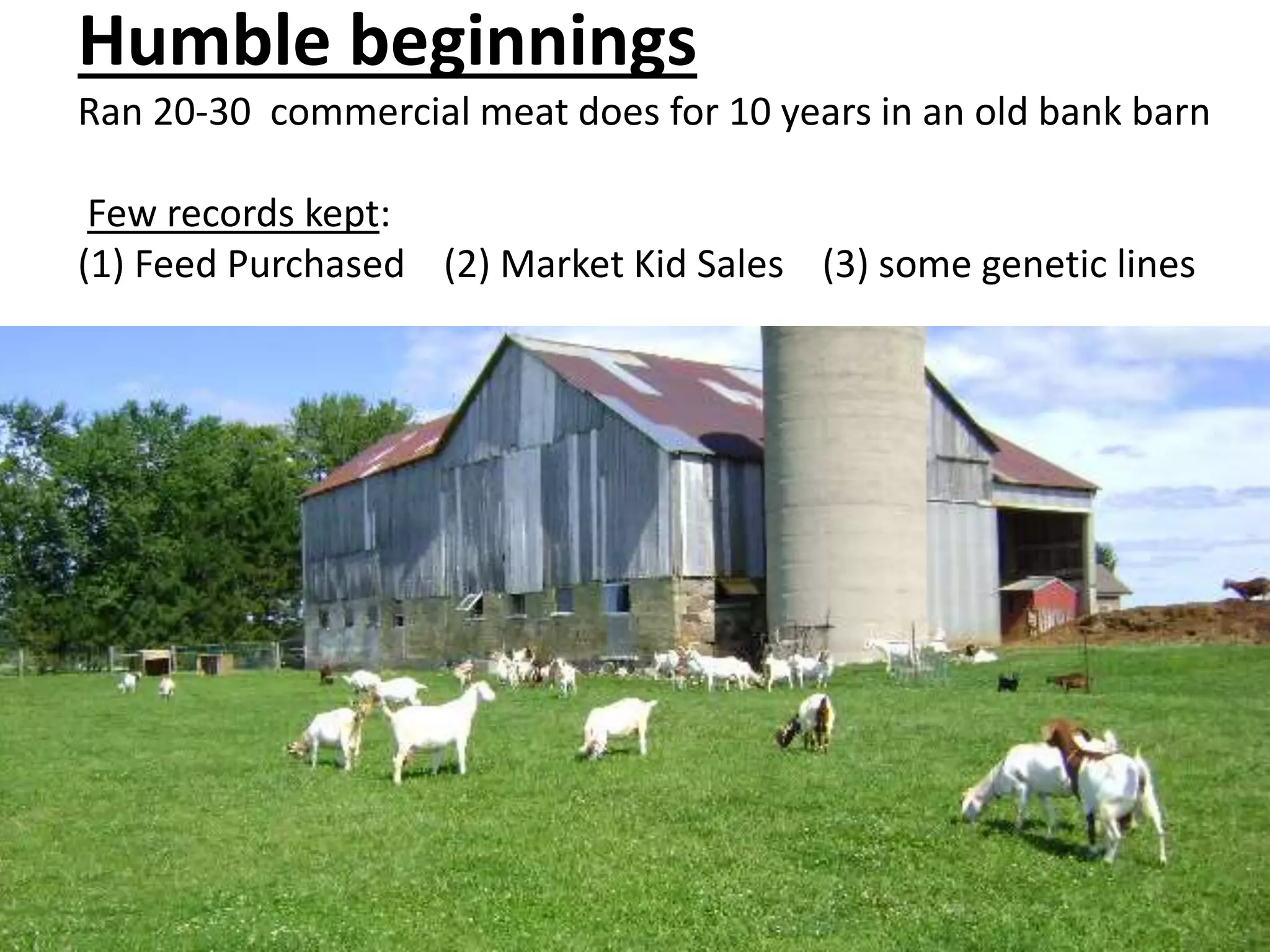
Ran 20-30 commercial meat does for 10 years in an old bank barn
Few records kept:
(1) Feed Purchased (2) Market Kid Sales (3) some genetic lines
ISSUES:
Who stays? Who goes?
Which sire should we (not) use?
Can we do better?
Participated in our first
Ontario Goat studies
2011-2012
Q-fever testing
CAE testing
New Barn Construction 2012
Herd Expansion
PERFECT time to improve management & records
1. Sell goats at:
optimum weight for optimum price.
2. Select best replacements to increase herd
3. Know our production – numbers & costs
OUR FARM GOALS
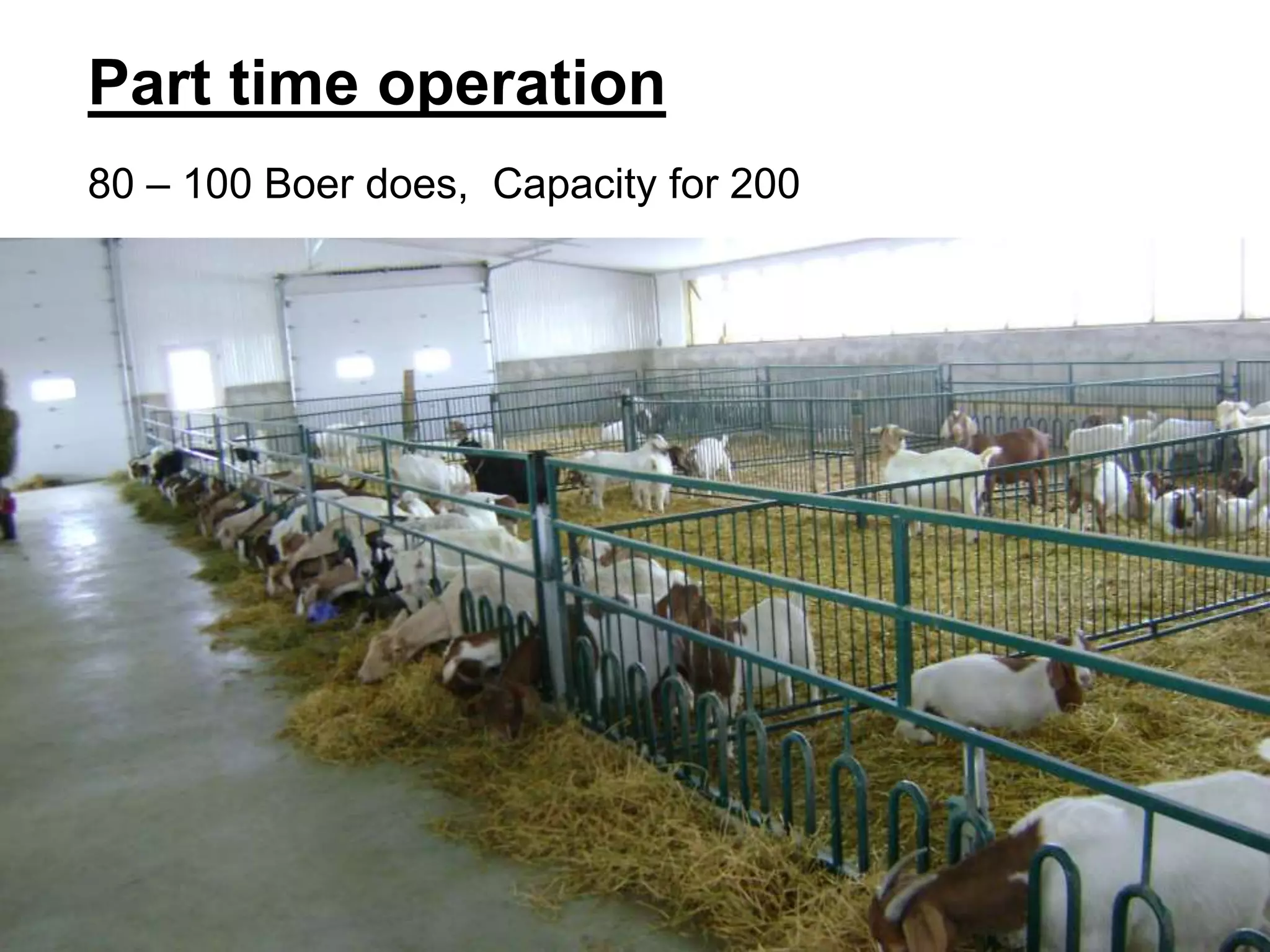
Part time operation
80 – 100 Boer does, Capacity for 200
IDENTIFY GOATS
Step 1
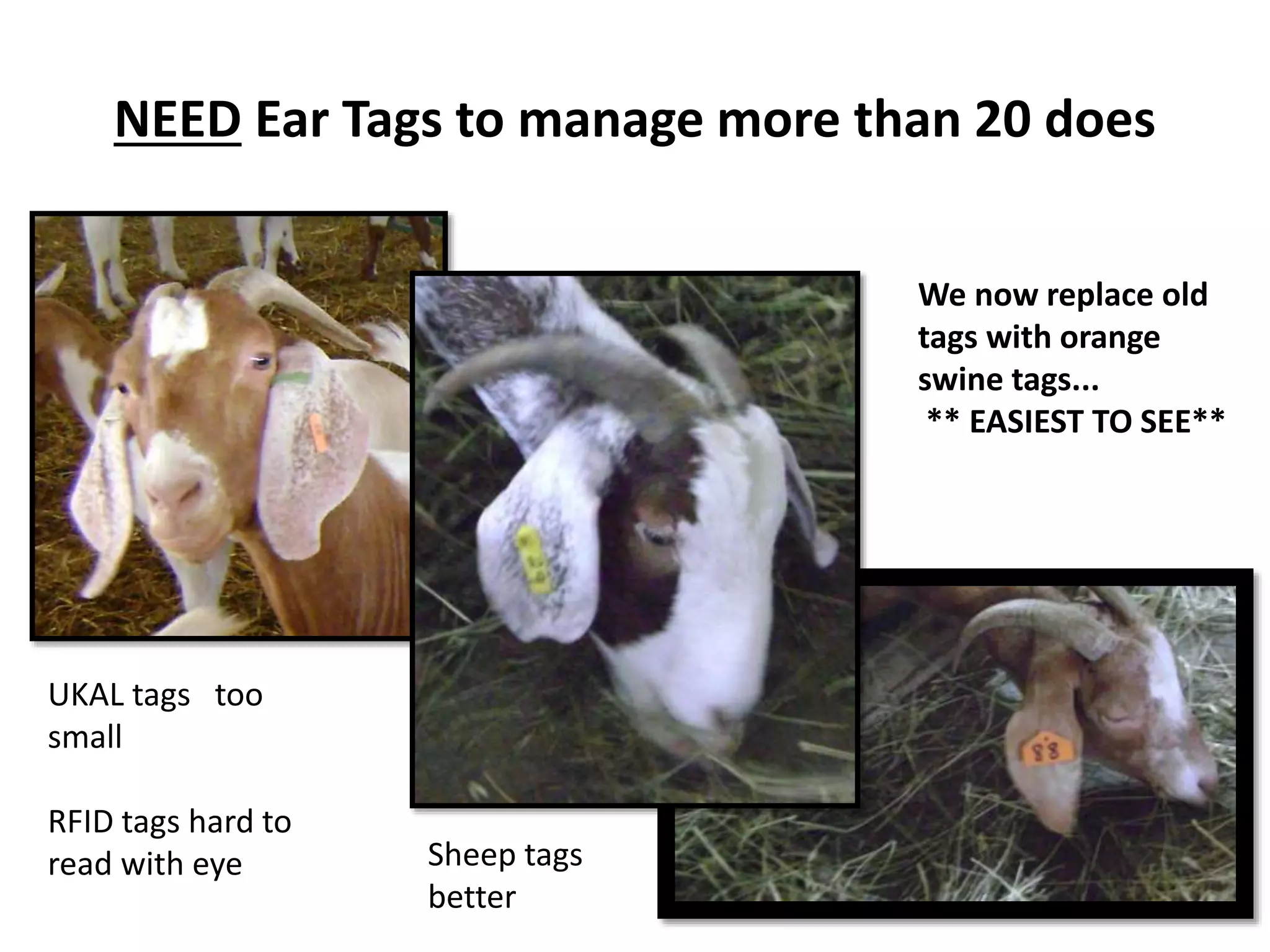
NEED Ear Tags to manage more than 20 does
Sheep tags
better
UKAL tags too
small
RFID tags hard to
read with eye
We now replace old
tags with orange
swine tags...
** EASIEST TO SEE**
Pilot Herd – O.G. Traceability Project
•RFID eartags on 100 animals in herd
•OPPORTUNITY to try out tag system before we have to invest
•Roughly 1 ½ years after trial, 80-85% retention, and a few
ripped ears from sheep clips
•Use RFID tags as secondary ID if management tags lost
IDEAL USE for us – WEIGHING & SCANNING with Digital scale
Better kidding records
Step 2
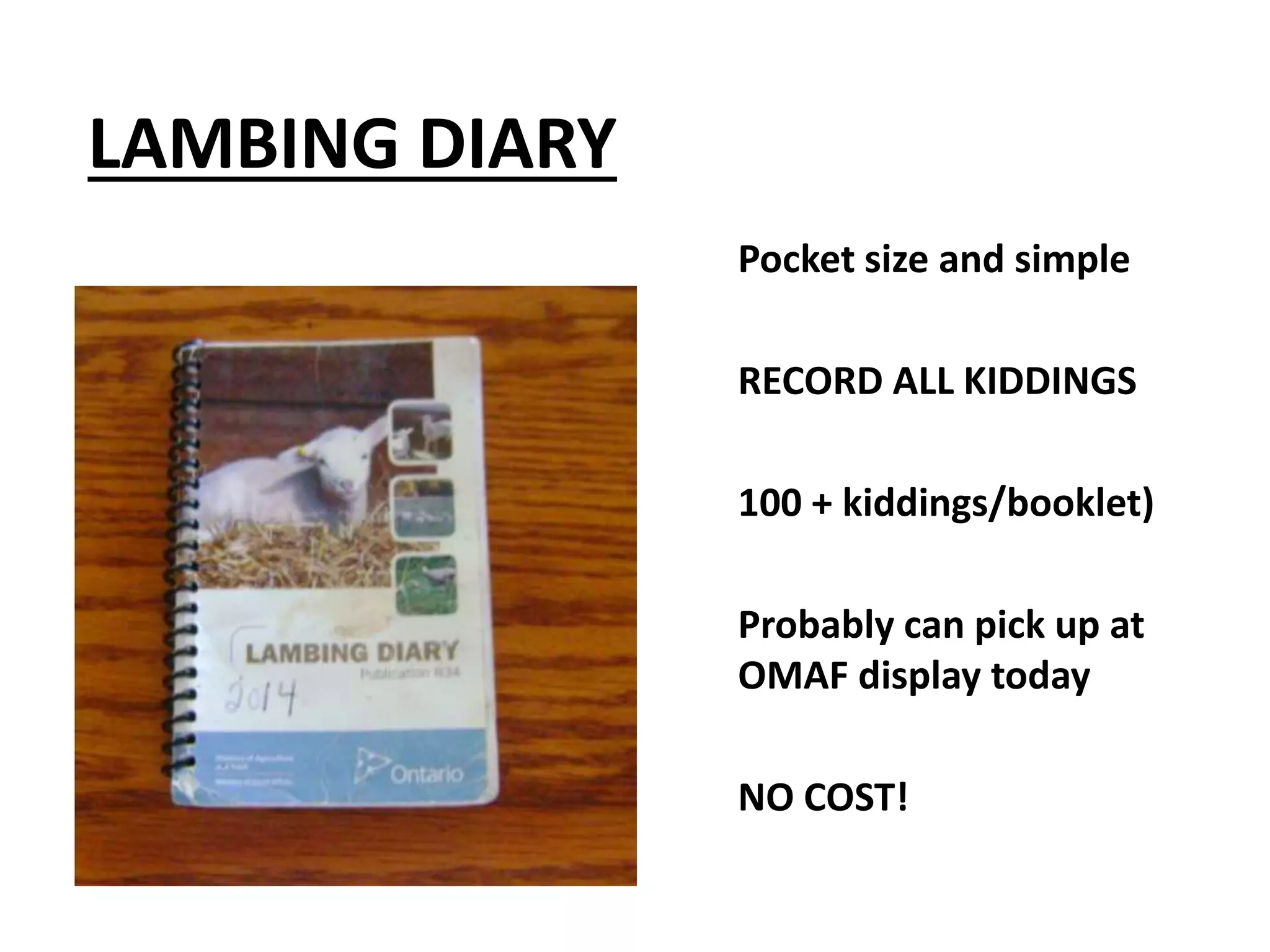
LAMBING DIARY
Pocket size and simple
RECORD ALL KIDDINGS
100 + kiddings/booklet)
Probably can pick up at
OMAF display today
NO COST!
New Kid Protocol
 first 12-24 hours, kids are weighed on hanging scale
 Colours and identifying markings are written down
 Sire and dam are recorded as well as pen #
 EAR TAGS applied to right ear
 Sequential tag order used
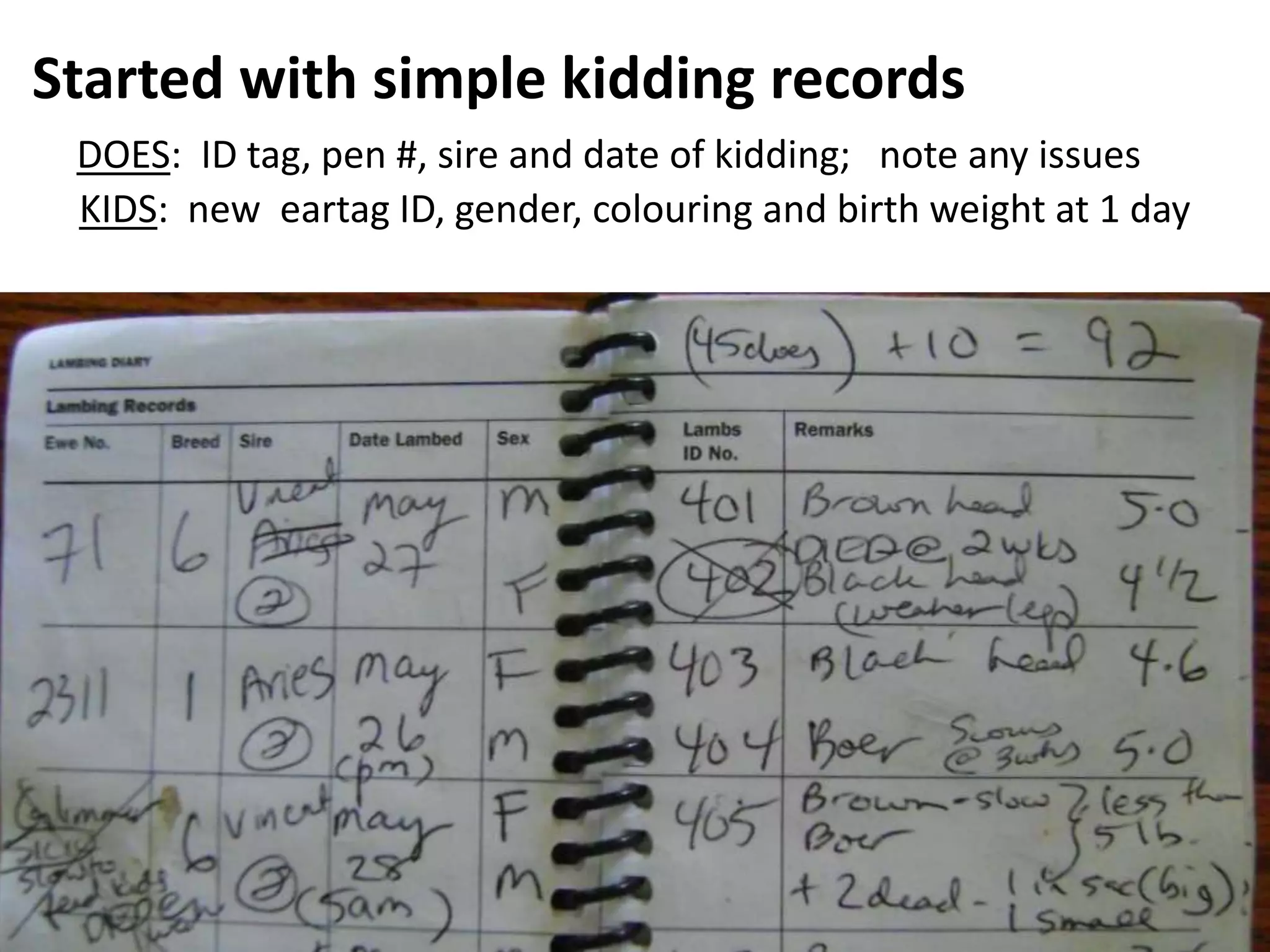
Started with simple kidding records
DOES: ID tag, pen #, sire and date of kidding; note any issues
KIDS: new eartag ID, gender, colouring and birth weight at 1 day
TAG ALL NEW KIDS and
RECORD BIRTH WEIGHTS ON FIRST DAY
1) Don’t mix up any kids and mothers
2) Keep running tally of # kiddings and # kids
3) Easy to keep a few notes on health /
mortality in early days
ENTER DATA LATER ON Excel SPREADSHEET
Benefits of using the LAMB DIARY
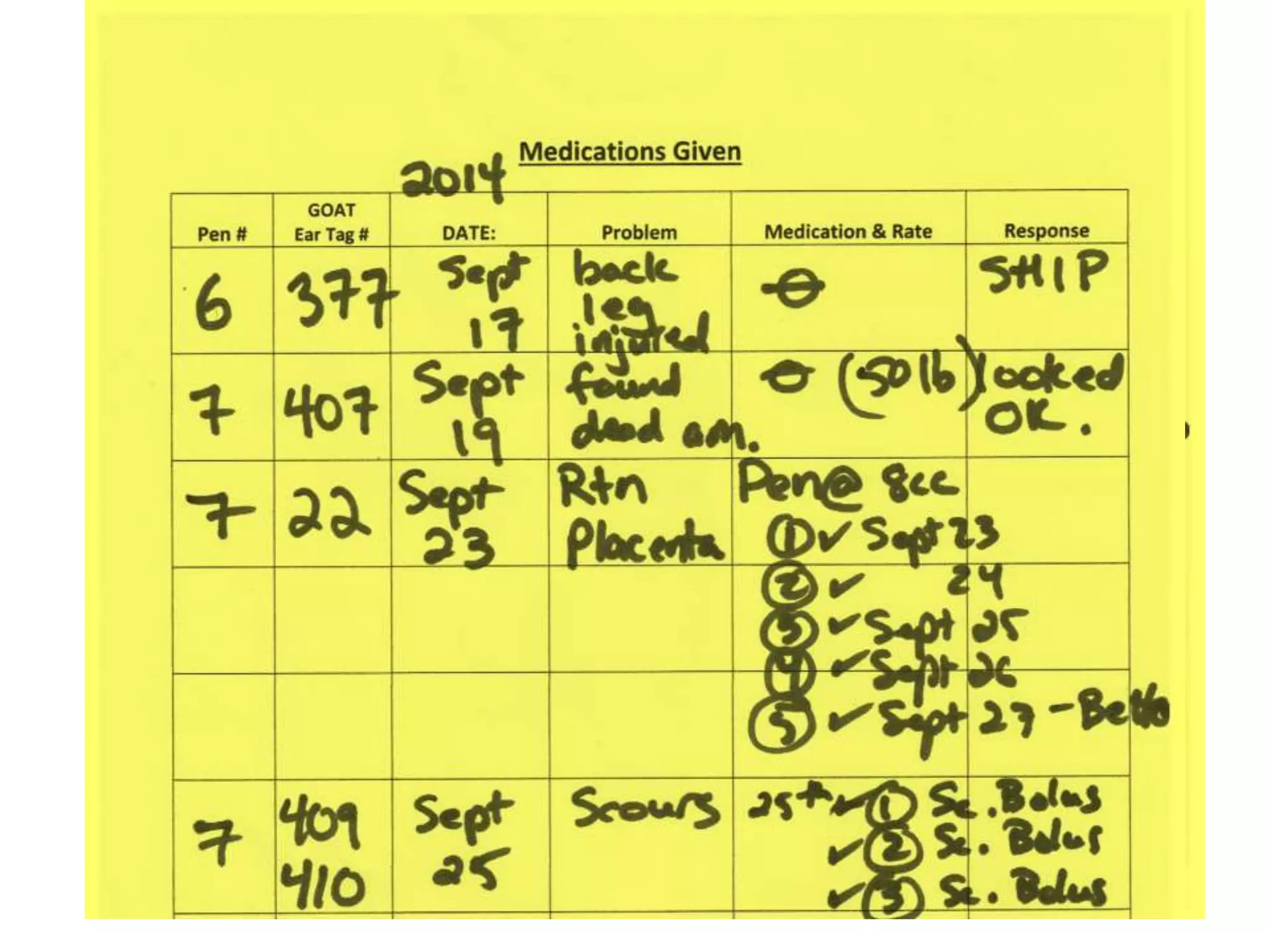
Medication Records
Step 3
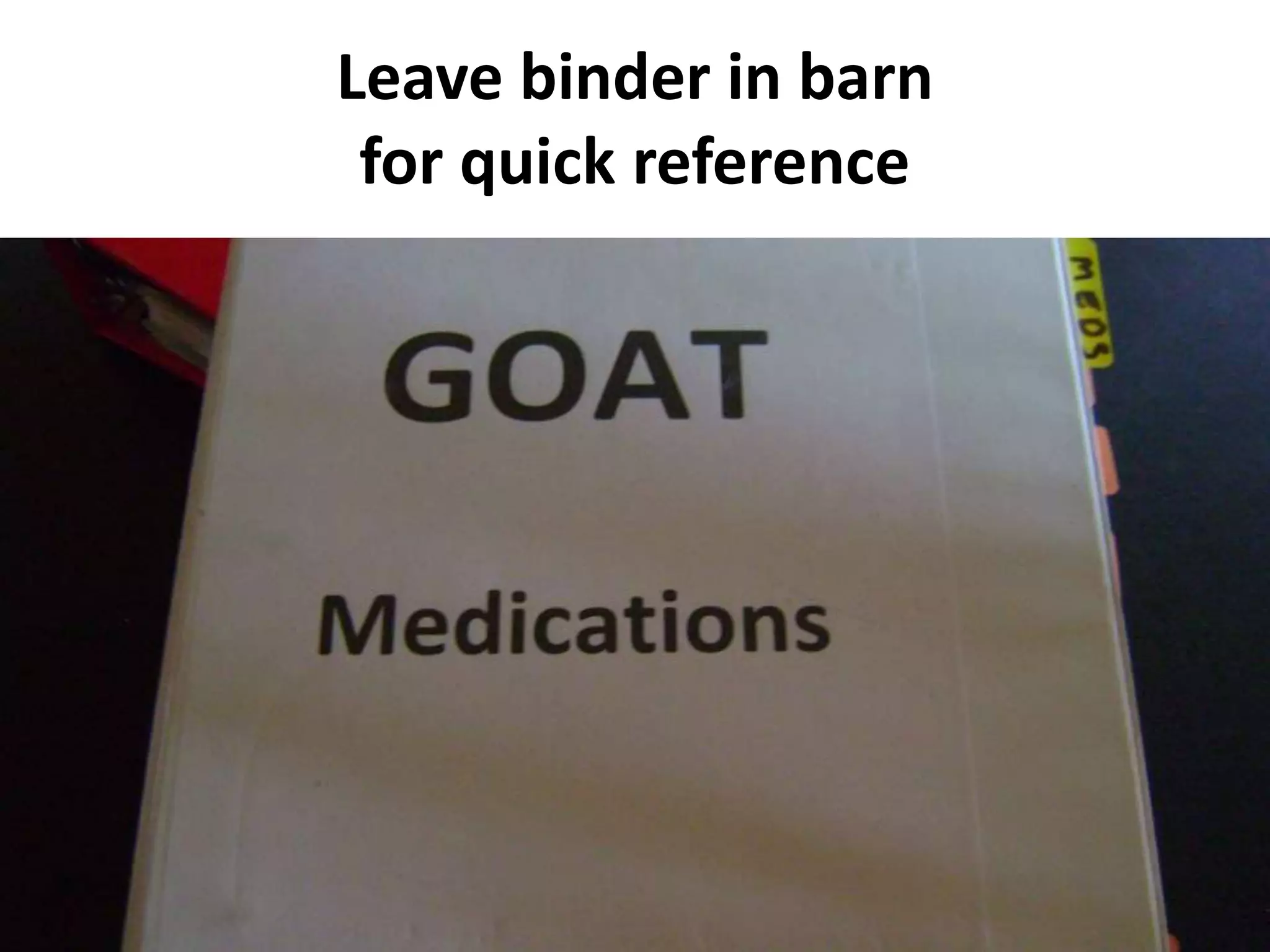
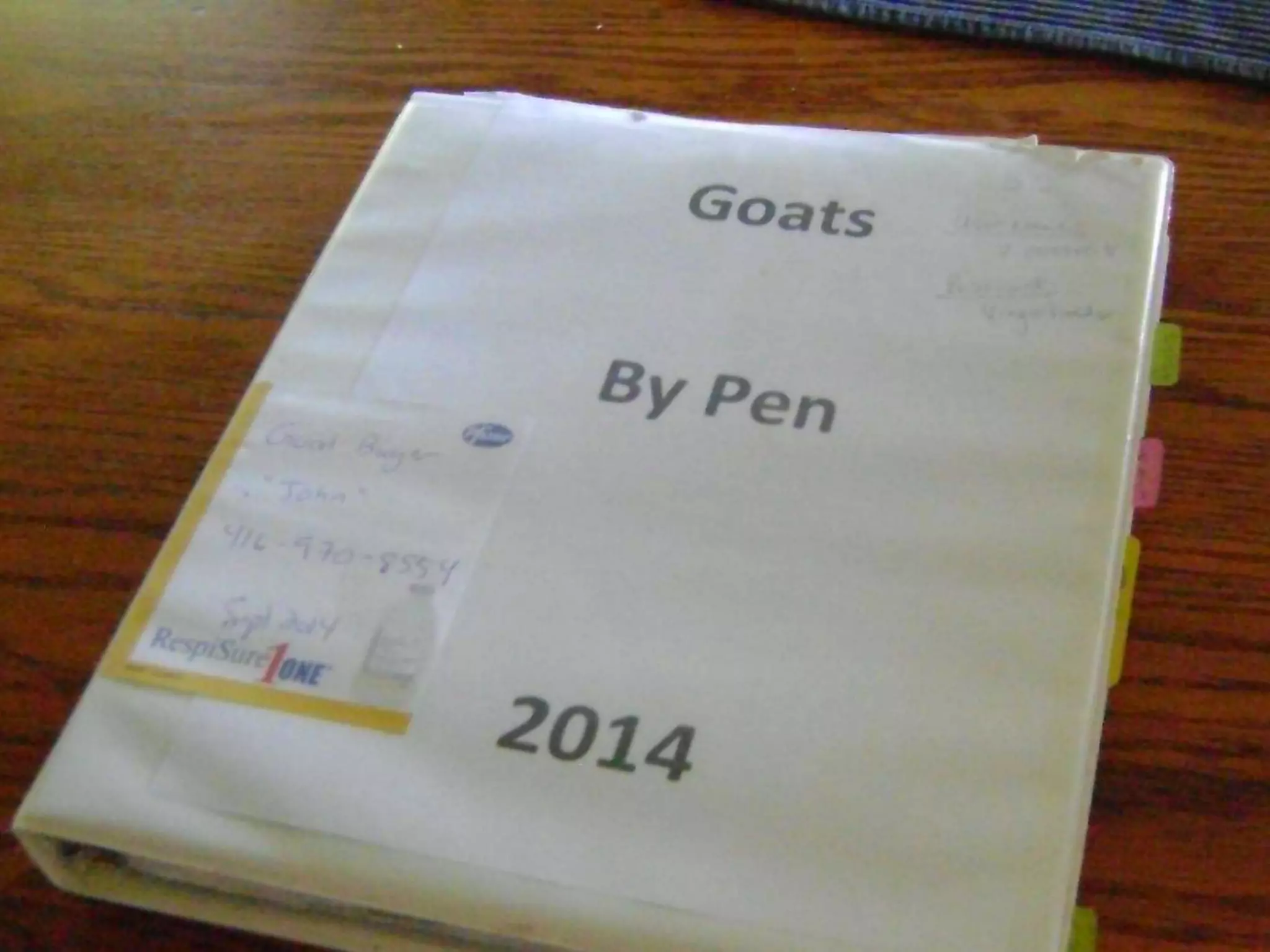
Leave binder in barn
for quick reference
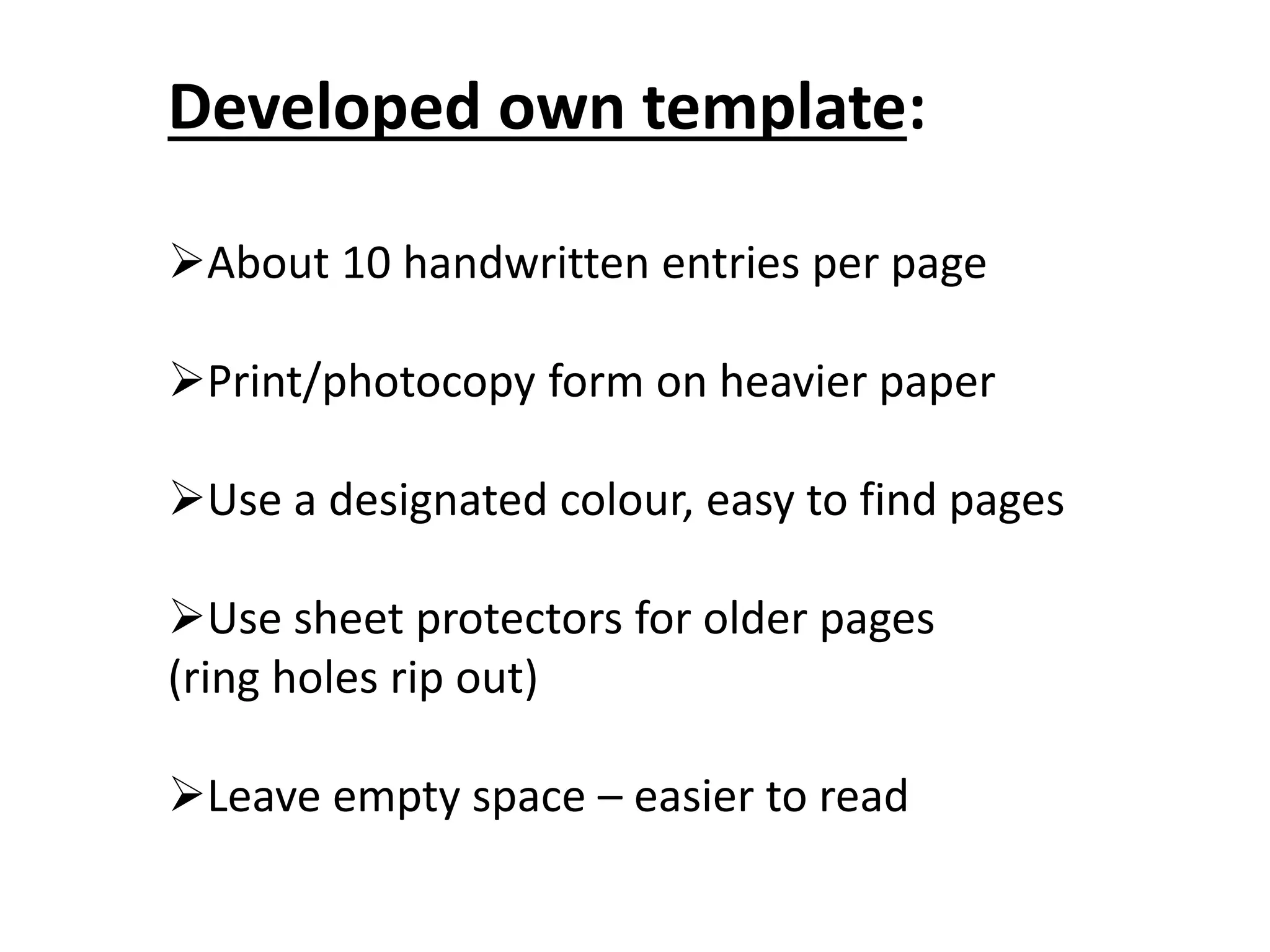
Developed own template:
About 10 handwritten entries per page
Print/photocopy form on heavier paper
Use a designated colour, easy to find pages
Use sheet protectors for older pages
(ring holes rip out)
Leave empty space – easier to read
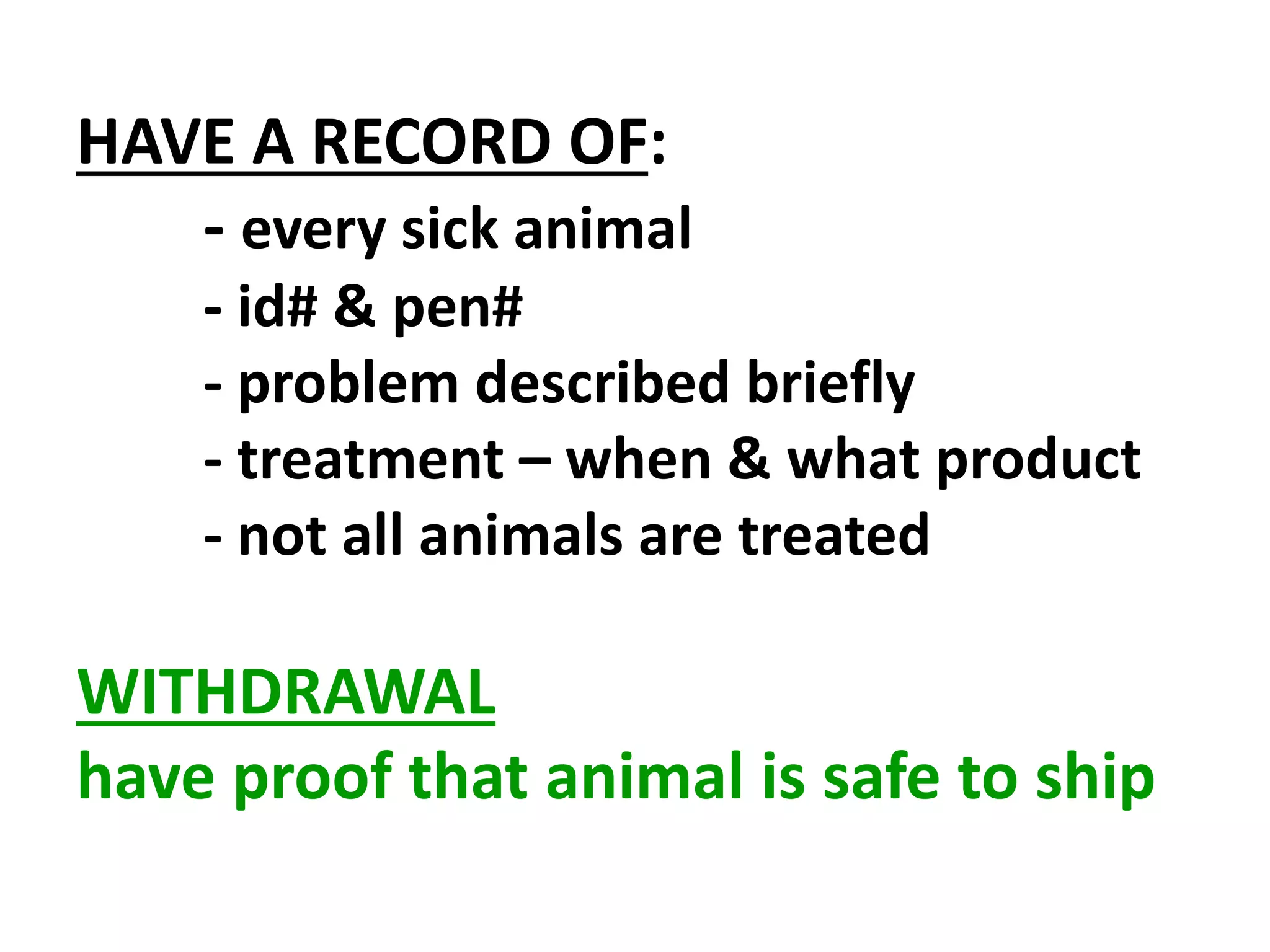
HAVE A RECORD OF:
- every sick animal
- id# & pen#
- problem described briefly
- treatment – when & what product
- not all animals are treated
WITHDRAWAL
have proof that animal is safe to ship
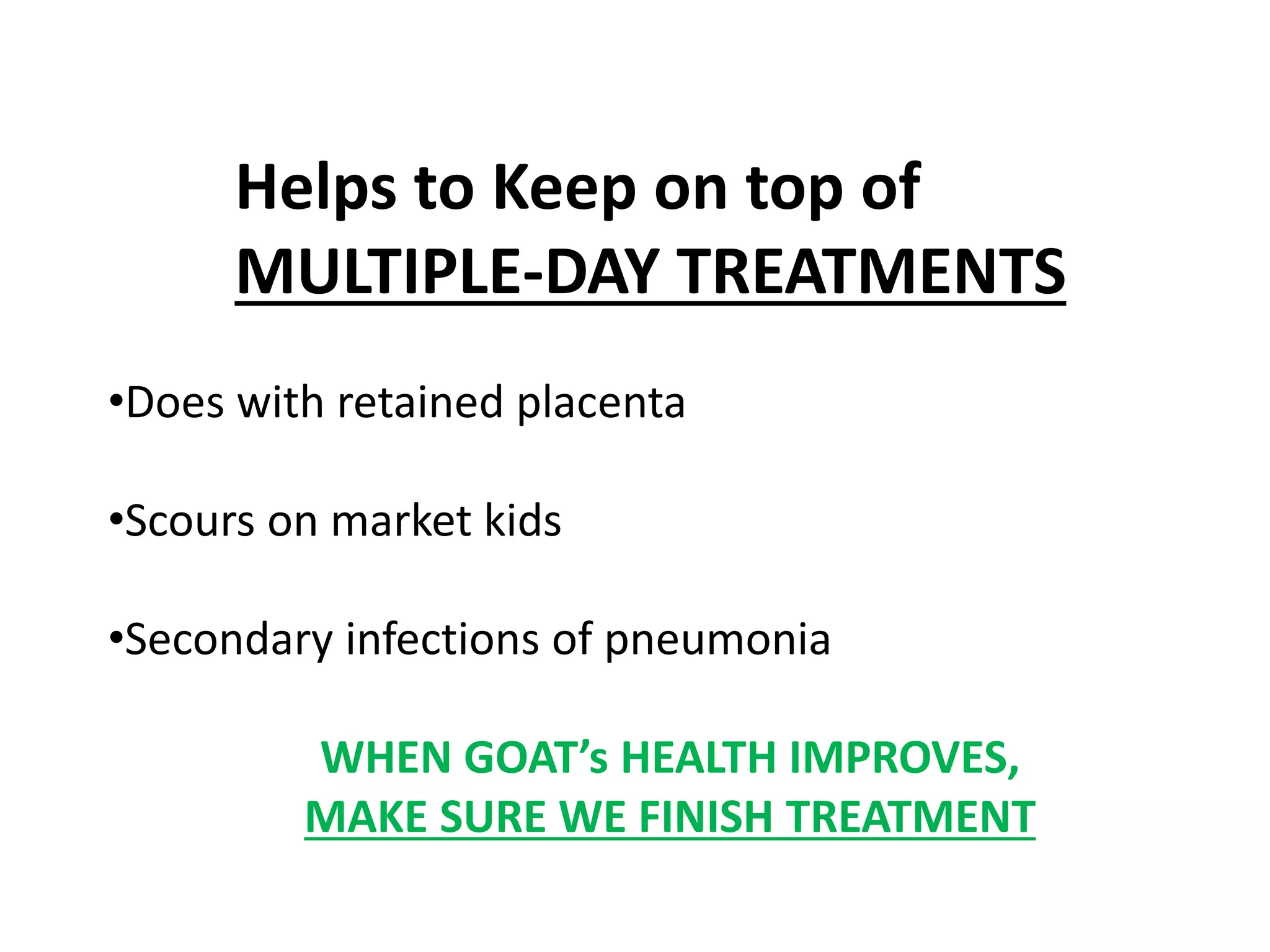
Helps to Keep on top of
MULTIPLE-DAY TREATMENTS
•Does with retained placenta
•Scours on market kids
•Secondary infections of pneumonia
WHEN GOAT’s HEALTH IMPROVES,
MAKE SURE WE FINISH TREATMENT
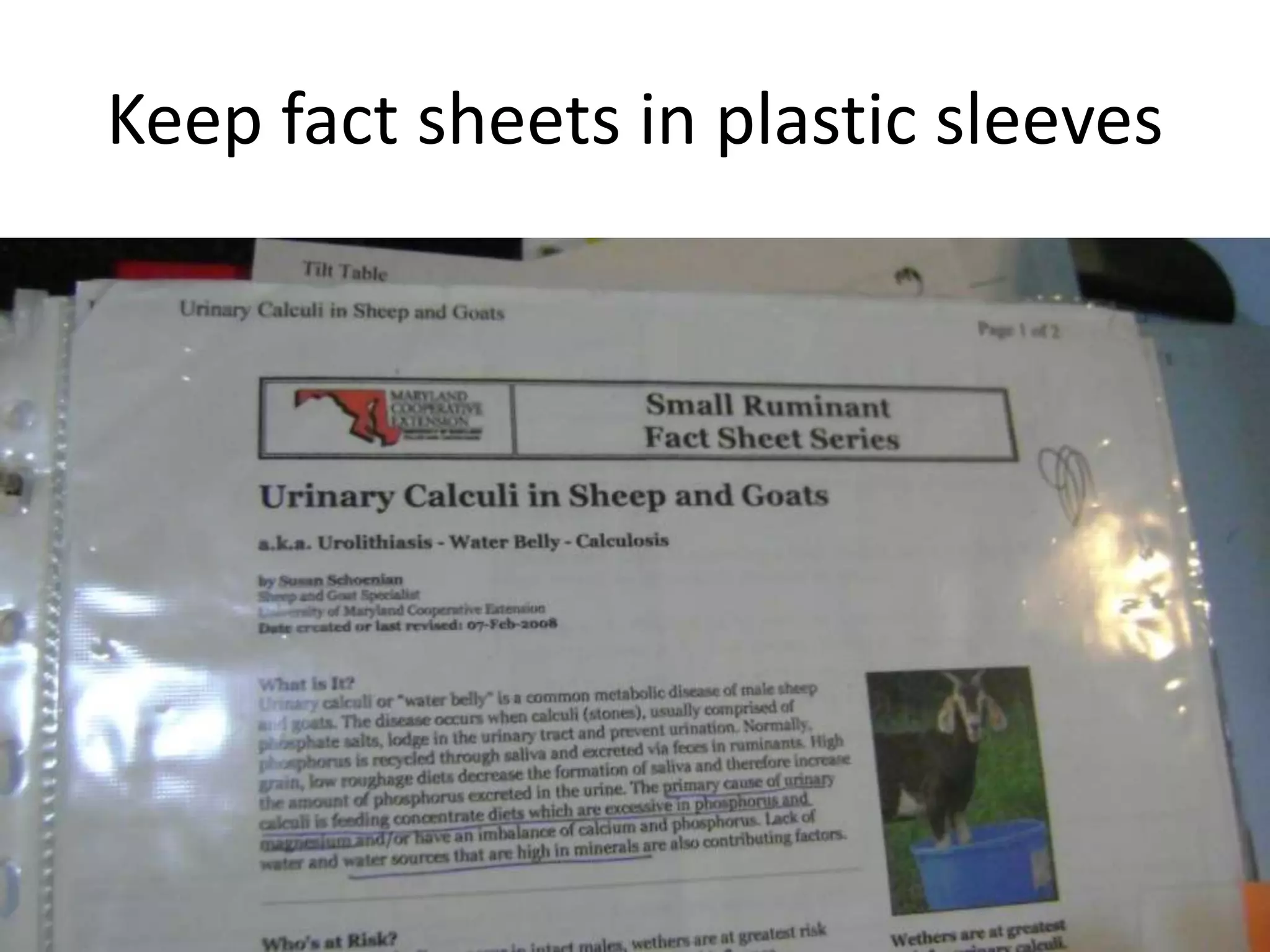
Keep fact sheets in plastic sleeves
BUILD A GOAT LIBRARY
•Save all vet scripts and vet recommendations
•Save diagnostic / treatment info from reliable
sources
•Save any test results
•Save vaccination lists
•CRITICAL RESOURCE with so few registered
medications for goats
Feeding Records
Step 4
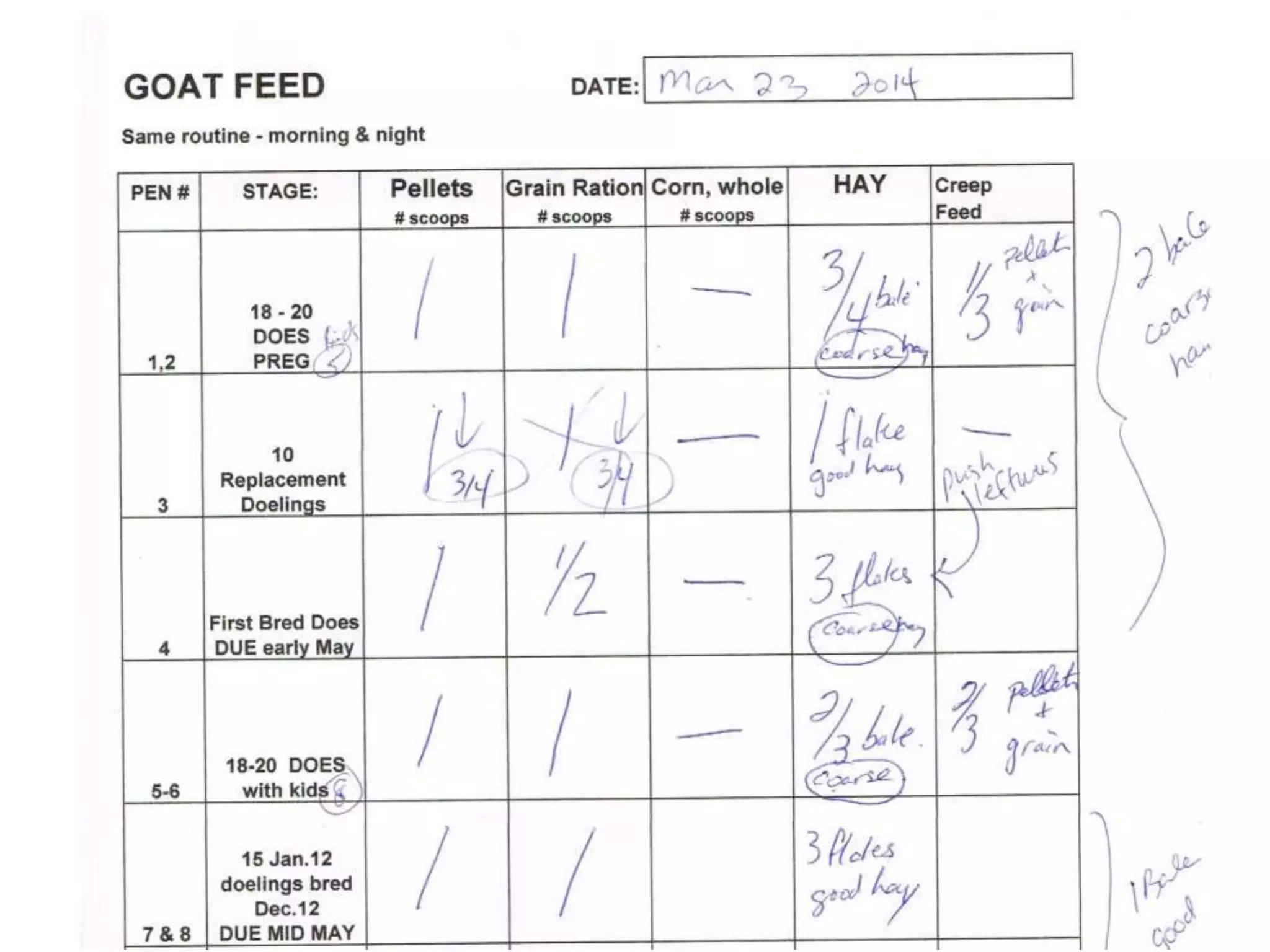
FEED SHEETS originally prepared as instructions
for our relief chore person
Update every couple months
Record of amounts fed to each group
Goat numbers/stage in each pen
Get a snapshot of feed consumption & costs
BASIC SCHOOL SUPPLIES
binders
sheet protectors
photocopier/printer
Weighing Market Kids
Benchmarking
Step 5
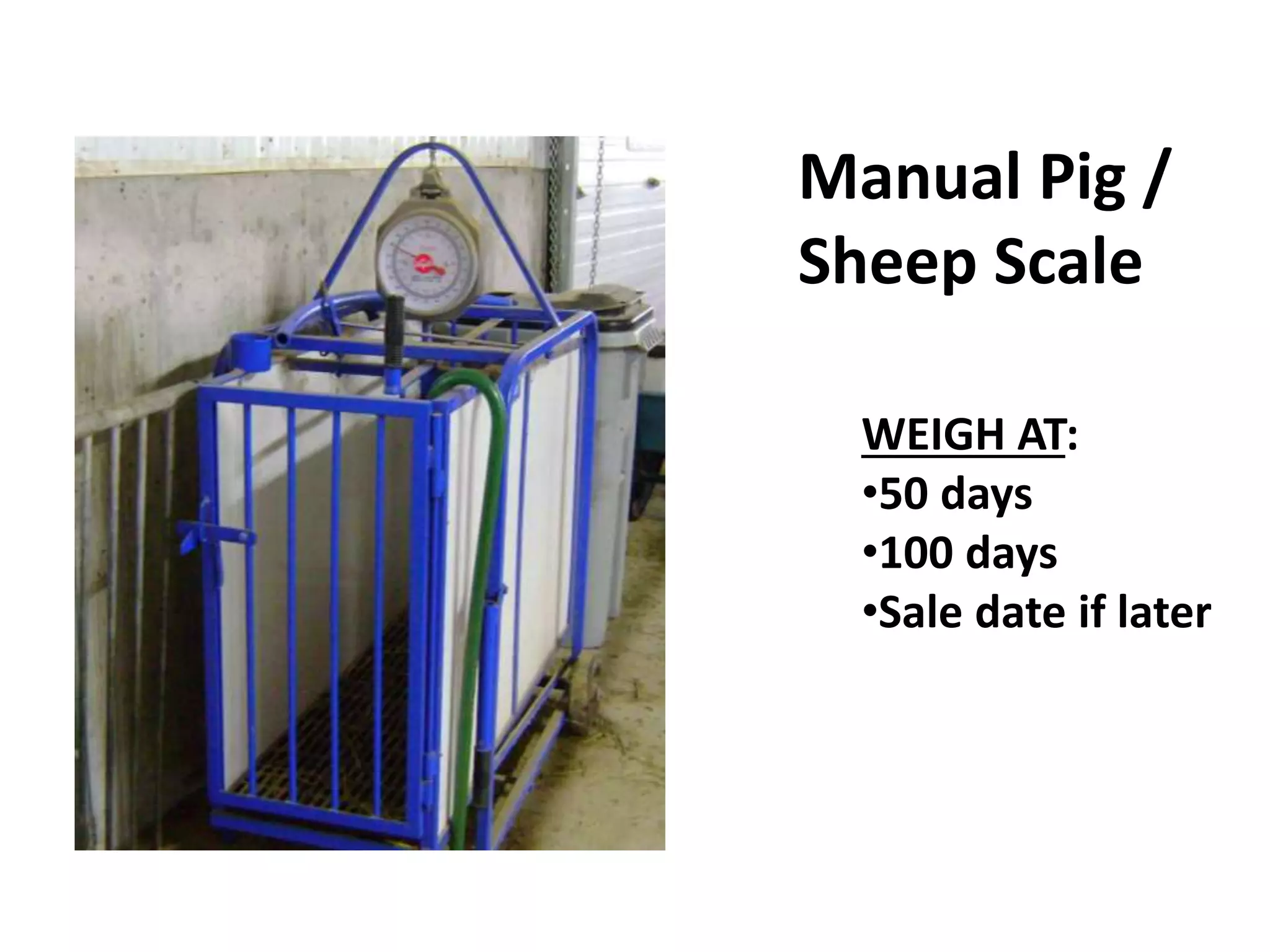
Manual Pig /
Sheep Scale
WEIGH AT:
•50 days
•100 days
•Sale date if later
WEIGHING Market Kids
KEY IMPROVEMENT in goat operation
Provides us MOST information
Measure growth, calculate ADG
Best way to improve marketing
Setting up Record Sheets
ONE PAGE per PEN
Step 6
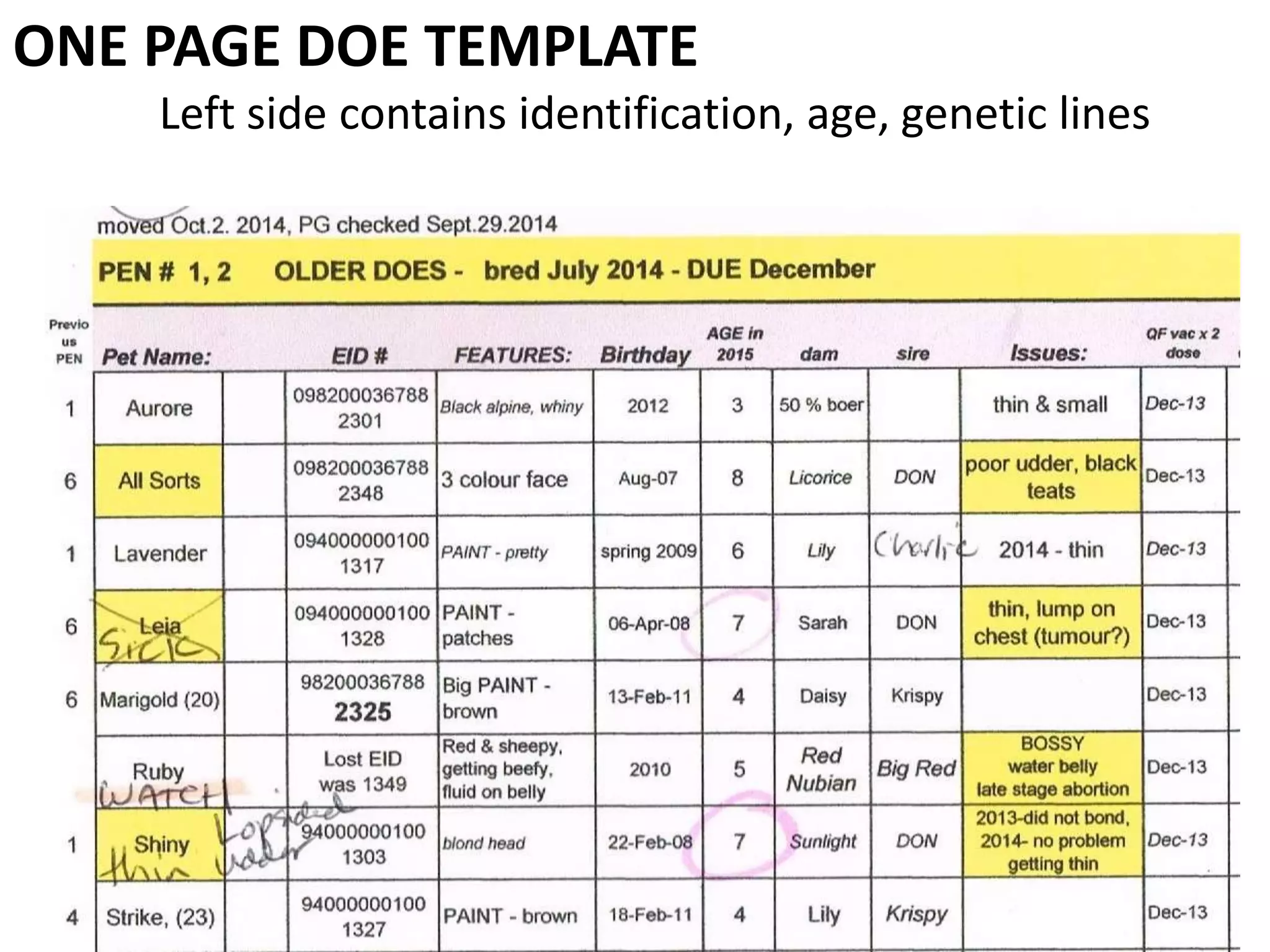
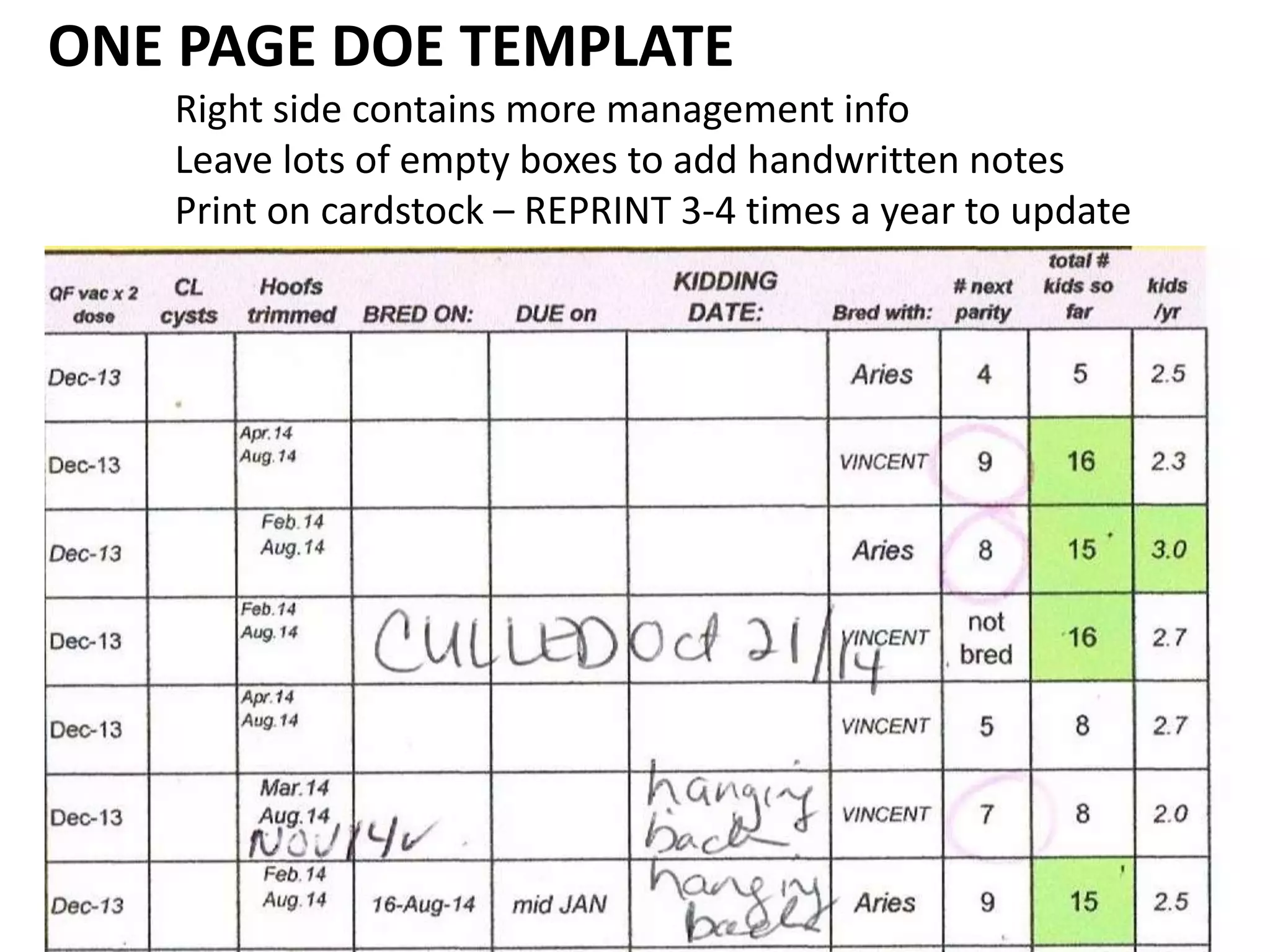
ONE PAGE DOE TEMPLATE
Left side contains identification, age, genetic lines
ONE PAGE DOE TEMPLATE
Right side contains more management info
Leave lots of empty boxes to add handwritten notes
Print on cardstock – REPRINT 3-4 times a year to update
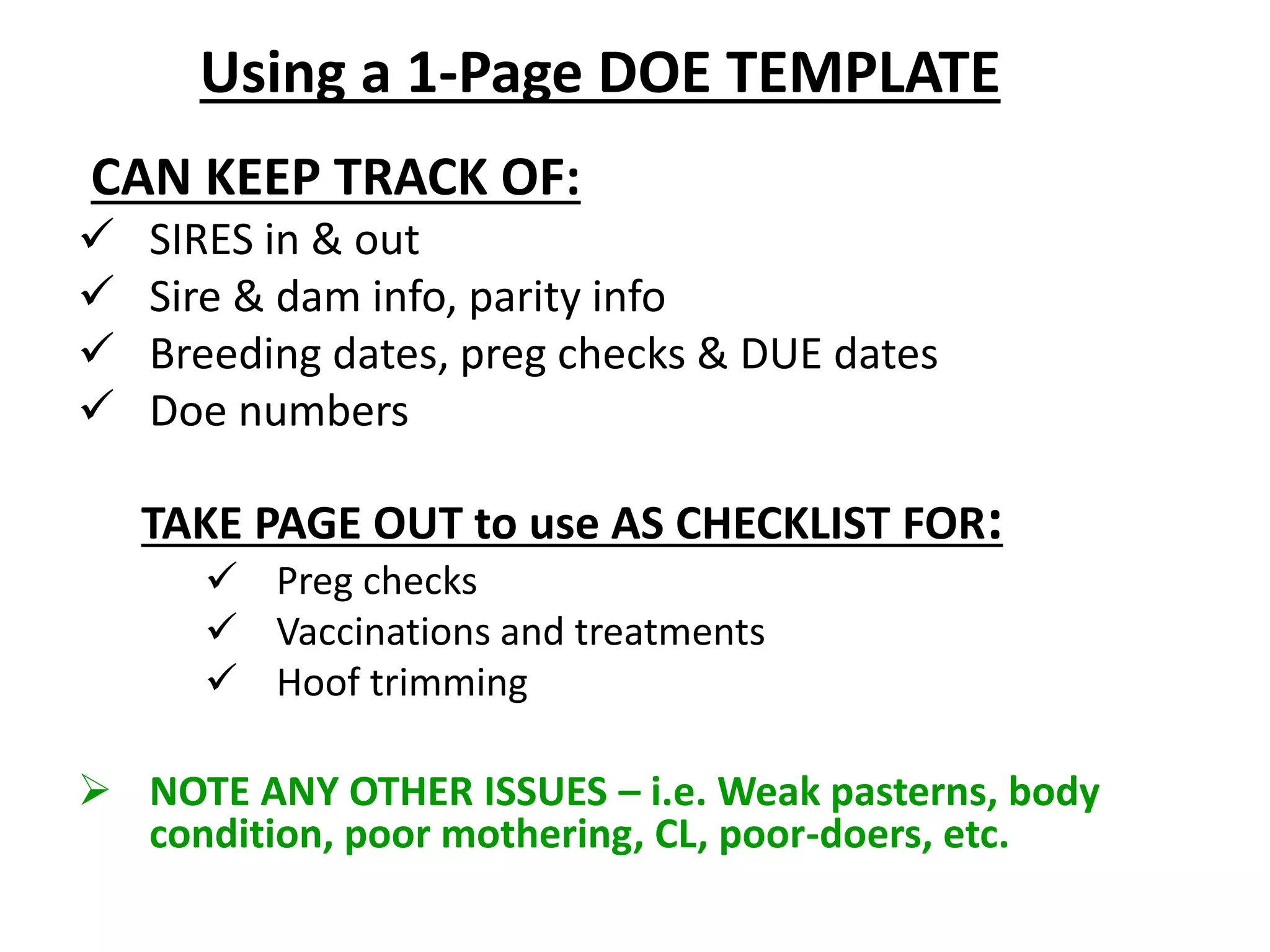
CAN KEEP TRACK OF:
 SIRES in & out
 Sire & dam info, parity info
 Breeding dates, preg checks & DUE dates
 Doe numbers
TAKE PAGE OUT to use AS CHECKLIST FOR:
 Preg checks
 Vaccinations and treatments
 Hoof trimming
 NOTE ANY OTHER ISSUES – i.e. Weak pasterns, body
condition, poor mothering, CL, poor-doers, etc.
Using a 1-Page DOE TEMPLATE
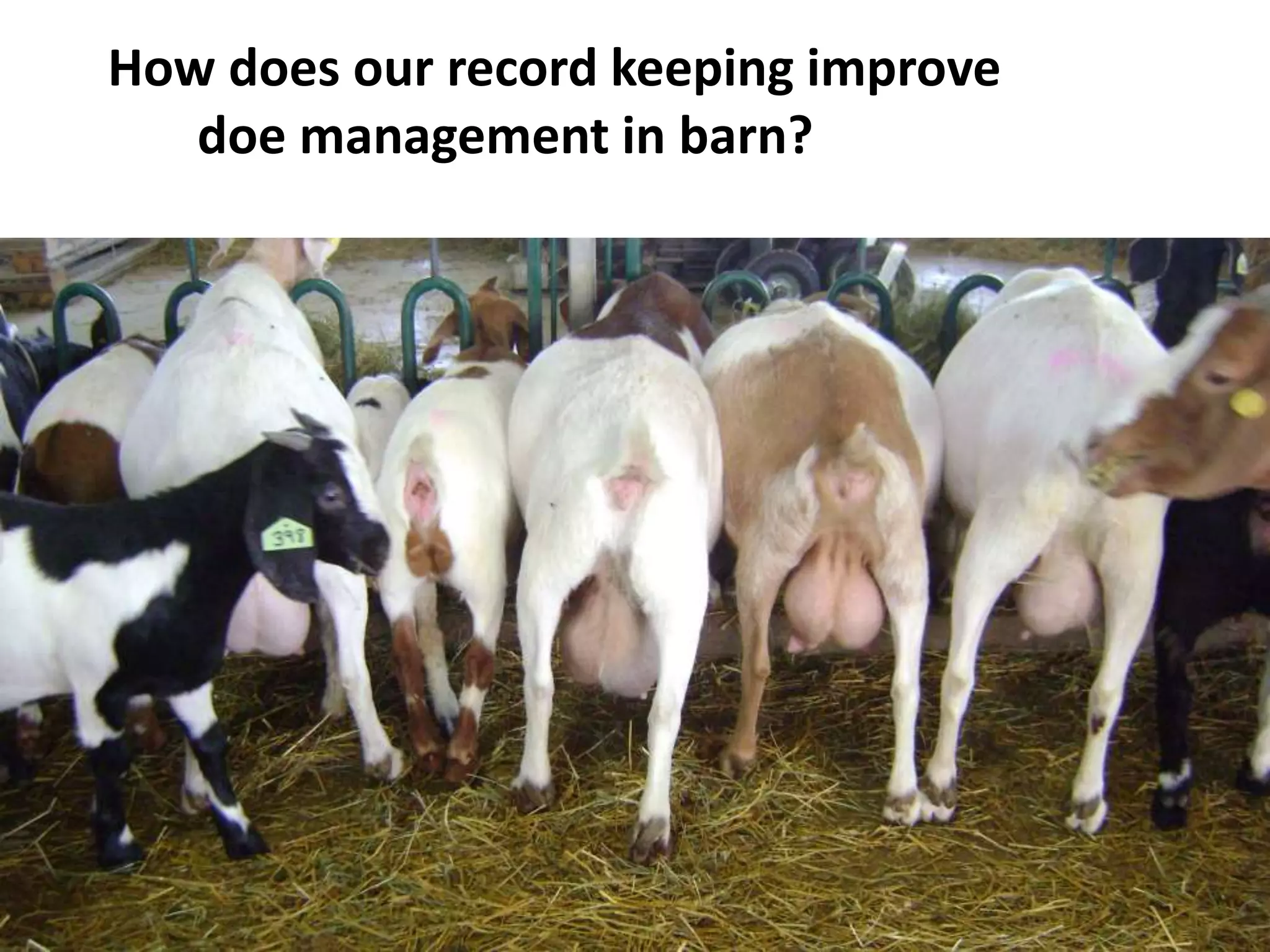
How does our record keeping improve
doe management in barn?
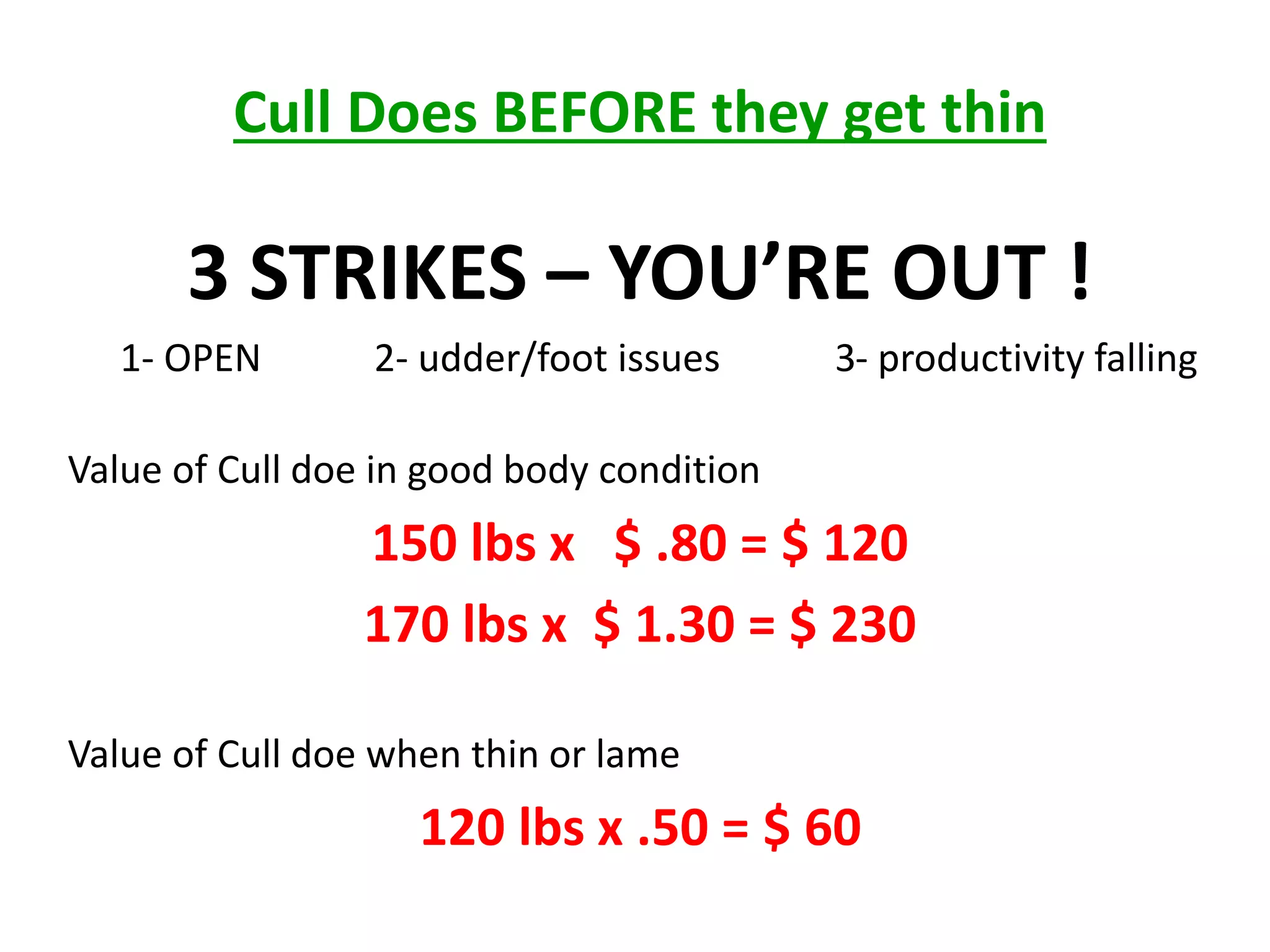
Cull Does BEFORE they get thin
3 STRIKES – YOU’RE OUT !
1- OPEN 2- udder/foot issues 3- productivity falling
Value of Cull doe in good body condition
150 lbs x $ .80 = $ 120
170 lbs x $ 1.30 = $ 230
Value of Cull doe when thin or lame
120 lbs x .50 = $ 60
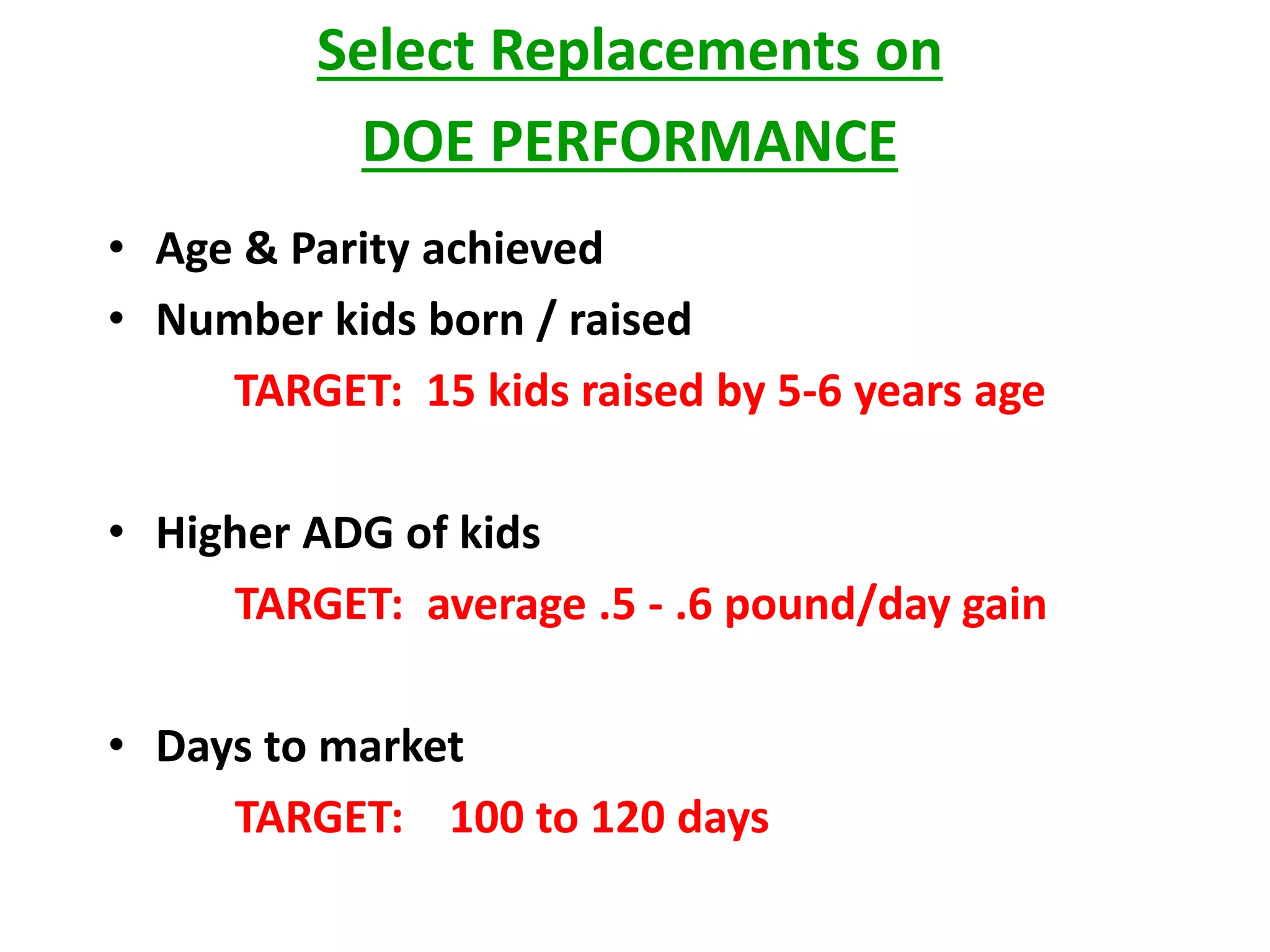
Select Replacements on
DOE PERFORMANCE
• Age & Parity achieved
• Number kids born / raised
TARGET: 15 kids raised by 5-6 years age
• Higher ADG of kids
TARGET: average .5 - .6 pound/day gain
• Days to market
TARGET: 100 to 120 days
Have enough info to figure out:
• Regularity of Hoof clipping
• Vaccinations & boosters
• Breeding dates & Sire info
• Movement between pens
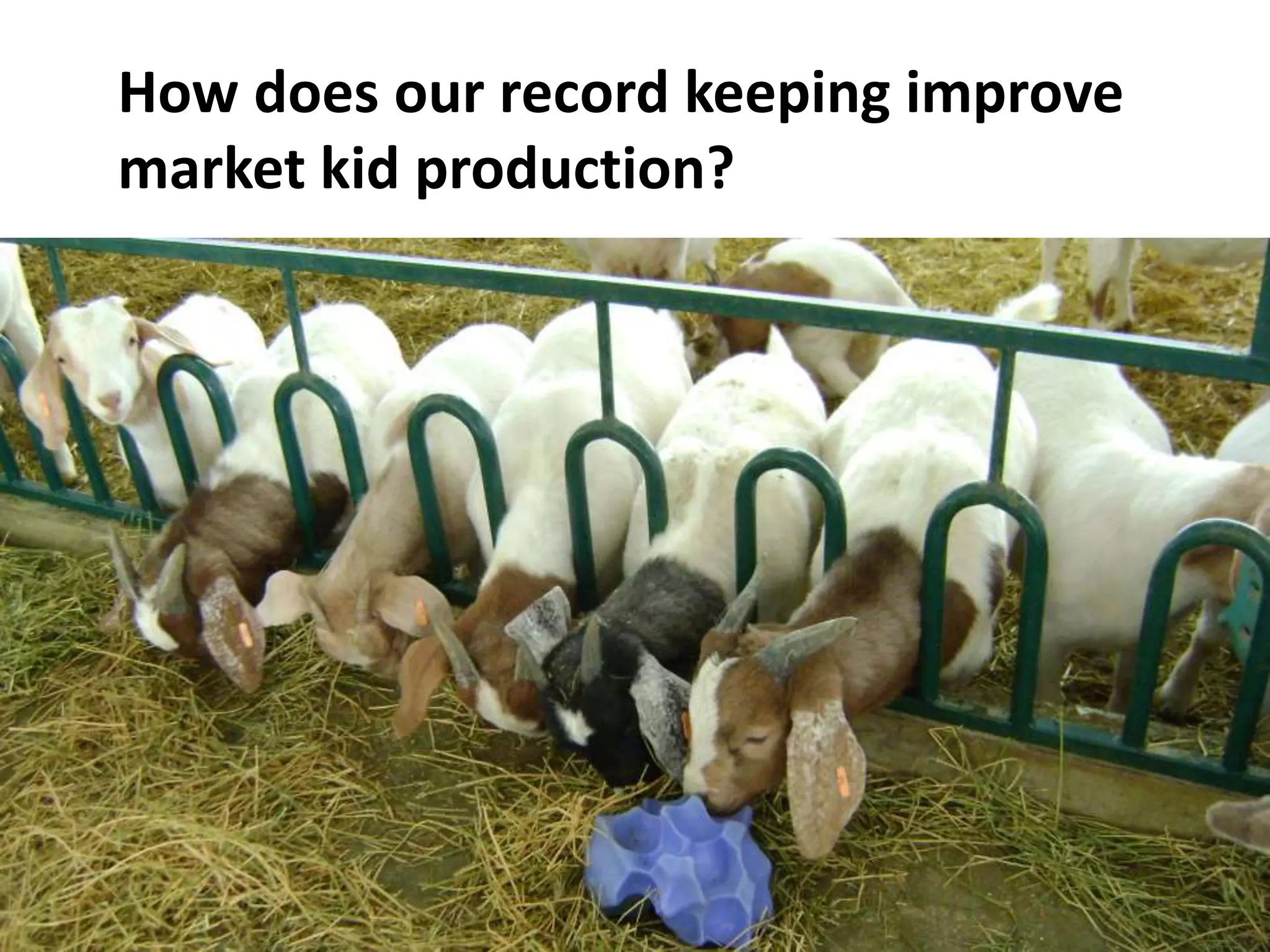
How does our record keeping improve
market kid production?
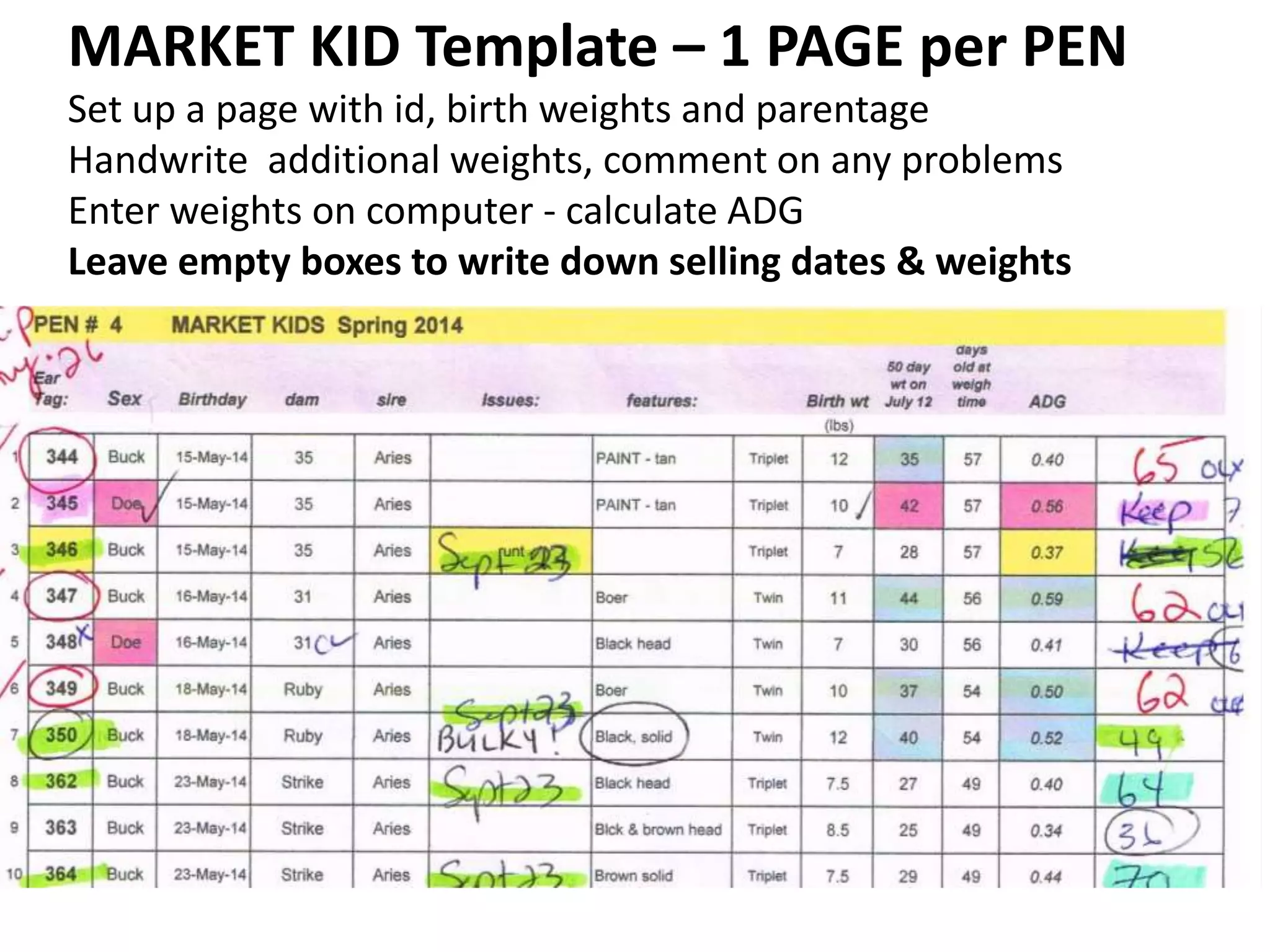
MARKET KID Template – 1 PAGE per PEN
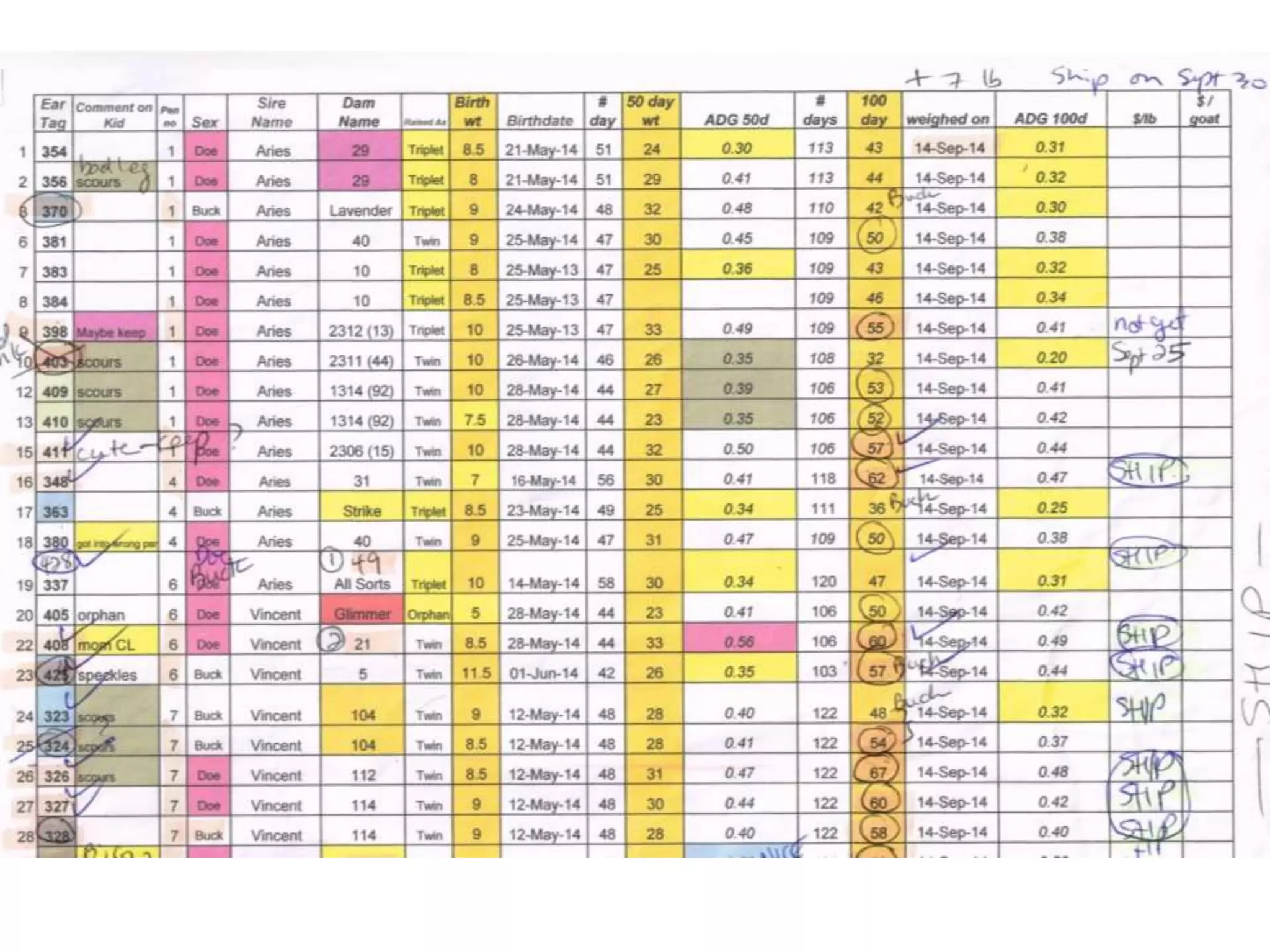
Set up a page with id, birth weights and parentage
Handwrite additional weights, comment on any problems
Enter weights on computer - calculate ADG
Leave empty boxes to write down selling dates & weights
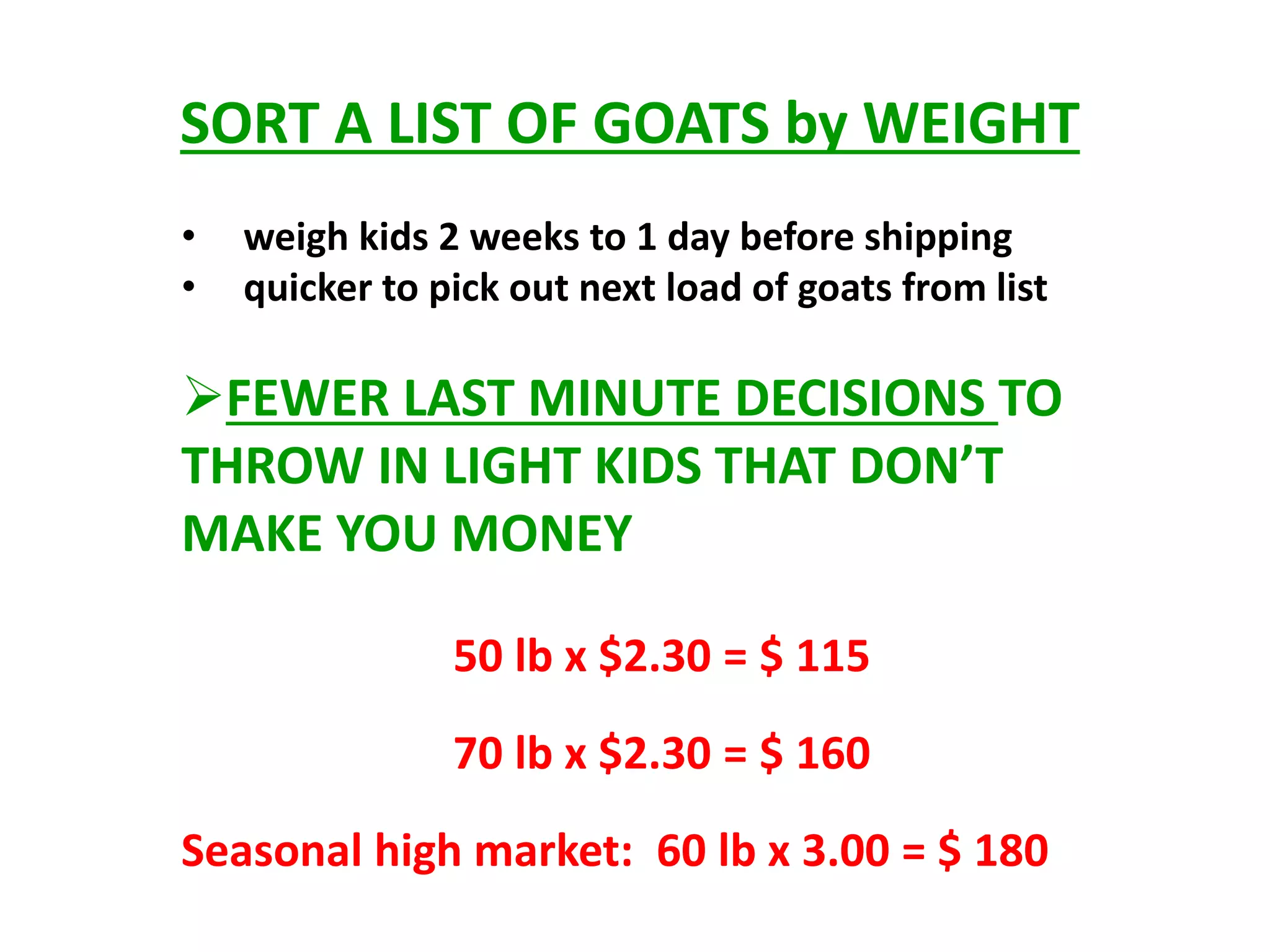
SORT A LIST OF GOATS by WEIGHT
• weigh kids 2 weeks to 1 day before shipping
• quicker to pick out next load of goats from list
FEWER LAST MINUTE DECISIONS TO
THROW IN LIGHT KIDS THAT DON’T
MAKE YOU MONEY
50 lb x $2.30 = $ 115
70 lb x $2.30 = $ 160
Seasonal high market: 60 lb x 3.00 = $ 180
Predict more accurately
when market kids are ready to be shipped:
We know top 15 % are ready in 95 to 100 days (65 lbs)
We know 70% of our kids are ready in 120 days (65-70 lbs)
We know bottom 15% are ready in 150 days
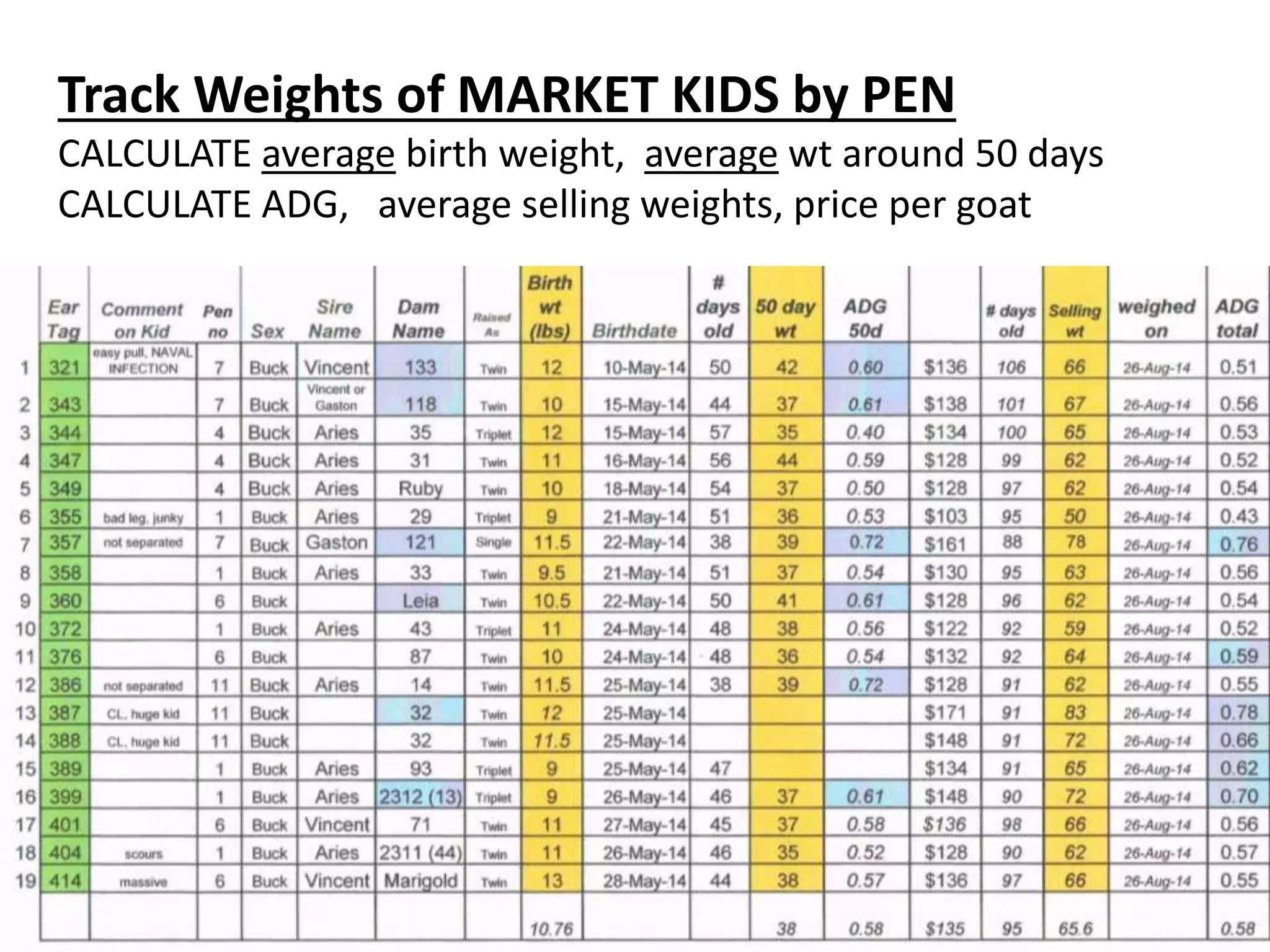
Track Weights of MARKET KIDS by PEN
CALCULATE average birth weight, average wt around 50 days
CALCULATE ADG, average selling weights, price per goat
How long to feed market kids ?
TARGET WEIGHT 60 to 75 lbs
Value of Market Kid at Price of $2.30
60 lbs x 2.30 = $ 138
75 lbs x 2.30 = $ 172
DIFFERENCE $34
COST TO GAIN 15 lbs takes 1 month (ADG = .5 lb/day)
Feeding pellets for 1 extra month, COST = $5
KEEP EXTRA $ 30+ NET PROFIT per KID
Breeding Stock
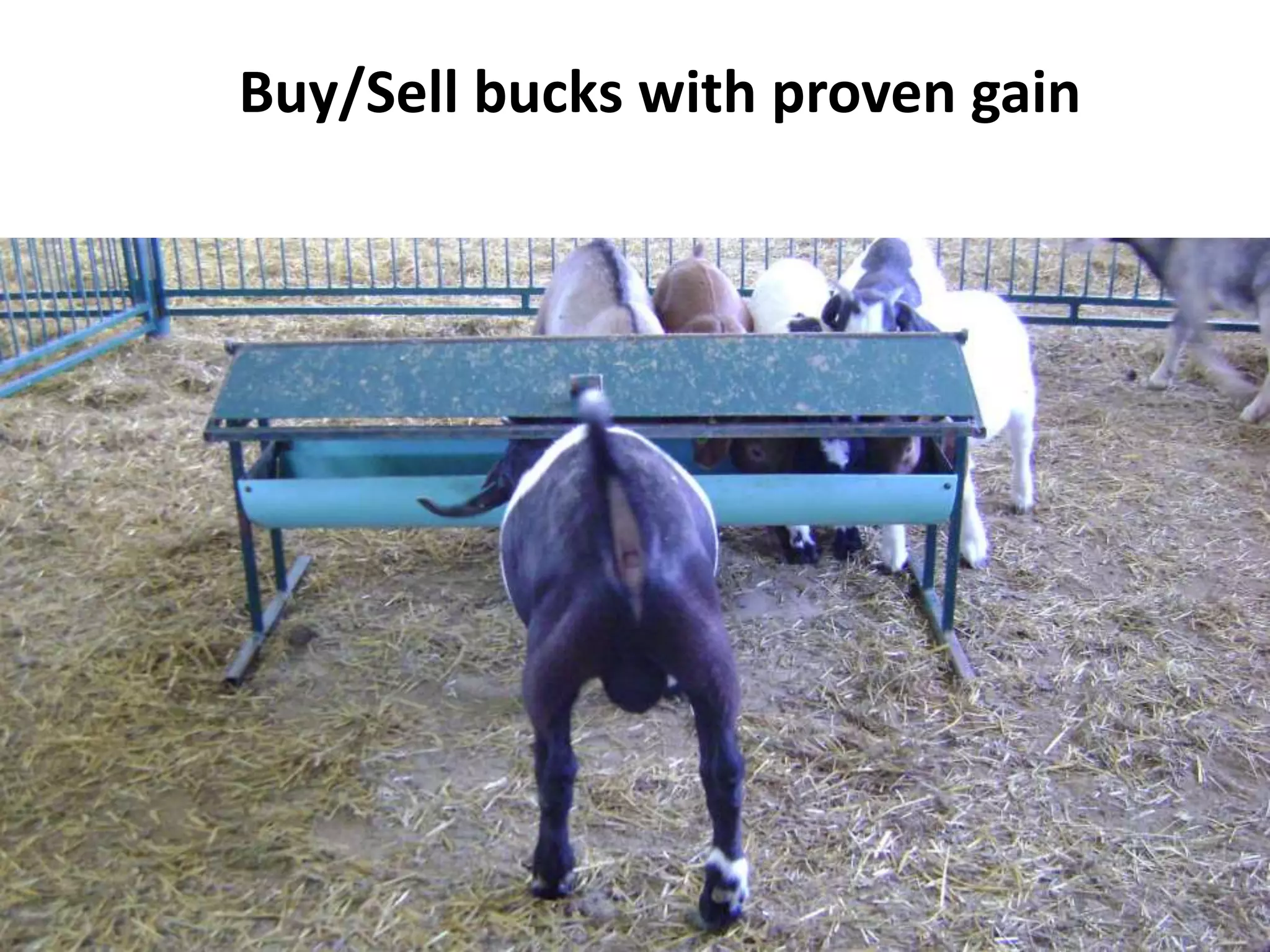
Buy/Sell bucks with proven gain
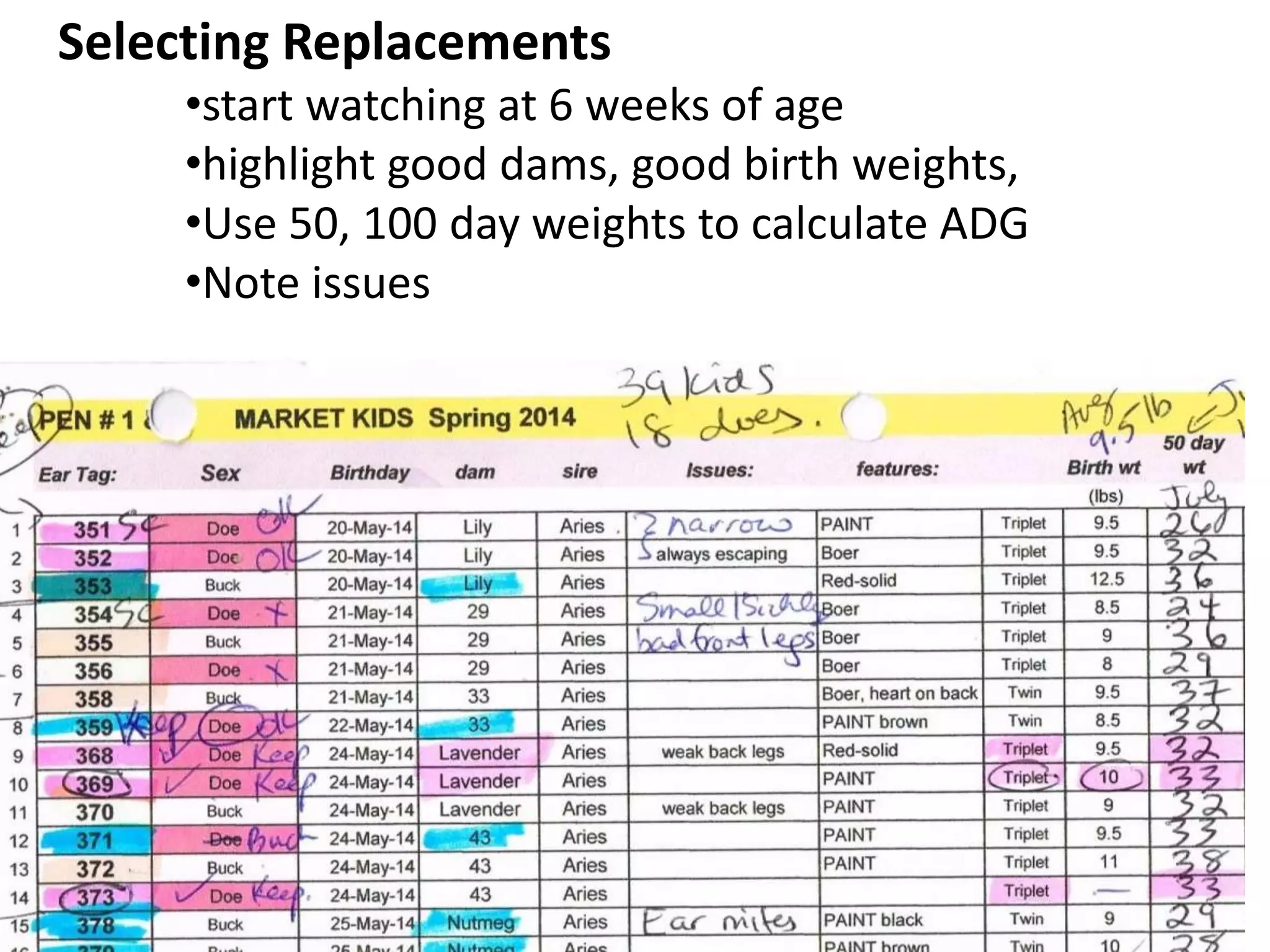
Selecting Replacements
•start watching at 6 weeks of age
•highlight good dams, good birth weights,
•Use 50, 100 day weights to calculate ADG
•Note issues
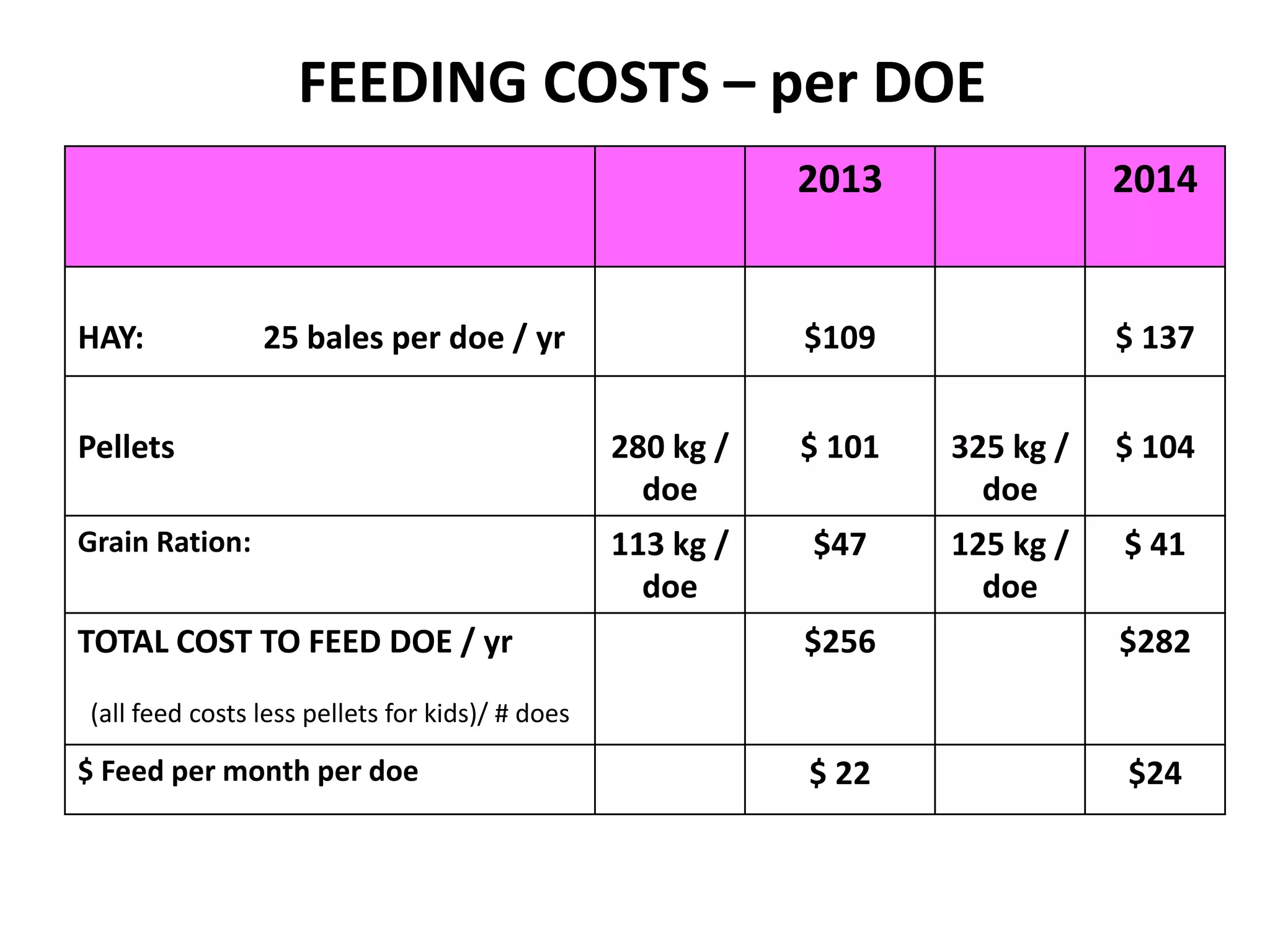
FEEDING COSTS – per DOE
2013 2014
HAY: 25 bales per doe / yr $109 $ 137
Pellets 280 kg /
doe
$ 101 325 kg /
doe
$ 104
Grain Ration: 113 kg /
doe
$47 125 kg /
doe
$ 41
TOTAL COST TO FEED DOE / yr
(all feed costs less pellets for kids)/ # does
$256 $282
$ Feed per month per doe $ 22 $24
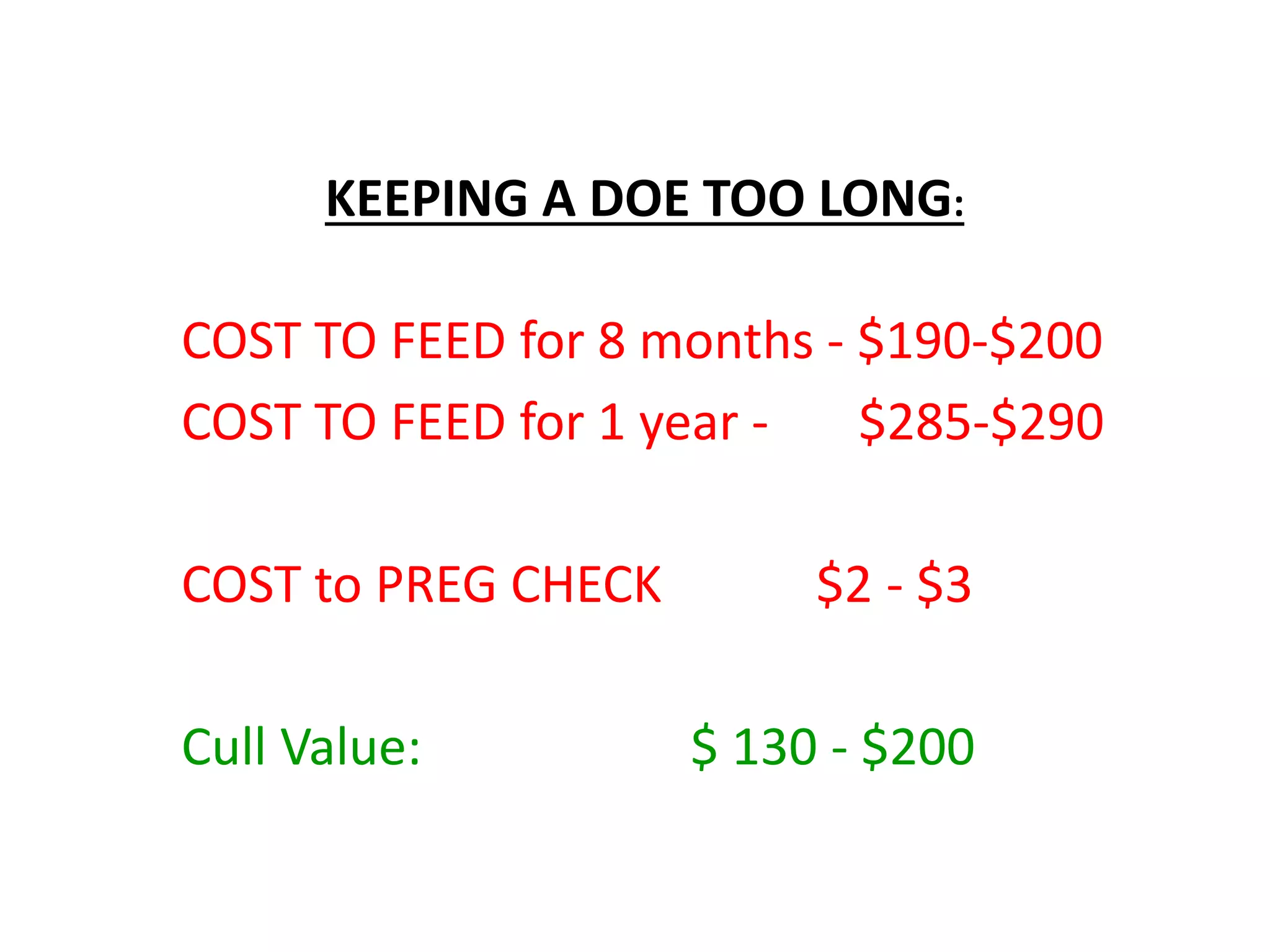
KEEPING A DOE TOO LONG:
COST TO FEED for 8 months - $190-$200
COST TO FEED for 1 year - $285-$290
COST to PREG CHECK $2 - $3
Cull Value: $ 130 - $200
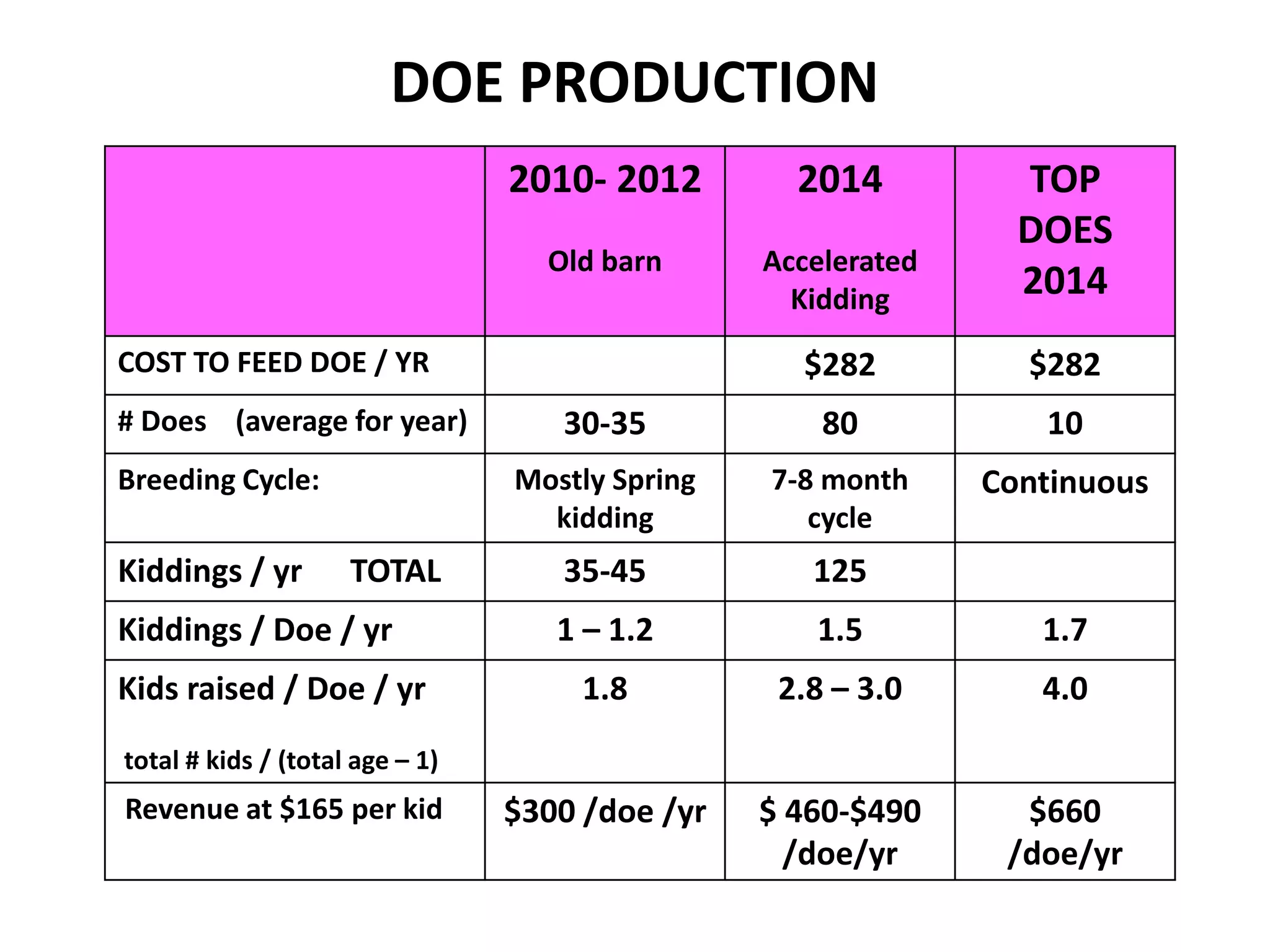
DOE PRODUCTION
2010- 2012
Old barn
2014
Accelerated
Kidding
TOP
DOES
2014
COST TO FEED DOE / YR $282 $282
# Does (average for year) 30-35 80 10
Breeding Cycle: Mostly Spring
kidding
7-8 month
cycle
Continuous
Kiddings / yr TOTAL 35-45 125
Kiddings / Doe / yr 1 – 1.2 1.5 1.7
Kids raised / Doe / yr
total # kids / (total age – 1)
1.8 2.8 – 3.0 4.0
Revenue at $165 per kid $300 /doe /yr $ 460-$490
/doe/yr
$660
/doe/yr
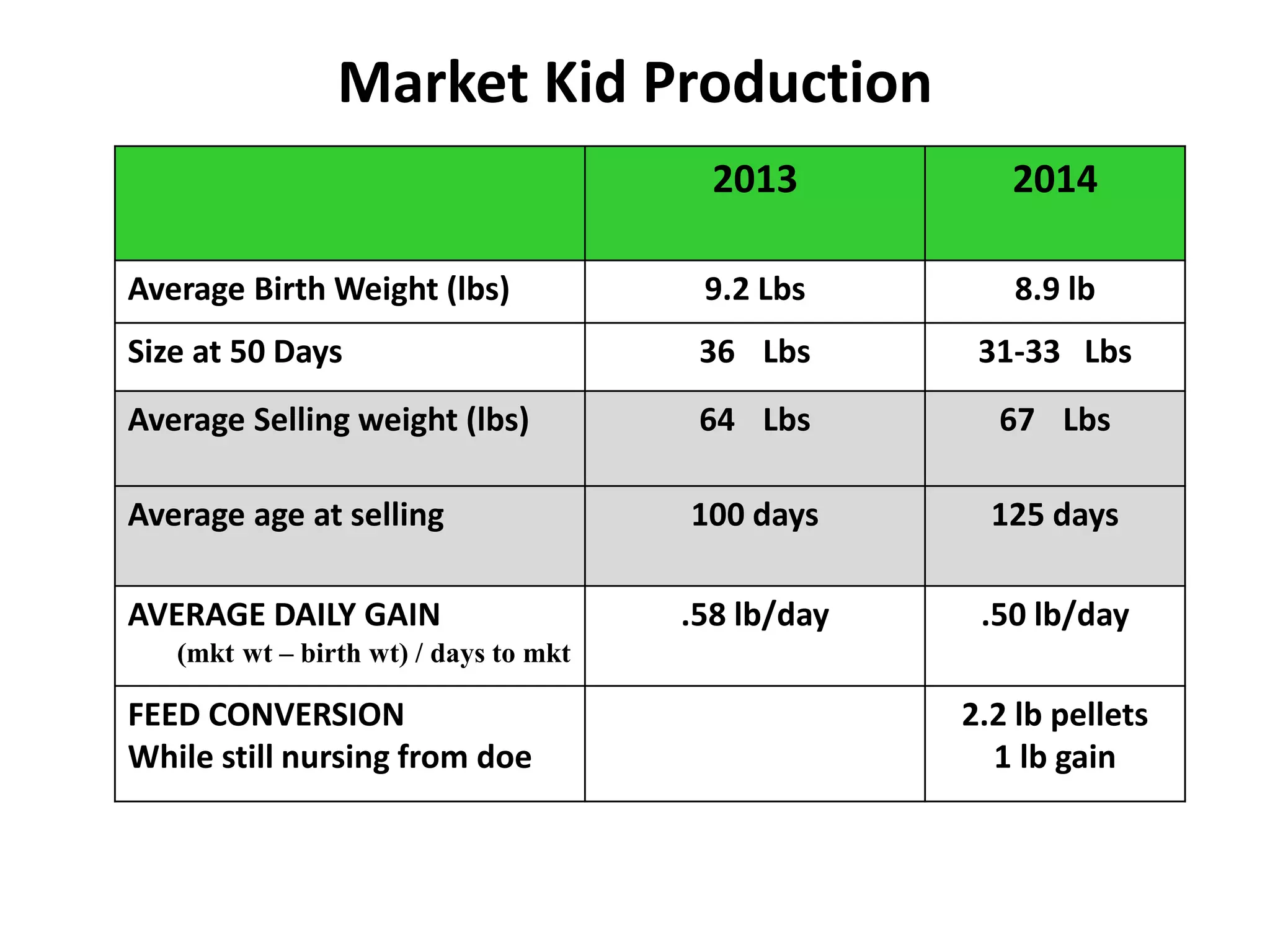
Market Kid Production
2013 2014
Average Birth Weight (lbs) 9.2 Lbs 8.9 lb
Size at 50 Days 36 Lbs 31-33 Lbs
Average Selling weight (lbs) 64 Lbs 67 Lbs
Average age at selling 100 days 125 days
AVERAGE DAILY GAIN
(mkt wt – birth wt) / days to mkt
.58 lb/day .50 lb/day
FEED CONVERSION
While still nursing from doe
2.2 lb pellets
1 lb gain
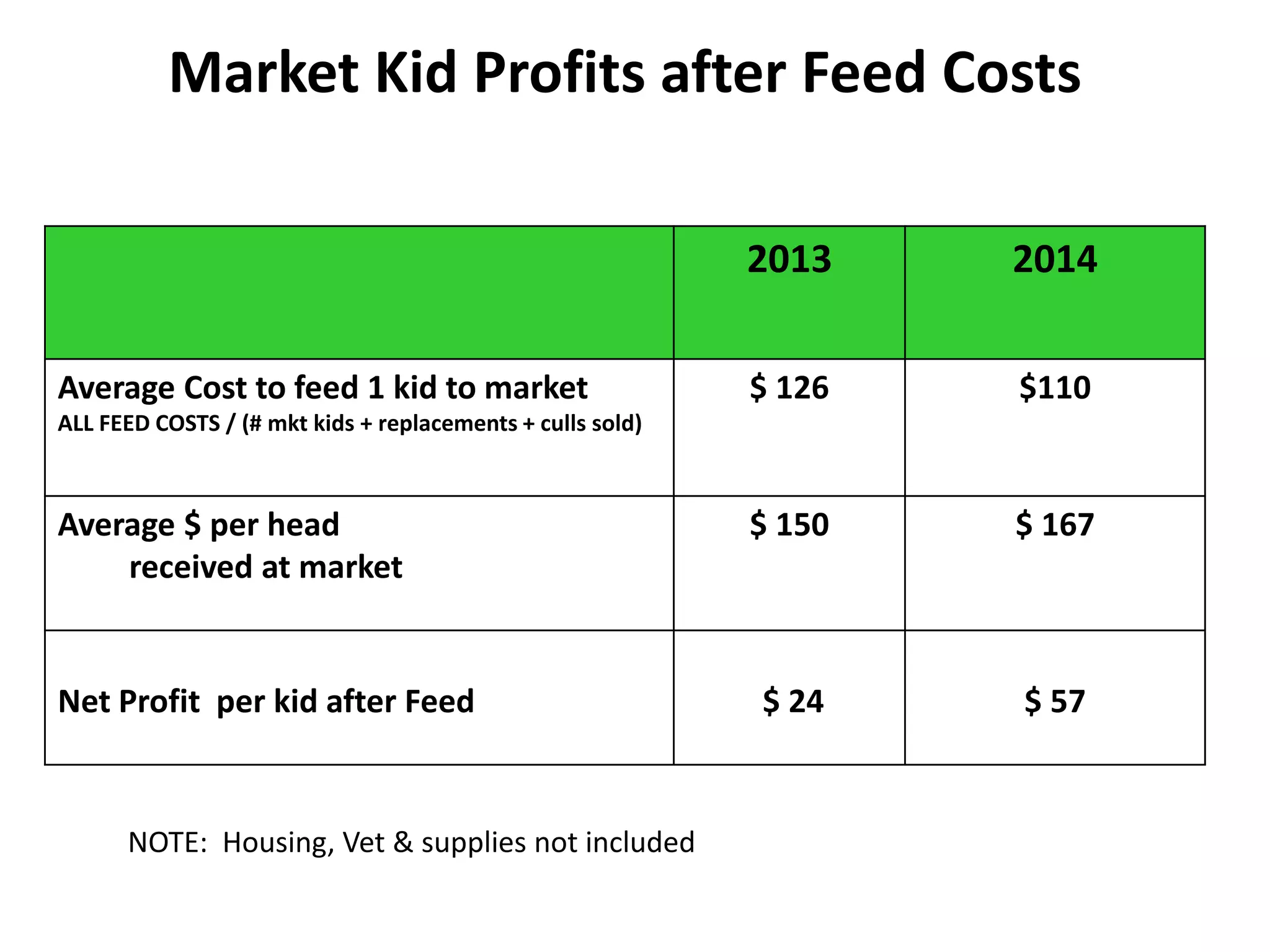
Market Kid Profits after Feed Costs
2013 2014
Average Cost to feed 1 kid to market
ALL FEED COSTS / (# mkt kids + replacements + culls sold)
$ 126 $110
Average $ per head
received at market
$ 150 $ 167
Net Profit per kid after Feed $ 24 $ 57
NOTE: Housing, Vet & supplies not included
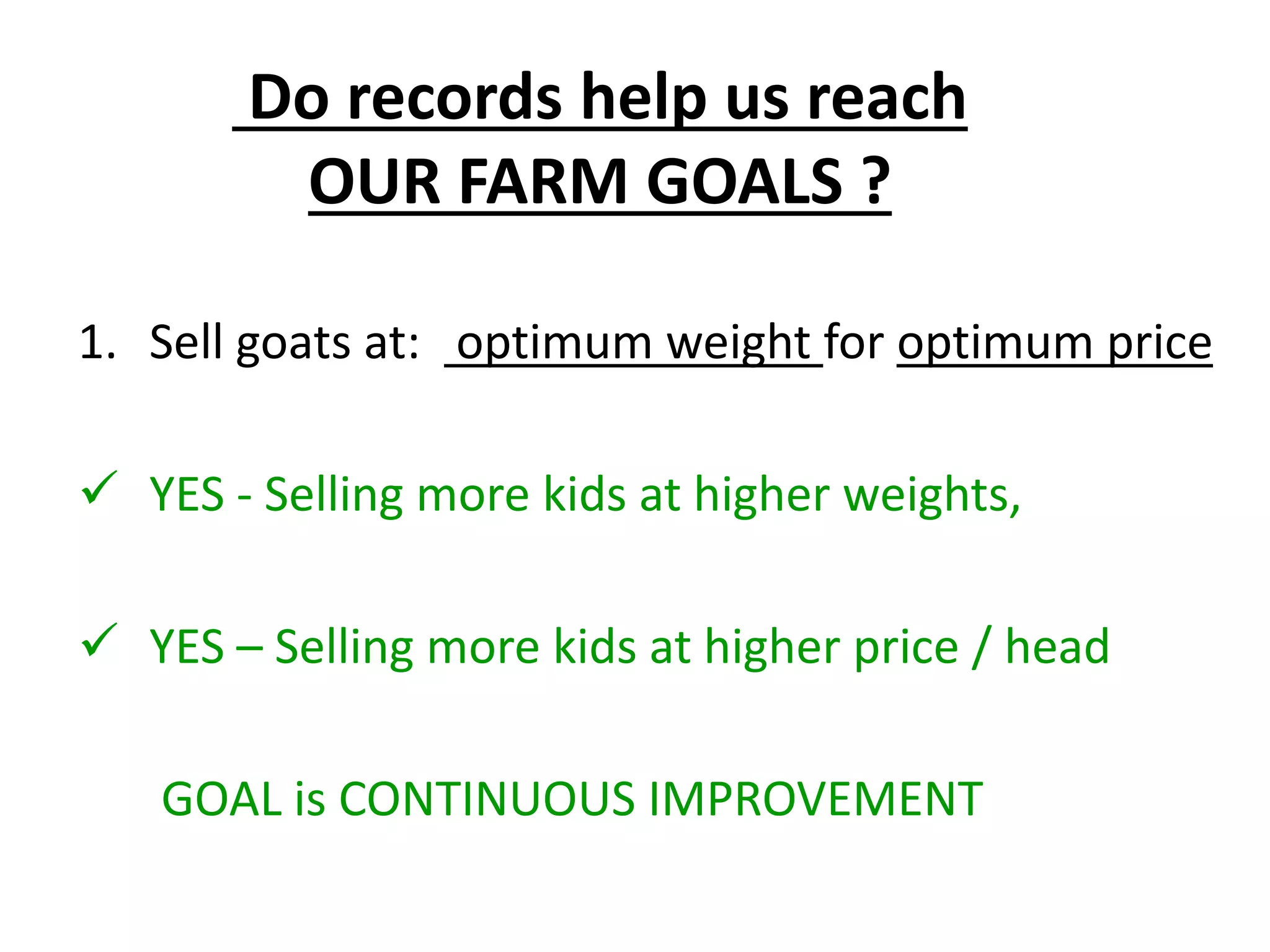
1. Sell goats at: optimum weight for optimum price
 YES - Selling more kids at higher weights,
 YES – Selling more kids at higher price / head
GOAL is CONTINUOUS IMPROVEMENT
Do records help us reach
OUR FARM GOALS ?
2. Select best replacements to increase herd
 YES – select higher ADG doelings
 YES – select from parents with proven
production
 YES – track goat diseases in herd
Do records help us reach
OUR FARM GOALS ?
3. Know our production – numbers & costs
 YES – track production cost changes
 YES – know cost per doe & cost per kid
 MAKE BETTER DECISIONS
Do records help us reach
OUR FARM GOALS ?
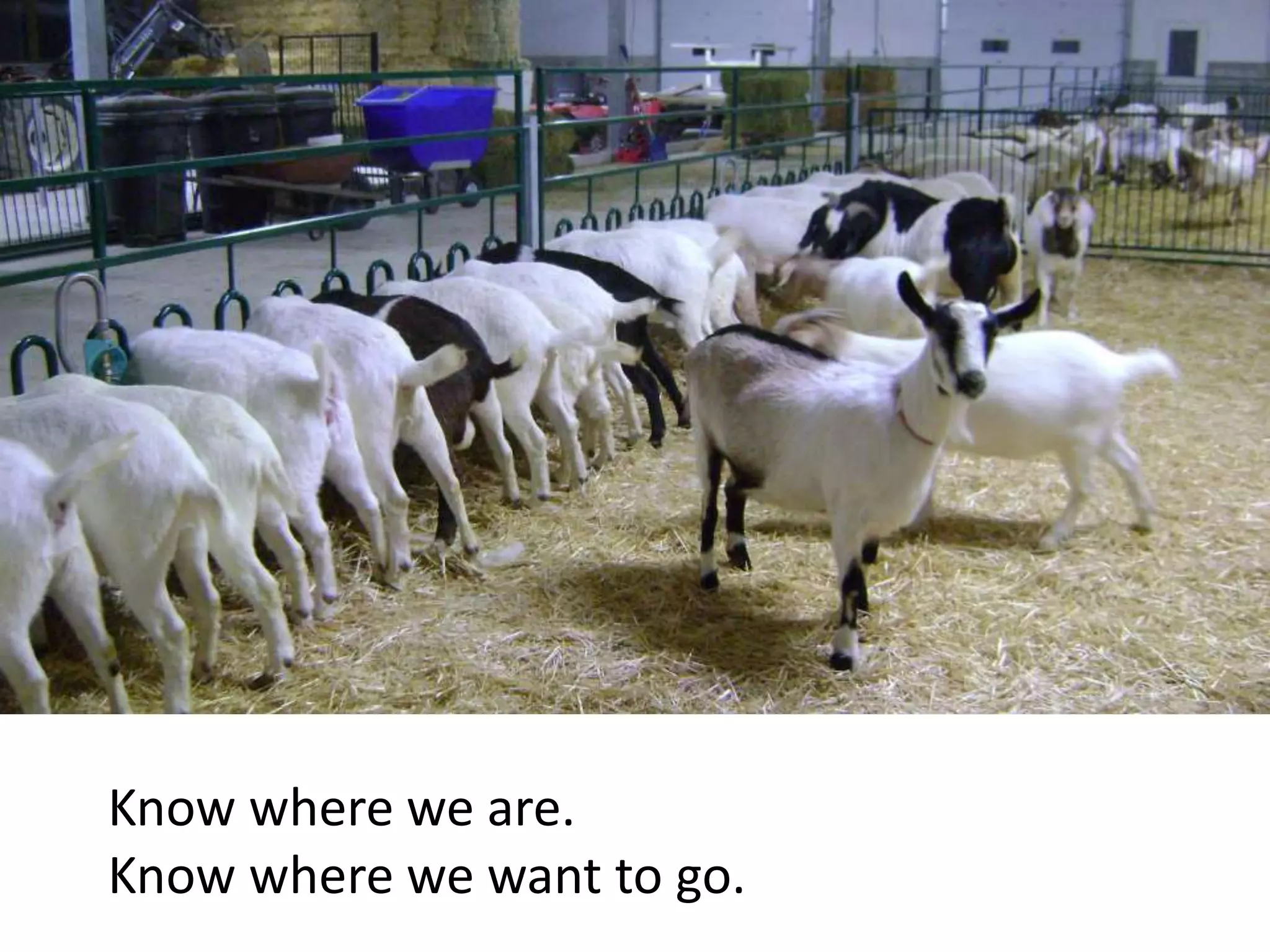
Know where we are.
Know where we want to go.
Keeping Better Records

Keeping Better Records

  • 1.
    Peter & AmyVingerhoeds RR 1 Hensall, ON NOM 1X0 519-229-8810 avingerhoeds@quadro.net Keeping Better Records
  • 2.
    Humble beginnings Ran 20-30commercial meat does for 10 years in an old bank barn Few records kept: (1) Feed Purchased (2) Market Kid Sales (3) some genetic lines
  • 3.
    ISSUES: Who stays? Whogoes? Which sire should we (not) use? Can we do better?
  • 4.
    Participated in ourfirst Ontario Goat studies 2011-2012 Q-fever testing CAE testing
  • 5.
    New Barn Construction2012 Herd Expansion PERFECT time to improve management & records
  • 6.
    1. Sell goatsat: optimum weight for optimum price. 2. Select best replacements to increase herd 3. Know our production – numbers & costs OUR FARM GOALS
  • 7.
    Part time operation 80– 100 Boer does, Capacity for 200
  • 8.
  • 9.
    NEED Ear Tagsto manage more than 20 does Sheep tags better UKAL tags too small RFID tags hard to read with eye We now replace old tags with orange swine tags... ** EASIEST TO SEE**
  • 10.
    Pilot Herd –O.G. Traceability Project •RFID eartags on 100 animals in herd •OPPORTUNITY to try out tag system before we have to invest •Roughly 1 ½ years after trial, 80-85% retention, and a few ripped ears from sheep clips •Use RFID tags as secondary ID if management tags lost IDEAL USE for us – WEIGHING & SCANNING with Digital scale
  • 11.
  • 12.
    LAMBING DIARY Pocket sizeand simple RECORD ALL KIDDINGS 100 + kiddings/booklet) Probably can pick up at OMAF display today NO COST!
  • 13.
    New Kid Protocol first 12-24 hours, kids are weighed on hanging scale  Colours and identifying markings are written down  Sire and dam are recorded as well as pen #  EAR TAGS applied to right ear  Sequential tag order used
  • 14.
    Started with simplekidding records DOES: ID tag, pen #, sire and date of kidding; note any issues KIDS: new eartag ID, gender, colouring and birth weight at 1 day
  • 15.
    TAG ALL NEWKIDS and RECORD BIRTH WEIGHTS ON FIRST DAY 1) Don’t mix up any kids and mothers 2) Keep running tally of # kiddings and # kids 3) Easy to keep a few notes on health / mortality in early days ENTER DATA LATER ON Excel SPREADSHEET Benefits of using the LAMB DIARY
  • 16.
  • 17.
    Leave binder inbarn for quick reference
  • 18.
    Developed own template: About10 handwritten entries per page Print/photocopy form on heavier paper Use a designated colour, easy to find pages Use sheet protectors for older pages (ring holes rip out) Leave empty space – easier to read
  • 20.
    HAVE A RECORDOF: - every sick animal - id# & pen# - problem described briefly - treatment – when & what product - not all animals are treated WITHDRAWAL have proof that animal is safe to ship
  • 21.
    Helps to Keepon top of MULTIPLE-DAY TREATMENTS •Does with retained placenta •Scours on market kids •Secondary infections of pneumonia WHEN GOAT’s HEALTH IMPROVES, MAKE SURE WE FINISH TREATMENT
  • 22.
    Keep fact sheetsin plastic sleeves
  • 23.
    BUILD A GOATLIBRARY •Save all vet scripts and vet recommendations •Save diagnostic / treatment info from reliable sources •Save any test results •Save vaccination lists •CRITICAL RESOURCE with so few registered medications for goats
  • 24.
  • 26.
    FEED SHEETS originallyprepared as instructions for our relief chore person Update every couple months Record of amounts fed to each group Goat numbers/stage in each pen Get a snapshot of feed consumption & costs
  • 27.
    BASIC SCHOOL SUPPLIES binders sheetprotectors photocopier/printer
  • 28.
  • 29.
    Manual Pig / SheepScale WEIGH AT: •50 days •100 days •Sale date if later
  • 30.
    WEIGHING Market Kids KEYIMPROVEMENT in goat operation Provides us MOST information Measure growth, calculate ADG Best way to improve marketing
  • 31.
    Setting up RecordSheets ONE PAGE per PEN Step 6
  • 33.
    ONE PAGE DOETEMPLATE Left side contains identification, age, genetic lines
  • 34.
    ONE PAGE DOETEMPLATE Right side contains more management info Leave lots of empty boxes to add handwritten notes Print on cardstock – REPRINT 3-4 times a year to update
  • 35.
    CAN KEEP TRACKOF:  SIRES in & out  Sire & dam info, parity info  Breeding dates, preg checks & DUE dates  Doe numbers TAKE PAGE OUT to use AS CHECKLIST FOR:  Preg checks  Vaccinations and treatments  Hoof trimming  NOTE ANY OTHER ISSUES – i.e. Weak pasterns, body condition, poor mothering, CL, poor-doers, etc. Using a 1-Page DOE TEMPLATE
  • 36.
    How does ourrecord keeping improve doe management in barn?
  • 37.
    Cull Does BEFOREthey get thin 3 STRIKES – YOU’RE OUT ! 1- OPEN 2- udder/foot issues 3- productivity falling Value of Cull doe in good body condition 150 lbs x $ .80 = $ 120 170 lbs x $ 1.30 = $ 230 Value of Cull doe when thin or lame 120 lbs x .50 = $ 60
  • 38.
    Select Replacements on DOEPERFORMANCE • Age & Parity achieved • Number kids born / raised TARGET: 15 kids raised by 5-6 years age • Higher ADG of kids TARGET: average .5 - .6 pound/day gain • Days to market TARGET: 100 to 120 days
  • 39.
    Have enough infoto figure out: • Regularity of Hoof clipping • Vaccinations & boosters • Breeding dates & Sire info • Movement between pens
  • 40.
    How does ourrecord keeping improve market kid production?
  • 41.
    MARKET KID Template– 1 PAGE per PEN Set up a page with id, birth weights and parentage Handwrite additional weights, comment on any problems Enter weights on computer - calculate ADG Leave empty boxes to write down selling dates & weights
  • 42.
    SORT A LISTOF GOATS by WEIGHT • weigh kids 2 weeks to 1 day before shipping • quicker to pick out next load of goats from list FEWER LAST MINUTE DECISIONS TO THROW IN LIGHT KIDS THAT DON’T MAKE YOU MONEY 50 lb x $2.30 = $ 115 70 lb x $2.30 = $ 160 Seasonal high market: 60 lb x 3.00 = $ 180
  • 44.
    Predict more accurately whenmarket kids are ready to be shipped: We know top 15 % are ready in 95 to 100 days (65 lbs) We know 70% of our kids are ready in 120 days (65-70 lbs) We know bottom 15% are ready in 150 days
  • 45.
    Track Weights ofMARKET KIDS by PEN CALCULATE average birth weight, average wt around 50 days CALCULATE ADG, average selling weights, price per goat
  • 46.
    How long tofeed market kids ? TARGET WEIGHT 60 to 75 lbs Value of Market Kid at Price of $2.30 60 lbs x 2.30 = $ 138 75 lbs x 2.30 = $ 172 DIFFERENCE $34 COST TO GAIN 15 lbs takes 1 month (ADG = .5 lb/day) Feeding pellets for 1 extra month, COST = $5 KEEP EXTRA $ 30+ NET PROFIT per KID
  • 47.
  • 48.
    Selecting Replacements •start watchingat 6 weeks of age •highlight good dams, good birth weights, •Use 50, 100 day weights to calculate ADG •Note issues
  • 49.
    FEEDING COSTS –per DOE 2013 2014 HAY: 25 bales per doe / yr $109 $ 137 Pellets 280 kg / doe $ 101 325 kg / doe $ 104 Grain Ration: 113 kg / doe $47 125 kg / doe $ 41 TOTAL COST TO FEED DOE / yr (all feed costs less pellets for kids)/ # does $256 $282 $ Feed per month per doe $ 22 $24
  • 50.
    KEEPING A DOETOO LONG: COST TO FEED for 8 months - $190-$200 COST TO FEED for 1 year - $285-$290 COST to PREG CHECK $2 - $3 Cull Value: $ 130 - $200
  • 51.
    DOE PRODUCTION 2010- 2012 Oldbarn 2014 Accelerated Kidding TOP DOES 2014 COST TO FEED DOE / YR $282 $282 # Does (average for year) 30-35 80 10 Breeding Cycle: Mostly Spring kidding 7-8 month cycle Continuous Kiddings / yr TOTAL 35-45 125 Kiddings / Doe / yr 1 – 1.2 1.5 1.7 Kids raised / Doe / yr total # kids / (total age – 1) 1.8 2.8 – 3.0 4.0 Revenue at $165 per kid $300 /doe /yr $ 460-$490 /doe/yr $660 /doe/yr
  • 52.
    Market Kid Production 20132014 Average Birth Weight (lbs) 9.2 Lbs 8.9 lb Size at 50 Days 36 Lbs 31-33 Lbs Average Selling weight (lbs) 64 Lbs 67 Lbs Average age at selling 100 days 125 days AVERAGE DAILY GAIN (mkt wt – birth wt) / days to mkt .58 lb/day .50 lb/day FEED CONVERSION While still nursing from doe 2.2 lb pellets 1 lb gain
  • 53.
    Market Kid Profitsafter Feed Costs 2013 2014 Average Cost to feed 1 kid to market ALL FEED COSTS / (# mkt kids + replacements + culls sold) $ 126 $110 Average $ per head received at market $ 150 $ 167 Net Profit per kid after Feed $ 24 $ 57 NOTE: Housing, Vet & supplies not included
  • 54.
    1. Sell goatsat: optimum weight for optimum price  YES - Selling more kids at higher weights,  YES – Selling more kids at higher price / head GOAL is CONTINUOUS IMPROVEMENT Do records help us reach OUR FARM GOALS ?
  • 55.
    2. Select bestreplacements to increase herd  YES – select higher ADG doelings  YES – select from parents with proven production  YES – track goat diseases in herd Do records help us reach OUR FARM GOALS ?
  • 56.
    3. Know ourproduction – numbers & costs  YES – track production cost changes  YES – know cost per doe & cost per kid  MAKE BETTER DECISIONS Do records help us reach OUR FARM GOALS ?
  • 57.
    Know where weare. Know where we want to go.