ROCK O. KENDALL ATTORNEY AT LAW 28202 Cabot Road, Suite 300, Laguna Niguel, California 92677  (949) 388-0524 Cell (714) 404-4788     www.dmv-law.com     Fax (949) 388-0564 Pass the California DMV’s  Driving  Performance  Evaluation … by understanding why others failed   
You  can  pass the DMV test! 80%  of my clients pass this exam. 100%  get a chance to take lessons if they pass the written law test and their doctors are “okay” with driving. To be in this  80%  pass group, most drivers will want to have at least six hours of behind-the-wheel instruction.
“ I’m a good driver!” “I don’t need lessons!”  “I’ve been driving 50 years!” Being a good driver, for most of us, means we haven’t had any tickets or accidents in a long while, and no one has been honking at us.  Alas… That, alone, isn’t enough to pass the DMV’s  “performance”  exam.
A common lament of one who failed a driver’s test: “ I didn’t look over my shoulder  because I  knew  no one was there!” But this is a  “ PERFORMANCE. ”   The DMV’s official name for a  behind-the-wheel drive test is:  “ Driving  Performance  Evaluation.”
What does  “performance”  mean ?   It means…  what you  do  matters. The DMV will test what you  “know”  via the written “law” test back at its offices.  On the road—it is what you DO, not just what you KNOW, that counts.  So don’t make the mistake of failing to “do” the right thing at the right time—  even if you “know” no one is there.
PHYSICALLY   DRIVE   using your entire body Look   around — scan —as if you’re at war!   EXAMPLE:  Regarding your approach to  intersections , the DMV says that some drivers do not obey traffic signals so  before  you enter…  look  left ,  ri g ht ,  and  ahead   for approaching traffic… scanning like there’s incoming fire!
I wanted to show how safe I am,  so I drove very  s  l  o  w  l  y. During your “performance” evaluation… going too slow—10 miles per hour  UNDER  the posted speed limit—is sufficient for a failed drive test, even if you do nothing else incorrectly.  So, DRIVE THE CAR! But don’t go too fast either.  Recall  “ Goldilocks ”  here:  “Just right.” Ditto  for  accelerating  and  stopping.
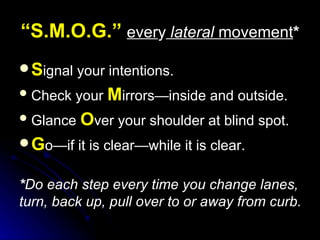
“ S.M.O.G.”   ever y   lateral  movement * S ignal your intentions. Check your  M irrors—inside and outside. Glance  O ver your shoulder at blind spot. G o—if it is clear—while it is clear. * Do each step every time you change lanes, turn, back up, pull over to or away from curb.
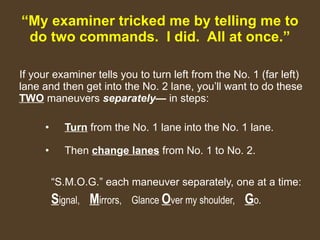
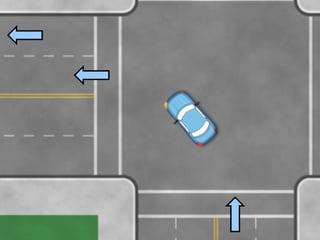
“ My examiner tricked me by telling me to do two commands.  I did.  All at once.” If your examiner tells you to turn left from the No. 1 (far left) lane and then get into the No. 2 lane, you’ll want to do these  TWO  maneuvers  separately—  in steps: Turn  from the No. 1 lane into the No. 1 lane. Then  chan g e lanes  from No. 1 to No. 2. “ S.M.O.G.” each maneuver separately, one at a time: S ignal,  M irrors,  Glance  O ver my shoulder,  G o.
 
Where  should I take my “performance” test? Someone said,  “The best place to succeed  is  where  you are with what you  have .”   ↓ Generally, the best place to take this test is  going to be  close to home where  you  have  the most experience.
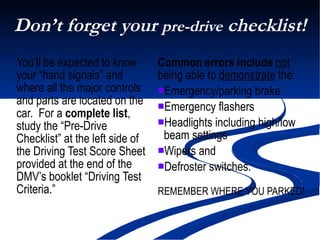
Don’t forget your  pre-drive  checklist! You’ll be expected to know your “hand signals” and where all the major controls and parts are located on the car.  For a  complete list , study the “Pre-Drive Checklist” at the left side of the Driving Test Score Sheet provided at the end of the DMV’s booklet “Driving Test Criteria.”  Common errors include   not  being able to  demonstrate  the: Emergency/parking brake Emergency flashers Headlights including high/low  beam settings Wipers and  Defroster switches. REMEMBER WHERE YOU PARKED!
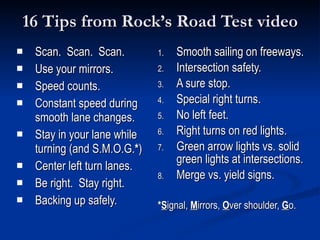
16 Tips from Rock’s Road Test video Scan.  Scan.  Scan. Use your mirrors. Speed counts. Constant speed during smooth lane changes. Stay in your lane while turning (and S.M.O.G. * ) Center left turn lanes. Be right.  Stay right. Backing up safely. Smooth sailing on freeways. Intersection safety. A sure stop. Special right turns. No left feet. Right turns on red lights. Green arrow lights vs. solid green lights at intersections. Merge vs. yield signs. * S ignal,  M irrors,  O ver shoulder,  G o.
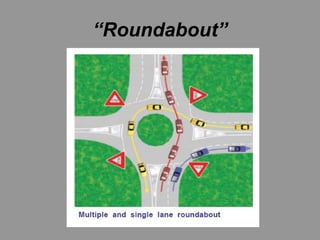
“ Roundabout”
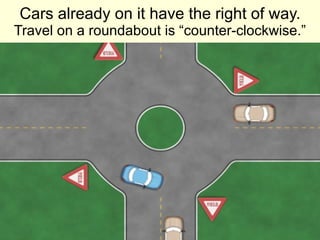
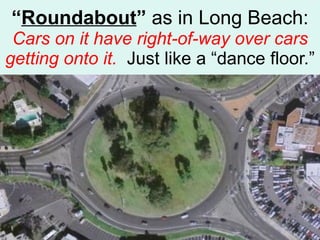
Cars already on it have the right of way. Travel on a roundabout is “counter-clockwise.”
“ Roundabout ”  as in Long Beach: Cars on it have right-of-way over cars getting onto it.   Just like a “dance floor.”
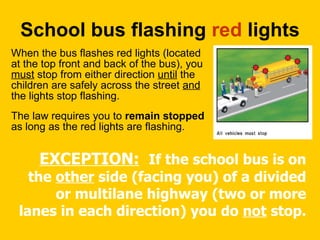
School bus flashing  red  lights  When the bus flashes red lights (located at the top front and back of the bus), you  must  stop from either direction  until  the children are safely across the street  and  the lights stop flashing.  The law requires you to  remain stopped  as long as the red lights are flashing.  EXCEPTION:   If the school bus is on the  other  side (facing you) of a divided or multilane highway (two or more lanes in each direction) you do  not  stop.
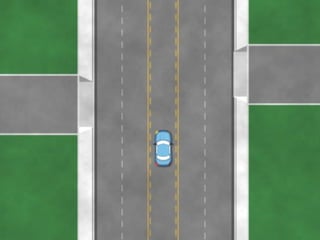
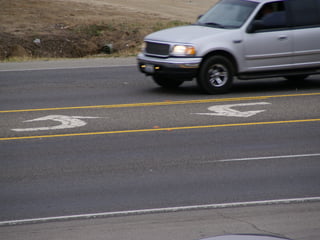
Center Left Turn Lanes  are for  turning A center left turn lane is in the  middle  of a two-way street and is marked on both sides by two painted lines.  The inner line is broken and the outer line is solid.  If a street has a center left turn lane, you  must  use it when you turn left [coming or going] or start a permitted U-turn.  You may only drive for  200 feet  in the center left turn lane.  This lane is  not  a regular traffic lane or a passing lane.  To turn left from this lane, signal and drive completely inside the center left turn lane.  Do  not  stop with the back of your vehicle blocking traffic.
 
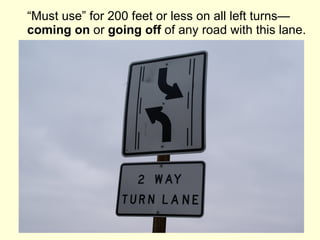
“ Must use” for 200 feet or less on all left turns— coming on  or  going off  of any road with this lane.
 
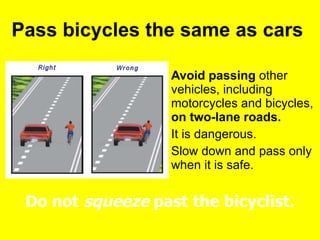
Pass bicycles the same as cars  Avoid passing  other vehicles, including motorcycles and bicycles,  on two-lane roads.   It is dangerous.  Slow down and pass only when it is safe.  Do not  squeeze  past the bicyclist.
Blind pedestrians Don’t wait too long for the blind pedestrian to cross the street.   If the person takes a step back and pulls in the cane , that’s a definite sign that you should  GO .
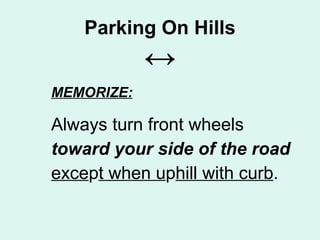
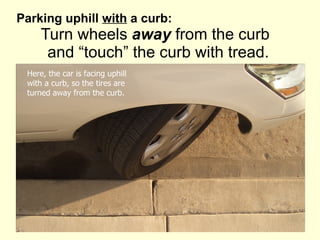
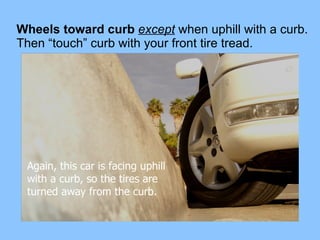
Parking On Hills ↔ MEMORIZE: Always turn front wheels  toward your side of the road exce p t when u p hill with curb .
Parking uphill  with  a curb:    Turn wheels  away  from the curb   and “touch” the curb with tread. Here, the car is facing uphill with a curb, so the tires are  turned away from the curb.
Wheels toward curb  except  when uphill with a curb.   Then “touch” curb with your front tire tread. Again, this car is facing uphill with a curb, so the tires are  turned away from the curb.
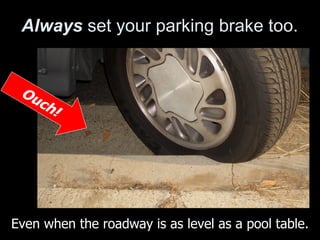
Always   set your parking brake too.   Ouch! Even when the roadway is as level as a pool table.
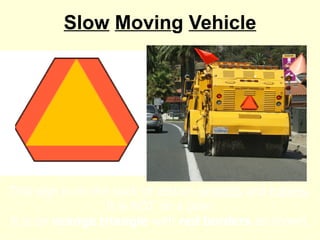
Slow   Movin g  Vehicle This sign is on the back of certain  vehicles  and  trailers . It is NOT on a pole! It is an  orange triangle  with  red borders  as shown.
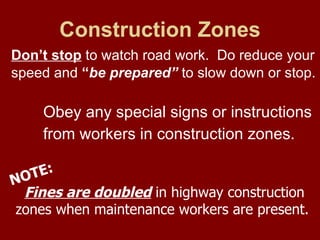
Construction Zones Don’t stop  to watch road work.  Do reduce your speed and  “ be prepared”  to slow down or stop.   Obey any special signs or instructions  from workers in construction zones.  Fines are doubled  in highway construction  zones when maintenance workers are present. NOTE:
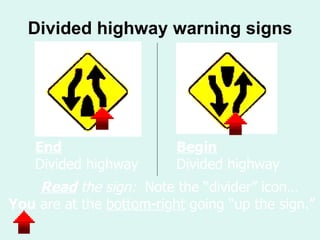
Divided highway warning signs End   Divided highway Be g in   Divided highway Read   the sign:  Note the “divider” icon…   You  are at the  bottom-ri g ht  going “up the sign.”
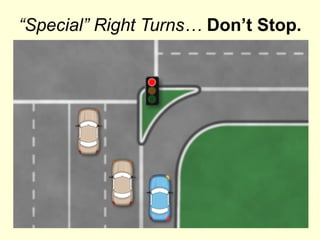
“ Special” Right Turns…   Don’t Stop.
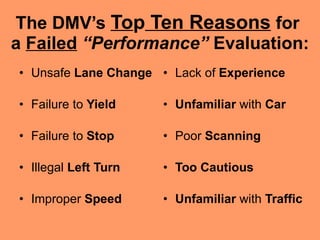
The DMV’s  To p  Ten Reasons  for   a  Failed   “Performance”  Evaluation: Unsafe  Lane Change Failure to  Yield Failure to  Stop Illegal  Left Turn Improper  Speed Lack of  Experience Unfamiliar  with  Car Poor  Scanning Too Cautious Unfamiliar  with  Traffic
The “take home” message: This is  your   “performance”  exam!  What you say and what you do matters. S.M.O.G.  each and every lateral move.  DRIVE   THE CAR!   (This is  your  “performance.”) Do not slow down or stop unnecessarily.  Doing so is cause for a failed test.  So DRIVE!
ROCK O. KENDALL ATTORNEY AT LAW 28202 Cabot Road, Suite 300, Laguna Niguel, California 92677  (949) 388-0524 Cell (714) 404-4788     www.dmv-law.com     Fax (949) 388-0564 Good Luck!

Pass the California DMV's Driver Performance Evaluation 4 20 09

  • 1.
    ROCK O. KENDALLATTORNEY AT LAW 28202 Cabot Road, Suite 300, Laguna Niguel, California 92677 (949) 388-0524 Cell (714) 404-4788  www.dmv-law.com  Fax (949) 388-0564 Pass the California DMV’s Driving Performance Evaluation … by understanding why others failed 
  • 2.
    You can pass the DMV test! 80% of my clients pass this exam. 100% get a chance to take lessons if they pass the written law test and their doctors are “okay” with driving. To be in this 80% pass group, most drivers will want to have at least six hours of behind-the-wheel instruction.
  • 3.
    “ I’m agood driver!” “I don’t need lessons!” “I’ve been driving 50 years!” Being a good driver, for most of us, means we haven’t had any tickets or accidents in a long while, and no one has been honking at us. Alas… That, alone, isn’t enough to pass the DMV’s “performance” exam.
  • 4.
    A common lamentof one who failed a driver’s test: “ I didn’t look over my shoulder because I knew no one was there!” But this is a “ PERFORMANCE. ” The DMV’s official name for a behind-the-wheel drive test is: “ Driving Performance Evaluation.”
  • 5.
    What does “performance” mean ? It means… what you do matters. The DMV will test what you “know” via the written “law” test back at its offices. On the road—it is what you DO, not just what you KNOW, that counts. So don’t make the mistake of failing to “do” the right thing at the right time— even if you “know” no one is there.
  • 6.
    PHYSICALLY DRIVE using your entire body Look around — scan —as if you’re at war! EXAMPLE: Regarding your approach to intersections , the DMV says that some drivers do not obey traffic signals so before you enter… look left , ri g ht , and ahead for approaching traffic… scanning like there’s incoming fire!
  • 7.
    I wanted toshow how safe I am, so I drove very s l o w l y. During your “performance” evaluation… going too slow—10 miles per hour UNDER the posted speed limit—is sufficient for a failed drive test, even if you do nothing else incorrectly. So, DRIVE THE CAR! But don’t go too fast either. Recall “ Goldilocks ” here: “Just right.” Ditto for accelerating and stopping.
  • 8.
    “ S.M.O.G.” ever y lateral movement * S ignal your intentions. Check your M irrors—inside and outside. Glance O ver your shoulder at blind spot. G o—if it is clear—while it is clear. * Do each step every time you change lanes, turn, back up, pull over to or away from curb.
  • 9.
    “ My examinertricked me by telling me to do two commands. I did. All at once.” If your examiner tells you to turn left from the No. 1 (far left) lane and then get into the No. 2 lane, you’ll want to do these TWO maneuvers separately— in steps: Turn from the No. 1 lane into the No. 1 lane. Then chan g e lanes from No. 1 to No. 2. “ S.M.O.G.” each maneuver separately, one at a time: S ignal, M irrors, Glance O ver my shoulder, G o.
  • 10.
  • 11.
    Where shouldI take my “performance” test? Someone said, “The best place to succeed is where you are with what you have .” ↓ Generally, the best place to take this test is going to be close to home where you have the most experience.
  • 12.
    Don’t forget your pre-drive checklist! You’ll be expected to know your “hand signals” and where all the major controls and parts are located on the car. For a complete list , study the “Pre-Drive Checklist” at the left side of the Driving Test Score Sheet provided at the end of the DMV’s booklet “Driving Test Criteria.” Common errors include not being able to demonstrate the: Emergency/parking brake Emergency flashers Headlights including high/low beam settings Wipers and Defroster switches. REMEMBER WHERE YOU PARKED!
  • 13.
    16 Tips fromRock’s Road Test video Scan. Scan. Scan. Use your mirrors. Speed counts. Constant speed during smooth lane changes. Stay in your lane while turning (and S.M.O.G. * ) Center left turn lanes. Be right. Stay right. Backing up safely. Smooth sailing on freeways. Intersection safety. A sure stop. Special right turns. No left feet. Right turns on red lights. Green arrow lights vs. solid green lights at intersections. Merge vs. yield signs. * S ignal, M irrors, O ver shoulder, G o.
  • 14.
  • 15.
    Cars already onit have the right of way. Travel on a roundabout is “counter-clockwise.”
  • 16.
    “ Roundabout ” as in Long Beach: Cars on it have right-of-way over cars getting onto it. Just like a “dance floor.”
  • 17.
    School bus flashing red lights When the bus flashes red lights (located at the top front and back of the bus), you must stop from either direction until the children are safely across the street and the lights stop flashing. The law requires you to remain stopped as long as the red lights are flashing. EXCEPTION: If the school bus is on the other side (facing you) of a divided or multilane highway (two or more lanes in each direction) you do not stop.
  • 18.
    Center Left TurnLanes are for turning A center left turn lane is in the middle of a two-way street and is marked on both sides by two painted lines. The inner line is broken and the outer line is solid. If a street has a center left turn lane, you must use it when you turn left [coming or going] or start a permitted U-turn. You may only drive for 200 feet in the center left turn lane. This lane is not a regular traffic lane or a passing lane. To turn left from this lane, signal and drive completely inside the center left turn lane. Do not stop with the back of your vehicle blocking traffic.
  • 19.
  • 20.
    “ Must use”for 200 feet or less on all left turns— coming on or going off of any road with this lane.
  • 21.
  • 22.
    Pass bicycles thesame as cars Avoid passing other vehicles, including motorcycles and bicycles, on two-lane roads. It is dangerous. Slow down and pass only when it is safe. Do not squeeze past the bicyclist.
  • 23.
    Blind pedestrians Don’twait too long for the blind pedestrian to cross the street. If the person takes a step back and pulls in the cane , that’s a definite sign that you should GO .
  • 24.
    Parking On Hills↔ MEMORIZE: Always turn front wheels toward your side of the road exce p t when u p hill with curb .
  • 25.
    Parking uphill with a curb: Turn wheels away from the curb and “touch” the curb with tread. Here, the car is facing uphill with a curb, so the tires are turned away from the curb.
  • 26.
    Wheels toward curb except when uphill with a curb. Then “touch” curb with your front tire tread. Again, this car is facing uphill with a curb, so the tires are turned away from the curb.
  • 27.
    Always set your parking brake too. Ouch! Even when the roadway is as level as a pool table.
  • 28.
    Slow Movin g Vehicle This sign is on the back of certain vehicles and trailers . It is NOT on a pole! It is an orange triangle with red borders as shown.
  • 29.
    Construction Zones Don’tstop to watch road work. Do reduce your speed and “ be prepared” to slow down or stop. Obey any special signs or instructions from workers in construction zones. Fines are doubled in highway construction zones when maintenance workers are present. NOTE:
  • 30.
    Divided highway warningsigns End Divided highway Be g in Divided highway Read the sign: Note the “divider” icon… You are at the bottom-ri g ht going “up the sign.”
  • 31.
    “ Special” RightTurns… Don’t Stop.
  • 32.
    The DMV’s To p Ten Reasons for a Failed “Performance” Evaluation: Unsafe Lane Change Failure to Yield Failure to Stop Illegal Left Turn Improper Speed Lack of Experience Unfamiliar with Car Poor Scanning Too Cautious Unfamiliar with Traffic
  • 33.
    The “take home”message: This is your “performance” exam! What you say and what you do matters. S.M.O.G. each and every lateral move. DRIVE THE CAR! (This is your “performance.”) Do not slow down or stop unnecessarily. Doing so is cause for a failed test. So DRIVE!
  • 34.
    ROCK O. KENDALLATTORNEY AT LAW 28202 Cabot Road, Suite 300, Laguna Niguel, California 92677 (949) 388-0524 Cell (714) 404-4788  www.dmv-law.com  Fax (949) 388-0564 Good Luck!